Stanford Uni research finds wind farms provide a surplus of clean reliable energy
 Wind farms can provide society a surplus of reliable clean energy, Science Daily, March 20, 2014 Source: Stanford University
Summary:
Researchers have found that the wind industry can easily afford the energetic cost of building batteries and other grid-scale storage technologies. However, for the solar industry, scientists found that more work is needed to make grid-scale storage energetically sustainable. e worldwide demand for solar and wind power continues to skyrocket. Since 2009, global solar photovoltaic installations have increased about 40 percent a year on average, and the installed capacity of wind turbines has doubled.
The dramatic growth of the wind and solar industries has led utilities to begin testing large-scale technologies capable of storing surplus clean electricity and delivering it on demand when sunlight and wind are in short supply.
Now a team of Stanford researchers has looked at the “energetic cost” of manufacturing batteries and other storage technologies for the electrical grid. At issue is whether renewable energy supplies, such as wind power and solar photovoltaics, produce enough energy to fuel both their own growth and the growth of the necessary energy storage industry………..
One advantage of wind over solar power is that it has an enormous energy return on investment, Benson explained. “Within a few months, a wind turbine generates enough electricity to pay back all of the energy it took to build it,” she said. “But some photovoltaics have an energy payback time of almost two years. To sustainably support grid-scale storage will require continued reductions in the amount of fossil fuel used to manufacture photovoltaic cells.”
Other costs
The Stanford team’s primary focus was on the energetic cost of deploying storage on wind and solar farms. The researchers did not calculate how much energy would be required to build and replace grid-scale batteries every few years, nor did they consider the financial cost of building and installing large storage systems on the grid.
“People often ask, is storage a good or bad solution for intermittent renewable energy?” Benson said. “That question turns out to be way too simplistic. It’s neither good nor bad. Although grid-scale storage of wind power might not be cost effective compared to buying power from the grid, it is energetically affordable, even with the wind industry growing at a double-digit pace.
“The solar industry needs to continue to reduce the amount of energy it needs to build photovoltaic modules before it can afford as much storage as wind can today.”http://www.sciencedaily.com/releases/2014/03/140320140854.htm
China’s nuclear power ambitions fading?
 Why China’s nuclear energy ambitions are falling flat http://qz.com/189731/why-chinas-nuclear-energy-ambitions-are-falling-flat/ By Lily Kuo @lilkuo March 19, 2014 At a time when other countries are scaling back their nuclear energy programs, China has been plowing ahead. Its largest nuclear energy companies are considering initial public offerings to raise over $2 billion, and Chinese researchers are racing to build the world’s first nuclear plant that runs on thorium. China’s nuclear reactors account for almost 40% of the world’s total. This year alone, the country plans to add 8.6 gigawatts of nuclear power capability—almost as much as the United Kingdom’s annual nuclear power capacity.
Thus, nuclear power’s contribution to China’s goal of reducing its reliance on coal—and, crucially, reducing the air pollution that is choking many of its major cities and contributing to global warming—is likely to be modest for decades to come.
Nuclear power has been underwhelming in China for many of the same reasons it has struggled elsewhere: it’s technically difficult, expensive, and resisted by parts of the public. Because nuclear power plants take so long to build, and China’s energy demands are imminent, other forms of renewable energy like wind and hydropower have taken precedence. (Nuclear reactors typically require at least six years to build, compared to around two years for geothermal power plants and just a few months for wind farms.)
Engineering problems and delays are also a major culprit, and may prevent China from meeting its scaled-down nuclear power goals. As Grist points out, even if all Chinese nuclear capacity currently under construction were to become operational in the next six years, China would have reached only 45 gigawatts by 2020, well shy of its 58 gigawatts goal. Advanced plants that could bring higher efficiency, like a thorium reactor, will still require years of work to resolve engineering issues, researchers say.
Moreover, one of the benefits of nuclear power is that it can be installed close to where it is in demand—in contrast to wind and hydropower—lessening the distance that electricity has to travel along a power grid where some of the power is inevitably lost. But China is spending over 1 trillion yuan ($162.8 billion) to upgrade and expand its grid. As of last year, 84% of the country’s wind capacity was connected to the grid, from 72% in 2011, and the amount of wind-generated electricity wasted in transfer has fallen to 11% from 16% over the same period,according to Fitch Ratings.
European Union working through the costs associated with renewable energy introduction
EU mulls aid to industries to cope with cost of renewable energy SMH, March 18, 2014 The European Union is considering allowing state aid to 62 energy-intensive industries including aluminium- and petroleum-product manufacturers to help with the cost of boosting renewable energy, a draft EU document showed.
The European Commission, the EU regulatory arm, will approve support in the form of reductions in environmental taxes if the beneficiaries cover at least 20 per cent of the additional costs, according to state-aid guidelines for 2014-2020 obtained by Bloomberg News. Continue reading
Careful plan to replace San Onofre Nuclear Plant with Renewables and Efficiency
 How California Will Use Renewables to Replace Massive Nuclear Plant, Eco Watch Natural Resources Defense Council | March 17, 2014 By Sierra Martinez California took another major and symbolic step this month with its decision to rely significantly on energy efficiency and other clean energy resources to help replace electricity once generated by the San Onofre Nuclear Generation Station (SONGS) serving San Diego and the greater Los Angeles area.
The California Public Utilities Commission (CPUC) made official its strategy to address the loss of the huge nuclear plant, which had been offline since January 2012 and was officially retired last year. Fortunately, it closely resembles its proposal released last month.
The final plan uses efficiency and other “preferred resources”—those resources with lower environmental impacts—like demand response (ways customers can consume less energy at key times during the day) and renewable energy such as wind and solar, as well as some upgrades to the electric system, to replace the vast majority of the lost SONGS generation. Instead of turning directly to dirty gas-fired power to replace SONGS, this decision fills the gap left by SONGS with at least two-thirds of clean energy resources, and up to 100 percent clean energy. That means that dirty gas-fired power is limited to contributing, at most, one-third of the replacement energy and at best, zero. Continue reading
Dispelling the false story that Germany imports nuclear power
since the nuclear phaseout of March 2011, power exports in Germany have boomed. Germany remained a net power exporter in 2011 (PDF). 2012 was a record year. So was 2013. 2014 in shaping up to be a fierce competitor for the title (PDF).
So no, Germany has not imported more nuclear power from abroad during its nuclear phaseout.
 German imports of nuclear power – the myth revisited REneweconomy, By Craig Morris on 13 March 2014 Energy Transition When Germany shut down nearly half of its nuclear capacity in the week after Fukushima, critics charged that the country would only be importing more nuclear power from its neighbors as a result. Craig Morris says it is a physical impossibility.
Perhaps the best example of such claims is an article published in September 2011 by Der Spiegel. The opening paragraph sums up the argument well: “the country is now merely buying atomic energy from neighbors like the Czech Republic in France.” Later, we read that “the Czech nuclear industry went into the export business. These days, it’s sending roughly 1.2 gigawatts-hours of electricity across the border every day.”
Embarrassingly, it gets worse from there: Continue reading
Wind power racing ahead of nuclear in China
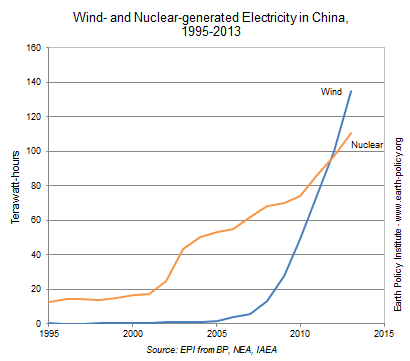
Why is Wind Power Generation Surpassing Nuclear? One of the reasons why nuclear power has not kept up with wind in China is the relative time it takes to get a project up and running. Whereas the typical Chinese nuclear reactor takes roughly six years to build, a wind farm can be completed in a matter of months.
Wind Leaves Nuclear Behind In China http://cleantechnica.com/2014/03/13/wind-leaves-nuclear-behind-china/By J. Matthew Roney In China, wind power is leaving nuclear behind. Electricity output from China’s wind farms exceeded that from its nuclear plants for the first time in 2012, by a narrow margin. Then in 2013, wind pulled away—outdoing nuclear by 22 percent. The 135 terawatt-hours of Chinese wind-generated electricity in 2013 would be nearly enough to power New York State. Once China’s Renewable Energy Law established the development framework for renewables in 2005, the stage was set for wind’s exponential growth. Wind generating capacity more than doubled each year from 2006 to 2009 and has since increased by nearly 40 percent annually, to reach 91 gigawatts by the end of 2013 (1 gigawatt = 1,000 megawatts). Over 80 percent of this world-leading wind capacity is now feeding electricity to the grid.
Wind generation in 2013 could have been even higher, by an estimated 10 percent, but for the problem known as curtailment—when wind turbines are stopped because the grid cannot handle any more electricity. To help reduce curtailment and reach the official 2020 goal of 200 grid-connected gigawatts, China is building the world’s largest ultra-high-voltage transmission system. The raft of projects now under construction will connect the windier north and west to population centers in the central and eastern provinces. Continue reading
Exciting innovations in wind energy
A Peek Into The Astonishing Future Of Wind Power CLIMATE PROGRESS, BY ARI PHILLIPS ON MARCH 13, 2014 “WHAT IF YOU COULD SCOOP THE AIR? SCOOP IT AND MOVE IT DOWNWARD, AMPLIFYING ITS KINETIC ENERGY ALONG THE WAY, CONCENTRATE IT TO A SINGLE POINT OF INTENSITY, THE WAY A MAGNIFYING GLASS CONCENTRATES SUNLIGHT TO A SINGLE INCENDIARY POINT?”
Dr. Daryoush Allaei, an engineer and founder of Sheerwind, an innovative wind power company, is concentrating his unique thought process on harnessing wind energy in new ways.
“And assuming you could do this technically, could you do it on a large enough scale to make it economically feasible?” Allaei writes in his company description. “More to the point, could you generate energy so inexpensively that it stages a renaissance?”
Sheerwind is pushing the boundaries of wind power innovation with its bladeless wind turbine, called INVELOX. The turbines funnel wind into ground-level generators through a tapering passageway that squeezes and accelerates the air. The units are about half as tall as traditional wind towers, which rise up to 260 feet into the air, and the ground-based turbine blades are more than 80 percent smaller than conventional wind turbine blades, which are about 115-feet long. The device resembles a giant gramophone that sucks in wind instead of blurting out sound.
Sheerwind represents a small point in the larger picture of wind power development, itself part of the story of renewable energy technology. The entire history of power generation, from Ben Franklin’s kite experiments 250 years ago to deep sea drilling for oil and gas is a complex tale of imaginative inventiveness riding up against economic realities. As wind power takes hold across the world, developers are constantly looking for new ways to make the technology lighter, faster, and more efficient but some of the most inventive ideas are often stymied by a lack of financial support during early stages…….http://thinkprogress.org/climate/2014/03/13/3366401/future-of-wind-power/
California moves toward efficiency and clean energy to replace San Onofre nuclear power
 It’s Official: Efficiency, Clean Energy to Help Fill California’s Nuclear Generation Gap Switchboard, Switchboard 13 Mar 14 Sierra Martinez, California took another major and symbolic step today with its decision to rely significantly on energy efficiency and other clean energy resources to help replace electricity once generated by the San Onofre Nuclear Generation Station (SONGS) serving San Diego and the greater Los Angeles area.
The California Public Utilities Commission (CPUC) today made official its strategy to address the loss of the huge nuclear plant, which had been offline since January 2012 and was officially retired last year. Fortunately, it closely resembles its proposal released last month.
The final plan uses efficiency and other “preferred resources”—those resources with lower environmental impacts—like demand response (ways customers can consume less energy at key times during the day) and renewable energy such as wind and solar, as well as some upgrades to the electric system, to replace the vast majority of the lost SONGS generation. Continue reading
Revolutionary new system for solar power in remote parts of Africa
 Renewable energy: Samsung introduces digital village concept Ghana Web 12 Mar 14, Samsung Electronics is developing a concept that will make use of sunshine, which is an abundant natural resource in Africa, to change and improve the lives of inhabitants of rural communities in Africa.
The leading provider of digital solutions will use sunshine as a renewable source of energy in Africa to establish various facilities that can be operated through transportable solar-powered generators.
Officials of Samsung therefore seek to introduce what is called the digital village with solar integrated solutions, a unique concept that harnesses technology in a way that breaks through traditional, social and economic barriers and takes real support and opportunities to people where they live.
Mr Thierry Boulanger, Director of Information Technology (IT) and Business to Business (B2B) Solutions of Samsung Electronics in charge of Africa, said the solar-powered generators constituted the heart of the digital village that could be erected in 60 minutes of arrival.
He said the solar-powered generators could be used to power classrooms, small businesses, government offices, health facilities and remote -controlled gates…….
Europe on track to meet its renewable energy target
EU edges towards renewable energy targets http://au.news.yahoo.com/thewest/business/world/a/21909665/eu-edges-towards-renewable-energy-targets/Brussels (AFP) – The European Union is making steady progress towards its 2020 renewable energy target, a key effort in curbing the greenhouse gas emissions blamed for global warming, official data showed Monday. Renewables — predominantly wind but including tidal and biomass sources as well — accounted for 14.1 percent of the EU’s energy consumption in 2012, up from 13 percent in 2011, the Eurostat statistics bureau said.
The EU has set itself a 20-percent target for renewable energy use by the year 2020, part of its overall “Europe 2020″ strategy of sustainable economic growth.
Eurostat said of the 28 member states, Sweden continues to lead the field, with 51 percent of its energy coming from renewables, up from almost 39 percent 10 years ago when the EU average was 8.3 percent. Latvia on 35.8 percent was the next best performer, followed by Finland on 34.3 percent and Austria 32.1 percent.
Among the lowest ranked were Malta at just 1.4 percent, Luxembourg with 3.1 percent, Britain with 4.2 percent and the Netherlands with 4.5 percent.
Nova Scotia’s renewable energy success
Nova Scotia set to exceed renewable energy targets: minister http://globalnews.ca/news/1108849/nova-scotia-set-to-exceed-renewable-energy-targets-minister/ By Brett Ruskin Global News HALIFAX — Nova Scotia’s Minister of Energy says the province is on track to exceed its renewable energy goals.
In 2010, the government passed a law requiring 25 per cent of the province’s power to come from renewables — like wind and hydro — by 2015. The law’s second target is set at 40 per cent by 2020.
“We have no concerns about meeting that 25 per cent,” said Andrew Young, Nova Scotia’s Minister of Energy.
“In fact, we expect that that will be exceeded.”
A more accurate measure of how much renewable energy Nova Scotia generates is expected in two to three weeks.Nova Scotia’s 40 per cent renewable target for 2020 should be easily met as well. “The fact that we have the Maritime Link coming on stream,” said Younger, “we’re not concerned about meeting the 40 per cent target.”
Younger’s comments come the same week the government announced plans to reinvigorate Nova Scotia’s tidal power opportunities. Companies looking to sell tidal power to the grid can now apply for feed-in tariffs, outlined by a Utility and Review Board decision.In March, the government will grant access to two undersea berths for companies to test tidal technology and possibly begin feeding small amounts of tidal power to the grid.
Renewable energy help to climate-change affected States – from UAE
“During the campaign we saw the impacts of climate change. We know those islands are among the most vulnerable to climate change.”The desire to more effectively conduct projects in the Pacific was also the reason the UAE signed the partnership arrangement with the New Zealand ministry of foreign affairs and trade.
Renewable energy projects key to UAE’s diplomatic efforts http://www.thenational.ae/uae/environment/renewable-energy-projects-key-to-uaes-diplomatic-efforts 26 Jan 14 ABU DHABI // Renewable-energy projects are now a mainstay of diplomatic efforts with developing nations, the Ministry of Foreign Affairs says.
At Abu Dhabi Sustainability Week last week, technology partnerships were signed with New Zealand and Denmark, and plans announced to give US$20 million (Dh73.4m) in aid to Pacific Island states.
Dr Thani Al Zeyoudi, director of energy and climate change at the ministry, said clean energy had been identified as a major area of focus for UAE diplomacy. Dr Al Zeyoudi said the money would go to Fiji, Kiribati, Samoa, Tuvalu and Vanuatu. Continue reading
Renewable energy is the future for Jordan, not nuclear energy
The cost issues of renewable energy are developing in such a way that are much cheaper than nuclear energy and safer, he said, indicating that there are many expenses associated with nuclear energy that are not applicable when utilising renewable resources, such as risks, insurance and development costs.
“Our belief is that renewable energy is the most viable approach for the future and much more environmentally safe,” Amin stressed.
Jordan’s future lies in renewable energy http://www.albawaba.com/business/jordan-renewable-energy-549840
 January 26th, 2014 Renewable energy is the most viable approach for the future of Jordan and regional countries, according to International Renewable Energy Agency (IRENA) Director General Adnan Amin.
“Jordan is a very interesting market because it has a very developed institutional structure in terms of government agencies dealing with energy issues,” Amin said in a recent interview with The Jordan Times on the sidelines of the Abu Dhabi Sustainability Week.
“Jordan is looking very positively at the future of renewable energy,” he added. Continue reading
London gets world’s largest solar-powered bridge
World’s largest solar-powered bridge opens in London, Guardian, 24 Jan 14 Blackfriars rail station secures half its power from 4,400 roof-mounted solar panels, reports BusinessGreenAfter nearly five years in the making, Network Rail has today cut the ribbon on the world’s largest solar-powered bridge at Blackfriars Bridge across the River Thames.
As part of a project with solar installation firm Solarcentury, the roof of the bridge has been covered with 4,400 photovoltaic panels, providing up to half of the energy for London Blackfriars station.
First Capital Connect, which runs Blackfriars, expects the panels to cut the stations’ carbon emissions by an estimated 511 tonnes a year, further reducing the carbon footprint of its train routes to the south east of England.
“Electric trains are already the greenest form of public transport – this roof gives our passengers an even more sustainable journey,” said David Statham, managing director of First Capital Connect. “The distinctive roof has also turned our station into an iconic landmark visible for miles along the River Thames.”
The bridge will also act as a major advertisement for London’s efforts to become a sustainable city, with tourists and workers viewing the panels as they enter the capital……http://www.theguardian.com/environment/2014/jan/22/worlds-largest-solar-powered-bridge-opens-in-london
Solar PV installation at record high in China
China’s solar PV installations soared to record in 2013 http://www.smh.com.au/business/carbon-economy/chinas-solar-pv-installations-soared-to-record-in-2013-20140124-31cck.html Developers in China installed a record 12 gigawatts of solar panels last year, almost matching the total amount of solar power in operation in the U.S., and may exceed that this year, according to Bloomberg New Energy Finance.
The power plants were built mostly in the sunny, western provinces of Gansu, Xinjiang and Qinghai and make China’s state-owned power companies the world’s biggest owners of solar assets, the London-based research company said today in a statement.
China was the biggest solar market last year, surpassing longtime leader Germany. Chinese installation more than tripled from 3.6 gigawatts in 2012, and the nation expects to add 14 gigawatts of solar capacity this year, according to New Energy Finance.
China led a 28 per cent increase in global solar installations last year of 39 gigawatts, and total installation may increase another 20 per cent this year, according to the statement. Before 2013, no nation had ever installed more than 8 gigawatts of solar power in a year.
1 This Month

petition to oppose the rapid increase of space-military industry threatening Jeju Island and the region.
[Petition by April 19th (KST)] Stop the joint military-Hanwha Systems-Jeju Provincial Government Sea Launch!

Chernobyl: The Lost Tapes – A good documentary on Chernobyl on SBS available On Demand for the next 3 weeks– https://www.sbs.com.au/ondemand/tv-program/chernobyl-the-lost-tapes/2352741955560

of the week–London Campaign for Nuclear Disarmament


Tell the Ukrainian Government to Drop Prosecution of Peace Activist Yurii Sheliazhenko
To see nuclear-related stories in greater depth and intensity – go to https://nuclearinformation.wordpress.com
-
Archives
- April 2026 (194)
- March 2026 (251)
- February 2026 (268)
- January 2026 (308)
- December 2025 (358)
- November 2025 (359)
- October 2025 (376)
- September 2025 (257)
- August 2025 (319)
- July 2025 (230)
- June 2025 (348)
- May 2025 (261)
-
Categories
- 1
- 1 NUCLEAR ISSUES
- business and costs
- climate change
- culture and arts
- ENERGY
- environment
- health
- history
- indigenous issues
- Legal
- marketing of nuclear
- media
- opposition to nuclear
- PERSONAL STORIES
- politics
- politics international
- Religion and ethics
- safety
- secrets,lies and civil liberties
- spinbuster
- technology
- Uranium
- wastes
- weapons and war
- Women
- 2 WORLD
- ACTION
- AFRICA
- Atrocities
- AUSTRALIA
- Christina's notes
- Christina's themes
- culture and arts
- Events
- Fuk 2022
- Fuk 2023
- Fukushima 2017
- Fukushima 2018
- fukushima 2019
- Fukushima 2020
- Fukushima 2021
- general
- global warming
- Humour (God we need it)
- Nuclear
- RARE EARTHS
- Reference
- resources – print
- Resources -audiovicual
- Weekly Newsletter
- World
- World Nuclear
- YouTube
-
RSS
Entries RSS
Comments RSS
 nuclear-news