North Korea, nuclear proliferation and why the ‘madman theory’ is wrong about Kim Jong-unç
North Korea, nuclear proliferation and why the ‘madman theory’ is wrong about Kim Jong-unç https://theconversation.com/north-korea-nuclear-proliferation-and-why-the-madman-theory-is-wrong-about-kim-jong-un-167939, Colin Alexander, Lecturer in Political Communications, Nottingham Trent University 15 Sep 21, The two missile tests conducted by North Korea in recent days have reopened discussions about the country, its leadership, its foreign policy, its perception around the world and the use (and usefulness) of nuclear weapons as an option within global politics.
North Korea’s official Korean Central News Agency announced on September 12 that it had test-fired a new long-range cruise missile, believed by analysts to be the country’s first missile with the capacity to carry a nuclear warhead.
Three days later the South Korean military said the North had launched “two unidentified ballistic missiles” into the Sea of Japan, prompting Japan’s outgoing prime minister, Yoshihide Suga, to order his country’s defence agencies to investigate.
North Korea usually makes grand nuclear statements like the ones we have seen in recent days during early September to mark the founding of the DPRK on September 9 1948. As such, these tests are as much about domestic propaganda and internal regime prestige as they are about threat to the outside world.
More broadly though, North Korea’s advance of its nuclear weapons technology – off and on since the 1950s – has made its integration with the rest of the international community much less likely. This is primarily on account of its development coming at considerable cost and sacrifice to the small nation.
No moral high ground
It can be argued that, given the indiscriminate barbarity of the destruction that a nuclear attack would cause, no state has a moral right to nuclear weapons over that of another state. But countries which already have a nuclear arsenal will often push the line that while it’s OK for them to have a nuclear stockpile, other countries do not necessarily have that right. These communications often rely on a manufactured sense of who is responsible and stable-minded and who is irresponsible and unstable. In short, it is an attempt to create a polarised world of good and evil.
This simplistic polarisation is encouraged through government communications regarding foreign policy. But they also depend on wider more implicit perception management strategies. These include harnessing the agendas of global mainstream news media and exporting popular culture products, films, television programmes and the like, that seek to encourage certain worldviews and to marginalise ones that are undesirable to the world’s most powerful nations.
It should always be remembered that the United States is the only state to have used nuclear weapons as an act of war (twice during 1945). Yet it declares North Korea to be a nuclear threat based on its “madness” (Donald Trump repeatedly called Kim Jong-un “mad”). But if we are to believe revelations from the upcoming book Peril by journalists Bob Woodward and Robert Costa, America’s top military personnel had to take action in the final months of the Trump administration to limit any risks of a nuclear showdown with China.
It’s probably true to say that few aspiring candidates for high office are going to say that they would never use their country’s nuclear capability in any circumstance. But it could also be said that any head of government who boasts of their readiness to use nuclear weapons is demonstrating their lack of fitness to govern. But, as the first part of this paragraph suggests, no candidate is likely to make this assertion.
Madman’ theory wrong
There is no evidence that the previous leaders of North Korea, Kim Il-sung or Kim Jong-il, were assessed by psychologists and found to be suffering from mental ill health. This is also true of Kim Jong-un, the country’s current leader – in fact before Kim’s summit with Trump in 2018, a former State Department psychiatrist, Kenneth Dekleva, who creates psychological profiles of foreign leaders, told America’s National Public Radio that: “I think the madman theory was wrong.”
I would say he’s smart, that he’s a very, very savvy diplomat, a leader with a sense of gravitas. He wants to be a player on the world stage.
For Simon Cross, a colleague of mine at Nottingham Trent University, “madness” is an imprecise term and a cultural construct that does not require a trained medical professional to identify it, but it resonates with ease with audiences when uttered by someone they trust. Stephen Harper at the University of Portsmouth, says our perception of what represents “madness” is based on uncritical interpretations of the past and fantasies and inclinations within the human mind towards what he calls “self-haunting”. These tropes are perpetuated, confirmed and even encouraged at the persuasion of powerful individuals reinforced by mainstream media content.
So, for example, the Hollywood films Team America: World Police (2004) and The Interview (2014), despite being satires of North Korea’s leaders, promote this idea of the North Korean leader and his senior advisers as mad. And Trump kept hammering at this with his regular references to Kim as a “madman”, as “crazy” and as a “little rocket man”.
North Korea’s prevailing international image of being mad is thus predominantly the creation of hostile external parties. But Pyongyang has also played up to it at times when it has been deemed useful – as the psychologist Dekleva said earlier in this article, it could be a useful tool of diplomacy. This is a theme explored by Niccolo Machiavelli in his book The Prince in 1517.
That said, what is perhaps most interesting is the extent to which recent US administrations and their allies appear to have come to believe the madness story – despite the fact that they are largely responsible for it. This has been the case with successive US administrations – but whether they genuinely believe it, or perpetuate it because it is convenient to their wider foreign policy ambitions to do so, remains to be seen.
Growing aggressive behaviour by nuclear proponents – is nuclear facing obsolescence?
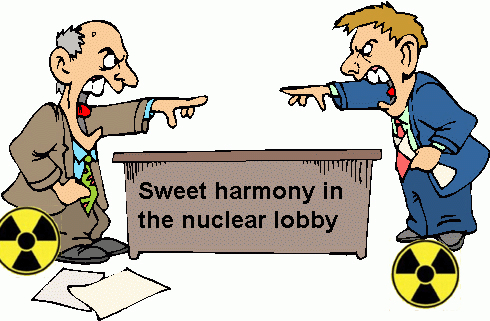
Nuclear Engineering International 29th April 2021, Extract from Letter Andy Stirling, Science Policy Research Unit, University of Sussex.
It is reasonable to give particular scrutiny both to the style and content of a commentary by Jeremy Gordon published on an article issued last year in the peer-reviewed journal Nature Energy. This is sadly especially so, because what we see as Jeremy Gordon’s aggressive tone and superficial arguments display behaviour that is sadly growing among nuclear proponents.
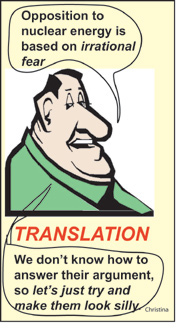
These are worrying signs of a wider malaise in current nuclear debates. It is a growing problem in nuclear advocacy that those holding contrasting informed and measured views – or who simply question the comparative merits of nuclear power – are so often smeared as ‘anti-nuclear’.
It is hysterical to brand someone raising evidence of a problem with something, as being somehow intrinsically ‘anti’ that thing. Yet on nuclear, this is a norm. Even to raise questions about relative pros and cons of nuclear versus renewable based strategies is treated by Gordon as if inherently biased.
Gordon criticises us for not analysing coal, oil or gas. Our purpose is to examine associations between carbon emissions and the uptake of two families of technologies that are variously claimed as “zero carbon”: nuclear and renewables. We are ourselves clear in urging further more specific work addressing finer details and wider dimensions
But it is not unreasonable that this pioneering study focuses specifically on technologies for which zero carbon
claims are actually made. Whatever ‘side’ one is on, it is striking that as the relative position of nuclear power deteriorates, the invective grows more intense. But perhaps all may agree (on any side), that spurious caricatures and personal attacks undermine themselves?
No technology is entitled to immunity either from criticism or obsolescence. Whether nuclear power faces this latter fate is unsure. But if (like many earlier technologies) its time has come, then this past quintessential icon of scientific prowess should not bring down with it the reasoned policy discourse that forms the lifeblood of democracy itself.
Scientists must tell the truth on our consumerist, ecology-killing Ponzi culture

Scientists must not sugarcoat the overwhelming challenges ahead. Instead, they should tell it like it is. Anything else is at best misleading, and at worst potentially lethal for the human enterprise.
Worried about Earth’s future? Well, the outlook is worse than even scientists can grasp , The Conversation, Corey J. A. Bradshaw, Matthew Flinders Professor of Global Ecology and Models Theme Leader for the ARC Centre of Excellence for Australian Biodiversity and Heritage, Flinders University. Daniel T. Blumstein, Professor in the Department of Ecology and Evolutionary Biology and the Institute of the Environment and Sustainability, University of California, Los Angeles, Paul Ehrlich, President, Center for Conservation Biology, Bing Professor of Population Studies, January 13, 2021
Anyone with even a passing interest in the global environment knows all is not well. But just how bad is the situation? Our new paper shows the outlook for life on Earth is more dire than is generally understood.
The research published today reviews more than 150 studies to produce a stark summary of the state of the natural world. We outline the likely future trends in biodiversity decline, mass extinction, climate disruption and planetary toxification. We clarify the gravity of the human predicament and provide a timely snapshot of the crises that must be addressed now.
The problems, all tied to human consumption and population growth, will almost certainly worsen over coming decades. The damage will be felt for centuries and threatens the survival of all species, including our own………
academics tend to specialise in one discipline, which means they’re in many cases unfamiliar with the complex system in which planetary-scale problems — and their potential solutions — exist.
What’s more, positive change can be impeded by governments rejecting or ignoring scientific advice, and ignorance of human behaviour by both technical experts and policymakers.
More broadly, the human optimism bias – thinking bad things are more likely to befall others than yourself – means many people underestimate the environmental crisis.
Numbers don’t lie
A bad situation only getting worse
The human population has reached 7.8 billion – double what it was in 1970 – and is set to reach about 10 billion by 2050. More people equals more food insecurity, soil degradation, plastic pollution and biodiversity loss.
Essentially, humans have created an ecological Ponzi scheme. Consumption, as a percentage of Earth’s capacity to regenerate itself, has grown from 73% in 1960 to more than 170% today.
High-consuming countries like Australia, Canada and the US use multiple units of fossil-fuel energy to produce one energy unit of food. Energy consumption will therefore increase in the near future, especially as the global middle class grows.
The danger of political impotence
Our paper found global policymaking falls far short of addressing these existential threats. Securing Earth’s future requires prudent, long-term decisions. However this is impeded by short-term interests, and an economic system that concentrates wealth among a few individuals.
Right-wing populist leaders with anti-environment agendas are on the rise, and in many countries, environmental protest groups have been labelled “terrorists”. Environmentalism has become weaponised as a political ideology, rather than properly viewed as a universal mode of self-preservation.
Changing course
Fundamental change is required to avoid this ghastly future. Specifically, we and many others suggest:
- abolishing the goal of perpetual economic growth………..
Don’t look away………
Scientists must not sugarcoat the overwhelming challenges ahead. Instead, they should tell it like it is. Anything else is at best misleading, and at worst potentially lethal for the human enterprise. https://theconversation.com/worried-about-earths-future-well-the-outlook-is-worse-than-even-scientists-can-grasp-153091
Uranium Film Festival 2020 – a huge success under difficult circumstances
 Uranium Film Festival 2020 – a huge success under difficult circumstances https://www.icbuw.eu/uranium-film-festival-2020-a-huge-success-under-difficult-circumstances/ Uranium Film Festival 2020 – a huge success under difficult circumstances https://www.icbuw.eu/uranium-film-festival-2020-a-huge-success-under-difficult-circumstances/
(Manfred Mohr)5. Dezember 2020 The Berlin event marked the tenth anniversary of the International Uranium Film Festival (IUFF). The fact that it took place at all in the times of Corona and that there was such a great response from the public, as well as high-quality content was a huge success that one could not have expected. ICBUW was there from the beginning as we were „promoted“ to be co-organizer this year and were even more involved than before, also in the form of the ICBUW team (Eliah Buchholz, Ilia Kukin, Arina Shpanova).
ICBUW spokesman Prof. Manfred Mohr opened – alongside IUFF producer Jutta Wunderlich – the Berlin festival and proceeded to the opening film “Vom Sinn des Ganzen” (English: „Of the sense of the whole“), which had its world premiere at the festival. This was followed by a conversation about the film, which focused on the researcher Hans-Peter Dürr. Among other things, there was a question of whether our new, younger generation is ready to replace the older one (the one of e.g.Biegert and Mohr) in peace and disarmament matters. The answer was affirmative… There was another moderation from the side of ICBUW for the film „The Beginning of the End of Nuclear Weapons“. An intensive conversation developed with the present producer Tony Robinson, ICAN, and IPPNW representatives. Among other things, it concerned whether there is – in addition to or in connection with the Nuclear Weapons Prohibition Treaty – an international law ban on the use or threat of use of nuclear weapons. This could be derived from customary international law, as expressed in the 1996 International Court of Justice opinion on nuclear weapons. As expected, a highlight of the festival was the performance and discussion of the film “Balentes”, which was awarded as the best documentary film. It led to an exciting, stimulating panel discussion with the director Lisa Camillo and the Sardinian ICBUW friend Pitzente Bianco. The central issue was whether and in what way the specific, culturally and traditionally shaped commitment of the Sardinian population to the protection of the island’s homeland must be strengthened through external structures and networking. ICBUW spokesman Mohr pointed out the potential of UN human rights complaints procedures for protecting depleted uranium and environmental victims. The end phase of the festival, which the ICBUW special event on October 18 in Marienstrasse 19/20 belonged to, was marked by the award-winning film “Valley of the Gods” by Lech Majewski. In his short closing speech as well as in his festival greeting, the ICBUW spokesman expressed the hope that the IUFF will continue: „… It is essential in its bringing together of the public, artists and civil society actors concerning existing, unsolved humanity issues. We’ll stick with it in any case.“
|
|
Britain, and other countries, got nuclear weapons for reasons of status and pride
|
We’re nuclear because of the kudos, https://www.heraldscotland.com/news/18818883.letters-nuclear-kudos/ Ian W Thomson, Lenzie. 23 Oct 20 DAVID Crawford asks a question about why the UK Government allows a large element of UK tax revenue to be spent with the US facilities to support the UK nuclear weapon submarine resource. He answers his question by saying “money”, because the UK itself is a substantial supplier of weapons
I believe that there is more to it than he suggests. The Labour Government at the end of the Second World War could have decided not to have nuclear weapons. It initially took the option to have them largely because of status and pride. Ernest Bevin, then the Foreign Secretary, stated: “We’ve got to have the bloody Union Jack on top of it.” The costs of maintaining that status have become more and more expensive over the years, which has led to the UK becoming more and more reliant upon the US for technical support at a cost. The theory must be that it is better to have a nuclear deterrent sort of independent rather than not have such deterrent at all. I also believe that status still has a large part to play in the UK’s position today, albeit we are far removed from the circumstances prevailing at the end of the Second World War. It is interesting that all five permanent members of the UN Security Council are nuclear powers: China, France, Russia, the UK and the US. The UK, no doubt, places great value upon that status and is likely to regard being a nuclear power as helping to sustain it. The original idea was that the five would progressively disarm in exchange for other states not acquiring nuclear weapon facilities. That idea has gone well, hasn’t it? Look at India and Pakistan and the likelihood of some others. |
|
Culture and pride – Britain’s unnecessary attachment to nuclear weapons
|
THE NUCLEAR TREATY dividing the World, Byline Times, Stephen Colegrave, 21 October 2020 “……….. Problem for Brexit Britain In the UK, our predilection for nuclear arms is cultural as much as political.
Brexit Britain is clinging on to its belief that it can regain and retain its place at the centre of the world. But the irony is that many of the nations that it wants to trade with as it turns its back on Europe are in the Nuclear Weapon Free Zones and have been part of developing and signing the treaty banning nuclear weapons. The Brexiters’ love of patriotic militarism with navy ships and flags spearheading trade missions are likely to have the opposite effect than expected. These nuclear-free nations might be no match for the military might of NATO and the other nuclear powers but they do have complete control of their own trade. “The ground is moving under the UK’s feet,” says Ben Donaldson, head of campaigns at the United Nations Association. “Whether or not the UK supports the UN Treaty on the Prohibition of Nuclear Weapons, the impact will be felt. The treaty is popular with states the UK is looking to strike trade deals with and the UK is finding itself increasingly diplomatically isolated on this issue. A large majority of countries have made it clear they have lived in fear of nuclear fallout for too long and want action. As well as being immoral, the UK’s current position of variously ignoring and attacking the treaty and its supporters is unsustainable and damages its influence on the world stage.” Government Gives Arms Industry Extra Tens of Millions of Pounds During COVID-19 Pandemic Joshua Stein As the fiftieth nation prepares to sign the treaty, there is hope that the nations with nuclear weapons themselves are finding it harder to justify themselves to their own populations. There have been concerns about US President Donald Trump pressing the red button in the same way he presses ‘tweet’. Even in Britain there is a backlash. Although there are not protests on the streets like at the height of the Campaign for Nuclear Disarmament (CND), more and more councils are signing up to be nuclear-free zones, such as Manchester City Council. In America, the whole state of California, which has the fourth largest GDP in the world, has gone down this route. Increasingly, financial institutions are divesting in companies that are part of the supply chain and manufacturing nuclear weapons in an initiative called Wall of Fame. Hopefully this treaty will start to call time on the nuclear weapon nations and their allies ignoring the moral and ethical case for a ban, when an increasingly large part of the world wants nothing to do with these dangerous and potentially powerless ‘deterrents’. |
|
Racism in nuclear bomb testing, bombing of Japanese people, and nuclear waste dumping

Langston Hughes voiced the opinion that until racial injustice on home ground in the United States ceases, “it is going to be very hard for some Americans not to think the easiest way to settle the problems of Asia is simply dropping an atom bomb on colored heads there.”[25] While his statement was made in 1953, near the eighth anniversary of the Hiroshima and Nagasaki bombings, it remains equally relevant today, as we approach the 75th anniversary
Memorial Days: the racial underpinnings of the Hiroshima and Nagasaki bombings , Bulletin of the Atomic Scientists, Elaine Scarry, Elaine Scarry is the author of Thermonuclear Monarchy: Choosing between Democracy and Doom and The Body in Pain: the Making and Unmaking of the World. She is Cabot Profess… By Elaine Scarry, August 3, 2020
This past Memorial Day, a Minneapolis police officer knelt on the throat of an African-American, George Floyd, for 8 minutes and 46 seconds. Seventy-five years ago, an American pilot dropped an atomic bomb on the civilian population of Hiroshima. Worlds apart in time, space, and scale, the two events share three key features. Each was an act of state violence. Each was an act carried out against a defenseless opponent. Each was an act of naked racism. ……….
Self-defense was not an option for any one of the 300,000 civilian inhabitants of the city of Hiroshima, nor for any one of the 250,000 civilians in Nagasaki three days later. We know from John Hersey’s classic Hiroshima that as day dawned on that August morning, the city was full of courageous undertakings meant to increase the town’s collective capacity for self-defense against conventional warfare, such as the clearing of fire lanes by hundreds of young school girls, many of whom would instantly vanish in the 6,000° C temperature of the initial flash, and others of whom, more distant from the center, would retain their lives but lose their faces.[2] The bombing of Hiroshima and Nagasaki initiated an era in which—for the first time on Earth and now continuing for seven and a half decades—humankind collectively and summarily lost the right self-defense. No one on Earth—or almost no one on Earth[3]—has the means to outlive a blast that is four times the heat of the sun or withstand the hurricane winds and raging fires that follow………
Centuries of political philosophers have asked, “What kind of political arrangements will create a noble and generous people?” Surely such arrangements cannot be ones where a handful of men control the means for destroying at will everyone on Earth from whom the means of self-defense have been eliminated……..
When Americans first learned that the people of Hiroshima and Nagasaki had been collectively vaporized in less time than it takes for the heart to beat, many cheered. But not all. Black poet Langston Hughes at once recognized the moral depravity of executing 100,000 people and discerned racism as the phenomenon that had licensed the depravity: “How come we did not try them [atomic bombs] on Germany… . They just did not want to use them on white folks.”[4] Although the building of the weapon was completed only after Germany surrendered on May 7, 1945, Japan had been designated the target on September 18, 1944, and training for the mission had already been initiated in that same month.[5] Black journalist George Schuyler wrote: “The atom bomb puts the Anglo-Saxons definitely on top where they will remain for decades”; the country, in its “racial arrogance,” has “achieved the supreme triumph of being able to slaughter whole cities at a time.”[6]
Still within the first year (and still before John Hersey had begun to awaken Americans to the horrible aversiveness of the injuries), novelist and anthropologist Zora Neale Hurston denounced the US president as a “butcher” and scorned the public’s silent compliance, asking, “Is it that we are so devoted to a ‘good Massa’ that we feel we ought not to even protest such crimes?”[7] Silence—whether practiced by whites or people of color—was, she saw, a cowardly act of moral enslavement to a white supremacist. Continue reading
The Russian Orthodox Church just might cease its blessing of nuclear weapons
 THE RUSSIAN ORTHODOX CHURCH MAY STOP BLESSING NUCLEAR
  WEAPONS https://futurism.com/the-byte/russian-orthodox-blessing-nuclear-weapons JULY 10TH 19__DAN ROBITZSKI
A faction of clergy within the Russian Orthodox Church wants to end the eyebrow-raising practice of blessing the country’s nuclear missiles.
First of all, yes: Russian priests currently sprinkle holy water on nuclear missiles as part of an old tradition in which Orthodox priests bless soldiers and their weapons, reports Religion News Service. But that may change, as some priests feel that intercontinental ballistic missiles belong in a different category from individual firearms.
Faith Militant
The Russian military and the Russian Orthodox church have long worked hand in hand, according to RNS, framing many of the country’s military conflicts as holy wars. The nuclear arsenal even has its own patron saint — RNS reports that St. Seraphim’s remains were found in a Russian town that housed several nuclear facilities.
As such, the push to stop blessing nukes faces strong opposition among members of the clergy, such as the high-ranking priest Vsevolod Chaplin, who referred to the country’s nukes as “guardian angels.”
“Only nuclear weapons protect Russia from enslavement by the West,” Chaplin once said, per RNS.
Changing Hearts
One priest, Dmitry Tsorionov, parted from the more militant aspects of the Orthodox Church after seeing men willingly sign up to fight Russia’s wars “under the banner of Christ,” he told RNS. Now he wants to see less warmongering among the clergy.
“It was not uncommon to see how church functionaries openly flirted with these toxic ideas,” he told RNS. “It was only then that I finally realized what the blessing of military hardware leads to.”
The age of the individual must end – our world depends on it
10th International Uranium Film Festival in Rio de Janeiro, May 2020
Marcia Gomes de Oliveira shared a link. 2 Nov 19
These filmmakers and producers have already agreed to come to Rio 2020: Peter Kaufmann (Australia), Kim Mavromatis (Australia), Laura Pires (Brazil), Angelo Lima (Brazil), Miguel Silveira (USA/Brazil), Cris Uberman (France), Marcus Schwenzel (Germany), Rainer Ludwigs (Germany), Michael von Hohenberg (Germany), Peter Anthony (Denmark), Michael Madson (Denmark), Lise Autogena (Denmark), Masako Sakata (Japan), Maurizio Torrealta (Italy), Alessandro Tesei (Italy), Amudhan R.P. (India), Tamotsu Matsubara (Japan), Tamiyoshi Tachibana (Japan), Tineke Van Veen (Netherlands), Mafalda Gameiro (Portugal), James Ramsay Cameron (Scotland), José Herrera Plaza (Spain), Marko Kattilakoski (Sweden), Edgar Hagen (Switzerland),Tetyana Chernyavska (Ukraine), Brittany Prater (USA), Ian Thomas Ash (Japan/USA).
Rio’s 10th International Uranium Film Festival is scheduled for May 21st to 31st. Do not miss it!
The dangers of Chernobyl nuclear site being turned into a tourism mecca
The grounds remain coated with plutonium, cesium, strontium and americium — radionuclides (atoms that emit radiation) that could pose potentially serious health risks to those who touch or ingest them. Some areas are more radioactive, and therefore more dangerous, than others.
“Even though the accident occurred over 33 years ago it remains one of the most radiologically contaminated places on earth.”
Chernobyl tourists should avoid plant life, and especially the depths of the forests.
Those areas were not cleaned in the aftermath of the disaster and remain highly contaminated by radiation. Research has showed that the fungus, moss and mushrooms growing there are radioactive. Eating or drinking from the area is not safe.
Those who stay on the paved pathways, which officials cleaned, are much less likely to absorb harmful toxins.
Ukraine wants Chernobyl to be a tourist trap. But scientists warn: Don’t kick up dust.  https://www.washingtonpost.com/travel/2019/07/12/ukraine-wants-chernobyl-be-tourist-trap-scientists-warn-dont-kick-up-dust/?utm_term=.5e82b547ceaf By Katie Mettler, July 12 2019
The tourists first started flocking to Chernobyl nearly 10 years ago, when fans of the video game S.T.A.L.K.E.R. wanted to see firsthand the nuclear wasteland they’d visited in virtual reality.
Next came those whose curiosity piqued when in 2016 the giant steel dome known as the New Safe Confinement was slid over the sarcophagus encasing nuclear reactor number four, which exploded in April 1986, spewed radiation across Europe and forced hundreds of thousands to flee from their homes.
Then in May, HBO’s “Chernobyl” miniseries aired, and tourism companies reported a 30 to 40 percent uptick in visitors to the Chernobyl Exclusion Zone, abandoned and eerily frozen in time.
Now the Ukrainian government — capitalizing on the macabre intrigue — has announced that Chernobyl will become an official tourist site, complete with routes, waterways, checkpoints and a “green corridor” that will place it on the map with other “dark tourism” destinations.
“We must give this territory of Ukraine a new life,” President Volodymyr Zelensky said during a visit to Chernobyl this week. “Until now, Chernobyl was a negative part of Ukraine’s brand. It’s time to change it.”
Zelensky, who was inaugurated in May, signed a decree July 10 to kickstart the Chernobyl Development Strategy, which the president hopes will bring order to the 19-mile Exclusion Zone that has become a hotbed for corruption, trespassing and theft. At the nuclear facility and in the nearby town of Pripyat, wildlife has returned and now roams freely. Flora and fauna grow up around decaying homes, playgrounds and an amusement park. Letters, dinner tables and baby dolls remain where their owners abandoned them 33 years ago.
Radioactive dust still coats it all.
“Chernobyl is a unique place on the planet where nature revives after a global man-made disaster, where there is a real ‘ghost town,’” Zelensky said during his visit. “We have to show this place to the world: scientists, ecologists, historians, tourists.”
Though exploiting a historical space like Chernobyl could infuse Ukraine’s economy with tourism dollars and motivate developers to revive the sleepy towns surrounding the “dead zone,” there are significant downsides, experts say.
[Thanks to HBO, more tourists are flocking to the eerie Chernobyl nuclear disaster site]
The grounds remain coated with plutonium, cesium, strontium and americium — radionuclides (atoms that emit radiation) that could pose potentially serious health risks to those who touch or ingest them. Some areas are more radioactive, and therefore more dangerous, than others.
“Chernobyl was the worst nuclear accident in human history,” said Jim Beasley, an associate professor at the University of Georgia who has been studying wildlife in the Exclusion Zone since 2012. “Even though the accident occurred over 33 years ago it remains one of the most radiologically contaminated places on earth.”
More than 30 people were killed in the immediate aftermath of the explosion, and officials are still debating the full extent of the longterm death toll in Ukraine and nearby countries where people grew sick with cancer and other illnesses.
The World Health Organization estimates total cancer deaths at 9,000, far less than a Belarusian study that put the death toll at 115,000, reported Reuters.
Today, radiation levels inside the Exclusion Zone vary widely from location to location, said Dr. T. Steen, who teaches microbiology and immunology at Georgetown’s School of Medicine and oversees radiation research in organisms at nuclear disaster sites. Because of that, she advises anyone visiting to be educated and cautious while inside the Exclusion Zone, and to limit time spent there.
“The longer you’re exposed, the more that future impact is,” she said.
She advises visitors to the Exclusion Zone to wear clothes and shoes they are comfortable throwing away. If they’re going to be touching or disturbing anything, she recommends a mask and gloves. Most importantly, Steen says, Chernobyl tourists should avoid plant life, and especially the depths of the forests.
Those areas were not cleaned in the aftermath of the disaster and remain highly contaminated by radiation. Research has showed that the fungus, moss and mushrooms growing there are radioactive. Eating or drinking from the area is not safe.
Those who stay on the paved pathways, which officials cleaned, are much less likely to absorb harmful toxins.
Generally speaking, Chernobyl can be safe, Steen said, “but it depends on how people behave.”
And so far, the accounts of tourists behaving badly are abundant.
Timothy Mousseau, a biologist and University of South Carolina professor, has been studying the ecological and evolutionary consequences of radioactive contaminants on wildlife and organisms at Chernobyl for 20 years. He just recently returned from his annual, month-long trip to the Exclusion Zone and said he was shocked to see 250 tourists in street clothes wandering Pripyat.
Some hopped in bumper cars at the abandoned amusement park there to take selfies.
“Part of the reason people don’t think twice about it is because there is this highly organized tourism operation,” Mousseau said. “A lot of people don’t give it a second thought.”
He is concerned that the government’s tourism campaign could only make that worse.
“The negative aspects that are being completely ignored are the health and safety issues of bringing this many people, exposing this many people to what is a small risk, albeit a significant risk, to this kind of contamination,” Mousseau said. “The more traffic there is, the most dust there is, and the dust here is contaminated.”
[We’re in the age of the overtourist. You can avoid being one of them.]
But Mousseau’s worries, and the anxieties of his colleagues, extend beyond health factors.
For decades, biologists, ecologists and medical researchers have been studying the mostly undisturbed expanse that is the Exclusion Zone. They’ve studied DNA mutations in plants and insects, birds and fish. As larger mammals, like moose, wolves and fox, have slowly re-occupied the surrounding forests, biologists have searched for clues about the ways short-term and long-term radiation exposure have altered their health.
Scientifically, there is no place on earth like Chernobyl. Beasley, who studies wolves there, calls it a “living laboratory.” An influx of humans — especially reckless ones — could destroy it.
“This is really the only accessible place on the planet where this kind of research can be conducted at a scale both spatial and temporal that allows for important scientific discovery,” Mousseau said. “Given increased use of radiation in technology and medicine, in going to Mars and space, we need to know more about radiation and its effects on biology and organisms.”
“And Chernobyl provides a unique laboratory to do this kind of research,” he said.
Tourism’s negative footprint in the Exclusion Zone is not theoretical, either.
They are leaving behind trash, rummaging through abandoned homes and buildings and, in Mousseau’s experience, stealing his research equipment. Cameras he has hidden in the depths of the most radioactive parts of the zone to capture the wildlife he studies have been vandalized or gone missing, he said.
It’s something that absolutely astounds me,” he said.
Theoretically, more government oversight at Chernobyl could help curb this kind of interference, especially if a financial investment in the zone will help preserve the ghost town there and bring in more guards and checkpoints to patrol who comes and goes.
None of that will prevent tourists from disturbing Chernobyl’s spirit.
“I think it is important to not lose sight of the fact that Chernobyl represents an area of tremendous human suffering,” Beasley said, “as hundreds of thousands of people were forever displaced from their homes or otherwise impacted by the accident.”
Claims of bullying and sexual harassment rock Sellafield nuclear facility
Daily Mail 26th April 2019 , Exposed: Britain’s largest nuclear power plant Sellafield is rocked by claims of bullying and sexual harassment with female staff ‘routinely
propositioned by male bosses’ https://www.dailymail.co.uk/news/article-6965179/Exposed-Britains-largest-nuclear-power-plant-rocked-claims-bullying-sexual-harassment.html
Chilling similarity between out-dated nuclear weapons policies and world of Game of Thrones
Nuclear weapons are archaic weapons that promote an outdated global order rooted in inequality and oppressive patriarchy. Which is another way of saying: our world isn’t that dissimilar to the world of Game of Thrones. The destruction that happened in King’s Landing could happen here, too. My hope is that the fictional blaze witnessed by the Game of Thrones viewership (43 million people!) will serve as a warning, and will spark denuclearization action.
|
What ‘Game of Thrones’ Taught Us About Nuclear Devastation https://www.thedailybeast.com/what-game-of-thrones-taught-us-about-nuclear-devastation?ref=scroll
The destruction that happened in King’s Landing can happen in our world, too, writes Beatrice Fihn, winner of the Nobel Peace Prize in 2017. |
|
What the planet needs from men
Brisbane Times, by Elizabeth Farrelly, 15 Feb 19…………women aren’t the only victims. Nature too bears the brunt. The world is being shoved off a cliff not by masculinity’s strength but by its terrifying fragility.Fragile masculinity is fear pressurised into rage; fear of losing control – of liberated femininity, of mysterious nature, of a world bucking its traces, of chaos. The anger is a desperate attempt to reinstate that control, illusory as it may always have been.
We [in Australia] have just endured a series of 40-plus days across much of the country, last month was the hottest on record. We joke. Thirty-six is the new normal, haha. I gaze with cold-envy at Antarctica, minus 29. But see this for what it is. This is the will-to-dominance: fragile masculinity in action.
Yet we continue to beat nature into submission, as if striving to make the world hotter and weather events more extreme. Other countries reduce emissions. Germany pledges to close its remaining coal-fired power plants in 30 years. Australia could match that. Both UNSW and the CSIRO with Energy Networks Australia argue that renewables could easily supply most or all of our future energy needs. Instead, we become the developed world’s only deforestation hotspot, expected to clear-fell a further 3 million hectares in 15 years.
The Darling Basin Royal Commission finds “gross maladministration” and “negligence” in our governments’ wilful ignorance of climate change. Even the courts, bless them, have started to disallow coal mines for their climate impact. Yet the government response is, well, nothing, actually. Minister Littleproud mentions “learnings” from the Darling but still our noble leaders favour irrigators, build motorways, approve new mines, deny climate science and ease the path to public subsidies for one the biggest coal mines on earth as though it’s all fine.
It’s not fine. This is domestic violence. This planet is our home and they thrash around in it yelling, intimidating, wrecking the joint. Like violent husbands they get all remorseful and beg forgiveness only to do it all again. Why? Because we’ve always thrashed nature, and nature has always coped. As a bloke once said to me: “You don’t want me to shout and get possessive? But I’ve always treated women like this.”
Stoically, the planet has housed and nourished us, tolerated us. But it can’t last. A dominance relationship is never sustainable, human-to-human or human-to-nature. Winning? To win this battle is to lose. The era of collaboration is here………….
It’s when people “stitch their self-worth to being all-powerful” that things go bad. An equal-status relationship – with a partner or with nature – requires listening, empathy, the antidote to shame.
We talk as though “traditional masculinity” were the enemy, as though we want men to evolve into something more like women. But that’s wrong.
What we need is not faux-women but nobler, more confident men. The man-heroes of the future, if we’re to have one, won’t be the brutes and sociopaths. They won’t be the cruel and the thoughtless, the boat-stoppers and coal-brandishers. They’ll be those who hold power but refuse to exploit it, renowned as much for their kindness as their exploits. Literally, gentlemen.
Male anger is leading us over a cliff. If men can find the strength to be truly vulnerable, they deserve to lead. If not, if they persist in this fragile rage, it’ll be up to Rosie the Riveter to save the day. Why? Because there is no spare room to sleep in. https://www.brisbanetimes.com.au/national/what-the-planet-needs-from-men-20190214-p50xrq.html
Time to jolt people out of their apathy about danger of nuclear war
It’s Time to Face Up to Our Nuclear Reality
The made-for-TV movie The Day After had an enormous impact on America’s national conversation about nuclear weapons in 1983. Resuming that conversation today is essential, and the movie holds some lessons about what that would take. The Nation, By Dawn Stover– 14 Dec 18 This article originally appeared as part of a special section on The Day After at the Bulletin of the Atomic Scientists “…….The television movie The Day After depicted a full-scale nuclear war and its impacts on people living in and around Kansas City.
It became something of a community project in picturesque Lawrence, 40 miles west of Kansas City, where much of the movie was filmed. Thousands of local residents—including students and faculty from the University of Kansas—were recruited as extras for the movie; about 65 of the 80 speaking parts were cast locally. The use of locals was intentional, because the moviemakers wanted to show the grim consequences of a nuclear war for real Middle Americans, living in the real middle of the country. By the time the movie ends, almost all of the main characters are dead or dying.
ABC broadcast The Day After on November 20, 1983, with no commercial breaks during the final hour. More than 100 million people saw it—nearly two-thirds of the total viewing audience. It remains one of the most-watched television programs of all time. Brandon Stoddard, then-president of ABC’s motion picture division, called it “the most important movie we’ve ever done.” The Washington Post later described it as “a profound TV moment.” It was arguably the most effective public-service announcement in history.
It was also a turning point for foreign policy. Thirty-five years ago, the United States and the Soviet Union were in a nuclear arms race that had taken them to the brink of war. The Day After was a piercing wake-up shriek, not just for the general public but also for then-President Ronald Reagan. Shortly after he saw the film, Reagan gave a speech saying that he, too, had a dream: that nuclear weapons would be “banished from the face of the Earth.” A few years later, Reagan and Soviet leader Mikhail Gorbachev signed the Intermediate-Range Nuclear Forces (INF) Treaty, the first agreement that provided for the elimination of an entire category of nuclear weapons. By the late 1990s, American and Russian leaders had created a stable, treaty-based arms-control infrastructure and expected it to continue improving over time.
Now, however, a long era of nuclear restraint appears to be nearing an end. Tensions between the United States and Russia have risen to levels not seen in decades. . Alleging treaty violations by Russia, the White House has announced plans to withdraw from the INF Treaty. Both countries are moving forward with the enormously expensive refurbishment of old and development of new nuclear weapons—a process euphemized as “nuclear modernization.” Leaders on both sides have made inflammatory statements, and no serious negotiations have taken place in recent years.
There are striking parallels between the security situations today and 35 years ago, with one major discordance: Today, nuclear weapons are seldom a front-burner concern, largely being forgotten, underestimated, or ignored by the American public. The United States desperately needs a fresh national conversation about the born-again nuclear-arms race—a conversation loud enough to catch the attention of the White House and the Kremlin and lead to resumed dialogue. A look back at The Day After and the role played by ordinary citizens in a small Midwestern city shows how the risk of nuclear war took center stage in 1983, and what it would take for that to happen again in 2018.
[Article goes on to detail the story]……
It is no coincidence that nuclear war begins in The Day After with a gradually escalating conflict in Europe. In one scene, viewers hear a Soviet official mention the “coordinated movement of the Pershing II launchers.”
The Intermediate-Range Nuclear Forces Treaty that Reagan and Gorbachev signed in 1987 resolved that conflict, banning all ground-launched and air-launched nuclear and conventional missiles (and their launchers) with ranges between 500 and 5,500 kilometers, or 310 to 3,420 miles. However, Trump said in October that he plans to withdraw from the treaty, and on December 4 Secretary of State Mike Pompeo said the United States would withdraw in 60 days if Russia continues its alleged non-compliance. Gorbachev and Shultz, in a Washington Post op-ed published that day, warned that “[a]bandoning the INF Treaty would be a step toward a new arms race, undermining strategic stability and increasing the threat of miscalculation or technical failure leading to an immensely destructive war.”………
A BRIGHT TOMORROW?
In one scene in The Day After, a pregnant woman who has taken shelter in the Lawrence hospital along with fallout victims tells her doctor that her overdue baby doesn’t want to be born. You’re holding back hope, he says.
“Hope for what?” she asks. “We knew the score. We knew all about bombs. We knew all about fallout. We knew this could happen for 40 years. Nobody was interested.”
It won’t be long before another 40 years have passed. Americans have not yet perished in a nuclear war or its aftermath, but a new arms race is beginning and the potential for an intentional or accidental nuclear war seems to be rising…….. https://www.thenation.com/article/nuclear-weapons-bulletin-atomic-scientists/
1 This Month

of the week – Shut Down Drone Warfare!


Tell the Ukrainian Government to Drop Prosecution of Peace Activist Yurii Sheliazhenko

Petition to revoke the licensing of the Near Surface Nuclear Disposal Facility (NSDF) at Chalk River. https://www.ourcommons.ca/petitions/en/Petition/Details?Petition=e-7247
To see nuclear-related stories in greater depth and intensity – go to https://nuclearinformation.wordpress.com
-
Archives
- March 2026 (237)
- February 2026 (268)
- January 2026 (308)
- December 2025 (358)
- November 2025 (359)
- October 2025 (376)
- September 2025 (257)
- August 2025 (319)
- July 2025 (230)
- June 2025 (348)
- May 2025 (261)
- April 2025 (305)
-
Categories
- 1
- 1 NUCLEAR ISSUES
- business and costs
- climate change
- culture and arts
- ENERGY
- environment
- health
- history
- indigenous issues
- Legal
- marketing of nuclear
- media
- opposition to nuclear
- PERSONAL STORIES
- politics
- politics international
- Religion and ethics
- safety
- secrets,lies and civil liberties
- spinbuster
- technology
- Uranium
- wastes
- weapons and war
- Women
- 2 WORLD
- ACTION
- AFRICA
- Atrocities
- AUSTRALIA
- Christina's notes
- Christina's themes
- culture and arts
- Events
- Fuk 2022
- Fuk 2023
- Fukushima 2017
- Fukushima 2018
- fukushima 2019
- Fukushima 2020
- Fukushima 2021
- general
- global warming
- Humour (God we need it)
- Nuclear
- RARE EARTHS
- Reference
- resources – print
- Resources -audiovicual
- Weekly Newsletter
- World
- World Nuclear
- YouTube
-
RSS
Entries RSS
Comments RSS
 nuclear-news