Nuclear Free Local Authorities back councillor’s call to preserve bunker as museum to folly of nuclear war
The UK/Ireland Nuclear Free Local Authorities is backing the recent call of
an Oldham Councillor for the preservation of the town’s nuclear bunker in
the name of peace. In January 2016, at a time when North Korea was testing
nuclear weapons, the Mirror newspaper posed a question of its readership:
‘Where are the best places in the UK to survive nuclear war?’ with the
surprising number one answer being the northern town of Oldham. Why?
Because when the new municipal Civic Centre was built, designers Cecil
Howitt and Partners built a bunker of reinforced concrete and brick beneath
it.
NFLA 12th Sept 2023
Exhibition for nuclear-free world opens online
Sunday, Sept. 3 https://www3.nhk.or.jp/nhkworld/en/news/20230903_05/
An online exhibition promoting a nuclear-free world has opened, set up by a group of survivors of the atomic bombings of Hiroshima and Nagasaki.
The Japan Confederation of A-and H-bomb Sufferers Organizations, or Hidankyo, says the threat of nuclear weapons is increasing as Russia’s invasion of Ukraine continues.
The group’s Assistant Secretary General Hamasumi Jiro said the world must be informed of the consequences of nuclear weapons now more than ever, amid the heightened risk of nuclear weapons being used.
The exhibition, made up of about 50 panels of photos and texts, was set up by the confederation and other non-profit organizations.
It features items displayed in the past by the group at the UN Headquarters and elsewhere. Online visitors can see images of the devastation in Hiroshima and Nagasaki immediately after the bombings.
The site is available in Japanese and English to highlight the efforts of the survivors and others whose aim is to realize a world without nuclear weapons.
Officials say that the English site has been accessed mainly by overseas viewers in the US.
Crowdfunding is helping to manage the site with hopes of soon making it available in the languages of nuclear states Russia and China.
The Fukushima Wastewater ‘Discharge’: What’s in a Name? – technostrategic language.
Japan is very carefully shaping the narrative around its release of radioactive water into the Pacific Ocean.
The Diplomat By Maxime Polleri, June 12, 2023
Japan is planning to soon release a million tons of radioactive water from the Fukushima power plant. Since the 2011 Fukushima nuclear disaster, water used to cool the crippled power plant has become contaminated, while being kept in huge storage tanks. Advanced techniques of water treatment have removed many of the radioactive substances from this stored water, but one pollutant, radioactive tritium, remains especially tricky to get rid of. Since tritium is a radioactive isotope of hydrogen – a key component of water – it cannot be removed by purification and remains in the treated water.
Currently, tritium-contaminated water is filling Japan’s tanks to the brink and the government has no choice but to release this water in the sea. This decision is fueling numerous controversies surrounding the potential danger of releasing nuclear wastewater in the ocean. It is notably facing stark opposition from Japan’s fishing industry, which has been scrambling to recover ever since the 2011 nuclear meltdowns.
As a social anthropologist working on this disaster, I am less concerned about the scientific debates over the safety vs. danger, and more interested in another type of battle that surrounds this decision: a linguistic one. For instance, when fishermen discuss their concerns, they at times use a specific narrative that accuses the authorities of treating the sea as a garbage dump. On the other hand, state authorities and nuclear organizations like The International Atomic Energy Agency (IAEA), rarely talk about “dumping” wastewater in the sea. Instead, they use words like “release,” “disposal,” or even “dilution.” Words like “garbage,” “pollutants,” “contaminants,” or “waste” are also utterly absent from these expert organizations’ vocabulary. In talking about tritium-contaminated water, for example, IAEA prefers resorting to highly technical terms like Advanced Liquid Processing System-treated water.
These words are not random choices. They reflect highly peculiar ways of governing environmental risks in the aftermath of nuclear disasters. In particular, they echo what scholar Carol Cohn famously called “technostrategic language,” that is, terminologies that disregard particular realities in the face of risks, while preventing the expression of specific values. Cohn first talked about technostrategic languages in the context of nuclear defense intellectuals, arguing that their specific language allowed a rejection of the idea that they too could become victims of the wrath of nuclear weapons.
Similarly, words like “discharge,” “dilution,” or “treated water” are part of governance techniques that have powerful symbolic functions. This language imbues post-disaster narratives with specific values, while shutting out alternatives. Let us examine some of the consequences of this technostrategic language.
First, technical words provide an aura of expertise, legitimacy, and control toward the things that cannot be governed, such as the slow accumulation of tons of contaminated water………………………..
Second, much like the phenomenon of radioactive decay – a process where unstable atomic elements gradually transform themselves into wholly different elements – bringing discussions of contamination into the technical sphere literally transmutes the narrative of “waste dumping” into what appears to be a sound policy of “treated-water management.”………………….
Third, the use of scientific jargon also creates powerful hierarchical divisions between people and experts. For instance, Japanese fishermen are worried that the release of radioactive water will affect their livelihood. Yet they can rarely compete against the technical lingo of reified expertise. https://thediplomat.com/2023/06/the-fukushima-wastewater-discharge-whats-in-a-name/
A-bombed artist to distribute ‘war brooms’ in Hiroshima as he calls for nuclear abolition
June 11, 2023 (Mainichi Japan)
SHIKAOI, Hokkaido — A Hiroshima A-bomb survivor ink artist seeking to amplify his nuclear abolition message will hand out miniature brooms signifying the renunciation of war in front of Hiroshima Peace Memorial Museum, coinciding with his art show opening in the city on June 24.
Miki Tsukishita, 82, a resident of the Hokkaido town of Shikaoi, was exposed to radiation from the atomic bombing in Hiroshima when he was 4 years old. He is upset that the recent Group of Seven (G7) summit held in the A-bombed city from May 19 to 21 recognized the deterrence of war through the possession of nuclear weapons.
The joint document, “G7 Leaders’ Hiroshima Vision on Nuclear Disarmament,” set forth the direction that the G7 would pursue to realize a world without nuclear weapons. At the same time, the document referred to nuclear deterrence. While it also pointed out the importance of nuclear nonproliferation, Tsukishita said emphatically, “What we are seeking is not nuclear nonproliferation, but nuclear abolition.”
After the summit, he wrote a letter of appeal to the participating leaders in his distinctive ink brush strokes, which was full of sarcasm, beginning with “Did the ‘okonomiyaki’ (savory pancakes that are a Hiroshima specialty) suit your palate?” It is lined with harsh phrases such as, “You left us with the continuation of nuclear nonproliferation,” “What was the purpose of your visit to Hiroshima?” “The tender ‘heart of Hiroshima’ has been trampled on by all of you.”
The feelings of the people of Hiroshima cannot be conveyed only by the appeal letter. So, in line with his already scheduled show in Hiroshima, Tsukishita decided to convey the wishes of A-bomb survivors for nuclear abolition by distributing miniature brooms, paper cranes and letters of appeal to foreign visitors to the Hiroshima museum……………………………………………..
The upcoming exhibition, titled “war brooms art exhibition,” will be held at Aster Plaza in the city of Hiroshima from June 24 to 29. In addition to Tsukishita’s ink artwork, pictures such as “The boy standing by the crematory” and a young A-bombed Chinese parasol tree will be on display. Seeds of the tree will also be handed out. https://mainichi.jp/english/articles/20230608/p2a/00m/0na/025000c
(Japanese original by Hitoshi Suzuki, Obihiro Bureau)
Everything’s Getting Way More Dangerous And Way More Stupid

CAITLIN JOHNSTONE, MAY 27, 2023
Moon of Alabama has an article out on how an uncomfortable number of relatively restraint-oriented foreign policy officials have been exiting the Biden administration, while a China hawk has just been appointed the next chairman of the Joint Chiefs of Staff.
Antiwar has an article out about how New York congressman Jerry Nadler told an Epoch Times reporter that he “wouldn’t care” if Ukraine used US-made F-16s to strike Russian territory, and doesn’t find the possibility that they might do so concerning.
This comes days after we learned that the Biden administration has signed off on Ukraine getting F-16s while also greenlighting an offensive on Crimea using US-made weapons, a nightmare scenario which greatly escalates the risks of nuclear war.
There are no adults behind the wheel of the vehicle that’s driving us toward World War Three. We’re on a bus that’s being driven straight toward a cliff, and it’s being driven by infants. If we survive this it will not be because of the experienced leadership of western governments, but completely in spite of it.
It’s getting more and more dangerous, and it’s getting more and more stupid. The other day the Ukrainian government tweeted a video in which the faces of characters from the Harry Potter film series are superimposed over Ukrainian soldiers, a perfect compliment to an earlier tweet by NATO about the Ukrainian military saying “We are Harry Potter and William Wallace, the Na’vi and Han Solo. We’re escaping from Shawshank and blowing up the Death Star. We are fighting with the Harkonnens and challenging Thanos.” This truly is the phoniest, most PR-intensive proxy war of all time.
And that’s nothing compared to how stupid the 2024 US presidential race is getting, already in May of 2023. In a recent interview on Fox News, Republican presidential hopeful Ron DeSantis was asked by Trey Gowdy how he would respond to the war in Ukraine on day one of his presidency and he started babbling about wokeness and gender ideology………………………….. more https://caitlinjohnstone.substack.com/p/everythings-getting-way-more-dangerous?utm_source=post-email-title&publication_id=82124&post_id=124081677&isFreemail=true&utm_medium=email
The Kremlin Did Not Kill Itself
Caitlin Johnstone, Substack, 5 May 23

“………………………………………………………………………………………Western mass media are saturating the airwaves with the narrative that Wednesday’s drone bombing of the Kremlin was a “false flag”, by which they mean that Russia did it to themselves to advance some nefarious agenda.
False flags are a thing and they do happen, but to act like that’s the most likely explanation for the Kremlin bombing when Russia is currently at war with a neighbor who has the means, motive and opportunity is something only a propagandist would do. Especially when oligarchs from that neighboring nation are openly incentivizing people to attack Russia with drones for cash rewards, when Zelensky’s coinciding absence from the country prevented immediate retaliation, and when Atlantic propagandists are writing enthusiastically about the sophisticated drone facilities they visited in Ukraine……………………………………………………………
I say we arm Russia against Russia. If it’s bombing its own government buildings, its own pipelines, its own captured power plants, then it’s the best proxy force against Russia we’ve got. Send the Russians tanks and F-16s immediately.
Russia’s fighting Russia over there so we don’t have to fight Russia over here.
NUCLEAR AFTER-LIFE: FROM TRAGEDY TO FARCE, THE CLAIMS OF A NUCLEAR RENAISSANCE
the nuclear industry. It is the option you choose when you have trouble moving on and you embrace absurd self-destruction and the visiting of farce and misery on others.

[ED. I’m not attempting here to reproduce this entire scholarly and well-referenced article, or even to summarise it. I recommend the whole article – but here are extracts, including ones that particularly refer to Australia]
ARENA QUARTERLY NO.13, DARRIN DURANT, MAR 2023
……………….YESTERDAY’S HERO
The World Nuclear Industry Status Report (WNISR) is an annual update charting what is in effect the demise of the nuclear industry. The WNISR (2022) shows that nuclear power’s global share of commercial gross electricity generation peaked at 17.5% in 1996, but by the end of 2021 had dropped to 9.8%. Reactor construction starts peaked in 1979 at 234, but forty-eight of those were later abandoned. Thus 1979 was also a year of peak-abandonment. The number of operating reactors peaked in 2005 at 440. Net operating capacity peaked in 1990 at 312GW and has held roughly steady at 312-381GW until the present; it is what can be called a stagnant industry.
………………………….The false claim of mastery of technological destiny is a key part of the tragedy of nuclear power. A tragedy is not just an unhappy ending, but a story of an imperfect and flawed hero occasioning his or her own downfall. In many Greek tragedies, that flaw was hubris, and hubris characterized the development of the nuclear industry.
While Dwight D. Eisenhower’s ‘Atoms for Peace‘ speech in December 1953 promised to solve the atomic dilemma by turning that power from death to life, that hope was immediately translated into hubristic over-promising.
…………….The over-confidence of the nuclear industry is illustrated by its failed projections. …………..
The nuclear industry has always tried to distance itself from its parent, the atomic bomb, but in the 1950’s and 60’s the legacy of weapons testing was a litany of environmental, political, and social injustices. British weapons testing in Australia is a case in point. ……………
Nuclear power is also an extractive industry, and uranium mining is a story of environmental degradation, contamination, and health inequalities visited upon vulnerable communities…………………………
The closing of the nuclear fuel cycle is similarly problematic, with waste disposal programs encountering persistent technical and social obstacles. My own volume, Nuclear Waste Management in Canada: Critical Issues, Critical Perspectives, co-edited with Genevieve Fuji-Johnson, shows how public participation initiatives nevertheless retain a scientistic framing of the issue. Only the public’s knowledge was problematized, as either emotively irrational or too diverse to constitute a coherent political demand. …………………….
IS NUCLEAR POWER NECESSARY FOR DECARBONIZATION?
………………… the GenCost 2022 report by Australia’s Commonwealth Scientific and Industrial Research Organisation (CSIRO), in conjunction with the Australian Energy Market Operator (AEMO), found renewables vastly cheaper than nuclear even after factoring in integration costs such as storage and transmission.
Dumbfounded by such cost comparisons, those new to the nuclear vs renewables debate wonder how nuclear survives as a financial idea at all. Martin Cohen and Andrew McKillop, in The Doomsday Machine: The High Price of Nuclear Energy, provide some clues, revealing an array of nuclear industry accounting tricks and a strategy that amounts to a nuclear asset bubble…………………….Independent energy analysts concluded power from Vogtle 3 & 4 will be five times as expensive as Georgia Power having acquired the same amounts of energy and capacity from renewables plus storage.
A POOR FIT FOR AUSTRALIA
…………………………. The trend is clear: nuclear is being replaced as a source of electricity. The first replacement was by natural gas and the second by non-hydro renewables. Renewables advocates point to such trends as indicators that nuclear power is not necessary for decarbonization.
Australia, which operates an Open-pool lightwater 20MW research reactor at Lucas Heights in New South Wales, has no commercial nuclear power reactors, and is thus an interesting test-case for the ‘nuclear is necessary’ claim.
South Australia is the model for an all-renewables grid, having already had extended runs (10+ days) in which wind and solar accounted for 100% of local demand. Moreover, AEMO’s Quarterly Energy Dynamics report (for 2022) depicts a north/south divide. Northern States (Queensland and New South Wales) are reliant on unreliable coal plants and suffer price spikes, while the southern States (Victoria and South Australia) saw a surge in renewables penetration into the grid, driving prices down. Renewables directly replace coal and lower prices.
Nuclear power is not deemed necessary for decarbonization in the Australian context. AEMO’s Integrated System Plan of 2022 modelled a step-change scenario, regarding it both most likely and compatible with net-zero emissions, in which renewables generate 98% of national electricity market energy by 2050 (including 10GW gas and 26GW dispatchable storage). Successive GenCost reports by AEMO, up to the latest in 2022, have deemed nuclear power in general too costly compared to renewables.
AEMO also skewers Small Modular Reactors (SMR), which are the modern nuclear industry fantasy. AEMO argues that SMR cost estimates are hopelessly biased and unreliable and that evidence of a positive learning rate (capacity to lower costs and build time when scaling up) is absent……..
THE MEANINGS OF NUCLEAR POWER
The Australian example suggests nuclear power is not a solution to climate concerns, but a potentially costly and burdensome engineering redundancy. ……………………………
The World Nuclear Association (WNA_ presents the nuclear industry as the victim of a renewables-biased investment and electricity market and an over-zealous regulatory environment. Calling for a more level playing field, nuclear power here is ‘victimized nuclear power’.
TECHNOLOGICAL DRAMAS
………………………… The far-right are straight climate deniers, yet fans of nuclear power. In Australia, see Pauline Hanson and Craig Kelly. In Europe, see the AfD (Germany), SvP (Sweden), Nye Borgerlige (Denmark), Fdl (Italy), Vlaams Belang (Belgium) and RN (France). Lukewarmer ecomodernists agree on anthropogenic warming but minimize the climate problem, criticize environmentalism for being alarmist, and support nuclear power on scientistic grounds Some craft their messages in a way that climate deniers and/or advocates for fossil fuels always (just so happen to) find them acceptable. ……………….
GO BIG OR GO HOME
The nuclear renaissance has been offered as a magical and flexible antidote to concerns that we cannot power our way through to decarbonization……..
Chief among the conjuring tricks is a conflation of abundant and minimum power. The World Nuclear Association depicts the future as a big energy world, where electricity demand will rise substantially, engorged by urbanisation and the electrification of end-uses, and outpace total final energy demand. Simultaneously we are told that renewables are intermittent and only nuclear power can supply baseload power (minimum power required to supply average electricity demand). We are told that only baseload (nuclear) gives us reliable power. ‘Reliable’ is made to stand for both abundant and minimum. Unpacking each of those elements is part of demystifying the potential role of nuclear power.
Forecasts of electricity demand vary greatly. Amory Lovins predicts soft energy paths can protect both climate and economy at the same time as curtailing rampant consumption………….
‘Baseload is required for reliable power’ is a myth. Baseload power is more an economic than a technical concept, because baseload power supplies average electricity demand: it is the minimum power a power plant can produce without being switched off. When your car is idling at a traffic light, it is at baseload power. Practical experience and modelling confirm that variable renewables can be balanced by dispatchable (supply on demand) energy sources…………………………………..
THE NUCLEAR RENAISSANCE
………….. Is nuclear power there when you need it, as renaissance rhetoric suggests? France has a fleet of fifty-six reactors supplying 70 per cent of its electricity, but as gas shortages hit Europe in 2022 in the wake of Russia’s invasion of Ukraine, the Électricité de France fleet suffered an annus horribilis. Over half of the fleet was shut down for repair, maintenance, and cracking and corrosion issues, resulting in record unplanned outages and nuclear output at a thirty-year low.
Consider the Japanese nuclear fleet post- Fukushima. Gross electricity generation dropped from 275 TWh in 2011 to about 50 TWh as of July 2022…………..Neither reliable nor resilient, nuclear is often not there when you need it.
Can nuclear be there if we want it? …………………………… In 2019–2021 the mean construction time for reactors connected to the grid was 8.2 years, exceeding ‘expected’ estimates, which are usually quoted in the range of 4–5 years. Moreover, a host of Generation III+ reactor projects, touted as resolving engineering and project management issues that contributed to cost and construction blowouts, have all experienced cost and construction blowouts.
Prime examples are Olkiluoto-3 in Finland (expected 2009 become 2023, costs quadrupled), Flamanville-3 in France (expected 2012, still building, and costs increased fivefold), and Vogtle 3 & 4 in the USA (expected 2016-17, still building, and costs increased fivefold). The nuclear power industry has a negative, almost forgetting by doing, learning curve, rather than a positive learning curve. Even the IAEA admitted investors were being scared off nuclear power by repeated failure to live up to promises…………….
Can nuclear power change? Advocates often pin their hopes on Small Modular Reactors (SMR), defined as sub-300MWe, designed for either serial construction or as sub-15MWe reactors for remote uses. Yet SMR’s are framed by the same kinds of utopian rhetorical visions we saw in the industry development stage, such as SMR’s as risk-free (extreme reliability and perfect safety), vehicles for indigenous autonomy (remote, portable or infrastructure-lite), and environmental saviours (waste and carbon free).
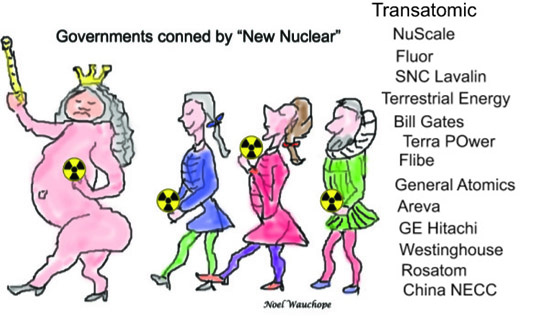
Meanwhile material reality reveals the would-be emperor already has excessively expensive clothes. As documented by independent energy analysts at the Institute for Energy Economics and Financial Analysis, the NuScale SMR-plant proposal offered to Utah in the USA has already seen a reduction in units and a 53% jump in costs that render it even less cost-competitive with renewables than its originally uncompetitive offer.
SMRs do more than inherit farcical versions of the nuclear industry’s past over-promising. SMR proponents also push the technology in a way that would be a hindrance to decarbonisation……………..
………………… We should be suspicious about breezy nuclear industry claims that nuclear power and renewables can co-exist. In fact, research on resource allocation between nuclear and renewables finds evidence for the ‘crowding-out hypothesis’: that countries with greater attachment to nuclear will tend to have lesser attachment to renewables and vice versa). Any talk of SMRs should be interrogated for signs of material commitments, such as opposing grid upgrades, that would in fact mitigate against renewables, thus casting doubt on claims of ‘all of the above’ and on lip service paid to renewables as parts of decarbonisation pathways.
NUCLEAR AFTERLIFE
Some will respond to this analysis by suggesting my anti-nuclear stance is anti-technology or anti-science………..
An apt metaphor for nuclear power might thus be that of the afterlife: not the religious one – rather the Netflix series After Life, a dark comedy written and produced by Ricky Gervais. The central character Tony, played by Gervais, has lost his wife and, in his grief, decides he is just going to punish himself and the world by being a complete jerk. That is the nuclear industry. It is the option you choose when you have trouble moving on and you embrace absurd self-destruction and the visiting of farce and misery on others.
‘Everything Russian’ must be eradicated in Crimea – Zelensky aide
https://www.rt.com/russia/574300-ukraine-crimea-russian-culture-eradication-plans/ 9 Apr 23
Mikhail Podoliak has claimed that Ukraine will retake the peninsula within seven months
Russian culture will be off-limits in Crimea if Ukraine regains control of the peninsula, Mikhail Podoliak, a senior aide to Ukrainian President Vladimir Zelensky, has claimed. Podoliak added Kiev is planning on meting out legal punishments to Russian passport holders and other “traitors” living in the region.
“As soon as we enter, we must eradicate everything Russian in Crimea,” Podoliak stated in an interview with US government-controlled RFE/RL published on Wednesday. He argued that the predominantly Russian-speaking region should instead become part of the “Ukrainian cultural space.”
Acknowledging that his views are among the most radical within the leadership in Kiev, Podoliak insisted that Crimean residents would not be able to read Russian literature or watch Russian movies, let alone speak Russian in public. Instead, the language would only be permitted in private, the official added.
According to Podoliak, those who refused to comply would have to leave.
Locals would also face mass investigations and “legal punishments” for anyone who has switched from Ukrainian to Russian citizenship, as well as those deemed to be “collaborators and traitors” by the Ukrainian authorities.
Podoliak argued that the process, which he described as “very powerful stabilization measures,” would be difficult.
“We’re going to have to break it all down,” he said with respect to Crimea’s Russian identity.
The presidential aide expressed confidence that Ukrainian forces would retake the peninsula within seven months, claiming that his outlook is “mathematically verified” and that Russia lacked the necessary resources to retain the region.
However, Podoliak did not rule out negotiations between Kiev and Moscow on Crimea, provided that the Kremlin first withdrew its troops from territory Ukraine claims as its own.
Crimea has been part of Russia since 2014, when residents voted overwhelmingly to reunify with Moscow soon after the Maidan coup in Kiev. There were fears among the ethnically Russian majority of the peninsula that Ukrainian nationalists who had come to power in Kiev would try to forcefully impose their language and culture on them.
The peninsula was historically part of Russia since 1783, and was only transferred to Kiev’s administrative control by the Soviet authorities in 1954.
AUKUS, NUCLEAR TECHNOLOGY AND AUSTRALIA’S FUTURE

ARENA ONLINE, JOHN HINKSON, 6 APR 2023 https://arena.org.au/aukus-nuclear-technology-and-australias-future/
The AUKUS agreement attempts developments that will shift Australia into a zone that will threaten the existence of Australia itself.
I am not merely thinking of the militarisation of Australia, although that is definitely one likely outcome. I also have in mind our way of life that, while still set in settler-colonial assumptions that give First Nations people no substantial value in Australian society, is relatively relaxed when compared with the way of life of people in the United States. Australia has not experienced the focus upon security that high-powered militarisation associated with nuclear weapons brings. This is the world our leaders are leading us towards.
I want to take up two lines of inquiry into Aukus in this brief article. Firstly AUKUS brings together three Anglo-settled countries – two examples of settler-colonial domination that date back two centuries and more. plus of course the original Anglo-source nation, the United Kingdom. This may seem like an insignificant reference to an aspect of European colonialism that has shaped the whole world for centuries. However, Anglo colonialism has a particular complexion. Here I am drawing in part on the book by James Belich, Replenishing the Earth, about the history of Anglo colonialism. It is well-known these days in anti-colonialism circles that the Anglo slavery pursued in the Caribbean by England was the worst form of slavery, with cruelty on a scale that makes slavery in the United States seem enlightened. Anglo colonialism is typified by relations of difference that deal with colonised peoples with a vengeance. It is noteworthy that Anglo-settled countries like Australia have not at all come to terms with the cultures that pre-existed them. All invading cultures find this difficult, but Anglo-based cultures, as Belich shows, are a special case. It is no coincidence that Adolf Hitler looked with admiration to the United States for its ‘handling’ of its First Nations ‘problem’—a form of extermination of the Native American population—in how to think about the treatment of Jews and Slavs in Europe. Anglo cultures’ commitment to freedom and democracy has a repellent underbelly of racism and cultural suppression, not to mention genocidal elimination.
Significant cultural reform is always difficult but clearly the Anglo-powers have made the decision, at a time when in many respects their backs are up against the wall, to stand and fight—not for their own territory, but against the emergence of China, which was itself on the humiliating receiving end of Anglo colonialism in the nineteenth century. AUKUS in a strong sense is a thumbing of the West’s nose at all the emerging powers in Asia—on racial grounds. They must toe the line.
This is surely a crisis for an Australia seeking in the first half of the twenty-first century to survive in our region. To survive here Australia has to change its spots profoundly. It needs a form of cultural regeneration, in significant combination with Australian First Peoples, to justify its presence outside of the strategies of colonial power. While cultural change is always slow and complex, it is Australia’s only hope of both flourishing and being accepted in this region. It is also crucial because our allies are, in any case falling apart.
While I think the Voice could be the first step towards a significant and substantial change, only a weak version of the Voice, suitable for photo opportunities and feel-good policy, will survive the reassertions of this new Anglo alliance. Australia combines an especially empty form of recognition of First Nations with the arrogance of a superior colonial presence, coloured only a little by multiculturalism, and all this in a region where it has no basic right to exist.
The AUKUS alliance represents an incapacity to flexibly adjust to an emerging situation in which a new world power has emerged, one that will not go away. It is deeply ironic that the United States has fostered this emergence by its global development strategies, just as it fostered its opponents in Afghanistan at an earlier time.
That China is a new superpower is a reality—not that being a superpower is good for China or for us. Like large bureaucracies, superpowers develop self-oriented agendas related to their size, and are not to be trusted. But linking up with the remnants of the old powers to resist emergence means that Australia has resorted to a last gasp Anglo-cultural alliance rather than enter a serious process of rethinking its social composition and its place in the world.
The second line of comment is about nuclear submarines, drawing on a piece that appears in Arena Quarterly, just publishe
I want to take up two lines of inquiry into Aukus in this brief article. Firstly AUKUS brings together three Anglo-settled countries – two examples of settler-colonial domination that date back two centuries and more. plus of course the original Anglo-source nation, the United Kingdom. This may seem like an insignificant reference to an aspect of European colonialism that has shaped the whole world for centuries. However, Anglo colonialism has a particular complexion. Here I am drawing in part on the book by James Belich, Replenishing the Earth, about the history of Anglo colonialism. It is well-known these days in anti-colonialism circles that the Anglo slavery pursued in the Caribbean by England was the worst form of slavery, with cruelty on a scale that makes slavery in the United States seem enlightened. Anglo colonialism is typified by relations of difference that deal with colonised peoples with a vengeance. It is noteworthy that Anglo-settled countries like Australia have not at all come to terms with the cultures that pre-existed them. All invading cultures find this difficult, but Anglo-based cultures, as Belich shows, are a special case. It is no coincidence that Adolf Hitler looked with admiration to the United States for its ‘handling’ of its First Nations ‘problem’—a form of extermination of the Native American population—in how to think about the treatment of Jews and Slavs in Europe. Anglo cultures’ commitment to freedom and democracy has a repellent underbelly of racism and cultural suppression, not to mention genocidal elimination.
Significant cultural reform is always difficult but clearly the Anglo-powers have made the decision, at a time when in many respects their backs are up against the wall, to stand and fight—not for their own territory, but against the emergence of China, which was itself on the humiliating receiving end of Anglo colonialism in the nineteenth century. AUKUS in a strong sense is a thumbing of the West’s nose at all the emerging powers in Asia—on racial grounds. They must toe the line.
This is surely a crisis for an Australia seeking in the first half of the twenty-first century to survive in our region. To survive here Australia has to change its spots profoundly. It needs a form of cultural regeneration, in significant combination with Australian First Peoples, to justify its presence outside of the strategies of colonial power. While cultural change is always slow and complex, it is Australia’s only hope of both flourishing and being accepted in this region. It is also crucial because our allies are, in any case falling apart.
While I think the Voice could be the first step towards a significant and substantial change, only a weak version of the Voice, suitable for photo opportunities and feel-good policy, will survive the reassertions of this new Anglo alliance. Australia combines an especially empty form of recognition of First Nations with the arrogance of a superior colonial presence, coloured only a little by multiculturalism, and all this in a region where it has no basic right to exist.
The AUKUS alliance represents an incapacity to flexibly adjust to an emerging situation in which a new world power has emerged, one that will not go away. It is deeply ironic that the United States has fostered this emergence by its global development strategies, just as it fostered its opponents in Afghanistan at an earlier time.
That China is a new superpower is a reality—not that being a superpower is good for China or for us. Like large bureaucracies, superpowers develop self-oriented agendas related to their size, and are not to be trusted. But linking up with the remnants of the old powers to resist emergence means that Australia has resorted to a last gasp Anglo-cultural alliance rather than enter a serious process of rethinking its social composition and its place in the world.
The second line of comment is about nuclear submarines, drawing on a piece that appears in Arena Quarterly, just published.
The AUKUS strategy seeks to assert massive power, especially surveillance in the Pacific, surrounding China. Nuclear submarines combined with surveillance are the main focus of this attempt to cripple what actually, as I see it, cannot be stopped, in a way similar to Paul Keating’s argument. AUKUS shifts the whole emphasis away from how we protect our independence to what is needed to contain China. For Australia this seems to mean we have to achieve interoperability with US weaponary and systems, with nuclear submarines a key aspect of this. It means Australia must take a first step into adopting nuclear technology, and its consequences. We should not be assured by those who claim that it will be the last step.
Much has been written about the dangers of nuclear power and weapons over the years, to the point where it seems many in the community are now blasé about it—unless radiation waste is to be placed next door to you. Part of what the nuclear industry and its supporters have done is to launch smaller scale tactical nuclear weapons and also small-scale nuclear power plants because both large-scale nuclear weapons and large-scale power plants have unmanageable consequences and poor public acceptance, either because of non-human-scale destruction or ridiculous costs, which only keep escalating.
No one, with the exception of some military strategists, favours nuclear war. The reasons are obvious. The level of destruction of atomic bombs steps beyond our capacity to comprehend: it steps into another realm, a post-human one. Even the seemingly more mundane questions associated with nuclear waste are on another scale because they cannot be effectively disposed. All around the world nuclear waste is piling up around nuclear power stations as well as ‘storage’ of used nuclear submarines components because the waste is not of this world. There is no solution to the waste question. Nuclear waste is killing us on an increasing scale, as exposed by Kate Brown in her book A Manual for Survival. Contrary to the findings of mainstream Western science, she argues that low-level radiation is a mass killer and a general source of ill health As one Russian scientist she quotes puts it: ‘Chronic radiation is a crime’, and chronic radiation is a process that Australia has just signed up for with its nuclear submarines, adding its contribution to the systemic decline of the Earth’s environment, at least one that is suitable for human habitation.
We need to give some focus to this because it is an embarrassment to the nuclear lobby, which they handle and largely get away with by resorting to silence. But nuclear waste is a contradiction that will not go away. All attempts at solutions have failed in every part of the world. This cannot be emphasised enough.
What sort of contradiction is this?
Like nuclear technology, nuclear waste is usually simply regarded as a special category of danger. But its special effects arise out of a social process that is usually ignored. And this is a disaster because that social process is transforming our world in unprecedented ways.
This new world first burst upon us in 1945, with the practical scientific triumph of the atomic bomb. It was not merely novel. It was a consequence of the practical/conceptual reconstructions in the early twentieth century we associate with Albert Einstein and his associates. It was not merely a new theory. It was a combination of abstract academic theory with practical technology in the real world that gave birth to technoscientific society and culture, most importantly through its systematic approach to the transformation of nature. As such, academic theory entered the world of production, as an alternative or supplement to the transformations performed by the working classes, in a way that has expanded exponentially ever since. For better or worse, our world has become increasingly composed socially of the intellectually-trained.
The novelty of nuclear technology is contained within this social approach. Scientific intellectuals now uncover deep levels of the natural world, levels never before encountered by human societies that turn out to be mysterious and unmanageable. Nuclear is not the only example but it is a key one that destroys whatever it touches.
This is the world we are now entering, and doing so with great enthusiasm. It is not only a question of nuclear war. It is just as much one of the levels of security needed when dealing with what we do not know how to control. Nuclear weapons have been ‘controlled’ by such monstrosities as the Cold War and MAD (Mutually Assured Destruction) strategies that give reason a bad name. And low-level radiation has been controlled by denial of any major effects, while the environment of Planet Earth deteriorates. As Brown remarks, ‘Western researchers are discovering, like Soviet scientists before them, that radioactive decay at low doses changes the way cells behave in subtle and life-changing ways’, laying the basis for ‘chronic radiation syndrome’.
AUKUS is a strategy that pursues these outcomes systematically, our leaders planning to leave submarine waste in the desert, once again to be dealt with by First Nations people, now to be permitted by the WA Labor government. Among other things, the crime of chronic radiation poisoning needs to be sheeted home to the powers that be, and in particular now, the Albanese government.
France in national denial- rejecting renewable energy, clinging to out-dated nuclear
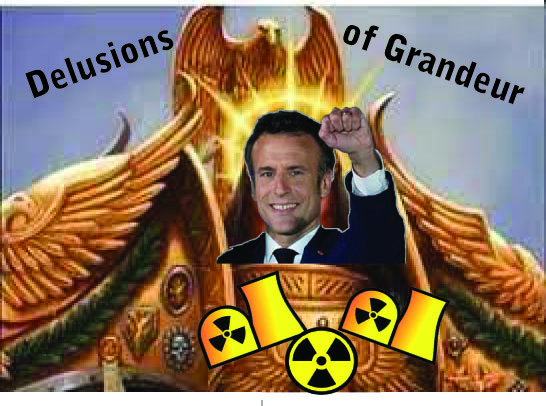
our country seems to be in a form of denial of the difficulties of the
nuclear sector and has been rehashing the same arguments against renewable energies for twenty years: supposed overconsumption of materials, lack of aesthetics, presumed destruction of biodiversity… and a allegedly
astronomical cost.
The debate in the energy sector has intensified in recent years as
important deadlines have come and gone in terms of choices regarding
France’s climate and energy future. But this confrontation of proposals,
necessary and commendable, is struggling to find its place, as illustrated
by the failure of the debate organized by the National Commission for
Public Debate on the construction of the EPR2 reactors, which ended on
February 27.
It usually boils down to invective, at the expense of the
quality of the information brought to the attention of the greatest number.
This desperate state of affairs must change so as not to mislead us
collectively about the choices that determine the country’s energy future.
The debate on energy in France is skewed by the place of nuclear power
which, for a long time, relegated renewable energies to the bare minimum.
At a time when the question arises of renewing our electricity generation
system, it is appropriate to question the relevance of maintaining the same
technological choices as fifty years ago in an eminently different context.
But our country seems to be in a form of denial of the difficulties of the
nuclear sector and has been rehashing the same arguments against renewable
energies for twenty years: supposed overconsumption of materials, lack of
aesthetics, presumed destruction of biodiversity… and a allegedly
astronomical cost.
Le Monde 16th March 2023
Jerome in Paris 18th March 2023
We’ve Forgotton The Potential Horrors of What a Nuclear Winter Would Be Like

The results revealed 3.2 percent of UK respondents and 7.5 percent of US respondents had heard about the consequences of a nuclear war from contemporary media or culture.
In the event of a nuclear attack on Ukraine from Russia, nearly one in five people involved in the study supported retaliation with nuclear weapons. For those who had seen the infographics ahead of time, that figure dropped by 13 percent in the UK and 16 percent in the US – showing how education makes a difference in public opinion.
15 February 2023, By DAVID NIELD https://www.sciencealert.com/weve-forgotton-the-potential-horrors-of-what-a-nuclear-winter-would-be-like—
Under the shadow of the Cold War, many in the world feared the impending prospect of a nuclear winter. According to a new report, our focus has since drifted from its horrors, leaving us with a general lack of awareness that could be dangerous for the future of humankind.
It goes without saying that the threat of a nuclear blast is no trivial event. Decades of pop culture have left society with a relatively strong association between global calamity and atomic weapons.
But the exact details on exactly what we might expect from such an escalating conflict have become hazy in the past few decades.
The facts themselves are fairly clear. Besides the many millions who would be killed directly from the blasts, climate models predict the debris resulting from nuclear war would block out much of our sunlight for up to a decade. The consequences for survivors would be devastating: a decline in global temperature, followed by widespread crop failure, and then mass starvation.
In spite of this dark threat, just a small percentage of today’s population claim to be well informed about the precise consequences of a nuclear war – and many of those people are relying on outdated information spread amid the political tensions between superpowers in the 1980s.
“In 2023 we find ourselves facing a risk of nuclear conflict greater than we’ve seen since the early eighties,” says Paul Ingram, a global risk researcher and diplomacy expert at the Centre for the Study of Existential Risk (CSER) run by the University of Cambridge in the UK. Ingram is the sole author of the report, which has not been peer reviewed.
“Yet there is little in the way of public knowledge or debate of the unimaginably dire long-term consequences of nuclear war for the planet and global populations.”
An online poll of 1,500 people in the UK and 1,500 people in the US was used to prepare the new report. The participants were quizzed on how much they know about a potential nuclear winter, and where they had got their information from. The survey allowed multiple sources to be picked, so they’re not mutually exclusive.
The results revealed 3.2 percent of UK respondents and 7.5 percent of US respondents had heard about the consequences of a nuclear war from contemporary media or culture. A greater fraction of people said their recollection of information spread in the 1980s, during a period of increasing hostility in the US-Soviet Union Cold War, informed their views of the risk of a nuclear winter. Unsurprisingly, few people relied on recent academic papers.
Using hypothetical news reports as a prompt, Ingram also looked at how people would want their governments to respond in the event of a nuclear strike. Half of those surveyed were shown infographics on the effects of nuclear winter before they answered, while the other half were not.
In the event of a nuclear attack on Ukraine from Russia, nearly one in five people involved in the study supported retaliation with nuclear weapons. For those who had seen the infographics ahead of time, that figure dropped by 13 percent in the UK and 16 percent in the US – showing how education makes a difference in public opinion.
“There is an urgent need for public education within all nuclear-armed states that is informed by the latest research,” says Ingram. “We need to collectively reduce the temptation that leaders of nuclear-armed states might have to threaten or even use such weapons in support of military operations.”
The nuclear winter infographics used by the researchers were published in a 2022 peer-reviewed study. The smallest nuclear war theorized involved 100 nukes of 15 kilotons each (about the same size used on Hiroshima), which represents just 0.1 percent of the total combined nuclear arsenal of Russia and the US.
That ‘small’ war would lead to 27 million direct fatalities and 225 million additional deaths from starvation, scientists calculate. At the top end of the scale, all-out nuclear war, we’re looking at 400 million direct deaths and more than 5 billion people dying of starvation because of the consequences of nuclear war.
With so many factors to consider, estimates differ when it comes to the impact of a nuclear war – but even the best case scenarios will clearly be unimaginably terrible. What this report shows is that a big part of avoiding the self-destruction of our species is in raising awareness of what we might be about to do to ourselves.
“Ideas of nuclear winter are predominantly a lingering cultural memory, as if it is the stuff of history, rather than a horribly contemporary risk,” says Ingram.
The report is available to read in full online at the Centre for the Study of Existential Risk.
Twin threats to the Marshallese — Beyond Nuclear International

Art reflects trauma of nuclear testing and climate change
Twin threats to the Marshallese — Beyond Nuclear International
Youth activists paint pictures of their forgotten history and perilous present
From Reverse The Trend and the Marshallese Educational Initiative
Last summer, Reverse The Trend and Marshallese Educational Initiative showcased a series of paintings by Marshallese youth that reflect the twin existential threats of nuclear testing and climate change as part of the Amnesia Atómica Exhibit in New York City’s Times Square.
The paintings expose the trauma experienced by youth living in diaspora in the United States who are learning about the ongoing biological, ecological, and cultural consequences of US nuclear testing on their homelands — a history not taught in US schools.
Joining other youth from affected communities and using art as activism, Marshallese youth are reversing the trend and engaging leaders and their communities to act on these twin threats.
The Amnesia Atómica exposition centered around artist Pedro Reyes’s ZERO NUKES, a 30-foot-tall inflatable sculpture serving as a beacon to bring experts, political leaders, and engaged citizens together to address the nuclear threat.
It was commissioned by the Bulletin of the Atomic Scientists, which focuses on three main areas—nuclear risk, climate change, and disruptive technologies—and equips the public, policymakers, and scientists with the information needed to reduce man-made threats to our existence.
The sculpture was designed to serve as a central platform for a series of public programs and events to spotlight the voices of activists, artists, scientists, and community organizations in the anti-nuclear field, and drive conversations around non-proliferation and disarmament.
Amnesia Atómica was curated by Pedro Alonzo, who specializes in ambitious artworks in public spaces.
We are also sharing our documentary, “A Journey Home.” The film is based on a community poem written by six Marshallese students — ranging from high school to undergraduate — living in Springdale, Arkansas. It is a reflection on the many meanings of home: as Arkansas, as the Marshall Islands, and as Earth that needs to be protected and cultivated for the next generation…………more https://beyondnuclearinternational.org/2023/02/05/twin-threats-to-the-marshallese/—
The dirty secret of US nuclear energy
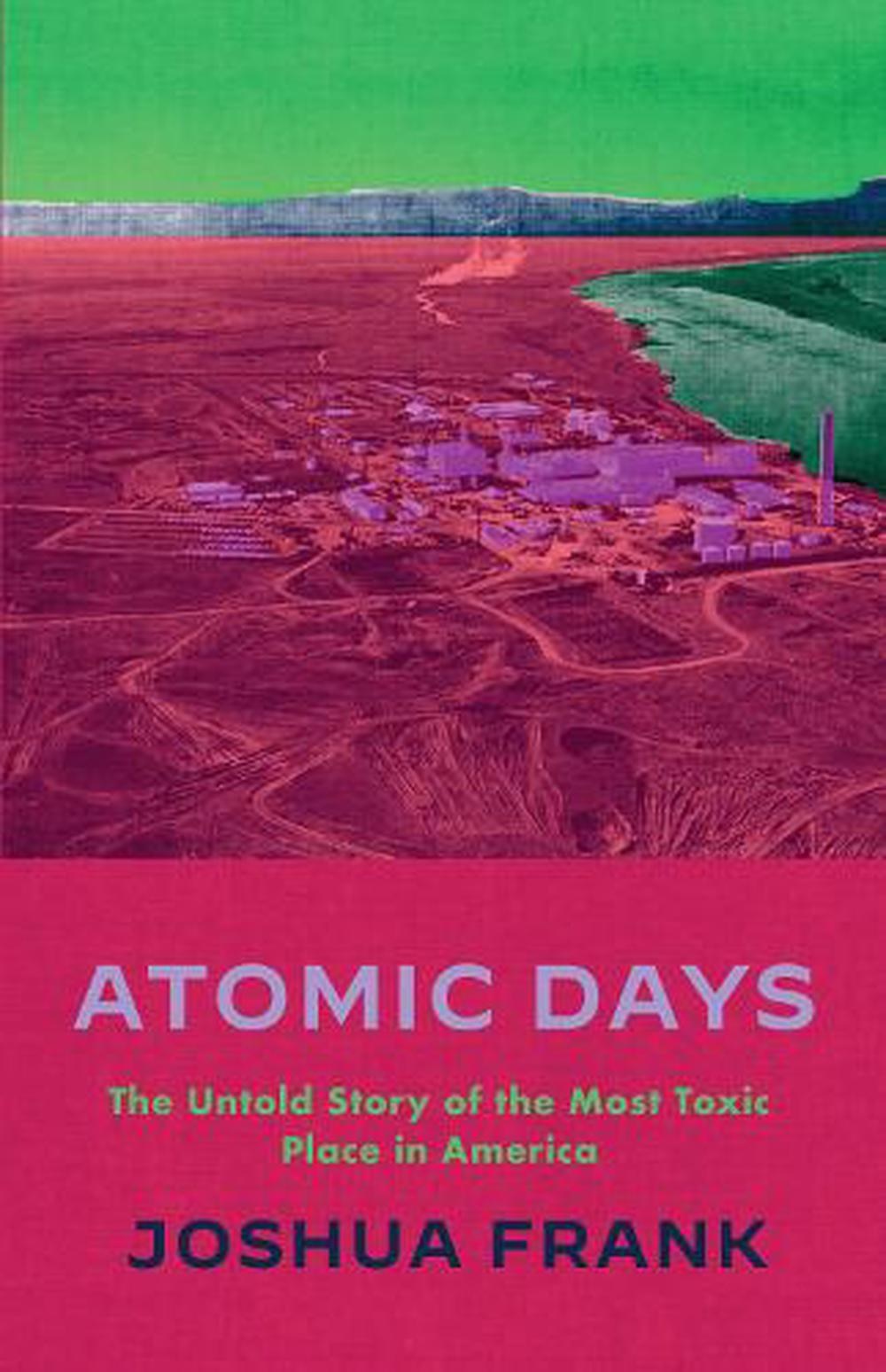
JOHN GREEN recommends an exposé of dangerous malpractice at the oldest and largest nuclear site in the US
Atomic Days: The Untold Story of the Most Toxic Place in America
By Joshua Frank
A DESCRIPTION of Hanford in Washington state — the place where the US stores much of its plutonium waste — sounds like something out of a dystopian novel by Kurt Vonnegut.
The town of Richland, a stone’s throw from Hanford’s boundary fence and where many of the workers’ families live, is an odd place. No rich mineral deposits, no surrounding agricultural landscape, no ski slopes or well-heeled tourists.
Richland was established by the atom bomb project and celebrates that history. The local pub is called Atomic Ale Brewpub. It showcases beers like Plutonium Porter, half-life Hefeweizen and Atom Bustin’ IPA.
The local school coat of arms boasts an exploding mushroom cloud. There is “a fervent mystifying patriotism” running deep in Richland, says Frank. The town also boasts more PhDs than any similar sized town in the state but voted overwhelmingly for Trump in recent elections.
Hanford’s B reactor has been designated a National Historic Landmark and was the first full scale plutonium production plant in the world. Those acting as guides do not appear to reflect on its legacy or suggest, perhaps, a moment of silence for the victims of nuclear bombs; for them it is a reason to rejoice at the ingenuity and superiority of the US war machine
Atomic Days reads at times like a political thriller, involving government lying and cover-ups, corruption, private-sector rapaciousness, spying on union “troublemakers” or anyone concerned about health and safety, and even the attempted murder of a whistleblower. There is no transparency and little accountability.
Many Hanford workers and their families have suffered serious illness as a result of radioactive contamination, from hyperthyroidism to miscarriages, disabilities and cancers, and numbers of unexplained deaths.
All this has been largely ignored by the national media, despite the fact that Hanford poses not only a danger to local people but to the whole country.
While focusing on Hanford, Frank encompasses the nuclear story on a global scale, from the US army injecting unsuspecting human guinea-pigs with plutonium in the 1940s, to the bombing of Hiroshima and Nagasaki, Chernobyl, Fukushima and the air crash over Spain involving nuclear weapons, to the legacy of nuclear bomb testing.
During the Cold War, the project expanded to include nine nuclear reactors and five large plutonium processing complexes, the last of which was decommissioned in 1987.
Once home to the US largest plutonium production site, the Hanford Nuclear complex is laced with 56 million gallons of radioactive waste. There have been numerous releases of radioactive isotopes into the ground water and into the atmosphere, but it has all been shrouded in secrecy. Today, the EPA has designated Hanford the most toxic place in America; it is also the most expensive environmental clean-up job the world has ever seen, with a soaring price tag of £553 billion.

At present, Hanford’s radioactive waste is stored in 177 waste tanks, 149 of them with just a single wall. The facility sits over a huge aquifer, above which 53 million gallons of radioactive and chemically hazardous waste are stored in leaky underground tanks.
These tanks are well past their life expectancy and full of boiling radioactive gunk. They are leaking, infecting groundwater supplies and threatening the nearby Columbia River. It also sits on around 750,000 cubic metres of buried solid waste, spent nuclear fuel and leftover plutonium.
The threat of an explosive accident at Hanford is all too real and could be more catastrophic than Chernobyl. There have already been numerous accidents, mostly unregistered and unknown to the public. It is one of the most radioactive wastelands on Earth.
It used to be home to several indigenous groups who once fished in the fish-rich Columbia River and hunted the deer and other animals in the surrounding woods. They were resettled from their ancestral lands once the US government determined to use the land to build the biggest plutonium production plant and waste dump in the country.
Frank’s chilling account should certainly disabuse the illusions of anyone out there who still views nuclear energy as a means of producing clean energy and saving the planet.
Joshua Frank is co-editor of the radical magazine, Counterpunch.
MIND OF THE MACHINE Chilling AI predicts what nuclear war would look like with attacks on London, Moscow and Washington
https://www.the-sun.com/news/7027327/artificial-intelligence-nuclear-war-prediction/ Henry Holloway, Dec 31 2022
ARTIFICIAL intelligence has offered a horrifying vision of what the world faces in nuclear armageddon and World War 3.
Responding to prompts such as “nuclear bomb”, “war” and “apocalypse” – the AI tool produced a series of truly grim pictures which could offer a glimpse into the future.
Pictures show devastated cityscapes burning with what could be nuclear fire and grim looking soldiers amongst the ruins.
Mushroom clouds rise over desolate landscapes – including one seen looming beside the US Capitol building in Washington DC.
Strange looking machines rumble in what the AI envisioned could be the weapons of the future
And lone figures walk amongst eerie, unrecognisable hellscapes when the AI was asked who it thinks could be the “last man on earth”.
Huge fireballs are seen descending towards burning cities in what could be a nuclear attack.
Soldiers walk amongst ruined landscapes as aircraft, appearing to be giant quadcopter drones fly overhead.
And when asked about what could happen to London, it produced what appears to be an image of Big Ben and the Houses of Parliament.
And another image shows what could be Oxford or Regent Street utterly deserted as its left in total ruin.
Other images show a horde of hopeless looking people stood amongst the ruins of an unidentified city.
Piles of rubble surround them as they hunker beneath the ruins of what may have once been a skyscraper.
And one chilling image shows the Washington Monument – two of them – with a mushroom cloud rising around them.
Massive vehicles are also seen hauling huge missiles in the AI generated images.
Enormous tank-like machines are also seen in the pictures.
Could this really be what the world will look like during a nuclear apocalypse and World War 3?
The AI system of course just responds to the limited prompts given to it rather than world events, but right now the talk of Armageddon has been compared to the height of the Cold War.
ART OF THE FUTURE
AI system NightCafe Creator was used to produce the images – and its one of many new tools showing the boundaries of computer tech.
It works by simply offering a few words as a prompt before the system then produces a piece of “art”.
The system was invented by Angus Russell and takes its name from the famous Vincent Van Gogh painting the The Night Cafe.
It uses machine learning and a neural network to put together pictures based on the prompts offered to it by humans.
AI generated art has caused controversy as some systems are allowing users to actually sell their pieces.
v
Russia’s former southern capital renounces its past: How Ukraine is destroying its heritage

Rt.com 27 Nov 22, Ukraine is turning into a significantly more homogeneous and far less culturally diverse country.
In recent years, Ukraine has become the battleground for a ‘war of monuments’ waged among various political forces. In 2014, the process reached a peak during the mass demolition of statues of Vladimir Lenin and other Soviet politicians. These events fundamentally changed the symbolism and policy of the country’s historical memory, paving the way to a reality in which any public speech must now be accompanied by the words ‘Glory to Ukraine! Glory to the heroes!’
This was the slogan of Stepan Bandera’s World War Two nationalist movement, which collaborated with Adolf Hitler’s Nazis and took part in the Holocaust.
Although Ukrainian President Vladimir Zelensky’s team initially tried to ‘reset’ the historical memory policy, radical nationalism got the upper hand in this symbolic battle. Following the start of Russia’s military operation, this year, the so-called ‘decommunization’ policy became openly known as ‘de-Russification’ – even with over half of the population officially recognized as Russian-speaking.
Memory wars
After Russian troops entered Ukraine in February, many locals projected their hatred of Moscow onto objects of cultural and historical heritage that were in any way linked to the Russian Empire or the Soviet Union. Meanwhile, politicians actively supported such sentiment, using it as a cheap way to boost their personal ratings.
Over the past months, the number of initiatives aimed at the cultural and historical ‘de-Russification’ of Ukraine have ballooned. Examples abound. The Kiev City Council recently renamed 11 streets having any reference to Russia (Lomonosov, Magnitogorsk, and Belomorskaya streets, among others). It also completely excluded the Russian language from the curricula of the capital’s kindergartens and schools.
The decision was supported by 64 out of 120 deputies. Vadim Vasilchuk, head of the Standing Committee on Education, Science, Family, Youth and Sports of the body, commented that teaching Russian in the current situation is “inappropriate.” In fact, Kiev’s educational institutions stopped teaching the language in any shape or form (including as electives) at the beginning of the academic year.
Meanwhile, other Ukrainian cities saw a wave of ‘de-Pushkinization’ sweep through. In November, monuments to the great Russian poet were toppled in Kharkov and Zhitomir, while the monument in Odessa was painted over with the inscription ‘Get out!’ In Kiev, one of the oldest monuments to the bard had been taken down a few weeks earlier.
The demolition of monuments to Russian and Soviet statesmen has continued as well. The Ukrainian Ministry of Culture’s expert council on ‘overcoming the consequences of Russification and totalitarianism’ decided to demolish monuments to Soviet military commanders Nikolay Vatutin and Nikolay Shchors (even though Leonid Kravchuk – a student at the time and later the first president of Ukraine – posed for the Shchors monument).
A memorial to Soviet soldiers erected on May 8, 1970 on the 25th anniversary of victory in WWII was demolished in Uzhgorod in November. The decision dates back to October 13. In its place, Kiev proposed a memorial to the soldiers of the 128th separate mountain assault brigade of the Armed Forces of Ukraine – a military unit that took an active part in the Donbass war unleashed by Kiev in 2014.
The story of one monument
Perhaps the most dramatic case of ‘de-Russification’ unfolded in the port city of Odessa. The city’s history dates back to the end of the 18th century, when the Russian Empire colonized the northern Black Sea region. In November, Odessa’s mayor, Gennady Trukhanov, announced the impending demolition of one of the historical city symbols – a monument to its founders that shows Catherine the Great and her associates, thanks to whom the city became the southern capital of the Russian Empire by the end of the 19th century………………………………………………………………….
How has this become possible? When Ukraine gained independence following the collapse of the Soviet Union, its political (electoral) geography acquired stable borders and became integrated into the self-consciousness of the country’s two parts. In fact, several population groups with powerful national identities emerged at the time: Ukrainian-speaking (mostly living in the western and central regions, and professing a purely ethnic narrative), Russian-speaking (mostly living in the center, south and east, for whom Russians were not ‘strangers’ or ‘enemies’), and actual Russians.
These groups, particularly the Ukrainian speakers and Russian speakers, long had their own heritage, language, and political representation. Recall the Orange Revolution of 2004 or the Euromaidan of 2014, during which the ‘pro-Ukrainian’ part of society opposed the ‘pro-Russian’ leader Viktor Yanukovych. Who, in reality, had spent years negotiating with the EU about eventual Ukrainian membership. ………………………………………….
A few years ago, residents of Ukraine’s south and east spoke Russian while recognizing themselves as Ukrainians. Now, the Russian language and its cultural and historical symbols are undergoing irreversible changes and becoming a marker of political affiliation – namely, of being pro-Russian.
Conscious of this, the authorities are striving to gain control over historical heritage and memory policies and expect to win this battle for public opinion. The current southern and eastern regions are turning into a testing ground for experimental nation-building. Their political self-determination fully depends on the historical memory and language policies. Meanwhile, nationalism offers all the necessary tools for constructing a cohesive socio-political community. That is why such a striking ‘de-Russification’ initiative as the demolition of the monument to Catherine the Great in Odessa will not be the last.
For many years, the main political and cultural debate in Ukrainian society has revolved around the question of preserving or eradicating its Russian and Soviet cultural heritage. In the present situation of armed conflict, supporters of the latter skillfully use public outrage to achieve their aims. Should the process continue (and there’s little reason to think it won’t), in a few years Ukraine will turn into a significantly more homogeneous and far less culturally diverse country – one that has willingly renounced a major part of its heritage.
By Alexander Nepogodin, an Odessa-born political journalist, expert on Russia and the former Soviet Union. https://www.rt.com/russia/566917-ukraine-is-losing-heritage/—
1 This Month
23-25 October – on Zoom – World BEYOND War’s annual global conferenc


Shut down the radiation-damaged Heysham nuclear reactors now
To see nuclear-related stories in greater depth and intensity – go to https://nuclearinformation.wordpress.com

Say No to NASA’s Reckless Nuclear Reactor on the Moon
Say No to NASA’s Reckless Nuclear Reactor on the Moon

-
Archives
- October 2026 (247)
- September 2026 (339)
- August 2026 (330)
- July 2026 (355)
- June 2026 (287)
- May 2026 (306)
- April 2026 (356)
- March 2026 (251)
- February 2026 (267)
- January 2026 (308)
- December 2025 (358)
- November 2025 (359)
-
Categories
- 1
- 1 NUCLEAR ISSUES
- business and costs
- climate change
- culture and arts
- ENERGY
- environment
- health
- history
- indigenous issues
- Legal
- marketing of nuclear
- media
- opposition to nuclear
- PERSONAL STORIES
- politics
- politics international
- Religion and ethics
- safety
- secrets,lies and civil liberties
- spinbuster
- technology
- Uranium
- wastes
- weapons and war
- Women
- 2 WORLD
- ACTION
- AFRICA
- Atrocities
- AUSTRALIA
- Christina's notes
- Christina's themes
- culture and arts
- Events
- Fuk 2022
- Fuk 2023
- Fukushima 2017
- Fukushima 2018
- fukushima 2019
- Fukushima 2020
- Fukushima 2021
- general
- global warming
- Humour (God we need it)
- Nuclear
- RARE EARTHS
- Reference
- resources – print
- Resources -audiovicual
- Weekly Newsletter
- World
- World Nuclear
- YouTube
-
RSS
Entries RSS
Comments RSS

