Need to include a No New Nuclear clause in climate emergency planning
 Radiation Free Lakeland 1st Feb 2020, Kevin Frea is co-chair of the Climate Emergency Network and deputy leader of Lancaster City Council and has worked hard to sign local councils up declaring a climate emergency. “This movement is being led by every political group and is involving local people in planning the actions needed to cut carbon …
”. There is one critical action that is being missed – a No New Nuclear Clause! Last September members of Radiation Free Lakeland lobbied Lancaster City Council asking the council to include a No New Nuclear clause in their climate emergency planning.
The council agreed with us that renewables are the way forward and it is brilliant that council members are actively involved in local community renewable schemes.
However, they thought that including a No New Nuclear Clause in their
Climate Emergency Planning was not necessary. Because as Cllr Kevin Frea
said “Heysham, number 8 on the new nuclear plant list it is not likely to
go ahead”. This new nuclear nonchalence rather misses the point that the
continued push (billions of pounds of public money) for new nuclear is
decimating urgent steps towards renewables and energy efficiency. The sole
reason we are in the situation we are in is entirely down to the continued
efforts of the nuclear industry and its vested interests to suppress
renewables.
https://mariannewildart.wordpress.com/2020/02/01/14471/
As forests burn around the world, drinking water is at risk
 As forests burn around the world, drinking water is at risk https://www.westhawaiitoday.com/2020/01/31/features/as-forests-burn-around-the-world-drinking-water-is-at-risk/
In Australia’s national capital of Canberra, where a state of emergency was declared on Friday because of an out-of-control forest fire to its south, authorities are hoping a new water treatment plant and other measures will prevent a repeat of water quality problems and disruption that followed deadly wildfires 17 years ago.
|
“The forest area burned in Australia within a single fire season is just staggering,” said Stefan Doerr, a professor at Swansea University in England who studies the effects of forest fires on sediment and ash runoff. “We haven’t seen anything like it in recorded history.” The situation in Australia illustrates a growing global concern: Forests, grasslands and other areas that supply drinking water to hundreds of millions of people are increasingly vulnerable to fire due in large part to hotter, drier weather that has extended fire seasons, and more people moving into those areas, where they can accidentally set fires. More than 60% of the water supply for the world’s 100 largest cities originates in fire-prone watersheds — and countless smaller communities also rely on surface water in vulnerable areas, researchers say. When rain does fall, it can be intense, dumping a lot of water in a short period of time, which can quickly erode denuded slopes and wash huge volumes of ash, sediment and debris into crucial waterways and reservoirs. Besides reducing the amount of water available, the runoff also can introduce pollutants, as well as nutrients that create algae blooms. What’s more, the area that burns each year in many forest ecosystems has increased in recent decades, and that expansion likely will continue through the century because of a warmer climate, experts say. Most of the more than 25,000 square miles that have burned in Victoria and New South Wales have been forest, including rainforests, according to scientists in New South Wales and the Victorian government. Some believe that high temperatures, drought and more frequent fires may make it impossible for some areas to be fully restored. When rain does fall, it can be intense, dumping a lot of water in a short period of time, which can quickly erode denuded slopes and wash huge volumes of ash, sediment and debris into crucial waterways and reservoirs. Besides reducing the amount of water available, the runoff also can introduce pollutants, as well as nutrients that create algae blooms. What’s more, the area that burns each year in many forest ecosystems has increased in recent decades, and that expansion likely will continue through the century because of a warmer climate, experts say. Most of the more than 25,000 square miles that have burned in Victoria and New South Wales have been forest, including rainforests, according to scientists in New South Wales and the Victorian government. Some believe that high temperatures, drought and more frequent fires may make it impossible for some areas to be fully restored. Very hot fires burn organic matter and topsoil needed for trees and other vegetation to regenerate, leaving nothing to absorb water. The heat also can seal and harden the ground, causing water to run off quickly, carrying everything in its path. That in turn can clog streams, killing fish, plants and other aquatic life necessary for high-quality water before it reaches reservoirs. Already, thunderstorms in southeast Australia in recent weeks have caused debris flows and fish kills in some rivers, though fires continue to burn. “You potentially get this feedback cycle,” where vegetation can’t recolonize an area, which intensifies erosion of any remaining soil, said Joel Sankey, research geologist for the U.S. Geological Survey. The role of climate change is often difficult to pin down in specific wildfires, said Gary Sheridan, a researcher at the University of Melbourne. But he said the drying effects of wildfire — combined with hotter weather and less rainfall in much of Australia, even as more rain falls in the northern part of the country — mean that “we should expect more fires.” But climate change has affected areas such as northern Canada and Alaska, where average annual temperatures have risen by almost 4 degrees since the 1960s, compared to about 1 degree farther south. As a result, the forested area burned annually has more than doubled over the past 20 to 30 years, said Doerr, from Swansea University. Although there might be fewer cities and towns in the path of runoff in those areas, problems do occur. In Canada’s Fort McMurray, Alberta, the cost of treating ash-tainted water in its drinking-water system increased dramatically after a 2016 wildfire. In the Western U.S., 65% of all surface water supplies originate in forested watersheds where the risk of wildfires is growing — including in the historically wet Pacific Northwest. By mid-century almost 90% of them will experience an increase — doubling in some — in post-fire sedimentation that could affect drinking water supplies, according to a federally funded 2017 study. “The results are striking and alarming,” said Sankey, the USGS geologist, who helped lead the study. “But a lot of communities are working to address these issues,” he added. “It’s not all doom and gloom because there are a lot of opportunities to reduce risks.” Denver Water, which serves 1.4 million customers, discovered “the high cost of being reactive” after ash and sediment runoff from two large, high-intensity fires, in 1996 and 2002, clogged a reservoir that handles 80% of the water for its 1.4 million customers, said Christina Burri, a watershed scientist for the utility. It spent about $28 million to recover, mostly to dredge 1 million cubic yards of sediment from the reservoir. Since then, the utility has spent tens of millions more to protect the forests, partnering with the U.S. Forest Service and others to protect the watershed and proactively battle future fires, including by clearing some trees and controlling vegetation in populated areas. Utilities also can treat slopes with wood chips and other cover and install barriers to slow ash runoff. They purposely burn vegetation when fire danger is low to get rid of undergrowth. Canberra’s water utility has built in redundancies in case of fire, such as collecting water from three watersheds instead of two, and it can switch among sources if necessary, said Kristy Wilson, a spokeswoman for Icon Water, which operates the system. Water can be withdrawn from eight different levels within the largest dam to ensure the best-quality water, even if there is some sediment, she said. That is paired with simpler measures such as using straw bales, sediment traps and booms with curtains to control silt, and physically removing vegetation around reservoirs and in watersheds to reduce fire fuel, she said. Eventually, some communities might need to switch their water sources because of fires and drought. Perth, on the western coast, has turned to groundwater and systems that treat saltwater because rainfall has decreased significantly since the early 1970s, said Sheridan of University of Melbourne. But, for now, millions of people will continue to drink water that originates in increasingly fire-prone forests. |
|
Raging wilfires threaten Canberra, Australia’s capital city
Times 2nd Feb 2020, An inferno was raging near the Australian capital, Canberra, yesterday as a heatwave combined with high winds to prolong the country’s devastating bushfire season. The tiny Australian Capital Territory (ACT), between Sydney and Melbourne, declared a state of emergency as the fire, covering 140 square miles, threatened Canberra’s southern suburbs.
Meet the scientists quitting academia for climate activism

Meet the scientists quitting academia for climate  activism, https://www.dw.com/en/meet-the-scientists-quitting-academia-for-climate-activism/a-51452337–12 Dec 2019, Emotional stress, burnout, and a sense of frustration at policy makers are driving some academics to take a different path in tackling climate change. DW spoke to three people to find out why they became activists.
Most people have the option to switch off from the terrifying media stories of how climate change is affecting the planet. This isn’t so easy for environmental scientists and academics who spend their days researching the consequences of climate change.
In a letter published in Science magazine in October this year, biologists Andy Radford, Stephen Simpson and Tim Gordon, said the loss of nature for people with a strong emotional attachment to it “triggered strong grief responses.”
They argued institutes needed to adapt strategies from “healthcare, disaster relief, law enforcement and military” for environmental scientists so they can manage their “emotional stress.”
After the letter a number of colleagues reached out to Radford, a professor at the University of Bristol, to express their comfort at the views being made public.
Caught between frustration at the disconnect between climate science and policy, and a hope inspired by burgeoning global climate protests in the last year, DW spoke to three people shunning academia in favor of activism.
Dr Wolfgang Knorr: ‘We know a lot less than we pretend to’
Dr Wolfgang Knorr, 53, researcher, physical geography and ecosystem science, and principal investigator (BECC), Lund University, Sweden
Knorr handed in his resignation in September 2019 after 27 years in environmental science. He believes his skills could be better applied as an activist, though he’s not yet sure what form this will take.
“My attraction to science has always been emotional. But in science, it’s all about keeping the emotions down, because they’re not wanted, basically. On the emotional level, I have this strong sense that there is a tremendous risk out there and we know a lot less than we pretend to.
In 2005, I joined the UK’s Natural Environment Research Council. On a daily basis, I would sit in meetings, debating new renewable energy schemes or whatever. On the train back, you read newspaper stories about climate change, but the next page will be economic news about expansion and GDP growth. At that time it became clear to me that there’s a dichotomy between the work and what’s going on in the rest of the world.
That gut feeling at that time continued until very recently — until the youth protests. There was a real step-change in public perception due to these protests. I would say, as a climate scientist, we’re following the lead of these protesters in a way, because it made me realize that I had a potential for being an advocate. I got a new perspective about what I could do with these skills.
I am hoping to find new uses for the skills that I used as a scientist, and make better use of them.”
Jess Spear: ‘I was really demoralized’
Jess Spear, 38, scientist, educator and socialist activist, RISE, Dublin
Spear left climate science in 2013 to work on a campaign in the US city of Seattle that elected its first socialist city councillor in a century. She moved to Dublin, Ireland, in 2017 and works for a new Irish left-wing group called Radical Internationalist Socialist Environmentalist (RISE).
“I worked at the US Geological Survey. It is much easier to be a scientist working as a civil servant than it is in academia. It wasn’t that stressful and was rewarding, but it wasn’t actually producing what I wanted in the world.
At the beginning of 2011 I was really demoralized about the state of the movement for climate action. There didn’t appear to be very many people concerned about it.
To see constant emission rises and failure of governments was like watching a train about to go off a cliff in slow motion. You know what’s going to happen. You feel powerless to do anything about it when you’re just one person.
In 2013 when I started to work in activism, I can remember standing in my kitchen, watching videos of Occupy Wall Street. It was like a light turning on. That was a life-changing moment for me because it opened up the possibilities for shifting away from finding solutions, to focusing on community activism.”
Mathieu Munsch: ‘What I’m doing now is much more meaningful’
Mathieu Munsch, 30, builder, educator and community activist, France
Munsch quit his PhD in climate change at Strathclyde University in Scotland after two and a half years in September 2018. He’s now constructing an eco-friendly house in rural France and has become involved in local politics.
One major impetus was what he saw as a conflict with his values as an academic concerned about the environment if he continued on a certain career path.
“Strathclyde has a big engineering department that does research on fracking. It receives funding from the oil industry. Professors within my departments, theirpension funds were invested in fossil fuels.
In the first year, I still had some faith that I was doing the right thing. But it became more and more obvious to me that I was never going to be able to have a successful career, access to a pension and all of that if for me to benefit from that, the current economic system would need to continue functioning, and therefore we would go into catastrophic climate change. It became a wake-up call that I needed to get out of that system.
I experienced some burnout, specifically when I was spending eight hours of my day on the computer reading documents about climate change. It was pretty emotionally heavy, even though I don’t think I was in the deep despair that I know some people experience.
Something that helped me cope was giving time to activist groups. But it’s only leaving and finding a completely different way to do things that helped me overcome the stress and burnout.
Since I left, I’ve had people contacting me over Twitter as well, specifically for the decision, and one of them said, ‘Oh, yeah, I did exactly the same thing two years ago. I feel like what I’m doing now is much more meaningful.”
These interviews have been edited and condensed for clarity and length
Could geoengineering strategies help tackle climate change?
 Could geoengineering strategies help tackle climate change? DW, 31 Jan 2020, A range of technologies — loosely defined as ‘geoengineering’ — are being explored as responses to climate change. Yet their effectiveness, and whether they should be implemented at all, is debated among scientists.Australia’s bushfires have brought the devastating consequences of a warming world into sharp relief. And with modelling pointing to temperature increases of between three and four degrees Celcius by 2100 in a business-as-usual scenario, predictions suggest such extreme events are set to become more frequentV.
What if we could reverse the warming that is fueling drought and causing flooding around the world?
That is exactly what organizations like the US-based non-profit Foundation for Climate Restoration (F4CR), are proposing. The group wants to restore carbon dioxide levels in the atmosphere to under 300 parts per million, as was the case in the pre-fossil fuel age. Today, the global average measures more than 400 parts per million.
“I’m very interested in leaving [behind] a world where our children can survive,” Pieter Fiekowsky, an MIT-trained physicist who founded F4CR in 2015, told DW. To him, “that clearly requires getting CO2 back to safe levels.”
According to the foundation, achieving that involves “climate restoration,” that is, making sure we’re collectively removing more greenhouse gases from the atmosphere than we produce. The foundation believes around a trillion tons of carbon dioxide needs to be extracted.
That would require large-scale implementation of nature-based or artificial technologies to suck vast quantities of greenhouse gases out of the atmosphere to cool the planet — strategies that fall under the loose definition of “geoengineering.” However, which technologies are best suited, and whether to implement them at all, is hotly debated among scientists.
Climate benefits
Rob Jackson, an earth systems scientist at Stanford University,believes that restoring the climate to what it once was is a better goal than merely stabilizing Earth’s temperatures.
“We need a new story, a new narrative around climate change,” says Jackson, who argues this should involve ambitions that go beyond merely limiting the damage of climate change. “[Climate restoration] will bring climate benefits. It will save lives by reducing air pollution. It will provide a host of other benefits.”
One solution proposed by F4CR in awhite paper last year entails restoring marine habitats that store carbon, such as underwater kelp forests. Another is a form of concrete that binds carbon as it’s made, which was used recently to build a new terminal at San Francisco airport……….
“I think these long-term goals [of climate restoration] take away focus from the really important challenge that we have today of bending the emissions curve downward,” says Joeri Rogelj, a climate scientist at Imperial College London.
There is also concern that geoengineering technologies could create a false sense of security that increased emissions could be removed. Rogelj says ecosystems unable to adapt to current warming are not likely to return even if temperatures decrease……..
A middle ground?
Bhowmik believes it should be possible to achieve a net decline in greenhouse gases without resorting to the most radical geoengineering approaches. The Exponential Roadmap report published in 2019, in which Bhowmik led the modelling work, lays out a strategy focused heavily on nature-based solutions.
To follow that roadmap, the world would need to halve global greenhouse gas emissions every decade from 2020 onwards, improve agricultural practices so farmland absorbs rather than emits carbon, restore large areas of forest and protect carbon-storing ecosystems like peatlands.
“If you follow that route, it would actually be possible by the end of this century to have a substantial reduction in the atmosphere greenhouse gas concentrations. And soon thereafter we will reach the level that was in the preindustrial period,” Bhowmik believes.
Climate restoration got a boost in September 2019 when F4CR joined scientists, venture capitalists and youth activists at a UN Forum aiming to spur investment for a range of nascent technologies to reverse global warming.
Even though there’s disagreement on what — if any — form climate restoration should take, most scientists do agree that it shouldn’t be a replacement for mitigating climate change or helping communities around the world cope with the impacts of rising temperatures.
That includes F4CR. “Climate restoration is a critical third pillar,” says Rick Parnell, CEO of the organization. “[It’s] a third leg of the stool, along with mitigation and adaptation.” https://www.dw.com/en/geoengineering-projects-climate-change/a-52117714
UK government could save money, promote health, by energy efficiency programmess
 Edie 30th Jan 2020, By implementing stronger policies around walking, cycling, electric vehicles and energy efficiency in homes, the Government could save the NHS at least £3.7bn per year. That is according to a new report from think-tank Green Alliance. Drawing on research by CREDS, a body convening research from academics at 15 UK universities. Edie 30th Jan 2020, By implementing stronger policies around walking, cycling, electric vehicles and energy efficiency in homes, the Government could save the NHS at least £3.7bn per year. That is according to a new report from think-tank Green Alliance. Drawing on research by CREDS, a body convening research from academics at 15 UK universities.The report concludes that improved policies on active travel and electric mobility could save the NHS £2.5bn in costs annually, mainly through reduced rates of cardiovascular and lung problems, as well as diabetes. This saving could be realised if just 1.7% of car journeys made annually in England are replaced by walking or cycling.
Green Alliance claims this shift could also improve air
quality, quality of life and public satisfaction with local authorities and Government. |
New interactive flood-risk map shows that global vulnerability to sea level rise is worse than previously understood.

Eastern Daily Press 23rd Jan 2020, Huge swathes of the Broads, the Fens and even parts of Great Yarmouth and Norwich could be under water in 30 years unless drastic action is taken to halt global warming.
That is the shocking conclusion drawn from a new
interactive flood-risk map built by US-based researchers who claim that
global vulnerability to sea level rise is worse than previously understood.
Doomsday clock now closest ever to midnight, due to climate and nuclear dangers
|
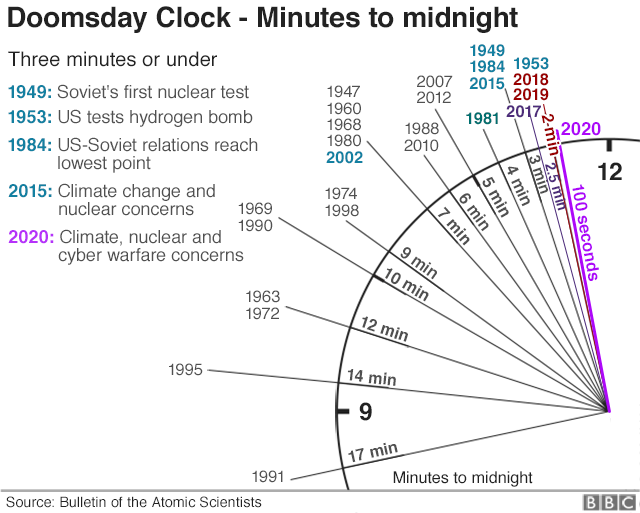
Doomsday Clock nears apocalypse over climate and nuclear fears, BBC, 23 Jan 2020, The symbolic Doomsday Clock, which indicates how close our planet is to complete annihilation, is now only 100 seconds away from midnight.The Bulletin of the Atomic Scientists (BAS) said on Thursday that the change was made due to nuclear proliferation, failure to tackle climate change and “cyber-based disinformation”.
The clock now stands at its closest to doomsday since it began ticking. Last year the clock was set at two minutes to midnight – midnight symbolises the end of the world – the same place it was wound to in 2018…….. The idea began in 1947 to warn humanity of the dangers of nuclear war……….. https://www.bbc.com/news/world-us-canada-51213185 |
|
Greta Thunberg says climate demands ‘completely ignored’ at Davos
|
Greta Thunberg says climate demands ‘completely ignored’ at Davos, https://www.sbs.com.au/news/greta-thunberg-says-climate-demands-completely-ignored-at-davos 24 Jan 2020, Greta Thunberg says she isn’t surprised that calls to disinvest in fossil fuels have fallen on deaf ears at the World Economic Forum in Davos. Teenage climate activist Greta Thunberg said calls to the corporate elite meeting in Davos to immediately disinvest in fossil fuels had been ignored. “We had a few demands (coming into the World Economic Forum). Of course these demands have been completely ignored. We expected nothing less,” Thunberg told reporters in the Swiss ski resort on the last day of the conference. Thunberg was a highlight of the 50th edition of the conference, drawing massive attention including barbs by US Secretary Steven Mnuchin who on Thursday told the teen to go “study economics”. Asked about Mnuchin’s comments, the Swede said: “Of course it has no effect. We are being criticised like that all the time.” “If we cared about that, we would not be able to do what we do. We put ourselves in the spotlight.” The spat between Mnuchin and Thunberg underlined the tensions over climate change at the World Economic Forum (WEF) in Davos, where governments and major firms have come under pressure to act now on global warming. Asked about the 17-year-old’s demand for an immediate halt to investment in fossil fuels, Mnuchin said on Thursday: “Is she the chief economist? Who is she? I’m confused,” adding after a pause that it was “a joke”. “After she goes and studies economics in college, she can come back and explain that to us.” In a speech on Tuesday, US President Donald Trump castigated the “prophets of doom” that predict a climate “apocalypse”, in comments widely seen as an attack on Thunberg who sat in the audience. But either by accident or design, there was no meeting between Trump and Thunberg at the forum. |
|
Wildfires – drastic climate effects in Australia, but Europe is copping it, too

Wildfires show us how the climate emergency is already affecting Europe, Guardian, Imogen West-Knights We look at the devastation of Australia’s bushfires and don’t believe it could happen here. But it already is, 22 Jan 2020 “……… what we’re seeing in Australia. Since the fire season began there, in the middle of last year, 29 people have died, along with more than a billion animals, and an area comparable in size to the whole of England has been ablaze. It’s a vicious reminder that, for all the sophistication of the modern world, something as primitive as fire can still bring us to our knees. As shocking as the scale of the destruction has been, though, it’s easy to see it on our computer screens here on the other side of the world, in the middle of a British winter, and feel disconnected from it. We accept that the climate emergency is now truly upon us yet still feel that it’s mostly happening to other people, elsewhere.wildfires are increasingly a problem for everyone, including in the UK. Last August, there were almost five times as many of them around the world as there had been the previous August. In the EU, the number of wildfires in the first half of 2019 was three times the annual average for the previous decade. And while they used to be a serious problem only in hotter, southern European countries such as Portugal and Spain, now northern Europe is in trouble too.
The Swedish fires of 2018 were by far the most severe in the country’s history, burning an area almost twice as large as the worst previous wildfire, in 2014. In the UK, 2018 and 2019 were the worst two years on record for wildfires, particularly on moors in the north-west of England and parts of Scotland. One fire last year, at Marsden Moor in Yorkshire, destroyed almost three square miles of land. The damage is on a very different scale to the almost 30,000 square miles that have burned in Australia, of course, but this is still a development we can’t afford to ignore.
Aside from all the more immediate effects – the threat to humans, livestock and wildlife – the recent increase in wildfires has been linked to severe air quality problems. People living up to 62 miles (100km) downwind of fires in the Pennines in 2018 were exposed to toxic fumes. And as there is no sign of cooler weather in the years ahead, it is reasonable to expect more fires in 2020. The EU has now established a fleet of firefighting planes, and the European Forest Institute has warned that unless we take steps to protect the countryside – for instance, by planting less-flammable species and creating barriers to the spread of flames – emergency services won’t be able to prevent the rapid spread and firestorms that have characterised the Australian crisis.
This isn’t all because of the climate crisis – changes to land use and increased urbanisation over several decades are also factors. Weather patterns are noisy data, and it’s difficult to attribute any single wildfire to the climate crisis. The scientific consensus, however, is that it is increasing the intensity and frequency of fire-conducive weather across the world.
Even those fires that are eventually linked to human error, like a still-lit disposable barbecue, are increasingly likely due to warming temperatures. Hotter summers mean more barbecues lit in the first place. The climate crisis is going to change the way we behave in every aspect of our lives. And with the probability of another summer of extreme weather coming, we will need to adapt to new dangers that won’t just be on the other side of the planet but, quite literally, in our own backyards.
It’s not at all clear that we’re ready for what might be coming. There is still a cognitive jump yet to be made when those of us in Europe read about the fires in Australia, from mourning the destruction there to recognising that we face some version of the same threat. When we look at Australia, we’re not looking at the future that might await Europe. That future is already here.
• Imogen West-Knights is a writer and freelance journalist
Vulnerability of nuclear facilities to climate extremes – Australian wildfires as a warning
the task of civil society is to organize more strongly in order to increase awareness regarding the link between the climate crisis and the vulnerability of nuclear facilities so that public opinion may begin to be altered and political powers may be pressured to begin an exit from the innately dangerous nuclear path.

What Australia type fire may tell us about the possibility of nuclear disasters, https://www.dianuke.org/what-australia-type-fire-may-tell-us-about-the-possibility-of-nuclear-disasters/ JANUARY 22, 2020 Australia is one of the countries that have experienced extreme weather events, especially in the last decade due to the effect of global warming. According to experts, system interactions triggered global warming, and extinguishing fires has become impossible due to reduced water resources as a result of excessive evaporation and mismanagement of these resources in the last decade in the country. It is estimated that nearly 1.25 billion animal species and at least 27 people have lost their lives, in addition to annihilation of forests and vegetation due to the fires which could not be controlled for almost four months; other species are threatened with extinction and 1800 houses have reportedly burned down.
Unfortunately, the impact of the events is not limited to the period of their occurrence – while four months of carbon emissions, as much as the annual carbon emission amount to the atmosphere, there are scientific studies indicating that there may be an increase in various diseases, especially asthma, especially among children, with the air quality rising to nearly 21 times the dangerous level. Things could have been much worse if the fires had reached the region where uranium mines are located in Australia, which supplies 12% of the uranium fuel used in nuclear power plants operating worldwide; Australia however, has no nuclear power plant of its own.
Even though the extraction of uranium which is used for nuclear power generation, requires high security standards worldwide, danger to these facilities is possible under all conditions, since in order to obtain 30 tonnes of uranium that is used in a 1200 MW capacity reactor in a year, 440 thousand tons of uranium rock must be extracted from the ground. However, heavy metals such as thorium, radium, radon gas, and nickel which are released in the waste and waste pools following the extraction and other processes, causing heavy substances such as arsenic and mercury getting mixed in the environment and groundwater.
Actually such health-related concerns are not limited to Australia since there are also uranium mines in India, the United States, primarily in Niger and Kazakhistan. For Australia, Ranger Uranium Mine, Olympic Dam and Beverly uranium mines have long been on the radar of environmental organizations. According to Dave Sweeney, a renowned anti-nuclear campaigner at the Australian Protection Foundation (ACF), uranium mining and the processing of the extracted material pose enormous risks to the environment and health. However, Sweeney underlines that there are families working in the uranium mines, who inadvertently carry home radioactive dust from the job site.
‘If the fire reached the mines, it would be a nightmare for the world’
A relatively new scientific study published on January 8, 2019, on this subject also points out the danger in uranium mines, especially for those working in the extraction, grinding and production of nuclear fuel and uranium oxide production. Accordingly, due to the regular exposure of employees to radon gas even at low doses every day, it is possible to develop lung cancer due to the cumulative dose accumulated at the end of 10 years. Sweeney argues that the spread of the fires to the uranium mining areas would have been a “ nightmare for the world” since it would have meant the spread of radioactive particles into the air. This would have been in addition to the already existing dangers posed by the uranium mines, such as, in the case of the Ranger uranium mine, whose license, although it has not expired and rehabilitation has not begun yet, there are mineral wastes stacked in waste pools at the production site.
A warning for the rest of the world
Australian fires can even be considered as a warning in many respects for the rest of the world for the factors which triggered the fires, including the mismanagement of water resources that may occur in other continents within five to ten years and lead to the occurrence of large-scale and non-extinguishable fires. Undoubtedly, any explosion at gas facilities, gas plants, chemical factories, cyanide pools, silver, gold, and copper mines would also have multi-dimensional impacts on the overall pollution levels, but it would be infinitely worse if we were to take the nuclear chain into consideration.
What if similar mega-fires were to break out in the US?
When we look at the issue in terms of the location of nuclear power plants and uranium mines, health, and environment-related risks should be remembered. Considering a note by Dr. Helen Caldicott, author of ‘Nuclear Energy No Solution’ – according to her, an average 1000 megawatts reactor produces 225 kilograms of plutonium annually, and the spread of 500 kilograms of plutonium into the atmosphere is enough to have everyone in the world get exposed to cancer. In this respect, if mega-fires were to break out in the US, it would mean that according to the data of October 2019, 98 commercial reactors and 4000 uranium mines will be at unprecedented risk. At this point, I would like to point out that I do not mean that there will certainly be fires happening at nuclear facilities but, in the case of a fire, nuclear disasters may occur.
Similarly, when we evaluate the map of Australia, where the fire density is seen, over the continent of Europe, we see that 128 reactors pose a risk that according to the map, this number increases to 164 with the addition of 36 reactors from Russia. On the other hand, the possibilities for experiencing such multiple disasters are not limited to fires alone. As experienced in the USA with the Harvey and Irma hurricanes in 2017, there is a danger for the whole world in terms of both, the reactors and the wastes accumulated in the facilities due to extreme weather events such as storm and hurricanes, and the melting of glaciers and rising water levels. Therefore, these reactors should be shut down as soon as possible since there will be a need to wait for 10 years to have used reactor fuel rods transported from nuclear power plant area in case sea level rises become dangerous for nuclear power plants plus the amount of unsolvable waste problem should not be increased. The Fukushima Nuclear Disaster and the radioactive solid wastes stacked in the open area which have since found their way into the sea with each storm can be considered as an example of the susceptibility of nuclear facilities/sites to extreme weather events. The risk and danger posed by these nuclear reactors and their radioactive wastes can be understood more clearly when one considers the fact that the half-life of the plutonium is 24 thousand years and the cancer-causing effects last at least 240 thousand years.
Moreover, according to their half-life, other radioactive isotopes (strontium 90, cesium 137…) extending to tens of millions of years are also spread into the atmosphere. Unfortunately, there are nearly 400 nuclear reactors worldwide, thousands of uranium mines as well as waste facilities in operation, which have the potential of Chernobyl and Fukushima-like disasters.
These grim scenarios are meant to underscore the fact that the reality of the climate crisis often hides within its folds the very real possibility of a multiplicity of disasters. If scientists, who predict that the climate crisis will cause climate migration in the near future, could also take into account the fact that the conditions of the climate crisis may trigger nuclear disasters, and in turn, lead to massive waves of migration, steps can be taken to demand urgent changes in this regard, or at the very least the weak and often demonised voices of opposition to nuclear energy and weapons worldwide may be strengthened.
In this regard, the task of civil society is to organize more strongly in order to increase awareness regarding the link between the climate crisis and the vulnerability of nuclear facilities so that public opinion may begin to be altered and political powers may be pressured to begin an exit from the innately dangerous nuclear path. ‘Children for nuclear-free life’ and the involvement of more well-meaning youth such as Greta Thunberg will go a long way into promoting an appreciation of this little understood and/or acknowledged threat to our environment and health – there is an urgent need to phase out polluting industries including nuclear mines and promote worldwide usage of renewable sources such as solar and wind energy.
The author is a Turkish activist and researcher. Earlier, we published her interview on our website.
The global danger as insect species disappear
 Call for action on decline of insects: ‘Without them we’d be in big trouble NZ Herald, By Karoline Tuckey for RNZ, 22 Jan 2020
Governments around the world are being warned more must be done to prevent declining insect numbers, or the consequences could be severe and wide-reaching.
More than 70 scientists from 21 countries have written an appeal for immediate steps to reduce threats to insect species, and a roadmap to recovery, which has been published in the journal Nature Ecology & Evolution.
“There is now a strong scientific consensus that the decline of insects … and biodiversity as a whole, is a very real and serious threat that society must urgently address,” the group said.
Waikato University’s Dr Christina Painting contributed to the text, and said a decline in insects could mean “big trouble” for humans because they were crucial to agriculture and healthy ecosystems.
Insect pollinators were needed for growing crops, to keep our forests healthy, and insects were the main food source for many of our native fish and birds, she said.
The group have praised the German government for committing €100 million ($NZ168m) to the problem, which they say is a “clarion call to other nations”.
What do they say should be done?
Painting said there were smart and achievable steps that could be taken to make an immediate difference.
“They’re ideas we think scientists, policymakers, land managers and communities can all use together to help insect conservation.”
High on the list is for natural areas to be planned for within urban and “homogenous” environments, which could provide havens for insects, and support species diversity.
“I think in New Zealand we’re pretty good and very proactive about trying to come up with restoration areas in both urban and in our conservation estate. But perhaps we haven’t really been thinking about what’s good for insects while we’ve been designing those programmes,” she said.
The group have also called for “aggressive steps to reduce greenhouse gas emissions, reversing agricultural intensification, including reduced [use of] synthetic pesticides and fertilisers and pursuing their replacement with agroecological measures.”
Phasing out pesticides could be one of the trickiest challenges, but it was important to start, Painting said.
“There are problems because they’re generally not that specific in the species they target – so if you put a broad-spectrum pesticide out it’s going to knock off not just the pest species you’re worried about for your crop, but also anything else that might be there. ……
more support was needed from the public and for government to recognise just how important insects ewre.
“We fund things that people value, and to date there has been a much lower appreciation of insects than other species, so it makes sense that we’ve seen less money put into insect conservation.”
More public education could lead to more appreciation for insects and the roles they play – and then should translate to more justification for policy-makers to commit funding to protect them, she said.
“Some of us think insects are gorgeous and very cute, but it’s crucial to understand that without them we’d be in big trouble – they’re just so incredible because it’s such an intricate system of interactions between different species and within communities – and we’re just in our infancy of understanding just how those pieces together.
“Those questions and the mystery around that alone, I think, is something we should really be excited about.”………https://www.nzherald.co.nz/nz/news/article.cfm?c_id=1&objectid=12302483
Climate change could unlock new microbes and increase heat-related deaths
Climate change could unlock new microbes and increase heat-related deaths, Science Daily, January 22, 2020, Source: Johns Hopkins Medicine
- Summary:
- Scientists warn that global climate change is likely to unlock dangerous new microbes, as well as threaten humans’ ability to regulate body temperature…..
- Ahima, director of Johns Hopkins’ Division of Endocrinology, Diabetes and Metabolism, wrote in the journal that “global warming threatens human thermoregulation and survival.” ……
- Casadevall’s article explores “the specter of new infectious diseases” as a result of the changing climate.
“Given that microbes can adapt to higher temperatures,” writes the professor of molecular microbiology and immunology, and infectious diseases, at Johns Hopkins’ schools of medicine and public health, “there is concern that global warming will select for microbes with higher heat tolerance that can defeat our endothermy defenses and bring new infectious diseases.”
Endothermy allows humans and other warm-blooded mammals to maintain high temperatures that can protect against infectious diseases by inhibiting many types of microbes.
Casadevall cites a particular climate threat from the fungal kingdom.
“We have proposed that global warming will lead many fungal species to adapt to higher temperatures,” he writes, “and some with pathogenic potential for humans will break through the defensive barrier provided by endothermy.”….
- In all four JCI “Viewpoint” articles, long-term strategies are urged to reduce greenhouse gas emissions and slow the trend of rising temperatures. ….https://www.sciencedaily.com/releases/2020/01/200122122105.htm
Climate change afflicting the health of the world’s children
 Warning: Climate change will bring major new health risks for kids https://thebulletin.org/2020/01/warning-climate-change-will-bring-major-new-health-risks-for-kids/?utm_source=Newsletter&utm_medium=Email&utm_campaign=MondayNewsletter01202020&utm_content=ClimateChange_HealthRisks_01172020#
By Kathleen E. Bachynski, January 17, 2020 As we enter a new decade, headlines from across the world make all too clear that the effects of climate change are not just looming. They’re here, they’re now, and they’re devastating communities on every continent. For example, in Australia, unprecedented fires have emitted roughly 400 million tons of carbon, killed at least 25 people, and destroyed 2,000 homes. In Indonesia, terrible flooding has killed at least 67 people and caused 400,000 to abandon their homes. The loss of sea ice in the Arctic is shrinking access to food resources that numerous indigenous communities have depended on for generations.
But the health effects of climate change go beyond even the most immediate and obvious consequences of fires, floods, and melting ice. In November 2019, the medical journal The Lancet published a detailed report examining the effects that climate change will have on human health under two scenarios: one in which the world reins in emissions according to commitments laid out in the Paris agreement, and one in which the world does not. In both cases, children will be most vulnerable to the numerous health harms resulting from decisions made by their parents and grandparents. Children are particularly likely to suffer the effects of climate change for numerous reasons: Their immune and organ systems are still developing, they drink relatively more water and breathe in more air than do adults relative to their body weight, and they tend to spend more time outdoors. Understanding the full scope of the public health consequences of a changing climate, then, involves examining how the risks will affect the bodies of the youngest people.
According to the Lancet report, air pollution—specifically, exposure to fine particulate matter known as PM 2.5—represents the largest environmental risk factor for premature deaths across the globe. When people think of the public health effects of air pollution, they often imagine the worst-case scenarios. For example, the smoke from the fires in Australia is currently so severe that a day spent inhaling the air in east Sydney represents the equivalent of smoking 19 cigarettes.
But air pollution need not reach such extreme levels to cause serious harm. Far more commonly, people are unaware of the daily pollution that they are breathing in due to the burning of fossil fuels, such as coal and gas. In fact, more than 90 percent of children are exposed to concentrations of PM 2.5 higher than the World Health Organization’s guidelines on outdoor air pollution. Over a lifetime, unhealthy air damages lungs and increases risks for a host of diseases, from asthma to pneumonia. And due to their small body size and the factors cited above, children absorb more of this pollution than do adults.
Similarly, The Lancet report notes that children are particularly vulnerable to the effects of heat. Specifically, young children are at greater risk for experiencing electrolyte imbalance, fever, respiratory disease, and kidney disease during periods of extreme heat. Rates of heat-related deaths are four times higher among children younger than one year old as compared to people aged 1-to-44. Changing temperature and precipitation patterns are also influencing the transmission of disease from insects to humans. In particular, malaria and dengue are spread by mosquitoes, and climate suitability for transmission of these diseases is increasing in numerous parts of the world. Because children tend to spend more time outdoors, they are more likely to contract these diseases. In 2017, children accounted for 61 percent of all malaria deaths worldwide, and climate change is putting more children at even greater risk.
Changing climate patterns, droughts, and fires also threaten to reduce crop yields and increase food insecurity. Moreover, rising carbon dioxide appears to diminish the nutrient quality of crucial staple foods such as wheat and rice. Combined, these trends are likely to exacerbate the already serious global health problem of malnutrition, which currently accounts for nearly one-fifth of premature deaths and poor health globally. The consequences of malnutrition are particularly severe among children. In 2018, 22 percent of children under five years of age were stunted, meaning they experienced impaired growth and development. Stunting is largely irreversible and includes serious consequences, from poorer cognition to increased risk of nutrition-related chronic diseases later in life.
Finally, The Lancet report observes that climate change has other health implications that are more challenging to quantify but crucial to address, such as mental health effects. Researchers have found that children are at high risk of mental health problems following the types of natural disasters that are likely to increase due to climate change. For example, one study found that 31 percent of a group of children who were evacuated during Hurricane Katrina reported clinically significant symptoms associated with depression and Post Traumatic Stress Disorder. According to the Centers for Disease Control, children are at particular risk for stress after a disaster because they often understand less about what is occurring, feel less able to control events, and have less experience coping with difficult situations.
Protecting children from air pollution, heat-related deaths, infectious diseases, malnutrition, and mental health effects associated with climate change will involve the mobilization of all sectors of society to drastically reduce emissions and invest in health systems and infrastructure. The Lancet report notes a few promising signs, such as increased public and political engagement, and increasing health adaptation spending to improve communities’ resilience to a changing climate. Unfortunately, however, current efforts are falling far short of what is needed to meaningfully reduce carbon emissions on the scale needed to address the threat posed to human health. According to a 2019 United Nations report, greenhouse gas emissions must begin falling by 7.6 percent this year in order to meet the most ambitious goals laid out in the 2015 Paris climate accord. But the world is nowhere near this goal, and many countries are heading in the opposite direction. Notably, in 2018, energy-related carbon dioxide emissions rose by 2.7 percent in the United States. The United Nations has warned that every year of delay “brings a need for faster cuts, which become increasingly expensive, unlikely, and impractical.”
Waiting until action becomes more difficult, or perhaps even impossible, has appalling moral consequences. The longer we fail to act to address the risks of climate change, the more human lives we place on the line. And the majority of those lives will belong to the most vulnerable among us. It is no wonder, then, that children across the world have taken the lead in advocating for urgent, necessary action. The public health stakes for them—and for all people—grow higher with each passing year. Our health is fundamentally tied to our planet’s health. We must all consider, then, what actions we need to take to protect our planet—and thereby our communities, our children, and our selves.
Vast swarm of locusts ruining the livelihood of 1000s in East Africa
Locust swarm 37 miles long and 25 miles wide threatens crops across swathes of east Africa, ITV News, 17 Jan 2020, A swarm of locusts measured at 37 miles long and 25 miles wide has been tracked in Kenya – and the insects are now threatening to decimate crops across swatches of east Africa.
The most serious outbreak of desert locusts in 25 years is posing an unprecedented threat to food security in some of the world’s most vulnerable countries, authorities say.
Unusual climate conditions are partly to blame.
Kenya’s Intergovernmental Authority on Development said: “A typical desert locust swarm can contain up to 150 million locusts per square kilometre.
“Swarms migrate with the wind and can cover 100 to 150 kilometres in a day. An average swarm can destroy as much food crops in a day as is sufficient to feed 2,500 people.”
Roughly the length of a finger, the insects fly together by the millions and are devouring crops and forcing people in some areas to bodily wade through them.
The outbreak of desert locusts, considered the most dangerous locust species, also has affected parts of Somalia, Ethiopia, Sudan, Djibouti and Eritrea and IGAD warns that parts of South Sudan and Uganda could be next.
The “extremely dangerous” outbreak is making the region’s bad food security situation worse, the United Nations’ Food and Agriculture Organisation has warned.
Hundreds of thousands of acres of crops have been destroyed……. https://www.itv.com/news/2020-01-17/locust-swarm-37-miles-long-and-25-miles-wide-threatens-crops-across-swathes-of-east-africa/?fbclid=IwAR1cn3AzYPruUHLGk_0dgXtQvDvh9bjrehBk7AeCTXeru2AjLKdlmmrYz_g
1 This Month
26 September – International Day for the Total Elimination of Nuclear Weapons





PLEASE OPPOSE HR 8255 AND S.3639 – bills would accelerate satellite deployment, with no environmental review or safeguards – https://ncstd5li.quorum.us/campaign/169331/
To see nuclear-related stories in greater depth and intensity – go to https://nuclearinformation.wordpress.com
-
Archives
- September 2026 (281)
- August 2026 (330)
- July 2026 (355)
- June 2026 (287)
- May 2026 (306)
- April 2026 (356)
- March 2026 (251)
- February 2026 (267)
- January 2026 (308)
- December 2025 (358)
- November 2025 (359)
- October 2025 (375)
-
Categories
- 1
- 1 NUCLEAR ISSUES
- business and costs
- climate change
- culture and arts
- ENERGY
- environment
- health
- history
- indigenous issues
- Legal
- marketing of nuclear
- media
- opposition to nuclear
- PERSONAL STORIES
- politics
- politics international
- Religion and ethics
- safety
- secrets,lies and civil liberties
- spinbuster
- technology
- Uranium
- wastes
- weapons and war
- Women
- 2 WORLD
- ACTION
- AFRICA
- Atrocities
- AUSTRALIA
- Christina's notes
- Christina's themes
- culture and arts
- Events
- Fuk 2022
- Fuk 2023
- Fukushima 2017
- Fukushima 2018
- fukushima 2019
- Fukushima 2020
- Fukushima 2021
- general
- global warming
- Humour (God we need it)
- Nuclear
- RARE EARTHS
- Reference
- resources – print
- Resources -audiovicual
- Weekly Newsletter
- World
- World Nuclear
- YouTube
-
RSS
Entries RSS
Comments RSS

