Wildfires in Ukraine: authorities say that those near Chernobyl are now extinguished
Ukraine Says Fire Extinguished Near Contaminated Site Of Chernobyl Nuclear Disaster, Emergency authorities in Ukraine say there are no signs of any fire still burning in the uninhabited exclusion zone around the decommissioned Chernobyl nuclear plant after firefighters mobilized to put out a blaze.
Radio Free Europe, 5 Apr 20, The country’s State Emergency Service said early on April 5 that background radiation levels were “within normal limits.”
More than 130 firefighters, three aircraft, and 21 vehicles were deployed on April 4 to battle the fire, which was said to have burned around 20 hectares (50 acres) in the long-vacated area near where an explosion at a Soviet nuclear plant in 1986 sent a plume of radioactive fallout high into the air and across swaths of Europe.
Fire and safety crews were said to be inspecting the area overnight on April 4-5 to eliminate any threat from sites where there was still smoldering.
The blaze required seven airdrops of water, officials said.
There was no threat to settlements, the State Emergency Service said.
Firefighters battle forest blazes near Chernobyl nuclear site
 Ukraine battles forest fires near Chernobyl https://abcnews.go.com/Health/wireStory/forest-fire-chernobyl-boosts-radiation-level-69983859 Ukraine battles forest fires near Chernobyl https://abcnews.go.com/Health/wireStory/forest-fire-chernobyl-boosts-radiation-level-69983859
Ukrainian says firefighters are laboring to put out two forest blazes in the area around the Chernobyl nuclear power station that was evacuated because of radioactive contamination after the 1986 explosion at the plant By The Associated Press 6 April 2020 MINSK, Belarus — Ukrainian firefighters labored into Sunday night trying to put out two forest blazes in the area around the Chernobyl nuclear power station, which was evacuated because of radioactive contamination after the 1986 explosion at the plant.
Ukraine’s emergencies service said one of the fires, covering about five hectares (12 acres), had been localized. It said the other fire was about 20 hectares (50 acres). Earlier Sunday, the head of the state ecological inspection service, Yehor Firsov, said the fires had spread to about 100 hectares (250 acres). The discrepancy in sizes could not immediately be resolved. Firsov said radiation levels at the fire were substantially higher than normal. But the emergencies service said radiation levels in the capital of Kyiv, about 100 kilometers (60 miles) south, were within norms. The fires were within the 2,600-square-kilometer (1,000-square-mile) Chernobyl Exclusion Zone established after the 1986 disaster at the plant that sent a cloud of radioactive fallout over much of Europe. The zone is largely unpopulated, although about 200 people have remained despite orders to leave. |
|
Radiation spike as forest fire hits Chernobyl nuclear zone
Radiation spike as forest fire hits Chernobyl nuclear zone https://www.deccanherald.com/international/world-news-politics/radiation-spike-as-forest-fire-hits-chernobyl-nuclear-zone-821778.html AFP, Kiev, APR 05 2020, AFP, Kiev, APR 05 2020, 21:04 IST UPDATED: APR 05 2020, 21:31 IST AFP/file photo Ukrainian authorities on Sunday reported a spike in radiation levels in the restricted zone around Chernobyl, scene of the world’s worst nuclear accident, c aused by a forest fire.
To get a perspective – the climate crisis is a greater catastrophe than Coronavirus

While we fixate on coronavirus, Earth is hurtling towards a catastrophe worse than the dinosaur extinction, The Conversation, Andrew Glikson
Earth and paleo-climate scientist, 3 Apr 20, At several points in the history of our planet, increasing amounts of carbon dioxide in the atmosphere have caused extreme global warming, prompting the majority of species on Earth to die out.
In the past, these events were triggered by a huge volcanic eruption or asteroid impact. Now, Earth is heading for another mass extinction – and human activity is to blame.
I am an Earth and Paleo-climate scientist and have researched the relationships between asteroid impacts, volcanism, climate changes and mass extinctions of species.
My research suggests the current growth rate of carbon dioxide emissions is faster than those which triggered two previous mass extinctions, including the event that wiped out the dinosaurs.
The world’s gaze may be focused on COVID-19 right now. But the risks to nature from human-made global warming – and the imperative to act – remain clear………
My research suggests the current growth rate of carbon dioxide emissions is faster than those which triggered two previous mass extinctions, including the event that wiped out the dinosaurs.
The world’s gaze may be focused on COVID-19 right now. But the risks to nature from human-made global warming – and the imperative to act – remain clear……
The next mass extinction has begun
Current atmospheric concentrations of carbon dioxide are not yet at the levels seen 55 million and 65 million years ago. But the massive influx of carbon dioxide means the climate is changing faster than many plant and animal species can adapt.
A major United Nations report released last year warned around one million animal and plant species were threatened with extinction. Climate change was listed as one of five key drivers.
The report said the distributions of 47% of land-based flightless mammals, and almost 25% of threatened birds, may already have been negatively affected by climate change.
Many researchers fear the climate system is approaching a tipping point – a threshold beyond which rapid and irreversible changes will occur. This will create a cascade of devastating effects.
There are already signs tipping points have been reached. For example, rising Arctic temperatures have led to major ice melt, and weakened the Arctic jet stream – a powerful band of westerly winds.

This allows north-moving warm air to cross the polar boundary, and cold fronts emanating from the poles to intrude south into Siberia, Europe and Canada.
A shift in climate zones is also causing the tropics to expand and migrate toward the poles, at a rate of about 56 to 111 kilometres per decade. The tracks of tropical and extra-tropical cyclones are likewise shifting toward the poles. Australia is highly vulnerable to this shift…….
Earth’s next mass extinction is avoidable – if carbon dioxide emissions are dramatically curbed and we develop and deploy technologies to remove carbon dioxide from the atmosphere. But on the current trajectory, human activity threatens to make large parts of the Earth uninhabitable – a planetary tragedy of our own making. https://theconversation.com/while-we-fixate-on-coronavirus-earth-is-hurtling-towards-a-catastrophe-worse-than-the-dinosaur-extinction-130869
Cop26 climate talks in Glasgow postponed until 2021
 Cop26 climate talks in Glasgow postponed until 2021, Crucial UN conference will be delayed until next year as a result of the coronavirus crisis, Guardian Jillian Ambrose Energy correspondent 2 Apr 2020 The UN climate talks due to be held in Glasgow later this year have been postponed as governments around the world struggle to halt the spread of coronavirus.
The most important climate negotiations since the Paris agreement in 2015 were scheduled to take place this November to put countries back on track to avoid climate breakdown. They will now be pushed back to 2021.
A statement from the UN on Wednesday night confirmed that the meeting of over 26,000 attendees would be delayed until next year. It said new dates for the conference would be decided in due course……. https://www.theguardian.com/environment/2020/apr/01/uk-likely-to-postpone-cop26-un-climate-talks-glasgow-coronavirus
Pandemic is distracting the world from an even bigger emergency – global heating
Beneath the virus lurks a bigger emergency, but the world is distracted from the climate threat, SMH, Bob Carr 2 Apr 20, What did our battered old planet do to bring this run of wretchedly bad luck? Just before the 2008 Wall Street disaster, Washington was about to force emitters to pay for the privilege of dumping carbon waste in the upper atmosphere. Congress approved a cap and trade scheme so its economy could trade its way to a low carbon future. In a similar spirit the Rudd government was legislating its own carbon trading model.
Last month the temperature on the Antarctic peninsular hit 65 degrees Fahrenheit, beating all previous records. For the globe, 2019 was the second hottest year on record, and the hottest without the contribution of a big El Nino.
The coming decade may be our last chance to contain the chaos driven by humankind’s craziest experiment: the idea that carbon can be stored in the thin filigree of air around the planet. The Paris Agreement provides a road map and the falling price of renewables a market impulse. ….
In the middle of the coronavirus crisis, The Sydney Morning Herald and The Age, to their credit, still find space to record the conclusion of leading reef scientist, Terry Hughes, that there is a third major bleaching of the Great Barrier Reef now under way. This follows the bleachings of 2016 and 2017. This is every bit a climate event as were the mega fires over Christmas.
Yet the irrevocable loss of healthy coral may not galvanise the way fires did…..
Meanwhile, the pandemic emergency may kill off the Glasgow conference on climate planned for November. The UN event is aimed at averting runaway climate change by keeping the temperature rise to 1.5 degrees. ……
if the breaking up of permafrost in the Arctic circle assumes an extra ferocity. That would release plumes of methane, 30 times more lethal at trapping heat than carbon, but on a scale to blow apart every calibration of how fast climate is shifting.
For Australia, Black Swan climate events could include a cyclone beyond what we have seen before, hitting the Queensland coast. Experts say there is still enough unburnt bush to give us a fire season as bad as the last, even next season – if we suffer the same malevolent mix of heat, low humidity and strong wind……
Beneath news of virus and slump there simmers an even bigger story. The planet keeps warming. And there’s no guarantee the rate may not pick up alarmingly. ……https://www.smh.com.au/environment/climate-change/beneath-the-virus-lurks-a-bigger-emergency-but-the-world-is-distracted-from-the-climate-threat-20200328-p54et4.html
Trump doesn’t ‘get it’ -climate change as the next great engine for the next pandemic
 With the Coronavirus, It’s Again Trump vs. Mother Nature, The president’s failure to understand his limits is very costly. NYT, By Thomas L. Friedman, March 31, 2020
- Today’s news quiz: What do these data points have in common?Jan. 22: President Trump is asked by CNBC: “Are there worries about a pandemic at this point?” Trump answers: “No. Not at all. And we’re, we have it totally under control. It’s one person coming in from China. … It’s — going to be just fine.”
Jan. 31: Moving to counter the spreading coronavirus outbreak, Trump bars entry by most foreign nationals who had recently visited China…….
Nov. 26, 2018: CNN reports that Trump “dismissed a study produced by his own administration … and more than 300 leading climate scientists, warning of the potentially catastrophic impact of climate change.” Asked why, Trump told reporters, “I don’t believe it.” Asked if he read it, Trump said, “some.”
March 30, 2020: This newspaper reports that Trump completed plans to scrap Obama-era automobile fuel efficiency standards that limited climate-warming tailpipe pollution — a move that will “allow cars on
American roads to emit nearly a billion tons more carbon dioxide over the lifetime of the vehicles.”
What’s the common theme? We have a president who is enamored with markets but ignorant of Mother Nature, and we have paid a steep, steep price for that — and will pay an even bigger price when it comes to climate change, if Trump remains in charge……..
there is one huge difference between the coronavirus and climate change: Climate change doesn’t “peak” — and then flatten out and then maybe dissipate or be permanently prevented by vaccine — so normal life resumes.
No, when the Greenland and Antarctic ice melts, it’s gone, and we humans will have to contend with the implications of sea level rise, mass movements of populations and various kinds of extreme weather — wetter wets, hotter hots and drier dries — forever.
There is no herd immunity to climate change. There are only endless impacts on the herd.
Thinking about climate change, even in the middle of this pandemic, is actually useful in a number of ways. For starters, they follow similar natural laws and have common mitigation strategies………
Finally, epidemiologists will tell you that climate change may well be the next great engine for the next pandemic — only this virus could easily be carried by mosquitoes, which, because of warmer temperatures in the global north, are able to migrate up from places they’ve never migrated from before.
For all these reasons, as we invest in infrastructure to stimulate our economy out of this corona crisis, we should be doing it to make our society more resilient against both pandemics and climate change. ……
Now that we have tasted Mother Nature’s wrath in the form of both Covid-19 and climate change, let’s get her on our side. She’s as happy to help as to destroy. Let’s use chemistry, biology and physics, not to mention sun and wind, to create the vaccines and power systems that immunize us from viruses and weather extremes — and not double down on bad habits that will only make us sick again. https://www.nytimes.com/2020/03/31/opinion/covid-trump-climate-change.html
The Climate Crisis Will Be Just as Shockingly Abrupt as the Coronavirus Pandemic

The Climate Crisis Will Be Just as Shockingly Abrupt https://newrepublic.com/article/157078/climate-crisis-will-just-shockingly-abrupt The coronavirus isn’t a reason to put climate policy on hold. It’s a warning of the calamities ahead., By MELODY SCHREIBER, March 27, 2020
The coronavirus pandemic has reshaped the way we live, work, and interact in a matter of weeks. It has also shown that governments are able—and in many cases are expected—to take swift, significant action on crises. “Under these extraordinary circumstances, there can be quite decisive action from governance and policy that changes the way we’re all living day to day,” Lenton said. “It is possible to change large-scale patterns of human behavior, pretty quickly.”
The question is whether governments, and voters, can appreciate the true urgency of the task. In reality, the climate crisis cannot be solved incrementally, Lenton said, because it’s taken too long to spur action: Many warming-related changes are already underway. Global greenhouse gas emissions must be dramatically reduced and eventually eliminated. “If we’re going to avoid the worst of bad climate tipping points, then we’re going to need to find some positive tipping points in society and ourselves to transform the way we live—in a generation—to a more sustainable but also perhaps a more flourishing kind of future,” Lenton said.
Pandemics like this are expected to rise as the climate changes. The SARS-CoV-2 virus causing the disease known as Covid-19, scientists suspect, may have originated in a wild animal, like a bat, and transferred through an intermediate animal to people. Zoonotic spillovers like these, as well as illnesses carried by mosquitoes, ticks, and other animals, will likely increase on a hotter planet. It’s not just because more people are pressing into areas where wildlife lives; as their habitats change in new climate conditions, more animals are adapting to new environments and seeking relief in places where people live, thus increasing the chance of contact between people and animals.
“We are really messing up with the natural world, and with the climate system, and things like this can be expected to happen more often,” Otto said. “It’s one reason to think that climate change is actually a permanent threat and we have to think of fixing the whole system, not only the economy.”
The coronavirus is a real and urgent threat. But there’s also a pressing danger in failing to address climate change in policies and funding, both now and in the future. What’s happening to the planet, experts agree, isn’t going to stop just because we’re dealing with another crisis, and this is no time to ease up on the climate fight. In fact, because of the ways climate change contributes to poor health, it makes action even more urgent.
Melody Schreiber is a freelance journalist based in Washington, D.C. @m_scribe
Countries may use coronavirus crisis to rein in climate commitments: Japan a case in point
Campaigners attack Japan’s ‘shameful’ climate plans release
Proposals criticised amid fears countries may use coronavirus crisis to rein in commitments, Guardian, Fiona Harvey Environment correspondent 30 Mar 20, Japan has laid out its plans to tackle greenhouse gas emissions under the Paris agreement in the run-up to UN climate talks this year, becoming the first large economy to do so.
But its proposals were criticised by campaigners as grossly inadequate, amid fears the Covid-19 crisis could prompt countries to try to water down their climate commitments.
The UK, which will host the talks, hopes every country will produce renewed targets on curbing emissions and achieving net zero carbon by 2050.
New commitments are needed to achieve the Paris goals of holding temperature rises to no more than 2C, and ideally 1.5C, above pre-industrial levels, as on current national targets the world would far exceed those limits.
Japan’s carbon targets – known as its nationally determined contribution (NDC) in the UN jargon – as announced on Monday morning are almost unchanged from its commitments made in 2015 towards the Paris accord, however.
The country’s target of a 26% reduction in emissions by 2030, based on 2013 levels, is rated as “highly insufficient” by the Climate Action Tracker analysis, meaning that if all targets were at this level, temperature rises would exceed 3C.
The country, the world’s fifth biggest emitter and third biggest economy, is one of the only developed countries still building new coal-fired power stations, although there are signs it may hold back……
Campaigners fear the coronavirus pandemic will be seen by some countries as a way to weaken their commitment to the Paris accord and present less stringent targets instead of the strong cuts needed.
“Japan should not slow down climate actions even amid the Covid-19 global fights, and must revisit and strengthen this plan swiftly in order to be in line with the Paris agreement,” said Kimiko Hirata, the international director of the Kiko Network, a climate group in Japan……
Environmental regulations and climate commitments have come under attack in the context of the coronavirus crisis. Under Donald Trump’s administration in the US, the Environmental Protection Agency has rolled back key regulations including car efficiency standards. In the EU, carmakers wrote to the European commission last week to demand a loosening of requirements on them to cut carbon.
There is still scope for Japan to revise its targets. Other countries have yet to submit their detailed NDCs, but several – including the UK and the EU, and more than 70 smaller economies – made public their intention to reach net zero carbon by 2050, at last year’s UN climate talks in Madrid……. https://www.theguardian.com/environment/2020/mar/30/campaigners-attack-japan-shameful-climate-plans-release
Some politicians realising that climate change needs dramatic action, too
 FT 30th March 2020 As the coronavirus pandemic has sent governments scrambling to respond, many politicians have drawn a parallel with another global threat: climate change. “We have to act dramatically, boldly, if we’re going to save lives in this country and around the world,” Bernie Sanders, one of the Democratic presidential contenders, said recently. “I look at climate
change in the exact same way.”
Yet while the principles may be the same, the politics of the two pressing challenges are very different. The analogies between the coronavirus and climate change are easy to understand. The radical measures adopted to fight the pandemic look like precedents for addressing the potentially greater danger from climate change.
Fatih Birol, executive director of the International Energy Agency, has suggested that the need for widespread intervention by governments to
prevent economic collapse should be seen as a “historic opportunity” to
direct energy investment into technologies that reduce greenhouse gas
emissions. Large-scale investment to support solar and wind power,
batteries, hydrogen and carbon capture and storage would “bring the twin
benefits of stimulating economies and accelerating clean energy
transitions,” he wrote earlier this month.
https://www.ft.com/content/13ce469c-68fa-11ea-a6ac-9122541af204
Coronavirus Shows Us What Our Future Could Look Like During Climate Crisis
Coronavirus Shows Us What Our Future Could Look Like During Climate Crisis, BY Sharon Zhang, Truthout, March 29, 2020 The COVID-19  pandemic has rapidly been absorbed into our collective consciousness, remaking the fabric of our lives. Suddenly, millions are sheltering in place, strangers have started wishing each other well when exiting grocery stores, people have stopped touching their faces and shelves that are normally stocked with bleach and hand sanitizer are barren.
For many, the looming sense of dread is a new sensation….
But for those of us who have lived in acute awareness of the reality of the climate crisis, the current state of pandemic dread feels awfully familiar — just a more imminent version of the dread about the climate that we have been feeling for years.
It’s a psychological phenomenon known informally in the climate community as climate anxiety, climate grief or eco-anxiety…….
Though the pandemic-panic that Mull and others have written on has been ongoing for the past few weeks, climate writers started opening up about their climate grief years ago. …….
But it’s not just psychological trauma that these two crises share — if you take the time to look, the similarities run wide and deep. These are twin worldwide crises that require global cooperation to defeat; they will ravage the way of life as we know it; they will affect, in one way or another, nearly every single person on Earth.
The economy as we know it — rather, as we knew it three months ago — will be a thing of the past if we let the climate crisis continue unmitigated…….
Economists are currently struggling to model all of the short-term effects of the pandemic, so many of those remain unknown. Climate researchers, however, have had much more time to model the future economic impacts of the climate crisis. By 2090, in the U.S. alone and under the same high emissions scenario, NCA researchers predict that costs from mortality due to extreme temperatures will total $141 billion a year, losses of coastal property will total $118 billion a year, and labor losses will cost $155 billion a year. That’s equivalent to a Hurricane Katrina every single year, just from lost labor.
The health care system, too, will be overwhelmed by the climate crisis, just as hospital beds are rapidly being filled by COVID-19 patients. In some places, the climate crisis has already given a preview of this: In 2018, record heat waves caused U.K. hospitals to utilize emergency procedures, when people were being sent to the hospital in such an overwhelming volume that ambulances had to line up outside.
Though COVID-19 is causing hospitals to fill up simultaneously nationwide, “climate-related events will be more limited in their spatial scale, but will be increasingly frequent over time,” says Kristina Dahl, a senior climate scientist at the Union of Concerned Scientists. A heat wave in San Francisco won’t set the whole country ablaze, but it could overwhelm the local health care system.
The key difference between illness caused by a pandemic and the climate crisis, Dahl points out, is that it’s much easier to trace the illness caused by the former. “Things like hurricanes and heat waves and wildfires have always occurred,” she says, but, “to some extent, we know that we are amping them up by adding greenhouse gases to the atmosphere.”
This is likely, in part, why the federal government has quickly pivoted to action on COVID-19, while greenhouse gases have remained largely untouched by Congress for decades. While right-wing media and politicians denied the consequences of inaction on the virus just weeks ago, they have quickly had to change their tune as the spread of the virus has become undeniable. Whereas with long-term, gradual change, it’s easy for deniers to blame such things as the severity of the bushfires in Australia on anything but increasingly hot and arid conditions caused by climate change.
The ruling class has also had less motivation to address the climate crisis because the people suffering the most are, disproportionately, already marginalized. Poor, Black and health-compromised people are and will be the hardest hit by both crises — and some are already being affected by both at once. Air pollution is continually one of the most pronounced issues of environmental justice, and physicians have said those with continual exposure to air pollution are likely to be more vulnerable to the effects of coronavirus……..
“Coronavirus has made so clear that global issues can’t be easily categorized as just a health issue or just an environmental issue,” says says Kristina Dahl, a senior climate scientist at the Union of Concerned Scientists. “They really encompass our broader economy and encompass or entire social systems and ways of life.” ….. https://truthout.org/articles/coronavirus-shows-us-what-our-future-could-look-like-during-climate-crisis/?eType=EmailBlastContent&eId=5e383daa-77a3-48e3-a6f5-f82b689f50fc
Action on Covid19 gives a lesson for action on climate change
 Delay is deadly: what Covid-19 tells us
 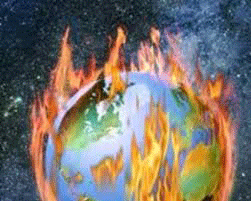 about tackling the climate crisis https://www.theguardian.com/commentisfree/2020/mar/24/covid-19-climate-crisis-governments-coronavirus, Jonathan Watts
Rightwing governments have denied the problem and been slow to act. With coronavirus and the climate, this costs lives.
The coronavirus pandemic has brought urgency to the defining political question of our age: how to distribute risk. As with the climate crisis, neoliberal capitalism is proving particularly ill-suited to this.
Like global warming, but in close-up and fast-forward, the Covid-19 outbreak shows how lives are lost or saved depending on a government’s propensity to acknowledge risk, act rapidly to contain it, and share the consequences.
On these matters, competence and ideology overlap. Governments willing to intervene have been more effective at stemming the virus than laissez-faire capitalists. The further right the government, the more inclined it is to delay action and offload blame elsewhere. International comparisons suggest this could be making infection and death rates steeper.
Take the US, where Donald Trump is only now acknowledging the seriousness of the pandemic after weeks of claiming fears were exaggerated. Until recently, his government put more money into shielding the oil industry than providing adequate testing kits. He reportedly ordered officials to downplay early warnings because he did not want bad news in an election year. The US now has one of the fastest rising numbers of new cases in the world.
In Brazil, the ultra-right president, Jair Bolsonaro, is equally reckless. He claimed the risks of coronavirus were overblown, until 17 of his aides and security detail tested positive after a trip to the US. Last weekend, he ignored his own government’s advice and chose to shake hands and pose cheek-to-cheek for selfies at a mass rally of supporters. As cases and deaths surge, his support has plummeted.
In the UK, Boris Johnson acknowledged the risk, but did little about it. Though not as extreme in his denial as Trump or Bolsonaro, Johnson’s government first dithered, then dabbled with a policy of “herd-immunity”that was reportedly driven by Dominic Cummings’ desire to protect the economy, even if it cost pensioners’ lives. The UK has since shifted tack and enforced a lockdown, but its controls are still haphazard. Last week, daily deaths in the UK were reckoned to be on a steeper upward curve than Italy was at the same stage.
By contrast, more interventionist governments – generally but not exclusively those which are centrist or leftwing – have acted more quickly and shared the burden of risk more widely. Norway, Denmark and Sweden already appear to have flattened the coronavirus curve. Spain and France implemented lockdowns at around 200 deaths, which the UK and US have far surpassed.
In Asia, China initially attempted to hide the problem from the public when the virus emerged in Wuhan, then mobilised huge public resources to enforce a strict lockdown and provide extra hospital beds. South Korea, Taiwan and Thailand also appear to have turned the corner thanks to different combinations of extensive testing, quarantine measures and public health education.
Other factors are at play. Asian countries with prior experience of the Sars epidemic appear to have been better prepared. Italy, one of the worst affected countries, has one of the world’s oldest populations. In Japan’s case, the relatively flat curve of confirmed cases may also be a result of the government’s unwillingness to do widespread testing because it could jeopardise the Olympics.
Similarly, the relatively low number of cases in the global south has raised hopes that warmer weather might slow the disease – but this is far from certain. A comparatively low number of coronavirus cases could be the result of a lag caused by distance from the origin of the disease, relatively lower levels of international traffic, and fewer resources for testing.
This pandemic has amplified the importance of assessing and controlling risk before it gets out of hand. But the political champions of the neoliberal right, such as Trump and Bolsonaro, are more inclined to deny and delay, as climate politics have shown us in recent years.
When it comes to a pandemic like Covid-19, that position is untenable. No leader can deny the science, nor can they endlessly delay action as they have done on global heating. Muddling through until the next election is not an option; leaders will be judged on deaths next week, not emissions reductions in 2050.
The demographics are also completely different. Unlike the climate crisis, the virus predominantly threatens the elderly – the right’s core support group – rather than millennials. So far, the worst affected regions are also closer to the centre of economic power: the cool industrialised north rather than the warmer developing south (though the latter may suffer more in the future due to weaker healthcare systems).
For the right, this makes the pandemic a greater political threat than the climate crisis has ever been. Unless they can quickly get on top of the disease, they will lose any claim to being champions of national security. It is entirely possible that the effects of this pandemic could be one of the most catastrophic failures of free-market capitalism.
This should also be a lesson for the left. If state intervention and scientific advice is effective in dealing with the virus, the same principles should be applied more aggressively towards the still more apocalyptic threats of climate disruption and the collapse of nature. Until now, the left has recognised these dangers, but done little to act on them because economic growth has always taken precedence.
The pandemic has proved that delays are deadly and expensive. If we are to avoid a cascade of future crises, governments must think beyond a return to business as usual. Our conception of what is “normal” will have to change. We’ll need to invest in natural life-supporting systems such as a stable climate, fresh air and clean water. In the past, those goals have been dismissed as unrealistic or expensive, but recent weeks have shown how quickly the political compass can shift.
First though, we need to accept – and share – risk. Instead of deferring risks to future generations, weaker populations and natural systems, governments need to transform risks into responsibilities we all bear. The longer we hesitate, the fewer resources we will have at our disposal, and the more risk we will have to divide.
• Jonathan Watts is the Guardian’s global environment editor
Bill McKibben on the Virus and the Climate Movement
How the Virus Has Hit the Climate Movement: Bill McKibben
The Tyee talks to the prominent activist and author about fighting on two fronts. Geoff Dembicki 23 Mar 20 | TheTyee.ca
Geoff Dembicki reports for The Tyee. His work also appears in Vice, Foreign Policy and the New York Times. A few weeks ago, this was looking like a big year for Canada’s climate movement.
After years of grassroots opposition to the Trans Mountain pipeline in B.C., an eruption of rail blockades across the country in solidarity with the Wet’suwet’en natural gas fight and Teck Resources shelving a major new oil sands mine for economic reasons, all the conditions seemed there to push for economy-transforming policies on the scale of the Green New Deal.
Then the coronavirus hit.
At a time when climate leaders in Canada, the U.S. and Europe imagined millions of people on the streets pressuring financial institutions to ditch fossil fuels and forcing political leaders to enact bold legislation, people are now fearful and physically alone, stuck in their homes to prevent a public health catastrophe as outside ecosystems veer towards collapse.
To help Tyee readers make sense of this new reality, we reached out to author and activist Bill McKibben, co-founder of the climate group 350 and a global authority on what must be done to fight the climate emergency. It was McKibben who wrote the book The End of Nature about climate change in 1989 that put the threat firmly on the public radar.
On the impact of coronavirus on the climate movement:
In a conversation that has been edited for length and clarity, he urges Canadians to pressure politicians to keep the climate emergency front and centre as we navigate this crisis, while using these terrifying and inexplicable times as a chance to reflect on the fairer and more sustainable world we must build after the crisis is over.
On the similarities between coronavirus and climate change:
There’s a sense in which something like coronavirus is like climate change except encapsulated in a few months instead of a few decades…The biggest difference is that there’s no enormous industry that gets rich off of coronavirus, so there’s not like a built-in opposition to doing what needs to be done and that’s always been one of the problems with climate change.
On how coronavirus is helping kill off the fossil fuel industry:
One thing that’s happening I think is that last year will mark the peak of fossil fuel demand. I don’t think fossil fuels will be able to recover to the point they were at before. I can’t imagine anyone deciding that what they’re going to invest their money now in is another tar sands mine. I find it hard to imagine that even the Canadian government is going to want to spend $12 billion to build its pipeline out to Burnaby. I think we’re going to be reminded that there are other more important things to spend money on.
It seems to me that probably some of the landscape of oil and gas is getting rewritten even as we watch. That is a direct testament to the power of protest and organization over this last decade and to the incredible work of people, especially Indigenous organizers, pushing this case for a very long time. And it’s gotten through. Earlier this winter, the decision of investors that they weren’t going to throw more money into the Teck Frontier mine was a kind of bell ringing and those echoes will reverberate for a long time.
On the message Canadians should send to businesspeople and politicians:
I do think that the best thing for people to be doing in North America at the moment is to be putting huge pressure on the banks and financial institutions that fund fossil fuels, like JPMorgan Chase, BlackRock, Liberty Mutual, RBC, all the Toronto banks, reminding them that it’s not ok to be trying to profit off the end of the world.
Some of these banks are going to need bailouts as the economy tanks and it should be pretty clear that we should not be bailing out them without making sure that they’re not going to contribute to the next even larger crisis facing the planet. https://thetyee.ca/News/2020/03/22/How-The-Virus-Has-Hit-Climate-Movement-McKibben/
A new low-cost solar technology for environmental cooling
A new low-cost solar technology for environmental cooling https://www.eurekalert.org/pub_releases/2020-03/pdt-anl032320.php POLITECNICO DI TORINO Space cooling and heating is a common need in most inhabited areas. In Europe, the energy consumed for air conditioning is rising, and the situation could get worse in the near future due to the temperature increase in different regions worldwide. The increasing cooling need in buildings especially during the summer season is satisfied by the popular air conditioners, which often make use of refrigerants with high environmental impact and also lead to high electricity consumption. So, how can we reduce the energy demand for building cooling?
A new study comes from a research group based at the Politecnico di Torino (SMaLL) and the National Institute of Metrological Research (INRiM), who has proposed a device capable of generating a cooling load without the use of electricity: the research has been published in Science Advances*. Like more traditional cooling devices, this new technology also exploits the evaporation of a liquid. However, the key idea proposed by the Turin researchers is to use simple water and common salt instead of chemicals that are potentially harmful for the environment. The environmental impact of the new device is also reduced because it is based on passive phenomena, i.e. spontaneous processes such as capillarity or evaporation, instead of on pumps and compressors that require energy and maintenance.
“Cooling by water evaporation has always been known. As an example, Nature makes use of sweat evaporation from the skin to cool down our body. However, this strategy is effective as long as air is not saturated with water vapour. Our idea was to come up with a low-cost technology capable to maximize the cooling effect regardless of the external water vapour conditions. Instead of being exposed to air, pure water is in contact with an impermeable membrane that keeps separated from a highly concentrated salty solution. The membrane can be imagined as a porous sieve with pore size in the order of one millionth of a meter. Owing to its water-repellent properties, our membrane liquid water does not pass through the membrane, whereas its vapour does. In this way, the fresh and salt water do not mix, while a constant water vapour flux occurs from one end of the membrane to the other. As a result, pure water gets cooled, with this effect being further amplified thanks to the presence of different evaporation stages. Clearly, the salty water concentration will constantly decrease and the cooling effect will diminish over time; however, the difference in salinity between the two solutions can be continuously – and sustainably – restored using solar energy, as also demonstrated in another recent study from our group**”, explains Matteo Alberghini, PhD student of the Energy Department of the Politecnico di Torino and first author of the research.
The interesting feature of the suggested device consists in its modular design made of cooling units, a few centimetres thick each, that can be stacked in series to increase the cooling effect in series, as happens with common batteries. In this way it is possible to finely tune the cooling power according to individual needs, possibly reaching cooling capacity comparable to those typically necessary for domestic use. Furthermore, water and salt do not need pumps or other auxiliaries to be transported within the device. On the contrary, it “moves” spontaneously thanks to capillary effects of some components which, like in kitchen paper, are capable of absorbing and transporting water also against gravity.
“Other technologies for passive cooling are also being tested in various labs and research centres worldwide, such as those based on infrared heat dissipation into the outer space – also known as radiative passive cooling. Those approaches, although promising and suitable for some applications, also present major limitations: the principle on which they are based may be ineffective in tropical climates and in general on very humid days, when, however, the need for conditioning would still be high; moreover, there is a theoretical limit for the maximum cooling power. Our passive prototype, based instead on evaporative cooling between two aqueous solutions with different salinities, could overcome this limit, creating a useful effect independent of external humidity. Moreover, we could obtain an even higher cooling capacity in the future by increasing the concentration of the saline solution or by resorting to a more sophisticated modular design of the device” commented the researchers.
Also due to the simplicity of the device assembly and the required materials, a rather low production cost can be envisioned, in the order of a few euros for each cooling stage. As such, the device could be ideal for installations in rural areas, where the possible lack of well-trained technicians can make operation and maintenance of traditional cooling systems difficult. Interesting applications can also be envisioned in regions with large availability in water with high saline concentration, such as coastal regions in the vicinity of large desalination plants or nearby salt marshes and salt mines.
As of now, the technology is not yet ready for an immediate commercial exploitation, and further developments (also subject to future funding or industrial partnerships) are necessary. In perspective, this technology could be used in combination with existing and more traditional cooling systems for effectively implementing energy saving strategies.
[*] Matteo Alberghini, Matteo Morciano, Matteo Fasano, Fabio Bertiglia, Vito Fernicola, Pietro Asinari, Eliodoro Chiavazzo. Multistage and passive cooling process driven by salinity difference, SCIENCE ADVANCES (2020), URL: https://advances.sciencemag.org/content/6/11/eaax5015
[**] Eliodoro Chiavazzo, Matteo Morciano, Francesca Viglino, Matteo Fasano, Pietro Asinari, Passive solar high-yield seawater desalination by modular and low-cost distillation, NATURE SUSTAINABILITY (2018), URL: https://www.nature.com/articles/s41893-018-0186-x
No place for atomic power amidst climate chaos and pandemics
 Nuclear lessons from the corona virus March 22, 2020 by beyondnuclearinternational No place for atomic power amidst climate chaos and pandemics Beyond Nuclear By Linda Pentz Gunter
There is nothing like being shut in your own home, alone with your human and animal nearest-and-dearests, to focus the mind on the crises that now swirl outside.
And it is “crises” in the plural, because while all the focus is of course on the corona virus, there is one giant crisis steamrollering toward us that will wreak orders of magnitude more devastation, but somehow does not merit the same kind of emergency action. And that, of course, is climate change.
Denial seems to be one of the greatest of human achievements. It’s also why we have nuclear power. It will be too cheap to meter. An accident will never happen. We will solve the radioactive waste problem later.
With the climate crisis upon us, it should be patently obvious that building new nuclear power plants anywhere is not an intelligent plan. Sea level rise is a certainty, and fires, flooding, storm surges, and earthquakes are likely to increase both in frequency and force. Building power plants that contain an inventory of long-lived lethally radioactive fuel in such an environment is insane. And then to build them on shorelines, as is currently happening at Hinkley, and is threatened for similar settings at Sizewell and possibly Wylfa — all of them in the UK— is irresponsible in the extreme.
The covid-19 crisis almost certainly won’t be the last such Biblical-style plague to strike us. If we fail to learn our lesson this time around, we will be equally unprepared and again forced to quarantine ourselves and call workforces home. But while wind turbines will keep spinning and solar arrays will continue to collect sunlight without any help from us, workers cannot leave a nuclear power plant untended. Knowing this, why build an installation that cannot be safely abandoned?
The answer, of course, is money. But not the industry’s money. Ours. We are the ones who will pay to keep nuclear plants running, and to build new ones……….
The French government is on record as saying that without Hinkley and Sizewell, the French nuclear brand will be finished. It sees the UK projects as an essential redemptive step, given the EPR, its supposed flagship, has so far been a financial and technical shipwreck.
As the Financial Times pointed out in May 2018, “Avoiding delays in the UK will be crucial if EDF is to persuade international buyers — and its own shareholders, not least the French government — that the EPR’s teething problems are over.” ……..
Maybe all of us, becalmed and decelerated, will start to come to our senses. We may see climate changes for the better as we stop flying and driving and cruise-shipping and needlessly consuming, while factories are idled and our air quality improves. The wake-up call comes at a terrible price. But the bigger cost could be everything. https://beyondnuclearinternational.org/2020/03/22/nuclear-lessons-from-the-corona-virus/
1 This Month
26 September – International Day for the Total Elimination of Nuclear Weapons





PLEASE OPPOSE HR 8255 AND S.3639 – bills would accelerate satellite deployment, with no environmental review or safeguards – https://ncstd5li.quorum.us/campaign/169331/
To see nuclear-related stories in greater depth and intensity – go to https://nuclearinformation.wordpress.com
-
Archives
- September 2026 (281)
- August 2026 (330)
- July 2026 (355)
- June 2026 (287)
- May 2026 (306)
- April 2026 (356)
- March 2026 (251)
- February 2026 (267)
- January 2026 (308)
- December 2025 (358)
- November 2025 (359)
- October 2025 (375)
-
Categories
- 1
- 1 NUCLEAR ISSUES
- business and costs
- climate change
- culture and arts
- ENERGY
- environment
- health
- history
- indigenous issues
- Legal
- marketing of nuclear
- media
- opposition to nuclear
- PERSONAL STORIES
- politics
- politics international
- Religion and ethics
- safety
- secrets,lies and civil liberties
- spinbuster
- technology
- Uranium
- wastes
- weapons and war
- Women
- 2 WORLD
- ACTION
- AFRICA
- Atrocities
- AUSTRALIA
- Christina's notes
- Christina's themes
- culture and arts
- Events
- Fuk 2022
- Fuk 2023
- Fukushima 2017
- Fukushima 2018
- fukushima 2019
- Fukushima 2020
- Fukushima 2021
- general
- global warming
- Humour (God we need it)
- Nuclear
- RARE EARTHS
- Reference
- resources – print
- Resources -audiovicual
- Weekly Newsletter
- World
- World Nuclear
- YouTube
-
RSS
Entries RSS
Comments RSS

