Pandemic side-effects offer glimpse of alternative future on Earth Day 2020

Pandemic side-effects offer glimpse of alternative future on Earth Day 2020 https://www.theguardian.com/environment/2020/apr/22/environment-pandemic-side-effects-earth-day-coronavirus
Coronavirus has led to reduced pollution, re-emerging wildlife and plunging oil prices and shown the size of the task facing humanity Oliver Milman. @olliemilman, Wed 22 Apr 2020 The skies are clearing of pollution, wildlife is returning to newly clear waters, a host of flights have been scrapped and crude oil is so worthless that the industry would have to pay you to take it off their hands – a few months ago, environmentalists could only dream of such a scenario as the 50th anniversary of Earth Day hove into view.
But this disorientingly green new reality is causing little cheer given the cause is the coronavirus pandemic that has ravaged much of the world.
“This isn’t the way we would’ve wanted things to happen, God no,” said Gina McCarthy, former head of the US Environmental Protection Agency in the Obama administration. “This is just a disaster that pointed out the underlying challenges we face. It’s not something to celebrate.”
Wednesday’s annual Earth Day event, this year largely taking place online, comes as public health restrictions to prevent the spread of Covid-19 have resulted in a sharp dip in air pollution across China, Europe and the US, with carbon emissions from the burning of fossil fuels heading for a record 5% annual drop.
The waters of Venice are now clear, lions lounge on roads normally frequented by safari-goers in South Africa and bears and coyotes wander around empty accommodation in Yosemite national park in California.
Meanwhile, nearly eight in 10 flights globally have been canceled, with many planes in the US carrying just a handful of people. The oil industry, a key driver of the climate crisis and direct environmental disaster, is in turmoil, with a barrel of crude hitting an unprecedented minus-$40 on Monday.
These would perhaps be the sort of outcomes seen had stringent environmental policies been put in place in the wake of the first Earth Day in 1970, which saw 20 million Americans rally in support of anti-pollution measures.
Instead, the pain of the Covid-19 shutdown has highlighted how ponderous the world’s response has been – the expected cut in emissions, for example, is still less than what scientists say is needed every year this decade to avoid disastrous climate impacts for much of the world.
“It’s the worst possible way to experience environment improvement and it has also shown us the size of the task,” said Michael Gerrard, an environmental law expert at Columbia University.
How people react to the return of normalcy after the pandemic will help define the crises racking the environment, according to Gerrard. “A key question will be do we have a green recovery, do we seize the opportunity to create jobs in renewable energy and in making coastlines more resilient to climate change?” he said. “The current US president clearly has no inclination to do this.”
McCarthy, now head of the Natural Resources Defense Council, noted that some Indian people were seeing the Himalayas for the first time due to the veil of air pollution lifting.
“You wonder if people will want to go back to what it was like before,” she said. “The pandemic has shown people will change their behavior if it’s for the health of their families. This has been the lost message on climate, that it’s a human problem, not a planetary problem. We have to show you can have a stable environment and your job, too.”
The problems in the natural world haven’t suddenly vanished – this week various researchers found that the Arctic is very likely to be free of sea ice in summers before 2050, that the bushfires that torched Australia earlier this year released more carbon than the country’s annual CO2 output and that the first quarter of 2020 was the second-warmest on record.
Donald Trump has signaled that he will try to provide a bailout to the US oil and gas industry, with $25bn already handed out by the US government to prop up airlines. In China, it’s not certain that the wildlife-packed “wet markets” where Covid-19 is believed to have originated will be shut down.
Conservationists warn that returning the world to its pre-pandemic settings will quickly wipe out any environmental benefits of the shutdown.
“It’s a serious wake-up call,” said Thomas Lovejoy, an ecologist who coined the term “biological diversity”. “We bulldoze into the last remaining places in nature and then are surprised when something like this happens. We have done this to ourselves by our continual intrusion into nature. We have to re-chart our course.”
This story is a part of Covering Climate Now’s week of coverage focused on Climate Solutions, to mark the 50th anniversary of Earth Day. The Guardian is the lead partner in Covering Climate Now, a global journalism collaboration committed to strengthening coverage of the climate story.
Coronavirus recovery can pave the way to a green energy future

around the world, electricity demand has reduced in COVID-19 hotspots. This could have a knock-on effect for the renewable sector.China, where the outbreak first took hold, is the world’s biggest electricity consumer. Output from factories has been substantially diminished with many unable to return to their jobs in manufacturing. Due to the curtailing of industrial electricity use, cuts in energy consumption for 2020 could be equivalent to the power used by the whole of Chile, according to IHS Markit.
In Europe, peak power consumption has also gone down. Italy, Spain, and the UK have all seen an average 10 per cent drop in energy usage with bars, restaurants, offices and factories, which remain closed as social distancing measures continue.In particular, fossil fuel based sources of electricity have been impacted by reduced requirements. Coal, usually one of the cheapest options, has now become the most expensive fuel in the world in the face of cheap green alternatives and natural gas, according to Bloomberg Green.
PAVING THE WAY FOR A GREEN FUTURE?
Renewable energy sources seem to have been given an unexpected boost. Around 40 per cent of the electricity generated in the UK on Sunday 5th March came from wind farms, with nearly a fifth being provided by solar energy. This was due to the unusually sunny day, says the National Grid ESO carbon intensity tracker.
These conditions have meant that renewable sources generated more than enough energy to cover the country’s reduced needs. Green supplier, Octopus Energy, even paid some customers to use energy during the day, using a scheme that has previously only been available during the night when demand is very low.
“In most economies that have taken strong confinement measures in response to the coronavirus – and for which we have available data – electricity demand has declined by around 15%, largely as a result of factories and businesses halting operations,” Dr Fatih Birol, Executive Director of the International Energy Agency wrote in a blog post.
“In this way, the recent drop in electricity demand fast-forwarded some power systems 10 years into the future, suddenly giving them levels of wind and solar power they wouldn’t have had otherwise without another decade of investment in renewables.”
He went on to explain that this increase in renewable energy usage could even help some countries figure out how to deal with the drop in power that comes from the sun setting or a strong wind dying down. Previously, these kinds of fluctuating energy sources have proved challenging for those who work to keep our lights on. Managing them more ntelligently by shutting off solar panels at midday when there is more electricity than usual and slowing down wind power as demand decreases at night are just some options Dr Birol suggests.
These new findings have also put the spotlight on more reliable and often neglected sources of green energy, like hydropower, which are essential to making sure we have a consistent supply of energy. In exceptional situations like the current pandemic, where a fluctuation in energy supply could put lives and employment at even greater risk, this is particularly important.
To save the planet, cultural, social and political transformation is essential; new technologies only part of the answer.

Why relying on new technology won’t save the planet https://www.sciencedaily.com/releases/2020/04/200420125510.htm April 20, 2020, Lancaster University
- Summary:
- Over-reliance on promises of new technology to solve climate change is enabling delay, say researchers. They argue instead for cultural, social and political transformation to enable widespread deployment of both behavioral and technological responses to climate change.
-
Overreliance on promises of new technology to solve climate change is enabling delay, say researchers from Lancaster University.
Their research published in Nature Climate Change calls for an end to a longstanding cycle of technological promises and reframed climate change targets.
Contemporary technological proposals for responding to climate change include nuclear fusion power, giant carbon sucking machines, ice-restoration using millions of wind-powered pumps, and spraying particulates in the stratosphere.
Researchers Duncan McLaren and Nils Markusson from Lancaster Environment Centre say that: “For forty years, climate action has been delayed by technological promises. Contemporary promises are equally dangerous. Our work exposes how such promises have raised expectations of more effective policy options becoming available in the future, and thereby enabled a continued politics of prevarication and inadequate action.
- “Prevarication is not necessarily intentional, but such promises can feed systemic ‘moral corruption’, in which current elites are enabled to pursue self-serving pathways, while passing off risk onto vulnerable people in the future and in the global South.
The article describes a history of such promises, showing how the overarching international goal of ‘avoiding dangerous climate change’ has been reinterpreted and differently represented in the light of new modelling methods, scenarios and technological promises.
The researchers argue that the targets, models and technologies have co-evolved in ways that enable delay: “Each novel promise not only competes with existing ideas, but also downplays any sense of urgency, enabling the repeated deferral of political deadlines for climate action and undermining societal commitment to meaningful responses.
They conclude: “Putting our hopes in yet more new technologies is unwise. Instead, cultural, social and political transformation is essential to enable widespread deployment of both behavioural and technological responses to climate change.”
The researchers map the history of climate targets in five phases: “stabilization,” followed by a focus on “percentage emissions reductions,” shifting to “atmospheric concentrations” (expressed in parts per million), “cumulative budgets” (in tonnes of carbon dioxide), and currently “outcome temperatures.”
- In the first phase (around Rio, 1992) technological promises included improved energy efficiency, large-scale enhancement of carbon sinks, and nuclear power
- In the second phase around the Kyoto summit (1997) policy promises focused on cutting emissions with efficiency, fuel switching and carbon capture and storage (CCS).
- In the third phase (around Copenhagen, 2009), CCS became linked to bioenergy, while policy focused on atmospheric concentrations.
- Phase four saw the development of sophisticated global carbon budgeting models and the emergence of a range of putative negative emissions technologies.
- Policy in phase five focused increasingly on temperature outcomes, formalised with the Paris accord of 2015.
Story Source:
Materials provided by Lancaster University. Note: Content may be edited for style and length.
North pole soon to be ice free in summer
|
North pole soon to be ice free in summer https://www.eurekalert.org/pub_releases/2020-04/uoh-nps042020.php
UNIVERSITY OF HAMBURG The Arctic Ocean in summer will very likely be ice free before 2050, at least temporally. The efficacy of climate-protection measures will determine how often and for how long. These are the results of a new research study involving 21 research institutes from around the world, coordinated by Dirk Notz from the University of Hamburg, Germany.The research team has analyzed recent results from 40 different climate models. Using these models, the researchers considered the future evolution of Arctic sea-ice cover in a scenario with high future CO2 emissions and little climate protection. As expected, Arctic sea ice disappeared quickly in summer in these simulations. However, the new study finds that Arctic summer sea ice also disappears occasionally if CO2 emissions are rapidly reduced. “If we reduce global emissions rapidly and substantially, and thus keep global warming below 2 °C relative to preindustrial levels, Arctic sea ice will nevertheless likely disappear occasionally in summer even before 2050. This really surprised us” said Dirk Notz, who leads the sea-ice research group at University of Hamburg, Germany. Currently, the North Pole is covered by sea ice year round. Each summer, the area of the sea ice cover decreases, in winter it grows again. In response to ongoing global warming, the overall area of the Arctic Ocean that is covered by sea ice has rapidly been reduced over the past few decades. This substantially affects the Arctic ecosystem and climate: The sea-ice cover is a hunting ground and habitat for polar bears and seals, and keeps the Arctic cool by reflecting sunlight. How often the Arctic will lose its sea-ice cover in the future critically depends on future CO2 emissions, the study shows. If emissions are reduced rapidly, ice-free years only occur occasionally. With higher emissions, the Arctic Ocean will become ice free in most years. Hence, humans still have an impact on how often the Arctic loses its year-round sea-ice cover. Technical details: The simulations used in this study are based on so-called SSP Scenarios (shared socio-economic pathways), which will also be used for the next IPCC report. Scenarios SSP1-1.9 and SSP1-2.6 are used to simulate a rapid reduction of future CO2 emissions, while scenario SSP5-8.5 is used to simulate largely unchanged future CO2 emissions. The study is based on simulations from the most recent generation of climate models, collected within the Coupled Model Intercomparison Project Phase 6 (CMIP6). Pictures Artic sea ice (free download): https://www.cen.uni-hamburg.de/en/about-cen/news/11-news-2020/2020-04-20-sea-ice-notz.html Contact: Continue reading |
Investment in green energy could drive Covid-19 recovery – International Renewable Energy Agency report
|
The agency’s director general, Francesco La Camera, said the global crisis ignited by the coronavirus outbreak exposed “the deep vulnerabilities of the current system” and urged governments to invest in renewable energy to kickstart economic growth and help meet climate targets. The agency’s landmark report found that accelerating investment in renewable energy would help tackle the climate crisis and would in effect pay for itself. Investing in renewable energy would deliver global GDP gains of $98tn above a business-as-usual scenario by 2050 by returning between $3 and $8 on every dollar invested. It would also quadruple the number of jobs in the sector to 42m over the next 30 years, and measurably improve global health and welfare scores, according to the report. “Governments are facing a difficult task of bringing the health emergency under control while introducing major stimulus and recovery measures,” La Camera said. “By accelerating renewables and making the energy transition an integral part of the wider recovery, governments can achieve multiple economic and social objectives in the pursuit of a resilient future that leaves nobody behind.” The report also found that renewable energy could curb the rise in global temperatures by helping to reduce the energy industry’s carbon dioxide emissions by 70% by 2050 by replacing fossil fuels. Renewables could play a greater role in cutting carbon emissions from heavy industry and transport to reach virtually zero emissions by 2050, particularly by investing in green hydrogen…… The call for a green economic recovery from the coronavirus crisis comes after a warning from Dr Fatih Birol, head of the International Energy Agency, that government policies must be put in place to avoid an investment hiatus in the energy transition. “We should not allow today’s crisis to compromise the clean energy transition,” he said. “We have an important window of opportunity.”….. https://www.theguardian.com/environment/2020/apr/20/green-energy-could-drive-covid-19-recovery-international-renewable-energy-agency |
|

Climate Change Multiplies the Threats of Infectious Diseases
 Climate Change Multiplies the Threats of Infectious Diseases, BY Daniel Ross, Truthout,
  April 19, 2020
As the novel coronavirus continues to rage like a wildfire across the planet, its devastating toll has left many asking whether climate change — another multifaceted phenomenon with global reach — has played a part in spreading, even triggering, the pandemic. Some, like Katharine Hayhoe, a climate change scientist and professor of public policy at Texas Tech University, have been able to provide answers.
“Climate change didn’t cause the pandemic, and climate change directly causes very few of them,” Hayhoe told Truthout. “But what climate change does is it interacts with, and in many cases has the potential to exacerbate the impacts.”
For those well-versed in the mechanics of climate change, this comes as no surprise — scientists, policy makers and other experts have long acknowledged the links between global warming and the spread of infectious diseases, promulgating the sorts of findings described in the wide-ranging 2018 Intergovernmental Panel on Climate Change report, detailing what efforts are needed to limit global warming to 1.5 degrees Celsius.
Dig down, and this multilayered issue has knock-on effects — from the way rising temperatures exacerbate certain health problems to the disruptions that extreme weather events have on the global supply chain — that are inextricably linked with one another. What’s more, the governmental response to the coronavirus crisis, say experts, offers a troubling glimpse into what might happen in the future as the global thermometer inches upwards.
“What it underscores in the first instance is how underprepared we are,” said Sherri Goodman, a senior fellow at the Wilson Center’s Environmental Change and Security Program and Polar Institute.
As a former first deputy undersecretary of defense in environmental security, she coined the term “threat multiplier” to describe climate change’s kaleidoscopic impacts.
“Our systems — institutional, infrastructure, health, emergency response — could all be overwhelmed from the climate crisis,” Goodman said, warning that the time for wholesale climate resiliency preparedness is upon us. “What we have now is history accelerating itself — things are happening so fast.”
“Where Can These People Go?”
Perhaps most salient in terms of current events is the issue of zoonotic diseases spread between animals and humans, like the COVID-19 virus, which is believed to have originated in bats before being transferred to humans via scaly animals like pangolins. As the world’s population growth continues to rise, natural habitats will continue to be encroached upon and destroyed, not only removing valuable carbon sinks like rainforests but creating environments in which notorious zoonotic disease carriers like bats and rats thrive.
Climate change is also likely to encourage the spread — both in terms of seasonal risk and geographic reach — of “vector-borne” diseases. These are illnesses like West Nile Virus and Lyme Disease that are borne by mosquitoes, ticks and fleas, and already account for a significant number of deaths annually.
According to Sheri Weiser, a professor of medicine at the University of California, San Francisco (UCSF), there’s still much to learn about how rising temperatures are impacting the spread of infectious diseases. “But we know the common cause of climate change and COVID-19 — the globalization that’s driving fossil fuel emissions — contributes to the pre-conditions that pave the way for viruses like that,” Weiser said.
Indeed, there’s already an extensive library of medical literature detailing how climate change can impact human health. Extreme weather events — a symptom of a warming planet — can lead to fluctuating temperatures which have been shown to contribute to and worsen cardiovascular and cerebrovascular diseases, kidney disorders and a host of other illnesses. On top of that, extreme heat and humidity can limit the effectiveness of certain medications used to treat these conditions………
the Trump administration’s slash-and-burn approach to the scientific wing of the federal government is the elephant in the room during the COVID-19 pandemic.
Last September, for example, the U.S. Agency for International Development (USAID) effectively shuttered its PREDICT program, which was charged with identifying and combating new emerging viruses. With the COVID-19 death toll in the U.S. now well into five figures, USAID has injected more than $2 million to kickstart the program, at least temporarily. The Environmental Data and Governance Initiative recently found that the Trump administration has repeatedly, “and sometimes successfully,” sought to cut funding aimed at the Centers for Disease Control and Prevention for fighting global pandemics. Nevertheless, the Trump administration isn’t alone in neglecting science and research; for nearly two decades now, the amount of federal funds funneled toward basic research has shrunk markedly……. https://truthout.org/articles/climate-change-multiplies-the-threats-of-infectious-diseases/?eType=EmailBlastContent&eId=71649a96-ad00-4169-afc2-bb1b572e3345
To tackle the climate crisis, the world cannot return to normal after Covid-19.
 New Statesman 16th April 2020, To tackle the climate crisis, the world cannot return to normal after
Covid-19. This moment must be used to build a new economic consensus founded on justice, care and sustainability. The same fractures exposed by this pandemic are the fault lines along which the battle for climate justice is fought.
Many of the people most vulnerable in the current crisis will be worst affected by environmental breakdown, while those who are enriched by this pandemic are likely to benefit in the future. Reports this week that UK hedge funds are cashing in on Covid-19 ring eerily similar to now regular stories of investors betting on climate collapse, water
scarcity and crop failure, and investing in the infrastructures and technologies of disaster.
And just as many nations and communities have been abandoned in our response to this pandemic, it is all too easy to imagine a future in which communities from Jakarta to east Yorkshire are left to fend for themselves amid accelerating climate breakdown. Indeed, to imagine it one has only to look at the present.
Post-crisis stimulus should be directed towards green infrastructure and innately low carbon forms of work like health and social care, proven so vital and so undervalued by this crisis. Debts must be written off to allow those countries most vulnerable to climate crisis to build resilience against it. And having exposed austerity as an ideological choice, rather than a necessity, we must ensure these mistakes are never repeated, and social safety nets are both valued and strengthened.
Rapid Transition Alliance 16th April 2020, Andrew Simms: In the debate over the global response to Covid19 a battle of hashtags has broken out between those urging a quick return to ‘normal’, and those saying that ‘normal’ had many problems and the crisis has revealed both the need and an opportunity for changing direction, and a shift of economic purpose.
With dry and windy conditions, new areas of ‘smoldering’ reported near Chernobyl nuclear plant
New areas of ‘smoldering’ reported near Chernobyl nuclear plant, Accu Weather, By Courtney Spamer, AccuWeather meteorologist, Apr. 18, 2020 A massive fire that broke out in northern Ukraine at the beginning of April is no longer said to be threatening the infamous Chernobyl nuclear power plant in the region. However, officials are monitoring hot spots as winds whip through the region.
The fire began to burn in the region back on April 3, near the town of Pripyat, located over two hours north of the country’s capital of Kiev and near the border with Belarus.
Police say they arrested a 27-year-old man who is being accused of starting the fire last week. On Monday, police said that another local resident burned waste and accidentally set dry grass ablaze.
The location of the fire was reportedly only one kilometer (less than one mile) away from the Chernobyl nuclear power plant, the site of the world’s largest nuclear catastrophe back in April 1986.
However, Greenpeace Russia, on Monday, warned that the fire being in close proximity of the power plant posed a radiation risk.
“Higher-than-usual” radiation levels were first reported by the AP on April 5, and are being carefully monitored as the fire continues.
According to Reuters, Chernobyl tour operator, Yaroslav Yemelianenko, shared on Facebook that the fire was only two kilometers away from where “the most highly active radiation waste of the whole Chernobyl zone is located.” He called on officials to warn people of the danger.
Emergency services said on Tuesday morning that there were still some acreage “smoldering” in the Chernobyl Exclusion Zone, but that the zone contained no open fire.
Acting Chairman of the State Environmental Inspectorate, Yegor Firsov, later said that the fire in the Chernobyl exclusion zone was extinguished, and cited some rain that moved through the region as one helpful factor.
Hundreds of firefighters, as well as several planes and helicopters, battled the blaze for 10 days.
………Strong winds increased the difficulty in containing what’s left of the blaze and new areas of “smoldering” were reported in the Exclusion Zone, but did not pose a threat to any critical facilities, reported officials……..
Dry weather across much of eastern Europe has allowed for a more volatile environment for fire to thrive.
Through April 13, only two percent of the month’s normal rainfall has fallen in Kiev. Since the beginning of 2020, the city has been much drier than normal, only recording 81 mm of rain instead of the average 150 mm.
The dry weather has also caused crop losses already this year across Ukraine, with further damage possible should the dry stretch continue.
Keep checking back on AccuWeather.com and stay tuned to the AccuWeather Network on DirecTV, Frontier and Verizon Fios.
2020 predicted to be Earth’s warmest year on record
2020 expected to be Earth’s warmest year on record, scientists say, Doyle Rice, USA TODAY, 17 Apr 20,
- This year’s warmth is “unusual,” given the lack of a strong El Niño.
- Already, through the first three months of the year, it’s the second-warmest on record.
- There’s a 99.9% chance that 2020 will end among the five warmest years on record.
Federal scientists announced Thursday that 2020 has nearly a 75% chance of being the warmest year on record for the planet Earth.
Already, through the first three months of the year, it’s the second-warmest on record, trailing only the El Niño fueled year of 2016, the National Oceanic and Atmospheric Administration (NOAA) said.
This year’s warmth is “unusual,” given the lack of a strong El Niño, a natural warming of tropical Pacific Ocean water that influences temperatures worldwide, according to Deke Arndt of NOAA’s National Centers for Environmental Information.
He said both February and March were the warmest months on record without an El Niño present. The long-term trend of ongoing heat the planet continues to see is primarily because of the emission of greenhouse gases from the burning of fossil fuels, he said.
Even if 2020 ends up not being the warmest year, NOAA said there’s a 99.9% chance that 2020 will end among the five warmest years on record.
The warmth has been nearly global so far this year: “Record-hot January-through-March temperatures were seen across parts of Europe, Asia, Central and South America, as well as the Atlantic, Indian and western Pacific Oceans,” NOAA said. “No land or ocean areas had record-cold temperatures during this period.”
Climate change:Antarctic glacier retreated 3 miles in 22 years, threatening global sea-level rise
What winter?:Earth just had its second-warmest December-February on record……
Sea-level rise:Greenland and Antarctica are now melting six times faster than in the 1990s https://www.usatoday.com/story/news/nation/2020/04/16/global-warming-2020-expected-warmest-year-record-noaa-said/5144767002/
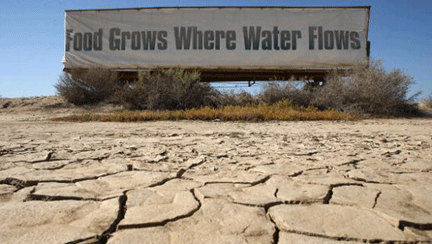
Global heating dries up vast areas of the American West, could bring long-lasting megadroughts
|
The Parched West is Heading Into a Global Warming-Fueled Megadrought That Could Last for Centuries,
Warmer temperatures and shifting storm tracks are drying up vast stretches of land in North and South America.BY BOB BERWYN, INSIDECLIMATE NEWS, APR 16, 2020 The American West is well on its way into one of the worst megadroughts on record, a new study warns, a dry period that could last for centuries and spread from Oregon and Montana, through the Four Corners and into West Texas and northern Mexico.Several other megadroughts, generally defined as dry periods that last 20 years or more, have been documented in the West going back to about 800 A.D. In the study, the researchers, using an extensive tree-ring history, compared recent climate data with conditions during the historic megadroughts. They found that in this century, global warming is tipping the climate scale toward an unwelcome rerun, with dry conditions persisting far longer than at any other time since Europeans colonized and developed the region. The study was published online Thursday and appears in the April 17 issue of the journal Science. Human-caused global warming is responsible for about half the severity of the emerging megadrought in western North America, said Jason Smerdon, a Columbia University climate researcher and a co-author of the new research. “What we’ve identified as the culprit is the increased drying from the warming. The reality is that the drying from global warming is going to continue,” he said. “We’re on a trajectory in keeping with the worst megadroughts of the past millennia.” The ancient droughts in the West were caused by natural climate cycles that shifted the path of snow and rainstorms. But human-caused global warming is responsible for about 47 percent of the severity of the 21st century drought by sucking moisture out of the soil and plants, the study found. The regional drought caused by global warming is plain to see throughout the West in the United States. River flows are dwindling, reservoirs holding years worth of water supplies for cities and farms have emptied faster than a bathtub through an open drain, bugs and fires have destroyed millions of acres of forests, and dangerous dust storms are on the rise. A similar scenario is unfolding in South America, especially in central Chile, a region with a climate similar to that in western North America. Parts of the Andes Mountains and foothills down to the coast have been parched by an unprecedented 10-year dry spell that has cut some river flows by up to 80 percent. In both areas, research shows, global warming could make the droughts worse than any in at least several thousand years, drying up the ground and shifting regional weather patterns toward drier conditions. This is bad news for modern civilizations that have developed in the last 500 years, during which they enjoyed an unusually stable and wet climate. And assumptions about water availability based on that era are not realistic, said climate scientist Edward Cook, another co-author on the study who is also with the Lamont-Doherty Earth Observatory. The impacts of a long-lasting drought in the West could also affect adjacent regions. A 2019 study showed that dry conditions in upwind areas may be intensifying agricultural droughts. With west winds prevailing across North America, hot and dry conditions in the Southwest could reduce the amount of atmospheric moisture available to produce rainfall farther east, in Oklahoma and Texas, for example. The study found that such drought linkages accounted for 62 percent of the precipitation deficit during the 2012 Midwest drought. In Chile, A Shared, Drought-Prone ClimateIn Chile, the current drought, with rainfall deficits of 20 to 40 percent, started in 2010, said René Garreaud, a climate researcher at the Universidad de Chile. Common threads run through the research on the two hemispheres because the climate system is globally linked. Large-scale changes in the tropical Pacific affect both regions, Garreaud said……. The only real long-term solution is to halt greenhouse gas pollution, he said. “It’s like with the coronavirus pandemic, we have to flatten the curve of global warming. We do that by removing the emissions.” https://insideclimatenews.org/news/15042020/megadrought-american-west-south-america-drought-climate-change |
|
Climate change will bring regular major floods to USA – no longer “once in a lifetime” floods
 US to have major floods on daily basis unless sea-level rise is curbed – study
- New Orleans, Honolulu and Miami expected to be vulnerable
- Research: advancing tides will ‘radically redefine the coastline’ Guardian, Oliver Milman
@olliemilman, Fri 17 Apr 2020 Flooding events that now occur in America once in a lifetime could become a daily occurrence along the vast majority of the US coastline if sea level rise is not curbed, according to a new study that warns the advancing tides will “radically redefine the coastline of the 21st century”.The research finds major cities such as Honolulu, New Orleans and Miami will become increasingly vulnerable to elevated high tides and stronger storms fueled by the global heating caused by human activity. Beach and cliff erosion will exacerbate this situation.
The accelerating pace of sea level rise means that by the end of the century floods currently considered once in a lifetime, or once every 50 years or so, will become a daily high tide occurrence for more than 90% of the coastal locations assessed by researchers from the US government, the University of Illinois at Chicago and the University of Hawaii.
Within 30 years from now, these now-rare flooding events will become annual occurrences for more than 70% of the locations along the US coast according to the research published in Scientific Reports. This scenario threatens huge, multibillion-dollar damages and, potentially, the viability of some coastal communities.
“If future sea-level rise causes once extreme but rare floods to occur frequently then … this may render some parts of the US coastline uninhabitable,” said Sean Vitousek, a scientist at the US Geological Survey.
The disruption caused by frequent flooding will threaten the habitability of much of the US coastline as it is already widely projected to do to many low-lying islands in the Pacific, Vitousek added……. https://www.theguardian.com/environment/2020/apr/16/us-climate-change-floods-sea-level-rise
Heavy winds fan new fires breaking out in Chernobyl exclusion zone
— New wildfires spread around Chernobyl nuclear plant, New Europe, By Elena Pavlovska, 17 Apr 20,
The state emergency service said three new fires had broken out, but were “not large-scale and not threatening”…..
The [previous] fire sparked concerns that clouds of radioactive smoke could be released and blow south towards Kyiv, after an activist posted a video online showing a cloud of smoke rising within sight of the protective dome over Chernobyl’s Unit 4 nuclear reactor. https://www.neweurope.eu/article/new-wildfires-spread-around-chernobyl-nuclear-plant/
For UK’s new Labour leader, climate action and Green New Deal will be key goals
Business Green 14th April 2020, Newly appointed Labour leader Sir Keir Starmer completed his front bench
team late last week, handing key green positions to a raft of experienced
MPs. Starmer is widely expected to make climate action and Labour’s Green
New Deal a key plank in the Opposition’s offer to the public – a fact
underlined by the handing of specific green briefs to senior MPs. But it
remains to be seen if he retains the unprecedented levels of low carbon
infrastructure funding pledges and nationalisation programmes proposed
under Corbyn’s leadership.
https://www.businessgreen.com/news/4013864/labour-completes-green-shadow-ministerial-lin
Changes for a low carbon economy are possible: we must advocate for this

The major impact of coronavirus on the trajectory of climate change must not be a temporary reduction in emissions from cars, trucks and airplanes. It must be a collective recognition that rapid and significant voluntary changes in our behavior are possible. For individual climate action to be sustained, people must find honor and joy in it. And that action must also be supported by government leadership and coordination. We must advocate now, as vocally as we can, for immediate and significant investments in green infrastructure. To avert disaster, we must change how we live.
The Coronavirus and Climate Action https://blogs.scientificamerican.com/observations/the-coronavirus-and-climate-action/ Confronting global warming will take a completely different approach from confronting the pandemic, By Laura J. Martin on April 10, 2020
In recent weeks, many Americans have voluntarily and radically altered their behavior in order to protect others from the novel coronavirus. Those who are less vulnerable are making sacrifices in order to protect those who are more vulnerable: the elderly, the immunocompromised, and—in our country, with its broken social safety net—the uninsured and the poor.
Climate scientists have been quick to draw parallels between the need to “flatten the curve” of coronavirus spread and the need to flatten the carbon emissions curve. The Intergovernmental Panel on Climate Change states that we must reduce emissions by about 45 percent from 2010 levels by 2030 in order to lessen the severity of future emergency; to reduce, but not eliminate, the probability of catastrophic changes in sea level, ocean acidity, extreme weather, food security and biodiversity.
But confronting climate change will require a completely different generational politics than confronting coronavirus. Rather than young people changing their lifestyles to protect the elderly, the large and growing proportion of older citizens in industrialized countries will have to change their lifestyles in order to protect children and those not yet born. Those with power and resources today will have to change their lifestyles dramatically in order to protect the world’s poorest and most marginalized, those who will not be able to move away from climate hazards. This is the message that youth activists like Zero Hour, Isra Hirsi and Greta Thunberg implore us to heed. It is also the premise of DearTomorrow, a storytelling project where people write climate messages to loved ones living in the future.
Who is right? Continue reading
The planet needs a green recovery. But are governments up for this?
|
The Guardian view on the climate and coronavirus: global warnings, https://www.theguardian.com/commentisfree/2020/apr/12/the-guardian-view-on-the-climate-and-coronavirus-global-warnings 13 Apr 20, Editorial Steep falls in emissions have been the pandemic’s immediate effect. But what’s needed is a green recovery. So far, discussions of a coronavirus exit strategy have mainly focused on the steps that could bring an end to the lockdown. In the short term, both in the UK and elsewhere, there is nothing more desirable than letting people resume their lives, once it is safe to do so.
But the speed of the “return to normal” is not the only thing that matters. The manner in which the world’s leaders manage the colossal economic and political shocks caused by the virus is also of the utmost importance. And at the top of their list of priorities, alongside human welfare, must be the biosphere and its future. It’s too soon to say with any confidence what impact coronavirus will have on the climate emergency. The brakes placed on economic activities of many kinds, worldwide, have led to carbon emission cuts that would previously have been unthinkable: 18% in China between February and March; between 40% and 60% over recent weeks in Europe. Habits and behaviours once regarded as sacrosanct have been turned on their heads: road traffic in the UK has fallen by 70%. Global air traffic has halved. Meanwhile, a much-needed spotlight has been thrown on humans’ troubling relationship to wildlife, with some experts arguing that the degradation of the natural world and exploitation of other species is among the pandemic’s causes. In human terms, the economic contraction precipitated by the virus – and predicted by the World Bank to lead to a severe depression – is sure to be brutal. No one, and least of all an elected government, would have chosen to limit emissions in this way. But if further savage waves of destruction to people’s livelihoods are to be avoided, rather than simply stored up or ignored until they become unignorable, just as coronavirus was, every possible effort must now be made to ensure that the recovery, when it comes, is as green as possible; that any and every stimulus package is directed towards renewable energy and zero- or low-carbon infrastructure and transport. The urgency and desperation surrounding all such efforts are likely to militate against progressive measures. Already, governments are coming under huge pressure to bail out oil and gas companies (in the US and Canada this has already begun). But while in the short term the low oil price, which is also the result of a price war being waged by Saudi Arabia and Russia, could have the damaging effect of making oil more competitive against renewables, plunging demand and turmoil in the industry provide an opportunity that must be seized by all who oppose the continued dominance of fossil fuels. There are other questions besides the future of oil that the crisis has opened up in unexpected ways. Huge political shifts are under way, with fiscally conservative governments such as Boris Johnson’s intervening in economies to an unprecedented extent. What was once impossible (socialist, reckless) now turns out not to be, at all. Could the renewed shock of human vulnerability in the face of Covid-19 make way for an increased willingness to face other perils, climate chaos among them? Impossible to say at this stage, perhaps. Certainly not without a fight against all those who will promote a return to business (and emissions) as usual. But with the postponement of crucial UN biodiversity and climate conferences, it has never been more important to keep up the pressure. There is no exit strategy from our planet. |
|
1 This Month

22 June – Virtual Event –Climate Change: New Data, New Debate

Monday, June 22, 2026 2:30 p.m. – 3:15 p.m. CT
YouTube. Register here

25 June- THE PUKE ON NUKES
Thursday, June 25, 2026
7pm Central Time (8pm ET, 6pm MT, 5pm PT) UTC – 5
From NRC & DOE Deregulation to Techno-Fascist Billionaires Going Nuclear, Plus a Few Songs from Atomic Cabaret REGISTER
26 June – Radiation Trainwreck at the NRC / Join the Protect Better Campaign – https://us02web.zoom.us/meeting/register/4ZlZ5_qLSHGiLSCg8FF6Bg#/registration
1st July – Webinar Waste of Space: The Environmental Harm of Military and Civil Space Activity st July, 7 pm

Report Launch Online: We are seeing an increasing exploitation of space for military and commercial purposes. This must change.

Protect Sazan Island from the Trump family! https://secure.avaaz.org/campaign/en/protect_sazan_island_from_the_trump_family_loc/?bqFCVab&v=174511&cl=22707147157&_checksum=5e9dde668860e8231c33699735e16a1fbf22ab2cb01da50c999fe8732b9775ef&utm_source=email&utm_medium=blast_email&utm_campaign=174511


Cuba Is Not a Failed State – It Is a Besieged State
PETITION: “Global Appeal to Endorse Palestinian Right of Return of Refugees”
To see nuclear-related stories in greater depth and intensity – go to https://nuclearinformation.wordpress.com
-
Archives
- June 2026 (227)
- May 2026 (306)
- April 2026 (356)
- March 2026 (251)
- February 2026 (268)
- January 2026 (308)
- December 2025 (358)
- November 2025 (359)
- October 2025 (376)
- September 2025 (257)
- August 2025 (319)
- July 2025 (230)
-
Categories
- 1
- 1 NUCLEAR ISSUES
- business and costs
- climate change
- culture and arts
- ENERGY
- environment
- health
- history
- indigenous issues
- Legal
- marketing of nuclear
- media
- opposition to nuclear
- PERSONAL STORIES
- politics
- politics international
- Religion and ethics
- safety
- secrets,lies and civil liberties
- spinbuster
- technology
- Uranium
- wastes
- weapons and war
- Women
- 2 WORLD
- ACTION
- AFRICA
- Atrocities
- AUSTRALIA
- Christina's notes
- Christina's themes
- culture and arts
- Events
- Fuk 2022
- Fuk 2023
- Fukushima 2017
- Fukushima 2018
- fukushima 2019
- Fukushima 2020
- Fukushima 2021
- general
- global warming
- Humour (God we need it)
- Nuclear
- RARE EARTHS
- Reference
- resources – print
- Resources -audiovicual
- Weekly Newsletter
- World
- World Nuclear
- YouTube
-
RSS
Entries RSS
Comments RSS
 nuclear-news