New research: global temperature increase will surpass 2.6 degrees Celsius: the role of clouds
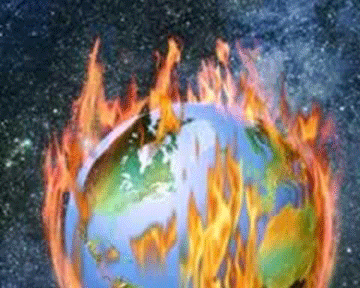 Groundbreaking study: Earth will warm 4.9 to 7 degrees F, E and E News, Chelsea Harvey, E&E News reporter Thursday, July 23, 2020 Research released yesterday suggests that a global temperature increase will surpass 2.6 degrees Celsius. Clouds can influence how much warming Earth experiences from greenhouse gases. NASA How much warming will greenhouse gas emissions cause in the coming years? It’s one of the most fundamental questions about climate change — and also one of the trickiest to answer.Now, a major study claims to have narrowed down the range of possible estimates. Groundbreaking study: Earth will warm 4.9 to 7 degrees F, E and E News, Chelsea Harvey, E&E News reporter Thursday, July 23, 2020 Research released yesterday suggests that a global temperature increase will surpass 2.6 degrees Celsius. Clouds can influence how much warming Earth experiences from greenhouse gases. NASA How much warming will greenhouse gas emissions cause in the coming years? It’s one of the most fundamental questions about climate change — and also one of the trickiest to answer.Now, a major study claims to have narrowed down the range of possible estimates.
It presents both good and bad news. The worst-case climate scenarios may be somewhat less likely than previous studies suggested. But the best-case climate scenarios — those assuming the least amount of warming — are almost certainly not going to happen. It’s “the most important climate science paper that’s come out in several years,” according to climate scientist Andrew Dessler of Texas A&M University, who was not involved with the study. The effort also illuminates some of the challenges of a decadeslong scientific quest to predict the strength of future climate change. At the heart of the new study is a concept known as “climate sensitivity” — how sensitive the Earth is to greenhouse gas emissions and how much it’s likely to warm in response. In studies, scientists often focus on the amount of warming that might be expected if carbon dioxide concentrations doubled their preindustrial levels. It’s a hypothetical scenario, but one that’s not impossible. Prior to the industrial era — around 150 years ago — global CO2 concentrations hovered around 280 parts per million in the atmosphere. Doubling that amount would put the total at 560 ppm. Today, CO2 levels have climbed above 400 ppm. The metric has existed for decades now. In 1979, a groundbreaking report led by Massachusetts Institute of Technology scientist Jule Charney — dubbed the “Charney Report” — suggested the planet’s climate sensitivity probably fell within a range of 1.5 to 4.5 degrees Celsius for a doubling of CO2. In the years since, that range hasn’t changed much. Most studies have found that the amount of warming to be expected after a doubling of CO2 probably falls within those boundaries……… The new report devotes a large chunk of its analysis exclusively to clouds. It examines the growing body of science on how different types of clouds respond to climate change, and how changes in these clouds may affect future climate change. The mounting evidence suggests that clouds are unlikely to mitigate climate change on a global scale, the report concludes. On the contrary, they’re more likely to make it worse. With a new, more confident sensitivity estimate in hand, the report begs the question: What does this mean for future climate policy? On the one hand, the study strikes a blow to a favorite argument used by climate deniers: The uncertainty about climate sensitivity suggests future warming might not actually be that severe. The new report strongly suggests that the best-case sensitivity scenarios — those at the lower end of the old ranges — are probably not in the cards. Still, the revised range doesn’t change much when it comes to the international climate goals outlined by the Paris Agreement. Nations worldwide are striving to keep global temperatures within 2 C of their preindustrial levels. To reach that target, world leaders would have to ensure global CO2 concentrations never double at all. “It’s not clear to me how much we would gain from further decreases in the uncertainty” of this metric, Dessler said. “What this has done, in my opinion, is it’s really moved the game away from these questions about the physics of the climate system into questions about how are humans going to react to climate change.” https://www.eenews.net/stories/1063611707 |
|
How Facebook fosters climate denial
 ‘Everybody’s entitled to their opinion – but not their own facts’: The spread of climate denial on Facebook‘The arguments are that people can’t trust scientists, models, climate data. It’s all about building doubt and undermining public trust in climate science’, Independent Louise Boyle, New York @LouiseB_NY, 24 July 20,
An article linking climate change to Earth’s solar orbit went viral last year, racking up 4.2million views on social media and widely shared on Facebook. It was the most-engaged with climate story in 2019, according to Brandwatch.
There was just one problem. It wasn’t true.
Facebook removed the article from Natural News, a far-right conspiracy outlet with 3 million followers, after it was reported.
But the spread of misinformation on the climate crisis by groups who reject climate science continues on Facebook and other social media platforms.
While tech giants have taken steps to remove, or label as false, potentially harmful misinformation on the Covid-19 pandemic, there has been a seeming acceptance of those who spread false theories on the climate crisis.
In August, an op-ed by two members of the CO2 Coalition, a pro-fossil fuel nonprofit with close ties to the Trump administration, was published in the Washington Examiner and subsequently posted to the group’s Facebook page.
The article, which claimed climate models are inaccurate and climate change has been greatly exaggerated, was initially tagged as “false” by five scientists from independent fact-checkers Climate Feedback who said it used “cherry-picked” evidence and deemed its scientific credibility “very low”.
Facebook doesn’t check content but outsources to dozens of third-party groups. A fact-checker’s false designation pushes a story lower in News Feed and significantly reduces the number of people who see it, according to Facebook policies.
The CO2 Coalition did not take the fact-checkers’ decision lying down, branding Climate Feedback “alarmists” and writing an open letter to Facebook CEO Mark Zuckerberg. They succeeded in having the false label removed.
Andy Stone, Facebook’s policy communications director, told the New York Times last week that all opinion content on the platform, including op-eds, has been exempt from fact-checking since 2016…………
South Asia floods displace millions and kill 550
|
Humanitarian crisis warning as South Asia floods displace millions and kill 550, The Canary 23 Jul 20, More than 9.6 million people across South Asia have been affected by severe floods, with hundreds of thousands struggling to get food and medicine, officials and aid organisations said.About 550 people have died in India, Bangladesh and Nepal, while millions have been displaced from their homes since the flooding began last month, said the International Federation of Red Cross and Red Crescent Societies (IFRC). The organisation warned of a humanitarian crisis, saying that close to one third of Bangladesh has already been flooded, with more flooding expected in the coming weeks. It said 2.8 million people have been affected, and that more than one million are isolated In India, more than 6.8 million people have been affected by the flooding, mainly in the northern states of Assam, West Bengal, Bihar and Meghalaya bordering Bangladesh, the IFRC said, citing official figures. In India’s north-eastern state of Assam alone, some 2.5 million people were affected and at least 113 have died, authorities said. MS Manivannan, head of Assam’s Disaster Management Authority, said many rivers were still flowing above the danger level……. Jagan Chapagain, secretary general of the IFRC, said South Asia could face a humanitarian crisis. “People in Bangladesh, India and Nepal are sandwiched in a triple disaster of flooding, the coronavirus and an associated socioeconomic crisis of loss of livelihoods and jobs,” he said. “Flooding of farmlands and destruction of crops can push millions of people, already badly impacted by Covid-19, further into poverty.” https://www.thecanary.co/discovery/news-discovery/2020/07/22/humanitarian-crisis-warning-as-south-asia-floods-displace-millions-and-kill-550/?fbclid=IwAR3qePVk0IamgIn4kqDOarIgD-NX7iNROR87_3Ui0OO_vdSNG9_iuNKUx6M |
|
Crucial need to fix air-conditioning: it causes billions of tons of greenhouse gases
 We Essentially Cook Ourselves’ if We Don’t Fix Air Conditioning, Major UN Report Warns, Gizmodo, Dharna Noor, July 18, 2020 A new United Nations report shows why it’s crucial to clean up air conditioning. In fact, the authors found that switching over to energy-efficient and climate-friendly air conditioning units could save the world up to 460 billion tons of greenhouse gas emissions over the course of the next 40 years. For context, that’s roughly eight times the amount of greenhouse gases the entire world emitted in 2018.
“If we deal with cooling wrong, we essentially cook ourselves,” Gabrielle Dreyfus, the cool efficiency program manager at the Institute for Governance and Sustainable Development, said on a press call.
Cooling technology plays many important roles in our global society. The report estimates that worldwide, 3.6 billion cooling appliances, including refrigerators, freezers, and air conditioning units, are in use. As the climate crisis warms the planet, access to air conditioning will become all the more important. In the U.S., more people die from heat each year than any other form of extreme weather. The report shows that if cooling units were provided to everybody who needs them — not just those who can afford them — the world would need up to 14 billion units by 2050. But the way they’re made right now, air conditioners are emitting tons of greenhouse gases that heat up the planet.
In the 1980s, scientists around the world realised that chlorofluorocarbons (CFCs) — the chemicals used as refrigerants for air conditioners, aerosol sprays, refrigerators, freezers — were depleting the Earth’s ozone layer, which blocks the sun’s damaging ultraviolet rays. To remedy that, in 1987, governments got together to pass an international treaty called the Montreal Protocol, under which they pledged to stop using the harmful refrigerants.
For the most part, air conditioner producers aren’t using CFCs anymore. The problem is, they’ve replaced them with industrial chemicals called hydrofluorocarbons (HFCs) that warm the planet up to 11,700 times more than carbon dioxide. That means air conditioning could make climate change much, much worse, forcing more people to turn to air conditioning, and creating an unfortunate feedback loop unless world leaders help break the cycle.
Last year, governments adopted the Kigali Amendment to the Montreal Protocol, under which they agreed to phase out the use of HFCs. Doing so could avoid as much as 0.4 degrees Celsius of global warming if it were adopted universally. As of this week, that amendment has been ratified by 100 countries. But 95 countries around the world still haven’t signed onto the amendment, including major greenhouse gas emitters like the U.S., India and China.
We have the technology to make air conditioners work way more efficiently by switching to more sustainable chemical refrigerants that not only reduce HFCs but carbon dioxide and black carbon emissions and require less energy. The report estimates that doubling the efficiency of air conditioners by 2050 could save us the use of 1,300 gigawatts of electricity around the world. That’s the equivalent of all the coal-fired power generation capacity in 2018 in China and India combined……… https://www.gizmodo.com.au/2020/07/we-essentially-cook-ourselves-if-we-dont-fix-air-conditioning-major-un-report-warns/
Environmentalists, political groups, companies demand that Facebook crack down on climate denialism
Everybody’s entitled to their opinion – but not their own facts’: The spread of climate denial on Facebook
‘The arguments are that people can’t trust scientists, models, climate data. It’s all about building doubt and undermining public trust in climate science’ Independent, Louise Boyle, New York @LouiseB_NY, 24 July, 20.
“………The pushbackOn 1 July, a coalition of environmental and political groups sent a letter to Facebook’s oversight board demanding a crackdown on climate denial and to close the “giant” opinion loophole that allows climate misinformation to be posted as an opinion. “Facebook is allowing the spread of climate misinformation to flourish, unchecked, across the globe. Instead of heeding the advice of independent scientists and approved fact-checkers from Climate Feedback, Facebook sided with fossil fuel lobbyists by allowing the CO2 Coalition to take advantage of a giant loophole for “opinion” content. The loophole has allowed climate denial to fester by labelling it “opinion,” and thus, avoiding the platform’s fact-checking processes,” they wrote. More than 500 companies including Coca-Cola, Dunkin’ Donuts, Verizon, and this week Disney, according to WSJ, have slashed or suspended ad spends on Facebook as part of the “Stop Hate for Profit” boycott, a move by civil rights groups to try to force the social media giant to address hate speech and misinformation. An independent audit of Facebook earlier this month reached harsh conclusions on the social media giant, reporting that it was allowing hate speech and disinformation to proliferate. Separately, Generation Progress, the youth-centered research and advocacy group, on Thursday launched a “Get The Facts Out Campaign” website aimed at debunking myths on the climate crisis and calling out climate deniers across Congress and the Trump administration, with a focus on the interwoven issues of climate and racial justice. “Black Americans have been fighting for clean air and water in their communities for years. Our legislators must understand the importance of addressing these inequities, not deny their existence,” the group said. And earlier this month, two senators introduced legislation to reform Section 230 of the 1996 Communications Decency Act, Reuters reported. The legislation, titled the Platform Accountability and Consumer Transparency Act, or PACT, from Democratic Senator Brian Schatz and Senate Republican John Thune, aims to provide more accountability and transparency for large tech platforms with respect to content moderation decisions……… Climate experts were sceptical of tech platforms’ ability, or desire, to enact meaningful change, and said that public action was key. For Dr Mann that means political overhaul. “Americans must vote in a Democratic president and Congress in the next US election. Unlike Trump and Congressional Republicans, who appear beholden to both Russia and fossil fuel interests, will be willing to crack down on Zuckerberg/Facebook’s nefarious activities,” he said. Dr Cook is working with machine-learning researchers on a system to detect and categorise climate misinformation in real-time. He acknowledged that social media platforms would have to be incentivised to use such a model, as it “would basically be taking money out of their pockets” in terms of ad revenue. Just as important, he says, is “building public resilience against misinformation” – teaching people how to spot misleading or rhetorical techniques and logical fallacies in climate denial arguments. “We found that when you explain techniques, that not only neutralises and inoculates people against that myth, but also against other topics like the tobacco industry and anti-vaxxer misinformation,” he said. Dr Cook and his team have created a smart-phone app for public use and for schools. He added: ”We need to look at technological solutions but ultimately we need to make ourselves un-hackable.” Additional reporting from Reuters https://www.independent.co.uk/environment/climate-crisis-denial-facebook-global-warming-denier-social-media-a9595546.html |
|
Bradwell B new nuclear project probably doomed, -on fragile shore subject to flooding
 Maldon Standard 19th July 2020, Andy Blowers: There has been much fevered speculation about the Bradwell B
new nuclear project falling in the wake of the current breakdown of relations with China.
That may be so, but what few commentators seem to have observed is that Bradwell is probably doomed because it is a wholly unsuitable and unsustainable site. Plans recently released indicate a giant industrial complex on a flat, low-lying peninsula ringed about with various designations, including protection for the Colchester Native Oyster.
Who in their right mind would consider erecting two mega reactors with all the attendant bells and whistles, including twin cooling towers and long-term highly radioactive spent fuel stores on a site that is likely to become
flooded and stranded as climate change impacts wreak havoc on the fragile Essex shores? Beijing to Bradwell – the terminus of the Belt and Road where Chinese infiltration in our sensitive nuclear infrastructure begins
and ends.
https://www.maldonandburnhamstandard.co.uk/news/18590061.letter-site-totally-unsuitable-bradwell-b/
With loss of biodiversity will come new pandemics
|
To prevent the next deadly disease, we must stop harming nature
The coronavirus pandemic proves it: By damaging the planet, we have sapped nature’s power to protect humanity from diseases. National Geographic, BY ENRIC SALA 22 Jul 20, SINCE MY CHILDHOOD by the Mediterranean Sea, I’ve been enchanted by the diversity of life on our planet and eager to learn all I could about it. I’ve spent much of my career studying the ocean food web, where in the course of natural events the smallest of the small are consumed by larger and larger predators, often ending in us. But scientists know there is more to the story, and I’ve been humbled to see life on our planet brought to a standstill by a tiny virus. From a Wuhan, China, “wet market” where freshly butchered meat and live wild animals are sold for food and medicine, the virus likely was transmitted in late 2019 via wildlife to humans. And in a matter of months, COVID-19 has felled hundreds of thousands of Homo sapiens, Earth’s preeminent predator. Writing about this for my new book, I was deeply saddened: The virus has struck people I knew, in Europe and around the world. But this pandemic is a powerful argument for something I believe unequivocally: that biodiversity is necessary for human health, and ultimately, human survival. People have been acquiring harmful viruses and bacteria from contact with animals in the wild for millennia. As humans relentlessly encroach upon wild habitats and compete with animals for water, food, and territory, there’s bound to be more physical contact, yielding more conflict—and more contagion. A 2020 study explored the link between the abundance of species that carry such zoonotic viruses and the likelihood of spillover to humans. Researchers combed the scientific literature, obtained data on 142 zoonotic viruses, and found that rodents, primates, and bats carried more of these viruses than other species. The researchers also found that the risk of virus transmission to humans was highest from animals that are more abundant, because they have adapted to human-dominated environments. What about risks from the creatures in the ocean, which is more than 70 percent of the planet? Does our exploitation of ocean life also threaten human health? I discovered the answer during our exploration of some of the most remote islands in the central Pacific…………
We are all in this together, all species on the planet. So what can we do? While the world has stepped up to help those in need during the COVID-19 outbreaks, we might also start thinking about how to prevent the next zoonotic pandemic.
We have seen, again and again, that even though we don’t know what most of them do, all wild animals have important jobs that keep our biosphere running. If we’ve learned anything from our study of natural ecosystems as it applies to these recent diseases, it’s that instead of exterminating wild animals to stop the passage of disease to people, we should do the opposite: We should safeguard the natural ecosystems that are their homes and, if needed, help set them back on their path to maturity through rewilding.
If we degrade habitats, animals become stressed and shed more viruses. On the other hand, habitats with diverse microbial, plant, and animal species harbor less disease. Biodiversity dilutes any viruses that emerge and provides a natural shield that absorbs the fallout from pathogens. Clamping down on the illegal trade of wildlife, ending deforestation, protecting intact ecosystems, educating people about the risks of consuming wildlife, changing the way we produce food, phasing out fossil fuels, and transitioning to a circular economy: These are the things we can and must do. https://www.nationalgeographic.com/magazine/2020/09/pristine-seas-enric-sala-we-must-stop-harming-nature-to-prevent-deadly-disease-coronavirus/
|
|
Global heating will mean that many areas become too hot for human activities
In one manifestation of a warming planet billions of people could soon be exposed to such high levels of heat that spending longer periods outdoors during sweltering summer months could prove fatal.
Parts of the planet, such as the Sahara desert, are already largely unsuitable for people other than the hardiest souls. Yet other regions with currently temperate climates could also become too hot for much of the year. Once levels of heat stress rise to a certain threshold in these areas millions of people could suffer serious health effects, experts warn.
Across much of the planet, in other words, a warmer climate “will pose greater risk to human health,” says Tom Matthews, a climate scientist at Loughborough University in the United Kingdom. “[W]e can say we are universally creeping close to this magic threshold of 35°C,” he elucidates. “It looks like, in some cases for a brief period of the day, we have exceeded this value.”
Matthews has reached this conclusion after analyzing weather station data from around the world with his colleagues. What they have found is a marked increase in the recurrence of so-called wet bulb (WB) temperatures (which is a measurement of heat and humidity taken together) that exceed limits we can still safely handle.
Beyond a WB threshold of 35°C, our bodies can no longer cool themselves by sweating in humid weather. Just think of staying in a sauna for too long. As a result, we are likely to experience heat stroke and organ failure because the core temperature of out bodies remains too high. Yet since 1979 the frequency of dangerous heatwaves have doubled in countries such as India, Pakistan, parts of the United States and Mexico.
Even across much of Europe last summer thousands of people succumbed to extreme heat during long spells of unusual heat. Not only will such deadly heatwaves become more common but they will also continue to impact more and more people across an ever larger area, scientists say.
According to a new study, in just a couple of generations (in half a century) up to 3.5 billion people could find themselves living in areas that are too hot for humans throughout much of the year.
At present the planet seems to be on track for a warming of 3°C on average by the end of the century, which will make much of the planet uninhabitable for humans. Because land areas are warming faster than the oceans, temperatures in certain parts of the world could rise by as much as 7.5°C by 2070. The most-affected regions will include Sub-Saharan Africa, South America, Southeast Asia, Arabian Peninsula, the Indian subcontinent and Australia.
Prolonged droughts and other weather extremes could make things even worse for people living in these areas. “Absent climate mitigation or migration, a substantial part of humanity will be exposed to mean annual temperatures warmer than nearly anywhere today,” the scientists behind the study warn.
Greta Thunberg calls for immediate action on ‘existential crisis’ of climate emergency
INTERVIEW-Greta Thunberg demands ‘crisis’ response to climate change, https://in.reuters.com/article/climate-change-greta/interview-greta-thunberg-demands-crisis-response-to-climate-change-idINL5N2EN3E3
* Thunberg says people in power have practically ‘given up’
* Signed letter to European leaders with other activists
* ‘We need to treat this crisis as a crisis’ (Add quotes from Thunberg to Reuters television)
In an interview with Reuters television, the 17-year-old said governments would only be able to mount a meaningful response once they accepted they needed to transform the whole economic system.
“We need to see it as, above all, an existential crisis. And as long as it’s not being treated as a crisis, we can have as many of these climate change negotiations and talks, conferences as possible. It won’t change a thing,” Thunberg said, speaking via video from her home in Stockholm.
“Above all, we are demanding that we need to treat this crisis as a crisis, because if we don’t do that, then we won’t be able to do anything,” Thunberg said.
Thunberg joined several thousand people, including climate scientists, economists, actors and activists in signing an open letter climateemergencyeu.org urging European leaders to start treating climate change like an “emergency.”
The letter was made public on Thursday, a day before a European Council summit where countries in the 27-member EU will try to reach a deal on the bloc’s next budget and a recovery package to respond to the economic shock of the coronavirus pandemic.
Demands in the letter included an immediate halt to all investments in fossil fuel exploration and extraction, in parallel with a rapid ending of fossil fuel subsidies.
It also called for binding annual “carbon budgets” to limit how much greenhouse gas countries can emit to maximise the chances of capping the rise in average global temperatures at 1.5C, a goal enshrined in the 2015 Paris climate accord.
“We understand and know very well that the world is complicated and that what we are asking for may not be easy. The changes necessary to safeguard humanity may seem very unrealistic,” the letter said.
“But it is much more unrealistic to believe that our society would be able to survive the global heating we’re heading for, as well as other disastrous ecological consequences of today’s business as usual.”
The letter called for climate policies to be designed to protect workers and the most vulnerable and reduce economic, racial and gender inequalities, as well as moves to “safeguard and protect” democracy. (Reporting by Matthew Green; Editing by Andrew Heavens)
The ever-increasing threat of coronavirus, but the global heating threat is even worse
 Climate change is the greatest threat, The Canberra Times, 18 Jul 20 While the world was preoccupied with an ever increasing number of coronavirus cases this week, a hugely significant scientific report was allowed to pass under-reported and unremarked.
This was the study of the 2020 Siberian heatwave by World Weather Attribution, a group of scientists who have been monitoring extreme weather events for years.
The heatwave had contributed to raising the world’s average temperature to the second highest on record for the period from January to May this year.
WWA said Siberia had experienced “unusually high temperatures”, including a record-breaking 38 degrees celsius in the town of Verkhoyansk on June 20, causing wide-scale impacts including “wildfires, loss of permafrost, and invasion of pests”.
While all of this, and reports food supplies are being affected with fish swimming deeper in search of cooler water, is alarming, the real cause for concern is the finding the prolonged heatwave had been made “600 times more likely as a result of human-induced climate change”……….
while it is a given that the climate deniers will dismiss the report as “bunkum” and “fake news”, those who actually know what they are talking about have no such doubts.
Michael Wehner, a senior scientist at Lawrence Berkeley National Laboratory – who was not involved in the study – said the methodology was “state of the art” and that the findings were, if anything, “conservative”.
If, as many believe, temperatures in Arctic and Antarctic regions are “canaries in the coal mine”, this latest report is a warning that should not be ignored. Given it comes on top of linkages between Australia’s spring and summer bushfires and man-made global heating, it is yet another argument for this country to do much more to reduce to carbon dioxide emissions as a matter of urgency.
And let’s not forget, if 2019 was anything to go by, our next bushfire season is just around the corner.
While the federal government has done a commendable job in seeking the best possible expert advice on the coronavirus and then following it, it has yet to do the same with climate and energy policy. That has to change. Coronavirus is a crisis, climate change is an existential threat. https://www.canberratimes.com.au/story/6838483/climate-change-is-the-existential-crisis/?cs=14245
Global heating is turning cities into death traps
|
Cities Are Becoming Climate Death Traps https://newrepublic.com/article/158537/cities-becoming-climate-death-traps 17 July 20 A new era of heat waves is here. We aren’t ready. As the coronavirus pandemic continues throughout the United States, another deadly pandemic comes out to strike in the summer: extreme heat. Year after year, more people are dying because it’s simply too hot. As of right now, both this country and others lack even an accurate way of counting those deaths—let alone a comprehensive plan to reduce them. Thanks to climate change, it’s about to get much worse.
For the past week, the American South and Southwest have been experiencing record-breaking temperatures. The National Oceanic and Atmospheric Administration has predicted above-average heat for nearly the entire U.S. this summer. Unprecedented, early-summer heat waves roasted the Middle East in May and Siberia in June, setting the latter on fire. Arizona had its earliest-ever hundred-degree heat wave in April—and another 110 degree heat wave in May. Spain endured 105 degree heat this month. When the heat index, a “feels-like” combination of temperature and humidity, reaches 104 degrees Fahrenheit indoors or out, human body temperature risks rising above the typical roughly 99 degrees Fahrenheit. When body temperature rises above 104 degrees, the consequences can be fatal within 30 to 60 minutes. “Heat-related deaths are notoriously difficult to track because the role of heat isn’t always obvious. One 2017 study found that extreme heat can kill people in 27 different ways,” Juanita Constible, senior advocate, climate and health at the National Resources Defense Council, told me. “If someone dies of a heart attack during a heat wave, there’s a good chance that’s how their death will be recorded by officials, even if high temperatures were the trigger.” Many scientists argue that official heat-death counts underestimate substantially. According to the World Health Organization, 166,000 people died due to heat waves between 1998 and 2017, but the true figure may be far higher. In the U.S., the Centers for Disease Control and Prevention only count deaths where heat illness is explicitly noted, so the official CDC count of heat-triggered deaths sits at just around 600 per year. Epidemiologists estimate that the real figure may be closer to 12,000—20 times higher than the official count. Climate change is making heat waves longer, hotter, and more deadly. Scientists estimate that 80 percent of record-breaking heat waves would not have occurred without human-caused warming due to greenhouse gas emissions. And urban areas, in particular, face special risk of heat deaths because of the heat island effect, in which dark pavement, roofs, and concrete absorb additional heat, making temperatures much hotter than the reported weather in any given city. In the U.S., heat deaths have more than doubled in Arizona in the last 10 years. Last year, a dangerous heat wave hit while storms left residents in the D.C. and New York City metro areas without power. Power outages can be deadly in a heat wave because without air conditioning, many people can’t cool off. In two heat deaths in a 2018 Arizona heat wave, the deceased were found indoors with a broken air conditioning unit that they couldn’t afford to fix. “Some people won’t use their air conditioning because they’re afraid of the bills,” Patricia Solís, executive director of the Knowledge Exchange for Resilience at Arizona State University, told National Geographic. “They think they’re OK without it, but that’s how people die.” “There are huge policy gaps in the U.S. with respect to extreme heat protections,” Rachel Licker, a senior climate scientist at the Union of Concerned Scientists, told me. “We found that without real action on climate change, by midcentury more than 250 cities across the U.S. are projected to experience 30 or more days with a heat index above 100 degrees Fahrenheit. This includes many cities that historically haven’t experienced this level of extreme heat.” |
|
Forest fires raging over wide areas of the Brazilian Amazon
|
Dramatic footage fuels fears Amazon fires could be worse than last year
As dry season starts campaigners sound alarm over ‘shocking’ scale of fires, as Bolsonaro doubles down on denials, Guardian, Dom Phillips in Rio de Janeiro, Sat 18 Jul 2020 Dramatic new images have shown fires raging over wide areas of the Brazilian Amazon nearly a year after blazes across the region sparked an international crisis for the far-right government of President Jair Bolsonaro. The video images and photographs were filmed during a flight by Greenpeace over a wide area of forest in Mato Grosso state in the south of the Amazon on 9 July. Filmed just as the Amazon dry season was beginning, they raise fears that this year’s fires could be as devastating and perhaps worse than 2019’s. “It was shocking to see the size of this deforestation and fires, at a time when the government is dismantling environment protection,” said Rômulo Batista, senior Amazon campaigner for Greenpeace, who spent days flying over a wide area. “It is the beginning of the dry season and we saw fires and areas being prepared for deforestation.”………. official data shows the Brazilian government’s efforts so far this year have failed to bring results. Brazil saw more fires in the Amazon this June than in any year since 2007. Brazil’s space research agency INPE spotted 2,248, compared with 1,880 in June last year. Preliminary data showed deforestation from January to June, at 3,069 sq km, was 25% up on the same period last year. ……… https://www.theguardian.com/environment/2020/jul/17/dramatic-footage-fuels-fears-amazon-fires-could-be-worse-than-last-year |
|
|
Wildfire out of control in Greece?

 Homes under threat as wildfire burns southeast of Athens, https://www.sbs.com.au/news/homes-under-threat-as-wildfire-burns-southeast-of-athens Homes and camps were evacuated as a precaution around the coastal town of Laviro in Greece while firefighters worked to contain a wildfire.
Additional resources requested for Siberian forest fire; state of emergency

 Additional resources requested for Siberian forest fire, https://www.sbs.com.au/news/additional-resources-requested-for-siberian-forest-fire 17 Jul 20, A state of emergency has been declared in the Khanti-Mansi Autonomous District as 25 fires continue to burn across 12,000 hectares.
Massive wildfire in rural central California

 Massive wildfire in rural central California, https://www.sbs.com.au/news/massive-wildfire-in-rural-central-california 17 Jul 20 More than 900 firefighters aided by helicopters and air tankers battled a wildfire in a rural area of central California.
1 This Month



26 September – International Day for the Total Elimination of Nuclear Weapons


PLEASE OPPOSE HR 8255 AND S.3639 – bills would accelerate satellite deployment, with no environmental review or safeguards – https://ncstd5li.quorum.us/campaign/169331/
To see nuclear-related stories in greater depth and intensity – go to https://nuclearinformation.wordpress.com
-
Archives
- September 2026 (269)
- August 2026 (330)
- July 2026 (355)
- June 2026 (287)
- May 2026 (306)
- April 2026 (356)
- March 2026 (251)
- February 2026 (267)
- January 2026 (308)
- December 2025 (358)
- November 2025 (359)
- October 2025 (375)
-
Categories
- 1
- 1 NUCLEAR ISSUES
- business and costs
- climate change
- culture and arts
- ENERGY
- environment
- health
- history
- indigenous issues
- Legal
- marketing of nuclear
- media
- opposition to nuclear
- PERSONAL STORIES
- politics
- politics international
- Religion and ethics
- safety
- secrets,lies and civil liberties
- spinbuster
- technology
- Uranium
- wastes
- weapons and war
- Women
- 2 WORLD
- ACTION
- AFRICA
- Atrocities
- AUSTRALIA
- Christina's notes
- Christina's themes
- culture and arts
- Events
- Fuk 2022
- Fuk 2023
- Fukushima 2017
- Fukushima 2018
- fukushima 2019
- Fukushima 2020
- Fukushima 2021
- general
- global warming
- Humour (God we need it)
- Nuclear
- RARE EARTHS
- Reference
- resources – print
- Resources -audiovicual
- Weekly Newsletter
- World
- World Nuclear
- YouTube
-
RSS
Entries RSS
Comments RSS

