If we can tackle corona, why not climate?


If we can tackle corona, why not climate? April 12, 2020 by beyondnuclearinternational
What the pandemic can teach us about changing our ways, By Alex Kirby, Climate News Network
Societies worldwide are changing overnight to meet the coronavirus threat. The climate crisis should match the rapid pandemic response.
If you want to know how fast a modern society can change, go to most British town centres and see the pandemic response. They will be unrecognisable from what they were 10 days ago.
You’ll see far fewer pedestrians, now sheltering from coronavirus infection at home, far fewer vehicles, hardly an aircraft in the skies above. The familiar levels of urban noise have faded to a murmur. The usual air pollution is dropping fast, with reports of significant falls from not just the UK but China and northern Italy as well.
So we can change when we decide to, and a pandemic demands change that’s both radical and rapid. But pandemics are not unique in that respect: there’s something else on the world’s agenda that’s crying out for action to match what’s happening today .
Dieter Helm is professor of economic policy at New College, University of Oxford. He writes in the latest entry on his site: “The coronavirus crisis will come to an end even if coronavirus does not … What will not be forgotten by future historians is climate change and the destruction of the natural environment.” What can we learn from this crisis that will help us when it’s over?
The Rapid Transition Alliance (RTA) is a UK-based organisation which argues that humankind must undertake “widespread behaviour change to sustainable lifestyles … to live within planetary ecological boundaries and to limit global warming to below 1.5°C”.
It says pandemics show how good governments are at responding fast and effectively, and at changing economic priorities in the public interest. But one vital element is to ensure that people clearly understand the risks involved, as this can lead to much faster, co-ordinated responses to an emergency, explaining and justifying policy changes that otherwise might lack support.
People can change their daily habits very quickly. Where behaviour changes show that more sustainable behaviour is possible – such as avoiding unnecessary travel – many could be encouraged to adopt them as a new norm.
Reactions to COVID-19 in China have improved urban air quality, leading to emissions reductions in different industrial sectors ranging from 15% – 40%. If plummeting levels of air pollution gave people a lasting taste for cleaner air, the Alliance suggests, this might shift expectations and open up new possibilities for change.
We can very quickly change our expectations about how we travel, work and entertain ourselves in a pandemic, it believes, and how we learn to behave, so as to minimise transmission risks.
There have been previous successes in overcoming pandemics, although they happened in different eras, using different technologies and living with different customs and systems of belief, so we cannot always learn directly from them.
One recent success has been the international effort to subdue HIV/AIDS. First identified in the Democratic Republic of the Congo in 1976, the disease has killed more than 32 million people, yet since 1995 death rates from it have dropped by 80%.
Not profit alone….
There have been previous successes in overcoming pandemics, although they happened in different eras, using different technologies and living with different customs and systems of belief, so we cannot always learn directly from them.
One recent success has been the international effort to subdue HIV/AIDS. First identified in the Democratic Republic of the Congo in 1976, the disease has killed more than 32 million people, yet since 1995 death rates from it have dropped by 80%……..
The RTA argues that inadequate action on climate heating is like knowing the cure to COVID-19 and yet failing to manufacture and distribute it and treat people affected by it.
Action trails promises
Some of the latest climate research points to a growing gap between the commitments on the climate emergency which nations have made, and the action which scientists say is needed, and the RTA says three lessons on rapid transition stand out from global pandemic responses:
- A clear understanding of risk can lead to much faster, co-ordinated responses to an emergency
- The rapid, physical mobilisation of resources can happen alongside behaviour change. People can change their daily habits very quickly and adapt to new social norms
- Where adaptations and behaviour changes reveal possibilities for more sustainable behaviour – such as avoiding unnecessary travel – they should be encouraged to become the new norm, and part of the broader climate emergency response.
Professor Helm agrees that there are lessons to be learnt about the climate crisis from the world’s reaction to pandemics, but he doesn’t think they will all necessarily be welcome.
For a start, he says, “the virus has created an economic crisis, and people will be less willing to pay for saving future generations. There are more immediate pressing problems.”
Warning that history will remember climate change, biodiversity loss and our ravaging of the Earth, he concludes: “It remains to be seen whether this particular crisis leads to a broader and a more fundamental rethink. We have not paid enough to support the health service, preferring lower taxes.
“There is a broader lesson here too, and a really great legacy of this crisis would be that we learn it. Prevention and resilience are what we need, to mitigate not just viruses, but also the destruction of the wider natural environment.” − Climate News Network https://beyondnuclearinternational.org/2020/04/12/if-we-can-tackle-corona-why-not-climate/
Chernobyl wildfires now ‘close’ to exploded nuclear reactor
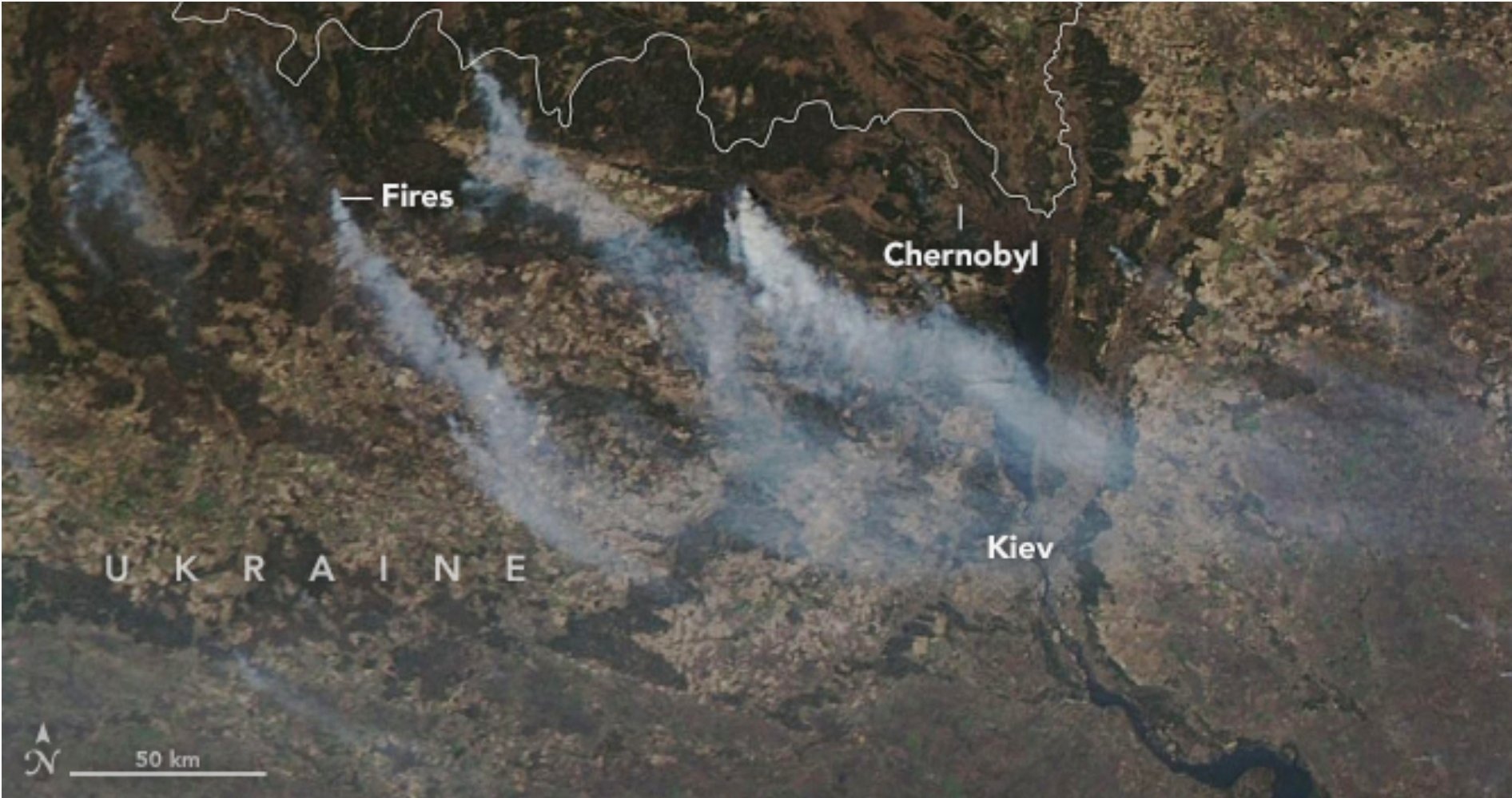
Raging forest infernos in Chernobyl Exclusion Zone burning for eight days are now ‘close’ to exploded nuclear reactor amid new fears of radiation contamination
- Wildfires burning through Chernobyl forests are nearing the nuclear reactor
- There are fears that flames could reach radioactive trucks and vehicles abandoned after the notorious 1986 power station explosion
- Kiev has deployed more than 300 people and 85 pieces of equipment By JACK WRIGHT FOR MAILONLINE, 13 April 2020
- Wildfires burning through radioactive forests in the Chernobyl Exclusion Zone are getting ever closer to the exploded nuclear reactor.Firefighters are rushing to build firebreaks around the sarcophagus covering the ruined plant in Ukraine amid swirling winds.
There are fears that flames could reach abandoned trucks and other vehicles contaminated from the disastrous 1986 explosion.
An extraordinary video from firefighter Andrei Kukib shows an emergency vehicle driving through the raging fire and smoke laying waste to the polluted ‘dead zone’.
Fires have been blazing for nine days in the almost uninhabited 1,000-square-mile exclusion zone surrounding the disused plant. On Tuesday, the fire covered some 87 acres, having tripled in size due to strong winds, the emergencies service said in a statement.
- There are fears of radiation in the ground unleashed by the infernos can reach nearest city Kyiv, the Ukrainian capital, and other populated areas.This could be worse if the flames reach the Chernobyl reactors.
Kateryna Pavlova, a senior official involved in the firefighting, said: ‘We have been working all night digging firebreaks around the plant to protect it from fire.’
She told The New York Times: ‘At the moment, we cannot say the fire is contained.’
More than 300 people and 85 pieces of equipment have been deployed daily in the fight to extinguish the flames which comes as Ukraine – one of Europe’s poorest countries – is also battling against coronavirus.
- The State Agency for Management of the Exclusion Zone – which Pavlova heads – has ordered in three Antonov planes (AN-32P) and two MI-8 helicopters which have air dropped more than 250 tonnes of water in the wildfires.Police said the blaze broke out after a man set fire to dry grass near the exclusion zone. The man was detained by Ukrainian police. Ukrainian authorities rejected the warnings of the acting head of the country’s state ecological inspection service, Yehor Firsov, who withdrew remarks made this week that ‘radioactivity is higher than normal at the heart of the blaze’.
Initially covered up by the USSR, the 1986 explosion sent radioactive fallout across Europe exposing millions to dangerous levels of radiation. People are not allowed to live within 18 miles of the power station, which is some 62 miles north of Ukraine’s capital city Kiev.
The three other reactors at Chernobyl continued to generate electricity until the power station finally closed in 2000.
A giant protective dome was put in place over the fourth reactor in 2016.
Fires occur regularly in the forests near the Chernobyl power plant.
- Wildfires burning through radioactive forests in the Chernobyl Exclusion Zone are getting ever closer to the exploded nuclear reactor.Firefighters are rushing to build firebreaks around the sarcophagus covering the ruined plant in Ukraine amid swirling winds.
The Coronavirus and Climate Change: How We’re Making the Same Mistakes


The Coronavirus and Climate Change: How We’re Making the Same Mistakes, medium.com Charles Kutscher 12 Apr 20, We Americans are now experiencing the tragic consequences of our slow, uncoordinated response to the coronavirus pandemic. While this experience will surely help us respond better to future health crises, it’s important we apply the hard lessons learned to even greater disasters. In particular, there are many parallels between the coronavirus pandemic and the climate change crisis. We need to recognize that we’re making the same mistakes with climate change and correct them before it’s too late. Below are some of these key blunders.
Failure to heed the warnings
Scientific experts warned us for months about COVID-19, just as they have warned us for decades about climate change. The rapid spread and deadly impact of the disease in other countries, especially in Italy, should have given us plenty of advance warning that we were headed down a similar path. In the case of climate change, we have witnessed countless warnings. As the result of a 1°C temperature rise to date, we have seen unprecedented wildfires in California and Australia, record heat waves and drought across the globe, more powerful storms, and more frequent major floods, to list but a few. In fact, while no direct connection has been made between COVID-19 and climate change, the changing climate is accelerating the incidence of other deadly diseases, such as the West Nile virus. Within the next 50 years, climate change could subject a billion more people to serious vector-borne diseases. It’s critical that we recognize the enormous impacts climate change is already having and heed the warnings of climate scientists who have painted a clear picture of what the future holds if we don’t act aggressively.
Failure to comprehend the delay between the problem and its consequences……..
Being misled by disinformation
With both the coronavirus and climate change, our sluggish response is largely the result of human denial. Both the Chinese and U.S. governments downplayed the threat of the virus. In the case of climate change, the oil and gas industry has a strong financial motive to discount the impact of fossil fuel emissions, and it has long funded an extensive campaign to make light of the effects of climate change. …….
Lack of federal leadership
In the absence of federal action, the governors of states such as Washington and California have had to play leadership roles in limiting the spread of the virus and expanding hospital capability to care for the victims. But relying on individual states has resulted in a competitive, patchwork approach that has proven to be a costly, inefficient means to address a national crisis……
Moreover, with both crises, the federal government has actually been moving in exactly the opposite direction from what is needed. In 2018 the current administration weakened the White House pandemic response capability, leaving us less prepared to face the coronavirus. In the case of climate change, the administration is simultaneously withdrawing from the Paris climate agreement and scaling back automobile fuel efficiency standards, as just two examples. Furthermore, the federal government continues to provide generous subsidies for fossil fuels — the very cause of climate change.
Looking ahead
It’s important we recognize that the blunders we’ve made in addressing the coronavirus are the same ones we’re making in addressing the much bigger climate change crisis. Climate change impacts have greatly worsened over time, but we have continued to ignore the warnings. The delay between our burning of fossil fuels and the environmental consequences has lulled us into a state of inaction, and this has been exacerbated by an ongoing disinformation campaign. We’ve been scaling back — and even reversing — federal action at the exact time we should be accelerating it.
Our experience with COVID-19 will almost certainly prepare us better for the next pandemic. But there is no second chance when it comes to climate change. It’s not as if we can let the ice sheets melt this time and protect them better when they return in the future. With climate change, we’ve got one shot at thinking ahead and addressing this crisis — one shot at understanding what scientists have long been telling us about how bad a 3°C or 4°C temperature rise will be. As with the coronavirus pandemic, climate change is an international crisis that calls for a comprehensive federal commitment to address it. Let’s stop making the same mistakes we’ve made with COVID-19. https://medium.com/@chuck.kutscher/the-coronavirus-and-climate-change-how-were-making-the-same-mistakes-2cd01cce2295
Climate change could cause sudden biodiversity losses worldwide
 Climate change could cause sudden biodiversity losses worldwide, Science Daily, April 8, 2020 Climate change could cause sudden biodiversity losses worldwide, Science Daily, April 8, 2020
|
|
|
As at 5 April, radiation levels in Chernobyl area were 16 times above normal, due to forest fires
 A FIRE AT CHERNOBYL IS RELEASING LARGE AMOUNTS OF RADIATION, https://futurism.com/the-byte/fire-chernobyl-releasing-radiation APRIL 6TH 20__JON CHRISTIAN__ Ukrainian authorities say a forest fire is causing radiation levels to spike in the area of Chernobyl, a nuclear power plant that melted down in 1986.“There is bad news — in the center of the fire, radiation is above normal,” wrote Egor Firsov, the head of Ukraine’s ecological inspection service, in a Facebook post. “As you can see in the video, the readings of the [Geiger counter] are 2.3, when the norm is 0.14. But this is only within the area of the fire outbreak.” A FIRE AT CHERNOBYL IS RELEASING LARGE AMOUNTS OF RADIATION, https://futurism.com/the-byte/fire-chernobyl-releasing-radiation APRIL 6TH 20__JON CHRISTIAN__ Ukrainian authorities say a forest fire is causing radiation levels to spike in the area of Chernobyl, a nuclear power plant that melted down in 1986.“There is bad news — in the center of the fire, radiation is above normal,” wrote Egor Firsov, the head of Ukraine’s ecological inspection service, in a Facebook post. “As you can see in the video, the readings of the [Geiger counter] are 2.3, when the norm is 0.14. But this is only within the area of the fire outbreak.”
Since Chernobyl’s deadly 1986 meltdown, the area around the plant has remained uninhabited — allowing nature to take over the abandoned town. But now the blaze is reigniting the specter of the decades-old disaster site. Residents of the Ukranian capital of Kiev are even concerned about breathing in the radiation, according to The Guardian, which is about 60 miles south of Chernobyl, though Firsov said there was not yet cause for alarm. Authorities say that a 27-year-old man has admitted that he set the fires “for fun,” according to The Guardian. It’s unclear whether the radiation levels will continue to spike or die down as firefighters continue their work in the area, but Firsov said that as of Sunday, radiation levels at the site were about sixteen times the norm. |
|
The Carbon Brief Profile: South Korea
COUNTRY PROFILES 6 April 2020 The Carbon Brief Profile: South Korea, 6 Apr 20,
As part of its series on how key emitters are responding to climate change, Carbon Brief looks at South Korea’s attempts to balance its high-emitting industries with its “green”aspirations.
the nation has drawn criticism for not always matching its green-growth rhetoric with action. Proposed phaseouts of coal and nuclear have been prompted primarily by concerns about air pollution and safety,as opposed to climate.
With an election approaching, many environmental groups joined together to call for more action from the major parties, which they claimed have prepared virtually “no countermeasures” against climate change.
In March, a group of Korean youth activists sued the government over its climate framework, which they deemed insufficient to meet the nation’s Paris Agreement targets.
According to a 2019 study by the Pew Research Centre, South Koreans place climate change highest in their list of potential national threats…….. Recent polling suggests 77% of voters would vote for political parties promising to respond to the threat of climate change in the general election……
This year, nations are expected – though not strictly required – under the Paris Agreement to come forward with updated plans that scale up the ambition of their original target. South Korea has yet to indicate whether it intends to meet this expectation. …….
Finally, South Korea is home to the Green Climate Fund (GCF), a UN body based in the “international business district” of Songdo, near the north-western city of Incheon. The fund is the main mechanism set up for mobilising $100bn every year “by 2020” from richer countries to finance climate mitigation and adaptation in the developing world…….
‘Green growth’ policies
In keeping with South Korea’s rapid industrialisation over the past few decades, the nation’s approach to climate and energy is best summarised by the principle of “green growth”.
Upon the inauguration of President Lee Myung-bak in 2008, he made it clear his overarching philosophy would be based on clean-energy technologies and environmentally friendly development in order to fuel long-term economic growth. In a speech at the time, he said:
“If we make up our minds before others and take action, we will be able to lead green growth and take the initiative in creating a new civilisation.”
This was reflected in the flagship Framework Act on Low Carbon, Green Growth (pdf), which was passed in 2009 and provided the legislative framework for emissions targets and renewable energy expansion, as well as the basis for a carbon trading system.
A five-year plan implemented the same year saw South Korea commit 2% of its GDP through to 2013 to invest in the green economy, which included investing in renewable energy, smart grids and green homes.
According to the World Bank, this focus on green investment is partly credited with the nation’s early recovery from the global financial crisis…….
there are concerns that this system still does not make it attractive enough for private entities to invest in renewables, with insufficient subsidies for solar and wind while coal is still being incentivised .
Another issue with the current Korean system concerns the electricity grid, with renewable energy facilities facing delays in being connected due to inadequate substations.
The government-owned KEPCO controls the grid and has a monopoly on electricity generation. The International Energy Agency (IEA) has identified restructuring of KEPCO as a key recommendation for energy reform.
There are also concerns in South Korea that expanding renewable capacity only benefits foreign companies that already dominate these markets. Earlier this year, the Ministry of Trade, Industry and Energy issued a press release reassuring people that reports of Chinese companies dominating the Korean solar market were “not true”.
Despite all these issues, the SFOC has identified the “biggest problem” facing renewable expansion as conflicts arising with local communities, when trying to construct new renewable facilities in their vicinity.
Conservatives politicians and news outlets, often with a pro-nuclear slant, have been blamed for “tarnishing” the reputation of renewables by stating that solar projects in particular are the cause of “environmental destruction”. According to SFOC:
“As a result, there is an increasing number of local governments autonomously establishing ordinances and rules restricting the sites for solar PV and wind power.”
Nuclear
Around a quarter of South Korea’s electricity comes from its 24 nuclear reactors, placing it “among the world’s most prominent nuclear energy countries”, according to the World Nuclear Association. Its nuclear power output is the fifth largest in the world…….
However, the nation has been shaken by two events that have, ultimately, left the future of South Korea’s
First came the Fukushima nuclear disaster in 2011. Most reactors in South Korea are located close nuclear energy looking highly uncertain.together, often near major population centres, and the accident in neighbouring Japan galvanised anti-nuclear movements across the country who feared a similar event closer to home.
The impact of the disaster on South Korea is reflected in the country’s NDC, which states:
“Given the decreased level of public acceptance following the Fukushima accident, there are now limits to the extent that Korea can make use of nuclear energy, one of the major mitigation measures available to it.”
Next, the industry was hit by a major scandal in which 100 people were indicted for corruption after fake safety certificates were issued at nuclear facilities.
This “mafia-style behaviour”, as one government official put it, led to several reactors being shut down so that cabling could be replaced after it emerged it had received certification through the corrupt operation.
The culmination of this was President Moon and his Democratic Party coming to power in 2017 with a pledge to phase out nuclear energy in South Korea.
While new reactors are still being constructed, Moon said they would not extend the operation of ageing reactors which will be decommissioned in the 2020s and 2030s. This is in line with “deliberative polling” conducted by the government to give a sense of the Korean population’s views on nuclear energy.
Analysis by SFOC found that South Korean public financial institutions have provided around $17bn (£13.7bn) of financial support for coal-power projects since 2008, around half of which was for schemes overseas.The group concludes that without this “easily available financing…such proliferation of coal-fired power plants would not have been possible”.
Another report by Carbon Tracker questions the economic viability of South Korean coal power, identifying the country as having “the highest stranded asset risk in the world” due to market structures which effectively guarantee high returns for coal.
It concludes that South Korea “risks losing the low-carbon technology race” by remaining committed to coal. A newer report from the thinktank says it is already cheaper to invest in new renewables than build new coal in South Korea and it will be cheaper to invest in new renewables than to operate existing coal in 2022. ………
https://www.carbonbrief.org/the-carbon-brief-profile-south-korea
Despite propaganda from nuclear/coal front group, NOW IS the time to talk about climate change
This is exactly the time to be talking about climate change, Joel Makower, Chairman & Executive Editor, Green Biz Group, Green Biz, March 31, 2020 – I rarely get exasperated from reading environmental business media, but a quote last week in a Bloomberg article about sustainability and the U.S. economic crisis got me headed in that direction.
 The quote came from Ted Nordhaus, co-founder of the Breakthrough Institute, a research group whose founders, self-described environmentalists, have made a career out of being gadflies — for example, arguing in favor of nuclear power and natural gas, arguing against putting a price on carbon emissions and claiming that there’s no real limit to the earth’s carrying capacity, or that energy efficiency doesn’t work because of something called the “rebound effect.”
I’ll leave it to you to proceed down the wormhole of websites critiquing the group’s analyses. Suffice to say that the Breakthrough Institute has become a darling of the anti-science, pro-pollution conservative right, which frequently cites its work in order to attack environmentalists and climate scientists and their fact-based policy recommendations.
Here’s last week’s quote, in reference to the notion of integrating climate measures into congressional appropriations as we rebuild the economy reeling from the coronavirus pandemic:
…… he says. “It would be tone-deaf to talk about climate change now.”
It’s a specious ploy often used by conservatives. Following a mass shooting, it’s not the right time to talk about gun control. Following a hurricane, it’s not the right time to talk about climate-exacerbated weather events. Following the police shooting of an unarmed black man, it’s not the right time to talk about race relations and inequality.
Of course, later on, when it’s presumably “the right time,” the public’s fickle attention likely has moved on to other front-burner topics.
Just because a problem isn’t in the news doesn’t mean it somehow has been solved. All of the above challenges remain, pandemic or not. And, to varying degrees, they all need to be kept alive, even amid other pressing priorities.
So, Nordhaus is dead wrong: This is exactly the right time to be talking about climate change.
In fact, we need to be talking unapologetically about climate, the clean economy, renewable energy, resilient food systems, sustainable mobility, the circular economy and the Sustainable Development Goals with more vigor than ever…….https://www.greenbiz.com/article/exactly-time-be-talking-about-climate-change
The pandemic is being used by Trump administration to help polluting industries
Trump Administration is using a pandemic to hand out gifts to its favorite polluters
The Trump Administration is using COVID-19 to further its dismantling of environmental protection. Environmental Health News, Peter Dykstra 5 Apr 20, “……… far away from the justifiably wall-to-wall coverage of COVID-19, the Trump Administration is unrepentantly using the pandemic to hand out gifts to its favorite polluters.COVID-19 news deeply saddens me. This other stuff infuriates me.
Last week, the American Petroleum Institute (API) sent a 10-page letter to the White House requesting a loosening of regulations, citing the COVID-19-related crash in oil and gas prices and the threat it posed to the fossil fuel industry. The White House, via Environmental Protection Agency Administrator Andrew Wheeler, granted their wish list and then some.
Past talk warning against the feds “picking winners and losers” in energy went by the boards.
Five days later, Wheeler issued an order that gave API even more than it asked for, calling for a suspension of any enforcement of EPA regulations if any company, fossil fuel-based or not, or local government can prove that COVID-19 was the cause of its failure to comply.
Former EPA Administrator Gina McCarthy, now the President and CEO of the Natural Resources Defense Council, called the move “an open license to pollute.”
The EPA required companies to disclose their greenhouse gas emissions. No more. Because coronavirus.
Wheeler also took the heat off entities forced by court-sanctioned consent decrees to fix pollution problems. Because coronavirus.
EPA cut frackers a break on wastewater discharges. Because coronavirus………. https://www.ehn.org/trump-epa-pollution-coronavirus-2645628019.html
Wildfires in Ukraine: authorities say that those near Chernobyl are now extinguished
Ukraine Says Fire Extinguished Near Contaminated Site Of Chernobyl Nuclear Disaster, Emergency authorities in Ukraine say there are no signs of any fire still burning in the uninhabited exclusion zone around the decommissioned Chernobyl nuclear plant after firefighters mobilized to put out a blaze.
Radio Free Europe, 5 Apr 20, The country’s State Emergency Service said early on April 5 that background radiation levels were “within normal limits.”
More than 130 firefighters, three aircraft, and 21 vehicles were deployed on April 4 to battle the fire, which was said to have burned around 20 hectares (50 acres) in the long-vacated area near where an explosion at a Soviet nuclear plant in 1986 sent a plume of radioactive fallout high into the air and across swaths of Europe.
Fire and safety crews were said to be inspecting the area overnight on April 4-5 to eliminate any threat from sites where there was still smoldering.
The blaze required seven airdrops of water, officials said.
There was no threat to settlements, the State Emergency Service said.
Firefighters battle forest blazes near Chernobyl nuclear site
|
Ukraine battles forest fires near Chernobyl https://abcnews.go.com/Health/wireStory/forest-fire-chernobyl-boosts-radiation-level-69983859
Ukrainian says firefighters are laboring to put out two forest blazes in the area around the Chernobyl nuclear power station that was evacuated because of radioactive contamination after the 1986 explosion at the plant By The Associated Press 6 April 2020 MINSK, Belarus — Ukrainian firefighters labored into Sunday night trying to put out two forest blazes in the area around the Chernobyl nuclear power station, which was evacuated because of radioactive contamination after the 1986 explosion at the plant.
Ukraine’s emergencies service said one of the fires, covering about five hectares (12 acres), had been localized. It said the other fire was about 20 hectares (50 acres). Earlier Sunday, the head of the state ecological inspection service, Yehor Firsov, said the fires had spread to about 100 hectares (250 acres). The discrepancy in sizes could not immediately be resolved. Firsov said radiation levels at the fire were substantially higher than normal. But the emergencies service said radiation levels in the capital of Kyiv, about 100 kilometers (60 miles) south, were within norms. The fires were within the 2,600-square-kilometer (1,000-square-mile) Chernobyl Exclusion Zone established after the 1986 disaster at the plant that sent a cloud of radioactive fallout over much of Europe. The zone is largely unpopulated, although about 200 people have remained despite orders to leave. |
|
Radiation spike as forest fire hits Chernobyl nuclear zone
Radiation spike as forest fire hits Chernobyl nuclear zone https://www.deccanherald.com/international/world-news-politics/radiation-spike-as-forest-fire-hits-chernobyl-nuclear-zone-821778.html AFP, Kiev, APR 05 2020, AFP, Kiev, APR 05 2020, 21:04 IST UPDATED: APR 05 2020, 21:31 IST AFP/file photo Ukrainian authorities on Sunday reported a spike in radiation levels in the restricted zone around Chernobyl, scene of the world’s worst nuclear accident, c aused by a forest fire.
To get a perspective – the climate crisis is a greater catastrophe than Coronavirus

While we fixate on coronavirus, Earth is hurtling towards a catastrophe worse than the dinosaur extinction, The Conversation, Andrew Glikson
Earth and paleo-climate scientist, 3 Apr 20, At several points in the history of our planet, increasing amounts of carbon dioxide in the atmosphere have caused extreme global warming, prompting the majority of species on Earth to die out.
In the past, these events were triggered by a huge volcanic eruption or asteroid impact. Now, Earth is heading for another mass extinction – and human activity is to blame.
I am an Earth and Paleo-climate scientist and have researched the relationships between asteroid impacts, volcanism, climate changes and mass extinctions of species.
My research suggests the current growth rate of carbon dioxide emissions is faster than those which triggered two previous mass extinctions, including the event that wiped out the dinosaurs.
The world’s gaze may be focused on COVID-19 right now. But the risks to nature from human-made global warming – and the imperative to act – remain clear………
My research suggests the current growth rate of carbon dioxide emissions is faster than those which triggered two previous mass extinctions, including the event that wiped out the dinosaurs.
The world’s gaze may be focused on COVID-19 right now. But the risks to nature from human-made global warming – and the imperative to act – remain clear……
The next mass extinction has begun
Current atmospheric concentrations of carbon dioxide are not yet at the levels seen 55 million and 65 million years ago. But the massive influx of carbon dioxide means the climate is changing faster than many plant and animal species can adapt.
A major United Nations report released last year warned around one million animal and plant species were threatened with extinction. Climate change was listed as one of five key drivers.
The report said the distributions of 47% of land-based flightless mammals, and almost 25% of threatened birds, may already have been negatively affected by climate change.
Many researchers fear the climate system is approaching a tipping point – a threshold beyond which rapid and irreversible changes will occur. This will create a cascade of devastating effects.
There are already signs tipping points have been reached. For example, rising Arctic temperatures have led to major ice melt, and weakened the Arctic jet stream – a powerful band of westerly winds.

This allows north-moving warm air to cross the polar boundary, and cold fronts emanating from the poles to intrude south into Siberia, Europe and Canada.
A shift in climate zones is also causing the tropics to expand and migrate toward the poles, at a rate of about 56 to 111 kilometres per decade. The tracks of tropical and extra-tropical cyclones are likewise shifting toward the poles. Australia is highly vulnerable to this shift…….
Earth’s next mass extinction is avoidable – if carbon dioxide emissions are dramatically curbed and we develop and deploy technologies to remove carbon dioxide from the atmosphere. But on the current trajectory, human activity threatens to make large parts of the Earth uninhabitable – a planetary tragedy of our own making. https://theconversation.com/while-we-fixate-on-coronavirus-earth-is-hurtling-towards-a-catastrophe-worse-than-the-dinosaur-extinction-130869
Cop26 climate talks in Glasgow postponed until 2021
Cop26 climate talks in Glasgow postponed until 2021, Crucial UN conference will be delayed until next year as a result of the coronavirus crisis, Guardian Jillian Ambrose Energy correspondent 2 Apr 2020 The UN climate talks due to be held in Glasgow later this year have been postponed as governments around the world struggle to halt the spread of coronavirus.
The most important climate negotiations since the Paris agreement in 2015 were scheduled to take place this November to put countries back on track to avoid climate breakdown. They will now be pushed back to 2021.
A statement from the UN on Wednesday night confirmed that the meeting of over 26,000 attendees would be delayed until next year. It said new dates for the conference would be decided in due course……. https://www.theguardian.com/environment/2020/apr/01/uk-likely-to-postpone-cop26-un-climate-talks-glasgow-coronavirus
Pandemic is distracting the world from an even bigger emergency – global heating
Beneath the virus lurks a bigger emergency, but the world is distracted from the climate threat, SMH, Bob Carr 2 Apr 20, What did our battered old planet do to bring this run of wretchedly bad luck? Just before the 2008 Wall Street disaster, Washington was about to force emitters to pay for the privilege of dumping carbon waste in the upper atmosphere. Congress approved a cap and trade scheme so its economy could trade its way to a low carbon future. In a similar spirit the Rudd government was legislating its own carbon trading model.
Last month the temperature on the Antarctic peninsular hit 65 degrees Fahrenheit, beating all previous records. For the globe, 2019 was the second hottest year on record, and the hottest without the contribution of a big El Nino.
The coming decade may be our last chance to contain the chaos driven by humankind’s craziest experiment: the idea that carbon can be stored in the thin filigree of air around the planet. The Paris Agreement provides a road map and the falling price of renewables a market impulse. ….
In the middle of the coronavirus crisis, The Sydney Morning Herald and The Age, to their credit, still find space to record the conclusion of leading reef scientist, Terry Hughes, that there is a third major bleaching of the Great Barrier Reef now under way. This follows the bleachings of 2016 and 2017. This is every bit a climate event as were the mega fires over Christmas.
Yet the irrevocable loss of healthy coral may not galvanise the way fires did…..
Meanwhile, the pandemic emergency may kill off the Glasgow conference on climate planned for November. The UN event is aimed at averting runaway climate change by keeping the temperature rise to 1.5 degrees. ……
if the breaking up of permafrost in the Arctic circle assumes an extra ferocity. That would release plumes of methane, 30 times more lethal at trapping heat than carbon, but on a scale to blow apart every calibration of how fast climate is shifting.
For Australia, Black Swan climate events could include a cyclone beyond what we have seen before, hitting the Queensland coast. Experts say there is still enough unburnt bush to give us a fire season as bad as the last, even next season – if we suffer the same malevolent mix of heat, low humidity and strong wind……
Beneath news of virus and slump there simmers an even bigger story. The planet keeps warming. And there’s no guarantee the rate may not pick up alarmingly. ……https://www.smh.com.au/environment/climate-change/beneath-the-virus-lurks-a-bigger-emergency-but-the-world-is-distracted-from-the-climate-threat-20200328-p54et4.html
1 This Month

22 June – Virtual Event –Climate Change: New Data, New Debate

Monday, June 22, 2026 2:30 p.m. – 3:15 p.m. CT
YouTube. Register here
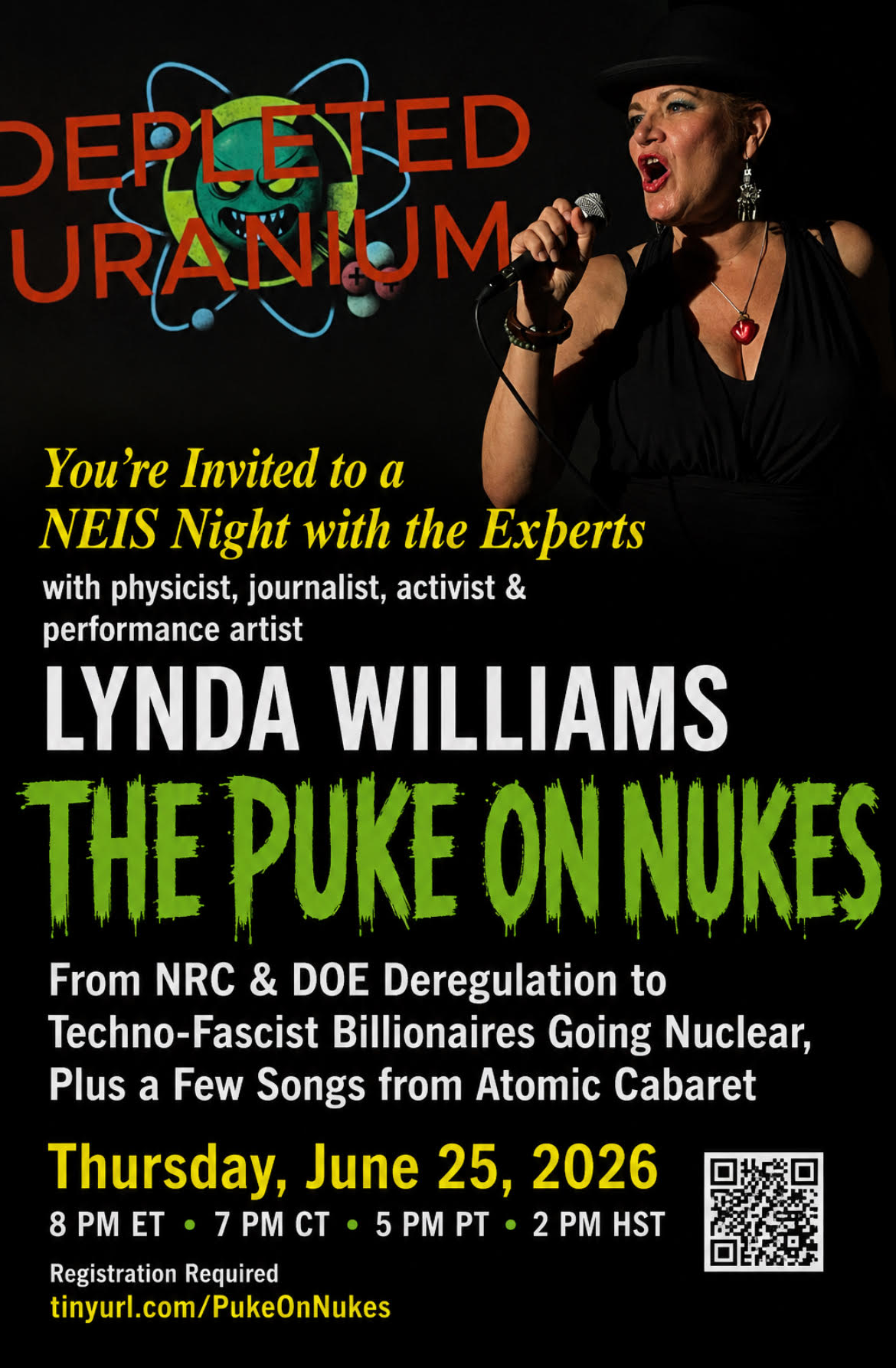
25 June- THE PUKE ON NUKES
Thursday, June 25, 2026
7pm Central Time (8pm ET, 6pm MT, 5pm PT) UTC – 5
From NRC & DOE Deregulation to Techno-Fascist Billionaires Going Nuclear, Plus a Few Songs from Atomic Cabaret REGISTER
26 June – Radiation Trainwreck at the NRC / Join the Protect Better Campaign – https://us02web.zoom.us/meeting/register/4ZlZ5_qLSHGiLSCg8FF6Bg#/registration
1st July – Webinar Waste of Space: The Environmental Harm of Military and Civil Space Activity st July, 7 pm

Report Launch Online: We are seeing an increasing exploitation of space for military and commercial purposes. This must change.

Protect Sazan Island from the Trump family! https://secure.avaaz.org/campaign/en/protect_sazan_island_from_the_trump_family_loc/?bqFCVab&v=174511&cl=22707147157&_checksum=5e9dde668860e8231c33699735e16a1fbf22ab2cb01da50c999fe8732b9775ef&utm_source=email&utm_medium=blast_email&utm_campaign=174511


Cuba Is Not a Failed State – It Is a Besieged State
PETITION: “Global Appeal to Endorse Palestinian Right of Return of Refugees”
To see nuclear-related stories in greater depth and intensity – go to https://nuclearinformation.wordpress.com
-
Archives
- June 2026 (227)
- May 2026 (306)
- April 2026 (356)
- March 2026 (251)
- February 2026 (268)
- January 2026 (308)
- December 2025 (358)
- November 2025 (359)
- October 2025 (376)
- September 2025 (257)
- August 2025 (319)
- July 2025 (230)
-
Categories
- 1
- 1 NUCLEAR ISSUES
- business and costs
- climate change
- culture and arts
- ENERGY
- environment
- health
- history
- indigenous issues
- Legal
- marketing of nuclear
- media
- opposition to nuclear
- PERSONAL STORIES
- politics
- politics international
- Religion and ethics
- safety
- secrets,lies and civil liberties
- spinbuster
- technology
- Uranium
- wastes
- weapons and war
- Women
- 2 WORLD
- ACTION
- AFRICA
- Atrocities
- AUSTRALIA
- Christina's notes
- Christina's themes
- culture and arts
- Events
- Fuk 2022
- Fuk 2023
- Fukushima 2017
- Fukushima 2018
- fukushima 2019
- Fukushima 2020
- Fukushima 2021
- general
- global warming
- Humour (God we need it)
- Nuclear
- RARE EARTHS
- Reference
- resources – print
- Resources -audiovicual
- Weekly Newsletter
- World
- World Nuclear
- YouTube
-
RSS
Entries RSS
Comments RSS
 nuclear-news