Even a “limited” nuclear war would bring nuclear winter: could the world survive this?

Project Force: Could the world survive a nuclear winter?
The consequences of a nuclear war would extend far beyond the blast itself, killing millions of people across the globe. Aljazeera, by Alex Gatopoulos, 2 Jul 2020 Firestorms triggered by burning cities create a huge plume of smoke, soot and ash. The plume rises above the clouds, into the upper atmosphere of the planet, where it will stay, encircling the globe, shielding the Earth from the Sun’s light, cooling the planet.
This is the scenario we could expect following a nuclear clash between nations.
The term nuclear winter was coined in the 1980s as scientists began to realise that the horrors of a nuclear war would not be confined to explosive blasts and radiation.
As climate prediction models become more powerful and sophisticated, scientists have been able to examine more closely what would happen in a nuclear conflict between two antagonists. In the past, most scenarios focused on potentially apocalyptic conflicts between Russia and the United States.
But new models now predict that even a very limited nuclear war would have drastic knock-on effects for global agriculture and dire consequences for life on Earth.
As climate prediction models become more powerful and sophisticated, scientists have been able to examine more closely what would happen in a nuclear conflict between two antagonists. In the past, most scenarios focused on potentially apocalyptic conflicts between Russia and the United States.
But new models now predict that even a very limited nuclear war would have drastic knock-on effects for global agriculture and dire consequences for life on Earth.
First, a blinding flash of light and radiation in the form of heat from the initial explosion would produce temperatures as high as that of the Sun. Wood, plastics, fabrics and flammable liquids would all ignite.
This would almost immediately be followed by the blast wave, moving at several times the speed of sound. A wall of compressed superhot air, the wave would gather up rubble and anything moveable, levelling all buildings within the blast zone and killing everyone in its path for several kilometres.
Within 20 to 30 minutes, a shroud of highly radioactive ash would begin to fall, blanketing both the blast site and the surrounding area, tens of kilometres downwind, and very quickly killing anyone caught outdoors who had somehow managed to survive the initial explosion.
For people outside the blast zone, the situation would also be grim. All electronic equipment would cease to function as the electromagnetic pulse fried every electronic circuit. No phones, internet, computers or cars would work.
Hospitals would be quickly overwhelmed, with the vast majority of the population needing some kind of medical care. Food would disappear as logistical supply trains stopped working. What little there was would be contaminated by the radioactive fallout, along with any water.
In the case of a nuclear conflict between India and Pakistan, for example, it is estimated that between 50 million and 125 million people would die.
What comes afterwards?
Those would be the initial, local effects of a nuclear conflict on a population. But the ensuing nuclear winter would take it to a whole new level.
The vast plumes of dark soot entering the upper atmosphere would spread not just regionally but right around the planet within months. The resulting darkening of the sky would severely affect harvests, even in areas nowhere near the conflict zone.
In one recent simulation, global harvests plummeted between 20 percent and 40 percent for at least a decade. Temperatures dropped dramatically as the climate shifted, triggering widespread drought, a worldwide famine and the death of tens of millions more people.
If these scenarios seem far-fetched, consider that the 1815 volcanic eruption of Tambora in Indonesia ruined harvests as far away as the US with 1816 known as the “Year Without Summer” as temperatures dropped sharply around the planet and the resultant failed harvests triggered severe famine across Europe.
The Tambora eruption lowered the global temperature by 0.7 degrees Celsius. The estimated temperature drop from a “limited” nuclear exchange is reckoned to be anywhere between 2 and 5 degrees Celsius.
The Pakistan vs India scenario
The latest studies show that there does not need to be a large-scale nuclear war to have this effect: A possible nuclear conflict between India and Pakistan is the scenario most of these studies have used as their prime example………
If these scenarios seem far-fetched, consider that the 1815 volcanic eruption of Tambora in Indonesia ruined harvests as far away as the US with 1816 known as the “Year Without Summer” as temperatures dropped sharply around the planet and the resultant failed harvests triggered severe famine across Europe.
The Tambora eruption lowered the global temperature by 0.7 degrees Celsius. The estimated temperature drop from a “limited” nuclear exchange is reckoned to be anywhere between 2 and 5 degrees Celsius.
…….. the greatest damage to the environment would be from the vast amount of superheated ash and soot that would rise from these destroyed cities, swept up by a nuclear firestorm into the upper atmosphere.
Darkness and starvation
The impact of even such a “limited” nuclear conflict would be devastating for the Earth as a whole. With global dimming, harvests would fail across the planet…….
In 2016, the United Nations’ Food and Agriculture Organisation estimated that 815 million people were food-insecure. They would all be put at far greater risk as food supplies rapidly dwindled in the aftermath of such a conflict.
Another major, cascading effect of even a partial nuclear winter would be the depletion of the ozone layer, allowing crops to be further damaged by unfiltered hard ultraviolet solar radiation.
Ozone would be destroyed by the heating of the upper atmosphere as the darker soot-laden layer of air absorbed more solar energy. The effect would last for more than five years, with 20 percent of the ozone lost across the planet and, in some places, as much as 70 percent, leading to significant destruction of plant, marine and animal life on Earth, and resulting in skin cancers, DNA mutation and eye damage in humans and animals alike.
This, coupled with the violent competition for shrinking resources, likely civil unrest due to mass starvation, rapidly shifting weather patterns and financial collapse, would disrupt all human life with no part of the planet left unscathed…….. https://www.aljazeera.com/indepth/features/project-force-world-survive-nuclear-winter-200622132211696.html
Germany the first major economy to phase out coal and nuclear
Germany is first major economy to phase out coal and nuclear, Economic Times, 3 July 20
The plan is part of Germany’s ‘energy transition’ – an effort to wean Europe’s biggest economy off planet-warming fossil fuels and generate all of the country’s considerable energy needs from renewable sources…….
Bills approved by both houses of parliament Friday envision shutting down the last coal-fired power plant by 2038 and spending some 40 billion euros ($45 billion) to help affected regions cope with the transition.
The plan is part of Germany’s ‘energy transition’ – an effort to wean Europe’s biggest economy off planet-warming fossil fuels and generate all of the country’s considerable energy needs from renewable sources…….
This week, utility companies in Spain shut down seven of the country’s 15 coal-fired power plants, saying they couldn’t be operated at profit without government subsidies.
But the head of Germany’s main miners’ union, Michael Vassiliadis, welcomed the decision, calling it a “historic milestone.” He urged the government to focus next on an expansion of renewable energy generation and the use of hydrogen as a clean alternativ ..
European Council stands firm on excluding nuclear power from energy transition money
 European Council resists calls for Just Transition Fund cash to be available for gas
  and nuclear generation https://www.pv-magazine.com/2020/07/01/european-council-resists-calls-for-just-transition-fund-cash-to-be-available-for-gas-and-nuclear-generation/
The heads of state of the 27 EU member states agreed to resist calls from a reported eight countries to expand the nature of projects eligible for energy transition support beyond renewables.
JULY 1, 2020 MAX HALL An EU spokesperson has confirmed the heads of the bloc’s 27 member states have announced an intent to block any of the European Commission’s proposed €40 billion energy transition money being spent on gas or nuclear power facilities.
The commission has proposed pulling together a Just Transition Fund (JTF) to be spent helping regions dependent on fossil fuels transition to clean energy as part of its much-vaunted Green Deal for Europe. The fund would comprise €30 billion from the bloc’s coronavirus recovery fund and €10 billion from the EU budget for 2021-27, both of which are yet to be ratified.
Reports late last week suggested the 27 heads of state who make up EU joint legislative body the European Council had agreed to resist calls from eight EU states to permit the proposed JTF to be spent on gas and nuclear facilities, as well as clean energy generation.
An EU spokesperson has told pv magazine the council wants to ensure the cash is spent only on renewables and confirmed the plans will now be negotiated with the other EU legislative body, the European Parliament, with the commission mediating.
“We would hope for an agreement as soon as possible, certainly this autumn,” said the spokesperson, indicating a hoped-for resolution by December 20.
Nuclear power is incompatible with a Green New Deal

Edmundson & Ramana: Nuclear power doesn’t fit with Green New Deal https://pamplinmedia.com/ttt/90-opinion/472125-380632-edmundson-and-ramana-nuclear-power-doesnt-fit-with-green-new-deal, Schyler Edmundson and M. V. Ramana, 1 July 20,
‘This is as it should be, for GND proposals also emphasize considerations having to do with ethics and equity.’
The COVID-19 pandemic and the resultant economic downturn have led, again, to calls for governments to institute some kind of a Green New Deal (GND) to both create jobs and deal with climate change. Most prominently, climate and environment ministers from 17 European countries have publicly called upon the European Commission to include some such deal as part of the EU recovery plan.
In the United States, too, there have been similar calls from academics, community organizers, and journalists; there are even hints that the presumptive Democratic nominee Joe Biden might embrace parts of this proposal.
There is no single version of a Green New Deal. Yet, all versions share many common features. They universally emphasize major investment in solar and wind energy to meet climate goals and because these sectors create many more jobs than older centralized energy forms. With the rapid declines in the costs of renewable energy and storage technologies, the economic logic for their expansion is impeccable.
Within discussions of the GND, what is fiercely debated is nuclear power. For proponents of nuclear power, the case for inclusion is obvious: it is a low-carbon source of electricity. Some go so far as arguing that it is impossible to meet any serious climate targets without nuclear energy. Conversely, most serious proponents of the GND would simply not countenance an increase in nuclear power.
This is as it should be, for GND proposals also emphasize considerations having to do with ethics and equity. These emphases are what make these Green New Deals rather than just climate change mitigation plans. They explain why the Green New Deal for Europe calls for supporting climate justice around the world and the New Democratic Party’s GND proposal in Canada stresses respect for indigenous rights.
Nuclear power is not compatible with this emphasis. The environmental impacts of the long chain of processes involved in generating electricity from nuclear reactors are unevenly spread out, and the heaviest burdens have been placed on historically marginalized communities, especially indigenous populations.
Consider, for example, uranium mining. Much of the uranium that has been mined around the world has come from areas occupied by indigenous peoples, including in Australia, in Canada, in India, and in the United States. Several examples of proposed uranium mining projects are in areas with large indigenous populations — for example, in Meghalaya in India. Indigenous communities have suffered incalculable health consequences as a result of these activities — for example, the Navajo Nation in the United States.
At the other end of the fuel chain is radioactive waste that is produced by all nuclear power plants. Many of the sites that have been proposed as potential hosting places for nuclear waste have high proportions of indigenous populations. This has been a major concern in Canada, and has been termed nuclear colonialism; earlier in January, the Saugeen Ojibway Nation voted overwhelmingly against one such proposal. The proposed Yucca Mountain repository is strongly resisted by the Western Shoshone people, on whose lands the site is located.
Underlying this resistance is the reality that there is no demonstrated solution to safely managing nuclear waste. The radioactive elements in nuclear waste will remain hazardous to human health for hundreds of thousands of years. This long period poses a challenge to distributive justice; any putative benefits of producing this nuclear waste will accrue to current generations while future generations will face the risks resulting from their production. This mismatch does not fit well with the ethical ideas underlying Green Nuclear Deal proposals.
Another tenet underlying all GND proposals is the need for rapid climate action, the importance of which was reinforced by the 2018 Intergovernmental Panel on Climate Change report outlining the impacts of global warming of 1.5 degrees Celsius above pre-industrial levels. International bodies have warned that we only have a decade to stop irreversible damage from climate change. Urgency is the reason GND proposals set ambitious targets for emission reductions.
Nuclear power is incompatible with this envisioned pace. It takes approximately 10 years to go from start of construction to connecting a new nuclear plant to the electricity grid. It might take another decade before starting construction to prepare the site, deal with the necessary safety and environmental licensing processes, and engage in complex negotiations needed to raise the billions of dollars the reactor costs. Nuclear energy capacity can simply not be scaled up rapidly.
The bottom line is that nuclear power is incompatible with any plan that strives to be a Green New Deal. Add to this the long list of other problems confronting nuclear power, including unfavorable economics, danger of catastrophic accidents, and connections with nuclear weapons proliferation, and the GND for Europe proposal that the world should be planning for the “obsolescence” of nuclear energy makes complete sense.
Schyler Edmundson is a policy professional from Vancouver, British Columbia, whose research explores the intersection between public policy and climate change, and has worked at Environment and Climate Change Canada and as a research assistant for the School of Public Policy and Global Affairs, University of British Columbia. M. V. Ramana is the Simons Chair in Disarmament, Global and Human Security and director of the Liu Institute for Global Issues at the School of Public Policy and Global Affairs, University of British Columbia.
A global push for racial justice in the climate movement
A global push for racial justice in the climate movement For years, mainstream environmental movements around the globe have excluded people of color, who are disproportionately impacted by climate change. Today’s global Black Lives Matter protests have amplified calls for institutions of all kinds — including environmental groups — to challenge and dismantle chronic systemic racism., The World, June 30, 2020 By Anna Kusmer
Environmental sociologist Dorceta Taylor remembers being the only Black person in her environmental science class at Northeastern Illinois University in the early 1980s. When she asked her white professor why there weren’t more Black students, he quickly told her that it was “because Blacks are not interested in the environment,” she said.
This assumption ran counter to everything she knew. She had grown up in Jamaica, where people from all backgrounds were passionate about the environment and loved nature.
Taylor, until recently a professor of environmental racism at the University of Michigan, found that underrepresentation exists at environmental organizations across the United States. In 2014, just under 16% of people of color were represented in a survey of hundreds of organizations, compared to about 35% of the population, she said. In the early 1990s, only about 2% of the staff of environmental nongovernmental organizations were people of color.
In the UK, the environmental sector is one of the least diverse sectors of the economy.
Yet, people of color are disproportionately impacted by environmental degradation and climate change, and environmental organizations are being called to focus more than ever before on environmental justice.
In the past few weeks, big international green groups including Greenpeace and 350.org have responded with statements, videos and op-eds supporting Black Lives Matter and calling for racial justice.
Related: Black Lives Matter UK says climate change is racist
But environmental activist Suzanne Dhaliwal is skeptical this will translate into real inclusion, particularly in the UK, where she lives and works. Dhaliwal, who identifies as British Indian Canadian Sikh, grew up partly in Canada and spent much of her 20s working alongside big environmental nonprofits in the UK. ………
So, Dhaliwal started her own environmental nonprofit, UK Tar Sands Network, which works alongside Indigenous communities and organizations to campaign against UK companies investing in oil extraction in Alberta, Canada.
“Now, what I call for is direct funding of Black and Brown and Indigenous organizations and leadership training,” said Dhaliwal. “We need research money so that we can research new strategies.”
Other environmentalists are trying to change environmental organizations from within.
Samia Dumbuya just started a job with the European branch of international nonprofit Friends of the Earth, working on climate justice and energy issues. She lives in the UK.
As a Black person whose parents are refugees from Sierre Leone, talking about racial justice issues within the environmental movement is personal for her. She says she sees how climate change is affecting her parents’ home country with increasingly bad flooding and landslides. ………
Across the globe, the urban spaces that are overpoliced and lack public investment also have the worst air quality and contaminated drinking water. The environmental movement will grow stronger with more diverse representation, but also by making these connections, Taylor said.
“Environmentalists all over the country are really taking note that they need to think of the environment now as not just the trees and the birds and the flowers, but the human relationships that are in them — and how these are really threatening some people way more than they’re threatening others.” https://www.pri.org/stories/2020-06-30/global-push-racial-justice-climate-movement
The Arctic’s climate disaster-Verkhoyansk goes from record cold to record heat
The Record, 28 June 20,The remote Siberian town of Verkhoyansk, three thousand miles east of Moscow and six miles north of the Arctic Circle, has long held the record, with another Siberian town, for the coldest inhabited place in the world. The record was set in 1892, when the temperature dropped to ninety below zero Fahrenheit, although these days winter temperatures are noticeably milder, hovering around fifty below. Last Saturday, Verkhoyansk claimed a new record: the hottest temperature ever recorded in the Arctic, with an observation of 100.4 degrees Fahrenheit—the same temperature was recorded that day in Las Vegas. Miami has only hit a hundred degrees once since 1896. “This has been an unusually hot spring in Siberia,” Randy Cerveny, the World Meteorological Organization’s rapporteur of weather and climate extremes, said. “The coinciding lack of underlying snow in the region, combined with over-all global temperature increases, undoubtedly helped play a critical role in causing this extreme.” Siberia, in other words, is in the midst of an astonishing and historic heat wave.
Anthropogenic climate change is causing the Arctic to heat up twice as fast as the rest of the planet. Climate models had predicted this phenomenon, known as Arctic amplification, but they did not predict how fast the warming would occur. Although Verkhoyansk has seen hot temperatures in the past, Saturday’s 100.4-degree record follows a wildly warm year across the region. Since December, temperatures in western Siberia have been eighteen degrees above normal. Since January, the mean temperature across Siberia has been at least 5.4 degrees Fahrenheit above the long-term average. As the meteorologist Jeff Berardelli reported for CBS, the heat that has fallen on Russia in 2020 “is so remarkable that it matches what’s projected to be normal by the year 2100, if current trends in heat-trapping carbon emissions continue.” By April, owing to the heat, wildfires across the region were larger and more numerous than they were at the same time last year, when the Russian government eventually had to send military aircrafts to battle vast blazes. The scale of the current wildfires—with towering plumes of smoke visible for thousands of miles on satellite images—suggest that this summer could be worse. Because of the coronavirus pandemic, they will also be more complicated to fight.
Toward the end of May, as the sun stopped dropping below the horizon, the heat continued. In the town of Khatanga, far north of the Arctic Circle, the temperature hit seventy-eight degrees Fahrenheit, or forty-six degrees above normal, topping the previous record by twenty-four degrees. The heat and fires are also hastening the dissolution of Siberian permafrost, perennially frozen ground that, when thawed, unleashes more greenhouse gases and dramatically destabilizes the land, with grave consequences. On May 29th, outside Norilsk, the northernmost city in the world, the thawing ground buckled, causing an oil-storage tank to collapse and spew more than a hundred and fifty thousand barrels, or twenty-one thousand tons, of diesel fuel into the Ambarnaya River. The spill was the largest to ever occur in the Russian Arctic.
Norilsk, which was constructed in the nineteen-thirties by prisoners of a nearby Gulag camp, Norillag, was already one of the most polluted places in the world. Most of its hundred and seventy-seven thousand residents work for Norilsk Nickel, the company that owns the collapsed oil tank. Its massive mining and metallurgy complex alone is worth two per cent of Russia’s G.D.P. The city contributes a fifth of the global nickel supply and nearly half of the world’s palladium, a metal used to make catalytic converters. Factories billow clouds of sulfur dioxide incessantly, and the resulting acid rain has turned the city and its surroundings into an industrial wasteland, with no green space or parks, just dirt and dead trees. Life expectancy in Norilsk is twenty years shorter than it is in the United States. The last time the town made the news, before the oil spill, was exactly a year ago, when an emaciated polar bear, a refugee from its melting home, was photographed rummaging through the city dump.
Norilsk Nickel’s executives have tried to skirt responsibility for the oil spill by blaming the thawing permafrost—or, as a press release stated, “a sudden sinking of the storage tank’s pillars, which served accident-free for more than thirty years.”
But the thaw did not happen unexpectedly, out of nowhere. Buildings in Norilsk have collapsed because of the sagging ground. Russian and international experts have been aware of the risks that rapidly thawing permafrost represents for more than a decade. A 2017 report from an Arctic Council working group said that “communities and infrastructure built on frozen soils are significantly affected by thawing permafrost, one of the most economically costly impacts of climate change in the Arctic.” They found that thawing permafrost could contaminate freshwater, when previously frozen industrial and municipal waste is released, and that the bearing capacity of building foundations has declined by forty to fifty per cent in some Siberian settlements since the nineteen-sixties. They also noted that “the vast Bovanenkovo gas field in western Siberia has seen a recent increase in landslides related to thawing permafrost.” The authors of a 2018 paper, published in Nature Communications, found that “45% of the hydrocarbon extraction fields in the Russian Arctic are in regions where thaw-related ground instability can cause severe damage to the built environment.” The paper continued, “Alarmingly, these figures are not reduced substantially even if the climate change targets of the Paris Agreement are reached.”
In early June, President Vladimir Putin declared a national emergency, and scolded local authorities for their slow response to the spill. The Kremlin allegedly found out about the spill two days after the fact, from pictures of a crimson river posted on social media. Although the Russian prosecutor general’s office agreed, in a preliminary finding, that the thawing permafrost was a contributing factor to the spill, investigators also said that the fuel-storage tank had needed repairs since 2018. They arrested four employees of the power plant on charges of violating environmental regulations. Norilsk Nickel denied the accusations but said that the company is coöperating with law-enforcement agencies and has launched “a full and thorough investigation.” “We fully accept our responsibility for the event,” the company said in a statement provided to the Guardian. Vladimir Potanin, the president of Norilsk Nickel and the richest man in Russia, said that the company will pay for the full cost of the disaster, which he estimated at ten billion rubles, or a hundred and forty-six million dollars. (A Russian environmental watchdog, Rosprirodnadzor, put the cost at around one and a half billion dollars.) Putin, meanwhile, publicly lambasted Potanin for the disaster, emphasizing that it was his company’s negligence that led to the spill. “If you replaced them in time,” Putin said, in a video call in early June, referring to the aging oil-storage tank, “there wouldn’t have been the damage to the environment and your company wouldn’t have to carry such costs.”
The company’s initial response efforts—floating booms to contain the spill—largely failed. By June 9th, the oil had entered the forty-three-mile-long Lake Pyasino, which borders a nature preserve and flows into the Pyasino River. “Once it enters that river system, it can’t be stopped,” Rob Huebert, an Arctic expert at the University of Calgary, said. “The oil could then make its way to the Arctic Ocean.” On June 11th, Russia’s investigative committee charged Norilsk’s mayor with criminal negligence, for his botched response to the disaster. Last Friday, in another video call, Putin’s emergencies minister reported that response teams had collected 3.6 million cubic feet of polluted soil and 1.1 million cubic feet of contaminated water. The company will construct a pipeline to pump the contaminated muck to unspecified disposal sites. But the region will remain toxic. Diesel oil seeps into river banks. Even if the oil is contained to the lake, the contamination can never be fully removed. Some of it will make its way through the food chain. Wildlife—fish, birds, reindeer—could suffer for decades. “You can’t ever really clean a spill up,” Huebert said. Putin, in the call, emphasized that work must continue until the damage is remedied. “Obviously, the disaster has brought dire consequences for the environment and severely impacted biodiversity in water bodies,” he said. “It will take a lot of time to reclaim and restore the environment.”
Putin, however, is not known for his environmentalism. His anger and concern about the Norilsk oil spill might have more to do with how much it exposed his government, making visible the overwhelming economic and environmental risks facing oil, gas, and mineral development in Siberia if temperatures there continue to rise. “The Russians’ continued development of oil and gas in the central Arctic region is their economic future,” Huebert said. “The Russians’ interest in all this is to keep the oil flowing, whatever it takes.” But sixty per cent of Russia is permafrost. Although much of the newest oil and gas infrastructure in the Far North has been engineered with climate change in mind, temperatures are currently on track to far exceed projections. Perhaps that is why the Kremlin did, finally, officially ratify the Paris accord last October. And yet the Kremlin continues to incentivize increased oil and gas development in eastern Siberia and the Arctic, which will lead to more greenhouse-gas emissions, which will continue speeding up the permafrost thaw.
It’s time to get emotional about climate change

Rebecca Huntley on why it’s time to get emotional about climate change, SMH, By Caitlin Fitzsimmons, June 28, 2020 —Rebecca Huntley had to submit her manuscript for her new book on climate change just as the country was entering lockdown for coronavirus.
The book, How to Talk about Climate Change in a Way that Makes a Difference, to be published this Thursday July 2, is based on social science rather than science. What scientists know about climate change is the jumping off point for Huntley’s exploration of the psychology behind activism, disengagement and denial.
“I nearly called it How to Talk about Climate Change with Your Drunk Uncle,” says Huntley, a social researcher and author. “It’s a bit derogatory but it’s about the idea that everybody who is concerned about climate change has somebody in their life who wants to pick a fight with them about it. Do we fight them or not?”
If the book is about the human factor in the climate change equation and society has just been through major disruption in the form of the pandemic and lockdown, it begs the question whether anything has changed since April, when she submitted her final edits.
The short answer is yes. Huntley says the way the pandemic has played out, at least in Australia, has given her unexpected hope.
She knew greenhouse emissions would go down if people stayed at home, industry was closed and flights were grounded and she knew there would be stories, some of them apocryphal, about wildlife reclaiming human spaces.
stories about low emissions and environmental rejuvenation would mean that people associated climate action with personal deprivation, that we’ve all got to be locked in our homes, losing our jobs, not being able to hug our aunt and uncle and not being able to go on holidays … or out to dinner and the movies,” Huntley says. “I thought if people thought that was the sacrifice we have to make in order to do something about climate change, it would be hugely detrimental.”
The book’s thesis is that the climate change argument won’t be won by reason alone: it’s time to get emotional. Huntley writes about her own emotional transformation from a citizen who believed in the science of climate change and tried to act accordingly to a citizen who believed in the science of climate change and organised her entire personal and professional life accordingly. Her belief in the scientific consensus did not shift, her world-view did……. https://www.smh.com.au/environment/climate-change/rebecca-huntley-on-why-it-s-time-to-get-emotional-about-climate-change-20200625-p5561z.html
South Pole warming at triple the global average

A record-breaking cold for a spell then made way for even warmer temperature anomalies from the early 2000s. For the 1989-2018 period, the mercury rose an average of 0.6 degrees per decade, or three times the global warming rate, the researchers found.
The report on the flipping of temperature trends at the most southerly point comes as abnormal warmth continues to bake the planet’s other polar extreme. The Russian town of Verkhoyansk last week reported 38 degrees, the warmest reading ever recorded within the Arctic Circle.
For Antarctica, the recent accelerated warming is estimated to be about two-thirds the result of natural variability with the role of rising greenhouse gases contributing about one-third, said Kyle Clem, a post-doctoral research fellow at New Zealand’s Victoria University.
The rapid warming “lies within the upper bounds of natural variability”, Dr Clem said. “It’s extremely rare and it appears very likely that humans played a role.”
The research shows “there’s no place on earth that’s immune to global warming”, he said. “There’s nowhere to hide – not even up on the Antarctic Plateau.”
Sitting at 2835 metres above sea level – or 600 metres higher than Mt Kosciuszko – on a rocky continent, the South Pole is exposed to different weather processes than its polar opposite. By contrast, the North Pole rests on shifting sea ice with the seabed more than four kilometres below.
Dr Clem, along with other researchers from the US and the UK, found changing circulation patterns in the Pacific and Southern Ocean determine which parts of Antarctica warm or cool.
For instance, the western tropical Pacific has periods when is warmer or cooler than usual.
The warmer period – known as the negative phase of the so-called Interdecadal Pacific Oscillation – set in about 2000. During this phase, there is more storm activity in the tropics which in turn spawns more high- and low-pressure systems that send heat far into the high latitudes.
The circumpolar westerly winds, which have been strengthening and contracting polewards under climate change – also play a role in amplifying the transfer of warmth into Antarctica.
When those two patterns align, as they have in recent decades, the South Pole warms but some parts, such as western Antarctica warm at a slow pace or even cool, as the frigid air shifts around.
Michael Mann, Director of the Earth System Science Centre at the University of Pennsylvania, said the study provided “a very detailed and useful analysis” of the forces at play in the far south.
If anything, though, the researchers’ use of model simulations to reach conclusions about regional trends probably understates the role of human-caused climate change.
“In short, what the authors attribute to natural internal cycles might just be a shift in atmospheric circulation that is actually due to human-caused climate change but isn’t accurately captured in the average over models,” Professor Mann said, in an email that included those italics.
The recent polar extremes – including eastern Siberian temperatures above 40 degrees – were important because “what happens in the poles doesn’t stay in the poles”, the prominent climate scientist said.
Changes at the South Pole itself were not as critical as the warming of the Southern Ocean, which is leading to the collapse of the West Antarctic ice shelves and the destabilisation of the interior ice sheet.
“This was not well predicted by climate models, meaning we are further along when it comes to the destabilisation of ice sheets and the commitment to rising sea levels than we expected to be at this point,” Professor Mann said.
Will the pandemic open up global action to halt global heating?
The world’s climate catastrophe worsens amid the pandemic https://www.washingtonpost.com/world/2020/06/29/worlds-climate-catastrophe-worsens-amid-pandemic/
But the romantic vision of nature “healing” itself was always an illusion. As my colleagues reported earlier this month, carbon dioxide levels in the atmosphere are the highest they’ve been in human history, and possibly higher than in the past 3 million years. The specter of man-made climate change looms all the more ominously over a planet in the grips of a viral pandemic.
A look at headlines in just the past few days paints a stark picture: The giant plumes of Saharan dust that wafted over the Atlantic and choked a whole swath of the southern United States — where authorities are, as it is, struggling to cope with a surge of infections of a deadly respiratory disease — was a generational event, which some scientists link to deepening, climate change-induced droughts in North Africa.
By Saturday, swarms of locusts reached the environs of the Indian capital New Delhi, marking the latest advance of a vast plague, the scale of which experts haven’t seen in decades. Successive invasions of the desert insects are expected to hit parts of South Asia through the summer, following multiple swarms ravaging countries in East Africa.
Scientists suggest the magnitude of the new swarms is a direct consequence of warming temperatures in the Indian Ocean, which created a pattern of torrential rainfall and cyclones that yielded more fertile breeding grounds for the locusts. Though much of the Indian spring harvest was collected before the locust swarms arrived, the Horn of Africa region could suffer up to $8.5 billion in lost crops and livestock production by the end of the year as a result of this locust outbreak, according to World Bank estimates.
“Nations which were already under threat of food insecurity now face a real danger of starvation,” Rep. Christopher H. Smith (R-N.J.) said in a statement touting bipartisan legislation in the House to boost aid to African countries affected by the infestation. “There are now up to 26 million people who are at risk of acute food shortages and widespread hunger.”
Earlier this month, record warm conditions in Siberia sparked raging wildfires in the peatlands that ring the Arctic. There have been what some scientists branded “zombie” blazes — fires sparked the previous summer that never fully died out as winter set in and then were reignited as temperatures soared. The Siberian Arctic is warming at twice the rate of the rest of the world.
“The Arctic is figuratively and literally on fire — it’s warming much faster than we thought it would in response to rising levels of carbon dioxide and other greenhouse gases in the atmosphere, and this warming is leading to a rapid meltdown and increase in wildfires,” climate scientist and University of Michigan environmental school dean Jonathan Overpeck told the Associated Press.
The heat and fires have terrifying consequences in the short term, too. It is believed that a monumental Arctic oil spill in Norilsk, north-central Russia, took place after melting permafrost led to a reservoir collapsing toward the end of last month, triggering a leak in the facility that reminded many of the 1989 Exxon Valdez spill.
Then there’s the Amazon rainforest, the proverbial lungs of the world: Experts fear an even greater spread of fires this year than in 2019, with Brazilian authorities amid the pandemic less able to guard against the illegal blazes often set by loggers, miners and would-be farmers.
Brazil isn’t alone in its struggles with the more immediate, invisible threat of the virus. But climate change doesn’t wait. “You may feel, because of the pandemic, that you are living to some degree in 1918,” wrote New York magazine’s David Wallace-Wells, referring to the flu outbreak that rattled the world a century ago. “The Arctic temperatures of the past week suggest that at least part of the world is living, simultaneously, in 2098.”
Optimists say the experience of the pandemic may focus policy minds more clearly on the need for more decisive, collective action on other fronts. “I was so worried about the dangers of going too far,” Sally Capp, lord mayor of the Australian city of Melbourne, recently told the BBC when discussing her reticence in the past over pushing too aggressive a climate platform. “I have become much more resolute about my values, prioritizing humanity and protecting the environment, so they can play a larger role in driving my agenda.”
On Sunday, municipal elections in France showed a surge in support for the left-leaning Greens, the latest sign that climate-minded politics is coming to dominate the agenda in the West’s major cities. But experts warn that even some of the most well-intentioned governments are behind in meeting carbon-slashing goals, while commitments to climate action around the world are not being upheld in any meaningfully consistent or uniform manner.
The Trump administration, of course, is the climate villain of the moment — rejecting international pacts, gutting national environmental protections and regulations, and sidelining and censoring its own climate researchers and scientists.
On Sunday, municipal elections in France showed a surge in support for the left-leaning Greens, the latest sign that climate-minded politics is coming to dominate the agenda in the West’s major cities. But experts warn that even some of the most well-intentioned governments are behind in meeting carbon-slashing goals, while commitments to climate action around the world are not being upheld in any meaningfully consistent or uniform manner.
The Trump administration, of course, is the climate villain of the moment — rejecting international pacts, gutting national environmental protections and regulations, and sidelining and censoring its own climate researchers and scientists.
“With the pandemic raging and public attention somewhat distracted away from continuing climate-destructive anti-scientist manipulations, protecting climate scientists is a more urgent task than ever,” wrote American meteorologist Jeff Masters. “The world-wide coronavirus lockdowns are proof that humanity can act quickly on a global scale to help pass our civilization’s pop quiz. Collectively, we can do so again to help us pass our coming climate change final exam.”
Sizewell nuclear plant – untried, costly, environmentally damaging, and no electricity for 10 years or more!

the government is exploring novel ways in which to lay the burden for financing a dangerous and costly nuclear venture on you, the consumer.
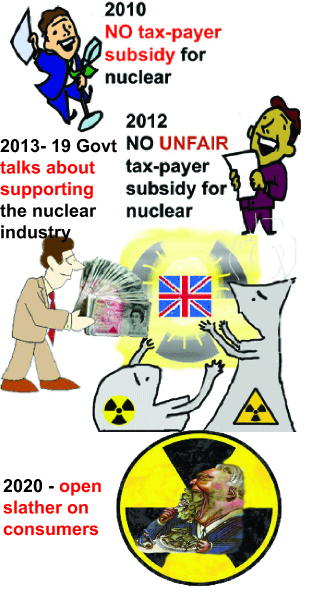 ‘The Sizewell C plans are an insult to the people of Suffolk’ https://www.eadt.co.uk/news/pete-wilkinson-together-against-sizewell-c-campaign-1-6718925 27 June 2020, Pete Wilkinson, Together Against Sizewell C
Chairman of Together Against Sizewell C, Pete Wilkinson, has described it is a “battle for the soul and integrity of East Suffolk”. Here he explains why he is opposing the nuclear project.
Anyone new to Suffolk, ignorant of EDF’s nuclear plans, would be forgiven for laughing out loud.
An untried reactor, labelled ‘technically complicated to construct’ by its own designers, a cost of £20billion-plus, taking at least 10 years to build, producing waste which is not only lethal to living tissue but which remains so for thousands of years and for which there is no agreed or proven disposal or management route, to be built in the middle of a community of 5,000, which will not produce electricity for at least 10 years by which time its output will be redundant to needs, built on an eroding coast? Yeah, sure: pull the other one.
You really couldn’t make it up.
Yet this is what residents up and down the East Suffolk are facing. They have been led to believe that the destruction of their environment on a massive scale, the compulsory purchases, the roads, the workers’ campuses, the borrow pits, the huge water demand in the driest county is inevitable – and to make the best of it.
When did anyone ask YOU, resident of East Suffolk, if you wanted your tranquil, culturally rich and peaceful rural environment urbanised and anonymised, requiring six new roundabouts on the A12 and up to 1,000 vehicle movements a day along our country roads to ferry the material required for our own white elephantine carbuncle on our heritage coast, light, noise and dust pollution 24 hours a day, seven days a week or a decade of accommodating 4,000 workers? Of course you were not asked. They knew the answer. The new nuclear policy has not been subjected to anything like forensic public or Parliamentary scrutiny.
Democratic deficit runs through all aspects of this programme like the letters in a stick of rock and is presented by its advocates as ‘inevitable’. The National Policy Statement process renders what government calls ‘national infrastructure projects of over-riding importance’ inviolate, untouchable and – yes – inevitable unless the planning authorities have the courage or unless the Secretary of State has the guts to do what they should – throw the EDF plans out as an insult to the people of Suffolk. Sizewell C is important to no-one other than EDF.
But just how ‘over-riding’ is the need for Sizewell C? The French-made film, ‘The Nuclear Trap’ makes it clear that Hinkley C in Somerset and Sizewell C are more critical to the survival of the French nuclear industry than they are to providing electricity to UK consumers.
There has been a huge reduction in electricity demand since 2013 – over 16% – making earlier predictions of an increase of 15% by 2020 an overestimation of more than 30%.
Renewables out-compete nuclear on every front – cost, waste, jobs, CO2 and time for deployment. If ever Sizewell was built, it would be at least a decade, probably more like 15 years given the history of cost and time over-runs of its flagship plant at Flamanville, before it turned one kilowatt hour of electricity.
In 15 years, we will – one can only hope – have grown out of our obsession with nuclear and invested at suitably high levels in realising the huge job potential in micro-technology, decentralisation, efficiency and conservation of energy, and look back on our nuclear infatuation with a shake of the head.
The current National Policy Statement which covers the nuclear component of the energy policy, EN6, is entirely unfit for purpose as it gives policy authority only to those nuclear plants which can be deployed before 2025 – i.e. not, Hinkley, not Sizewell and not Bradwell, none of which will be generating electricity by that date.
Therefore the EN6 policy document is null and void. Its replacement is still undergoing review and will depend heavily on the financing arrangements the government can agree to in order to remove the need for EDF to fork out for it.
Instead, the government is exploring novel ways in which to lay the burden for financing a dangerous and costly nuclear venture on you, the consumer.
So much for ‘no subsidy’ nuclear, but in policy terms, it is legally questionable for Hinkley C to continue to be built, for Sizewell C’s planning application to be submitted or for CGN/EDF to consult on plans to build Bradwell B when there is no policy architecture to justify and legitimise any of this work or progress.
EN6 has fallen as a legitimate policy statement for new nuclear build but that does not seem to have any effect on the way the French and Chinese backers of new nuclear in the UK are required to act nor the complacency and indifference with which the government seems to take these gaping legal inconsistencies.
The waste problem that nuclear generates is probably the most intractable. In the 15 years of the existence of the Nuclear Decommissioning Authority, it has failed to secure a site, a volunteer community or to satisfactorily solve many of the dozens of technical and engineering problems associated with burying 500,000 cubic metres of legacy waste while ensuring that the estimated 78,000,000 units of radioactivity remain underground.
While new build waste such as that from Sizewell C is likely to be less bulky, its high burn up in the reactor means that it will be far hotter than even Sizewell B’s waste and will generate much more radioactivity – up to five times that contained in the legacy waste. How can any government or industry knowingly embark on a development programme which will create such a mountain of waste when a repository for its safe disposal is still more a matter of hope over expectation?
The only legacy Sizewell C will leave for Suffolk is a degraded environment and a radioactive waste mountain which future generations will have to deal with. Please tell your councillor to vote to remove the support for Sizewell C at the full council meeting on July 7, please write to the planning inspector to voice your concerns and please urge your MP to tell the Secretary of State to put EDF’s planning application where it belongs – in the bin.
Need for action on global heating – It’s 38°C in Siberia
|
The Arctic heatwave: here’s what we know, https://www.theguardian.com/commentisfree/2020/jun/25/arctic-heatwave-38c-siberia-scienceTamsin Edwards
It’s 38°C in Siberia. The science may be complicated – but the need for action now couldn’t be clearer Fri 26 Jun 2020 There’s an Arctic heatwave: it’s 38°C in Siberia. Arctic sea ice coverage is the second lowest on record, and 2020 may be on course to be the hottest year since records began. For many people, such news induces a lurch of fear, or avoidance – closing the webpage because they don’t want to hear yet more bad news. A few might think “It’s just weather,” and roll their eyes. How can we make sense of such an event? Climate is subtle and shifting, with many drivers and timescales. But we can use this northern heatwave to illuminate the complexity of our planet. We can break this question into parts, from fast to slow. Fast: the immediate effect is to increase wildfires. Siberia has seen “zombie fires” reignited from deep smouldering embers in peatland. This is bad news, releasing particulate air pollution and more carbon in 18 months than in the past 16 years. The immediate cause? Here in the mid-high northern latitudes, we live in unstable weather under the influence of the polar jet stream. This rapid current of air high above our heads drags weather in a conveyor belt from west to east, with alternating patches of cold and warm air, low and high pressure. Sometimes the weather patterns get stuck, creating a stable period of weather, like a heatwave. This is one long, severe example. Does climate change make this “blocking” more likely? Maybe. The jet stream is created by the contrast between cold polar air and the warmer south. The Arctic is warming twice as fast as the global average: that means less north-south contrast, so the jet stream can become more wobbly and meandering. Loops break off like the oxbow lakes of school geography lessons, stranding particular weather patterns in one place. And why is the Arctic warming faster? Because sea ice and snow are so bright. When they melt with global warming, the ocean and land beneath are darker, so they absorb more of the sun’s heat. Their loss amplifies our warming. The current low in Arctic sea ice is itself partly the result of the Siberian heatwave, amplifying the usual year-to-year fluctuations. But the trend is down: the more CO2 we emit, the more the planet’s temperature rises, and the more sea ice we lose. Scientists predict the Arctic will start seeing summers without sea ice by 2050. But it’s not irreversible. It’s not a tipping point. The sea ice would return if we could cool the climate again. Unfortunately we know only three ways to do that: extract vast amounts of CO2 from the air with trees or technology; reflect the sun’s rays at a planetary scale; or wait, for many generations. This Arctic heatwave is a sharp spike on top of the global warming trend. That’s what makes it more intense, more likely and more of a warning: it’s a taste of the future predicted for Russia, if we burn quickly through our fossil fuels. The real fear around the Arctic for the longer term, I find when talking to people, comes from the idea of “runaway” warming from methane release. Warming could release stores of methane – a strong greenhouse gas – from permafrost or frozen sediments at the bottom of the ocean, which would add to the warming from our own activities. There is more than twice the amount of carbon in the permafrost as in the atmosphere, and thawing has already begun. There are big local impacts – damage to roads and buildings, because the ground can no longer bear so much weight, and an appalling story involving what appears to be anthrax release from thawing burial grounds. Permafrost thaw was even blamed by a Russian mining company for the recent collapse of a fuel reservoir, contaminating the river with 20,000 tonnes of diesel, though other factors were probably also involved. So could this Siberian heatwave, or ones like it, trigger catastrophic warming? I see much fear about amplifying methane feedbacks, including the false idea that climate scientists don’t consider them (we do, just separately to the main global climate models). Yet for several years there has been growing evidence that this risk is less than originally thought. Carbon stored in permafrost and wetlands is predicted to contribute around 100bn tonnes of CO2 this century. That’s a lot, but we add around 40bn tonnes ourselves every year. The methane at the bottom of the ocean would take centuries to release, so as long as we limit global warming we should keep those stores mostly locked up. There are uncertainties, of course, but the stores’ impact on warming is likely to be tenths of a degree, not several degrees. Yet every tonne of CO2 released from permafrost means one tonne fewer we can emit if we are to reach net zero emissions by 2050. Every year’s equivalent of our emissions brings our deadline closer. Every tenth of a degree of warming brings us closer to our target of 1.5°C and makes more permafrost thaw, and the impacts of climate change worse for the most vulnerable people and species of the world. The Arctic heatwave shows us that there are few simple stories in climate change. There is always a mix of natural and human influence, bad news and slightly-less-bad news, and occasionally even hopeful news. So, more than ever, we need to avoid over-simplifying or slipping into easy tropes like “We’re all doomed” or “It’s all weather,” but to try to understand the details. Perhaps there is one simple story though: every bit of warming we avoid will help keep our planet a more familiar and an easier place to live on. • Dr Tamsin Edwards is a senior lecturer in physical geography at King’s College London |
The Anthropocene, begun in 16th Century colonialism, slavery -? for repair in 21st Century post-Covid-19 recovery
Why the Anthropocene began with European colonisation, mass slavery and the ‘great dying’ of the 16th century, The Conversation, Mark Maslin, Professor of Earth System Science, UCL, Simon Lewis, Professor of Global Change Science at University of Leeds and, UCL June 25, 2020 The toppling of statues at Black Lives Matter protests has powerfully articulated that the roots of modern racism lie in European colonisation and slavery. Racism will be more forcefully opposed once we acknowledge this history and learn from it. Geographers and geologists can help contribute to this new understanding of our past, by defining the new human-dominated period of Earth’s history as beginning with European colonialism.Today our impacts on the environment are immense: humans move more soil, rock and sediment each year than is transported by all other natural processes combined. We may have kicked off the sixth “mass extinction” in Earth’s history, and the global climate is warming so fast we have delayed the next ice age.
We’ve made enough concrete to cover the entire surface of the Earth in a layer two millimetres thick. Enough plastic has been manufactured to clingfilm it as well. We annually produce 4.8 billion tonnes of our top five crops and 4.8 billion livestock animals. There are 1.4 billion motor vehicles, 2 billion personal computers, and more mobile phones than the 7.8 billion people on Earth.
All this suggests humans have become a geological superpower and evidence of our impact will be visible in rocks millions of years from now. This is a new geological epoch that scientists are calling the Anthropocene, combining the words for “human” and “recent-time”. But debate still continues as to when we should define the beginning of this period. When exactly did we leave behind the Holocene – the 10,000 years of stability that allowed farming and complex civilisations to develop – and move into the new epoch?
Five years ago we published evidence that the start of capitalism and European colonisation meet the formal scientific criteria for the start of the Anthropocene.
Our planetary impacts have increased since our earliest ancestors stepped down from the trees, at first by hunting some animal species to extinction. Much later, following the development of farming and agricultural societies, we started to change the climate. Yet Earth only truly became a “human planet” with the emergence of something quite different. This was capitalism, which itself grew out of European expansion in the 15th and 16th century and the era of colonisation and subjugation of indigenous peoples all around the world.
In the Americas, just 100 years after Christopher Columbus first set foot on the Bahamas in 1492, 56 million indigenous Americans were dead, mainly in South and Central America. This was 90% of the population. Most were killed by diseases brought across the Atlantic by Europeans, which had never been seen before in the Americas: measles, smallpox, influenza, the bubonic plague. War, slavery and wave after wave of disease combined to cause this “great dying”, something the world had never seen before, or since.
In North America the population decline was slower but no less dramatic due to slower colonisation by Europeans. US census data suggest the Native American population may have been as low as 250,000 people by 1900 from a pre-Columbus level of 5 million, a 95% decline.
This depopulation left the continents dominated by Europeans, who set up plantations and filled a labour shortage with enslaved workers. In total, more than 12 million people were forced to leave Africa and work for Europeans as slaves. ……….
In addition to the critical task of highlighting and tackling the racism within science, perhaps geologists and geographers can also make a small contribution to the Black Lives Matter movement by unflinchingly compiling the evidence showing that when humans started to exert a huge influence on the Earth’s environment was also the start of the brutal European colonisation of the world.
In her insightful book, A Billion Black Anthropocenes or None, the geography professor Kathryn Yusoff makes it very clear that predominantly white geologists and geographers need to acknowledge that Europeans decimated indigenous and minority populations whenever so-called progress occurred.
Defining the start of the human planet as the period of colonisation, the spread of deadly diseases and transatlantic slavery, means we can face the past and ensure we deal with its toxic legacy. If 1610 marks both a turning point in human relations with the Earth and our treatment of each other, then maybe, just maybe, 2020 could mark the start of a new chapter of equality, environmental justice and stewardship of the only planet in the universe known to harbour any life. It’s a struggle nobody can afford to lose. https://theconversation.com/why-the-anthropocene-began-with-european-colonisation-mass-slavery-and-the-great-dying-of-the-16th-century-140661
Nuclear power, far too slow to affect global heating – theme for July 20
In recent themes I wrote about nuclear power being in fact a big contributor to global warming, and about how climate change will in fact finish off the nuclear industry.
But – let’s pretend that nuclear reactors really could reduce greenhouse gas emissions.
TIME: To do that, 1500 one thousand megawatt-electric new reactors would be needed within a few years to displace a significant amount of carbon-emitting fossil generation. A Massachusetts Institute of Technology Study on “The Future of Nuclear Power” projected that a global growth scenario for as many as 1500 one thousand megawatt-electric new reactors would be needed to displace a significant amount of carbon-emitting fossil generation. Average 115 built per year would reduce our CO2 use by only 16%.
But the new flavour of the month is Small Modular Nuclear Reactors (SMRs), which generate from 50 to 200 megawatts. So the world would need, quickly, to have a significant reduction of carbon emissions, i.e at least 7500 largish SMRs – or 30,000 smaller ones., (and these SMRs are already shown to be more costly than large ones,)

Meanwhile – if the nuclear “climate cure” were to be pursued, the enormous costs and efforts involved would take away from the clean, fast, and ever cheaper solutions of energy efficiency and renewable energy.
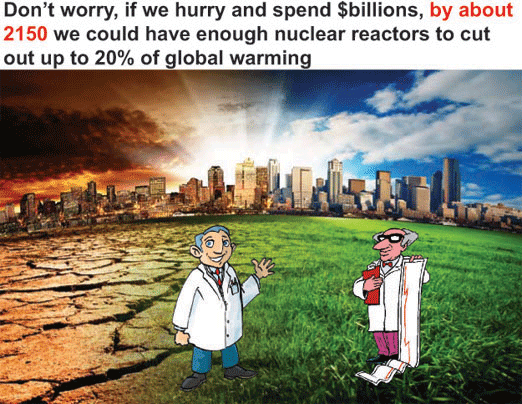
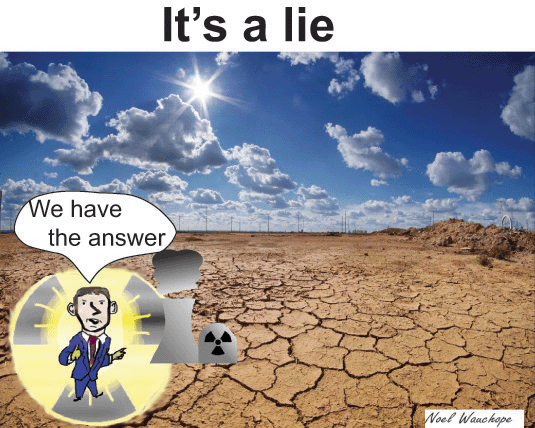
NUCLEAR’s WHOPPING CLIMATE LIE – theme for July 2020
 “If you tell a lie big enough and keep repeating it, people will eventually come to believe it. A lie told once remains a lie but a lie told a thousand times becomes the truth ”
Dr Goebbels would be delighted with the nuclear lobby’s lie that nuclear power is zero carbon and will fix climate change. He would be even more delighted with the current success of this lie.
“Think of the press as a great keyboard on which the government can play.”
The failing nuclear industry is fighting for its life. It now pitches its salvation on its claim to halt climate change. Even if 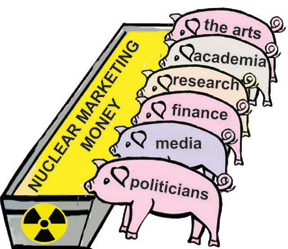
that were true (which it isn’t) the world would have to construct several thousand ‘conventional’ reactors, or several millions of Small Modular Reactors (SMRs) very quickly, within a decade or two.
How is it that politicians , media, academics have swallowed this lie?
Record breaking heat in Verkhoyansk, north of the Arctic Circle
|
A Siberian town near the Arctic Circle just recorded a 100-degree temperature https://www.vox.com/2020/6/21/21298292/siberia-temperature-100-climate-change
One of the coldest towns on Earth clocks a potentially record-breaking — and worrying — temperature. By Zeeshan Aleem@ZeeshanAleem Jun 21, 2020,A small town in Siberia reached a temperature of 100.4 degrees Fahrenheit on Saturday, which, if verified, would mark the hottest temperature ever recorded north of the Arctic Circle. Temperatures have jumped in recent months to levels rarely seen in the Russian region, and it’s a sign of a broader trend of human-caused climate change that’s transforming weather patterns in the Arctic Circle. The town of Verkhoyansk is one of the coldest towns on Earth — temperatures dropped to nearly 60 degrees below zero there this past November — and the average June high temperature is 68 degrees. The 100.4 reading in Verkhoyansk, which sits farther north than Fairbanks, Alaska, would be the northernmost 100-degree reading ever observed. The Washington Post reports that while there are questions about the accuracy of the record temperature, a Saturday weather balloon launch that found unusually high temperatures in the lower atmosphere supports the reading. And on Sunday, the town reached 95.3 degrees, according to the Post. CBS News meteorologist and climate specialist Jeff Berardelli wrote on Saturday that 100-degree temperatures in or near the Arctic are “almost unheard of.” Before Saturday, Siberia was already experiencing an extraordinary heat wave. Surface temperatures in Siberia were 18 degrees higher than average in May, making it the hottest May in the region since record-keeping began in 1979, according to the Copernicus Climate Change Service. “It is undoubtedly an alarming sign, but not only May was unusually warm in this region,” said Freja Vamborg, a senior scientist at the Copernicus Climate Change Service, in a statement about the finding. “The whole of winter and spring had repeated periods of higher-than-average surface air temperatures.” Climate scientist Martin Stendel said on Twitter that the temperatures recorded in northwestern Siberia last month would be a 1-in-100,000-year event — if not for climate change. Berardelli said the average heat across Russia between January and May actually matches what current models project to be normal for the region in 2100, if carbon emissions continue. “Due to heat trapping greenhouse gases that result from the burning of fossil fuels and feedback loops, the Arctic is warming at more than two times the average rate of the globe,” he explained in his analysis of the Verkhoyansk reading. “This phenomenon is known as Arctic Amplification, which is leading to the decline of sea ice, and in some cases snow cover, due to rapidly warming temperatures.” He noted that if the climate continues to heat up, extreme heat waves will become more of the norm. |
|
1 This Month
19 February – VIRTUAL EVENT-Decision Time: AI and Our Nuclear Arsenal
12:45 p.m. Central / 1:45 p.m. Eastern
To see nuclear-related stories in greater depth and intensity – go to https://nuclearinformation.wordpress.com
-
Archives
- February 2026 (181)
- January 2026 (308)
- December 2025 (358)
- November 2025 (359)
- October 2025 (376)
- September 2025 (258)
- August 2025 (319)
- July 2025 (230)
- June 2025 (348)
- May 2025 (261)
- April 2025 (305)
- March 2025 (319)
-
Categories
- 1
- 1 NUCLEAR ISSUES
- business and costs
- climate change
- culture and arts
- ENERGY
- environment
- health
- history
- indigenous issues
- Legal
- marketing of nuclear
- media
- opposition to nuclear
- PERSONAL STORIES
- politics
- politics international
- Religion and ethics
- safety
- secrets,lies and civil liberties
- spinbuster
- technology
- Uranium
- wastes
- weapons and war
- Women
- 2 WORLD
- ACTION
- AFRICA
- Atrocities
- AUSTRALIA
- Christina's notes
- Christina's themes
- culture and arts
- Events
- Fuk 2022
- Fuk 2023
- Fukushima 2017
- Fukushima 2018
- fukushima 2019
- Fukushima 2020
- Fukushima 2021
- general
- global warming
- Humour (God we need it)
- Nuclear
- RARE EARTHS
- Reference
- resources – print
- Resources -audiovicual
- Weekly Newsletter
- World
- World Nuclear
- YouTube
-
RSS
Entries RSS
Comments RSS
 nuclear-news