Trump Appoints Pair of Climate Science Deniers to National Oceanic and Atmospheric Administration (NOAA While Climate-Fueled Fires and Storms Rage
|
The White House has made a pair of controversial appointments to the National Oceanic and Atmospheric Administration (NOAA), positioning within the climate science agency two individuals who consistently misrepresent and disagree with the scientific consensus on various issues concerning climate change and who have notable ties with conservative think tanks that disseminate climate science denial. As the Washington Post first reported this week, President Trump is naming Ryan Maue to the role of chief scientist at NOAA, a position that will help enforce its scientific integrity process. Maue is a meteorologist who has downplayed the degree and impacts of global warming, particularly ties between extreme weather events and human-caused climate change, and he has a past connection with the Cato Institute. Maue’s appointment follows the White House’s appointment last week of climate science denier David Legates as NOAA’s deputy assistant secretary of commerce for observation and prediction. Legates refutes the well-established scientific understanding that human activity is causing climate breakdown and he is affiliated with the Heartland Institute, which has and continues to traffic in climate denial and disinformation……. These appointments of climate science deniers to NOAA — the agency charged with monitoring changes in the climate system and informing Americans on this science — come at a time when there is rising concern over the Trump administration’s embrace of pseudoscience and apparent attempts to interfere with or attack nonpartisan scientific and public health agencies like NOAA, the Environmental Protection Agency (EPA), the Food and Drug Administration (FDA), and the Centers for Disease Control and Prevention (CDC). A study published in April surveying federal scientists found a perceived loss of scientific integrity under the Trump administration. The new NOAA appointments also arrive as climate-fueled disasters such as unprecedented wildfires and a litany of tropical storms and hurricanes have roiled the nation. It is therefore worth taking a closer look at the backgrounds of these two individuals questioning mainstream climate science………….https://www.desmogblog.com/2020/09/24/trump-noaa-david-legates-ryan-maue-climate-denial?utm_source=DeSmog%20Weekly%20Newsletter |
|
|

Small modular nuclear reactors for Canada? – useless, expensive, untested, and a wasteful distraction
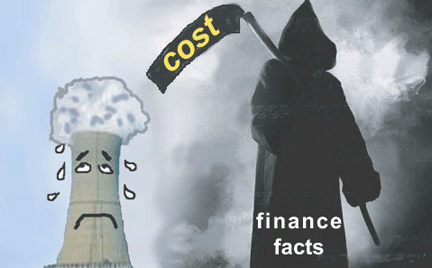 NB Media Co-op 22nd Sept 2020,Premier Blaine Higgs has endorsed so-called “small modular nuclear reactors” or SMRs. SMRs represent an untested technology but what we know on the basis of technical characteristics and historical precedent is that they will be expensive and any electricity they generate will not be economical. The nuclear industry is pushing small reactors because large reactors are simply not economical. Constructing nuclear plants is just too expensive—as Ontario’s government found out after its call in 2008 for bids to build two more reactors at the Darlington site.
https://nbmediacoop.org/2020/09/22/no-business-case-for-new-nuclear-reactors-in-new-brunswick/
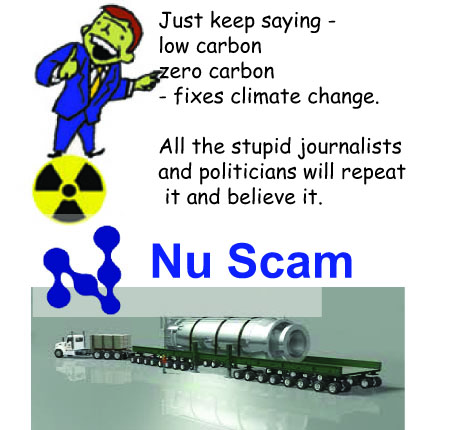 Sierra Club Canada (accessed) 23rd Sept 2020, No plan that gets us to net zero in a reasonable time frame includes new nuclear reactors. Nuclear is far too slow and expensive to deal with the climate emergency. Just like fossil fuel energy, nuclear produces wastes that pose unacceptable health hazards and economic costs.
Marshall Islands in danger of being overcome by rising sea levels
Star of the day: David Kabua, President of the Marshall Islands, believes his territory will disappear under rising sea levels, https://pledgetimes.com/star-of-the-day-david-kabua-president-of-the-marshall-islands-believes-his-territory-will-disappear-under-rising-sea-levels/ by Bhavi Mandalia, September 22, 2020 The Marshall Islands facing rising waters. (HILARY HOSIA / AFP)
David Kabua, 71, president for nine months of the Marschall Islands is worried. This small confetti of land lost in the Pacific Ocean, 180 km², perched just two meters from sea level, is threatened by rising waters. There is not much on the 30 atolls that make up the archipelago, nothing to covet, nothing to export, no natural resources, only small farms, fishing boats and a huge radioactive waste storage site. , memory of the American nuclear tests of the 1960s.
This little piece of land, so coveted during the wars for its strategic location, no longer has any leverage to attract attention. And yet, it will soon no longer appear on the world maps. This is the warning cry launched by David Kabua on Monday September 21 at the UN, a simple cry: “My country will disappear if the world does not keep its promises, those made during the Paris agreement.” He recounted the impact of climate change, the increasingly devastating tides, population evacuations, the intense droughts which generate another plague: swarms of mosquitoes carrying various diseases. And then there is the money that is lacking to build the necessary infrastructure to protect its 75,000 inhabitants. Money promised five years ago, and which does not arrive. Finally, there is worse:“The fact, he said, that industrialized countries continue to finance fossil fuels, oil, gas and coal. We are doing our part, but alone we can do nothing. “
David Kabua addresses the United Nations. The UN that the Marschall Islands joined in 1991 but that they could well leave, in fact, not voluntarily, but by force of circumstances, because the atolls will end up submerged. So he concluded by asking: “Will we still be here for the UN’s 100th anniversary in 2045? How about you? Are you going to help us keep our islands in this world?” In the assembly, the question created a long silence. David Kabua, for his part, has nothing more to give than a warning, a prophecy for all. We know. But we look elsewhere. Hope does exist, however, it is in the motto of the Marschall Islands: “Achievement through joint effort“. And we have 25 years ahead of us.
The pandemic is a massive thrat – so is climate change


|
The federal government shouldn’t feel it has to choose between addressing one crisis or the other, Aaron Wherry · CBC News · Sep 17, 2020 The profound and urgent threat of climate change still hangs over Prime Minister Justin Trudeau’s government — quite literally this week, after smoke from the wildfires in California and Oregon spread across the continent, casting a dull haze across the skies.Questions are being asked now about how quickly or enthusiastically the Liberals should turn their focus back to that challenge. There is, after all, the small matter of an ongoing health emergency to tackle. But the unfolding climate emergency will not get any easier to deal with over time — and the Liberals might regret missing any available opportunities to make meaningful progress toward the mid-century goal of net-zero emissions. Although it’s not clear if the government’s actual plans for the next year have changed (or if it’s merely the official messaging about those plans that has been adjusted), it has shifted its publicly stated focus conspicuously to the immediate crisis posed by COVID-19. [Controlling the spread of COVID-19] is our government’s 100 per cent priority,” Finance Minister Chrystia Freeland said Tuesday. “It is what we are overwhelmingly focused on.” “I think we recognize and have always recognized that dealing with the pandemic is job one,” Trudeau said Wednesday. Pandemic pessimismAfter the Liberals’ heady talk in late summer about a pivotal opportunity for ambitious change, that sounds like a course correction. If so, it’s a concession to simple reality. While a moment could be emerging when political circumstance and necessity align to create a rare opportunity for real change, it would be hard for any government to do much of anything if COVID-19 is allowed to run roughshod. COVID-19 is also (understandably) the central preoccupation of most Canadians: according to a survey by Abacus Data, 45 per cent of Canadians still believe the pandemic will get worse before it gets better. Parents nervously sending their children back to school might not be terribly interested right now in hearing about the better world that might emerge in the wake of COVID-19 — and they might be very inclined to punish any government that seems to take its eye off the immediate threat. As much as combating climate change and building a clean economy can still seem like optional pursuits — things that would be nice to have rather than necessary — Liberals might worry about seeming to have let “green” interests hijack the moment. Outside government, talk of a green recovery began soon after the pandemic’s arrival. But it would be a mistake to dismiss the idea as a passing fad; while Abacus polled fear about the pandemic, it also found that concern about climate change remains high, particularly among Liberal, NDP, Bloc Québécois and Green voters. While Gerald Butts, a former senior adviser to Trudeau, counselled progressive policy wonks on Monday to mind the real pandemic-related anxieties of voters, he also was part of a panel of experts that laid out a plan Wednesday calling for $55 billion in green spending over the next five years, largely focused on retrofitting buildings, expanding the use of zero-emission vehicles and accelerating the development of clean energy. But the task force also pointed out that such investments would be in line with plans being pursued by Germany, France and the United Kingdom. If Joe Biden is elected president of the United States in November, his plans could include as much as $2.7 trillion in green spending. It’s not an either-or choiceNot all of the problems COVID-19 has exposed or created can be solved by green spending — and it can’t be said that this government has demonstrated a peerless ability to manage multiple major priorities at once. But a government interested in the long-term goal of a clean economy should still be able to find opportunities to do that while simultaneously addressing the short-term needs of a battered economy. The Liberals themselves did that in May when they offered funding to clean up abandoned oil wells and asked large companies applying for pandemic-related loans to provide climate-risk disclosure. It also shouldn’t be forgotten that the Liberals already had a list of green things to do before the pandemic arrived. The platform that Trudeau ran on in the fall of 2019 promised new support for retrofits and zero-emission vehicles, a tax cut for companies that develop clean technology, climate change accountability legislation and new flood-mapping (not to mention that plan to plant two billion new trees). A global pandemic has complicated everyone’s plans for 2020. But Parliament should return next week with the ability to resume something resembling normal proceedings. And not even a global pandemic can fully excuse a government from doing important work. Climate change as an economic issueAs if to reassure the proponents of a green recovery that something is in the works, Environment Minister Jonathan Wilkinson was one of the four ministers selected to stand behind Trudeau on Wednesday when this week’s cabinet retreat ended. But when Trudeau and Freeland did talk about a green agenda, it was in terms of jobs. “As we reflect on how to restart the economy, how to create good jobs for now and into the future, obviously the green sector and newer jobs and innovation and clean tech are going to be an essential part of building back better and building a stronger future,” Trudeau said. An emphasis on jobs could ground the green aspect of the government’s agenda in the most immediate and practical concerns of both nervous families and fretful economists. It also would serve as a reminder that a green recovery isn’t about hugging trees — it’s about the future welfare and prosperity of Canadians. A report released by the Institute for Climate Choices today makes the case that reducing emissions and growing the economy should not be treated as mutually exclusive goals — and that Canada’s work of building a clean economy has only begun. If a government wants to build long-term growth, a transition to a low-carbon economy seems like a decent place to start. No one can dispute the fact that other issues are now demanding the government’s attention: child care, long-term care, inequality, precarious work, a wounded economy and the ongoing challenge of living with the threat of COVID-19. No government would be easily forgiven for ignoring such things. But until Canada is on a clear path to net-zero emissions, nearly every federal government can be asked whether it has fully seized every chance to combat the climate crisis — a crisis that was worth worrying about before COVID-19 arrived and will still be worth worrying about long after the virus has faded. |
|

Global heating – abrupt changes could bring interconnected tipping points
Cutting greenhouse gas emissions is not a surprising or original solution. But it is our best chance to stop the warning signs flashing red.
The tipping points at the heart of the climate crisis, https://www.theguardian.com/science/2020/sep/19/the-tipping-points-at-the-heart-of-the-climate-crisis Michael Marshall, Sun 20 Sep 2020
Many parts of the Earth’s climate system have been destabilised by warming, from ice sheets and ocean currents to the Amazon rainforest – and scientists believe that if one collapses others could follow.
The warning signs are flashing red. The California wildfires were surely made worse by the impacts of global heating. A study published in July warned that the Arctic is undergoing “an abrupt climate change event” that will probably lead to dramatic changes. As if to underline the point, on 14 September it was reported that a huge ice shelf in northeast Greenland had torn itself apart, worn away by warm waters lapping in from beneath.
That same day, a study of satellite data revealed growing cracks and crevasses in the ice shelves protecting two of Antarctica’s largest glaciers – indicating that those shelves could also break apart, leaving the glaciers exposed and liable to melt, contributing to sea-level rise. The ice losses are already following our worst-case scenarios.
These developments show that the harmful impacts of global heating are mounting, and should be a prompt to urgent action to cut greenhouse gas emissions. But the case for emissions cuts is actually even stronger. That is because scientists are increasingly concerned that the global climate might lurch from its current state into something wholly new – which humans have no experience dealing with. Many parts of the Earth system are unstable. Once one falls, it could trigger a cascade like falling domino
Tipping points
We have known for years that many parts of the climate have so-called tipping points. That means a gentle push, like a slow and steady warming, can cause them to change in a big way that is wholly disproportionate to the trigger. If we hit one of these tipping points, we may not have any practical way to stop the unfolding consequences.
The Greenland ice sheet is one example of a tipping point. It contains enough ice to raise global sea levels by seven metres, if it were all to melt. And it is prone to runaway melting.
This is because the top surface of the ice sheet is gradually getting lower as more of the ice melts, says Ricarda Winkelmann of the Potsdam Institute for Climate Impact Research in Germany. The result is familiar to anyone who has walked in mountains. “If we climb down the mountain, the temperature around us warms up,” she says. As the ice sheet gets lower, the temperatures at the surface get higher, leading to even more melting. “That’s one of these self-reinforcing or accelerating feedbacks.”
We don’t know exactly how much warming would cause Greenland to pass its tipping point and begin melting unstoppably. One study estimated that it would take just 1.6C of warming – and we have already warmed the planet 1.1C since the late 19th century.
The collapse would take centuries, which is some comfort, but such collapses are difficult to turn off. Perhaps we could swiftly cool the planet to below the 1.6C threshold, but that would not suffice, as Greenland would be melting uncontrollably. Instead, says Winkelmann, we would have to cool things down much more – it’s not clear by how much. Tipping points that behave like this are sometimes described as “irreversible”, which is confusing; in reality they can be reversed, but it takes a much bigger push than the one that set them off in the first place.
In 2008, researchers led by Timothy Lenton, now at the University of Exeter, catalogued the climate’s main “tipping elements”. As well as the Greenland ice sheet, the Antarctic ice sheet is also prone to unstoppable collapse – as is the Amazon rainforest, which could die back and be replaced with grasslands.
A particularly important tipping element is the vast ocean current known as the Atlantic meridional overturning circulation (AMOC), which carries warm equatorial water north to the Arctic, and cool Arctic water south to the equator. The AMOC has collapsed in the past and many scientists fear it is close to collapsing again – an event that was depicted (in ridiculously exaggerated and accelerated form) in the 2004 film The Day After Tomorrow. If the AMOC collapses, it will transform weather patterns around the globe – leading to cooler climates in Europe, or at least less warming, and changing where and when monsoon rains fall in the tropics. For the UK, this could mean the end of most arable farming, according to a paper Lenton and others published in January.
Tumbling dominoes
In 2009, a second study took the idea further. What if the tipping elements are interconnected? That would mean that setting off one might set off another – or even unleash a cascade of dramatic changes, spreading around the globe and reshaping the world we live in.
For instance, the melting of the Greenland ice sheet is releasing huge volumes of cold, fresh water into the north Atlantic. This weakens the AMOC – so it is distinctly possible that if Greenland passes its tipping point, the resulting melt will push the AMOC past its own threshold.
“It’s the same exact principles that we know happen at smaller scales,” says Katharine Suding of the University of Colorado, Boulder, who has studied similar shifts in ecosystems. The key point is that processes exist that can amplify a small initial change. This can be true on the scale of a single meadow or the whole planet.
However, the tipping point cascade is very difficult to simulate. In many cases the feedbacks go both ways – and sometimes one tipping point can make it less likely that another will be triggered, not more. For example, the AMOC brings warm water from equator up into the north Atlantic, contributing to the melting of Greenland. So if the AMOC were to collapse, that northward flow of warm water would cease – and Greenland’s ice would be less likely to start collapsing. Depending whether Greenland or the AMOC hit its tipping point first, the resulting cascade would be very different.
What’s more, dozens of such linkages are now known, and some of them span huge distances. “Melting the ice sheet on one pole raises sea level,” says Lenton, and the rise is greatest at the opposite pole. “Say you’re melting Greenland and you raise the sea level under the ice shelves of Antarctica,” he says. That would send ever more warm water lapping around Antarctica. “You’re going to weaken those ice shelves.”
“Even if the distance is quite far, a larger domino might still be able to cause the next one to tip over,” says Winkelmann.
In 2018, Juan Rocha of the Stockholm Resilience Centre in Sweden and his colleagues mapped out all the known links between tipping points. However, Rocha says the strengths of the interconnections are still largely unknown. This, combined with the sheer number of them, and the interactions between the climate and the biosphere, means predicting the Earth’s overall response to our greenhouse gas emissions is very tricky.
Into the hothouse
The most worrying possibility is that setting off one tipping point could unleash several of the others, pushing Earth’s climate into a new state that it has not experienced for millions of years.
Since before humans existed, Earth has had an “icehouse” climate, meaning there is permanent ice at both poles. But millions of years ago, the climate was in a “hothouse” state: there was no permanent polar ice, and the planet was many degrees warmer.
If it has happened before, could it happen again? In 2018, researchers including Lenton and Winkelmann explored the question in a much-discussed study. “The Earth System may be approaching a planetary threshold that could lock in a continuing rapid pathway toward much hotter conditions – Hothouse Earth,” they wrote. The danger threshold might be only decades away at current rates of warming.
Lenton says the jury is still out on whether this global threshold exists, let alone how close it is, but that it is not something that should be dismissed out of hand.
“For me, the strongest evidence base at the moment is for the idea that we could be committing to a ‘wethouse’, rather than a hothouse,” says Lenton. “We could see a cascade of ice sheet collapses.” This would lead to “a world that has no substantive ice in the northern hemisphere and a lot less over Antarctica, and the sea level is 10 to 20 metres higher”. Such a rise would be enough to swamp many coastal megacities, unless they were protected. The destruction of both the polar ice sheets would be mediated by the weakening or collapse of the AMOC, which would also weaken the Indian monsoon and disrupt the west African one.
Winkelmann’s team studied a similar scenario in a study published online in April, which has not yet been peer-reviewed. They simulated the interactions between the Greenland and west Antarctic ice sheets, the AMOC, the Amazon rainforest and another major weather system called the El Niño southern oscillation. They found that the two ice sheets were the most likely to trigger cascades, and the AMOC then transmitted their effects around the globe.
What to do?
Everyone who studies tipping point cascades agrees on two key points. The first is that it is crucial not to become disheartened by the magnitude of the risks; it is still possible to avoid knocking over the dominoes. Second, we should not wait for precise knowledge of exactly where the tipping points lie – which has proved difficult to determine, and might not come until it’s too late.
Rocha compares it to smoking. “Smoking causes cancer,” he says, “but it’s very difficult for a doctor to nail down how many cigarettes you need to smoke to get cancer.” Some people are more susceptible than others, based on a range of factors from genetics to the level of air pollution where they live. But this does not mean it is a good idea to play chicken with your lungs by continuing to smoke. “Don’t smoke long-term, because you might be committing to something you don’t want to,” says Rocha. The same logic applies to the climate dominoes. “If it happens, it’s going to be really costly and hard to recover, therefore we should not disturb those thresholds.”
“I think a precautionary principle probably is the best step forward for us, especially when we’re dealing with a system that we know has a lot of feedbacks and interconnections,” agrees Suding.
“These are huge risks we’re playing with, in their potential impacts,” says Lenton. “This is yet another compulsion to get ourselves weaned off fossil fuels as fast as possible and on to clean energy, and sort out some other sources of greenhouse gases like diets and land use,” says Lenton. He emphasises that the tipping points for the two great ice sheets may well lie between 1C and 2C of warming.
“We actually do need the Paris climate accord,” says Winkelmann. The 2016 agreement committed most countries to limit warming to 1.5 to 2C, although the US president, Donald Trump, has since chosen to pull the US out of it. Winkelmann argues that 1.5C is the right target, because it takes into account the existence of the tipping points and gives the best chance of avoiding them. “For some of these tipping elements,” she says, “we’re already in that danger zone.”
Cutting greenhouse gas emissions is not a surprising or original solution. But it is our best chance to stop the warning signs flashing red.
Global heating is disrupting the ground in Siberia
|
Bizarre Bumps come up in Siberia, The tundra climate of Siberia and Russia have been the victim of climate change and the bumps on the grounds bear its scars https://www.outlookindia.com/outlooktraveller/travelnews/story/70633/siberias-ground-bumps, Trinetra Paul, September 20 , 2020 Over the past few decades, climate change and global warming has had a string of adverse effects on the planet. And the signs of damage are increasing day by day. Siberia has been facing the wrath of this global phenomenon over the years. Now, the ground bears the scars of climate change. The Siberian permafrost (or frozen organic ground) is slowly thawing and this is resulting in huge, bizarre bumps on the ground. Many of the craters formed in between these bumps have been filled with melting water and have transformed into small lakes. The alarming rate at which the ground is thawing is a cause for major concern. The permafrost has frozen grass and shrubs and is a reservoir of greenhouse gases. When the layer thaws, these gases are directly emitted into the atmosphere. The Siberian city of Yakutsk has been standing on a permafrost, the depletion of which will not only be a hazard for the city but also for Siberian climate and weather. Siberia, and most parts of Russia, has witnessed a huge rise in temperatures, heat waves and an early summer with temperatures reaching almost 35 degrees. A large part of it is due to global warming, oil spills, factory leakages as well as increase in eco-tourism. Yes, even friendlier modes of tourism and travel too play a pivotal role in increasing the temperature. The COVID-19 pandemic too has had its share in this. With lack of proper maintenance, devastating Siberian wildfires in May proved to be deadly due to reduced workforce, and gave out large volumes of greenhouse gases. Though eco-tourism is beneficial in creating awareness about indiginous culture, and in creating employment among locals, it also leads to modernisation and artificial (often damaging) development of a place. Nature-based adventures, trails and extreme offbeat destinations are often held accountable for destruction of untramelled areas. Experts says that there must be conscious efforts in de-escalating these ventures. Such tourism must be curtailed, and introduced with buffers like controlling daily visitor numbers, maintaining a tab over timings, and consulting environmental organisations about the best measures to protect the vulnerable areas. Sometimes that may mean not allowing any tourists at all. |
|
Why NuScam and other ”small” nuclear proposals just don’t make any sense
New nuclear projects, like this NuScale proposal, make no sense, Deseret, By Robert Davies, Contributor Sep 18, 2020, The debate over nuclear power has ramped up recently in Utah, with a number of the state’s municipal power agencies wrestling with continued participation in an experimental nuclear project in Idaho, the Utah Associated Municipal Power Systems/NuScale project.
Much has already been written about the project itself. Though proponents tout benefits of cost and reliability, two municipalities so far, Logan and Lehi, have recently opted out of further participation, citing mainly financial concerns over an experimental design with delays and cost overruns mounting rapidly. Still, this extremely expensive energy might be worth it ― if the environmental benefits, particularly for climate change, were significant.
Climate change is regarded within the full scientific community as a bona fide civilizational emergency ― that is, a situation requiring immediate, meaningful response to avoid catastrophic outcomes. For the climate emergency, meaningful response means cutting global carbon emissions at least in half in the next decade, and eliminating them entirely in the next two to three decades.
Electricity generation, as roughly a third of the current carbon emissions, is a large piece of the equation ― and it is on this point that nuclear power has been worth considering. Indeed, the project’s developers, having christened the endeavor the “Carbon Free Power Project,” are emphasizing the climate angle. And if the question were about building new nuclear generation versus new fossil (coal or natural gas) generation, they would have a point; the clear winner with respect to climate would be nuclear.
But this isn’t the question. In rapidly decarbonizing the electrical grid, the name of the game is replacing existing high-carbon (coal and gas) with new low-carbon, as quickly as possible.
……..proposed new nuclear makes no sense ― because it isn’t competing with fossils. Instead, new nuclear is competing with low-carbon renewables, chiefly solar and wind. And it simply can’t compete.
Investing in new nuclear projects to combat climate change is akin to the crew of the Titanic devoting time to building a whole new ocean liner instead of putting all their effort into loading the lifeboats; it steals time and resources from a much better alternative. Any money spent on new nuclear could buy us four to six times more wind and solar energy, available in months instead of a decade. And, remember, the next 10 years are critical.
Faced with this reality, UAMPS/NuScale proponents have said they want a mostly renewable grid, but supplemented by just a bit of nuclear for “baseload” ― and that this is necessary.
The refrain of 20th century-era power managers is that renewables like wind and solar aren’t reliable (“The wind doesn’t always blow, the sun doesn’t always shine … ”) and so constantly humming “baseload” is necessary for reliability. It sounds reasonable, but like most bumper-sticker wisdom, doesn’t hold up. In fact, it is objectively, demonstrably wrong.
The technologies of energy storage (utility-scale battery systems, for example) and demand management (when the energy is used) have transformed the landscape. Traditional “baseload” is no longer a necessary grid attribute. Anyone who says it is simply isn’t keeping up.
In Australia, for example, a 100-megawatt utility-scale battery system (about 1.5 times bigger than one of NuScale’s nuclear modules) is already proving more reliable and 90% cheaper than the “baseload” natural gas system it’s replacing. ………
new nuclear makes no sense whatsoever ― financially, or far more importantly, for addressing climate change.
The UAMPS/NuScale project is a poor choice for the planet, for our nation and for Utah’s independent municipal power companies. A bright future is possible if we’re smart and focused; the nuclear power trap is a distraction we can’t afford.
Robert Davies is an associate professor of professional practice in Utah State University’s department of physics. His work focuses on global change, human sustainability and critical science communication.https://www.deseret.com/opinion/2020/9/18/21400144/guest-opinion-nuscale-uamps-nuclear-project-power-utah-idaho-makes-no-sense
Grief in Western America, as inequities, wildfires, and climate change collide
Climate change is making wildfires bigger, fiercer, and deadlier, fueling a new kind of despair on the West Coast—and beyond. Wired 16 Sept 20, GRIEF HAS SETTLED over the western US, along with the thick haze of smoke pouring from dozens of massive wildfires up and down California, Oregon, Colorado, and Washington. It’s grief over the thousands of structures and at least 33 lives lost so far; grief over another villain conspiring with Covid-19 to lock people indoors; grief that the orange-hued dystopia of Blade Runner is now a reality in smoky San Francisco; grief over losing any sense of normalcy, or indeed a clear future.Enveloping all of those emotions—packaging them into an overwhelming feeling of doom—is climate grief, as psychologists call it, the dread that humans have thoroughly corrupted the planet, and that the planet is now exacting its revenge. Wildfires were around before human-made climate change, but by pulling a variety of strings, it’s made them bigger, fiercer, and ultimately deadlier, creating what fire historian Steve Pyne has dubbed the Pyrocene, an Age of Flames.
By burning fossil fuels, we’ve primed the landscape to burn explosively, and by pushing human communities deeper and deeper into what was once wilderness, we’re provided plenty of opportunities for ignition—and plenty of opportunities for grief as these forces catastrophically combine.
“So much is out of our control,” says Adrienne Heinz, a research psychologist at the Stanford University School of Medicine, who studies the effects of disasters like wildfires and the Covid-19 pandemic. “We lose our sense of personal agency over how we will live—the decisions are made for us.”
It shifts from grief over what’s happening with our climate—can we feel safe in our own communities?—to despair, the differentiator being that you don’t feel like tomorrow is going to be any better than today,” Heinz adds. “That’s where it gets really dark.”
For the people of Northern California, an exhausting parade of massive wildfires have marched across the landscape over the past several autumns, with many people having to evacuate several years in a row. Last October, the Kincade Fire burned 120 square miles. The November before, the Camp Fire destroyed the town of Paradise and killed 86 people. And in October 2017, the Tubbs Fire obliterated 5,600 structures and killed 22.
“The catchphrase—kind of with a bitterness around here—is, ‘This is the new normal,’” says Barbara Young, a licensed marriage and family therapist in Healdsburg, north of San Francisco, who had to evacuate last month. “And so with that, I think it’s implied that this isn’t going away—our climate is changing. These aren’t flukes, this is the trend. And I think everyone is very clear that this is not a one-off. This is every year now.” ……………
Thus inequities, wildfires, and climate change collide. Each massive problem on its own is difficult for the human mind to parse, much less all three together. “I am doing a lot of work with people on really increasing psychological self-care, spiritual self-care, physical self-care, and to help that fatigue,” says Young, the therapist in Healdsburg. “And I do think that is connected with climate grief. Finally, maybe we are forced to see how interconnected everything is.” https://www.wired.com/story/climate-grief-is-burning-across-the-american-west/
In tropical areas, increasing heat and humidity will make life almost unbearable
 Climate explained: will the tropics eventually become uninhabitable? https://theconversation.com/climate-explained-will-the-tropics-eventually-become-uninhabitable-145174 James Shulmeister– 16 Sept 20, Professor, School of Earth and Environmental Sciences, University of Canterbury What is the impact of temperature increases in the tropics? How likely is it that regions along the Equator will be uninhabitable due to high wet bulb temperatures such as 35℃ and more in places like Singapore? Do we have models that suggest how likely this is and at what time frames?More than 3.3 billion people live in the tropics, representing about 40% of the world’s population. Despite some areas of affluence, such as Singapore, the tropics are also home to about 85% of the world’s poorest people and are therefore particularly susceptible to the impacts of climate change. Climate explained: will the tropics eventually become uninhabitable? https://theconversation.com/climate-explained-will-the-tropics-eventually-become-uninhabitable-145174 James Shulmeister– 16 Sept 20, Professor, School of Earth and Environmental Sciences, University of Canterbury What is the impact of temperature increases in the tropics? How likely is it that regions along the Equator will be uninhabitable due to high wet bulb temperatures such as 35℃ and more in places like Singapore? Do we have models that suggest how likely this is and at what time frames?More than 3.3 billion people live in the tropics, representing about 40% of the world’s population. Despite some areas of affluence, such as Singapore, the tropics are also home to about 85% of the world’s poorest people and are therefore particularly susceptible to the impacts of climate change.
The tropics are expected to experience rising temperatures and changes to rainfall, and the question is whether this could make this region uninhabitable. How would this happen? Heat stressHumans regulate their body temperature in warm conditions through sweating. The sweat evaporates and cools the skin. But if conditions are humid, sweating and evaporation are much less effective. Humans can survive and function in quite high temperatures if humidity is low, but as humidity increases our ability to function decreases rapidly. This effect is measured by a heat stress index which shows the apparent temperature you feel under different relative humidity conditions. From a human health point of view, the wet bulb temperature is critical. This is the temperature a thermometer covered in a wet cloth would measure, and it reflects the maximum amount of cooling that can be achieved by evaporation. High wet bulb temperatures are more problematic to human health than high absolute temperatures. Wet bulb temperatures above 35℃ are life-threatening because they cause hyperthermia, which means the body cannot cool down and the internal body temperature exceeds 40℃. Climate modelling predictions used by the Intergovernmental Panel on Climate Change (IPCC) for the period from 2080-2100 suggest warming in the tropics of about 1.6℃ under mid-range emissions scenarios and up to 3.3℃ under high emissions scenarios, with error margins of about 0.5℃ on both predictions. Different parts of the world respond in different ways to warming from greenhouse gas emissions. The projected warming in the tropics represents about 40% of the expected temperature rise in the Arctic. High-latitude regions – far north or south of the Equator – warm more rapidly than the global average because excess heat in the tropics creates a temperature and pressure gradient. This drives heat up to higher elevations and higher latitudes through an atmospheric circulation called the Hadley cell. The stronger the gradient, the more heat is exported. Hot in the cityThere is one additional factor: urbanisation. Singapore is a good place to look at actual climate change in the tropics. Records from Singapore indicate temperatures have increased by 1.1℃ over 42 years to 2014. This is nearly twice the average global rate of warming over recent decades and is opposite to expectations. The difference appears to be due to a heat island effect caused by the city itself. This is important because changes in land use amplify background global climate change and put tropical cities at greater risk of extreme heat. As populations are concentrated in cities, this increases the risk to human health. The mean average temperature for Singapore is about 27℃, whereas Jakarta in Indonesia is slightly warmer. At the scale of predicted mean annual temperature change, neither of these cities would become uninhabitable. But even a small temperature increase would make life more challenging. This is made worse in at least some parts of the tropics, because total rainfall is increasing, suggesting a long-term rise in humidity. For example, average rainfall in Singapore increased by more than 500mm from 2,192mm in 1980 to 2,727mm in 2014. Deadly heatPeople working outdoors are at higher risk, as are vulnerable populations, including the elderly. Under the IPCC’s high-emission trajectory, heat-related deaths in Jakarta in August are expected to rise from about 1,800 in 2010 to nearly 27,000 in 2050. Even allowing for a significant increase in elderly people as the Indonesian population ages, this means about 15,000 excess deaths in this month. Estimates under high-emission predictions for the tropics and mid-latitudes suggest about a 40% decline in the ability to undertake manual work during the warmest month by 2050. These impacts will be stronger in the seasonally wet tropics (such as the Northern Territory of Australia), where more extreme warming is expected than in the equatorial zone. Predictions for Darwin, in northern Australia, suggest an increase in days with temperatures above 35℃ from 11 days a year in 2015 to an average of 43 days under the mid-range emission scenario (IPCC’s RCP4.5 scenario) by 2030 and an average of 111 (range 54-211) days by 2090. Under the higher emission scenario (IPCC’s RCP8.5), an average of 265 days above 35℃ could be reached by 2090. In summary, while absolute temperatures are expected to rise more slowly in the tropics when compared with higher latitudes and polar regions, the combination of heat and rising humidity will make life challenging, but not impossible. |
|
Arctic sea ice becomes a sea of slush

|
Sea of Slush: Arctic sea ice lows mark a new polar climate regime Reporting by Natalie Thomas in the Arctic Ocean and Cassandra Garrison in Buenos Aires; Editing by Katy Daigle and Lisa Shumaker By Natalie Thomas, Cassandra Garrison ARCTIC OCEAN (Reuters) 14 Sept 20, – At the edge of the ice blanketing part of the Arctic Ocean, the ice on Monday looked sickly. Where thick sheets of ice once sat atop the water, now a layer of soft, spongey slush slid and bobbed atop the waves. From the deck of a research ship under a bright, clear sky, “ice pilot” Paul Ruzycki mused over how quickly the region was changing since he began helping ships spot and navigate between icebergs in 1996. “Not so long ago, I heard that we had 100 years before the Arctic would be ice free in the summer,” he said. “Then I heard 75 years, 25 years, and just recently I heard 15 years. It’s accelerating.” As if on cue, scientists on Monday said the vast and ancient ice sheet sitting atop Greenland had sloughed off a 113 square kilometer chunk of ice last month. The section of the Spalte Glacier at the northwest corner of the Arctic island had been cracking for several years before finally breaking free on Aug. 27, clearing the way inland ice loss to the sea, the Geological Survey of Denmark and Greenland bit.ly/2Rq5Mw2 reported. With climate change driving up Arctic temperatures, the once-solid sea ice cover has been shrinking to stark, new lows in recent years. This year’s minimum, still a few days from being declared, is expected to be the second-lowest expanse in four decades of record-keeping. The record low of 3.41 million square kilometers – reached in September 2012 after a late-season cyclonic storm broke up the remaining ice – is not much below what we see today. “We haven’t gone back at all to anything from 30 to 40 years ago,” said climatologist Julienne Stroeve at the National Snow and Ice Data Center in Boulder, Colorado. And as climate change continues, scientists say the sea ice is unlikely to recover to past levels. In fact, the long-frozen region is already shifting to an entirely new climate regime, marked by the escalating trends in ice melt, temperature rise and rainfall days, according to new research published Monday in the journal Nature Climate Change. Those findings, climate scientist Laura Landrum said, were “unnerving.” All three variables – sea ice, temperatures and rainfall – are now being measured well beyond the range of past observations. That makes the future of the Arctic more of a mystery……… https://www.reuters.com/article/us-climate-change-arctic-sea-ice/sea-of-slush-arctic-sea-ice-lows-mark-a-new-polar-climate-regime-idUSKBN2652UL |
|
Relicensing Turkey Point nuclear station – a striking example of a dangerous action in climate change times

 With climate change, aging nuclear plants need closer scrutiny. Turkey Point shows why. https://thebulletin.org/2020/09/with-climate-change-aging-nuclear-plants-need-closer-scrutiny-turkey-point-shows-why/ By Caroline Reiser , September 14, 2020
Last December, two nuclear reactors at Florida’s Turkey Point Nuclear Generating Station, located 25 miles south of Miami, became the first reactors in the world to receive regulatory approval to remain operational for up to 80 years, meaning reactors that first came online in the 1970s could keep running beyond 2050.
The ages of the Turkey Point reactors are not unusual; of the 95 reactors currently licensed to operate in the United States, only five are less than 30 years old, while more than half are 40 or more years old. The Turkey Point reactors are a bellwether, just the first of possibly many aging nuclear reactors that will seek permission to stay online well into the middle of the century. Not long after the December decision, in March 2020, the US Nuclear Regulatory Commission granted two more reactors, located in Pennsylvania, the same extensions that it gave Turkey Point.
In pursing these extensions, the US commercial nuclear industry and its supporters collide with the realities of the aging US nuclear fleet and climate science projections. Existing safety and environmental requirements fail to provide the oversight necessary to ensure communities and the environment are protected. As nuclear reactors receive permission to operate for twice as long as originally envisaged, and in a world that, because of climate change, is drastically different from the one they were built for, the insufficiency of the existing regulatory framework is daunting.
A 40-year lifespan? At the beginning of its commercial nuclear power program, the United States designed and licensed reactors with a 40-year projected lifetime. Once the 40-year license is set to expire, regulations require the reactor owner to apply for a renewed license in order to continue operating for an additional 20 years. What the regulations don’t make clear, however, is the number of times a reactor license can be renewed. What Turkey Point received last year was not its first, but its second extension—what regulators call a subsequent renewed license. Continue reading
Rapid climate change has made Greenland lose a record amount of ice
|
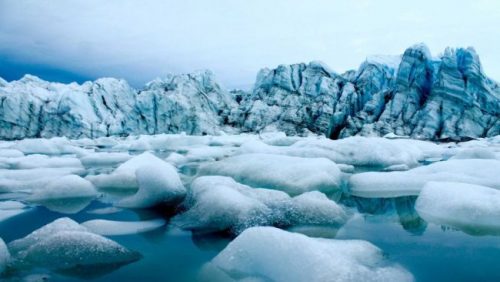
Greenland glacier loses 110 square kilometres’ worth of ice, ABC, 14 Sept 20, A chunk of Greenland’s ice cap estimated to be
Scientists say the incident is evidence of rapid climate change. The glacier section broke off the fjord called Nioghalvfjerdsfjorden, which is about 80 kilometres long and 20 kilometres wide, the National Geological Survey of Denmark and Greenland (GEUS) reported. The glacier is at the end of the north-east Greenland ice stream, where it flows off land into the ocean. Annual end-of-melt-season changes for the Arctic’s largest ice shelf in the region are measured by optical satellite imagery. GEUS showed area losses for the past two years each exceeded 50 square kilometres. “We should be very concerned about what appears to be progressive disintegration at the Arctic’s largest remaining ice shelf,” GEUS professor Jason Box said……. In August, a study showed that Greenland lost a record amount of ice during an extra-warm 2019, with the melt massive enough to cover the US state of California in more than 1.25 metres of water. https://www.abc.net.au/news/2020-09-14/chunk-of-greenlands-ice-cap-has-broken-off/12663510 |
|
|

Nuclear power is not climate-effective, simply because of comparative costs and delays

 This is a thorough analysis of the costs and time delays of nuclear power, as compared with those of energy efficiency and renewables. It does show that in the fight to stop climate change, the push for nuclear is a wasteful distraction.
My only problem with this argument is that it seems to imply that, apart from its exorbitant costs and delays, nuclear power might be effective. Not so!
Nuclear reactors make climate change worse, September 13, 2020 by beyondnuclearinternational
Being carbon-free does not establish climate-effectiveness, By Amory B. LovinsMost U.S. nuclear power plants cost more to run than they earn. Globally, the World Nuclear Industry Status Report 2019 documents the nuclear enterprise’s slow-motion commercial collapse—dying of an incurable attack of market forces. Yet in America, strong views are held across the political spectrum on whether nuclear power is essential or merely helpful in protecting the Earth’s climate—and both those views are wrong. In fact, building new reactors, or operating most existing ones, makes climate change worse compared with spending the same money on more-climate-effective ways to deliver the same energy services. Those who state as fact that rejecting (more precisely, declining to bail out) nuclear energy would make carbon reduction much harder are in good company, but are mistaken. If you haven’t heard this view before, it’s not because it wasn’t published in reputable venues over several decades, but rather because the nuclear industry, which holds the microphone, is eager that you not hear it. Many otherwise sensible analysts and journalists have not properly reported this issue. Few political leaders understand it either. But by the end of this article, I hope you will. For the details and documentation behind this summary, please see pp. 228–256 of the World Nuclear Industry Status Report 2019. A supporting paper provides simple worked examples of how to compare the “climate-effectiveness” of different ways to decarbonize the electricity system. Nuclear power’s potential role in the global climate challenge If the nuclear one-tenth of global electricity generation displaced an average mix of fossil-fueled generation and nothing else, it would offset 4% of fossil-fuel CO2 emissions. So in an era of urgent climate concern, should nuclear power continue, shrink, or expand? In May 2020, a report by the International Energy Agency claimed that not sustaining and even expanding nuclear power would make climate solutions “drastically harder and more costly.” To check that claim, we must compare nuclear power with other potential climate solutions. Here I’ll use only two criteria—cost and speed—because if nuclear power has no business case or takes too long, we need not address its other merits or drawbacks. How should we compare different ways to provide electrical services in a carbon-constrained world? Our society built coal-fired power plants by counting cost but not carbon. Nuclear advocates defend their preference by counting carbon but not cost. But to protect the climate, we must save the most carbon at the least cost and in the least time, counting all three variables—carbon and cost and time. Costly options save less carbon per dollar than cheaper options. Slow options save less carbon per year than faster options. Thus even a low- or no-carbon option that is too costly or too slow will reduce and retard achievable climate protection. Being carbon-free does not establish climate-effectiveness. Since in reality money and time are both limited, our priorities in providing energy services must be informed by relative cost and speed. Lower cost saves more carbon per dollar. Faster deployment saves more carbon per year. We need both. Buying nuclear power displaces buying some mixture of fossil-fueled generation, renewable generation, and efficient use. Nuclear owners strive to beat coal and gas while their allies often disparage or suppress renewables. Yet most US nuclear plants are uneconomic just to run, so many are closing. To keep milking those old assets instead, their powerful owners seek and often get multi-billion-dollar bailouts from malleable state legislatures for about a tenth of the US nuclear fleet so far. Such replacement of market choices with political logrolling distorts prices, crowds out competitors, slows innovation, reduces transparency, rewards undue influence, introduces bias, picks winners, invites corruption, and even threatens to destroy the competitive regional power markets where renewables and efficiency win. Yet many political leaders think climate’s urgency demands every option, including preserving nuclear power at any cost. So what is that cost, construed in the narrowest economic terms? Costs of new nuclear power vs. competing options Costly options save less carbon per dollar than cheaper options. Slow options save less carbon per year than faster options. Thus even a low- or no-carbon option that is too costly or too slow will reduce and retard achievable climate protection. Being carbon-free does not establish climate-effectiveness. Since in reality money and time are both limited, our priorities in providing energy services must be informed by relative cost and speed. Lower cost saves more carbon per dollar. Faster deployment saves more carbon per year. We need both. Buying nuclear power displaces buying some mixture of fossil-fueled generation, renewable generation, and efficient use. Nuclear owners strive to beat coal and gas while their allies often disparage or suppress renewables. Yet most US nuclear plants are uneconomic just to run, so many are closing. To keep milking those old assets instead, their powerful owners seek and often get multi-billion-dollar bailouts from malleable state legislatures for about a tenth of the US nuclear fleet so far. Such replacement of market choices with political logrolling distorts prices, crowds out competitors, slows innovation, reduces transparency, rewards undue influence, introduces bias, picks winners, invites corruption, and even threatens to destroy the competitive regional power markets where renewables and efficiency win. Yet many political leaders think climate’s urgency demands every option, including preserving nuclear power at any cost. So what is that cost, construed in the narrowest economic terms? Costs of new nuclear power vs. competing options On 7 November 2019, the eminent 170-year-old financial house Lazard published its 13th annual snapshot of relative 2019-$ prices for different ways to generate a megawatt-hour of electricity. The analysis is authoritative though imperfect. ……. Lazard’s comparison between new electricity resources is stark:…… New nuclear plants will save many-fold less carbon per dollar than competing carbon-free resources, in proportion to their relative costs. And new reactors’ expected performance must be tempered by historical experience: of the 259 power reactors ordered in the US, by mid-2017 only 28 units or 11% had been built, were still competitive in their regional markets, and hadn’t suffered at least one outage lasting at least a year. Should existing nuclear plants keep operating? Today’s hot question, though, is not about new US reactors, which investors shun, but about the existing reactors, already averaging about a decade beyond their nominal original design life. Most now cost more to run—including major repairs that trend upward with age—than their output can earn. They also cost more just to run than providing the same services by building and operating new renewables, or by using electricity more efficiently. So let’s go step by step through an eyechart about nuclear operating costs—which exclude original construction and financing costs (all sunk and usually amortized), but include those costs that need not be paid if the plant is closed………….. closing a top-quartile-cost nuclear plant and buying efficiency instead, as utilities could volunteer or regulators require, would save considerably more carbon than continuing to run the nuclear plant. Some modern renewables too can now rival efficiency’s cost and could compete for that opportunity. Thus, while we close coal plants to save carbon directly, we should also close distressed nuclear plants and reinvest their large saved operating cost in cheaper options to save carbon indirectly. These two climate-protecting steps are not alternatives; they are complements. Replacing a closed nuclear plant with efficiency or renewables empirically takes only 1–3 years. If owners don’t give such advance notice—a common tactic to extort subsidies by making closure more disruptive—more natural gas might temporarily be burned, but then more than offset over the following years by the carbon-free substitutes. California’s biggest utility will therefore replace its well-running Diablo Canyon reactors with least-cost carbon-free resources to save money and carbon and to help the grid work better. To get these outcomes, we must track not just carbon but also money and time. Investing judiciously, not indiscriminately, saves the most carbon per dollar. What about per year? Which technologies are faster to deploy?……………. Global carbon-free electricity is now less than one-third nuclear. Counting also carbon-free production of non-electric energy—biofuels and modern renewable heat—nuclear power struggles to sustain less than one-fourth of the world’s carbon-free final energy use. Why pay more to revive it at the expense of faster and cheaper competitors? Sustaining uneconomic reactors would not only divert public funding from more climate-effective competitors but also constrain their sales and degrade the competitive markets where they thrive. Slowing and blocking the fastest and cheapest climate solutions harms climate protection. How high can US nuclear subsidies go? Meanwhile, back in the United States, the climate-effectiveness of continued nuclear operations is not discussed; the conversation focuses solely on carbon, not on cost or time. Indeed, the industry’s immense lobbying power has now hatched a brazen new way to make taxpayers or customers pay for existing nuclear plants and disadvantage their most potent supply-side competitor (modern renewable power), and reduce and retard climate protection while claiming to increase it. Rarely have so many been so deceived so thoroughly, for so long, at such cost.……..https://beyondnuclearinternational.org/2020/09/13/nuclear-reactors-make-climate-change-worse/ |
|
American TV news covers wildfires, but mostly is careful not to mention climate change
 Most wildfire coverage on American TV news fails to mention link to climate crisis
A media watchdog analysis found that just 15% of broadcast news segments over a September weekend made the connection to climate breakdown, https://www.theguardian.com/environment/2020/sep/11/american-tv-news-california-oregon-fires-climate-crisis Lois Beckett in Los Angeles and Maanvi Singh in San Francisco
Most news coverage of the wildfires raging in California, Washington and Oregon on American TV channels made no mention of the connection between the historic fires and climate crisis, according to a new analysis from Media Matters
Reviewing coverage aired over the 5-8 September holiday weekend, the progressive media watchdog group found that only 15% of corporate TV news segments on the fires mentioned the climate crisis. A separate analysis found that during the entire month of August only 4% of broadcast news wildfire coverage mentioned climate crisis.
Wildfires are raging in states across the American west, burning record acreage in California, Washington and Oregon. The wave of fires was first sparked and stoked by a spate of unusual weather in August, including rare lightning storms that hit parts of California that were vulnerable to fire because drought and heat had dried out vegetation. The fires came before low-elevation, coastal parts of the state reached peak fire season in the autumn when fierce offshore winds have driven the biggest fires in recent years.
The fires that hit Oregon in recent days were stoked by dry conditions and rare easterly winds.
Although untangling the weather conditions from climate crisis is complicated, it’s clear that overall, in recent years “fire risk is increasing dramatically because of climate change”, said Chris Field, who directs the Stanford Woods Institute for the Environment. Global heating has given rise to drier, hotter conditions and more frequent, extreme droughts that have left the landscape tinder-dry and prone to explosive blazes.
Although California’s landscape has long been prone to fire, climate crisis has “put pressure on the entire system”, Field said, throwing it out of balance and giving rise to more extreme, catastrophic events. The current fires expanding with such explosive force have burned more acreage within a few weeks than what has burned in previous years.
A consensus of research has made clear that extreme heat and drought fueled by global heating has left the American west tinder-dry and especially vulnerable to runaway fires. A 2019 study found that from 1972 to 2018, California saw a five-fold increase in the areas that burned annually. Another study estimates that without human-caused climate crisis, the area that burned between 1984 and 2015 would have been half of what it actually was. And a research paper published last month suggests that the number of autumn days with “extreme fire weather” – when the risk of wildfires is extremely high – has more than doubled over the past two decades. “Our climate model analyses suggest that continued climate change will further amplify the number of days with extreme fire weather by the end of this century,” the researchers write, “though a pathway consistent with the UN Paris commitments would substantially curb that increase.”
Climate crisis is not the only factor driving the barrage of blazes across the region. Ironically, a century of suppressing fires – extinguishing the natural, necessary fires in western forests and other wildlands to protect homes and timber – has led to an accumulation of fire-fueling vegetation. “A deficit of fire, concatenated with the effects of climate change have led us here,” said Don Hankins, a fire ecologist at California State University, Chico.
Media Matters singled out two TV news journalists who are regularly talking about the role of climate crisis: the CBS meteorologist and climate specialist Jeff Berardelli and NBC’s Al Roker.
The Media Matters analysis also noted that so far, 2020 has been the third year in a row during which corporate broadcast TV news discussed the impacts of climate crisis in fewer than 5% of wildfire segments.
1 This Month



26 September – International Day for the Total Elimination of Nuclear Weapons


PLEASE OPPOSE HR 8255 AND S.3639 – bills would accelerate satellite deployment, with no environmental review or safeguards – https://ncstd5li.quorum.us/campaign/169331/
To see nuclear-related stories in greater depth and intensity – go to https://nuclearinformation.wordpress.com
-
Archives
- September 2026 (257)
- August 2026 (330)
- July 2026 (355)
- June 2026 (287)
- May 2026 (306)
- April 2026 (356)
- March 2026 (251)
- February 2026 (267)
- January 2026 (308)
- December 2025 (358)
- November 2025 (359)
- October 2025 (375)
-
Categories
- 1
- 1 NUCLEAR ISSUES
- business and costs
- climate change
- culture and arts
- ENERGY
- environment
- health
- history
- indigenous issues
- Legal
- marketing of nuclear
- media
- opposition to nuclear
- PERSONAL STORIES
- politics
- politics international
- Religion and ethics
- safety
- secrets,lies and civil liberties
- spinbuster
- technology
- Uranium
- wastes
- weapons and war
- Women
- 2 WORLD
- ACTION
- AFRICA
- Atrocities
- AUSTRALIA
- Christina's notes
- Christina's themes
- culture and arts
- Events
- Fuk 2022
- Fuk 2023
- Fukushima 2017
- Fukushima 2018
- fukushima 2019
- Fukushima 2020
- Fukushima 2021
- general
- global warming
- Humour (God we need it)
- Nuclear
- RARE EARTHS
- Reference
- resources – print
- Resources -audiovicual
- Weekly Newsletter
- World
- World Nuclear
- YouTube
-
RSS
Entries RSS
Comments RSS

