Hurricane shuts down Louisiana nuclear power station

Ida shuts Entergy’s Waterford-3 nuclear plant because of off-site power loss, S and P Global 31Aug 21,
Andrea Jennetta ,
1.2-GW Waterford-3 shut
992-MW River Bend-1 at 35%
Entergy shut its 1.2-GW Waterford-3 nuclear plant in Killona, Louisiana, at 6:12 pm CT Aug. 29 after off-site electrical power was lost because of Hurricane Ida, the US Nuclear Regulatory Commission said on Facebook Aug. 30.
Entergy spokesperson Mike Bowling said Aug. 30 that Waterford-3 was disconnected from the grid Aug. 29 at 10:29 am CT “per procedure as storm winds escalated.”
The company’s 992-MW River Bend-1 in St. Francisville, Louisiana, was operating at 35% of capacity early Aug. 30, NRC said.
The unit reduced power at the request of the Midcontinent Independent System Operator, Bowling said.
The action was taken “to preserve grid integrity” in the wake of Hurricane Ida, he said.
“The situation is fluid, and power levels could change in coordination with grid operators,” Bowling added……… https://www.spglobal.com/platts/en/market-insights/latest-news/electric-power/083021-ida-shuts-entergys-waterford-3-nuclear-plant-because-of-off-site-power-loss
Every euro invested in nuclear power makes the climate crisis worse’
Every euro invested in nuclear power makes the climate crisis worse’ https://www.dw.com/en/nuclear-climate-mycle-schneider-renewables-fukushima/a-56712368 29 Aug 21

Can nuclear energy help us meet climate goals? The editor of the World Nuclear Industry Status Report, Mycle Schneider, says no. He explains his stance to DW.
And if we’re talking about the construction of new power plants, then nuclear power is simply excluded. Not just because it is the most expensive form of electricity generation today, but, above all, because it takes a long time to build reactors. In other words, every euro invested in new nuclear power plants makes the climate crisis worse because now this money cannot be used to invest in efficient climate protection options.
As Japan marks the 10th anniversary of the Fukushima Daiichi nuclear disaster, the global conversation around the merits of using nuclear power to tackle the climate crisis remains hot. Many environmentalists are opposed, pointing to the risk of nuclear meltdowns and the difficulty of properly disposing of nuclear waste.
However, it has been championed by others for its ability to produce huge amounts of carbon-free energy. DW spoke to Mycle Schneider, editor of the annual World Nuclear Industry Status Report (WNISR), which assesses the status and trends of the global nuclear power industry.
DW: The goal is to keep global warming below 1.5 degrees Celsius (2.7 degrees Fahrenheit). What role can nuclear power play?
Mycle Schneider: Today we need to put the question of urgency first. It’s about how much we can reduce greenhouse gases and how quickly for every euro ($1.21) spent. So, it’s a combination between cost and feasibility, while doing it in the fastest possible way.
And if we’re talking about the construction of new power plants, then nuclear power is simply excluded. Not just because it is the most expensive form of electricity generation today, but, above all, because it takes a long time to build reactors. In other words, every euro invested in new nuclear power plants makes the climate crisis worse because now this money cannot be used to invest in efficient climate protection options.
What about existing nuclear power plants?
The power plants exist, they provide electricity. However, many of the measures needed for energy efficiency are now cheaper than the basic operating costs of nuclear power plants. That is the first point, and unfortunately it is always forgotten.
The second point is that renewables today have become so cheap that in many cases they are below the basic operating costs of nuclear power plants.
Let me give you two examples: The world’s lowest price for solar power in currently in Portugal, at 1.1 cents per kilowatt hour. And we now have the first results from Spain with costs for wind and solar power at around 2.5 cents per kilowatt hour. These are below the basic operating costs of the vast majority of nuclear power plants around the world.
It would often even be affordordable to pay 1 – 1.5 cents per kilowatt hour for electricity storage in addition to the generation costs for wind and solar power and still be below the operating costs of nuclear power plants. And here we have to ask the same question: How many emissions can I avoid with one euro, one dollar or one yuan?
So why are construction projects being announced now?
n the case of nuclear power, I often have the feeling that Trumpism prevails. Facts no longer matter. There is talk of plans and projects all over the place, but in reality, little or nothing actually happens. We document this in detail every year in the more than 300 pages of our World Nuclear Industry Status Report.
What sort of interests are behind this?
These are very clear self-interests. If the industry doesn’t launch phantom projects, then it will die even faster.
Why do politicians go along with it?
There are different interests here. During a visit to the Le Creusot forge in December 2020, for example, French President [Emmanuel] Macron made it clear that there are also military strategic interests in maintaining the nuclear industry. And France has never made a secret of the links between military and civil interests when it comes to nuclear.
In other countries like China there are different interests. China is funding infrastructure in a large number of countries through its Belt and Road Initiative, also known as the New Silk Road. This is geopolitics on a grand scale.
The co-financing of the Hinkley Point C nuclear power plant in Great Britain, for example, puts this into context. In this case, the fact that it is an inefficient project is irrelevant. The scale of Chinese infrastructure investments is huge. There’s talk of $1,000 billion (€821 billion). That means: You have to look at each country, because each country has their own self-interests.
What other interests do energy companies have in continuing to operate unprofitable reactors?
The main reason is that an operating nuclear power plant generates income. As soon as a nuclear power plant is decommissioned, liabilities appear in the balance sheet and additional expenses appear.
You can see an example of this in Japan. If often took years to officially close nuclear power plants because companies could not afford to remove these plants from their assets. Some of these operators would have gone bankrupt overnight.
There’s no doubt that energy companies like EDF in France face a serious financial crisis. The question is, how will they survive this? Certainly not without the help of massive state subsidies in the long term. But as long as they can keep earning money, even if it’s no longer profitable, investing in demolition and waste management isn’t a consideration.
How much does demolition cost?
In the order of €1 billion per reactor. In France, only a third of [the required funds] have been put aside. This means the problem starts once the reactors go offline.
What about the costs of the storage of high-level radioactive waste?
No one knows how much this really costs, because there is no functioning permanent storage facility.
Is there any chance of a permanent storage facility being operational in the future?
There is currently no operational permanent storage facility. The most advanced projects are in Finland and Sweden. However, the concept there is based on a design from the early 1980s, with storage in copper containers. However, recent research has shown that the copper containers are significantly more susceptible to corrosion than first thought. That means the viability of commissioning one of these facilities in Sweden or Finland is still totally unclear. It’s the same situation for other countries. They are even further behind on development or they don’t even have storage models, let alone locations.
How far along in this process are countries in Asia?
In Japan there is still no storage location or model. The same goes for Korea. In China they’re discussing whether or not nuclear waste should be reprocessed. That’s even further away.
Basically, these countries behave just like countries in the West where the nuclear power plants were built two or three decades ago. That means there is no advanced planning in place and no coherent concept as to how their highly radioactive nuclear waste should be stored for eternity.
Mycle Schneider is the initiator and lead author of the annual World Nuclear Industry Status Report, an independent reference report on the development of the global nuclear power industry. Schneider is an independent consultant to governments and international organizations around the world. In 1997 he was awarded the Alternative Nobel Prize (Right Livelihood Award).
This interview was conducted by Gero Rueter and adapted into English by Ineke Mules.
Hurricane Ida Shuts Down One Nuclear Plant in Louisiana.
Hurricane Ida Shuts Down One Nuclear Plant in Louisiana. Simply Info , August 29, 2021
Hurricane Ida prepares to make landfall mid day in Louisiana. The storm is predicted to be the strongest hurricane to hit the state in history as a strong cat 4. Hurricane Katrina had dropped to a category 3 by the time it made landfall yet caused extreme damage. Sustained winds reported this morning were 150 mph.
Entergy shut down Waterford nuclear plant around 10am Sunday due to the expected wind speeds. Ed Lyman at the Union of Concerned Scientists documented the flood risk at the plant when combining the predicted storm surge and rainfall. The plant may not flood in the reactor block area but it could end up surrounded by water. Entergy, the company that operates the plant mentioned they have sequestered enough staff on site to conduct needed operations and restart the plant whenever that might be possible. In Ed Lyman’s twitter posts about this issue he also cited dry cooling towers used at the site and that they require sump pumps to keep them operational. Depending on the water inundation that system could be offline until water recedes………….http://www.simplyinfo.org/?p=19672
Rocket launches may be damaging the ozone layer
Rocket launches could be affecting our ozone layer, say experts.
Industry experts are calling for more research into how launches affect our atmosphere, Nicole Mortillaro · CBC News · Apr 23, 2021
Industry experts are calling for more research into how launches affect our atmosphere Rocket launches are a breathtaking culmination of human ingenuity as they propel us into the future, but there is a growing concern that not enough research has been done on their effect on the environment.
While some may be worried about potential greenhouse gas emissions that’s not the main issue. Instead, it’s ozone depletion and the potential effects in our upper atmosphere, specifically the stratosphere, along with concerns about toxic fuels.
The problem has flown under the radar, according to Martin Ross, an atmospheric scientist at The Aerospace Corporation, because people still think of rocket launches as rare.
But it’s time to face the fact that we may be entering a boom era, he said.
“One of the arguments that people have used in the past was to say that we don’t really need to pay attention to rockets or to the space industry, or the space industry is small, and it’s always going to be small,” Ross said.
“But I think the developments that we’re seeing the past few years show that … space is entering this very rapid growth phase like aviation saw in the ’20s and ’30s.”
Black soot in the atmosphere
The stratosphere is an important weather driver for Earth’s systems, and that’s where some particles from rocket launches are ending up.
The ozone layer, which helps protect us from the sun’s harmful ultraviolet rays, is also located in the stratosphere. In 1990, the Montreal Protocol was signed into law, banning harmful ozone-depleting substances, such as chlorofluorocarbons (CFCs), used in things like refrigerators and air conditioners, after it was revealed that the ozone layer was being stripped away by these chemicals. While the protocol touched on airlines, there was no mention of the aerospace industry.
But now some industry experts are concerned that with no oversight, we could be in for a problem.
There are different types of rocket propellants. Some, like liquid oxygen and liquid hydrogen, produce mainly water vapour and have little environmental impact. These were used in past shuttle launches and even in the Apollo-era Saturn V vehicles.
Then there are those that produce alumina particles in the stratosphere, such as those in solid rocket boosters, which were also used in past shuttle launches, and are still being used today by some launch companies.
Finally, there are those that deposit black soot in the stratosphere, such as kerosene used in SpaceX’s Falcon 9 and Russia’s Soyuz rockets.
It’s the alumina and black soot that is most concerning to experts.
“The atmosphere is complex,” said Jessica Dallas, a PhD candidate at the Australian Centre for Space Engineering Research, in New South Wales. “We don’t have a complete understanding of atmospheric circulation and how all of the mechanisms in the atmosphere actually work. And so that means that we also don’t have a good idea of what happens when we’re injecting these particles into the stratosphere.”
Dallas, who wrote a comprehensive analysis of research on rocket propellants, said that she’s concerned that there haven’t been studies on how these particles interact in our atmosphere………………………. https://www.cbc.ca/news/science/rocket-launches-environment-1.5995252
Don’t Expect Real Climate Solutions From COP26. It Functions for Corporations.
Don’t Expect Real Climate Solutions From COP26. It Functions for Corporations. Simon Pirani, Truthout August 29, 2021
n the run-up to the United Nations Climate Change Conference (COP26) in the U.K. in November — the 26th session of the talks that were launched in Rio de Janeiro in 1992 — the governments of the world’s richest countries are making ever-louder claims that they are effectively confronting global warming. Nothing could be more dangerous than for social, labor and environmental movements to take this rhetoric at face value and assume that political leaders have the situation under control
There are three huge falsehoods running through these leaders’ narratives: that rich nations are supporting their poorer counterparts; that “net zero” targets will do what is needed; and that technology-focused “green growth” is the way to decarbonize.
First, wealthier countries claim to be supporting poorer nations — which are contributing least to global warming, and suffering most from its effects — to make the transition away from fossil fuels.
But at the G7 summit in June, the rich countries again failed to keep their own promise, made more than a decade ago, to provide $100 billion per year in climate finance for developing countries. Of the $60 billion per year they have actually come up with, more than half is bogus: analysis by Oxfam has shown that it is mostly loans and non-concessional finance, and that the amounts are often overstated.
Compare this degrading treatment of the Global South with the mobilization of many hundreds of billions for the post-pandemic recovery. Of $657 billion (public money alone) pledged by G20 nations to energy-producing or energy-consuming projects, $296 billion supports fossil fuels, nearly a third greater than the amount supporting clean energy ($228 billion).
Meanwhile, the impacts of climate change are magnified by poverty. This year’s floods, wildfires and record temperatures in Europe and North America have been frightful enough. The same phenomena cause far greater devastation outside the Global North.
In 2020, “very extensive” flooding caused deaths, significant displacement of populations and further impacts from disease in 16 African countries, the World Meteorological Organization’s (WMO’s) annual climate report recorded. India, China and parts of Southeast Asia suffered from record-breaking rainfall and flooding, too……………….
The political leaders’ second fiction is their pledge to attain “net zero” greenhouse gas emissions by 2050 (the U.S., U.K. and Europe) or 2060 (China).
“Net zero” signifies a point at which the amount of greenhouse gases being pumped into the atmosphere is balanced by the amount being withdrawn. Once, it may have been a useful way of taking into account the way that forests, in particular, soak up carbon dioxide. But three decades of capitulation to fossil fuel companies, since the UN Framework Convention on Climate Change was signed in 1992, have turned it into a monster of deceit.
Thanks to corporate capture and government complicity, many of the greenhouse gas emissions projections in the Intergovernmental Panel on Climate Change’s recent report factor in huge levels of carbon removal by dubious technologies that do not, and may never, work at scale (e.g., carbon dioxide removal, carbon capture and storage, and bioenergy with carbon capture and storage). Governments have drawn up “net zero” targets reliant on these myths………….
The politicians’ third and more complex deception is in the technology-centered “decarbonization” measures they embrace in the name of “green growth.” These rely on tweaking, rather than transforming, the big technological systems through which most fossil fuels are consumed — transport networks, electricity grids, urban infrastructure, and industrial, agricultural and military systems………………
In the U.S., community groups advocate zero-carbon energy systems as part of an integrated approach to a “just transition” away from fossil fuels.
Governments resist because the corporations resist. Energy corporations fear decentralized electricity generation outside of their control; property developers despise regulation that compels them to use zero-carbon building techniques; gas distributors hate electric heat pumps. Just as oil companies and car manufacturers dread radical decarbonization of transport, petrochemical giants fear plastic-free supply chains, big agribusiness is terrified by low-carbon food systems, and so on.
Climate researchers have shown that absolute zero (not “net zero”) emissions is entirely achievable, by reducing energy throughput and living differently. The path is blocked not by technological factors, but by political ones: by the dynamics of wealth and power that constitute capitalism — the same dynamics that force the burden of climate change on the Global South.
Tackling climate change involves overcoming those dynamics. It is not so much about replacing bad government with good government, as it is about subverting, confronting, confounding and defeating corporate power. It is about developing a vision of our collective future that goes beyond capitalism………….
The most powerful response to looming climate catastrophe will come not from within the COP26 process, but from outside it, in the actions of grassroots organizers, communities, social and labor movements, and of society as a whole. https://truthout.org/articles/dont-expect-real-climate-solutions-from-cop26-it-functions-for-corporations/?
Vulnerability of Louisiana’s Waterford 3 nuclear plant to storm surge
Intensifying Hurricane Ida a significant threat to key infrastructure. Ida is forecast to hit the industrial corridor between Baton Rouge and New Orleans, site of three key ports, petrochemical sites, and a nuclear power plant. Yale Climate Connections, by JEFF MASTERS and BOB HENSON, AUGUST 29, 2021
Vulnerability of Waterford 3 nuclear plant to storm surge. Although it lies 65 miles inland from the south coast of Louisiana, the Waterford 3 nuclear generating station, located at an elevation of 10-15 feet on the south shore of the Mississippi River, is vulnerable to storm surge from a major hurricane. Hurricane Betsy, a category 4 storm that hit Louisiana in 1965, brought a storm surge to the edge of the plant’s location (Figure 3 on original).
According to a 2019 analysis by Bloomberg, the Waterford 3 plant is designed to withstand a maximum storm surge of 23.7 feet above sea level, or about 10 feet higher than the plant’s elevation. According to NOAA’s National Storm Surge Hazard database, a worst-case category 3 hurricane could flood the plant to a depth of 3’, while a worst-case category 4 hurricane could flood the plant to a depth of more than 9’ – near its design limit. Fortunately, storm surge modeling by Louisiana State University using the 11 a.m. EDT Saturday NHC forecast showed Ida’s storm surge stopping just short of the plant (Figure 4 on original)
After the 2011 disaster at Japan’s Fukushima nuclear power plant, the Waterford 3 plant moved to store all of its emergency generators, pumps, and other essential safety equipment in a 30-foot flood-proof concrete bunker – a system called Flex, for Flexible Mitigation Capability. The bunker has manually operated and powered sump pumps to remove water in the event of a flood.
After the 2011 disaster at Japan’s Fukushima nuclear power plant, the Waterford 3 plant moved to store all of its emergency generators, pumps, and other essential safety equipment in a 30-foot flood-proof concrete bunker – a system called Flex, for Flexible Mitigation Capability. The bunker has manually operated and powered sump pumps to remove water in the event of a flood…………………….. https://yaleclimateconnections.org/2021/08/intensifying-hurricane-ida-a-significant-threat-to-key-infrastructure/
Hurricane Ida threatens 2 nuclear power stations in Louisiana
Two Nuclear Plants In Ida’s Path As Storm Expected At Cat 4, Simply Info, [excellent pictures and maps]
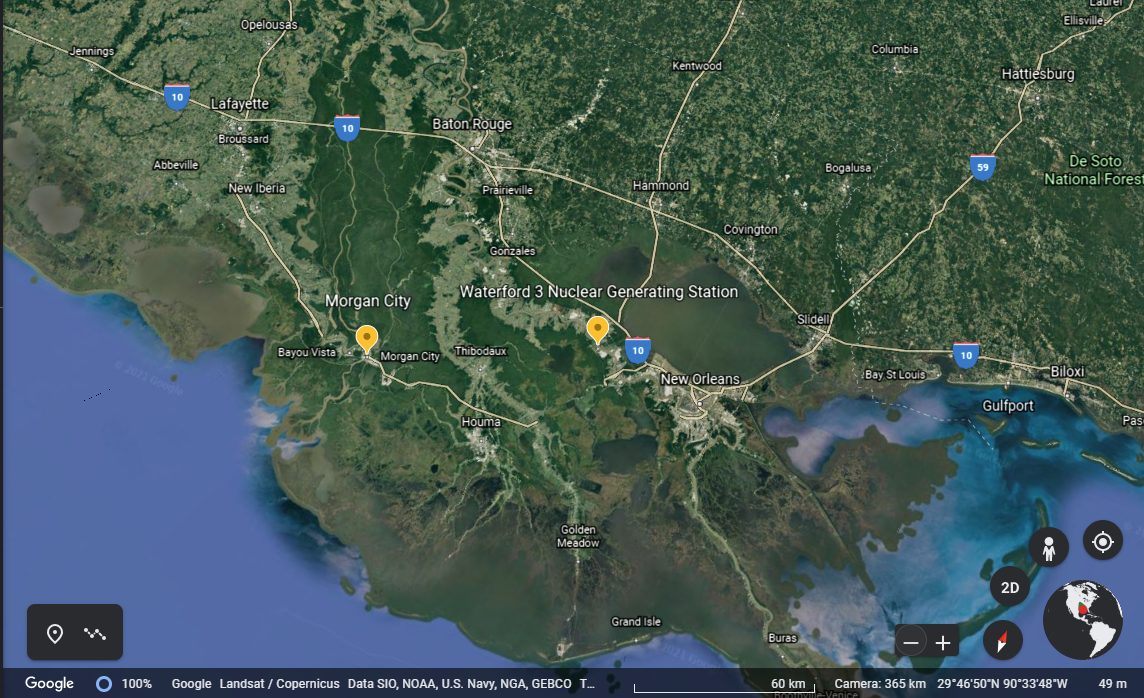
Hurricane Ida is expected to hit the US as a category 4 storm. The Weather Channel projects Sunday night landfall and a direct hit on Louisiana. Storm surges in the area range from the Texas border to Mobile Alabama.
Two nuclear power plants are in the direct storm path. River Bend and Waterford. Waterford sits near the mouth of the Mississippi and in the zone of the highest expected storm surge. Current estimates have a 10-15 foot surge expected for that area. This could be potentially more severe as the storm pushes water up the Mississippi River. Waterford sits about 24 miles from the mouth of the river and is next to Lake Pontchartrain……………..more http://www.simplyinfo.org/?p=19660
Nuclear and Climate Clash – Russia’s nuclear weapons centre threatened by wildfires.

The fires have reached the closed city of Sarov, which has been a center for nuclear research since the Soviet era and was the site of the first Soviet atomic bomb’s development.
Today, the research center makes nuclear warheads and is believed to be developing Russia’s strategic missiles, including its highly touted hypersonic arsenal.
Wildfires Near Russia’s Nuclear Research Center Spark State of Emergency https://www.themoscowtimes.com/2021/08/24/wildfires-near-russias-nuclear-research-center-spark-state-of-emergency-a74878 Aug. 24, 2021 Russian authorities have declared an interregional state of emergency as tough-to-contain forest fires threaten the country’s top-secret nuclear weapons research center, Interfax reported Tuesday, citing the emergencies ministry.
Wildfires have raged in the Nizhny Novgorod region and the neighboring republic of Mordovia, both roughly 500 kilometers east of Moscow, since early August.
The fires have reached the closed city of Sarov, which has been a center for nuclear research since the Soviet era and was the site of the first Soviet atomic bomb’s development.
Today, the research center makes nuclear warheads and is believed to be developing Russia’s strategic missiles, including its highly touted hypersonic arsenal.
Firefighters have struggled to contain the fires due to hard-to-reach terrain, dead wood that remained after the 2010 wildfires and poor weather conditions.
Several aircraft from the Emergency Situations Ministry and Defense Ministry have been deployed to fight the fires.
The emergencies ministry told Interfax that two helicopters and a Be-200ES aircraft will be deployed to the site of the fires on Wednesday.
Russia has been hit hard by an unprecedented wildfire season fueled by historic heatwaves and drought conditions exacerbated by climate change, particularly in Siberia.
Nuclear lobby miserable, but Friends of the Earth relieved, that nuclear industry is excluded from the Green Zone at COP26 Climate Summit.

We’re barred from COP26’: nuclear industry complains after rejected applications https://theferret.scot/were-barred-from-cop26-nuclear-industry-complains/ Paul Dobson, August 19, 2021
The international nuclear energy industry has complained about being excluded from the COP26 climate summit in Glasgow — prompting environmentalists to say it should have “no place” there.
In a letter to COP26 UK president, Alok Sharma, global trade body, the World Nuclear Association, said that every application made by nuclear groups for exhibits at the conference had been rejected.
This was “very disappointing”, the association told The Ferret. A Scottish environmental group, however, said that it was “right” to keep the nuclear industry out.
Nuclear power is seen by some as clean energy because they say it doesn’t emit greenhouse gases when producing electricity. But it has faced continual opposition from environmental groups due to high costs, complications with decommissioning and the need to dispose of radioactive waste.
The World Nuclear Association, which lists 183 nuclear companies as members, said it was “deeply concerned” that plans for nuclear exhibits in civil society’s Green Zone at COP26 had been turned down.
The Green Zone is billed as a space for organisations to host “workshops, panel discussions and keynote speeches” which “promote dialogue, awareness, education and commitments” on the climate crisis.
The Cabinet Office COP26 unit said it had received “a huge level of interest” from groups wanting to be in the Green Zone. “Discussions are still ongoing”, stressed a spokesperson, pointing out that “limited capacity” meant not all applicants could be accommodated.
Richard Dixon, Friends of the Earth ScotlandThe UK Government is managing the Green Zone, which will be located at the Glasgow Science Centre for the duration of the conference in November. Officials are determining which organisations will be granted space at the venue.
COP26, which stands for the UN’s 26th Conference of the Parties on Climate Change, is being held at the Scottish Events Campus (SEC) in Glasgow between 1-12 November. It is widely viewed as the last chance for world leaders to reach an agreement which mitigates the worst impacts of the climate crisis.
As part of the application process, organisations interested in making use of space in the Green Zone were required to provide details of their “sustainability or environmental policies”.
Businesses looking to host Green Zone events also had to be signed up to the Science Based Targets initiative and the Race to Zero campaign. These are UN schemes aimed at ensuring companies have “credible” plans to achieve net-zero emissions.
The Green Zone will be open to the general public and successful applicants could present to audiences of 200 people at a time.
Friends of the Earth Scotland criticised the criteria for getting a platform in the Green Zone as too weak. “But if they are keeping the nuclear industry out then they are definitely getting that bit right,” said the group’s director, Richard Dixon.
“Having failed with the ridiculous claim that nuclear is cheap, the latest wheeze from the nuclear industry is to tell us that nuclear reactors are the answer to climate change.”
There was an “very urgent” need to reduce emissions, Dixon argued. “The nuclear industry’s disastrous history of cost and time overruns show very clearly that what they offer would be too little, too expensive and far too late.”
The World Nuclear Association, however, insisted that nuclear power could help “meet increasing demand for low-carbon electricity”. Nuclear reactors could also play a role in “eliminating the use of fossil fuels in the production of glass and steel”, it said.
The association’s rejected exhibits would have made these points. They were also going to showcase plans to use nuclear energy in the future production of green hydrogen, which the industry says could be used as fuel to help decarbonise the economy.
The association hoped that the exclusion of its exhibits was not “indicative” of the way it will be treated throughout COP26. “It is very disappointing that no nuclear exhibits were selected for the UK’s Green Zone exhibition,” said an association spokesperson.
“More and urgent action is needed to advance the use of a broad range of low-carbon technologies, including nuclear, if we are to avoid the catastrophe that runaway climate change would cause.”
The association also confirmed that two unnamed UK-based nuclear trade associations have applied to be included in side events taking place within the UN-managed Blue Zone at COP26.
The Blue Zone will be inside the SEC alongside the main negotiations at the conference. Access will be limited to national delegations and accredited businesses and activist groups.
The two UK nuclear associations hope to be involved in panel discussions with what they consider “fellow clean energy groups”, including the renewables industry.
The UN is set to publish a list of organisations participating in side events in the Blue Zone on 30 September.
In July, The Ferret revealed that 19 nuclear industry executives were among a host of companies, including major fossil fuel polluters, who were part of key UN climate negotiations in the lead up to COP26.
This story is the fourth of a series The Ferret is planning in the run-up to COP26 in November. Investigations have been supported by the European Climate Foundation, which cannot be held responsible for any use which may be made of the information contained or expressed therein.
Bill Gates and the corporates behind the fake solutions to climate change

Gates: the interests behind the fake solutions to climate change, Navdanya International 02/04/2021 In Bill Gates’ vision, technology seems fated to fix every single damage that has been inflicted on our planet and climate change has recently been added to the list. But this is the same mentality that has taken us to the devastating stage we currently find ourselves in, while the only thing improving exponentially is the profits of the corporations taking advantage by selling these very technologies. It is necessary to step out of this technofix hysteria in order to reclaim a holistic vision based on real farmers, healthy and nutritious food, and on an agroecological model that does not impact on climate but, instead, helps to mitigate it. No fake burger can do that. The latest report from Navdanya International, “Bill Gates & his Fake Solutions to Climate Change“, details the reasons behind Bill and Melinda Gates’ attempts to focus the debate on miraculous technologies and the real interests behind its propaganda.
While Gates’ many investments are all seemingly justified by a noble humanitarian and environmental cause, the report shows that they actually allow him to impose his techno-solutionist strategy through direct influence over all types of global development protagonists.
But this game of billionaire profit-making and corporate partnerships is even clearer in one of Gates’ most prominent personal investment funds: Breakthrough Energy Ventures. The companies funded by Breakthrough are riddled with ex DuPont, Monsanto, PepsiCo, and Microsoft executives, revealing how the same corporations which precipitated our health and ecological crisis are now selling us back equally risky solutions to the problems they created in the first place……….. https://navdanyainternational.org/gates-the-interests-behind-the-fake-solutions-to-climate-change/
If children are to live with the climate crisis, we must green the curriculum
If children are to live with the climate crisis, we must green the curriculum, Guardian, Meryl Batchelder,
It’s clear to me when I teach that sustainability and the environment should be a thread running through every subject
Thu 19 Aug 2021 ”……………….. With so much focus on children – the ones who will have to live with the coming ecological disaster – the role of education is key. This summer has seen unprecedented wildfires and floods. Pupils see scenes of biblical devastation on the news, but in many schools they are not being given the required information or context and this can lead to misunderstanding or anxiety.
……………. There is still no mention of the climate crisis in the national curriculum for England in primary schools, and in key stage 3 science very little of the curriculum relates to climate education. Incredibly, the last major update to the national geography curriculum for England in 2013 saw the then education secretary, Michael Gove, attempt to drop climate change.
………….. So what needs to change? We need a green curriculum that starts in early years and extends through all key stages. Properly taught, climate change education should be a thread through all subjects – not just science and geography – from the food miles of the ingredients we cook in food technology to debates on humanitarian issues such as mass migration in religious education or personal, social, health and economic (PSHE) education.
Working in a state school means I am duty bound to teach lessons within the confines of the national curriculum. As far as this allows, I have sought to enrich my pupils’ learning with fieldwork, hands-on science, technology, engineering and mathematics (STEM) challenges and even gardening. But not every school has the resources or expertise to bring climate education into the classroom. Earlier this year, the climate education campaign group Teach the Future reported that seven in 10 UK teachers say they have not received adequate training to educate their students on the climate crisis……….. https://www.theguardian.com/commentisfree/2021/aug/19/children-climate-crisis-green-curriculum-sustainability-environment—
Dungeness area in England set to go underwater as global heating continues
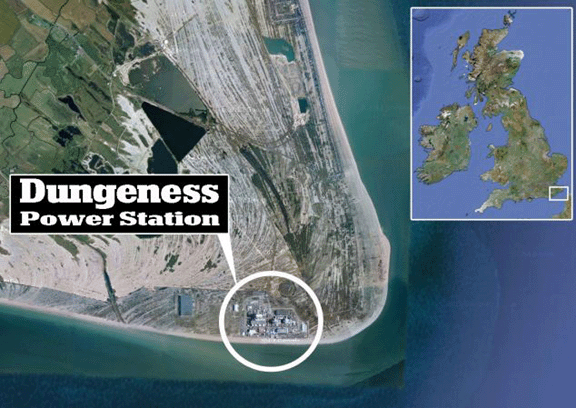
The Kent beaches set to be wiped out in 30 years because of climate
change. New data suggests that large parts of Kent could regularly fall
below sea level by the year 2050. The southern side of Kent looks to be
greatly impacted, with the entire Dungeness area to be underwater.
Kent Live 15th Aug 2021
https://www.kentlive.news/news/kent-news/kent-beaches-set-wiped-out-5789954
If nuclear power is adopted as the way ahead, the climate fight will be lost

We need to invest, and in terms of bangs per buck, we only have a certain amount, and nuclear eats up all the pies. Nuclear is so prohibitively expensive that it has the potential to undercut seriously our other more practical, economic, doable, viable climate response options.”
Climate change can be defeated. It can be defeated because this century has so far witnessed an extraordinary revolution in renewable energy and supporting technologies such as energy storage. As a new report from IRENA
pointed out,” The decade 2010 to 2020 saw renewable power generation becoming the default economic choice for new capacity.” So far this century, worldwide renewable power generation has increased three-fold.
Bear in mind that if in the year 2000 you had talked about the prospects of wind and solar, most experts would have laughed at you. This is because the costs back then were prohibitive. “Costs for electricity from utility-scale solar photovoltaics (PV) fell 85 per cent between 2010 and 2020,” states IRENA. That means the costs halved almost three times in a decade.
Of course, renewable cynics say that solar does not follow an exponential function, but if the price falls of the last decade and two decades can not be described by an exponential function, it is difficult to say what can. If we can rapidly move to net zero, we will create a staggering amount of wealth via more efficient use of energy, but if we
don’t do that, we will pay an enormous cost in terms of damage to the environment. there is a risk. If instead of renewables, we adopt nuclear, then the fight against climate change will be lost.
Paul Dorfman explained that nuclear is a very poor compliment to renewables. “Nuclear is very bad at ramping up and ramping down. So if the sun doesn’t shine or the wind doesn’t blow, you need something to switch on. Now nuclear doesn’t switch on. So the very last thing you need to support so-called intermittent renewables is nuclear.” He added, “
We need to invest, and in terms of bangs per buck, we only have a certain amount, and nuclear eats up all the pies. Nuclear is so prohibitively expensive that it has the potential to undercut seriously our other more practical, economic, doable, viable climate response options.”
Techopian 10th Aug 2021
https://www.techopian.com/climate-change-good-news-rubs-shoulders-with-the-bad-news/
Urgency of the IPCC climate report makes it clear that new nuclear is not the answer
The urgency of the IPCC report highlights the need to prioritise renewables and decentralised energy, and move away from new nuclear, says NFLA
Like many organisations, the UK and Ireland Nuclear Free Local Authorities (NFLA) reads the new report of the Intergovernmental Panel on Climate Change with a sense of alarm, but also new motivation to highlight the urgency to reduce carbon emissions across the board.
The IPCC report published yesterday says there are no scenarios where a 1.5 degrees Celsius increase in temperature in the world will now not be avoided, meaning some of the negative challenges of climate change will take place. This is now largely and almost entirely due to the actions of humanity in neglecting to reduce carbon emissions over previous decades, and not moving away from fossil fuels sooner.
In its analysis of the IPCC report, BBC Environment Correspondent Matt McGrath notes (1):
- Climate change is widespread, rapid and intensifying due to human actions (and inaction in preventing it).
- Extreme heat events, like that taking place presently across southern Europe, North America and northern Russia, will become more frequent.
- The 1.5C global temperature increase limit is now on ‘life support’. Keeping temperatures under this level was a key 2050 target, but the IPCC suggests the world will hit it possibly as early as 2030. The IPCC has previously said there are great advantages of staying under the 1.5C limit compared to a 2C temperature increase. To do that, it argued carbon emissions would need to be cut in half by 2030 and net zero emissions reached by 2050. Otherwise, the limit would be reached between 2030 and 2052.
- Under all likely scenarios, global sea levels will rise. The IPCC report shows that under current scenarios, the seas could rise above the likely range, going up to 2m by the end of this century and up to 5m by 2150. While these are unlikely figures, they cannot be ruled out under a very high greenhouse gas emissions scenario.
- There will be an increase in extreme rainfall, creating the types of serious flooding recently seen in the likes of Germany, Belgium and the Netherlands.
The core message of the IPCC report is the huge urgency in getting carbon emissions down as quickly as possible. For example, it notes the need to reduce methane emissions from oil, gas, agriculture and rice cultivation should be a core priority for all governments……………
For NFLA as well, the urgency of this report should now preclude the obsession from the UK Government to deliver new nuclear. It is in this decade when large carbon reduction is required, whilst any new nuclear development will be unlikely to be making any great impression until the 2030s at the very earliest. The billions being suggested to either bail out Hinkley Point C or back Sizewell C, or fund Rolls Royce’s ‘small’ modular nuclear reactor programme, would now be far better directed towards the cheaper, cleaner and more easily realisable renewable and energy efficiency programmes.
The IPCC report tells all of us to get real. NFLA agree. Our reports on best practice in delivering local decentralised energy solutions in carbon reduction show a positive way forward. (2) Our reports showing the heavy costs and technical challenges of new nuclear, as well as of the huge decommissioning and radioactive waste management costs of our existing nuclear legacy, emphasise as well that nuclear is not part of the solution to deliver a net zero response by 2050. (3) It is high time for radical change, and most Councils are ready for it – now it needs central government to respond to this highly alarming IPCC report………..
It is also clear to me and the NFLA that new nuclear is not the answer to this urgent emergency – it takes too long, costs too much and the existing nuclear legacy needs to be dealt with, not creating more radioactive waste that we still do not know what to do with. ,,,,NFLA UK & Ireland Steering Committee Chair Councillor David Blackburn ………… https://www.nuclearpolicy.info/news/urgency-ipcc-report-highlights-need-prioritise-renewables-and-decentralised-energy-move-away-from-new-nuclear/
NO SUPPORT for NUCLEAR in the new report from Intergovernmental Panel on Climate Change (IPPC).

10 Aug 21, The report is comprehensive on the present and future impacts of global heating, and on what needs to be done. But nuclear power as a method for action is not included.
Indeed, nuclear power is barely mentioned, and when it is, its negative effects on climate and environment are mentioned.
Page 236 line 39 – “Radioactive fallout from atmospheric nuclear weapons testing (1940s–1950s) and urban smog (1950s– 1960s) first provoked widespread attention to anthropogenic aerosols and ozone in the troposphere”
Page 261 – reference to nuclear war and volcanic eruptions
Page 309 – another reference to impacts of nuclear weapons
Page 971 – line 23 – reference to a nuclear holocaust – in reference to future uncertainties
Page 1380 – line 33 discussion on 14C released from nuclear weapons uptake into the ocean
Page 3161 – line 15 – 17 “Thermal and nuclear electricity plants may be challenged when using warmer river waters for cooling or when mixing waste waters back into waterways without causing ecosystem impacts (Kopytko and Perkins, 2011; van Vliet et al., 2016; Tobin et al., 2018)
1 This Month
19 February – VIRTUAL EVENT-Decision Time: AI and Our Nuclear Arsenal
12:45 p.m. Central / 1:45 p.m. Eastern
To see nuclear-related stories in greater depth and intensity – go to https://nuclearinformation.wordpress.com
-
Archives
- February 2026 (170)
- January 2026 (308)
- December 2025 (358)
- November 2025 (359)
- October 2025 (376)
- September 2025 (258)
- August 2025 (319)
- July 2025 (230)
- June 2025 (348)
- May 2025 (261)
- April 2025 (305)
- March 2025 (319)
-
Categories
- 1
- 1 NUCLEAR ISSUES
- business and costs
- climate change
- culture and arts
- ENERGY
- environment
- health
- history
- indigenous issues
- Legal
- marketing of nuclear
- media
- opposition to nuclear
- PERSONAL STORIES
- politics
- politics international
- Religion and ethics
- safety
- secrets,lies and civil liberties
- spinbuster
- technology
- Uranium
- wastes
- weapons and war
- Women
- 2 WORLD
- ACTION
- AFRICA
- Atrocities
- AUSTRALIA
- Christina's notes
- Christina's themes
- culture and arts
- Events
- Fuk 2022
- Fuk 2023
- Fukushima 2017
- Fukushima 2018
- fukushima 2019
- Fukushima 2020
- Fukushima 2021
- general
- global warming
- Humour (God we need it)
- Nuclear
- RARE EARTHS
- Reference
- resources – print
- Resources -audiovicual
- Weekly Newsletter
- World
- World Nuclear
- YouTube
-
RSS
Entries RSS
Comments RSS
 nuclear-news