Average global temperatures are forecast to reach near-record levels in the next five years, with Arctic temperatures expected to warm faster than other regions, a report by the U.N. weather agency and the UK’s Met Office said on Thursday. The annual report, opens new tab which gives regional predictions for temperatures and rain predicts that annual global mean near-surface temperatures will range between 1.3°C and 1.9°C above the 1850-1900 pre-industrial period.
COMMENT. The above video does tackle the problem, but eventually in a rather limited way, even putting in an advertisement for nuclear power as a way to combat climate change!
The military-industrial complex is not merely burning the planet. It is funding the political opposition to anyone attempting to put out the fire.
Every modern war is also a chemical event, a water event, an atmospheric event — consequences that accumulate in soil and groundwater long after the last ceasefire is signed and the reconstruction contracts are issued to the same companies that manufactured the weapons.
As global military spending surges to record levels, the climate cost of war and rearmament remains largely uncounted, unreported and exempt from scrutiny, writes Wayne Hawkins.
HUMANITY HAS A PROBLEM. Actually, humanity has several, but let us focus on the one where we are simultaneously spending nearly $3 trillion a year preparing to destroy civilisation while solemnly promising to save it.
Welcome to the military-industrial complex’s quiet war on the atmosphere. Fought without declaration. Exempt from accounting. Winning convincingly.
The number nobody counts
Here is a figure worth sitting with. Scientists for Global Responsibility estimate that the global military sector produces around 2.75 billion tonnes of CO₂ every year. That is not from active wars. That is peacetime — bases humming, jets training, supply chains churning.
If the world’s militaries were a country, they would be the fourth-largest emitter on Earth, behind only the United States, China and India. They would also be the only “country” explicitly exempt from international climate reporting requirements. Convenient.
The year 2025 was a banner year for the defence industry. Global military spending hit a record $2.887 trillion — the 11th consecutive year of growth. Europe increased defence budgets by 14%. NATO, not to be outdone, set a new target of 5% of GDP by 2035. The United States, briefly the exception, has already approved over $1 trillion for 2026, with $1.5 trillion potentially on the way.
Meanwhile, at COP30 in Belém in November, delegates scrutinised aviation, agriculture, steel and cement for their climate contributions. War did not make the agenda. Presumably, the irony was noted and filed.
When the shooting starts, so does the scoreboard
The moment active conflict begins, the numbers stop being merely alarming and start becoming geological. Russia’s invasion of Ukraine has generated an estimated 311million tonnes of CO₂ equivalent — comparable to the combined annual emissions of Belgium, New Zealand, Austria and Portugal. Not accumulated over decades — since February 2022.
The first 15 months of the war in Gaza produced more than 33 million tonnes. And these calculations do not fully capture the elegant brutality of modern warfare’s climate toolkit.
Russia’s strikes on Ukrainian electrical infrastructure have released sulfur hexafluoride – a greenhouse gas 24,000 times more potent than CO₂ – from high-voltage switching equipment. Civilian aircraft rerouting around the conflict zone has added an estimated 20 million extra tonnes of CO₂ equivalent. The planet did not get a vote on any of these design choices.
A 2025 Nature Communications study made the structural logic plain: rising global military spending is directly incompatible with limiting warming to 1.5–2°C. Military industries emit nearly twice the CO₂ per unit of economic output as civilian sectors. Every percentage-point increase in the share of military spending pushes emissions meaningfully upward — and expands fossil fuel-dependent industries that then lobby against the green transition.
The military-industrial complex is not merely burning the planet. It is funding the political opposition to anyone attempting to put out the fire.
The slow damage that outlasts the war
Then there is the legacy: the slow, generation-spanning damage that persists long after the press conferences and the peace agreements. In Gaza, the UN Environment Programme (UNEP) has documented the loss of 97% of tree crops, 95% of shrubland and 82% of annual crops since 2023. Food production at scale is not possible. The aquifer supplying most of Gaza’s water is likely contaminated by collapsed sewage infrastructure.
Cases of acute watery diarrhoea have increased 36-fold. Acute jaundice syndrome has increased 384-fold. Sixty-one million tonnes of debris laced with unexploded ordnance, asbestos and chemical munition residue now blanket the territory.
In Ukraine, environmental damage from soil contamination, heavy metal ordnance residue, landmines and destroyed ecosystems is estimated at over $50 billion. Scientists describe it plainly as a toxic legacy for generations.
Every modern war is also a chemical event, a water event, an atmospheric event — consequences that accumulate in soil and groundwater long after the last ceasefire is signed and the reconstruction contracts are issued to the same companies that manufactured the weapons.
The accountability black hole
Here is the part that should end careers, but does not. A 2025 analysis by the Conflict and Environment Observatory found that military emissions reporting is not merely inadequate; it is actively getting worse.
The top three military spenders, the United States, China and Russia, are either failing to submit data to international bodies or providing figures so incomplete as to be decorative. The solution, apparently, to the largest measurement gap in climate policy is to measure less.
Military emissions were explicitly exempted from international climate accounting frameworks at Kyoto. Countries lobbied for that exemption. It has never been corrected. When the world’s most destructive industry gets to operate outside the ledger, the ledger is not an accounting document. It is a performance.
So here we are. Spending nearly $3 trillion a year on systems that are structurally incompatible with our own survival. Exempting those systems from the accountability frameworks we built specifically to address our survival. Doing so at the fastest rate of increase since the Cold War.
The defence industry calls this deterrence. Climate scientists call it a fuse.
Notably, the planet has not exempted us from the consequences.
Shifting winds placed a former nuclear reactor and rocket testing site in the path of the growing Sandy Fire. The region’s first major blaze of the season raised alarm from families aware of the site’s history and spotty cleanup.
Melissa Bumstead lives less than four miles from the site of possibly the worst nuclear meltdown in U.S. history besides the Three Mile Island accident. The Santa Susana Field Laboratory, or SSFL, is known locally as a problem site—with a pockmarked history amid a spotty cleanup. A blaze hitting the former nuclear reactor and rocket testing site, Bumstead is sure, would be a cataclysm.
Any aliens who have been monitoring radio and television transmissions streaming outwards into space from Planet Earth over the past few decades will likely be intrigued, bemused or simply horrified at humanity’s headlong drive towards climate catastrophe. No matter the urgent warnings from climate scientists, the power of billionaires, financial speculators and corporations maintains a death-like grip on governments around the world. Amid the occasional flurry of big business greenwashing and government rhetoric about ‘climate protection’ and ‘eco-friendly’ initiatives, billions of people are being held hostage by the forces that are dragging everyone to the edge of the climate abyss.
New warnings about climate change do, of course, occasionally appear in the press. But rarely, if ever, are there prominent and sustained front-page headlines and news-leading television coverage. Rarer still are impassioned editorials, high-profile presenters and commentators demanding the substantive, radical changes that are needed to avoid the most damaging predicted impacts of business as usual.
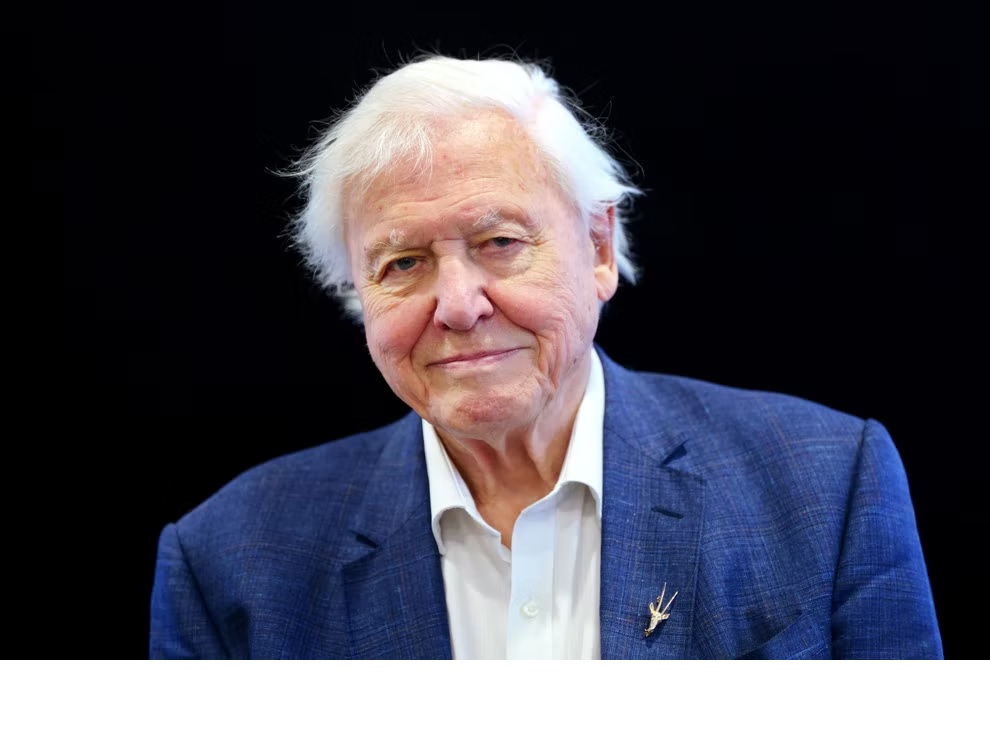
Earlier this month, the Royal Albert Hall hosted a 100th birthday party for naturalist David Attenborough, Britain’s most beloved broadcaster. Celebrities showered him with love and praise: Leonardo DiCaprio, Judi Dench, Olivia Colman, Emily Eavis, Chris Martin, Ben Fogle, Raye, Kate Winslet. And Paddington Bear. Attenborough sat in the royal box, alongside Prince William. King Charles delivered a handwritten message from Balmoral Castle via a ‘cavalcade of creature couriers’, including eagles, a red squirrel, a hedgehog, otters, ducks, a fox and deer, thanks to the wonders of CGI. All very nice; all very Disneyfied.
For many years now, Attenborough has been warning about the dangers of mass consumption, pollution, worldwide species loss and global warming. These subjects are clearly of great concern to him, although he started ringing the alarm bell very late.
But the evening gave a wide berth to such uncomfortable topics. ‘Life on Earth’? The climate crisis must be happening on a different planet entirely.
As Jonathan Liew, a Guardian sports journalist and columnist, pointed out:
‘This is, of course, the Attenborough with which our public discourse is most comfortable: depoliticised, universally adored, a man-sized Paddington Bear fit only for our veneration. Who teaches us about tree frogs and seal cubs and stick insects and asks for nothing in return.’
Of course, what Liew called ‘public discourse’ is the tightly constrained media space permitted by state and corporate power.
Liew continued:
‘And perhaps there are more difficult questions to negotiate here: the extent to which he has been a force for the meaningful and revolutionary change he seeks, and the extent to which his broad, inoffensive appeal has been more hindrance than help, allowing the powerful to feign concern for the planet while shirking the tough and bloody compromises required to secure it.’
To his credit, Attenborough has been eloquent and impassioned in recent years about the climate crisis. He addressed the COP26 climate summit in Glasgow in 2021, saying that:
‘We are already in trouble. The stability we all depend on is breaking. This story is one of inequality, as well as instability. Today, those who’ve done the least to cause this problem, are being the hardest hit. Ultimately, all of us will feel the impact, some of which are now unavoidable.’
But, even five years on, as the climate crisis worsens, the topic was deemed unmentionable by the organisers of Attenborough’s 100th birthday party.
‘Hothouse Earth’ And Collapsing Currents
In February, a new scientific report warned that runaway global warming is closer than had previously been thought. We are heading for the ‘point of no return’ after which we would be locked into a hellish ‘hothouse Earth’. Climate ‘tipping points’ would be triggered, producing rapid heating, which would lead to a domino effect of yet more tipping points and feedback loops. These include the melting of the Greenland and Antarctic ice sheets, drastic dieback of the Amazon rainforest and the weakening, and possible shutdown, of the Atlantic ocean conveyor belt known as the Atlantic Meridional Overturning Circulation (AMOC).The scientists stated that:
‘Earth’s climate is now departing from the stable conditions that supported human civilization for millennia.’
The world has already experienced a global average temperature rise of over 1.3C since pre-industrial times and is likely to surpass the Paris Agreement ‘limit’ of long-term average heating of 1.5C in the next few years. Current government and business policies are pushing us towards 2-3C of global warming, if not more, by 2100.
But, if trigger points are breached and runaway global warming occurs, we are talking about much higher temperature rises, perhaps 10C or more. This would mean almost unimaginable catastrophic effects on the climate system, global agriculture and societal infrastructure; not to mention the extinction of humans. Scientists have warned that even a rise of 3-4C means that ‘the economy and society will cease to function as we know it’.
Bill McGuire, Professor Emeritus of Geophysical and Climate Hazards at University College London, put things in grim perspective via X:
‘We are already locked-in to a return to Pliocene [around 2.6 to 5.3 million years ago] conditions (3C hotter and (eventually) ~ 20m sea-level rise)
‘Keep going as we are, and hotter Miocene [5.3 to 23 million years ago] conditions will result
‘Beyond this a return to early Eocene [around 48 to 56 million years ago] hothouse beckons – and potential oblivion’
During the Eocene, the global average temperature was well over 10C higher than present. Oblivion would hit humanity long before such a temperature rise occurred.
Earlier this month, yet another deeply disturbing scientific studyrevealed that the risk of AMOC reaching a tipping point by 2100, after which its shutdown would be inevitable, is as high as 50 per cent. Previously, this was considered ‘a low likelihood event’ of around five per cent. But even this should be held in perspective. How many of us would board a plane knowing that there was a five per cent chance that it would crash?
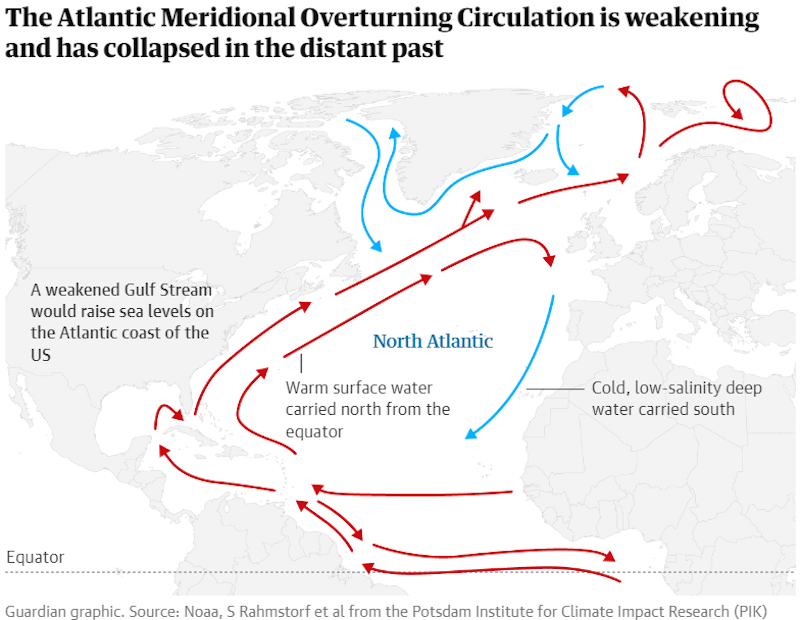
AMOC, of which the Gulf Stream is the best-known component, is a vital carrier of warm water from the tropics to high latitudes in the North Atlantic, returning cold water southwards. It is a primary source of heat for western and northern Europe, leading to the temperate climate here. AMOC connects with other ocean current systems in a global network that transports heat, water, nutrients and carbon around the planet. Any disturbance to AMOC, far less its collapse, would have devastating global consequences for climate, agriculture, infrastructure and even for the habitability of Earth.
Professor Stefan Rahmstorf of the Potsdam Institute for Climate Impact Research in Germany, who has studied AMOC for 35 years, said:
‘This is an important and very concerning result. It shows that the “pessimistic” models, which show a strong weakening of the AMOC by 2100, are, unfortunately, the realistic ones, in that they agree better with observational data.’
He added:
‘I now am increasingly worried that we may well pass that AMOC shutdown tipping point, where it becomes inevitable, in the middle of this century, which is quite close.’
To emphasise: the tipping point may be much earlier than 2100; it could happen by 2050, or even sooner. The vital point here is that scientists increasingly agree that the ‘safe window’ to stabilise the current by halting emissions is closing far faster than previously thought. And the public likely does not even realise it.
Rahmstorf had previously said that a collapse must be avoided ‘at all costs’. Now he added:
‘I argued this when we thought the chance of an AMOC shutdown was maybe 5%, and even then we were saying that risk is too high, given the massive impacts. Now it looks like it’s more than 50%. The most dramatic and drastic climate changes we see in the last 100,000 years of Earth history have been when the AMOC switched to a different state.’
In an English-language video for the German DW news channel, Rahmstorf explained the importance of AMOC for European and global climate, and the significance of the latest alarming results. He warned that we should expect more climate extremes in heat, cold, drought, floods and storms.
If and when the AMOC collapses, the impact on agriculture in the northern hemisphere will be devastating. The drop in harvest yields for key crops could be as high as 50 per cent. Mass starvation is a very real possibility.
Climate Shocks
……………………………………………………………………………………………………. The fact that deeply disturbing findings about a likely collapse of a vital component of the climate system were not given wider, extensive and sustained coverage is a devastating indictment of ‘mainstream’ journalism.
……………………….Scientists are warning, as loudly as they possibly can, that the present economic system of rampant capitalism is destroying the very life-support systems that made Planet Earth a habitable environment for humans to evolve and flourish.
……………………………………………………………………………………………………………………………………………….. Look at the daily, hour-by-hour obsessing over the endless maneuvering within the Labour government; every single statement from ministers and their allies scrutinised by the Westminster bubble of political correspondents.
Imagine that, instead of focusing on short-term melodramas, leading news organisations rigorously probed politicians, day in and day out, about the climate crisis.
Imagine that news editors and journalists relentlessly challenged the government about current policies that are bringing us closer to the brink of climate chaos.
Imagine that reporters investigated and exposed the deep reluctance and state-corporate obstacles, including the establishment media, that are blocking alternatives to climate Armageddon.
Climate crisis has tripled the likelihood of extreme heat occurring, study finds. Temperatures reaching the high 40 degrees Celsius across India and Pakistan are no longer extreme weather events but a regular feature of the pre-monsoon season, scientists have warned.
The finding comes from a rapid attribution study by World Weather Attribution, an international scientific collaboration that analyses the role of the human-caused climate crisis in extreme weather events. The study, published on Thursday, examined a prolonged period of extreme heat that struck India and Pakistan between mid-April and early May, when daily maximum temperatures exceeded 46C in several cities, causing at least 37 heat-related deaths in India and 10 in Karachi, Pakistan.
For one day in late April, all of the world’s 50 hottest cities were in India as the country experienced an extraordinarily severe heatwave. Air-quality monitoring platform AQI said that there was “no modern precedent” for this occurrence and that it was “not normal”. “This is not a normal April,” the platform said. “And it demands a serious, data-grounded reckoning.”
These data come from the National Oceanic and Atmospheric Administration’s Mauna Loa Observatory, which may soon be shut down because of proposed government budget cuts. The amount of carbon dioxide detected in the atmosphere hit a record high in April. CO2 levels averaged about 431 parts per million (ppm) over that month, according to data collected at the National Oceanic and Atmospheric Administration’s Mauna Loa Observatory in Hawaii.
After a landmark climate meeting in Santa Marta, Colombia, where nearly 60 countries gathered to work out how to end the production and use of planet-heating fossil fuels, what have we learned? The single most important thing to come from the first Transitioning Away from Fossil Fuels conference, in Santa Marta, has been a change of mood. Whereas the UN’s annual climate summits, or Cops, can often feel stuck and frustrating, with countries circling the same topics without resolution, nearly every delegate in Colombia felt liberated. In a world of climate denial and misinformation, Santa Marta was a shining example of science-led decision making. Hundreds of experts, academics and scientists inspired and informed the launch of three major initiatives on the energy transition.
Simultaneous exposure to toxic chemicals and climate change’s impacts likely generates an additive or synergistic effect that increases reproductive harm, and may contribute to the broad global drop in fertility, new peer-reviewed research finds. The review of scientific literature considers how endocrine-disrupting chemicals, often found in plastic, coupled with climate change’s effects, such as heat stress, are each linked to reductions in fertility and fecundity across global species – including in humans, wildlife and invertebrates.
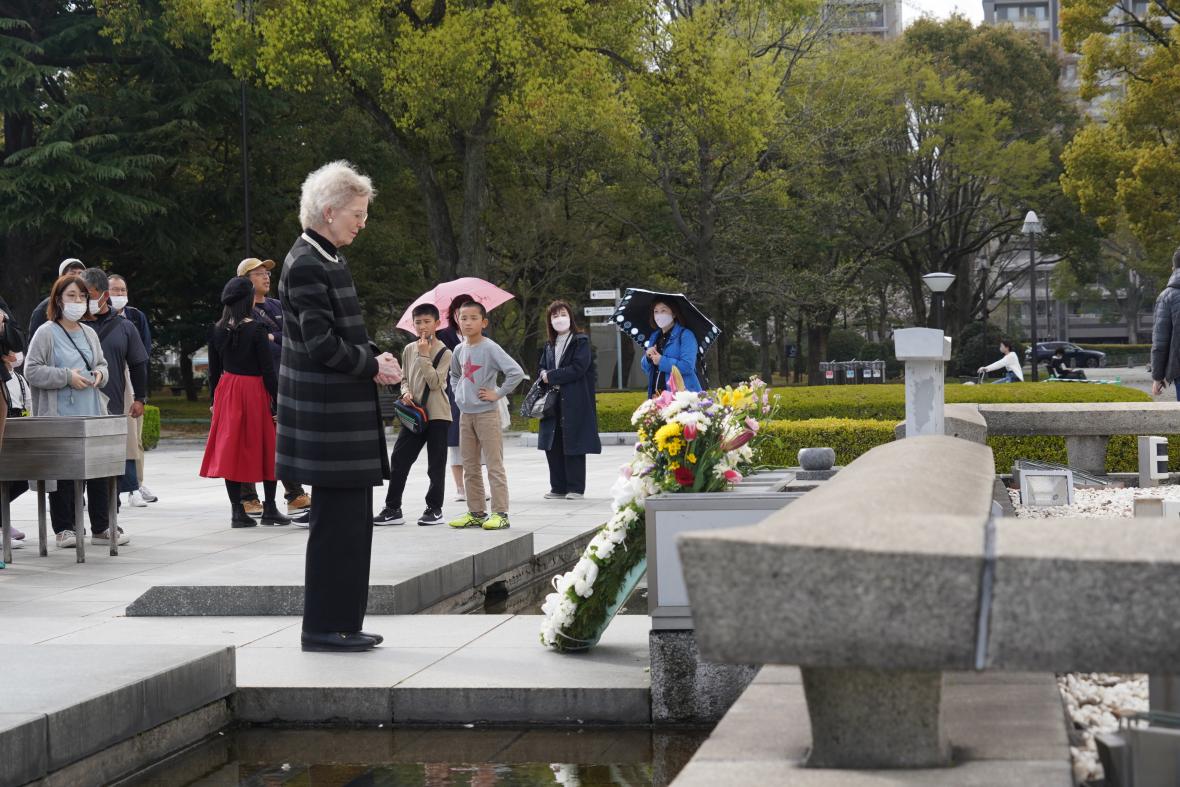
Santa Marta (Colombia) (AFP) – Former Irish President Mary Robinson has had a front-row seat to historic change — and senses another turning point coming at a fossil fuel phaseout meeting in Colombia.
She casts the Santa Marta conference as a rare opportunity to break the “fossil fuel mindset” — and as the Iran war roils energy markets, it spotlights the risks of coal, oil and gas dependence, particularly for the poor she has long championed.
Speaking to AFP on Monday in Santa Marta ahead of the high-level talks on April 28-29, Robinson also described how listening to a calving glacier brought her to tears — and crystallized the urgency of the climate fight.
This interview with Robinson, a member of The Elders group of former heads of state founded by Nelson Mandela, has been edited for length and clarity.
A: “I do believe the COP (UN Conference of the Parties) is still very important and I hope that Santa Marta will be a complement to it and feed into the process.
“There are many other ways in which we need the COP. But we failed in Belem (at COP30) to get reference to phasing out fossil fuel because of the penetration of the fossil fuel lobbies. So that’s a reality.
“But when we planned Santa Marta we didn’t know we’d be in the worst crisis of oil and gas. The timing is important. Now is the time to change the mindset — get out of a fossil fuel mindset into a future-oriented clean energy, renewable energy.
“It’s the way we have to go, it’s the way we are going, but we need to go far much faster.”
A: “There are real possibilities. We really have never had the time and space before to do it. It’s not a negotiated conference — you don’t have to worry about negotiation.
“Countries have come thinking of what they are prepared do: governments, sub-national organizations, business generally, civil society, and the energy of the people summit. The dynamic is real.
“We’re on the brink of a new dynamic way forward of doers, coalitions of doers and it has to be the outcome of Santa Marta.”
“They are the very citizens who are suffering now from this conflict, which has choked off 20 percent of oil and gas. And it’s the poorest that suffer most from the rise in prices, the farmers can’t get the fertilizer, etc. This is not a reliable future. I think that’s a really important moment for Santa Marta.”
A: “We are coming close to real tipping points, and the scientists have been warning us for years. But they are worried that things are accelerating.
“Not enough of the planning of governments is grounded in the science. One of the things we’re calling for — and I’m very keen on this — is that governments should have chief planetary scientists. During COVID, lots of countries had chief medical officers, and we listened because we were scared. They had a lot of authority.
“We’re in the same position. We haven’t thought it through yet, but we are.”
A: “When you hear the science, it is scary. And we should be more scared.
“Part of it is aligning ourselves with nature. I had an experience of doing that. I was lucky enough to be on a scientific expedition in Greenland where we were told to just be on your own and listen to the glacier.
“I was listening to the sound of thunder — which was a major calving — and then sharp, smaller calving like rifle shots, I found myself crying. I was on my own, listening to nature and I was crying because I knew it wasn’t right, I knew what we were doing, we shouldn’t be doing.
“I was so grateful to that moment of really understanding that nature was talking to us and saying, stop this.
“And so it’s the urgency of the science, the opportunity at the moment, and the space that is provided by Santa Marta. We must avail of it, and we must build momentum.”
Geopolitical tensions in Eastern Europe underscore the urgency of addressing the climate and radiological consequences of a regional nuclear conflict.
Even a small-scale nuclear conflict at the Ukraine–Russia border could cause years of severe global climate disruption and radioactive fallout across much of the world, new research suggests.
In the study, published in npj Clean Air, researchers at the University of Exeter used the UK Earth System Model to simulate a hypothetical regional nuclear conflict at the Ukraine-Russia border. The results shows that the soot emitted after nuclear detonation would rapidly spread through the atmosphere, block sunlight and disrupt climate across the Northern Hemisphere.
In the first year after the conflict, the Northern Hemisphere cools by about 1°C on average, with much larger regional drops of around 5°C in Russia and 4°C in the United States. Surface sunlight declines sharply, and precipitation falls substantially across key mid-latitude agricultural regions.
The researchers also found that the climate effects would not be short-lived, lasting for approximately 6 years. Stratospheric warming caused by the soot alters major atmospheric circulation patterns, including the jet streams and the Intertropical Convergence Zone.
Alongside the climate impacts, the study examined the long-term dispersion of radioactive material attached to the black carbon particles. The results suggest that long-lived radionuclides could be transported globally, with around 40% eventually depositing in the Southern Hemisphere. This means the consequences of a regional nuclear conflict would not remain confined to the war zone but would instead become a global humanitarian and environmental issue.
Lead author Dr Ananth Ranjithkumar, Post-Doctoral Research Fellow at the University of Exeter, said: “Even a small-scale regional nuclear conflict would not remain a regional catastrophe for long. Our simulations show that its effects could reverberate across the planet for years, disrupting climate systems and spreading radioactive fallout far beyond the detonation zone, turning a regional war into a global crisis.”
Co-Author Professor Jim Haywood, also of the University of Exeter added: “This study confirms the global impact of regional nuclear conflicts upon climate, and emphasises that the New Strategic Arms Reduction Treaty that ended February 5, 2026 urgently needs to be extended.”
Co-Author Professor Nathan Mayne, also from the University of Exeter said “This is an excellent example of how our studies of other planets can contribute to understanding Earth’s climate.
“From planet wide dust storms on Mars, to kilometre per second winds in the atmospheres of extremely hot gas giant planets, our adaptations lead to improvements in how we capture climate and weather phenomena for Earth itself both in `normal’ and, in this case, extreme situations.”
The study, Nuclear Conflict in Eastern Europe: Climate disruption and Radiological fallout, is available to read here .
Democracy is under mounting threat from the climate crisis, with new analysis documenting how elections are increasingly shaped not only by political forces but also by floods, wildfires and extreme weather.
At least 94 elections and referendums across 52 countries have been disrupted by climate-related impacts over the last two decades, researchers found. As risks intensify, the pressure on already fragile democratic systems – particularly in Africa and Asia – is forecast to grow.
The findings, from the International Institute for Democracy and Electoral Assistance, an intergovernmental organisation that aims to support democracy around the world, is the first global analysis of how natural hazards are affecting elections.
The critical Atlantic current system appears significantly more likely to collapse than previously thought after new research found that climate models predicting the biggest slowdown are the most realistic.
Scientists called the new finding “very concerning” as a collapse would have catastrophic consequences for Europe, Africa and the Americas. The Atlantic meridional overturning circulation (Amoc) is a major part of the global climate system and was already known to be at its weakest for 1,600 years as a result of the climate crisis.
Scientists spotted warning signs of a tipping point in 2021 and know that the Amoc has collapsed in the Earth’s past. Climate scientists use dozens of different computer models to assess the future climate. However, for the complex Amoc system, these produce widely varying results, ranging from some that indicate no further slowdown by 2100 to those suggesting a huge deceleration of about 65%, even when carbon emissions from fossil fuel burning are gradually cut to net zero.
The research combined real-world ocean observations with the models to determine the most reliable, and this hugely reduced the spread of uncertainty. They found an estimated slowdown of 42% to 58% in 2100, a level almost certain to end in collapse.
Dr Paul Dorfman, Bennett Scholar, makes a clear and evidence based case: new nuclear power cannot play a meaningful role in addressing the climate or energy crises. It is not simply expensive, it is structurally misaligned with the speed, scale and affordability required for effective climate action.
In the report, ‘Debt, Delays, Dependencies. Why Public Banks Should Not Support Nuclear Power‘, Dr Dorfman’s contribution makes clear that new nuclear power represents a policy dead end, diverting scarce resources away from climate‑effective solutions. The opportunity cost is enormous: every pound invested in nuclear is a pound not invested in renewables, energy efficiency, storage or grid resilience. New nuclear is already too late. The renewable transition is happening now – and smart policy must move with it.
Key Findings
Dr Dorfman shows that time is the critical constraint. New nuclear projects consistently take 15–20 years from planning to operation, with average construction overruns of more than 60%. In contrast, wind and solar projects move from planning to generation in months to a few years, making them vastly more effective in the decisive decade for emissions reduction. The Intergovernmental Panel on Climate Change (IPCC) has concluded that renewables are now up to ten times more effective at cutting emissions than new nuclear, underscoring the urgency of choosing technologies that can deliver now rather than decades from now.
Cost compounds the problem. Dr Dorfman highlights that new nuclear is the most expensive form of electricity generation. Nuclear projects routinely double their initial cost estimates, while renewable technologies continue to fall rapidly in price due to economies of scale, innovation and fast global deployment.
The chapter also challenges the notion that nuclear complements renewables. Evidence shows that large, inflexible nuclear plants crowd out investment in grids, storage and flexibility – exactly the systems needed to integrate high shares of renewable energy. Meanwhile, renewables already deliver the bulk of new global power capacity, with wind and solar generating significantly more electricity than nuclear worldwide, and expanding at a far faster rate.
Finally, Dr Dorfman highlights a growing but under‑discussed risk: climate change itself threatens nuclear infrastructure. Rising sea levels, heatwaves, floods and water scarcity increasingly disrupt reactor operation, driving up costs and safety risks. Rather than being a climate solution, nuclear power is becoming more vulnerable because of climate impacts, further undermining its viability.
Why this matters for policy and innovation
Dr Dorfman’s chapter, ‘New nuclear: Too late and too costly for the climate and energy crises‘ has a central insight that aligns squarely with the Bennett Institute’s mission to accelerate effective, evidence‑based policy innovation. The persistence of nuclear in policy debates is not driven by outcomes, but by legacy thinking, political inertia and vested interests. Dr Dorfman’s analysis shows that innovation is not about new reactor designs, but about deploying solutions that already work, quickly, affordably and at scale. This research reinforces a core Bennett Institute principle: policy decisions must be grounded in real‑world delivery.