Climate misinformation turning crisis into catastrophe, report says
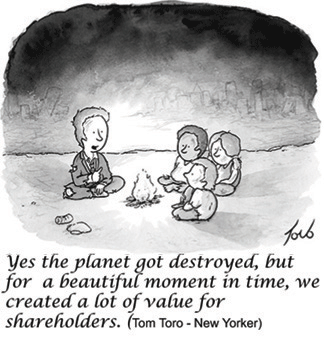
Rampant climate misinformation is turning the crisis into a catastrophe,
according to the authors of a new report.
It found climate action was being
obstructed and delayed by false and misleading information stemming from
fossil fuel companies, rightwing politicians and some nation states. The
report, from the International Panel on the Information Environment (Ipie),
systematically reviewed 300 studies.
The researchers found climate
denialism has evolved into campaigns focused on discrediting solutions,
such as the false claims that renewable energy caused the recent massive
blackout in Spain. Online bots and trolls hugely amplify false narratives,
the researchers say, playing a key role in promoting climate lies.
The experts also report that political leaders, civil servants and regulatory
agencies are increasingly being targeted in order to delay climate action.
The misinformation ranges from industry promoting fossil gas as a
“low-carbon fuel” to bizarre conspiracy theories such as that wildfires
in southern California this year were planned by officials in order to
destroy child-trafficking tunnels.
In the European context, rightwing
populist parties are “actively contravening climate science”, the
report says, including the AfD in Germany, Vox in Spain, and the National
Rally in France. Media outlets with conservative or rightwing political
ideologies give priority to and amplify denial, scepticism and conspiracy
theories regarding climate change, the report says.
Guardian 19th June 2025, https://www.theguardian.com/environment/2025/jun/19/climate-misinformation-turning-crisis-into-catastrophe-ipie-report
Could Britain face a winter ice age? How temperatures could one day plummet due to climate change

Could Britain face a winter ice age? How temperatures could one day
plummet due to climate change A small but growing stash of science warns a
crucial ocean current that warms Europe could one day collapse, bringing
winter lows of -19C to London and Cardiff and almost -30C to Edinburgh.
Sky 11th June 2025, https://news.sky.com/story/could-britain-face-a-winter-ice-age-how-temperatures-could-one-day-plummet-due-to-climate-change-13382063
How the ‘evil twin’ of the climate crisis is threatening our oceans
There’s frustration among researchers that falling pH levels in seas
around the globe are not being taken seriously enough, and that until the
buildup of CO2 is addressed, the consequences for marine life will be
devastating.
“At the end of the day, we know CO2 is going up, pH is going
down, and that’s an urgent issue that people are not talking about,”
says Turner. “It’s an overlooked consequence of carbon in our ocean
that governments can no longer afford to overlook in mainstream policy
agendas, and the time to address it is running out.”
Guardian 9th June 2025, https://www.theguardian.com/environment/2025/jun/09/the-scientists-warning-the-world-about-ocean-acidification-evil-twin-of-the-climate-crisis
The World Isn’t Ready for the Mental Health Toll of Extreme Heat
The coming summer is forecast to be a scorcher across the U.S. And climate
scientists predict that at least one of the next five years will beat 2024
as the hottest year ever recorded globally. As heat waves are getting more
intense and prolonged, their effect on the mind and body are also becoming
more dire. Children and older people, as well as those who work outdoors,
are most at risk. So are those with mental health disorders. Heat waves are
the single highest cause of weather-related deaths in the U.S., where an
estimated 1,300 fatalities from heat stroke and other temperature-related
complications occur every year. Even those who survive a period of extreme
heat may suffer serious neurological or other mental-health-related
disorders. A new study published in Current Environmental Health Reports
finds that the world is startlingly unprepared to deal with the mental
health consequences of climate change. Of 83 action plans for heat-related
health problems that were reviewed for the study, fewer than a third
acknowledged the mental health effects of extreme or prolonged high
temperatures. And only a fifth of these plans outlined specific actions to
deal with contingencies such as increased hospitalizations for mental
health disorders.
Scientific American 2nd June 2025, https://www.scientificamerican.com/article/the-world-isnt-ready-for-the-mental-health-toll-of-extreme-heat/
Almost 40% of world’s glaciers already doomed due to climate crisis – study
Almost 40% of glaciers in existence today are already doomed to melt due
to climate-heating emissions from fossil fuels, a study has found. The loss
will soar to 75% if global heating reaches the 2.7C rise for which the
world is currently on track. The massive loss of glaciers would push up sea
levels, endangering millions of people and driving mass migration,
profoundly affecting the billions reliant on glaciers to regulate the water
used to grow food, the researchers said. However, slashing carbon emissions
and limiting heating to the internationally agreed 1.5C target would save
half of glacier ice. That goal is looking increasingly out of reach as
emissions continue to rise, but the scientists said that every
tenth-of-a-degree rise that was avoided would save 2.7tn tonnes of ice.
Guardian 29th May 2025, https://www.theguardian.com/environment/2025/may/29/almost-40-of-worlds-glaciers-already-doomed-due-to-climate-crisis-study
Revealed: Nato rearmament could increase emissions by 200m tonnes a year

Exclusive: researchers say defence spending boosts across world will worsen climate crisis which in turn will cause more conflict
Damien Gayle 29 May 25, https://www.theguardian.com/environment/2025/may/29/nato-military-spending-could-increase-emissions-study-finds
A global military buildup poses an existential threat to climate goals, according to researchers who say the rearmament planned by Nato alone could increase greenhouse gas emissions by almost 200m tonnes a year.
With the world embroiled in the highest number of armed conflicts since the second world war, countries have embarked on military spending sprees, collectively totalling a record $2.46tn in 2023.
For every dollar invested in new hardware, there is not only a corresponding carbon cost but also an opportunity cost to potential climate action, critics say. This is on top of the huge death toll resulting from armed conflicts.
“There is a real concern around the way that we are prioritising short-term security and sacrificing long-term security,” said Ellie Kinney, a researcher with the Conflict and Environment Observatory and a co-author of the study, shared exclusively with the Guardian.
“Because of this kind of lack-of-informed approach that we’re taking, you’re investing in hard military security now, increasing global emissions for that reason, and worsening the climate crisis further down the line.”
That in turn is only likely to lead to further violence, with climate change itself now increasingly seen as a driver of conflict, albeit indirectly. In Sudan’s Darfur region, conflict was linked to competition over scarce resources after prolonged droughts and desertification. In the Arctic, receding sea ice is leading to tensions over who should control newly accessible oil, gas and critical mineral resources.
Few militaries are transparent about the scale of their fossil fuel use, but researchers have estimated that collectively they are already responsible for 5.5% of global greenhouse gas emissions.
That figure is expected to rise as tensions escalate in a number of regions and as the US, for decades the world’s biggest military spender, indicates that it expects its Nato allies to devote significantly more resources to their armed forces.
According to the Global Peace Index, militarisation increased in 108 countries in 2023. With 92 countries involved in armed conflict, in places ranging from Ukraine and Gaza to South Sudan and DRC, with tensions seething between China and the US over Taiwan, and with the frozen conflict between India and Pakistan flaring, governments fearful of war are investing heavily in their militaries.
In Europe, the increase has been particularly dramatic: between 2021 and 2024, EU states’ weapons spending rose by more than 30%, according to the International Institute for Strategic Studies.
In March, the EU, disconcerted by Donald Trump’s cutting of military aid and diplomatic support for Ukraine, indicated this would go further, with proposals for a further €800bn spend across the bloc outlined in a plan called “ReArm Europe”.
In analysis for the UN Office for Disarmament Affairs, Kinney and colleagues looked at the potential impact of increased militarisation on meeting climate goals. What they found was sobering: the likely increase in emissions from Nato’s remilitarisation alone would be the equivalent of adding the cost of a country as large and populous as Pakistan to the world’s remaining carbon budget.
“Our analysis specifically looks at the impact on sustainable development goal 13, which is climate action – to take urgent action to combat climate change and its impacts,” Kinney said. “And what our analysis finds, looking at the various sub-targets of that … [is] that there is a real threat to global climate action caused by global increase in military spending.”
Of all functions of states, militaries are almost uniquely carbon-intensive. “First of all, with the equipment that they purchase, which is mainly a lot of steel and aluminium, which is very carbon-intensive to produce,” said Lennard de Klerk, of the Initiative on the GHG Accounting of War, another co-author of the study.
“Secondly is during operations, armies are very mobile. And in order to move around they use fossil fuels – that’s diesel for ground operations and kerosene for air operations. Or for maritime operations it’s mainly diesel as well, if they’re not nuclear-driven.”
Given the secrecy that usually surrounds militaries and their operations, it is difficult to know just how much greenhouse gases they are emitting. Only Nato countries report enough of their emissions for scientists to attempt an estimate.
“We took Nato because they are the most transparent in terms of spending. So it’s not that we particularly want to focus on Nato, but simply because they have more data available,” De Klerk said.
The researchers calculated by how much greenhouse gas emissions would increase if Nato countries excluding the US – since it already spends far more than the others – made a two percentage point increase in the share of GDP they devoted to their militaries.
Such an increase is already under way, with many countries in Europe significantly increasing military spending in response to the crisis in Ukraine. Although Nato countries have publicly committed to increasing spending to 2% of GDP, the researchers say the ReArm Europe plan could lead to an eventual rise to 3.5%, from about 1.5% in 2020. The researchers assumed a similar eventual increase in Nato members that are not members of the EU, such as the UK.
Borrowing methodology from a recent paper that argued each percentage point increase in the share of GDP devoted to military spending would lead to an increase in national emissions of between 0.9% and 2%, they estimated that a two percentage point spending shock would lead to an increase across the bloc of between 87 and 194 megatonnes of carbon dioxide equivalent (CO2e) a year.
The researchers say that not only would such a huge increase in emissions supercharge climate breakdown but the increase in global temperatures would hurt the economy. Recent estimates of the social cost of carbon – a monetary indicator of the damage of CO2 emitted – put it at $1,347/tCO2e, suggesting the annual cost of Nato’s military buildup could be as much as $264bn a year.
And that is only a fraction of the true carbon cost of militarisation, Kinney points out. “The calculation in the paper, it’s 31 countries – that only represents 9% of total world emissions. If you consider … the impact of that, there’s a lot of the world that we haven’t taken into consideration of this specific calculation.”
The analysis notes that spending more money on militaries also reduces resources available for policies aimed at mitigating climate change. This already seems to be the case, with the UK, for example, funding its increase in spending by reducing its overseas aid budget – a move mirrored in Belgium, France and the Netherlands.
“This increase in military spending is impacting the kind of core trust that is necessary for multilateralism,” Kinney said. “At Cop29, global south countries like Cuba in particular pointed out the hypocrisy in the room of states being willing to spend increasing amounts on their military spending, but offering … completely, unacceptably low climate finance commitments.”
The Guardian has contacted Nato for comment.
Why nuclear power isn’t the green energy solution you’ve been told
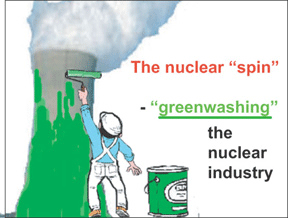
Lynn Jamieson, Chair Scottish CND, The National 30th May 2025
Energy policy has become a political
football with outrageous dishonesty about the real environmental
consequences and financial costs of nuclear power. Nigel Farage, Tony Blair
and, sadly, some Scottish political representatives are contributing to the
false narratives that only building nuclear power stations will save us
from future energy crises and that nuclear power is “green” or carbon
neutral.
Encouraged by persistent, well-funded charm offensives by the
nuclear industry, pro-nuclear narratives are repeated with vehement
conviction, ignoring counter-evidence. Pro-nuclear political leaders may
also be motivated by their wish to support Britain’s capacity to build
nuclear bombs.
Even setting aside this deadly link, however, there are
injustices, harms and risks that contradict the supposed attractiveness of
nuclear. Green claim ignores the carbon footprint of [uranium] mining, and
the milling and construction that involves extraordinary amounts of
concrete, the manufacture of which significantly contributes to climate
change. Moreover, the nuclear cycle ends with various levels of radioactive
nuclear waste that must be kept secure for the decades, hundreds and even
thousands of years it remains hazardous to health.
The National 30th May 2025,
https://www.thenational.scot/comment/25201517.nuclear-power-isnt-green-energy-solution-told/
World faces new danger of ‘economic denial’ in climate fight, Cop30 head says

André Corrêa do Lago says ‘answers have to come from the economy’ as climate policies trigger populist-fuelled backlash
Fiona Harvey Environment editor, Guardian, 28 May25
The world is facing a new form of climate denial – not the dismissal of climate science, but a concerted attack on the idea that the economy can be reorganised to fight the crisis, the president of global climate talks has warned.
André Corrêa do Lago, the veteran Brazilian diplomat who will direct this year’s UN summit, Cop30, believes his biggest job will be to counter the attempt from some vested interests to prevent climate policies aimed at shifting the global economy to a low-carbon footing.
“There is a new kind of opposition to climate action. We are facing a discredit of climate policies. I don’t think we are facing climate denial,” he said, referring to the increasingly desperate attempts to pretend there is no consensus on climate science that have plagued climate action for the past 30 years. “It’s not a scientific denial, it’s an economic denial.”
This economic denial could be just as dangerous and cause as much delay as repeated attempts to deny climate science in previous years, he warned in an exclusive interview with the Guardian.
As the climate crisis has gathered pace, temperatures have risen and the effects of extreme weather have become more obvious, scientists have been able to draw ever more clearly the links between greenhouse gas emissions and our impacts on the planet. So the argument has shifted, Corrêa do Lago believes, from undermining or misrepresenting the science to attempts to counter climate policy.
“It is not possible to have [scientific] denialism at this stage, after everything that has happened in recent years. So there is a migration from scientific denial to a denial that economic measures against climate change can be good for the economy and for people.”
The rise of populist politicians around the world has fuelled a backlash against climate policy, most clearly seen in the presidency of Donald Trump in the US, where he has set about cancelling policies intended to boost renewable energy and cut greenhouse gases, and dismantling all forms of government-sponsored climate-related institutions, including scientific research labs.
Corrêa do Lago wants to spur a new global effort to persuade people that remodelling the economy away from a reliance on fossil fuels and towards a clean energy future will reap benefits for all people. “The new populism is trying to show [that tackling the climate crisis does not work],” he said. “It’s the turn of those who believe in the fight against climate change to show and to prove that fighting climate change is possible, and that it can come with economic advantages and with a better quality of life.”
Corrêa do Lago is an economist by training – the youngest of five brothers, all of whom became economists. “My mother was horrified with our lack of originality,” he joked.
He has been a career diplomat, having joined Brazil’s foreign service in 1983 and serving previously as ambassador to India and Japan. He is also a veteran of the Cop talks – the annual “conference of the parties”, which will take place this year in Belém, near the mouth of the Amazon, in November.
“Most of the answers have to come from the economy,” said Corrêa do Lago. “Because we have now enough science, enough demonstration of how climate change can affect people’s lives. Now we need answers [in the form of policy measures]. We need economists to rally.”
Over the past two decades, economists have begun to take on the challenge of the climate crisis, after the 2006 landmark review by Nicholas Stern, the former chief economist of the World Bank, which found it would be cheaper to tackle emissions than to allow them to run unchecked. That contradicted the conclusions of some previous economists, who had claimed it was not worth trying to move away from fossil fuels, or it would be too expensive.
Since then, multiple reports have proved the same point. Most recently, the Organisation for Economic Co-operation and Development (OECD) and the UN Development Programme produced a joint report this year, with the final version to come out next month, showing that tackling the climate crisis would materially increase economic growth, rather than being a necessary cost.
But much mainstream thinking on economics does not take the climate crisis into account. Most governments preparing budgets, for instance, do not include climate impacts in their estimates, and nor do businesses. Many of the economic estimates of climate damage are also far too modest. For Corrêa do Lago, this shows that much more needs to be done.
“Climate has not been incorporated into economic theory in a satisfactory way yet,” he said. “Because it’s a very disturbing element.”…………………………………………………………………………………….. https://www.theguardian.com/environment/2025/may/28/andre-correa-do-lago-cop30-interview-climate-crisis
Earth is heading for 2.7°C warming this century. We may avoid the worst climate scenarios – but the outlook is still dire.

Is climate action a lost cause? The United States is withdrawing from the
Paris Agreement for the second time, while heat records over land and sea
have toppled and extreme weather events have multiplied.
In late 2015,
nations agreed through the Paris Agreement to try to hold warming well
under 2°C and ideally to 1.5°C. Almost ten years later, cutting emissions
to the point of meeting the 1.5°C goal looks very difficult. But humanity
has shifted track enough to avert the worst climate future.
Renewables,
energy efficiency and other measures have shifted the dial. The worst case
scenario of expanded coal use, soaring emissions and a much hotter world is
vanishingly unlikely. Instead, Earth is tracking towards around 2.7°C
average warming by 2100. That level of warming would represent
“unprecedented peril” for life on this planet. But it shows progress is
being made.
The Conversation 27th May 2025, https://theconversation.com/earth-is-heading-for-2-7-c-warming-this-century-we-may-avoid-the-worst-climate-scenarios-but-the-outlook-is-still-dire-254284
Is the COP30 climate summit already in crisis, with six months to go?

Mounting concerns about Brazil’s approach to the COP30 climate summit have
observers asking whether the meeting will be able to tackle the difficult
choices involved in curbing emissions. It is now less than six months
before the world’s nations gather in Brazil for the COP30 climate summit,
where observers hope to see key action on halting global warming. But with
skyrocketing accommodation prices, distracted world leaders and accusations
that the meeting’s Brazilian hosts are dodging the difficult topics, is
COP30 in crisis? This year’s meeting is particularly important, coming a
decade after countries struck the Paris Agreement, the landmark climate
deal designed that pledged to keep warming below 2°C or, ideally, 1.5°C.
While the latter goal looks increasingly out of reach, the Paris process
means all nations are required to submit fresh, more ambitious climate
plans this year outlining their strategies to cut emissions up to 2035.
“I think COP30 will be an inflection moment,” says Stela Herschmann at
the Brazilian climate NGO Observatório do Clima.
“We are in a tipping
point for the science – if we really want to keep the 1.5°C [goal]
within reach – we need to accelerate efforts.” But with just months to
go before the summit kicks off, that optimism is under threat. Under
current climate pledges, warming will escalate to 2.6°C by the end of the
century. Campaigners say it is critical that the next round of countries’
climate plans – known as nationally determined contributions (NDCs) –
ramp up to bring that number closer to the 2°C upper limit set by the
Paris Agreement.
New Scientist 20th May 2025, https://www.newscientist.com/article/2480461-is-the-cop30-climate-summit-already-in-crisis-with-six-months-to-go/
Sea level rise will cause ‘catastrophic inland migration’, scientists warn
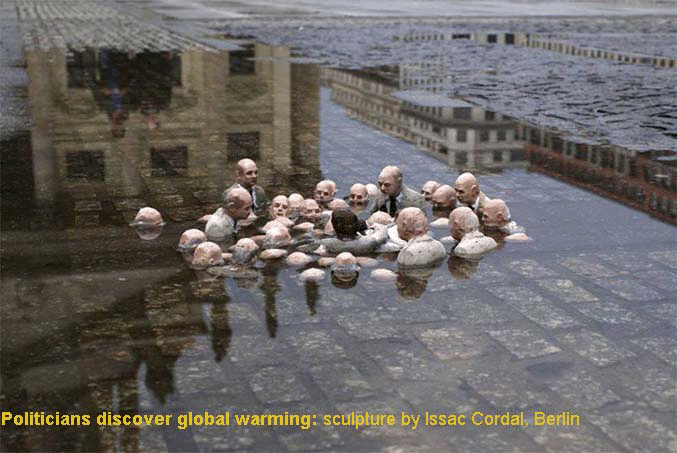
Sea level rise will become unmanageable at just 1.5C of global heating and
lead to “catastrophic inland migration”, the scientists behind a new
study have warned.
This scenario may unfold even if the average level of
heating over the last decade of 1.2C continues into the future. The loss of
ice from the giant Greenland and Antarctic ice sheets has quadrupled since
the 1990s due to the climate crisis and is now the principal driver of sea
level rise.
The international target to keep global temperature rise below
1.5C is already almost out of reach. But the new analysis found that even
if fossil fuel emissions were rapidly slashed to meet it, sea levels would
be rising by 1cm a year by the end of the century, faster than the speed at
which nations could build coastal defences. The world is on track for
2.5C-2.9C of global heating, which would almost certainly be beyond tipping
points for the collapse of the Greenland and west Antarctic ice sheets. The
melting of those ice sheets would lead to a “really dire” 12 metres of
sea level rise.
Guardian 20th May 2025,
https://www.theguardian.com/environment/2025/may/20/sea-level-rise-migration
Tropical forests destroyed at fastest recorded rate last year
The world’s tropical forests, which provide a crucial buffer against
climate change, disappeared faster than ever recorded last year, new
satellite analysis suggests. Researchers estimate that 67,000 sq km (26,000
sq mi) of these pristine, old-growth forests were lost in 2024 – an area
nearly as large as the Republic of Ireland, or 18 football pitches a
minute. Fires were the main cause, overtaking land clearances from
agriculture for the first time on record, with the Amazon faring
particularly badly amid record drought. There was more positive news in
South East Asia, however, with government policies helping to reduce forest
loss.
BBC 21st May 2025,
https://www.bbc.co.uk/news/articles/c0lnngl6713o
Want to know how the world really ends? Look to TV show Families Like Ours
John Harris, 1 May 25
The Danish drama is piercing in its ordinariness. In the real world, the climate crisis worsens and authoritarians take charge as we calmly look awaySun 11 May 2025 21.35 AESTShare649
The climate crisis has taken a new and frightening turn, and in the expectation of disastrous flooding, the entire landmass of Denmark is about to be evacuated. Effectively, the country will be shutting itself down and sending its 6 million people abroad, where they will have to cope as best they can. Huge numbers of northern Europeans are therefore being turned into refugees: a few might have the wealth and connections to ease their passage from one life to another, but most are about to face the kind of precarious, nightmarish future they always thought of as other people’s burden.
Don’t panic: this is not a news story – or not yet, anyway. It’s the premise of an addictive new drama series titled Families Like Ours, acquired by the BBC and available on iPlayer. I have seen two episodes so far, and been struck by the very incisive way it satirises European attitudes to the politics of asylum. But what has also hit me is its portrayal of something just as modern: how it shows disaster unfolding in the midst of everyday life. At first, watching it brings on a sense of impatience. Why are most of the characters so calm? Where are the apocalyptic floods, wildfires and mass social breakdown? At times, it verges on boring. But then you realise the very clever conceit that defines every moment: it is really a story about how we all live, and what might happen tomorrow, or the day after.
The writer and journalist Dorian Lynskey’s brilliant book Everything Must Go is about the various ways that human beings have imagined the end of the world. “Compared to nuclear war,” he writes, “the climate emergency deprives popular storytellers of their usual toolkit. Global warming may move too fast for the planet but it is too slow for catastrophe fiction.” Even when the worst finally happens, most of us may respond with the kind of quiet mental contortions that are probably better suited to literature than the screen. Making that point, Lynskey quotes a character in Margaret Atwood’s novel The Year of the Flood: “Nobody admitted to knowing. If other people began to discuss it, you tuned them out, because what they were saying was both so obvious and so unthinkable.”
These days, that kind of thinking reflects how people deal with just about every aspect of our ever-more troubled world: if we can avert our eyes from ecological breakdown, then everything else can be either underestimated or ignored. There is a kind of moment, I would wager, that now happens to all of us. We glance at our phones or switch on the radio and are assailed by the awful gravity of everything, and then somehow manage to instantly find our way back to calm and normality. This, of course, is how human beings have always managed to cope, as a matter of basic mental wiring. But in its 21st-century form, it also has very modern elements. Our news feeds reduce everything to white noise and trivia: the result is that developments that ought to be vivid and alarming become so dulled that they look unremarkable.
Where this is leading politically is now as clear as day. In the New Yorker, Andrew Marantz wrote, in the wake of Trump’s re-election, about how democracies slide into authoritarianism. “In a Hollywood disaster movie,” he writes, “when the big one arrives, the characters don’t have to waste time debating whether it’s happening. There is an abrupt, cataclysmic tremor, a deafening roar … In the real world, though, the cataclysm can come in on little cat feet. The tremors can be so muffled and distant that people continually adapt, explaining away the anomalies.” That is true of how we normalise the climate crisis; it also applies to the way that Trump and his fellow authoritarians have successfully normalised their politics.
Marantz goes to Budapest, and meets a Hungarian academic, who marvels at the political feats pulled off by the country’s prime minister, Viktor Orbán. “Before it starts, you say to yourself: ‘I will leave this country immediately if they ever do this or that horrible thing,’” he says. “And then they do that thing, and you stay. Things that would have seemed impossible 10 years ago, five years ago, you may not even notice.” The fact that populists are usually climate deniers is perfect: just as searingly hot summers become mundane, so do the increasingly ambitious plans of would-be dictators – particularly in the absence of jackboots, goose-stepping and so many other old-fashioned accoutrements. Put simply, Orbán/Trump politics is purposely designed to fit with its time – and to most of its supporters (and plenty of onlookers), it looks a lot less terrifying than it actually is.
Much the same story is starting to happen in the UK. On the night of last week’s local elections, I found myself in the thoroughly ordinary environs of Grimsby town hall, watching the victory speech given by Reform UK’s Andrea Jenkyns, who had just been elected as the first mayor of Greater Lincolnshire. For some reason, she wore a spangly outfit that made her look as if she was on her way to a 1970s-themed fancy dress party, which raised a few mirthless laughs. She said it was time for an end to “soft-touch Britain”, and suddenly called for asylum seekers to be forced to live in tents. That is the kind of thing that only fascists used to say, but it now lands in our political discourse with not much more than a faint thump.
Meanwhile, life has to go on. About 20 years ago, I went to an exhibition of works by the French photographer Henri Cartier-Bresson – one of which was of a family of four adults picnicking by the Marne, with their food and wine scattered around them, and a rowing-boat moored to the riverbank. When I first looked at it, I wondered what its significance was. But then I saw the date on the adjacent plaque: “1936-38.” We break bread, get drunk and tune out the noise until carrying on like that ceases to be an option: as Families Like Ours suggests, that point may arrive sooner than we think.
I just returned from Antarctica: climate change isn’t some far-off problem – it’s here and hitting hard.

The continent stands as a powerful symbol of our interconnected climate systems – a compelling case for conservation…………………… the ocean shapes our world – and Antarctica is central to that story. The surrounding waters link the Pacific, Indian and Atlantic oceans through the Antarctic Circumpolar Current. This connectivity means that what happens in Antarctica affects us all.
Jennifer Verduin, Sun 11 May 2025, https://www.theguardian.com/commentisfree/2025/may/11/antarctica-climate-change-threat
As an oceanographer, I study how the ocean shapes our world. For Australia and other nations, the lesson is urgent.
Antarctica is often viewed as the last truly remote place on Earth – frozen, wild and untouched. But is it really as untouched as it seems?
This vast frozen continent is encircled by the Antarctic Circumpolar Current, the only current in the world that connects all the oceans, showing how closely linked our planet really is.
Earlier this year, I joined more than 100 scientists on a journey to Antarctica. What we encountered was extraordinary: towering icebergs, playful penguins, breaching whales and seals resting on the ice. Yet beneath this natural wonder lies a sobering reality – Antarctica is changing, and fast. The experience left me both inspired and deeply saddened.
This unique environment highlights the fragility of our planet. Its pristine landscapes and thriving wildlife represent what we stand to lose if we don’t take urgent action to reduce human impact.
Historically, Antarctica suffered from exploitation – hunters came for whales and seals, leaving scars on its ecosystems. While wildlife is slowly recovering, these species now face a new threat: climate change. Rising ocean temperatures are melting ice, reshaping habitats and disrupting the delicate balance of life.
The continent stands as a powerful symbol of our interconnected climate systems – a compelling case for conservation. During our visit, we toured research stations and Port Lockroy, where gentoo penguins raise their chicks. Here, human activity is carefully managed. Half the island is set aside for the penguins, while the other half welcomes around 18,000 tourists each year who come to learn about this remarkable place. It’s a model of coexistence – one that shows how we can live alongside nature when we choose to act responsibly.
Along our journey, we witnessed diverse wildlife in their natural habitats – from penguins and seals to whales and seabirds. Albatrosses and cape petrels followed our ship, gliding effortlessly over the waves – symbols of resilience, yet also vulnerability.
But reminders of past damage still linger. On Deception Island, rusted remains of the whaling industry serve as stark evidence of the harm unchecked exploitation can cause. They also underscore why continued protection of these fragile ecosystems is vital.
As an oceanographer, I study how the ocean shapes our world – and Antarctica is central to that story. The surrounding waters link the Pacific, Indian and Atlantic oceans through the Antarctic Circumpolar Current. This connectivity means that what happens in Antarctica affects us all. Pollution, warming seas and oil spills know no borders. These changes disrupt ocean currents, harm marine life and influence climate systems around the globe.
The implications are clear: addressing environmental challenges requires international cooperation and decisive action.
Two-thirds of global heating caused by richest 10%, study suggests
Two-thirds of global heating caused by richest 10%, study suggests. Paper
in Nature Climate Change journal reveals major role wealthy emitters play
in driving climate extremes. The world’s wealthiest 10% are responsible
for two-thirds of global heating since 1990, driving droughts and heatwaves
in the poorest parts of the world, according to a study.
While researchers
have previously shown that higher income groups emit disproportionately
large amounts of greenhouse gases, the latest survey is the first to try to
pin down how that inequality translates into responsibility for climate
breakdown. It offers a powerful argument for climate finance and wealth
taxes by attempting to give an evidential basis for how many people in the
developed world – including more than 50% of full-time employees in the
UK – bear a heightened responsibility for the climate disasters affecting
people who can least afford it.
Guardian 7th May 2025, https://www.theguardian.com/environment/2025/may/07/two-thirds-of-global-heating-caused-by-richest-study-suggests
1 This Month


Website of the Week

New book – https://www.amazon.com/dp/1923372157?utm_source=substack&utm_medium=email
Now until to February 10, 2026 Radioactive waste storage in France: the debate is finally open! How to participate?
-
Archives
- January 2026 (106)
- December 2025 (358)
- November 2025 (359)
- October 2025 (377)
- September 2025 (258)
- August 2025 (319)
- July 2025 (230)
- June 2025 (348)
- May 2025 (261)
- April 2025 (305)
- March 2025 (319)
- February 2025 (234)
-
Categories
- 1
- 1 NUCLEAR ISSUES
- business and costs
- climate change
- culture and arts
- ENERGY
- environment
- health
- history
- indigenous issues
- Legal
- marketing of nuclear
- media
- opposition to nuclear
- PERSONAL STORIES
- politics
- politics international
- Religion and ethics
- safety
- secrets,lies and civil liberties
- spinbuster
- technology
- Uranium
- wastes
- weapons and war
- Women
- 2 WORLD
- ACTION
- AFRICA
- Atrocities
- AUSTRALIA
- Christina's notes
- Christina's themes
- culture and arts
- Events
- Fuk 2022
- Fuk 2023
- Fukushima 2017
- Fukushima 2018
- fukushima 2019
- Fukushima 2020
- Fukushima 2021
- general
- global warming
- Humour (God we need it)
- Nuclear
- RARE EARTHS
- Reference
- resources – print
- Resources -audiovicual
- Weekly Newsletter
- World
- World Nuclear
- YouTube
-
RSS
Entries RSS
Comments RSS
 nuclear-news