Developing countries demand action on climate from the polluting rich countries
Developing countries are calling on the G20 group of advanced economies to
come forward urgently with stiffer targets on greenhouse gas emissions, and
financial aid, to make this month’s UN Cop26 climate summit a success.
Simon Stiell, climate and environment minister of Grenada, said: “All
eyes are now on the G20. They must step up. There is a significant gap
between what has been pledged [on cutting emissions] and what is needed –
the big question is how we treat that gap.”
Observer 9th Oct 2021
Finland lobbied EU to declare nuclear power sustainable after unpublished cabinet decision.

Finland lobbied EU to declare nuclear power sustainable after unpublished cabinet decision supported by Greens, Uutiset, 9 Oct 21,
The EU Commission decides this autumn if nuclear power will be classified as sustainable.
Finland’s government has agreed to lobby the EU to declare nuclear power a sustainable energy source, but kept the decision secret.
If nuclear power gets the so-called ‘green label’, financing for nuclear projects will be easier to come by and the terms of any loans will be softer than for other energy projects…..
Finland’s decision was reached at a meeting of ministers on 9 July, but not announced publicly. Yle’s sources say that parliament’s Grand Committee, which sets the parameters of Finland’s EU policy, has not been informed of the change.
Yle requested the memo from the meeting, which was provided after publishing a report on the decision on Thursday.
Finance Minister Annika Saarikko (Cen) said that she did not see a reason to keep Finland’s view on nuclear power secret, and that the decision was reached in order to influence the EU decision-making process.
The EU has already granted solar and wind power projects the green ‘sustainable’ stamp of approval, but postponed decisions on gas and nuclear…..
Greens emphasise that there are still different views on nuclear within the party, but it has now adopted a ‘technology neutral’ stance on fighting climate change, according to Yle’s sources…..
On Thursday Iltalehti reported that Prime Minister Sanna Marin (SDP) raised the matter of nuclear policy with EU Commission President Ursula von der Leyen in Helsinki on Monday https://yle.fi/uutiset/osasto/news/finland_lobbied_eu_to_declare_nuclear_power_sustainable_after_unpublished_cabinet_decision_supported_by_greens/12135621
Extinction Rebellion climate activists vow to cause disruption at Glasgow COP26
EXTINCTION Rebellion activists have said they have “no choice” but to
cause disruption in Glasgow during COP26. Thousands of delegates, world
leaders and media will descend on the city during the first two weeks of
November for the climate summit, which is being held at the SEC.
Herald 4th Oct 2021
Saving Us: A Climate Scientist’s Case for Hope and Healing in a Divided World.

Climate scientist Professor Katharine Hayhoe gives on average 100 talks to
people around the world every year, according to her own calculations. At
the end of her (mostly virtual) engagements, she is always asked the same
question: what gives you hope? “I could be speaking to students at
Cambridge or a senior citizens home, it’s always right there at the top
of people’s minds,” she tells The Independent. “We’re desperate for
hope. If you go to any mainstream media outlet, the headlines are
depressing, scary, anxious, infuriating and enraging.
Humans can’t keep
that up long term.” In the face of news about stronger hurricanes,
melting ice sheets and thawing permafrost, the Canadian-born scientist has
“made a practice of hope”. S
She searches and shares stories about
floating solar farms in China and river-fired power in remote Arctic
villages. She spends time talking at rallies and events calling for greater
action on the climate crisis.
Hope runs as a central theme throughout her
new book: Saving Us: A Climate Scientist’s Case for Hope and Healing in a
Divided World. The book explores the politicisation of the climate crisis
from the US to the UK, increasing levels of climate anxiety among ordinary
people and what she views to be the solution finding hope and starting
conversations.
Independent 3rd Oct 2021
https://www.independent.co.uk/climate-change/news/climate-scientist-hope-katharine-hayhoe-b1928983.html
Russia confirms that ”Nuclear is Green”- George Orwell would be fascinated.
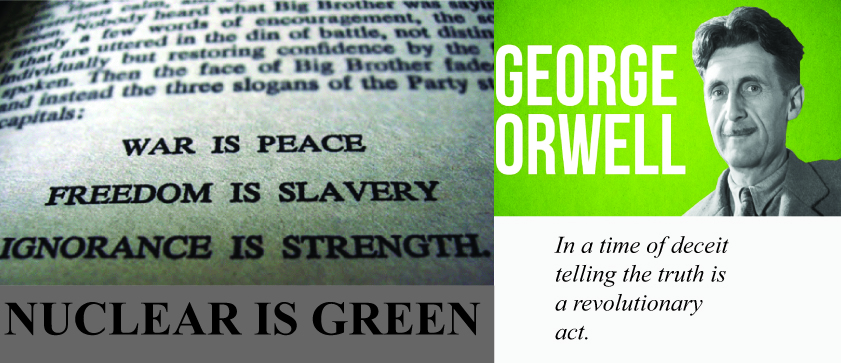
Russia confirms nuclear as green while EU remains undecided NEI, 30 September 2021 The assignment of the status of a “green” energy source to nuclear power generation in the Russian Federation should be a signal for other countries considering the inclusion of nuclear energy in their “green” lists, Rosatom Director General Alexei Likhachev said on 27 September. The previous week, Russian Prime Minister Mikhail Mishustin had approved the criteria for the selection of “green” projects and initiatives in the field of sustainable development for concessional financing.
Among the “green” areas of energy, nuclear energy is separately designated……….
The approval of the Russian“ green ”taxonomy is an important step within the framework of the national climate and environmental agenda, an incentive for the development of green industries and projects,” Likhachev noted. He added that the taxonomy officially established the status of nuclear energy as a “green” source, along with solar, wind and geothermal energy.
“This confirms the effectiveness of nuclear power plants in combating climate change and opens up access to green financing instruments. We hope that the Russian taxonomy will become a signal for foreign countries considering the issue of including nuclear energy in their green lists, he stressed.
Meanwhile, the European Union (EU) has pushed back the deadline for objections to proposed rules for green investments, allowing an additional two months to scrutinise the policy. EU countries will now have until early December, instead of October, to scrutinise these rules………
The Commission is due to publish a second proposal in the coming months, confirming whether the taxonomy will label investments in nuclear and gas as green………… Countries such as France and Hungary are strong supporters of nuclear power, and say investments the low-carbon energy source should be encouraged to fight climate change. Others, including Austria and Luxembourg, are strongly opposed. One EU official said the analysis suggested Austria may consider legal action if the EU included nuclear in the taxonomy, Reuters reported…….. https://www.neimagazine.com/news/newsrussia-confirms-nuclear-as-green-while-eu-remains-undecided-9120845
Australia’s nuclear submarine deal a distraction from international climate action

the main focus of Australia’s government has remained on the continuing mining and export of fossil fuels (for reasons I’ve detailed in The Hill previously). Even while Australian Prime Minister Scott Morrison was in Washington his government was attempting to persuade the Australian States to adopt a “Coalkeeper” policy that seemingly would continue to protect the fossil fuel industry and constrain new renewable energy projects
 |
Is Australia’s nuclear submarine deal a distraction from international climate action? The Hill, BY DAVID SHEARMAN, — 09/28/21 Climate warming and environmental degradation are damaging humanity each and every day and all the decisions we make must be questioned for their human health and survival implications.
The fundamental issue at the UN climate conference COP26 is not the distant target of zero emissions by 2050 but the need to focus on the huge task of delivering emission reductions of 45 percent or more by 2030 to limit a temperature rise to 1.5 degrees Celsius. Currently, the contribution of nations in the Paris Agreement will lead to an emissions rise of 16 percent and a 2.7 degree Celsius rise.
Australia and indeed some other countries must ask themselves if nuclear submarines will be relevant to their likely plight in 2050 or whether the $90 billion (AUD) should be a small down payment on the huge ongoing costs of survival from the predicted climatic ravages which have already commenced worldwide.
One positive has arisen from Australia’s shameful diplomatic treatment of France, whose earlier defense deal with Australia was abruptly canceled and replaced with AUKUS. There will now be much greater scrutiny of the proposed Australia-EU trade deal to ensure Australia complies with climate and environmental needs, as well as with means to assess compliance. Such pressure on Australia’s trading future is already having an impact on policy.
Impact on Australia’s Pacific policy
Trust and cooperation between Australia and France are essential for the needs of the Pacific Island nations. It had been expected that the French through their Pacific territories and commitment to climate change would encourage Australia to recognize its responsibilities.
Over many years, Australia has continued to dismiss the pleas of the islands for a climate policy that would help them avoid inundation. At the time of the 2019 Pacific Island Forum in low-lying Tuvalu, Australia’s Deputy Prime Minister Michael McCormack infamously said that Pacific island nations affected by the climate crisis will continue to survive “because many of their workers come here to pick our fruit.”…………
Even more shaming is Australian indifference to the needs of the Torres Strait Islanders who are the Indigenous peoples of this Australian territory. They have claimed before the UN Human Rights Committee that Australian inaction infringes their human rights. Australia has opposed their claim………
In 2050, conflicts will likely be within countries and between close neighbours over resources such as water and productive land — not based on nuclear threat. Defense services including those of the United States and China will be engulfed in saving lives and infrastructure from fire, flood, storm and drought.
Such conflicts are already with us and U.S. Secretary of State Antony Blinken has cited war in Syria, Mali, Yemen, South Sudan and Ethiopia due to water shortages.
Currently, Australia spends $45 billion (AUD) or 2.1 percent of GDP on defense. It has spent $130 billion on the economic recovery from COVID-19 much by increasing gas mining for export, but less than 2 percent of which has been spent on solutions to reduce emissions and even less on climate adaptation. Indeed, Australia does not have a national coordinated national adaptation policy.
The relevant questions are whether the defesnse agreement between the U.S., UK and Australia to provide nuclear submarines, dubbed AUKUS, has encouraged or coerced Australia to accept and deliver even a 2050 emission target —and how Australia can now cooperate on emission reduction within the Asian Pacific region and particularly the Pacific Island States.
Impact on Australian climate policy
The AUKUS agreement has already resulted in the re-examination of climate policy but discussion has been distracted by worries about AUKUS compromising our sovereignty in the event of armed conflict — and by the diplomatic failure to discuss the issue with Pacific neighbours. There are also concerns about the weakness of U.S. democracy and the possible irrationalities of any future president that could lead to Australian involvement in unnecessary conflict.
However, the main focus of Australia’s government has remained on the continuing mining and export of fossil fuels (for reasons I’ve detailed in The Hill previously). Even while Australian Prime Minister Scott Morrison was in Washington his government was attempting to persuade the Australian States to adopt a “Coalkeeper” policy that seemingly would continue to protect the fossil fuel industry and constrain new renewable energy projects
No wonder many Australian eyebrows were raised when U.S. House Speaker Nancy Pelosi (D-Calif.) hailed Australia as a global leader on climate change.
Currently, Australia is ranked 15 highest of 90 countries for domestic emissions and fifth or sixth if exports of fossil fuels are included. Clearly, Australia is the world’s laggard when the country has the wealth and expertise to take action.
Cop26 climate talks will not fulfil aims of Paris agreement, key players warn, but still offer hope

Some people would be disappointed by the admission that the high hopes for an outcome that would fulfil the Paris aspiration would not be met, said Mary Robinson, chair of the Elders Group, former UN climate envoy and former president of Ireland. “The NDCs will be disappointing, given the urgency and given the climate impacts. It is disappointing that leaders have not been able to step up enough. But the momentum will be there, and that’s very important. I am determined to be hopeful.”
Cop26 climate talks will not fulfil aims of Paris agreement, key players warn. Major figures privately admit summit will fail to result in pledges that could limit global heating to 1.5C https://www.theguardian.com/environment/2021/sep/27/cop26-climate-talks-will-not-fulfil-aims-of-paris-agreement-key-players-warn, Fiona Harvey Environment correspondent Mon 27 Sep 2021 Vital United Nations climate talks, billed as one of the last chances to stave off climate breakdown, will not produce the breakthrough needed to fulfil the aspiration of the Paris agreement, key players in the talks have conceded.
The UN, the UK hosts and other major figures involved in the talks have privately admitted that the original aim of the Cop26 summit will be missed, as the pledges on greenhouse gas emissions cuts from major economies will fall short of the halving of global emissions this decade needed to limit global heating to 1.5C.
Senior observers of the two-week summit due to take place in Glasgow this November with 30,000 attenders, said campaigners and some countries would be disappointed that the hoped-for outcome will fall short.
However, the UN, UK and US insisted that the broader goal of the conference – that of “keeping 1.5C alive” – was still in sight, and that world leaders meeting in Glasgow could still set a pathway for the future that would avoid the worst ravages of climate chaos.
That pathway, in the form of a “Glasgow pact”, would allow for future updates to emissions pledges in the next few years that could be sufficient for the world to stay within scientific advice on carbon levels.
A senior UN official said: “We are not going to get to a 45% reduction, but there must be some level of contributions on the table to show the downward trend of emissions.”
A UK official said: “Cop26 will not deliver all that we want [on emissions].” But the UK, charged as host with delivering a successful outcome, is hoping that progress will be made on other issues, including phasing out coal, providing climate finance to poor countries, and improving the protection of forests.
A US official told the Guardian countries must still aim as high as possible on emissions cuts: “We are going to try to achieve [the emissions cuts necessary]. No one in the administration wants to admit defeat before we have made the maximum effort. You should set an ambitious agenda and may have to, in the end, take baby steps but you should plan for long strides. We are taking long strides.”
Lord Nicholas Stern, the climate economist, said falling short on emissions plans should not be equated with failure. “I agree with [the UN] and most observers that we will not close that gap [between emissions pledges and scientific advice] completely,” he said. “But we should hope for good progress in closing that gap and we should hope for mechanisms and ways forward on how we close that gap further between now and 2025. That’s the way we should think about what is a good, or better, or worse result – a language of success or failure doesn’t seem to me to be very helpful.”
At the Paris climate summit in December 2015, 196 nations agreed to hold global temperature rises to “well below 2C” with an aspiration to limit rises to 1.5C above pre-industrial levels. But the pledges on emissions – known as nationally determined contributions, or NDCs – they brought to the French capital were not enough to fulfil either goal, and would have led to catastrophic heating of at least 3C.
For that reason, the French hosts wrote into the agreement a “ratchet mechanism” that would require countries to return to the negotiating table every five years with fresh targets to meet the temperature goals. Cop26, which was postponed by a year because of Covid, is the fifth Cop – conference of the parties – since Paris.
Some people would be disappointed by the admission that the high hopes for an outcome that would fulfil the Paris aspiration would not be met, said Mary Robinson, chair of the Elders Group, former UN climate envoy and former president of Ireland. “The NDCs will be disappointing, given the urgency and given the climate impacts. It is disappointing that leaders have not been able to step up enough. But the momentum will be there, and that’s very important. I am determined to be hopeful.”
She said the original conception of the Paris agreement, of returning every five years, should be revised so that countries would be asked to return every year with their plans.
The UN takes a similar view. “The Paris agreement built this five-year cycle of ambition, but there is nothing preventing a country from reviewing and updating its NDC next year,” said the senior UN official.
“Cop26 is a very important milestone but it should not be seen as the end of the game, where we give up on 1.5C,” he added. “[It] will signal that 1.5C remains in reach [through] a combination of NDCs, negotiated outcomes and signals in the real economy.”
While the UK, the US and the EU have submitted NDCs requiring much stiffer cuts than those proposed at Paris, the world’s biggest emitter – China – has yet to submit an NDC, and has only indicated that it will cause emissions to peak by 2030, which experts said was not enough to hold the world to 1.5C.
Alok Sharma, the UK cabinet minister who is Cop26 president-designate, said: “Cop26 has always been about delivering urgent action to ensure we keep the path to a 1.5C world alive. Those nations which have submitted new and ambitious climate plans are already bending the curve of emissions downwards by 2030. But we continue to push for increased ambition from the G20 to urgently close the emissions gap. The clock is ticking, and Cop26 must be the turning point where we change the course of history for the better.”
China has still not said whether president Xi Jinping will attend Cop26, causing consternation among climate diplomats who fear China will make no major move at the summit. Relations with China and the US and the UK have been strained by the announcement of the Aukus defence pact with Australia, and by trade differences.
Other countries have also failed to come up with improved NDCs, including Australia, Brazil, Mexico, Indonesia, Russia and Saudi Arabia. India is also the subject of intense diplomacy, as the world’s fourth-biggest emitter after the EU.
Campaigners said the focus should be on the biggest emitters. Mitzi Jonelle Tan, an activist for Fridays for Future in the Philippines, who joined the youth climate strike last Friday, said: “We have seen how big polluters, like the US and China, have promised and pledged less than what is needed from them in the past, yet have fallen short on those every time. Unlike the so-called leaders who like to cheer themselves on for subpar speeches [at the UN], the youth aren’t impressed.”
Far from being the solution to climate change, nuclear power will be a victim of global heating
Rae Street: Given the discussion at TUC Congress of a new generation of
nuclear plants, it is worth looking at the case against nuclear energy.
First, the question of climate change, where the proponents of nuclear
power say nuclear energy is “vital.”
According to Andrew Blowers, emeritus professor of social sciences at the Open University: “Far from
being a solution to the problem of climate change, new nuclear power
stations like Sizewell C and Bradwell B on the fragile and vulnerable east
coast, are likely to become victims of the inevitable, imminent and
irreversible consequences of global warming.” He continued:
“Put simply, there is little justification for these huge structures in terms of
need. But, regardless of need, given the threat to the integrity of the
sites and the risks to present and future generations and environments, the
proposals should be scrapped forthwith.”
Morning Star 23rd Sept 2021
https://www.morningstaronline.co.uk/article/f/the-fallacy-of-trusting-in-nuclear-power
Nuclear power for UK – slow, dangerous, exorbitantly expensive and useless to counter climate change.
An anti-nuclear group has blasted the UK Government for having talks on building another large-scale multi-billion pound nuclear power plant in Wales. Dylan Morgan, Co-ordinator for PAWB, has reacted furiously to the discussions with US reactor manufacturer Westinghouse to build a new
facility on Anglesey.
The UK Government say that the move is part of an effort to reduce the UK’s carbon emissions to net zero by 2050, but according to Morgan it isn’t an effective way to “counter climate change”. He argues that nuclear power is “slow, dangerous and extortionately expensive”.
According to the UK Government, a new nuclear power plant at the decommissioned Wylfa site could become operational in the mid-2030s and generate power for six million homes. Dylan Morgan said:
“We have an immediate crisis now. Building huge reactors at a nuclear power station take at least 15 years. “For example, EdF are involved in building their EPR at Olkiluoto in Finland. Comstruction started in 2005 with the boast it would be completed by 2009. “It still hasn’t been completed in 2021. Nuclear power is slow, dangerous and extortionately expensive. It will do nothing to address the current energy crisis, neither will it be effective to counter climate change.
Nation Cymru 24th Sept 2021
U.S. Militarism’s Toxic Impact on Climate Policy
Biden told the UN General Assembly that “…as we close this period of relentless war, we’re opening a new era of relentless diplomacy.” But his exclusive new military alliance with the U.K. and Australia, and his request for a further increase in military spending to escalate a dangerous arms race with China that the United States started in the first place, reveal just how far Biden has to go to live up to his own rhetoric, on diplomacy as well as on climate change
U.S. Militarism’s Toxic Impact on Climate Policy, Medea Benjamin and Nicolas J. S. Davies LA Progressive 22 Sept 21, President Biden addressed the UN General Assembly on September 21 with a warning that the climate crisis is fast approaching a “point of no return,” and a promise that the United States would rally the world to action. “We will lead not just with the example of our power but, God willing, with the power of our example,” he said.
But the U.S. is not a leader when it comes to saving our planet. Yahoo News recently published a report titled “Why the U.S. Lags Behind Europe on Climate Goals by 10 or 15 years.” The article was a rare acknowledgment in the U.S. corporate media that the United States has not only failed to lead the world on the climate crisis, but has actually been the main culprit blocking timely collective action to head off a global existential crisis.
The anniversary of September 11th and the U.S. defeat in Afghanistan should be ringing alarm bells inside the head of every American, warning us that we have allowed our government to spend trillions of dollars waging war, chasing shadows, selling arms and fueling conflict all over the world, while ignoring real existential dangers to our civilization and all of humanity.
The world’s youth are dismayed by their parents’ failures to tackle the climate crisis. A new survey of 10,000 people between the ages of 16 and 25 in ten countries around the world found that many of them think humanity is doomed and that they have no future.
Three quarters of the young people surveyed said they are afraid of what the future will bring, and 40% say the crisis makes them hesitant to have children. They are also frightened, confused and angered by the failure of governments to respond to the crisis. As the BBC reported, “They feel betrayed, ignored and abandoned by politicians and adults.”
Young people in the U.S. have even more reason to feel betrayed than their European counterparts. America lags far behind Europe on renewable energy. European countries started fulfilling their climate commitments under the Kyoto Protocol in the 1990s and now get 40% of their electricity from renewable sources, while renewables provide only 20% of electric power in America. ………..
the enormous amount of money the U.S. spends on militarism. Since 2001, the United States has allocated $15 trillion (in FY2022 dollars) to its military budget, outspending its 20 closest military competitors combined. The U.S. spends far more of its GDP (the total value of goods produced and services) on the military than any of the other 29 Nato countries—3.7% in 2020 compared to 1.77%. And while the U.S. has been putting intense pressure on NATO countries to spend at least 2% of their GDP on their militaries, only ten of them have done so. Unlike in the U.S., the military establishment in Europe has to contend with significant opposition from liberal politicians and a more educated and mobilized public. ………
On climate change, the infrastructure bill includes only $10 billion per year for conversion to green energy, an important but small step that will not reverse our current course toward a catastrophic future. Investments in a Green New Deal must be bookended by corresponding reductions in the military budget if we are to correct our government’s perverted and destructive priorities in any lasting way. This means standing up to the weapons industry and military contractors, which the Biden administration has so far failed to do.
The reality of America’s 20-year arms race with itself makes complete nonsense of the administration’s claims that the recent arms build-up by China now requires the U.S. to spend even more. China spends only a third of what the U.S. spends, and what is driving China’s increased military spending is its need to defend itself against the ever-growing U.S. war machine that has been “pivoting” to the waters, skies and islands surrounding its shores since the Obama administration.
Biden told the UN General Assembly that “…as we close this period of relentless war, we’re opening a new era of relentless diplomacy.” But his exclusive new military alliance with the U.K. and Australia, and his request for a further increase in military spending to escalate a dangerous arms race with China that the United States started in the first place, reveal just how far Biden has to go to live up to his own rhetoric, on diplomacy as well as on climate change
The United States must go to the UN Climate Summit in Glasgow in November ready to sign on to the kind of radical steps that the UN and less developed countries are calling for. It must make a real commitment to leaving fossil fuels in the ground; quickly convert to a net-zero renewable energy economy; and help developing countries to do the same. As UN Secretary General Antonio Guterres says, the summit in Glasgow “must be the turning point” in the climate crisis.
That will require the United States to seriously reduce the military budget and commit to peaceful, practical diplomacy with China and Russia. Genuinely moving on from our self-inflicted military failures and the militarism that led to them would free up the U.S. to enact programs that address the real existential crisis our planet faces – a crisis against which warships, bombs and missiles are worse than useless. https://www.laprogressive.com/toxic-impact-on-climate-policy/
Scientists still don’t know how far melting in Antarctica will go – or the sea level rise it will unleash
Chen Zhao and Rupert Gladstone
The Antarctic ice sheet is the largest mass of ice in the world, holding around 60% of the world’s fresh water. If it all melted, global average sea levels would rise by 58 metres. But scientists are grappling with exactly how global warming will affect this great ice sheet.
AUKUS military agreement – bad timing ahead of Glascow Climate Summit.

The timing of the new defence deal between the US, UK and Australia has dismayed climate experts, who fear it could have a negative effect on hopes of a deal with China on greenhouse gas emissions ahead of vital UN climate talks.
The Aukus trilateral security partnership has been interpreted as seeking to counterbalance Chinese power in the Asia-Pacific region, and has been likened to a new cold war by China. A Chinese foreign ministry spokesperson warned the three countries to “respect regional people’s aspiration and do more that is conducive to regional peace and stability
and development – otherwise they will only end up hurting their own interests”.
Tom Burke, founder of the E3G environmental thinktank, said: “This [Aukus announcement] is bad timing ahead of Cop26, as Glasgow is time-critical and it’s hard to see what was critical about the timing of this announcement. It does not appear to suggest that the prime minister is taking Glasgow very seriously. And it exposes the fact that he has not gotmuch to offer ahead of Glasgow.”
Guardian 16th Sept 2021
New research shows drastic climate effects of even a ”limited” nuclear war

Climate Change from Nuclear War’s Smoke Could Threaten Global Food Supplies, Human Health, https://www.miragenews.com/climate-change-from-nuclear-wars-smoke-could-632826/ Rutgers University, 15 Sep 21,
Nuclear war would cause many immediate fatalities, but smoke from the resulting fires would also cause climate change lasting up to 15 years that threatens worldwide food production and human health, according to a study by researchers at Rutgers University, the National Center for Atmospheric Research and other institutions.
The study appears in the Journal of Geophysical Research – Atmospheres.
Scientists have long understood that nuclear weapons used on cities and industrial areas could initiate large-scale fires whose massive amounts of smoke injected into the stratosphere could cause global climate change, leading to the term “nuclear winter.”
But in the new study, researchers for the first time used a modern climate model, including aerosols and nitric oxide emissions, to simulate the effects on ozone chemistry and surface ultraviolet light caused by absorption of sunlight by smoke from regional and global nuclear wars.
This could lead to a loss of most of our protective ozone layer, taking a decade to recover and resulting in several years of extremely high ultraviolet light at the Earth’s surface and further endangering human health and food supplies.
“Although we suspected that ozone would be destroyed after nuclear war and that would result in enhanced ultraviolet light at the Earth’s surface, if there was too much smoke, it would block out the ultraviolet light,” said one of the study’s authors Alan Robock, a Distinguished Professor in the Department of Environmental Sciences at Rutgers University-New Brunswick. “Now, for the first time, we have calculated how this would work and quantified how it would depend on the amount of smoke.”
The study’s results showed that for a regional nuclear war between India and Pakistan that would generate five megatons of soot, the enhanced ultraviolet light would begin within a year. For a global war between the United States and Russia generating 150 megatons, it would only begin after about eight years. For intermediate amounts of smoke, the effects would fall between these extreme cases.
For a global nuclear war, heating in the stratosphere and other factors would cause a 15 year-long reduction in the ozone column, with a peak loss of 75 percent globally and 65 percent in the tropics. This is larger than predictions from the 1980s, which assumed large injections of nitrogen oxides but did not include the effects of smoke.
For a regional nuclear war, the global column ozone would be reduced by 25 percent with recovery taking 12 years. This is similar to previous simulations but with a faster recovery time due to a shorter lifetime for soot in the new simulations.
“The bottom line is that nuclear war would be even worse than we thought, and must be avoided,” Robock said. “For the future, in other work, we have calculated how agriculture would change based on the changes of temperature, rain and sunlight, but have not yet included the effects of ultraviolet light. In addition, the ultraviolet light would damage animals, including us, increasing cancer and cataracts.”
The study, which included Rutgers Research Associate Lili Xia, also included researchers from the University of Colorado, NASA Goddard Institute for Space Studies, Columbia University, Potsdam Institute for Climate Impact Research, and Autonomous University of Barcelona.
Turkey Point nuclear station vulnerable to hurricanes, sea level rise, as climate change continues

Safety concerns at Turkey Point are rising, along with the sea level https://www.miamiherald.com/opinion/op-ed/article253692763.html
BY RACHEL SILVERSTEIN AUGUST 24, 2021 The Nuclear Regulatory Commission (NRC) recently granted the world’s first 80-year operating license to Miami’s Turkey Point nuclear reactor – that’s 40 years longer than the plant was ever meant to operate. While there are environmental concerns, this is, first and foremost, an issue of safety.
In the past year alone, three staff members were fired for forging safety inspections, and the plant experienced four unplanned shutdowns, or “scrams” — a disconcerting series of events that led the NRC to take the rare step of downgrading Turkey Point’s safety rating. Turkey Point is now one of only three reactors (out of almost 100 operating nationwide) to have received that ignominious distinction. As Turkey Point’s neighbors, this should alarm us.
Built in the 1970s by Florida Power & Light (FPL) — at a time when the world’s most powerful computers contained about as much storage capacity as a Casio watch — Turkey Point is the NRC’s first foray into this high-stakes game of nuclear roulette. The NRC’s extended license will allow the Turkey Point reactor to continue limping along through 2052. No nuclear plant anywhere in the world has ever operated that long, and the plant — with its Cold War technology, Cold War design and Cold War engineering — was never intended to do so.
If you live in South Florida, you likely know all about the crippling deficiencies that have hampered this aging plant for the past decade or so. It is uncontested, even by FPL, that the reactor’s cooling system — a giant, radiator-like series of unlined canals that’s not used in any other plant in the United States — has been leaking into Miami’s drinking-water supply; this contamination, in turn, has made it difficult for the reactor to tap into a reliable source of fresh water — without which the scalding reactor cannot properly cool itself.
South Florida, of course, gets hurricanes, and Turkey Point — like the Japanese reactor at Fukushima — sits precariously right on the water’s edge, with a growing population of more than 3 million people living less than 25 miles away. Now layer on the NRC’s refusal to consider realistic sea-level rise projections. Instead of trusting federal government recommendations to plan critical infrastructure for at least 6 feet of sea level rise by 2100, the NRC, instead, is accepting FPL’s own internal estimate: just one foot of sea-level rise by 2100.
Even the least severe government projections (as calculated by University of Florida mapping tools) predict that the cooling system will be underwater by 2040 — 12 years before this new license is set to expire.
Given the lessons of Chernobyl and Fukushima —that the costs of nuclear meltdowns are essentially infinite — should this unaccountable administrative agency really get to ignore key science from other federal agencies? This is why citizen groups such as mine and our partners have been challenging this license through the NRC’s administrative court system.
But the NRC granted this unprecedented license to FPL before our appeal had even been decided, let alone heard by a federal judge.
In doing so, the agency has seriously curtailed judicial oversight of the executive branch. Considering the close relationship between the nuclear industry and the NRC, it’s no surprise that the NRC has never — not once — refused to extend a nuclear reactor’s operating license.
Our community deserves to have all the facts about Turkey Point and its safety considerations. Reach out to our representatives to get answers to these important questions:
Who is in charge of a cleanup if the canals or the plant is inundated? What is FPL’s plan for dealing with sea-level rise? What is Plan B for providing energy to this region if the plant can no longer operate? What does this alarming safety-rating downgrade mean for us?
Our country, in short, doesn’t need limitless license extensions for flood-prone, leaking, vulnerable nuclear plants. What we need instead is to unleash American scientific and technical ingenuity to engineer the renewable-energy solutions of the future — and the regulatory support to foster the emergence of these new solutions.
Rachel Silverstein, Ph.D., is executive director and waterkeeper of Miami Waterkeeper, a South Florida-based non-profit organization with a mission to ensure swimmable, drinkable, fishable, water.
“The Invading Sea” is the opinion arm of the Florida Climate Reporting Network, a collaborative of news organizations across the state focusing on the threats posed by the warming climate.
Climate change, sea level rise – real and present danger to UK’s Bradwell and Sizewell nuclear sites
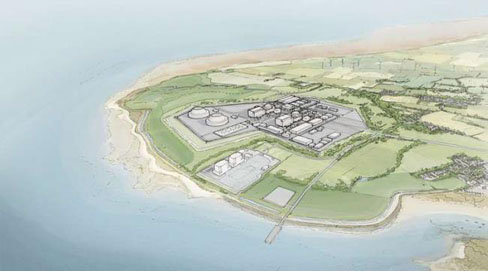
Climate Change the big issue for nuclear power on the East coast, https://www.banng.info/news/press-releases/climate-change-and-nuclear-power/ 11 September 2021 According to Andrew Blowers, Emeritus Professor of Social Sciences at the Open University, Climate Change has become the overriding issue facing the future of the proposed Sizewell C and Bradwell B nuclear power projects on the East Anglian coast. ‘Far from being a solution to the problem of Climate Change, new nuclear power stations like Sizewell C and Bradwell B on the fragile and vulnerable east coast, are likely to become victims of the inevitable, imminent and irreversible consequences of global warming’, he said.
Speaking at a Specific Hearing at the Sizewell C Examination to discuss Policy and Need, Professor Blowers stated that Climate Change was the ‘transformative issue’ of Policy and should be at the very heart of the discussion about building coastal infrastructures like nuclear power stations.
He was disappointed that the Examination Agenda was narrowly framed and the process favoured a legalistic approach. This encouraged a fragmented discussion and a tendency to focus on specific details while losing sight of the bigger picture.
The Examination process must raise its sights from the interminable and obfuscating legalistic debates controlled by developers and give attention to the real and present danger that Climate Change poses for the security and viability of projects in such unsuitable locations. ‘
‘Put simply, there is little justification for these huge structures in terms of need. But, regardless of need, given the threat to the integrity of the sites and the risks to present and future generations and environments, the proposals should be scrapped forthwith’.
The recent Report of the Intergovernmental Panel on Climate Change (IPCC) has spelled out in uncompromising, incontrovertible and unequivocal terms that a rise in global temperatures of 1.50C above pre-industrial levels is already inevitable. It is highly likely that 20C, the level which scientists say may just be manageable, will be reached by the end of the century, and possibly before, if present trends are not arrested. Sea level rise will be around a metre and, as ice melts and oceans heat up, it will continue thereafter. The IPCC states that a sea level rise of 2 metres by 2100 and 5 metres by 2150 ‘cannot be ruled out due to deep uncertainty in ice sheet processes’.
As sea levels rise, the frequency and severity of coastal flooding and erosion will increase and extreme events that occurred once in a century in the recent past are projected, in some scenarios, to occur annually in future. Of course, there is great uncertainty the further forward we look. But, what is certain, is that the impacts of climate change on sea level rise, storm surges and coastal processes could render these east coast sites unviable. This would pose a threat to the security of the highly radioactive wastes remaining stored on site until the latter half of the next century.
At the Hearing, Sizewell C’s developer, EDF relied on governmental polices enshrined in National Policy Statements (NPSs), now ten years old, to claim that the nuclear energy from Sizewell C was necessary. In its more recent pronouncements, the Government is far more equivocal in its support for nuclear energy from such large-scale power stations.
Regardless of whether nuclear is needed at all, Sizewell and Bradwell are manifestly not ‘potentially suitable’ sites as originally indicated in the NPS all those years ago. At both sites the developers claim that the hard defences proposed will be sufficient to protect the nuclear islands against the ravages of climate change.
But, beyond the end of the century, sea level will continue to rise and the impacts become more severe and scenarios for the worst case but plausible change are increasingly uncertain. It becomes impossible to make specific projections and modelling of more extreme coastal conditions is problematic. ‘What possible use will be projections into an unknowable future?’, asks Professor Blowers.
‘It is all too little, too late. I believe we must take the issue of Climate Change seriously and refuse permission to develop these coastal nuclear power stations. It seems inconceivable that the defensive structures can survive intact into the unknown but worsening conditions of continuing sea level rise and extreme events that are inevitable in the future. There can be no possible justification for inflicting this legacy on our coastal communities now and in the future.’
1 This Month
19 February – VIRTUAL EVENT-Decision Time: AI and Our Nuclear Arsenal
12:45 p.m. Central / 1:45 p.m. Eastern
To see nuclear-related stories in greater depth and intensity – go to https://nuclearinformation.wordpress.com
-
Archives
- February 2026 (170)
- January 2026 (308)
- December 2025 (358)
- November 2025 (359)
- October 2025 (376)
- September 2025 (258)
- August 2025 (319)
- July 2025 (230)
- June 2025 (348)
- May 2025 (261)
- April 2025 (305)
- March 2025 (319)
-
Categories
- 1
- 1 NUCLEAR ISSUES
- business and costs
- climate change
- culture and arts
- ENERGY
- environment
- health
- history
- indigenous issues
- Legal
- marketing of nuclear
- media
- opposition to nuclear
- PERSONAL STORIES
- politics
- politics international
- Religion and ethics
- safety
- secrets,lies and civil liberties
- spinbuster
- technology
- Uranium
- wastes
- weapons and war
- Women
- 2 WORLD
- ACTION
- AFRICA
- Atrocities
- AUSTRALIA
- Christina's notes
- Christina's themes
- culture and arts
- Events
- Fuk 2022
- Fuk 2023
- Fukushima 2017
- Fukushima 2018
- fukushima 2019
- Fukushima 2020
- Fukushima 2021
- general
- global warming
- Humour (God we need it)
- Nuclear
- RARE EARTHS
- Reference
- resources – print
- Resources -audiovicual
- Weekly Newsletter
- World
- World Nuclear
- YouTube
-
RSS
Entries RSS
Comments RSS
 nuclear-news