Including nuclear power as ”sustainable” completely undermines the European taxonomy’s original aim of the Green Deal

The published proposal is an incredible greenwashing of long outdated and dangerous technologies. It undermines the taxonomy’s original goal of providing investments for an ecological restructuring of society – the Green Deal.
Instead, the proposal keeps the nuclear technology, which has long since failed in reality, alive and tempts to rely on fossil gas for too long. Every euro that flows into nuclear and gas based on this
classification is missing for real sustainability and effective climate protection.
Ausgestrahlt 5th Jan 2022
https://www.ausgestrahlt.de/blog/2022/01/05/eu-taxonomie-analysiert-yellow-deal-statt-klimaschutz/
Ireland’s EU commissioner Mairead McGuinness insists that nuclear power is ”green”, amidst backlash over the EU ”taxonomy”
McGuinness insists EU move to label nuclear and gas ‘green’ based on science
Comments come amid backlash towards draft of so-called taxonomy
Naomi O’Leary Europe Correspondent, Irish Times, , Jan 4, 2022 Ireland’s EU commissioner Mairead McGuinness has insisted that a controversial plan to classify some nuclear and gas power energy as “green” for investment purposes is based on scientific advice.
It comes amid a backlash towards a draft of the so-called taxonomy, which is a labelling system for economic activities deemed to be “green” and is intended to drive investment towards achieving the European Union’s goals of carbon neutrality by 2050.
The draft was issued on New Year’s Eve, hours before a deadline to release it within 2021. The Commission has been forced to deny this was an attempt to slip the proposals out with little notice.
The deeply contentious file falls under Ms McGuinness’ brief as commissioner for financial stability, Financial Services and Capital Markets Union, putting the Irish former Fine Gael MEP in the hot seat as EU member states and political groups tussle over the topic.
Setting standards
The taxonomy is intended to set standards for what kind of activities businesses can present as “green”. There are plans to make it apply also to EU funds, potentially driving a flood of money towards the sectors included.
Under the draft plans, nuclear power plant investments could be labelled as green if it is a “transitional” fuel and receives a permit before 2045. Any project must include funding, plans and a site for the safe disposal of radioactive waste………
The draft proposal has been sent to member states and the European Parliament and will now be subject to discussions. It could be blocked if a qualified majority of at least 20 member states, or half the MEPs in the European Parliament, vote to oppose it.
Austria’s climate minister responded to the draft by threatening to “sue” if the plan for nuclear went ahead as described. Meanwhile, some in the nuclear industry protested the proposed tightened standards were too strict. The issue also caused discord between the Green and Social Democrat parties in Germany’s new coalition.
Ms McGuinness said in a statement to The Irish Times that the Commission’s work in the area “is based on robust, science-based criteria” and that the taxonomy regulation “gives a prominent role to scientific advice and advice from experts across the economy and civil society”………….. https://www.irishtimes.com/business/energy-and-resources/mcguinness-insists-eu-move-to-label-nuclear-and-gas-green-based-on-science-1.4768772
Anger as European Union is poised to subsidise the corrupt and rapacious nuclear industry

Germany and Austria have expressed their fury over a French victory on EU rules that would open the door to new investment in nuclear power. The European Commission’s proposed new “taxonomy” rules will allow private investment in atomic energy to be linked to climate policy subsidies as well as funding for gas-fuelled power stations to replace coal-fired generators.
Incensed Austrian ministers compared the Brusselsdecision, which was rushed through late on New Year’s Eve, to Adolf Hitler’s 1941 “Nacht und Nebel”, night and fog, decree to round upand destroy all resistance to the Nazis.
“The EU commission took a step towards greenwashing nuclear power and fossil gas yesterday in a night and fog action,” Leonore Gewessler, the Austrian climate protection minister, said. “They are harmful to the climate and the environment and destroy the future of our children.”
Greenpeace UK has urged Boris Johnson not to allow gas or nuclear to be included in Britain’s own green investment rules. “This loophole could be a drain for Europe’s climate ambitions, as they switch from phasing out dirty fuels, to phasing out dirty fuels only when it seems convenient. The UK must resist being pulled into this failing approach,” Doug Parr, the chief scientist and policy director of British Greenpeace, said.
Times 2nd Jan 2022
https://www.thetimes.co.uk/article/eu-capitals-at-odds-on-nuclear-power-kd2fsznr6
European Commission’s divisive plan to label nuclear power ”green”, revealed on the sly?
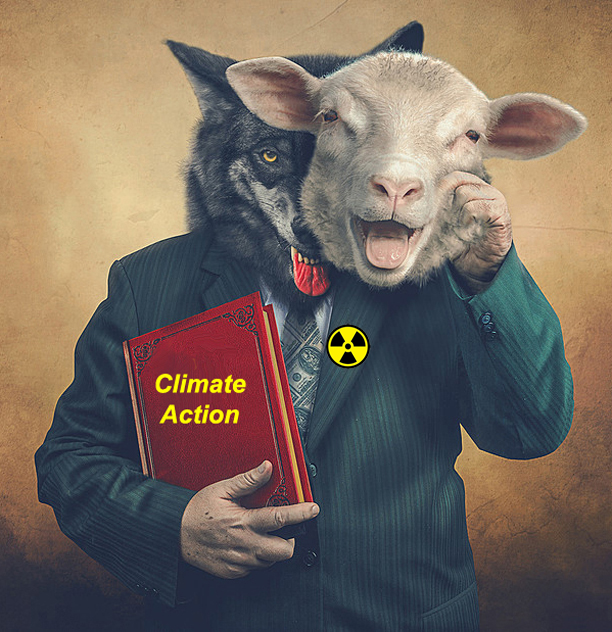
“Short of digging an actual hole, the European Commission couldn’t have tried harder to bury this proposal”
” we get a document written behind closed doors and published on New Year’s Eve,”
EU labels nuclear power ‘green’, Germany calls it dangerous, Sydney Morning Herald, By John Chalmers, January 4, 2022 Brussels: The German government has condemned nuclear energy as dangerous, slamming European Union proposals that would let the technology remain part of the bloc’s plans for a climate-friendly future.
Germany is on course to switch off its remaining three nuclear power plants at the end of this year and phase out coal by 2030, whereas its neighbour France aims to modernise existing nuclear reactors and build new ones to meet its future energy needs. Berlin plans to rely heavily on natural gas until it can be replaced by non-polluting sources for energy.
The opposing paths taken by two of the EU’s biggest economies have resulted in an awkward situation for the bloc’s Executive Commission.
“We consider nuclear technology to be dangerous,” German government spokesman Steffen Hebestreit told reporters in Berlin, noting that the question of what to do with radioactive waste that will last for thousands of generations remains unresolved.
Hebestreit added that Germany “expressly rejects” the EU’s assessment of atomic energy, has repeatedly stated this position towards the commission and is now considering next steps.
The European Union has rejected accusations that it waited until New Year’s Eve to publish the divisive proposals to allow some natural gas and nuclear energy projects to be labelled as sustainable, saying “we weren’t trying to do it on the sly”.
The commission’s decision to include gas and nuclear investments in the European Union’s “sustainable finance taxonomy” rules was circulated in a draft proposal late on December 31 and leaked to some media organisations.
“Short of digging an actual hole, the European Commission couldn’t have tried harder to bury this proposal,” said Henry Eviston, spokesman on sustainable finance at the European Policy Office of the environmental group WWF.
“When the question was whether renewables are green, the commission gave citizens three chances to provide their opinion. For fossil gas and nuclear, we get a document written behind closed doors and published on New Year’s Eve,” he said in an online posting………………………………….
The European Commission will now collect comments to its draft until January 12 and hopes to adopt a final text by the end of the month. After that, the text can be discussed with EU governments and Parliament for up to six months. But it is unlikely to be rejected because that would require 20 of the 27 EU countries, representing 65 per cent of EU citizens, to say “no”.
The aim of the agreement is to send a signal to private investors as to what the EU considers acceptably “green” and stop greenwashing, whereby companies or investors overstate their eco-friendly credentials. The deal will also set limits on what governments can use EU recovery funds to invest in.
https://www.smh.com.au/world/europe/eu-labels-nuclear-power-green-germany-calls-it-dangerous-20220104-p59lmt.html
German government struggles to unite on EU energy proposal
German government struggles to unite on EU energy proposal, DW, 4 Jan 22,
The EU Commission’s proposal to classify nuclear power and natural gas plants as “green” investments has sparked debate in Germany’s new coalition government. Conflict is also brewing between EU states.
Less than a month after Germany’s new coalition government was sworn in, it is facing a major test: To find a united stance in response to a controversial proposal by the EU Commission, published on New Year’s Eve.
The EU Commission wants to label natural gas and nuclear power as climate-friendly, and include investments in both energies on its long-awaited taxonomy list — a green labeling system for investments in the energy sector.
The list is part of the bloc’s plans to decarbonize the European economy and build clean power plants, which will require the investment of billions of euros.
Under the draft proposal, the gas and nuclear plants must meet certain criteria: Investment in new nuclear plants as they are planned in France, the Netherlands, and Poland, can be considered “sustainable” only if respective states ensure they meet the latest technology standards, and provide a concrete plan for the disposal for high-level radioactive waste.
Natural gas plants could also be granted a green label for a limited period of time, provided certain criteria are met. These could involve limits on the amount of greenhouse gas emitted or proving that the plants can also be operated with green hydrogen or low-carbon gas.
The classification of economic activities by the EU Commission under the so-called taxonomy is intended to enable investors to switch their investments to more sustainable technologies and companies.
Divided coalition………………
Climate and Economy Minister and Vice-Chancellor Robert Habeck, told German press agency dpa that he felt the EU proposal “waters down the good label for sustainability.”
“It’s questionable whether this greenwashing will be accepted by the financial markets anyway,” the Green politician said.
Environment Minister Steffi Lemke (Greens) also rated the EU proposal as “questionable.”………….
Klaus Jacob of the Research Center for Environment Policy at Berlin’s Freie Universität says the debate within the government was completely foreseeable.
“This isn’t a predetermined breaking point in the coalition,” Jacob told DW…………………….
Nuclear phaseout nearing completion
The three governing coalition parties are, however, in agreement when it comes to the phaseout of nuclear energy. Germany’s last nuclear power plants are due to be decommissioned just a year from now.
The decision to phase out nuclear power was made during the 1998-2003 coalition between the SPD and Greens under Chancellor Gerhard Schröder, in response to the realization that there was no way to store nuclear waste safely. Almost two decades earlier, Germany’s anti-nuclear protests gave birth to the Green Party and the phaseout has long been one of its core policies.
Angela Merkel’s coalition government of center-right Christian Democrats and FDP then rolled back the phaseout. But in 2011, after the accident at the Fukushima atomic power plant in Japan, Merkel made an about-turn and decided to push through with the phaseout after all.
Referring to the EU’s plans to green label nuclear energy, Environment Minister Lemke said the Commission “creates the great danger of blocking and damaging really viable, sustainable investments in favor of dangerous nuclear power.”……………
EU fissure
The 27 EU member states now have until January 12 to comment on the Commission’s draft. But it’s unlikely that the proposal can be blocked. Besides Germany, only Austria, Luxembourg, Denmark, and Portugal have voiced criticism.
Implementation can only be prevented if at least 20 EU countries (representing at least 65% of the total EU population) or at least 353 members of parliament vote against it.
Other EU countries are continuing to push nuclear energy and campaign for it to be included on the EU’s list of sustainable energy sources eligible for investment — prominently France which holds the rotating EU presidency and is heading for presidential elections in April.
Austria, meanwhile, is threatening to go to the European Court of Justice to stop the draft from being passed.
Edited by Rina Goldenberg https://www.dw.com/en/german-government-struggles-to-unite-on-eu-energy-proposal/a-60319292
Angry response in Europe to the draft European Commission plans to accept nuclear power as ”climate-friendly” – eligible for tax-payer financial help.
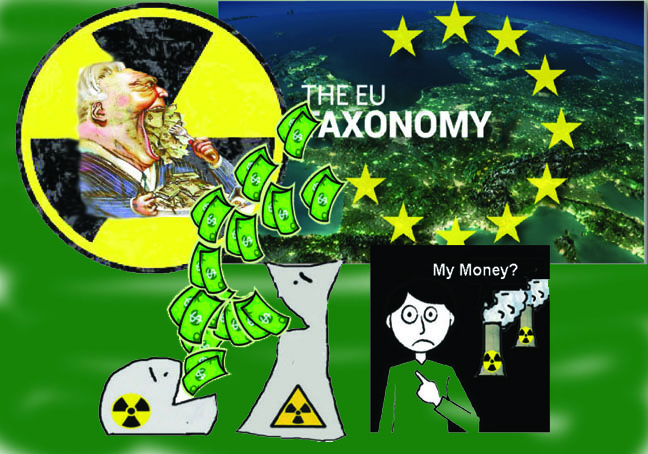
BRUSSELS (AP) — Draft European Union plans that would allow nuclear and gas energy to remain part of the bloc’s path to a climate-friendly future came under immediate criticism over the weekend from both environmentalists and some governing political parties in EU member nations.
In draft conclusions seen by The Associated Press, the EU’s executive commission proposes a classification system for defining what counts as an investment in sustainable energy. Under certain conditions, it would allow gas and nuclear energy to be part of the mix.
The plans would have a huge impact on nuclear-fired economies like France and on Germany’s gas-fueled power plants since they might have had to fundamentally change their strategies.
….. The plans still need the backing of a large majority of the 27 member states and a simple majority in the European Parliament. But the initial thrust from the EU Commission is a key element of the procedure for passage.
“Classifying investments in gas and nuclear power as sustainable contradicts the Green Deal,” the EU’s initiative that is intended to make the bloc climate-neutral by 2050, said Ska Keller, the president of the Green group in the European Parliament.
…..German Economy Minister Robert Habeck criticized the plan to classify investments in gas and nuclear power plants as climate-friendly.
“The EU Commission’s proposals water down the good label for sustainability,” Habeck, who represents the Germany’s environmentalist Greens in the country’s coalition government, told German news agency dpa. “We don’t see how to approve the new proposals of the EU Commission,” he said.
“In any case, it is questionable whether this greenwashing will even find acceptance on the financial market,” Habeck stressed, referring to the practice of painting investments as sustainable when they actually are not.
In Austria, Climate Protection Minister Leonore Gewessler from the Greens also sharply rejected the proposed regulation, saying “the EU Commission took a step towards greenwashing nuclear power and fossil gas in a night and fog action.”
“They are harmful to the climate and the environment and destroy the future of our children,” Gewessler said.
The environmental NGO Greenpeace called the Commission draft proposals “a licence to greenwash.”
“Polluting companies will be delighted to have the EU’s seal of approval to attract cash and keep wrecking the planet by burning fossil gas and producing radioactive waste, said Greenpeace’s Magda Stoczkiewicz.
Especially nuclear power remains extremely controversial in Europe, where many are still vividly remember the fear following the 1986 nuclear accident in Chernobyl, Ukraine. In Germany, children weren’t allowed to play outside anymore for months, couldn’t go mushroom hunting for years and the farmers had to destroy their entire harvest the year it happened………. https://spectrumnews1.com/ca/orange-county/ap-top-news/2022/01/02/eu-draft-on-financing-nuclear-and-gas-plants-raises-ire
German Greens fight plan to funnel billions of euros into the nuclear industry via deceptive taxonomy ”sustainable” label

German Greens lead attack on EU plan to label nuclear power ‘sustainable’. Brussels’ proposal is central to European goal of channelling billions of euros into green investments, Ft.com, Mehreen Khan in Brussels and Joe Miller in Frankfurt 3 Jan 21,
Germany, Austria and Luxembourg have hit out at Brussels’ plans to classify nuclear power as a sustainable technology in the EU’s landmark labelling system for green investment, which is central to Europe’s plans to decarbonise the bloc’s economy. German economy minister Robert Habeck, who is a member of the Green party in the country’s governing coalition, said: “It is questionable whether this greenwashing will even find acceptance on the financial market.” He told German press agency DPA on Saturday: “In our view, there was no need for this addition to the taxonomy rules.”
Brussels’ proposal is part of a so-called “taxonomy” list, which aims to help channel billions of euros of investment needed to decarbonise the bloc’s economy. The plan, the first attempt by a leading regulator to bring clarity to investors seeking to put private capital into sustainable economic activity, covers about 80 per cent of the bloc’s emissions and is intended to be a “gold standard” for markets to decide what is truly green or not. But the process has been beset by fierce political infighting inside the European Commission and its member states.
Leonore Gewessler, Austria’s minister for climate and energy, said on Saturday that Vienna would consider suing the European Commission if the classification of nuclear power as green went ahead. Claude Turmes, Luxembourg’s energy minister, meanwhile called the inclusion of nuclear power a “provocation”. The inclusion of nuclear power is widely seen as a victory for the French government which has urged Brussels to ensure the new rules do not punish a technology that provides almost two-thirds of French electricity. Nuclear reactors do not generate CO2 emissions but produce highly toxic waste…………..
The Brussels draft text will form part of a consultation with EU countries and independent experts that will run until January 12. However, anti-nuclear EU governments do not have the power to veto the taxonomy, which diplomats say is likely to win majority support in the EU Council. Astrid Matthey, one of the independent experts who advises the commission on the rules, criticised the draft for “contradicting the very purpose of the taxonomy”.
“The conditions under which both technologies are to be included are far from ensuring that we reach the Paris climate targets and do-no-significant-harm to the environment. There is still a long way to go for this draft to become aligned with the Green Deal and the EU’s environmental targets”, said Matthey. https://www.ft.com/content/92ab113f-ab17-4492-be65-56c9173cfc53
European Commission drafts plan to label gas and nuclear investments as ”green”

EU drafts plan to label gas and nuclear investments as green, Reuters, By Kate Abnett and Simon JessopSummary
EU drafts plan to label gas and nuclear investments as green Reuters, By Kate Abnett and Simon JessopSummary
EU drafts plan to label gas and nuclear investments as green Reuters, By Kate Abnett and Simon JessopSummary 2 Jan 22
- European Commission drawing up green investment rules
- Draft proposal labels nuclear, some gas plants as green
- Countries disagree on the fuels’ green credentials
- EU advisors said gas not compatible with climate goals
Jan 1 (Reuters) – The European Union has drawn up plans to label some natural gas and nuclear energy projects as “green” investments after a year-long battle between governments over which investments are truly climate-friendly.
EU countries and a panel of experts will scrutinise the draft proposal, which could change before it is due to be published later in January. Once published, it could be vetoed by a majority of EU countries or the European Parliament.
Brussels has also made moves to apply the system to some EU funding, meaning the rules could decide which projects are eligible for certain public finance.
A draft of the Commission’s proposal, seen by Reuters, would label nuclear power plant investments as green if the project has a plan, funds and a site to safely dispose of radioactive waste. To be deemed green, new nuclear plants must receive construction permits before 2045.
…………………. Gas and nuclear power generation would be labelled green on the grounds that they are “transitional” activities – defined as those that are not fully sustainable, but which have emissions below industry average and do not lock in polluting assets.
…………….. The policy has been mired in lobbying from governments for more than a year and EU countries disagree on which fuels are truly sustainable.
……………. Some environmental campaigners and Green EU lawmakers criticised the leaked proposal on gas and nuclear.
“By including them… the Commission risks jeopardising the credibility of the EU’s role as a leading marketplace for sustainable finance,” Greens president Philippe Lamberts said………. https://www.reuters.com/markets/commodities/eu-drafts-plan-label-gas-nuclear-investments-green-2022-01-01/
EU Commission’s draft taxonomy plan – ”a licence to greenwash”
 |
EU Commission’s taxonomy plan is “licence to greenwash” Greenpeace European Unit
https://www.greenpeace.org/eu-unit/issues/climate-energy/45988/nuclear-gas-eu-taxonomy-licence-to-greenwash/ 01/01/2022 Brussels – The European Commission intends to label certain fossil gas and nuclear activities as “sustainable” investments in the EU’s taxonomy of green economic activities, according to a draft communication released late on 31 December 2021.
According to the Commission document, nuclear projects with a construction permit issued by 2045 would be eligible for private investments, as long as they can provide plans for the management of radioactive waste and for decommissioning.
Gas projects with permits issued until 2030 would also be eligible, provided they fulfil a series of conditions, including emissions under 270g CO₂e/kWh. These provisions would deal a significant blow to the EU’s climate and environment action.
Nuclear power generates high-level radioactive waste, and a commercially viable long-term solution has yet to be found. Fossil gas is already the leading source of greenhouse gas emissions from power generation in Europe. Encouraging investments in fossil gas by giving it a green label will only exacerbate its devastating climate impact, warned Greenpeace.
In both cases, renewables are cheaper and faster to deploy, meaning that sending the wrong signal to private investors could disrupt the energy transition towards 100% renewables and delay the EU’s progress on its climate commitments.
The development comes after the EU had already severely undermined the taxonomy last year by labelling the burning of trees for energy as another sustainable activity.
Greenpeace EU programme director Magda Stoczkiewicz said: “The Commission’s taxonomy is a licence to greenwash. Polluting companies will be delighted to have the EU’s seal of approval to attract cash and keep wrecking the planet by burning fossil gas and producing radioactive waste. Promoting these toxic and expensive forms of energy for decades to come is a real threat to Europe’s energy transition. The Commission has shown a shocking disregard for the climate crisis, nature and the people of Europe. The European Parliament and governments need to stop this plan.”
Next steps
Following feedback from government representatives and experts, the Commission will present the final text later in January.
National governments and the European Parliament have the power to reject the proposal to stop it from automatically entering into force.
Contacts:Magda Stoczkiewicz – Greenpeace EU programme director: +32 (0)495 290028, magda.stoczkiewicz@greenpeace.orgGreenpeace EU press desk: +32 (0)2 274 1911, pressdesk.eu@greenpeace.org
COP 27 – the risk of climate summit becoming a stalemate
The UN climate summit to be held this November in Sharm el-Sheikh in Egypt
will be a crunch moment. As hosts of COP26, the UK holds the presidency of
COP for the next year, so over the next 11 months it will be Alok
Sharma’s job to persuade weary nations that they need to draw up fresh
climate plans once more. The COP president faces an uphill struggle:
Australia, New Zealand and the EU have already signalled they are unlikely
to play ball, and without concessions from richer countries, developing
nations such as China and India will be reluctant to deliver more. The risk
of COP27 resulting in a climate stalemate, while the world watches 1.5°C
slip out of reach, is high.
iNews 1st Jan 2022
https://inews.co.uk/news/2022-climate-change-preview-crunch-time-1377754
A technology that leaves behind hazardous wastes ”cannot be sustainable”
Federal government calls EU nuclear push “greenwashing”. Environment
Minister Lemke and Economics Minister Habeck sharply criticize the EU
Commission’s nuclear proposal. A technology that leaves behind hazardous
waste “cannot be sustainable”., Spiegel 1st Jan 2022
Will the European Commission buy into the lie that nuclear power is clean and green?
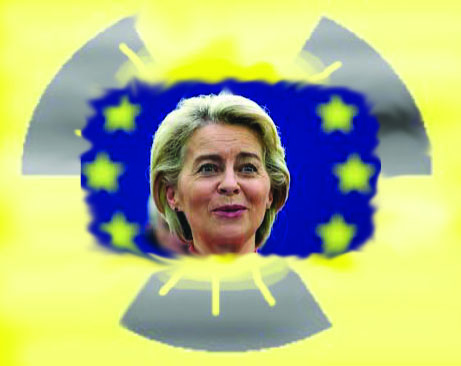
Just who will be making this decision? The global nuclear lobby is desperate to get tax-payer funding , to keep its expensive, dirty, dangerous product going.
Pro nuclear stooges, like Ursula von der Leyen (at left) are keen to get Europe to decide that nuclear power is necessary for climate change.
They keep calling nuclear “zero’ or ”low carbon” – ignoring the full chain of carbon-emiitting processes involved in nuclear structures and in fuelling rectors.
Also ignored , the delays in gettting the industry going – too late to be of any use.
nuclear: Fate of EU green taxonomy ‘now in the hands of von der Leyen’.
The taxonomy text will need approval from a majority of EU member states and members of the European Parliament.
Brussels proposes green label for nuclear and natural gas
European Commission paves way for investments despite concerns over waste and CO2 emissions , Ft.com, Mehreen Khan in Brussels, 1 January 2022.
Brussels wants to recognise nuclear power and forms of natural gas as “green” activity as part of a landmark EU classification scheme to help financial markets decide what counts as sustainable investment. In long-awaited plans, the European Commission has paved the way for investment in new nuclear power plants for at least the next two decades and natural gas for at least a decade, under a green labelling system known as the “taxonomy for sustainable finance”. The labelling system, which will cover industries that generate about 80 per cent of all greenhouse gas emissions in the EU, is the first attempt by a major global regulator to decide what counts as truly sustainable economic activity and help stamp out so-called greenwashing in the financial sector.
A draft legal text, seen by the Financial Times, says the EU’s green label should be awarded to controversial energy sources including nuclear power and natural gas under certain circumstances. The decision was taken after a vocal group of pro-nuclear countries, led by France, and pro-gas governments in southern and eastern Europe, demanded the taxonomy should not punish energy sources that provide a bulk of their power generation….
The draft taxonomy text says nuclear power should be considered a sustainable economic activity as long as EU countries that host power stations can safely dispose of toxic waste and meet a criteria to cause “no significant harm” to the environment. The construction of new nuclear plants will be recognised as green for permits granted until 2045, says the text. ……….
https://www.ft.com/content/7872a05f-9e38-4740-9b1b-4efc69ca316c
Germany aiming for far-reaching methods to reduce carbon emissions across all sectors
Germany is likely to fail to hit its carbon emissions reduction targets in
the coming two years, Economy and Climate Protection Minister Robert Habeck
told Die Zeit newspaper. The previous government set more ambitious CO2
reduction targets, including being carbon neutral by 2040, after a top
court ruled in April that Germany must tighten its climate protection law.
The new coalition government presented plans to step up climate protection
efforts entailing far-reaching reforms for the utility sector and across
manufacturing industries, buildings, transport and agriculture.”We will
probably miss our targets for 2022. … Even for 2023 it will be difficult
enough. We are starting with a drastic backlog,” said Habeck, co-leader of
the Greens who are part of the new ruling coalition. Germany aims to cut
emissions in industry, the biggest carbon emitting sector, to 177 million
CO2 tonnes in 2022, down 38% compared with 1990.
Independent 30th Dec 2021
https://www.independent.co.uk/climate-change/news/germany-carbon-targets-robert-habeck-b1984463.html
Nuclear power in the EU taxonomy and Germany’s position

Q&A: Why is Germany phasing-out nuclear power and why now? 28 Dec 2021, Kerstine Appunn ”……………………………..Nuclear power in the EU taxonomy and Germany’s position
Observers have called France’s push to include nuclear power projects in the EU taxonomy as a sustainable investment a “political nightmare” for Germany. Backed by a group of other European countries such as Bulgaria, Croatia, Czechia, Finland, Hungary, Poland and Romania, French President Emmanuel Macron tries to make nuclear power a pillar of the EU’s decarbonisation strategy, while Germany is betting heavily on wind and solar power. It is supported in its push for a nuclear-free taxonomy by Portugal, Austria, Luxembourg and Denmark. Germany’s new Chancellor Olaf Scholz, of the Social Democrats (SPD), has told Macron that he has always been opposed to nuclear power, much like his coalition partner, the Green Party.
If included in the taxonomy, nuclear power investments could be part of green funds, banks could declare loans to nuclear projects as sustainable investments – all in aid of getting more private investment to flow into climate friendly economic activities and businesses.
Agora Energiewende’s Müller says the German approach is still more future-proof. “The idea that nuclear power stations can be built at predictable costs and by a predictable schedule has not proven to be realistic. We also still have the unresolved problem of nuclear waste storage as well as the possibility of a major accident. Germany’s decision to focus on the expansion of renewables instead of nuclear is reflected also by the markets as renewables dominate electricity investments internationally.”
The European Commission is set to come out with a proposal for the taxonomy in January 2022, which EU member states will then decide on with a majority vote. Instead of an in-or-out decision on nuclear (and natural gas), the commission is likely to present a compromise that would classify nuclear as a temporary, transitional technology which has to be labelled and declared in funds so that consumers and investors have the choice between “entirely green” products, e.g. renewable energies, or second or third tier products that include nuclear or gas technology.
Whatever the decision, Müller says Germany and France should focus more on the common ground concerning the energy transition. “Recent French studies show – independently of the future of nuclear energy – that a massive expansion of renewables is needed to reach the climate targets. And there are also opportunities for cooperation between Germany and France on green hydrogen.”
Shouldn’t Germany – like other countries – embrace and support the use of new small modular reactors?
Using a large fleet of small modular reactors (SMR) to secure climate neutral electricity supply in the future – as proposed by billionaire and philanthropist Bill Gates – has been hailed as a climate change solution. In Belgium, which is set to shutter its two remaining nuclear power stations by 2025, the government agreed to invest 100 million euros in the research on SMR.
SMR proponents claim that, once produced in bulk, these small plants are cheaper and safer thanks to advanced reactor designs and can be operated with converted short-lived radioactive materials, solving the waste problem.

But two assessments commissioned by the Federal Office for the Safety of Nuclear Waste Management (BASE) have found that these tens of thousands of small reactors would carry enormous risks with regard to the proliferation of weapons-grade materials and will probably never be as cheap as their advocates say.
What is different in Germany compared to other countries in Europe which embrace nuclear as a CO2-free solution?
Germany not only has strong public support for, and a long history of, anti-nuclear sentiment, it also has only 11 percent of nuclear left in its power mix. Leaving it behind entirely is therefore a more obvious and easy decision than for other countries, such as France, where the share of nuclear power in domestic generation stands at 70.6 percent, but also in Bulgaria with 40.8 percent, in Sweden with 29.8 percent (in Spain: 22.2%, Russia at 20.%, United States at 19.7%, UK 16%, all in 2020).
Historians also explain the different attitude towards nuclear with the different reactions to the Chernobyl accident, which was felt much closer and more threatening to Germans compared to French or UK citizens. Another explanation for Germany’s sensitivity to nuclear power is that early on, the post-war critique of nuclear weapons was linked to the civilian use of nuclear fission. (A second wave of the German peace movement in the 1980s would also bolster a younger generation’s resistance to nuclear power.)
And even if there are people who make a case for nuclear for climate protection reasons, the exit has now proceeded too far to be reversed, and there is simply no influential political power that would consider re-opening the painful, decade-long debate on nuclear power that has finally been put to rest. https://www.cleanenergywire.org/news/qa-why-germany-phasing-out-nuclear-power-and-why-now
France to lead the European Council – a worrying situation as Macron cosies up to polluting corporations, especially nuclear.

In January, France will take on the rotating Presidency of the Council of
the EU for six months. This Presidency will have a particular resonance
both in France itself, coinciding as it does with Emmanuel Macron’s
re-election campaign, and at the European level, with many critical pieces
of legislation and policy on the line.
It is therefore worrying that this
Presidency has been prepared in close collaboration with the French
corporate sector, and is setting a policy agenda that strongly reflects
business demands.
In the name of climate action, the French Government is
pushing for more public support and funding for controversial industries,
including a renewed push for the nuclear sector. For the sake of nuclear
energy, the French Government appears willing to undermine the integrity of
the European Green Deal and other EU policies on the climate crisis, for
instance with the demand that gas is seen as ‘green’ in the Green
Taxonomy which will direct financial flows accordingly, and generally
through the prioritisation of industry-pushed ‘techno-fixes’ instead of
structural changes to make our lives more sustainable.
Corporate Europe 20th Dec 2021
https://corporateeurope.org/en/under-influence-distorted-priorities
1 This Month



26 September – International Day for the Total Elimination of Nuclear Weapons


PLEASE OPPOSE HR 8255 AND S.3639 – bills would accelerate satellite deployment, with no environmental review or safeguards – https://ncstd5li.quorum.us/campaign/169331/
To see nuclear-related stories in greater depth and intensity – go to https://nuclearinformation.wordpress.com
-
Archives
- September 2026 (233)
- August 2026 (330)
- July 2026 (355)
- June 2026 (287)
- May 2026 (306)
- April 2026 (356)
- March 2026 (251)
- February 2026 (267)
- January 2026 (308)
- December 2025 (358)
- November 2025 (359)
- October 2025 (375)
-
Categories
- 1
- 1 NUCLEAR ISSUES
- business and costs
- climate change
- culture and arts
- ENERGY
- environment
- health
- history
- indigenous issues
- Legal
- marketing of nuclear
- media
- opposition to nuclear
- PERSONAL STORIES
- politics
- politics international
- Religion and ethics
- safety
- secrets,lies and civil liberties
- spinbuster
- technology
- Uranium
- wastes
- weapons and war
- Women
- 2 WORLD
- ACTION
- AFRICA
- Atrocities
- AUSTRALIA
- Christina's notes
- Christina's themes
- culture and arts
- Events
- Fuk 2022
- Fuk 2023
- Fukushima 2017
- Fukushima 2018
- fukushima 2019
- Fukushima 2020
- Fukushima 2021
- general
- global warming
- Humour (God we need it)
- Nuclear
- RARE EARTHS
- Reference
- resources – print
- Resources -audiovicual
- Weekly Newsletter
- World
- World Nuclear
- YouTube
-
RSS
Entries RSS
Comments RSS
 nuclear-news