The science-based case for excluding nuclear power from the EU taxonomy

Not green and not sustainable, The science-based case for excluding nuclear power from the EU taxonomy, Beyond Nuclear, 15 Jan 2022,
A statement by Dawn Slevin, Dr. Erik Laes, Paolo Masoni, Jochen Krimphoff, Fabrizio Varriale, Andrea Di Turi, Dr. Ulrich Ofterdinger, Dr. Dolores Byrne, Dr. Petra Kuenkel, Ursula Hartenberger, Kosha Joubert, Dr. Paul Dorfman, Anders Wijkman, Prof. Petra, Seibert, Rebecca Harms, Joseph Kobor, Michel Lee, Dr. Stuart Parkinson, and Dr. Ian Fairlie
One of the most influential policy initiatives of the European Commission in the past years has been the “EU Taxonomy”, essentially a shopping list of investments that may be considered environmentally sustainable across six environmental objectives
To be deemed EU Taxonomy aligned, the activity must demonstrate a substantial contribution to one environmental objective, such as climate change mitigation, whilst causing no significant harm to the remaining five environmental objectives (climate change adaptation, sustainable use and protection of water and marine resources, transition to a circular economy, pollution prevention and control, and protection and restoration of biodiversity and ecosystems).
All eligible activities are required to comply with technical screening criteria (TSC) for ‘substantial contribution’ and ‘do no significant harm’ and to demonstrate that social safeguards are in place. The EU Taxonomy provides a common language for sustainability reporting, a foundation for green bond reporting and much more. It is intended to be used by international financial markets participants whose products are sold within the EU in order to evaluate the sustainability of their underlying investments.
The use of the EU Taxonomy is furthermore compulsory for the EU and member states when introducing requirements and standards regarding environmental sustainability of financial products, such as an EU ecolabel for investment products or an EU Green Bond Standard. It will also apply to 37% of activities earmarked as ‘climate-friendly’ financed by the EU COVID-19 recovery funding. Its science-based approach is designed to give confidence to a wide range of international stakeholders that environmental claims are not greenwashing.
The question whether nuclear fission energy complies with the ‘do no significant harm’ (DNSH) criteria of the EU Taxonomy was the focus of the Technical Expert Group (TEG) DNSH assessment on nuclear fission technologies which recommended to the Commission that nuclear should not be included in the EU Taxonomy of environmentally sustainable activities.
Taking into account the significant financial implications of adopting the TEG recommendations, it became the starting point of intense behind-door lobbying. France led a coalition of 10 EU Member States arguing that nuclear fission as well as gas-fired power plants should be included in the Taxonomy. Together with Finland (Olkiluoto-3), France is at present the only EU country constructing a new nuclear power plant (Flamanville-3).
The Finnish and French construction sites were meant to be the industrial demonstration of an evolutionary nuclear technology (the “European Pressurised water Reactor” or EPR). Olkiluoto-3 was meant to start generating power in 2009, followed by Flamanville-3 in 2012. Instead, the projects turned out to have multiple engineering difficulties and financial constraints that resulted in significant delays culminating in missed deadlines for various production start dates and tripling unit cost.
Nevertheless, in October 2021 president Macron announced that France will continue to invest heavily in the construction of EPR ‘light’ versions, next to research into small modular reactor (SMR) technology. Following consultation with Member States, the Commission charged its former nuclear Joint Research Centre (JRC) to draft another technical report in 2020 – the “Technical assessment of nuclear energy with respect to the ‘do no significant harm’ criteria of Regulation (EU) 2020/852”. This report was reviewed by two sets of experts, the Group of Experts on radiation protection and waste management under Article 31 of the Euratom Treaty (having no specific competences in sustainability impact assessment other than impacts incurred by radiation) and the Scientific Committee on Health, Environmental and Emerging Risks on environmental impacts (Sheer).
While the Sheer group pointed out some omissions, the Article 31 Group of Experts, unsurprisingly supported the conclusions of the JRC. Nevertheless, a minority report opposed the lack of integration of economic and environmental aspects, as put forward by the Rio principles for Sustainable Development.
The JRC, supported by the Art. 31 experts, concluded amongst others that: “…deep geological repositories are considered, at the state of today’s knowledge, appropriate and safe means of isolating spent fuel and other high-level waste (HLW) from the biosphere for very long timescales and the necessary technologies are now available;” “..the standards of environmental control needed to protect the members of the public are likely to be sufficient to ensure that other species are not put at risk;” “… the requirements in the [EU Taxonomy] TSC regarding protection of humans and the environment from harmful effects of ionising radiation are automatically satisfied in the EU if a licence can be issued.”
Notwithstanding the findings of the JRC and the Article 31 Group of Experts, members of the TEG DNSH maintain our position that nuclear fission energy should not be included in the EU Taxonomy of environmentally sustainable activities. We the TEG DNSH members observe that the above JRC/Article 31 Group of experts’ statements and conclusions drawn thereof cannot be fully based on scientific evidence as deep geological disposal of high-level nuclear waste entails the need for adequate quality assurance and control of waste form compatibility, as well as for monitoring of health impacts and preservation of knowledge and memory for possibly thousands of years. It also requires operational demonstration of disposal within Europe.
The fact that according to the current technical state of knowledge there is no alternative to deep geological disposal as a ‘solution’ for the nuclear waste problem does not take away from its ethically problematic character. Moreover the independent scientific evidence which the TEG presented to the European Commission, shows evidence of adverse impacts to the natural environment arising from the many processes involved in the nuclear power lifecycle (from uranium mining to waste disposal) that are operational today.
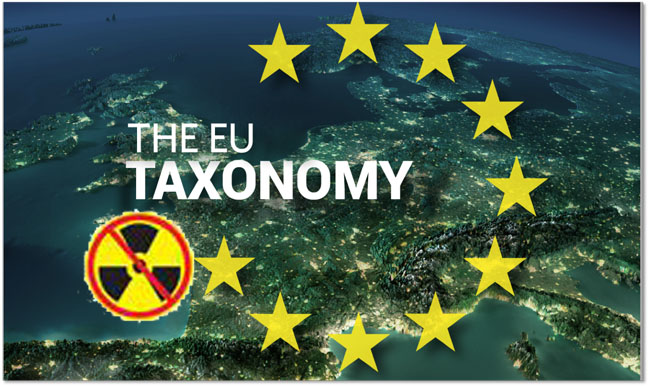
Therefore, we maintain our recommendation to the European Commission that nuclear fission energy has no place on the EU Taxonomy of sustainable activities, whether or not it is licensed. It is furthermore our view that the proponents of nuclear energy have guided the interpretation of scientific knowledge and the framing of sustainability assessment in order to use the EU Taxonomy to place a ‘scientific’ stamp on what is primarily a political position on nuclear fission energy aiming to satisfy the few EU member states that wish to promote the associated technologies.
Does the present generation of nuclear fission power plants ‘do no significant harm’? ………
The Taxonomy architecture is not designed to cater for such risks that carry an intergenerational impact lasting for thousands of years, making it an unsuitable instrument to decide on the sustainable nature of nuclear power. ………..
Other concerns with regard to DNSH criteria ……………………………..
Should nuclear fission power be included in the taxonomy as a transition activity? ……………………………………..
Further issues of justice beyond the DNSH criteria …………………….
The Way Forward .
Controlling nuclear technologies, investments, and practices requires a high level of technical expertise, which emphasizes the need for expert structures which are independent of the nuclear industry and can therefore better safeguard the common good at international, European and national levels.
The nuclear industry is currently self-regulating with oversight provided by the IAEA (with a mandate to promote the peaceful applications of nuclear technology), EURATOM framing and international committees such as UNSCEAR depending too much on international diplomacy (which recently cast doubt on the health effects of exposure to low levels of radiation).
We highlight the need for an independent international agency requiring revision of the EURATOM treaty as well in order to be able to review nuclear power issues with a focus on society’s need of sustainable development above nuclear sectoral interests, in terms of safeguarding public and environmental health, economic and energy security and general issues of justice.
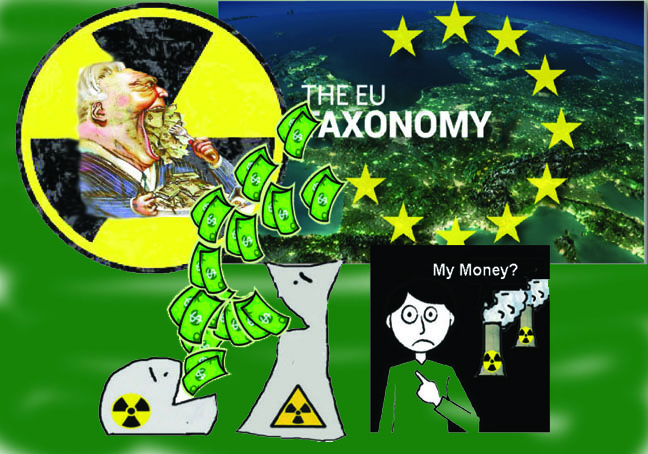
The proposed inclusion of nuclear fission energy in the EU Taxonomy will channel much needed capital away from proven sustainable energy sources, create more long-term operational and waste management risks and adverse environmental and social impacts that will undermine the principles and technical screening criteria of the EU Taxonomy and crucially, undermine Europe’s credibility and standing amongst its own citizens and international peers.
Instead of giving the nuclear industry a new financial injection for solutions of the past such as the large scale EPR, the EU should focus on pressing issues such as looking for common solutions to the existing HLW problem in EU Member States (and internationally) and taking up a strong regulatory position on nuclear safety and peaceful developments in nuclear technology.
It is the responsibility of Euratom to demonstrate a real European collaboration in solving the technical as well as the environmental and economic challenges related to HLW management (emergency management, harmonised safety and QA/QC criteria for waste forms, insurances).
The signatories of this letter understand the need of the nuclear industry to receive ongoing regulatory support to ensure that their current operations, management of waste, and decommissioning are authorized and carried out in a safe manner. We therefore encourage the JRC and EU Institutions to extend and harmonise their support and strategic direction of the nuclear industry in the new energy transition paradigm, but we state categorically that the proposed inclusion of nuclear fission energy on the EU Taxonomy of environmentally sustainable activities is contrary to the TEGs recommendation to the European Commission.
The above is the content of a Statement of Concern sent by the EU Taxonomy subgroup DNSH TEG members and expert supporters to the Commission on December 21, 2021. The statement can also be downloaded in PDF format. https://wordpress.com/read/feeds/72759838/posts/3774941784
The detail in the European Commission’s draft for ”sustainable nuclear energy” makes nuclear energy unfeasible – even the nuke lobby hates it!


“The taxonomy reporting is annual, so there’s something impossible to match there, which means a major greenwashing risk”
The European Parliament, however, has a lower voting threshold and will be able to block the proposal by simple majority (i.e. at least 353 MEPs in Plenary).
‘Misunderstanding’ could block nuclear from claiming green EU label, industry warns https://www.euractiv.com/section/energy-environment/news/misunderstanding-could-block-nuclear-from-claiming-green-eu-label-industry-warns/ By Kira Taylor | EURACTIV.com Ambiguities and misunderstandings contained in a draft EU proposal could block nuclear power plants from claiming a green investment label under the bloc’s sustainable finance taxonomy, the industry has warned. The European Commission is currently in the process of putting together a rulebook, known as the sustainable finance taxonomy, to define which investments can be labelled as climate-friendly in the EU.
As part of this, nuclear energy has tentatively been categorised as a “transitional” technology making a “substantial contribution to climate change mitigation” under draft EU plans circulated by the European Commission on 31 December.
To qualify for the transitional label, new nuclear plants must be built before 2045 and show detailed plans to have a disposal facility in place by 2050 for high-level radioactive waste.
However, issues with the draft criteria mean no nuclear power plant would currently be able to claim the coveted green label, the nuclear industry body Foratom told EURACTIV.
This is because of a requirement that power plants must fully apply “the best-available technology and accident-tolerant fuel” to qualify. That fuel is still in the research phase and is currently not available or licenced, Foratom says.
“As it currently stands, no nuclear entity is covered by the taxonomy because of this,” said Jessica Johnson, communications director at Foratom. “If the text does not change, then we do have problems, particularly in relation to accident tolerant fuels – they don’t exist on the market today,” she told EURACTIV.
Criteria based on a currently unavailable fuel “is obviously not acceptable,” Johnson said, adding however that this could simply be a “misunderstanding” by the European Commission.
Nuclear industry leaders expressed their concerns in a letter sent to the EU executive. “Given that Accident-Tolerant Fuels are still at the research phase we believe this requirement should be removed and instead limited to existing legislation and best available technologies.”
Ambiguous wording
Alongside this, the industry has flagged concerns about the draft’s wording regarding the types of nuclear power plants that could qualify.
According to Foratom, criteria for the operation and maintenance of nuclear plants is ambiguous as the proposal only seems to cover new build projects or those undergoing a lifetime extension, potentially excluding the normal operation and maintenance of existing plants.
“We think it’s just an oversight and more an issue of wording. But it is important that it’s clearly stated that the technical screening criteria cover operation and maintenance of existing power plants,” she said.
Foratom has also questioned a requirement for final repositories of high-level radioactive nuclear waste. Companies will only be able to claim the green EU investment label if they can show “a plan with detailed steps” to have them “in operation by 2050,” according to the draft.
While Foratom agrees that such repositories must be available, Johnson said the current wording could mean a plant built in the 2040s would need a final repository in place by 2050, despite not requiring it for decades.
“We don’t see a need to have a final repository lying idle for 20 to 30 years. It doesn’t make much sense to us,” she explained.
Also it shouldn’t be restricted just to final repositories. We shouldn’t be hampering innovation in other solutions because there is other innovation and research ongoing in terms of other solutions for high level waste and spent fuel,” she added.
Opposition
Environmental groups also have concerns about this part of the leaked draft – only for the opposite reason.
“If the nuclear plant is reported as taxonomy aligned from year one, but [its plan for disposing of high-level waste] fails by, say 2045, then that means the nuclear plant was not taxonomy aligned at all from year one,” explained Sebastien Godinot from WWF, the global conservation NGO.
“The taxonomy reporting is annual, so there’s something impossible to match there, which means a major greenwashing risk,” Godinot warned.
Some EU member states have vowed to oppose the inclusion of nuclear in the EU’s green finance taxonomy. “If the EU taxonomy includes nuclear energy, we are ready to challenge that in court,” Austria warned in November. The country has since repeated that threat.
Luxembourg, Denmark and Spain have also voiced their opposition to the proposal. But they currently have little support from other EU countries, which are either pro-nuclear or keeping silent on the matter.
Anti-nuclear countries are unlikely to have a sufficient majority to veto the Commission’s draft proposal, known as a “delegated act”. To block a delegated act, they would need at least 72% of EU member states in the EU Council (i.e. 20) representing at least 65% of the EU population.
The European Parliament, however, has a lower voting threshold and will be able to block the proposal by simple majority (i.e. at least 353 MEPs in Plenary).
This makes the Parliament more of a threat to the nuclear industry, even though Foratom is still confident about the outcome. “We don’t think that they would get the number of votes needed to achieve that simple majority. Nevertheless, we are keeping a very close eye on that,” Johnson told EURACTIV.
German conservative lawmaker Peter Liese also believes the Parliament won’t block the proposal. “If I had to make a bet, I’d still bet that the European Parliament wouldn’t end up blocking the delegated act, but I wouldn’t put a lot of money on it anymore,” he told the Suddeutsche Zeitung.
Some EU lawmakers will be hoping they can garner enough support to stop the Commission’s proposal. They include German Green MEP Michael Bloss, who launched a petition to try and increase citizen pressure on the European Commission.
“With this proposal, EU Commission President Ursula von der Leyen is destroying the credibility of the European eco-label for financial investments. Including nuclear power and gas is an unprecedented labelling fraud, because nuclear power and gas are not sustainable energy sources,” Bloss told EURACTIV.
“There is now a lack of clarity for citizens who want to invest their money in sustainable, in the sense of green transformation. Where it says sustainable on it, it must also be sustainable in it, otherwise the entire regulatory framework loses its credibility,” he added.
The European Commission has given EU countries until 21 January to provide feedback on its plans and is expected to publish its proposal shortly after this month the deadline for experts to give feedback on divisive plans to allow some natural gas and nuclear energy projects to be labelled as sustainable investments.
Nuclear: economically unsustainable, inherently dangerous and absolutely unfeasible as a solution to climate change

Nuclear: economically unsustainable, inherently dangerous and absolutely unfeasible as a solution to climate change.
A demolishing letter against those who postulate nuclear energy as part of the solution to the challenge
of climate change. The letter is signed by former top-level nuclear safety councils and regulatory authorities in France, Germany, the United Kingdom and the United States.
For nuclear power to contribute in a relevant way to the generation of energy on a global scale, the signatories maintain, it would take up to more than 10,000 new reactors, something that is “unsustainable from a financial point of view.”
Furthermore, nuclear power is still “subject to too many unresolved technical and safety problems” and
does not respond to the urgency of the challenge we face (climate change), given the construction times of the plants.
Energias Renovables 12th Jan 2022
The environmental impact of emissions from space launches: a comprehensive review
The environmental impact of emissions from space launches: A comprehensive review https://www.sciencedirect.com/science/article/abs/pii/S0959652620302560Author links open overlay panelJ.A.DallasabS.RavalbcJ.P.Alvarez GaitandS.SaydamabA.G.Dempsterae
a Australian Centre for Space Engineering Research, UNSW, Sydney, Australia
bSchool of Minerals and Energy Resources Engineering, UNSW, Sydney, Australia
cAustralian Centre for Sustainable Mining Practices, UNSW, Sydney, Australia
d School of Civil and Environmental Engineering, UNSW, Sydney, AustraliaeSchool of Electrical Engineering and Telecommunications, UNSW, Sydney, Australia
28 January 2020.
Highlights
•The environmental impact of space launches is becoming increasingly significant.•
Stratospheric ozone depletion is a key environmental concern for space launches.•
Environmental trade-offs exist between propellant types.•
Further study is required into the cumulative impact of launches.
Abstract
With the increasing accessibility of commercial space flight, the environmental impacts of space launches will become increasingly significant in the coming years. Here, for the first time, a review is presented of the environmental impacts of space launches, specifically of emissions from commonly used solid and liquid rocket propellants. While there are a number of environmental impacts resulting from the launch of space vehicles, the depletion of stratospheric ozone is the most studied and most immediately concerning. Solid rocket motors are the subject of most of the environmental studies on rocket launches, while the now more commonly used liquid rocket propellants are underrepresented in the literature. The limited studies of emissions from rocket engines using liquid propellent reveal that while they do result in stratospheric ozone loss, solid rocket motors are responsible for orders of magnitude greater loss. The comparison of commonly used propellants highlights the environmental trade-offs that must be made when selecting a launch system. This review highlights the need for further study of the cumulative impacts that frequent space launches have on all areas of the environment, including global climate, ecosystem toxicity, and human toxicity, and with consideration given to all commonly used propellants, to ensure that the impacts are well characterised and well understood before the number of launches greatly increases.
Fieldwork in the High Arctic found cataclysmic impact of climate change happening 70 years ahead of what the scientific models expected.

During the month of December 2021 two warnings of impending sea level rise were issued by highly respected groups of climate scientists. These are professional scientists who do not deal in hyperbole. Rather, they are archetypical conservative serious-minded scientists who follow the facts. The most recent warning on December 30th is of deteriorating conditions at the Arctic and Greenland. The second warning is the threatening collapse in Antarctica of one of the largest glaciers in the world. As these event unfortunately coincide so close together, one at the top of the world, the other at the bottom, should coastal cities plan to build sea walls? An article by M. Farquharson, et al in Geophysical Research Letters d/d June10, 2019 stated: “Observed maximum thaw depths at our sites are already exceeding those projected to occur by 2090.” In other words, fieldwork in the High Arctic found cataclysmic impact of climate change happening 70 years ahead of what the scientific models expected. Counterpunch 7th Jan 2022 https://www.counterpunch.org/2022/01/07/when-to-build-sea-walls/ |
Climate change destroying homes across the Arctic
Cracked homes, buckled roads and ruptured pipelines are likely to become common in and near the Arctic as warming temperatures cause frozen ground to thaw, new findings say. Five million people live on Arctic permafrost including in Russia, North America and Scandinavia.
Climate change is causing the Arctic to warm two-to-four times faster than the rest of the planet.
BBC 11th Jan 2022
Climate change crisis ranked as the biggest threat facing the global economy, ahead of wars and pandemics.

Extreme weather, biodiversity loss, and a global failure to tackle climate change are the biggest threats facing the global economy. Together they rank ahead of international conflicts, the collapse of financial markets, and pandemics as the major risks to economic stability, according to the latest edition of the annual World Economic Forum (WEF) Global Risks Report released today.
In the next 24 months extreme weather is the largest risk to economic stability, posing a bigger threat than the rising cost of living, poor mental health, and cybersecurity failure, the WEF said.
iNews 11th Jan 2022
Times 12th Jan 2022
Downright absurd to classify a technology with the potential danger of nuclear power plants as green and sustainable.
I am very sure that not a single private company will ever build a nuclear power plant on its own account and at its own risk. The taxonomy does not change that. At best, it reduces the enormous government subsidies needed to push this technology into the market
“Nuclear is the opposite of what wind & solar need to partner with” – ex energy state sec Nuclear phase-outEnergiewende Clean Energy Wire, 11 Jan 22 Without the anti-nuclear movement, the energy transition in Germany would likely look different. But despite a strong focus on fighting nuclear power, the civil society movement that marked the rise of the Green Party has always had the climate in mind and wanted to ensure that reactors weren’t substituted with coal plants.

Clean Energy Wire spoke to Rainer Baake, director of the Climate Neutrality Foundation, former energy state secretary, and one of the architects of the original German nuclear phase-out in 2000. He says that with all democratic parties pledged to the exit timetable, it is “absolutely out of the question” that Germany returns to using this high-risk technology. With a decision to include nuclear as a sustainable investment, the EU Commission would discredit the taxonomy, he said. “However, this will not stop the energy transition in Germany.”
……………………………………. The whole energy transition consists of replacing conventional power plants, nuclear as well as fossil power plants with renewables. And that’s what we started with simultaneously. When the nuclear phase-out was decided, the Renewable Energies Act was created. As a consequence of the Kyoto protocol, we decided on an emissions trading system in Europe. Nuclear energy will be history on 31 December 2022 and we will also completely phase out coal in this decade and replace both with renewables. The next step will be to exchange fossil natural gas against hydrogen.
…………………… Can nuclear power, as supplied by today’s nuclear power plants, make a meaningful contribution to an electricity system dominated by renewables? As base load or for other system services?
Is it a problem for the German energy transition if other (European) countries, also with the help of the new European taxonomy, invest in nuclear power instead of renewables?
The opposite is true. A climate-friendly electricity system dominated by weather-dependent production from wind and solar plants requires a great deal of flexibility to balance fluctuating supply with fluctuating demand. Nuclear power plants are technically and operationally designed to produce as consistently as possible. They are the exact opposite of what wind and solar need to partner with.
Is it a problem for the German energy transition if other (European) countries, also with the help of the new European taxonomy, invest in nuclear power instead of renewables?
I find it downright absurd to classify a technology with the potential danger of nuclear power plants as green and sustainable. And even more so because it produces radioactive waste that remains dangerous for the unimaginable period of a million years, and for which we have not yet found a safe solution. With this decision, the EU Commission discredits the taxonomy. However, this will not stop the energy transition in Germany.
I am very sure that not a single private company will ever build a nuclear power plant on its own account and at its own risk. The taxonomy does not change that. At best, it reduces the enormous government subsidies needed to push this technology into the market.
While innovations and learning curves over the past 20 years have ensured that renewable energies have become increasingly cheaper, the costs of nuclear energy have risen more and more. In this respect, it is no wonder that, according to IEA figures, 70 percent of global investment in the power sector now goes to renewable energies.
A recent survey showed that a slight majority of Germans would agree to give nuclear power a role for climate protection reasons. Do you see the possibility that attitudes towards nuclear power could change again in Germany?
What survey? Since Chernobyl, all the polls I know of have shown clear majorities in favour of phasing out nuclear power. Take a look at the last federal election, all democratic parties are sticking to the timetable for the nuclear phase-out and support the expansion of renewable energies. The last three reactors will go offline at the end of this year. This will mark the end of the use of nuclear energy in Germany.
Is there any scenario next year in which Germany will let the existing nuclear power plants run longer after all, as some are calling for?
I consider such a scenario to be absolutely out of the question.
Do you see the new small-scale nuclear reactors as a chance for a renewed use of nuclear power in the fight against the climate crisis?
These reactors, which allegedly are completely safe and produce no nuclear waste, have one major disadvantage: they don’t exist.
The 400 nuclear power plants in existence worldwide today cover only about ten percent of the demand for electricity. If we wanted to replace global fossil power generation with small nuclear reactors, we would need many thousands of these power plants. Precisely because they are so small, they would have to operate with highly enriched uranium. The danger that nuclear fuel would be illegally diverted and used to build bombs is real. No one can want that, and hopefully the free world will not allow it. https://www.cleanenergywire.org/news/nuclear-opposite-what-wind-solar-need-partner-ex-energy-state-sec
What motivates Canadian province Premiers to enthuse about costly, probably useless, Small Nuclear Reactors?
So why are Canadian provinces like Alberta so enthusiastic about the idea? Well, it provides a way for governments captured by the fossil fuel industry to show they’re doing something about climate change without actually doing anything about climate change. Of course, just because nuclear power generators might reduce the carbon footprint of oilsands extraction, that doesn’t mean the oil extracted would not be burned elsewhere, contributing to climate change.
Guess Who’s Leading the Charge for Nuclear Power in Canada?
Small reactors make no economic sense, despite the boost by Alberta Premier Jason Kenney and lobbyists. David Climenhaga The Tyee, Today | Alberta Politics 10 Jan 22,
”………………………………… Premier of Albeta Jason Kenney’s most recent tweet — which provides a link to a slick video touting nuclear power produced by the British newsmagazine the Economist, was posted on Jan. 6.
By coincidence, presumably, a communique issued the same day by the former heads of nuclear regulatory committees in the United Kingdom, United States, Germany and France concluded that “nuclear is not a practicable means to combat climate change.”
“The central message, repeated again and again, that a new generation of nuclear will be clean, safe, smart and cheap, is fiction,” the communique states.
Nuclear energy is neither cheap enough nor safe enough to provide an effective strategy against global climate change, the communique authors argued. “To make a relevant contribution to global power generation, up to more than 10,000 new reactors would be required, depending on reactor design.”
Among their key points:
- Nuclear power more expensive than renewable energy on a similar scale
- None of the problems of waste disposal have been solved
- It’s so expensive financial markets won’t invest in it, so it requires massive public subsidies
- No one is prepared to insure against the full potential cost of environmental and human impacts of accidental radiation releases
- Construction timelines are too long for it to make a contribution to stopping global warming.
- So why are Canadian provinces like Alberta so enthusiastic about the idea? Well, it provides a way for governments captured by the fossil fuel industry to show they’re doing something about climate change without actually doing anything about climate change.Of course, just because nuclear power generators might reduce the carbon footprint of oilsands extraction, that doesn’t mean the oil extracted would not be burned elsewhere, contributing to climate change.
- For a government like Kenney’s United Conservative Party, it’s also an opportunity to make positive-sounding announcements about new jobs in a new industry on days when news media would otherwise be concentrating on the latest scandal — nowadays pretty well every day.Moreover, the UCP Government is being actively lobbied by the Canadian Nuclear Association, “the voice of the Canadian nuclear industry since 1960,” which “promotes the industry nationally and internationally.

According to the Alberta Lobbyist Registry, Calgary-based New West Public Affairs, a firm with close ties to the Kenney government headed by former Harper government minister Monte Solberg, has been engaged to “facilitate introductions for the Canadian Nuclear Association and share information on small modular reactors” with various government departments.
New West was hired “specifically, to generate support for the technology and to identify if there is an opportunity in Alberta’s mining and oil and gas sectors for the deployment of new low carbon energy sources, including nuclear,” the registry entry says.
The CNA is also using Ottawa-based Earnscliffe Strategies, one of Canada’s best-known lobby firms, to seek “support for clean electricity — including nuclear electricity — as a foundation for emissions reduction in Canada.” In addition, Earnscliffe is lobbying for “support for the research and development of small modular reactors.” https://thetyee.ca/Analysis/2022/01/10/Nuclear-Power-Canada-Who-Leading-Charge/
The European Association for Renewable Energie Eurosolar rejects inclusion of nuclear and natural in the EU taxonomy
The European Association for Renewable Energie Eurosolar rejects »any
elements of nuclear and natural gas supply in the EU taxonomy for
environmentally sustainable activities«. The taxonomy is a classification
system for sustainable economic activities which are due to receive
advantageous financing conditions under EU regulations.
The European
Commision has proposed to include nuclear and natural gas into the
taxonomy. Member states like Germany strongly protested or, like Luxembourg
and Austria, even announced to bring action against the Commission, while
others are decisively supporting the proposal.
Photon 10th Jan 2022
EU delays deadline on green investment rules for nuclear and gas
EU delays deadline on green investment rules for nuclear and gas, By Kate Abnett BRUSSELS, Jan 10 (Reuters) – The European Commission said on Monday it has delayed to later this month the deadline for experts to give feedback on divisive plans to allow some natural gas and nuclear energy projects to be labelled as sustainable investments……… (subscribers only) https://www.reuters.com/markets/commodities/eu-delays-deadline-green-investment-rules-nuclear-gas-2022-01-10/
Austria ready to take legal action against inclusion of nuclear power in Europe’s ”green taxonomy”
Austria is ready to contest if Europe grants the green label to nuclear and gas. Under pressure from certain European states, the latest version of its “green” label to attract private capital includes gas and nuclear.
Austria, which has banned the atom in its constitution, is negotiating to remove it from this classification and reserves the right “to take legal action” if it does not, confirms diplomat Wolfgang Wagner.
Ouest France 7th Jan 2022
Enormous Antarctic glacier becoming unstable

Boaty McBoatface craft to explore further beneath ‘Doomsday glacier’ than ever before
Glacier the size of the UK contains enough water to raise global sea levels by 65cm
Harry Cockburn, Environment Correspondent,
Antarctica’s enormous Thwaites glacier, AKA the “Doomsday glacier”, is the size of Britain, but is becoming increasingly unstable and poses a major risk to millions of people living on coastlines around the world.
Thwaites contains enough water to directly raise sea levels by 65cm if it collapses, but there are fears it could also spark a chain reaction leading to
even greater sea level rises of several metres. Now, a new research mission has been launched using a fleet of underwater robots, to further investigate the melting ice sheet which is – for now – holding the
glacier back.
Independent 6th Jan 2022
European citizens divided over nuclear energy
European citizens divided over nuclear energy – What Greeks believe, https://greekcitytimes.com/2022/01/07/european-citizens-nuclear-energy/A “tie” prevails in the European public opinion for the production of energy through nuclear power plants, as recorded by the latest relevant Eurobarometer survey.
The differences, however, are large from country to country, with the weight of “NO” prevailing in the EU’s largest population, Germany, where 69% are against this form of energy.
It is also striking that in France, where about 70% of energy is produced in individual plants, the disapproval rate is quite high at 45%.
This number is particularly important if one takes into account that at this time the French government, with the personal mobilisation of President Emmanuel Macron, seeks to classify nuclear energy in “environmentally friendly” technologies.
This issue has provoked several reactions, both from some countries and from political forces, with the European Greens declaring a few days ago that they are considering appealing to the European Court of Justice against the Commission for its proposal.
Austrian Environment Minister Leonore Gewessler had hinted at something similar, with experts in European law questioning whether such an appeal could be justified.
Overall in Europe and with a sample of around 27,000 respondents the acceptance and rejection rates were exactly the same, with 46%.
3% had no opinion and 5% did not answer.
Opinions on solar (92%) and wind energy (87%) are overwhelmingly positive.
The countries with the highest percentages of negative opinion after Germany and Austria (66%) included Greece and Luxembourg.
Citizens are divided in Belgium, Denmark, Spain and Portugal, where YES or NO does not prevail.
High levels of support were recorded where nuclear power is already being used – the Czech Republic with 79%, Bulgaria with 69%, Poland with 60%, as well as in Finland where a new nuclear reactor has recently started operating. The survey also recorded slightly higher acceptance rates among men surveyed than women.
Emissions fromthe five major economies set to cause a doubling of extremely hot years in many nations
The emissions of five major economies over a 40-year period look set to
double the number of nations that will experience “extreme hot years”, new
research warns. A new scientific paper published today (6 January) in
Communications Earth and Environment from scientists at ETH Zurich and
Climate Analytics has examined the impacts of the emissions of China, the
US, the EU, India and Russia.
The emissions from these five economies
account for around 53% of global emissions. According to the study, the
emissions that will be emitted from these economies between 1991-2030 look
set to double the number of nations that will be exposed to increasingly
hot years. Under current emissions reductions targets, 92% of all countries
are expected to experience extreme hot years every second year by 2030,
which is twice the number of countries compared to removing emissions from
those five economies.
Edie 6th Jan 2022
1 This Month



26 September – International Day for the Total Elimination of Nuclear Weapons


PLEASE OPPOSE HR 8255 AND S.3639 – bills would accelerate satellite deployment, with no environmental review or safeguards – https://ncstd5li.quorum.us/campaign/169331/
To see nuclear-related stories in greater depth and intensity – go to https://nuclearinformation.wordpress.com
-
Archives
- September 2026 (233)
- August 2026 (330)
- July 2026 (355)
- June 2026 (287)
- May 2026 (306)
- April 2026 (356)
- March 2026 (251)
- February 2026 (267)
- January 2026 (308)
- December 2025 (358)
- November 2025 (359)
- October 2025 (375)
-
Categories
- 1
- 1 NUCLEAR ISSUES
- business and costs
- climate change
- culture and arts
- ENERGY
- environment
- health
- history
- indigenous issues
- Legal
- marketing of nuclear
- media
- opposition to nuclear
- PERSONAL STORIES
- politics
- politics international
- Religion and ethics
- safety
- secrets,lies and civil liberties
- spinbuster
- technology
- Uranium
- wastes
- weapons and war
- Women
- 2 WORLD
- ACTION
- AFRICA
- Atrocities
- AUSTRALIA
- Christina's notes
- Christina's themes
- culture and arts
- Events
- Fuk 2022
- Fuk 2023
- Fukushima 2017
- Fukushima 2018
- fukushima 2019
- Fukushima 2020
- Fukushima 2021
- general
- global warming
- Humour (God we need it)
- Nuclear
- RARE EARTHS
- Reference
- resources – print
- Resources -audiovicual
- Weekly Newsletter
- World
- World Nuclear
- YouTube
-
RSS
Entries RSS
Comments RSS
 nuclear-news