Why New Large and Small Nuclear Reactors are Not Green.
August 20, 2025, By: Mark Z. Jacobson, https://nationalinterest.org/blog/energy-world/why-new-large-and-small-nuclear-reactors-are-not-green
Despite their considerable allure in the eyes of many, and despite being put forth as the cure to the energy crisis, nuclear reactors are not green.

Air pollution, global warming, and energy security are three of the biggest problems facing the world. Many have suggested that new nuclear reactors can help solve these problems. However, due to the long time from planning to operation alone, new reactors are useless for solving any of these problems. This is just one of seven issues with nuclear electricity that illustrate why it can’t be classified as “green.” Developing more clean, renewable energy is a viable solution.
Long Planning-to-Operation Time
The planning-to-operation (PTO) time of a nuclear reactor includes the time to identify a site, obtain a site permit, purchase or lease the land, obtain a construction permit, finance and insure the construction, install transmission, negotiate a power purchase agreement, obtain permits, build the plant, connect it to transmission, and obtain an operating license.
New reactors now require PTO times of seventeen to twenty-three years in North America and Europe and twelve to twenty-three years worldwide. The only two reactors built from scratch in the United States since 1996 were two in Georgia. They had PTO times of seventeen and eighteen years (construction times of ten and eleven years). The Olkiluoto 3 reactor in Finland began operating in 2023 after a PTO time of twenty-three years. A French reactor began operating in 2024 after a PTO time of twenty years. Hinkley Point C in the UK is estimated to have a PTO time of up to twenty-three years. Four UAE reactors had PTO times of twelve to fifteen years (construction times of nine years). A Chinese reactor in Shidao Bay had a PTO time of seventeen years. China’s Haiyang 1 and 2 had PTO times of thirteen and fourteen years. No reactor in history has had a PTO time of less than ten years. Today, that number is twelve years,
Wind and solar take only two to five years. Rooftop PV is down to six months. Thus, new nuclear is useless, but renewables are not, for solving the three world problems, which need an eighty percent solution by 2030 and 100 percent renewable by 2035 to 2050.
Cost
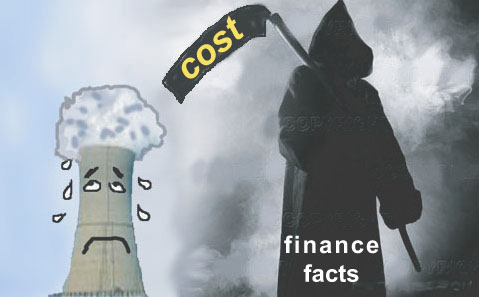
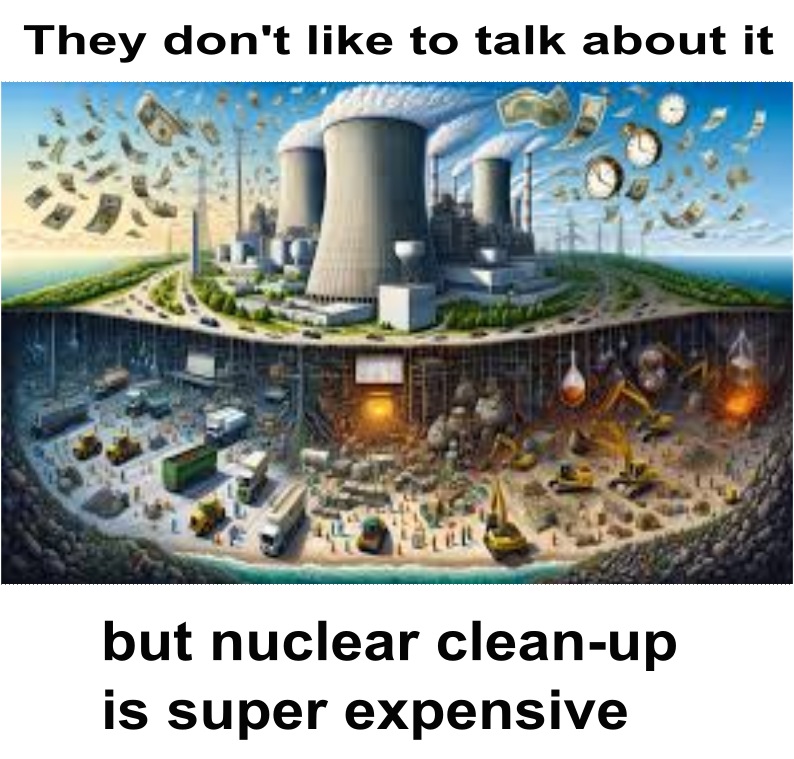
The 2025 cost of electricity for the new Vogtle nuclear reactors is $199 (169 to 228) per megawatt-hour. This compares with $61.5 (thirty-seven to eighty-six) for onshore wind and $58 (thirty-eight to seventy-eight) for utility-scale solar PV. Thus, new nuclear costs three (two to 6.2) times as much as new solar and wind. But nuclear’s cost does not include the cost to clean up the three Fukushima Dai-ichi reactor meltdowns, estimated at $460 to $640 billion, or ten to 18.5 percent of the capital cost of every reactor worldwide. Also, the cost of storing nuclear waste for 200,000 years is ignored. About $500 million is spent yearly in the United States to safeguard waste.
Air Pollution and Global Warming From Nuclear
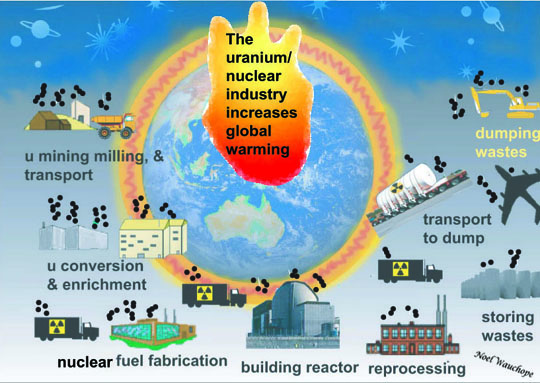
There is no such thing as a close-to-zero-emission nuclear power plant. Carbon-equivalent emissions per unit of electricity from new nuclear power plants are nine to thirty-seven times those of onshore wind. Higher nuclear emissions are due to emissions from the background electric grid during the long PTO time of nuclear as compared with that of wind, emissions from mining and refining uranium, emissions from constructing and decommissioning a reactor, and heat and water-vapor emissions during reactor operations.
Weapons Proliferation Risk
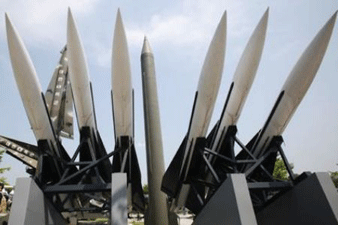
The growth of nuclear electricity has historically increased the ability of several nations, most recently Iran, to enrich uranium or harvest plutonium to build or attempt to build nuclear weapons. The Intergovernmental Panel on Climate Change (IPCC) states, with “robust evidence and high agreement,” that “barriers to and risks associated with an increasing use of nuclear energy include…nuclear weapons proliferation concerns…” Building a reactor allows a country to import and secretly enrich uranium and harvest plutonium from uranium fuel rods to help develop nuclear weapons. This does not mean every country will, but some have. Small modular reactors (SMRs) increase this risk, because SMRs can be sold more readily to and transported to countries without nuclear power.
Meltdown Risk
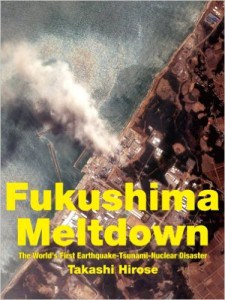
To date, 1.5 percent of all nuclear power plants built have melted down to some degree. Meltdowns have been either catastrophic (Chernobyl, Ukraine, in 1986; three reactors at Fukushima Dai-ichi, Japan, in 2011) or damaging (Three Mile Island, Pennsylvania, in 1979; Saint-Laurent, France, in 1980). The nuclear industry claims that new reactor designs are safe. But new designs are generally untested, and there is no guarantee that a new reactor will survive a disaster.
Waste Risk

Consumed fuel rods from nuclear reactors are radioactive waste. Most rods are stored near the reactor that used them. This has given rise to hundreds of radioactive waste sites that must be maintained for at least 200,000 years. The more nuclear waste that accumulates, the greater the risk of a leak that damages water supply, crops, animals, and/or humans.
Miining Lung Cancer Risk

Underground uranium mining, which is about half of all uranium mining, causes lung cancer in miners because uranium mines contain radon gas, some of whose decay products are carcinogenic. Wind and solar do not have this risk because they do not require continuous fuel mining, only one-time mining to produce the infrastructure, and such mining does not involve radon.
In sum, new nuclear takes seven to twenty-one years longer, costs two to 6.2 times as much, and emits nine to thirty-seven times the pollution per unit of electricity as new wind or solar. Beyond simply not being “green,” nuclear energy also has weapons proliferation risks, meltdown risks, waste risks, and mining lung cancer risks, which clean renewables avoid. SMRs will continue most of these problems and increase the risk of proliferation. In 2024, China added 378 gigawatts of wind, solar, and hydropower, ninety-five times the nuclear power it finished. Thus, even where nuclear is growing fastest, renewables are beating it by two orders of magnitude.
Finally, many existing reactors are so costly, their owners are demanding subsidies to stay open. But subsidizing existing nuclear may increase carbon emissions and costs versus replacing the plants with wind or solar.
Radiocarbon Dispersion around Canadian Nuclear Facilities
Published online by Cambridge University Press: 18 July 2016, https://www.cambridge.org/core/journals/radiocarbon/article/radiocarbon-dispersion-around-canadian-nuclear-facilities/3BEF0553EC67E4951B9D5EF132D7EDCA
G. M. Milton, S. J. Kramer, R. M. Brown, C. J. W. Repta, K. J. King and R. R. Rao
Abstract
Canadian deuterium uranium (CANDU) pressurized heavy-water reactors produce 14C by neutron activation of trace quantities of nitrogen in annular gas and reactor components (14N(n,p)14C), and from 17O in the heavy water moderator by (17O(n,α)14C). The radiocarbon produced in the moderator is removed on ion exchange resins incorporated in the water purification systems; however, a much smaller gaseous portion is vented from reactor stacks at activity levels considerably below 1% of permissible derived emission limits.
Early measurements of the carbon speciation indicated that >90% of the 14C emitted was in the form of CO2. We conducted surveys of the atmospheric dispersion of 14CO2 at the Chalk River Laboratories and at the Pickering Nuclear Generating Station. We analyzed air, vegetation, soils and tree rings to add to the historical record of 14C emissions at these sites, and to gain an understanding of the relative importance of the various carbon pools that act as sources/sinks within the total 14C budget. Better model parameters than those currently available for calculating the dose to the critical group can be obtained in this manner. Global dose estimates may require the development of techniques for estimating emissions occurring outside the growing season.
Information
TypeIV. 14C as a Tracer of the Dynamic Carbon Cycle in the Current EnvironmentInformation
Radiocarbon , Volume 37 , Issue 2 , 1995 , pp. 485 – 496
DOI: https://doi.org/10.1017/S0033822200030964
References…………………………………………………………………….
Do heatwaves, wildfires and travel costs signal the end of the holiday abroad?

It was a prediction nobody wanted to hear. On the main stage of the world’s
biggest tourism fair, Stefan Gössling, a leading researcher in sustainable
transport, had just calmly announced the looming death of the holiday
industry. “We have already entered the beginning of the age of
non-tourism,” said Gössling, to an uneasy audience of travel agencies,
car rental companies, cruise operators and hoteliers. That prophecy may
sound fanciful to holidaymakers in Europe and North America who have been
jetting off this summer – as well as to industry executives delighted to
see international tourism return to pre-pandemic highs last year – but
Gössling argues that as carbon pollution stokes heatwaves, fuels wildfires
and ruins harvests, the cost of foreign travel will soar, and fewer people
will be able to afford it. Gössling is not short of examples of
destinations already feeling the squeeze. Warm weather is melting snow that
keeps Alpine ski resorts alive. Coastal erosion is stripping sand from
southern European beaches. Droughts are forcing Spanish hotels to ship in
fresh water as swimming pools lie empty, while wildfires are setting scenic
Greek islands ablaze.
Guardian 23rd Aug 2025, https://www.theguardian.com/business/2025/aug/23/do-heatwaves-wildfires-and-travel-costs-signal-the-end-of-the-holiday-abroad
Europe’s nuclear power plants buckle under climate extremes.
Europe’s reliance on nuclear power faces a new climate test as heat waves scorch the continent
Necva Tastan Sevinc |19.08.2025 , https://www.aa.com.tr/en/environment/europe-s-nuclear-power-plants-buckle-under-climate-extremes/3663772
While a lot of the nuclear public relations relates to nuclear as a sort of savior of climate change, unfortunately, the reverse is true,’ says expert Paul Dorfman
Operations of nuclear plants are being strained by warming rivers, storm surges and rising sea levels,
ISTANBUL
As the summer sun scorches Europe, the effects of a warming planet are becoming increasingly tangible – and while nuclear energy is often touted as part of the solution, it too is buckling under the heat.
“While a lot of the nuclear public relations relates to nuclear as a sort of savior of climate change, unfortunately, the reverse is true,” Paul Dorfman, chair of the Nuclear Consulting Group and a senior academic at the University of Sussex, told Anadolu. “Nuclear will be a significant and early climate casualty.”
This year, several European plants have reduced output or shut down altogether – not due to technical faults, but because the rivers that cool them are either too shallow or too hot.
France, where nuclear accounts for around 65% of electricity, has been particularly affected, with nearly all of its 18 nuclear sites reporting capacity reductions this summer.
Cooling crisis: Rivers too warm for reactors
Europe hosts around 166 operable nuclear reactors with a combined capacity of nearly 149 gigawatts (GW), approximately one-third of the global total.
France leads with 57 reactors, followed by the UK with nine. Other major operators include Spain, Sweden, Finland, Switzerland and Belgium, with smaller but strategic fleets in the Czech Republic, Hungary and Slovakia.
Most were designed decades ago without climate resilience in mind, and rely heavily on water – often drawn from nearby rivers – to cool the systems that produce electricity.
After absorbing heat from the reactor, this water is typically returned to the environment. But when river levels drop or water temperatures rise too high, the cooling process becomes less effective, and in some cases, dangerous.
“If that … superheated water is discharged back to the rivers, basically it kills the river ecology,” said Dorfman. “So, there are regulatory temperature thresholds – and France has breached those numbers.”
He explained that inland reactors are already suffering due to “low flow and heating” in rivers such as the Rhone and the Loire, two of the country’s most crucial cooling sources.
While France may be the worst hit, the same situation played out in several countries this summer.
In Switzerland, at the Beznau plant on the Aare River, one reactor was halted entirely and the other reduced to 50% capacity. Other inland reactors across Central Europe, including those in countries like the Czech Republic, Hungary and Slovakia, face similar vulnerabilities.
Europe especially vulnerable
The issue is compounded by projections that Europe’s extreme heat events will only intensify in the coming decades.
According to the European Environment Agency, Europe is the fastest-warming continent in the world, with temperatures rising at roughly twice the global average rate.
Recently, the UK Met Office said that scorching temperatures are becoming the new normal, along with more frequent extreme events like drought, flash flooding and storms.
“We know what will happen in the next 10 to 20 years. We know that inland rivers will suffer. This is absolutely going to happen,” Dorfman said.
He added that even coastal plants are not safe from climate volatility.
“Coastal reactors will be increasingly subject to climate-driven storm surge flooding,” Dorfman warned. “We know that sea level rise, glacier melt, and storm surges will increasingly threaten nuclear sites. This is not speculative. It’s already happening.”
The majority of nuclear power plants were constructed long before climate change was evident. Now, he said, “they’re at greater risk.”
Demand soars, output drops
Europe’s energy dilemma is further complicated by surging electricity demand during heat waves, driven largely by air conditioning. Just as power is needed most, nuclear output often declines.
According to a new report by energy think tank Ember, the June-July 2025 heat wave caused electricity demand to surge by 14% in Spain, 9% in France and 6% in Germany. Peak demand was even higher.
The current energy model is showing its limits during temperature extremes, said Pawel Czyzak, Ember’s interim Europe Program director.
“Any thermal power plant draws water from a lake, river or the sea to cool its systems, like a car engine. But if the river is already hot, then it can’t cool efficiently,” he told Anadolu. “If you have a week of 35C (95F)-plus, rivers warm up, and you have issues with the cooling systems.”
The result, Czyzak explained, is that nuclear output is often scaled back.
“Normally that’s okay in summer, but during a heat wave, demand grows – and that causes a lot of stress for the power system.”
He explained that France is particularly vulnerable since it relies on nuclear for the bulk of its energy. “If nuclear goes down … then you don’t really have anything else to switch on,” he said.
Turning to renewables
But there are signs of a shift. According to Ember, solar power accounted for 22% of the EU’s electricity generation in July, narrowly surpassing output from the bloc’s nuclear power plants.
Combined generation from natural gas and coal fell short of both solar and nuclear. Meanwhile, electricity produced from wind and hydropower sources exceeded that of all fossil fuels combined.
“We know that 94.2% of all new worldwide electricity capacity last year was renewables,” Dorfman said.
“Nuclear takes 13 to 17 years to build, and that’s much too late for our climate needs,” he added.
He argues that renewables, paired with energy efficiency measures and grid innovations like battery storage and improved interconnectors, can help build a more resilient power system.
“It’s looking like a significant investment in renewables of all kinds – and in energy efficiency – is urgently needed,” said Dorfman.
Czyzak added that solar power is a particularly strong ally during heat waves.
“This year, pretty much every year, we’re seeing more solar power deployed and record generation volumes,” he added.
Still, he acknowledges the transition will not happen overnight. “I think maybe the next five years are a bit difficult, and then it will get better,” he said. “Generally, the countries that don’t have very flexible and diversified power systems are at most risk.”
Wildfire smoke far more dangerous to health than thought, say scientists.
Deaths from short-term exposure to fine particulates spewed by forest fires underestimated by 93%
Ajit Niranjan, Guardian, 19 Aug 25
Choking smoke spewed by wildfires is far more dangerous than previously thought, a new study has found, with death tolls from short-term exposure to fine particulates underestimated by 93%.
Researchers found that 535 people in Europe died on average each year between 2004 and 2022 as a result of breathing in the tiny toxic particles known as PM2.5 that are released when wildfires rage.
Under standard methods, which assume PM2.5 from wildfires is as deadly as from other sources, such as traffic, they would have expected just 38 deaths a year.
The study comes as wildfires ravage southern Europe, and new data from EU fire monitors shows that 895,000 hectares (2.2m acres) have burned so far in 2025, breaking records for this time of year. They have pumped out more than twice the amount of PM2.5 that wildfires have generated on average by this point in the year over the last two decades.
“Previously, people assumed the same toxicity for wildfire particles and all particles,” said Prof Cathryn Tonne, an environmental epidemiologist at the Barcelona Institute for Global Health (ISGlobal) and co-author of the study.
“Our paper shows evidence that – although it happens less often – the health impact for the same amount of particles is stronger for wildfire particles,” she added.
Dirty air is one of the biggest threats to human health, and research suggests wildfires are a significant contributor to the vast death toll. In December, a study attributed 1.53 million deaths around the world each year to short-term and long-term exposure to air pollution from wildfires.
The ISGlobal researchers, who looked only at the smoke’s short-term effects, for which the evidence base is stronger, combined daily mortality records from 32 European countries with estimates of PM2.5 pollution from 2004 to 2022.
Using models that account for an expected lag in deaths, they found exposure to wildfire smoke increased the risk of death in the following week………………………………………………………………………………………………. https://www.theguardian.com/environment/2025/aug/19/wildfire-smoke-far-more-dangerous-than-thought-say-scientists
EDF May Cut Nuclear Output in North France as River Levels Drop.
By Eva Brendel, August 19, 2025
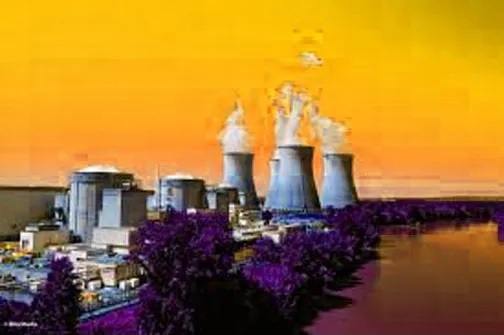
Electricite de France SA will likely cut nuclear power production in northern parts of the country this week because of forecast shallow waters on the Meuse River.
Low flows may affect output from the Chooz plant located near the Belgian border starting Friday, according to a company statement.
“The Meuse is quite far north for this sort of restriction, so it’s notable for that reason,” said William Peck, senior power analyst at Energy Aspects Ltd. “But given the weather forecasts and the time of year, I don’t think we’ll see a major ongoing issue or much additional upside risk from it.”
The country’s atomic power plants have been disrupted recently amid weather-related pressures. A heat wave forced several reactors to curb output because the river water used to cool them became too warm.
In addition, four reactors were shut down after a swarm of jellyfish clogged the filter drums. Their growing numbers can be linked to climate change.
Elsewhere, EDF ended heat-related production warnings on the Garonne and Rhône rivers that were imposed almost two weeks ago………………… https://www.bloomberg.com/news/articles/2025-08-18/edf-to-cut-nuclear-output-in-northern-france-on-low-river-levels
Hellish’: heatwave brings hottest nights on record to the Middle East.
Temperatures did not drop below 36C in Sedom, Israel on Tuesday
night, while several parts of Jordan stayed above 35C on Monday.
Guardian 15th Aug 2025, https://www.theguardian.com/world/2025/aug/15/hellish-heatwave-brings-hottest-nights-on-record-to-the-middle-east
Heat Waves Are a Growing Threat to Europe’s Nuclear Power Supply

Bloomberg News, Eamon Akil Farhat, Aug 08, 2025, https://financialpost.com/pmn/business-pmn/heat-waves-are-a-growing-threat-to-europes-nuclear-power-supply
Heat waves across Europe are increasing the need for nuclear power plants to be taken offline, with the situation expected to worsen in the coming decades and few options for mitigation.
(Bloomberg) — Heat waves across Europe are increasing the need for nuclear power plants to be taken offline, with the situation expected to worsen in the coming decades and few options for mitigation.
Weather-related nuclear outages, mainly caused by elevated temperatures of cooling water, increased threefold in the period from 2010 to 2019, compared with 1990 to 2009, according to a study published in Energy Economics. Due to climate change, the intensity and length of these heat waves is expected to increase.
“Summer heat waves are climbing fast — 0.85 more days each year since 2010,” said Jess Hicks, a weather analyst at BloombergNEF. “That trajectory spells growing cooling-water risks for French nuclear plants.”
…………………………….A separate study published in the journal Energy in April looked at two reactors operated by Electricite de France SA, Chooz and Golfech, which rely on river water for cooling. It concluded that climate change will increase water temperature and also reduce flow volumes. If both plants are still operating by 2050, the level of outages would have doubled at Chooz and increased tenfold for Golfech. In the worst years, about 14% of Chooz’s generation would need to be curtailed.
When faced with high water temperatures and low flows, nuclear operators have limited options.
A closed-cycle cooling system, which relies less on the external environment, is one option. However, the Energy Economics study found that retrofitting such systems would cost about $500 million per nuclear power plant.
Another option would be to relax environmental limits on river temperatures, allowing reactors to keep operating for longer during heat waves. Such restrictions have been waived in the past, for example in 2022 when the French nuclear regulator ASN temporarily allowed five nuclear plants to discharge hotter water into rivers as the nation struggled with an energy crisis.
EDF has been studying other methods to reduce water consumption at nuclear power plants, such as capturing the cooling vapor given off by the facilities.
Europe’s electricity system tested by heatwaves as air-conditioning use soars – nuclear power plants affected.
Record temperatures force temporary shutdowns at power plants.
Europe’s energy systems have come under intense strain this summer as
repeated heatwaves have driven up demand for electricity and forced plants
to pause production. June was the hottest on record in western Europe,
fuelling a rise in the use of air conditioning and prompting a sharp
increase in electricity prices. Most parts of the region experienced at
least two intense periods of heat in June and July, with some suffering
more.
The barrage of heatwaves this summer marked a “massive change”
for Europe’s energy systems, said Jan Rosenow, leader of the energy
programme at Oxford university’s Environmental Change Institute. Peak
electricity demand has historically happened in winter in Europe, but as
“summers get hotter at some point that might flip”, he said. SSE, the
UK power company, said generation from its hydropower plants dropped by 40
per cent quarter on quarter to the end of June, as Britain also grappled
with heatwaves and severe drought. Inland nuclear power plants across
France and Switzerland temporarily suspended or reduced activity earlier in
the summer, as it is harder to cool reactors in hot weather.
In France, 17 out of 18 nuclear power plants faced capacity reductions during the
June-July heatwave, Ember said. Most inland nuclear plants rely on rivers
to cool reactors and spent fuel, heating the water in the process before
discharging it back. But with many rivers already hot, the plants could not
discharge heated water without potentially damaging the river ecology.
FT 3rd Aug 2025, https://www.ft.com/content/23b3dc59-b40f-48e2-ad93-e301de7ac5f2
Melting glaciers threaten to wipe out European villages – is the steep cost to protect them worth it?

Melting glaciers threaten to wipe out European villages – is the steep
cost to protect them worth it? Switzerland spends almost $500m a year on
protective structures, but a report carried out in 2007 for the Swiss
parliament suggested real protection against natural hazards could cost six
times that. Is that a worthwhile investment? Or should the country – and
residents – really consider the painful option of abandoning some of their
villages?
BBC 3rd Aug 2025,
https://www.bbc.co.uk/news/articles/cj4w9ggzxv4o
Russian nuclear submarine base hit by tsunami.
Waves triggered by 8.8 magnitude earthquake damaged base that houses Pacific Fleet
Russia’s far east nuclear submarine base appears to have been damaged by
the tsunami that swept the country’s Pacific coast on Wednesday,
according to satellite imagery obtained by The Telegraph. The waves,
triggered by an 8.8 magnitude earthquake, hit the Rybachiy base in
Kamchatka peninsula, which houses most of the nuclear submarines in
Russia’s Pacific Fleet. A section of one pier has bent away from its
original position, possibly indicating that it was detached from its
moorings, images taken by the Umbra Space satellite on Thursday morning
have revealed.
It does not appear that a submarine was moored alongside at
the time of impact and experts said damage to the structure alone would
have little military significance. However, questions were raised about
whether the tsunami caused any further harm to the base, which was thought
to have been hit within 15 minutes of the earthquake.
Telegraph 1st Aug 2025, https://www.telegraph.co.uk/world-news/2025/08/01/russian-nuclear-submarine-base-earthquake-satellite/
We’re having a heatwave -and nuclear power can’t cope.
Nuclear power ……….is a sitting technological duck when extreme temperatures strike.
by beyondnuclearinternational, https://beyondnuclearinternational.org/2025/07/27/were-having-a-heatwave/
And nuclear power can’t cope. Worse still, it’s actually a liability under ever more extreme climate conditions, write Karl Grossman and Harvey Wasserman
At the core of the latest attempted “renaissance” of nuclear power is the Big Lie that atomic reactors are an answer to global warming. In fact, they are significant sources of heat.
There are more than 400 nuclear power plants in the world today that fission atoms at 300 degrees Centigrade, (572 degrees Fahrenheit). More are under construction or proposed. As the International Atomic Energy Agency states, “water-cooled reactors offer heat up to 300 degrees Celsius. These types of reactors include pressurized water reactors (PWRs), boiling-water reactors (BWRs), pressurized heavy-water reactors, and light-water-cooled graphite-moderated reactors (LWGRs).”
Some heat is absorbed in the water—drawn from water bodies—used to cool these nuclear power plants and then returned, still with considerable heat, to rivers or seas.
The heatwave going on in recent weeks in Europe, in combination with this discharge of heated water from nuclear plants, has caused nuclear plants there to shut down.
Consider these headlines from recent days:
“France and Switzerland shut down nuclear power plants amid scorching heatwave,” was the July 3rd headline on Euronews. As the piece explained: “To cool down, nuclear power plants pump water from local rivers or the sea, which they then release back into water bodies at a high temperature. However, Europe’s ongoing heatwave means that the water pumped by nuclear sites is already very hot, impacting the ability of nuclear plants to use it to cool down. On top of this, nuclear sites run the risk of posing a dangerous threat to local biodiversity, by releasing water which is too hot into rivers and seas.”
A New York Times article, also dated July 3rd, related how in Europe, “operators shut down one of the two reactors at the Golfech nuclear power plant in southern France after forecasts that the Garonne River, from which it draws water and then discharges it after it is used in the plant as coolant, “could top…82 degrees Fahrenheit.” The Times continued: “The Beznau Nuclear Power Plant in Switzerland, built along the Aare River followed suit, shutting down one of its reactors on Tuesday and the other on Wednesday.”
It quoted its European program director, Pawel Czyzak, saying: “Heatwaves will not go away—they will only get more severe in the future…Luckily, there is no lack of sunshine during heatwaves. The biggest opportunity is to store solar electricity…”
“The French nuclear fleet has been impacted the most, with all but one of the 18 facilities experiencing some type of capacity reduction,” said the report.
It continued: “While heatwaves bring major changes, these are partially offset by the large volumes of solar energy available during daytime. In fact, June 2025 was the highest European Union solar electricity production month on record.” And this “kept the grid well-supplied during daytime hours.”
The Ember report also pointed out, “Solar power is one of the cheapest forms of electricity that Europe has.”
Nuclear power, beyond being subject to catastrophic accidents such as those that occurred at Fukushima, Chernobyl and Three Mile Island, extreme cost, substantial carbon emissions during the nuclear “lifecycle”—mining of uranium, milling it, enrichment of the uranium fuel and other operations—is a sitting technological duck when extreme temperatures strike.
Ember, an independent London-based global energy think tank, on July 4th issued a report headed: “Heat and power: Impacts of the 2025 heatwave in Europe.” It noted: “Heatwaves are becoming more frequent in Europe, putting electricity grids under severe stress.”
“Europe embraces its new reality with heatwaves: ‘They are no longer an exception,’” was the headline of a July 3rd El Mundo article. “Heatwaves in Southern Europe are becoming increasingly early and intense,” it reported.
It quoted Meto-France climatologist Christine Berne saying: “Heatwaves are no longer an exception. They are now more frequent, longer, and spread over larger geographical areas…The phenomenon is directly related to global warming, which is profoundly altering weather patterns, both in France and elsewhere.”
In California, a “bait and switch” to continue operation of the Diablo Canyon atomic reactors is super-heating the Pacific Ocean. In 2018, Pacific Gas & Electric was being forced to stop violating state and federal water protection laws with its massive heat emissions from the twin nuclear power plants. Facing the expensive requirement to build cooling towers, the company agreed to shut down Diablo in 2024 and 2025, ushering in a transition to cheaper, safer, cleaner, more reliable and more job-producing renewables. But in 2022, Governor Gavin Newsom killed the phase-out agreement he had signed as Lieutenant-Governor. So, Diablo still pours billions of gallons of irradiated super-heated water into the Pacific, joining the billions of gallons of irradiated liquid that are pouring in from the site of the Fukushima catastrophe.
In addition to that heat, all nukes emit radioactive fallout, including a radioactive form of carbon, Carbon 14, along with other lethal pollutants, while costing ratepayers up to 10 times more than solar, wind, geothermal and battery backup.
Solar energy, its cost having plummeted in recent years, is now 90 percent cheaper per watt than nuclear power. Further, its efficiency level — its efficiency in converting sunlight to electricity — has dramatically increased. Safe, clean, renewable energy sources — primarily in the form of solar panels and wind turbines — now account for more than 80 percent of the world’s new electric generating capacity.
What’s gone on in the last several weeks in Europe is no exception. The heat is on all over the globe. But there’s solar (and wind) power continuing to function well, while adding no heat, radiation or carbon of its own — unlike the planet’s hyper-lethal nuke reactors.
Meanwhile, the nuclear industry is pushing a new kind of reactor — a fusion reactor that would operate at an astronomical level of heat. It would utilize, instead of fission, the fusion of atoms — the process that happens on the sun, and notes the World Economic Forum: “Temperatures in excess of 150 million degrees Celsius — 10 times hotter than the center of the sun — re required for fusion to occur on Earth.”
“Unsurprisingly,” says the Geneva, Switzerland-based organization, “achieving and controlling these enormous temperatures is a substantial technological challenge. This usually requires using incredibly powerful magnets to contain a hot plasma, preventing it from touching and melting the sides of vessels. Fusion research reactors have achieved temperatures in excess of 300 million degrees Celsius.”
The World Economic Forum’s 2020 analysis is headed: “What is fusion energy, and what will it take for it to go mainstream?”
What does 150 million degrees Celsius convert to in Fahrenheit: 270 million degrees!
To fantasize that Earth-threatening global warming happening now and gaining in intensity can be dealt with by fission nuclear power plants operating at 572 degrees Fahrenheit or fusion nuclear power plants operating at 270 million degrees Fahrenheit is among the great follies in human history.
Harvey Wasserman wrote the books Solartopia! Our Green-Powered Earth and The Peoples Spiral of US History and co-convenes the Grassroots Emergency Election Protection Coalition . Karl Grossman is the author of Cover Up: What You Are Not Supposed to Know About Nuclear Power and Power Crazy. He the host of the nationally-aired TV program Enviro Close-Up with Karl Grossman.
Greenpeace hails Italian court ruling allowing climate case against energy company Eni to continue
Italy’s highest court has ruled that a lawsuit brought by climate
activists against Italian energy company Eni and its government
shareholders can go ahead, in what Greenpeace said on Tuesday was a victory
for efforts to pursue climate justice in Italy.
In an ordinance released on
Monday, the Court of Cassation rejected the company’s motions to dismiss
the lawsuit on jurisdictional grounds and ordered the case to be heard on
its merits by a Rome tribunal. Eni said that it was greatly satisfied with
the decision, and said it expected that the Rome court would ultimately
“dismantle” the climate activists’ claims of responsibility.
Yahoo News 22nd July 2025, https://uk.news.yahoo.com/greenpeace-hails-italy-court-ruling-130205151.html
‘Keeping us hooked on fossil fuels’: how can we negotiate with autocracies on the climate crisis?

When it comes to the climate crisis, how do you negotiate with an
autocracy? It is the case today, and it is almost certain to remain so for
the dwindling number of years in which we can hope to stave off the worst
of climate breakdown, that the bulk of the world’s greenhouse gas
emissions come from countries that are not democratic. Add to that, many of
the major suppliers of oil and gas – the Gulf petrostates for instance,
plus Russia, Venezuela and a few others – are likewise authoritarian.
Their outsize impact puts autocratic nations in the spotlight when it comes
to global climate talks. How their governments decide to act will be
crucial to the planet’s future. But while democracies are subject to the
whims of electorates, which can often be unpredictable, autocratic nations
tend to be far more inscrutable. Take the small handful of the world’s
biggest fossil fuel companies, referred to as the “carbon majors”. They
hold our future in their hands, and of the top 20 with the biggest carbon
output globally, 16 are state-owned and were responsible for 52% of global
emissions in 2023.
Guardian 18th July 2025, https://www.theguardian.com/environment/2025/jul/18/climate-crisis-fossil-fuels-autocracies-authoritorian-countries
Wildfires: Could this be the worst year ever?
The area of land burnt in Europe this year is significantly higher than the average, and Britain is at risk as well thanks to sustained high global temperatures. Even Britain,
a country with a climate not normally conducive to wildfires, is recording
record amounts of burnt land for this stage of the summer. These fires are
starting abnormally early, and appear to be more severe than previous
years. What is causing them, and could 2025 be the worst year yet?
Times 13th July 2025, https://www.thetimes.com/uk/environment/article/wildfires-could-this-be-the-worst-year-ever-twnx25v7s
1 This Month
Website of the Week

New book – https://www.amazon.com/dp/1923372157?utm_source=substack&utm_medium=email
Now until to February 10, 2026 Radioactive waste storage in France: the debate is finally open! How to participate?
-
Archives
- January 2026 (74)
- December 2025 (358)
- November 2025 (359)
- October 2025 (377)
- September 2025 (258)
- August 2025 (319)
- July 2025 (230)
- June 2025 (348)
- May 2025 (261)
- April 2025 (305)
- March 2025 (319)
- February 2025 (234)
-
Categories
- 1
- 1 NUCLEAR ISSUES
- business and costs
- climate change
- culture and arts
- ENERGY
- environment
- health
- history
- indigenous issues
- Legal
- marketing of nuclear
- media
- opposition to nuclear
- PERSONAL STORIES
- politics
- politics international
- Religion and ethics
- safety
- secrets,lies and civil liberties
- spinbuster
- technology
- Uranium
- wastes
- weapons and war
- Women
- 2 WORLD
- ACTION
- AFRICA
- Atrocities
- AUSTRALIA
- Christina's notes
- Christina's themes
- culture and arts
- Events
- Fuk 2022
- Fuk 2023
- Fukushima 2017
- Fukushima 2018
- fukushima 2019
- Fukushima 2020
- Fukushima 2021
- general
- global warming
- Humour (God we need it)
- Nuclear
- RARE EARTHS
- Reference
- resources – print
- Resources -audiovicual
- Weekly Newsletter
- World
- World Nuclear
- YouTube
-
RSS
Entries RSS
Comments RSS
 nuclear-news