Extreme heat in South Korea kills 11 and decimates livestock

Eleven people and more than 250,000 livestock have died in extreme heat in
South Korea as record temperatures continue across Asia. The number of
people treated in hospital for heat-related conditions since May is 1,546,
the interior ministry said on Monday. Three women died at the weekend after
losing consciousness, raising the death toll to 11 over the past three
months.
Times 5th Aug 2024
France Warns of Nuclear Power Cuts as Heat Triggers Water Curbs
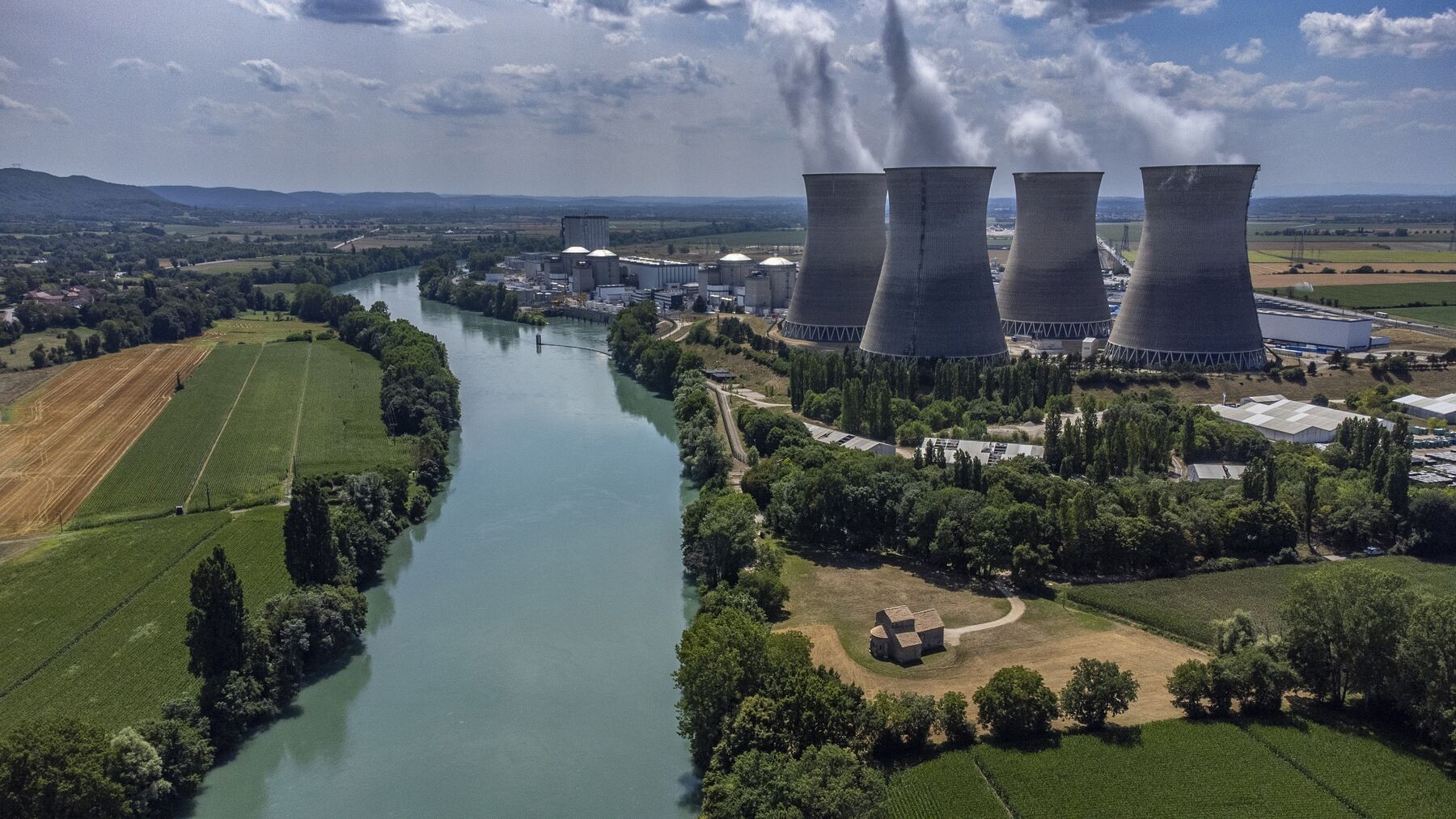
Bloomberg, By Lars Paulsson, August 8, 2024
Electricite de France SA will likely curtail production at nuclear reactors starting this weekend as hot weather restricts the amount of water that can be discharged into the Rhone River.
EDF uses water to cool its reactors before releasing it into the river, and overheating the waterway can threaten fish and other wildlife. Temperatures across much of western Europe are forecast to climb……………. (Subscribers only) https://www.bloomberg.com/news/articles/2024-08-08/france-warns-of-nuclear-power-cuts-as-heat-triggers-water-curbs?embedded-checkout=true
Extreme ‘heat dome’ hitting Olympics ‘impossible’ without global heating
The “heat dome” causing scorching temperatures across western Europe
and north Africa, and boiling athletes and spectators at the Olympic Games
in Paris, would have been impossible without human-caused global heating, a
rapid analysis has found. Scientists said the fossil-fuelled climate crisis
made temperatures 2.5C to 3.3C hotter. Such an event would not have
happened in the world before global heating but is now expected about once
a decade, they said. Continued emissions of heat-trapping carbon dioxide
will make them even more frequent, the researchers warned.
Guardian 31st July 2024
Largest wildfire in US grows to cover area bigger than Los Angeles
The largest wildfire in the US swelled to more than 380,000 acres (154,000
hectares) on Tuesday morning, an area bigger than the city of Los Angeles
and three times the surface area of Lake Tahoe, as thousands of
firefighters battled the blaze in a remote wilderness area in northern
California. Meanwhile, the destruction caused by wildfires raging across
the US west came into sharp focus as photographers documented the
destruction left by the Borel fire in southern California. The fast-growing
fire tore through the historic mining town of Havilah, leaving burnt
buildings, cars and forests.
Guardian 30th July 2024
https://www.theguardian.com/us-news/article/2024/jul/30/california-wildfires-los-angeles
As record heat risks bleaching 73% of the world’s coral reefs, scientists ask ‘what do we do now?’
A vast array of solutions are being worked on but experts urge a ‘fundamental rethink’ as temperatures are forecast to climb even higher in coming decades
Graham Readfearn Climate and environment reporter, Tue 30 Jul 2024 https://www.theguardian.com/environment/article/2024/jul/30/as-record-heat-risks-bleaching-73-of-the-worlds-coral-reefs-scientists-ask-what-do-we-do-now
After 18 months of record-breaking ocean temperatures, the planet’s reefs are in the middle of the most widespread heat-stress event on record.
Across the Pacific, Atlantic and Indian oceans, latest figures from the US government’s Coral Reef Watch, shared with the Guardian, show 73% of the world’s corals have been hit with enough heat for them to begin bleaching.
Beginning in February 2023, this is the fourth global mass bleaching event – the second in 10 years, and the most widespread on record.
After seeing their beloved reefs struggling to survive, some coral scientists are calling for a major rethink on how to protect reefs as temperatures climb even higher in the coming decades.
“We’re coming out of a couple of decades where we made predictions,” said Prof Tracy Ainsworth, the vice-president of the International Coral Reef Society.
“Now we are at a point where we hoped we would not be. Now we’re asking, what do we do now?”
In the scientific journal Nature Climate Change, three articles were published on Monday calling on the coral conservation and science community to have a collective rethink.
“I would call it soul searching,” said Prof Tiffany Morrison, a co-author of one of the articles which is sharply critical of widespread programs, many with corporate backers, to grow corals in nurseries and then plant them out on reefs.
“When everyone realised the scale of the climate impacts on coral reefs, the first instinct was to just do something and intervene because people were so distressed.”
In Florida and the Caribbean last year, many replanted corals died as record-breaking heat stress swept across the region
“We need a fundamental rethink,” said Prof David Bellwood, a colleague of Morrison’s at James Cook University in Australia.
“Too much is at stake. At the moment, coral restoration is at best psychological relief and cosmetic conservation, and at worst a dangerous distraction from climate action.”
Critical coral
Coral reefs provide food for millions of people around the world. They also provide the raw material that eventually becomes much of the sand on beaches and protect coastlines from wave damage.
When corals sit in water that is too hot, they expel algae in their tissues that provide colour and much of their nutrients.
Dr Derek Manzello, director of Coral Reef Watch, said the number of reefs affected by heat stress from the current global event was still rising and had “definitely led to most everyone involved with reef science and restoration having a hard think about future activities and best practices”.
The current global event has affected reefs in 70 countries and the full impact may never be fully understood.
The world’s biggest coral reef system – the Great Barrier Reef – has also likely been through its worst coral bleaching event, but government scientists may not know until next year how many corals died.
Whether an individual coral survives bleaching depends on each species and the extremes and duration of heat.
In another scientific article, Prof Michael Webster of New York University suggested a radical idea which, he said, would have been far too controversial for a scientific paper only 10 years ago.
Coral reefs exist across tropical waters around the world but are adapted to local conditions. Conservationists should consider introducing corals that have evolved in very hot regions to reefs where the current mix of corals are struggling to survive, Webster said.
“It’s incredibly controversial and we might not ever go there, but we’re in a situation where we’re questioning if we will have reefs in many places. Is it now worth asking that question?”
Webster said coral reefs would have a better chance of surviving through the coming decades if they had a diversity of coral species.
“Getting CO2 down has to be our end game, but we have centuries where coral systems like reefs will be in trouble.”
Cautious interventions
It’s interventions like that mooted by Webster that Morrison is cautious about.
There’s a vast array of scientific solutions for coral reefs currently being worked on around the world, from whitening clouds to shade reefs to selective breeding of corals for increased heat tolerance.
“We are vesting too much money and hope into these speculative coral bioengineering and genetic engineering solutions,” Morrison said. “We don’t know if they’re scalable and, if they are, whether we can afford to scale them.”
Many interventions come up against a philosophical question. Who decides which species to save or modify, or which steps to take? Those decisions could dictate what reefs look like in the future – decisions made by humans, not by nature.
“There are very few people looking at unintended consequences and there’s no governance systems in place to manage that,” Morrison said.
“But number one – we have to be mitigating fossil fuels.”
Freaking out
Members of the International Coral Reef Society wrote in May that scientists needed to “reconsider this challenge” of protecting reefs.
Because efforts to cut global greenhouse gas emissions were too slow, governments and communities needed to redouble efforts to reduce other stressors on corals, such as overfishing and local water pollution, the society said.
Tim McClanahan, a reef ecologist and director of marine science at the US-based Wildlife Conservation Society, admitted “people are freaking out” from the current bleaching.
He said there was little evidence coral restoration projects had restored reefs at scale, and in places like Florida, coral nurseries had been destroyed by heat.
“I think they are ignoring past experiences and not recognising the science,” he said.
“I’m concerned that a problem we have with NGOs is we’re not very good at admitting to our failures. I find there’s a tendency to act without consulting the literature.”
McClanahan, in a third article in Nature Climate Change, said predicting the future for coral reefs needed to be more sophisticated.
Rather than just including heat, modelling should account for how reefs react differently to heat stress depending on local conditions like the mix of coral species or how well protected they are. The prognosis for some reefs may not be quite so dire, he argued.
McClanahan has been working on reefs for 40 years and said he has seen them go from undisturbed wonders to shadows of their former selves.
“Yes, the reefs are screwed – in deep trouble. We’re experiencing very austere conditions for corals already,” he said.
“In the 90s I was in grief, but now I want to know how we deal with the situation that we’re in. We are not dealing with it very well and we have this fatalistic view.
“We should be freaking out. That’s not an unreasonable response, but we need to sit back and be a bit more intelligent.”
Californians defy evacuation orders as wildfire threatens homes
Residents of a small California town are refusing to evacuate as one of the
largest wildfires in the state’s history threatens their homes. More than
4,000 firefighters and emergency personnel are battling the Park fire in
northern California, which by Monday had burned more than 350,000 acres
across four counties. The fire broke out on Wednesday, when authorities say
a man pushed a burning car into a ravine near the city of Chico, about 160
miles north of San Francisco.
Times 29th July 2024
Extreme heat poses ‘real risk’ to Spain’s mass tourism industry
Public health adviser says higher temperatures caused by climate crisis pose danger for visitors not used to them.
Guardian, Sam Jones in Madrid, Sat 27 Jul 2024
The climate emergency poses a “real risk” to Spain’s traditional mass tourist model as rising temperatures and more frequent heatwaves hit the country’s most popular coastal destinations, a senior public health adviser has warned.
Héctor Tejero, the head of health and climate change at Spain’s health ministry, said the increasingly apparent physical impacts of the climate emergency had already led the ministry to begin talks with the British embassy on how best to educate “vulnerable” tourists about coping with the heat……………………………………………………………………………………………
The risks have been made clear in other parts of southern Europe grappling with extreme heat. In June, several foreign tourists, including the British television presenter Michael Mosley, died during a period of unseasonably high temperatures in Greece.
Tejero noted that recent epidemiological studies had shown that approximately 3,000 deaths are attributable to the heat each year in Spain, and that hot spells cause a 10% rise in urgent hospital admissions. He also said higher temperatures would also lead to an increase in vector-borne diseases, pointing out that a man was admitted to hospital in Madrid this week with Crimean-Congo hemorrhagic fever, an emerging disease spread by ticks. https://www.theguardian.com/world/article/2024/jul/27/extreme-heat-poses-real-risk-to-spains-mass-tourism-industry
Hungary to allow nuclear plant to exceed Danube water temperature limit
By Reuters, July 27, 202 https://www.reuters.com/business/energy/hungary-allow-nuclear-plant-exceed-danube-water-temperature-limit-2024-07-27/
BUDAPEST, July 27 (Reuters) – Hungary is planning to allow the temperature limit for a section of the Danube which receives cooling water from the Paks nuclear power plant to be exceeded for security of supply reasons, the energy ministry said in a statement on Friday.
The plant’s four reactors operate by using the water of the Danube to cool its operations. Currently, according to the regulation, the river cannot receive water if its temperature exceeds 30 degree Celsius, in which case the operator must cut output and wait for the river to cool below the limit.
“In addition to environmental considerations, it may therefore be justified to exceed the limit value on a case-by-case basis if this is unavoidable for security of supply.”
The Paks plant has four Russian-built VVER 440 reactors with a combined capacity of about 2,000 megawatts. The reactors became operational between 1982 and 1987 and are scheduled to be retired in 2032-2037.
Hungary plans to expand the plant, with Russia’s Rosatom building two VVER reactors with a capacity of 1.2 gigawatts each, in addition to the currently working four reactors.
Hungary is planning to allow the temperature limit for a section of the
Danube which receives cooling water from the Paks nuclear power plant to be
exceeded for security of supply reasons, the energy ministry said in a
statement on Friday. The plant’s four reactors operate by using the water
of the Danube to cool its operations. Currently, according to the
regulation, the river cannot receive water if its temperature exceeds 30
degree Celsius, in which case the operator must cut output and wait for the
river to cool below the limit.
Reuters 27th July 2024
Severe heatwave in Iran forces shops and public institutions to close
A heatwave blanketing Iran has forced authorities to cut operating hours at
various facilities on Saturday and order all government and commercial
institutions to close on Sunday, as hospitals received more than 200 people
for heatstroke treatment. Temperatures ranged from 37C (98.6F) to 42C
(107F) in the capital, Tehran, according to weather reports. The state-run
Islamic Republic News Agency (IRNA) said banks, offices and public
institutions across the country would close on Sunday to protect people’s
health and conserve energy and that only emergency services and medical
agencies would be excluded.
Guardian 27th July 2024
Texas Nuclear Power Plant Hit By Hurricane Beryl
Jul 08, 2024 , By Anna Skinner, https://www.newsweek.com/texas-nuclear-power-plant-hit-hurricane-beryl-1922433?fbclid=IwZXh0bgNhZW0CMTEAAR29mvidVj1SSXxwkVTE1ZlgUDnniN1ns2WYungAgepziqraWPcHYqrf1Ng_aem_n7E5P5-vOaqLLjIkP0kOkg
Hurricane Beryl made landfall in Matagorda, Texas, on Monday morning as a Category 1 hurricane, prompting concern and preparations at a nuclear power plant just miles away.
Beryl strengthened into a hurricane last Saturday, becoming June’s easternmost major hurricane in the Atlantic. The storm underwent rapid intensification and, at one point, was categorized as a Category 5 hurricane. It has killed at least 11 people in the Caribbean and two people in Texas, according to The Associated Press.
The system has since weakened to a tropical storm with maximum sustained wind speeds of 70 miles per hour. Despite the weakening, the storm still had the potential for life-threatening impacts, prompting a slew of weather-related warnings for much of southeastern Texas on Monday, including a tropical storm warning, flash flood warning and a storm surge warning, among others.
The South Texas Project Nuclear Operating Company (STPNOC), which is “one of the newest and largest nuclear power facilities in the nation” according to its website, has two nuclear units that provide energy to 2 million Texas homes. It is located in Bay City, which is near Matagorda. Storm-related warnings remain in place for Matagorda and Bay City as of Monday afternoon.
According to a satellite image from AccuWeather, STPNOC was directly in the path of the storm. It’s unclear what measures were taken at the facility to prepare for the severe weather, given that the company hasn’t provided an update to its website or social media pages. Newsweek reached out to STPNOC by email for comment.
Hurricane Harvey made landfall on the Texas coast on August 25, 2017, as a Category 4 hurricane.
“STP’s performance during 2017’s Hurricane Harvey helps make the case for nuclear power – thanks to a resilient Storm Crew, a robust design and solid severe weather plan,” the webpage said.
As of Monday afternoon, more than 2.7 million Texans were without power.
Beryl is the first hurricane of the 2024 Atlantic hurricane season and the second named storm. Tropical Storm Alberto made landfall in Mexico on the morning of June 20. Shortly after Beryl formed, the third named storm of the season—Tropical Storm Chris—formed quickly on June 30. Chris made landfall in Mexico that night, with wind speeds around 40 mph.
Multiple agencies, including the National Oceanic and Atmospheric Administration (NOAA), have issued forecasts warning that 2024 will be an exceptionally strong year for hurricanes.
Temperatures 1.5C above pre-industrial era average for 12 months, data show
The world has baked for 12 consecutive months in temperatures 1.5C (2.7F)
greater than their average before the fossil fuel era, new data shows.
Temperatures between July 2023 and June 2024 were the highest on record,
scientists found, creating a year-long stretch in which the Earth was 1.64C
hotter than in preindustrial times.
The findings do not mean world leaders
have already failed to honour their promises to stop the planet heating
1.5C by the end of the century – a target that is measured in decadal
averages rather than single years – but that scorching heat will have
exposed more people to violent weather.
A sustained rise in temperatures
above this level also increases the risk of uncertain but catastrophic
tipping points. Carlo Buontempo, director of the Copernicus Climate Change
Service, which analysed the data, said the results were not a statistical
oddity but a “large and continuing shift” in the climate.
Guardian 8th July 2024
How record-breaking Hurricane Beryl is a sign of a warming world
Hurricane Beryl is wreaking havoc in parts of the Caribbean – and
putting the role of climate change under the spotlight. With maximum
sustained wind speeds of more than 160mph (257km/h), it became the earliest
category five Atlantic hurricane in records going back around 100 years. In
fact, there has only been one previous recorded case of a category five
Atlantic hurricane in July – Hurricane Emily, on 16 July 2005.
BBC 4th July 2024
Climate hazards impact more than four-fifths of cities worldwide, study finds
New research has revealed that 83% of cities worldwide are dealing with
significant climate hazards, up from 80% in 2022, with flooding and extreme
heat being the most widespread challenges facing urban areas globally. As
global temperature records continue to be broken for the 12th consecutive
month, new data from CDP – the non-profit organisation managing voluntary
environmental disclosures from cities and businesses – indicates that
flooding and extreme heat are the most pervasive impacts of climate change
affecting cities worldwide. In 2023, 1,131 cities reported their
environmental data through CDP-ICLEI Track. More than 83% of these cities
reported significant climate hazards, an increase from 80% in 2022. More
than half (56%) are already experiencing substantial impacts from these
hazards. Looking ahead, around two-thirds of the cities expect these
hazards to become more intense (67%) and more frequent (64%). Flooding was
the most reported hazard, with 58% of cities identifying it as a concern,
followed by extreme heat (54%), drought (38%), heavy rain (35%) and the
risk of wildfires (22%).
Edie 3rd July 2024
https://www.edie.net/climate-hazards-impact-more-than-four-fifths-of-cities-worldwide-study-finds/
Climate-Nuclear Nexus

BASEL PEACE OFFICE, July 24
“The threats to our planet – of climate change, poverty and war – can only be overcome by nations and the global community working in cooperation – something not possible while nations maintain large and expensive militaries and threaten to destroy each other.”
PNND Co-President’s statement on International Women’s Day for Disarmament, May 24, 2008
The Basel Peace Office highlights the links between climate change and nuclear weapons/security to forge solutions to these two principal threats to human survival. The climate-nuclear nexus manifests itself in a number of ways.
- Climate change-induced weather events can impact on nuclear security and safety
- Nuclear war would create catastrophic climatic and environmental consequences
- Conflicts due to climate change could trigger the use of nuclear weapons
- The funding currently devoted to nuclear weapons is sorely needed to combat climate change
- The nuclear deterrence stand-off prevents the global cooperation required to address climate change
Climate change-induced weather impacts on nuclear security and safety
The nuclear disaster in Fukushima in March 2011 has drawn attention to the possible effects of extreme weather events, environmental degradation and seismic activity on nuclear security and safety.
The wildfires that spread through Russia in the summer of 2010, possibly an effect of climate-change, posed a severe nuclear risk to the country when they were on their way to engulf key nuclear sites. In addition, there was widespread concern that radio-nuclides from land contaminated by the 1986 Chernobyl nuclear disaster could rise together with combustion particles, resulting in a new pollution zone.
In the UK, leading geologist Prof. Rob Duck of Dundee University has warned that if climate change continues it may lead to the erosion of Britain’s coast and may even cause tsunamis. This in turn will have critical implications for the safety of Britain’s nuclear power stations, all but one of which lie on the coast………………………………………………………………………………….. https://www.baselpeaceoffice.org/article/climate-nuclear-nexus
Wildfires ravaging Arctic Circle – EU monitor
Wildfires are once again ravaging the Arctic Circle, the EU’s climate
change monitor – Copernicus – has reported. It is the third time in the
past five years that high intensity fires have swept across the region.
In a statement released on Thursday, Copernicus reported higher air
temperatures and drier conditions in Sakha, Russia, which are rendering the
ideal conditions for wildfires once there is a spark. Quoted by Russia
state news agency Tass, the region’s deputy minister of ecology, management
and forestry said more than 160 wildfires affected nearly 460,000 hectares
of land up until 24 June.
Scientists are concerned that smoke from the
flames will hinder the ability of the Arctic ice to reflect solar radiation
– which would mean both the land and sea absorb more heat. Professor Gail
Whiteman from the University of Exeter told the BBC that the Arctic region
was “ground zero for climate change”.
BBC 27th June 2024
1 This Month



26 September – International Day for the Total Elimination of Nuclear Weapons


PLEASE OPPOSE HR 8255 AND S.3639 – bills would accelerate satellite deployment, with no environmental review or safeguards – https://ncstd5li.quorum.us/campaign/169331/
To see nuclear-related stories in greater depth and intensity – go to https://nuclearinformation.wordpress.com
-
Archives
- September 2026 (206)
- August 2026 (330)
- July 2026 (355)
- June 2026 (287)
- May 2026 (306)
- April 2026 (356)
- March 2026 (251)
- February 2026 (267)
- January 2026 (308)
- December 2025 (358)
- November 2025 (359)
- October 2025 (375)
-
Categories
- 1
- 1 NUCLEAR ISSUES
- business and costs
- climate change
- culture and arts
- ENERGY
- environment
- health
- history
- indigenous issues
- Legal
- marketing of nuclear
- media
- opposition to nuclear
- PERSONAL STORIES
- politics
- politics international
- Religion and ethics
- safety
- secrets,lies and civil liberties
- spinbuster
- technology
- Uranium
- wastes
- weapons and war
- Women
- 2 WORLD
- ACTION
- AFRICA
- Atrocities
- AUSTRALIA
- Christina's notes
- Christina's themes
- culture and arts
- Events
- Fuk 2022
- Fuk 2023
- Fukushima 2017
- Fukushima 2018
- fukushima 2019
- Fukushima 2020
- Fukushima 2021
- general
- global warming
- Humour (God we need it)
- Nuclear
- RARE EARTHS
- Reference
- resources – print
- Resources -audiovicual
- Weekly Newsletter
- World
- World Nuclear
- YouTube
-
RSS
Entries RSS
Comments RSS
 nuclear-news