2023 confirmed as world’s hottest year on record

The year 2023 has been confirmed as the warmest on record, driven by
human-caused climate change and boosted by the natural El Niño weather
event. Last year was about 1.48C warmer than the long-term average before
humans started burning large amounts of fossil fuels, the EU’s climate
service says. Almost every day since July has seen a new global air
temperature high for the time of year, BBC analysis shows.
Sea surface temperatures have also smashed previous highs. The Met Office reported last
week that the UK experienced its second warmest year on record in 2023.
These global records are bringing the world closer to breaching key
international climate targets. “What struck me was not just that [2023] was
record-breaking, but the amount by which it broke previous records,” notes
Andrew Dessler, a professor of atmospheric science at Texas A&M University.
The margin of some of these records – which you can see on the chart below
– is “really astonishing”, Prof Dessler says, considering they are averages
across the whole world.
BBC 9th Jan 2024
Analysis: Record opposition to climate action by UK’s right-leaning newspapers in 2023
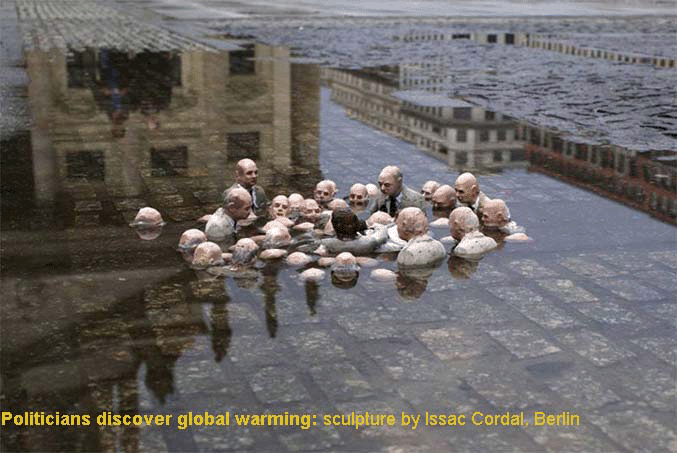
Last year saw a record number of UK newspaper editorials opposing climate
action – almost exclusively from right-leaning titles – new Carbon
Brief analysis shows.
The analysis is based on hundreds of UK national
newspaper editorials, which are the formal “voice” of the publications.
The 354 editorials published in 2023 relating to energy and climate change
add to thousands more collected in a long-running project started by Carbon
Brief. Newspapers such as the Sun and the Daily Mail published 42
editorials in 2023 arguing against climate action – nearly three times
more than they have printed before in a single year.
They called for delays
to UK bans on the sale of fossil fuel-powered cars and boilers, as well as
for more oil-and-gas production in the North Sea. In response to such
demands, prime minister Rishi Sunak performed a “U-turn” in September
on some of his government’s major net-zero policies. Last year also saw a
surge in hostility towards climate protesters, with editorial attacks
doubling compared to recent years.
Carbon Brief 9th Jan 2024
What a farce! Another veteran of the oil and gas industry to lead the next round of COP 29 climate talks

Cartoon courtesy of Simon Kneebone
Cop29, the next round of UN talks to tackle the climate crisis, will be
led by another veteran of the oil and gas industry.
Mukhtar Babayev, Azerbaijan’s ecology and natural resources minister, has been appointed
the president-in-waiting for the Cop29 climate talks when they take place
in the country in November. Before his entry into politics in the
autocratic country in western Asia, once a Soviet republic, Babayev spent
26 years working for the State Oil Company of the Azerbaijan Republic
(Socar).
Close observers of the Cop process will see parallels with the
appointment of Sultan Al Jaber, who moonlighted from his role as the chief
executive of the Abu Dhabi National Oil Company to preside over the summit
when it took place in Dubai last year.
Guardian 5th Jan 2024
BBC 5th Jan 2024
Sea level rise: ‘We can’t afford to wait’: a Cornish town faces climate threat head on
Earlier this year the north Cornwall town received a profound shock when
it was presented with a visualisation created by the Environment Agency of
the impact of rising sea levels on Bude. It left little doubt about the
seriousness of the threat and made it clear that global heating-induced sea
level rises will push the community into full-scale retreat. If nothing is
done, by 2050 rising sea levels will consume landmarks, such as the surf
life-saving club, and the Bude seawater swimming pool, as well as cafes,
businesses and car parks.
Guardian 14th Dec 2023
https://www.theguardian.com/environment/2023/dec/14/cornish-town-faces-climate-threat-head-on-bude
The failed Nuscale project lets Utah down — again

Every time we gamble on a nuclear project like Nuscale to deliver carbon-free power, we are hampering our ability to meet critical climate goals by 2030.
By Lexi Tuddenham | For The Salt Lake Tribune, Dec. 29, 2023 https://www.sltrib.com/opinion/commentary/2023/12/29/opinion-failed-nuscale-project/
Early last month, Nuscale made headlines by canceling its 462 MW proposal for a small modular nuclear reactor (SMNR) at the Idaho National Laboratory. Here in Utah, the news was met with little surprise.
For the past six years, we’ve been raising crucial questions about the viability of the so-called “Carbon Free Power Project” (CFPP). Was it a project that could deliver power on time and at a reasonable cost to ratepayers? How much would taxpayers and ratepayers ultimately pay, and who would bear the environmental, public health and financial risks? Could it meet our energy needs at a time when electrification is more critical than ever?
In 2015, the Nuscale project was eight years out. In 2022, it was still eight years out. As we watched other nuclear power projects be abandoned or blunder online years late and billions of dollars over cost, there was a sense of inevitability about who would suffer when this project failed: the communities who had placed their faith in its fantastical promises of affordable, reliable and “clean” power.
We were told that these SMNRs would be revolutionary — smaller, more cost-effective and with cutting-edge technology, but as we watched the costs swell from $55/MWh to $89/MWh and well beyond, even with huge federal subsidies, it was clear the financial risks were only mounting. With the collapse of the hypothetical project, Utah Associated Municipal Power Systems (UAMPS) member communities in rapidly growing areas like Hurricane and Washington City are now left with the reality of scrambling for alternatives to meet their future energy needs.
As we see nuclear projects around the country experience delay after delay, the Nuscale experience is one reason why we continue to watch the developments of the Terrapower Natrium reactor in Kemmerer, Wyoming, with a mix of skepticism and concern. The other reason is that the Terrapower project has promised not just electricity to Pacificorp customers, but also jobs in a community that desperately needs them. This is irresponsible at best.
The projected timeline for the Terrapower reactor to come online has already been pushed to 2030, which Terrapower external affairs director Jeff Navin admits is “cutting it close.” In addition, the community faces an economic abyss between the projected closure of the coal plant and the startup of the nuclear facility, and federal officials recently noted that with no permanent waste repository existent in the U.S., spent nuclear fuel will be stored “temporarily” on-site. Similar concerns can and should be raised about the proposed nuclear plants at Hunter and Huntington in Utah. At the end of the day, it is workers who are being let down, and it is communities who have to deal with the long term consequences.
We know that the next few years are of critical importance in our ability to combat the worst effects of climate change before we kick off even more warming feedback loops. Every time we gamble on a nuclear project like Nuscale to deliver carbon-free power, we are hampering our ability to meet critical climate goals by 2030. As timelines for such projects are inevitably dragged out, in the interim we continue to burn fossil fuels that choke the air that people breathe and force the climate ever closer to its tipping point.
The hard truth is that there is no silver bullet for climate change. Relying on nuclear power maintains dependence on a flawed energy system that primarily benefits industries that have historically profited from past harms. Now they promise to seamlessly plug in nuclear power and conduct business as usual.
According to the latest estimates, about a billion dollars was sunk into the now-abandoned Nuscale CFPP. This is a drop in the bucket compared to some other nuclear projects this country has seen over the last 30 years. But imagine that $1 billion spent elsewhere on legacy cleanups of the nuclear and uranium mining industry, aiding Downwinders or boosting renewable energy capacity that we know can work. There is an opportunity cost for investing in nuclear when we have faster, lower-risk options that we can prioritize now. Instead, we can take on climate change with what has been called “rational hope,” by investing in wind, solar, geothermal power, storage, grid improvements and efficiency technologies that offer cost-effective climate solutions. And Utah’s potential in these areas is immense.
But this energy future requires a reimagining. It requires permitting and energy-sourcing processes that put the health and vitality of communities front and center. It means changing course to avoid mistakes of the past.
Here at HEAL Utah, we collaborate with communities to shape an energy future crafted by the people it serves. This future prioritizes clean air, a healthy environment and family-sustaining jobs, all powered by accessible, sustainable and affordable renewable energy sources. In short, this is rational hope in practice. Together, we can make it a reality.
Lexi Tuddenham is the executive director of the Healthy Environment Alliance of Utah (HEAL Utah).
Why Artificial Intelligence is a disaster for the climate.

What this excellent article does not go on to explain is that the “tech gods” (that’s Musk, Gates, Bezos etc) are happy to have nuclear power expand – to fill the endless hunger for electricity of artificial intelligence and the rest of the digital marvels to come.

AI requires staggering amounts of computing power. And since computers require electricity, and the necessary GPUs (graphics processing units) run very hot (and therefore need cooling), the technology consumes electricity at a colossal rate. Which, in turn, means CO2 emissions on a large scale – about which the industry is extraordinarily coy, while simultaneously boasting about using offsets and other wheezes to mime carbon neutrality.
Guardian, John Naughton, 24 December 23
Amid all the hysteria about ChatGPT and co, one thing is being missed: how energy-intensive the technology is.
What to do when surrounded by people who are losing their minds about the Newest New Thing? Answer: reach for the Gartner Hype Cycle, an ingenious diagram that maps the progress of an emerging technology through five phases: the “technology trigger”, which is followed by a rapid rise to the “peak of inflated expectations”; this is succeeded by a rapid decline into the “trough of disillusionment”, after which begins a gentle climb up the “slope of enlightenment” – before eventually (often years or decades later) reaching the “plateau of productivity”.
Given the current hysteria about AI, I thought I’d check to see where it is on the chart. It shows that generative AI (the polite term for ChatGPT and co) has just reached the peak of inflated expectations. That squares with the fevered predictions of the tech industry (not to mention governments) that AI will be transformative and will soon be ubiquitous. This hype has given rise to much anguished fretting about its impact on employment, misinformation, politics etc, and also to a deal of anxious extrapolations about an existential risk to humanity.
All of this serves the useful function – for the tech industry, at least – of diverting attention from the downsides of the technology that we are already experiencing: bias, inscrutability, unaccountability and its tendency to “hallucinate”, to name just four. And, in particular, the current moral panic also means that a really important question is missing from public discourse: what would a world suffused with this technology do to the planet? Which is worrying because its environmental impact will, at best, be significant and, at worst, could be really problematic.
How come? Basically, because AI requires staggering amounts of computing power. And since computers require electricity, and the necessary GPUs (graphics processing units) run very hot (and therefore need cooling), the technology consumes electricity at a colossal rate. Which, in turn, means CO2 emissions on a large scale – about which the industry is extraordinarily coy, while simultaneously boasting about using offsets and other wheezes to mime carbon neutrality.
The implication is stark: the realisation of the industry’s dream of “AI everywhere” (as Google’s boss once put it) would bring about a world dependent on a technology that is not only flaky but also has a formidable – and growing – environmental footprint. Shouldn’t we be paying more attention to this?
Fortunately, some people are, and have been for a while. A study in 2019, for example, estimated the carbon footprint of training a single early large language model (LLM) such as GPT-2 at about 300,000kg of CO2 emissions – the equivalent of 125 round-trip flights between New York and Beijing. Since then, models have become exponentially bigger and their training footprints will therefore be proportionately larger.
But training is only one phase in the life cycle of generative AI. In a sense, you could regard those emissions as a one-time environmental cost. What happens, though, when the AI goes into service, enabling millions or perhaps billions of users to interact with it? In industry parlance, this is the “inference” phase – the moment when you ask Stable Diffusion to “create an image of Rishi Sunak fawning on Elon Musk while Musk is tweeting poop emojis on his phone”. That request immediately triggers a burst of computing in some distant server farm. What’s the carbon footprint of that? And of millions of such interactions every minute – which is what a world of ubiquitous AI will generate?……………………………………………………more https://www.theguardian.com/commentisfree/2023/dec/23/ai-chat-gpt-environmental-impact-energy-carbon-intensive-technology
The faith leaders fighting for the climate: ‘we have a moral obligation’
It has been another catastrophic climate year: record-breaking wildfires
across Canada scorched an area the size North Dakota, unprecedented
rainfall in Libya left thousands dead and displaced, while heat deaths
surged in Arizona and severe drought in the Amazon is threatening
Indigenous communities and ecosystems.
The science is clear: we must phase
out fossil fuels – fast. But time is running out, and as the climate
crisis, biodiversity loss and environmental degradation worsen, there is
mounting recognition that our political and industry leaders are failing
us. If the science isn’t enough, what role could – or should – faith
leaders play in tackling the climate crisis? After all, it is also a
spiritual and moral crisis that threatens God’s creation, according to
many religious teachings.
Guardian 23rd Dec 2023
COP28’s Unrealistic Tripling of Nuclear Power

according to the Bulletin of the Atomic Scientists, the declaration by 22 countries calling for a tripling of nuclear energy by 2050 is more fantasy than reality: “Even at best, a shift to invest more heavily in nuclear energy over the next two decades could actually worsen the climate crisis, as cheaper, quicker alternatives are ignored for more expensive, slow-to-deploy nuclear reactors.” (Bulletin of the Atomic Scientists, Dec. 13th, 2023)
BY ROBERT HUNZIKER, 22 Dec 23, https://www.counterpunch.org/2023/12/22/cop28s-unrealistic-tripling-of-nuclear-power/
UN climate conferences since 1992 have failed to follow thru with results, as CO2 emissions continue higher and higher with every passing year. In fact, post climate conference impact of adopted proposals has become something 0f an inside joke. The most recent conference, COP28, embraced nuclear power as a godsend challenging climate change.
“Triple Nuclear Power” still echoes throughout the halls of COP28. If one stands at the podium in the convention center now empty and listens intently, echoes reverberate “triple nuclear power” spewing out of red-faced maniacs from over 20 countries that committed to tripling nuclear power to bail our global asses out of a crazed climate system of epic proportions.
The US, UK, UAE, and others signed a declaration. Since they couldn’t budge oil and gas, it was decided to favor nuclear power as a surrogate for fixing the rip snorting global heating imbroglio found from pole to pole, from ocean to ocean. It’s real, it’s palpable; it’s now, much earlier than forecasts, as 1.5C prematurely comes to surface during irregular episodes.
Yet, according to the Bulletin of the Atomic Scientists, the declaration by 22 countries calling for a tripling of nuclear energy by 2050 is more fantasy than reality: “Even at best, a shift to invest more heavily in nuclear energy over the next two decades could actually worsen the climate crisis, as cheaper, quicker alternatives are ignored for more expensive, slow-to-deploy nuclear reactors.” (Bulletin of the Atomic Scientists, Dec. 13th, 2023)
Building nuclear power facilities has a long history that unfortunately casts a doubtful shadow over the idea of tripling by 2050. A now-famous plan by Princeton University in 2004 called for a “stabilization wedge” to avoid one billion tons of carbon emissions per year by 2055 by building 700 large nuclear reactors over 50 years.
In 2022, there were 416 operating reactors in the world. Starting in 2005 when the Princeton plan was announced, it would have meant building 14 reactors per year, assuming all existing reactors continued to function. However, over the 50-year cycle aging reactors and those going into retirement would ultimately require 40 new reactors per year. But throughout the entire history of nuclear power, on average 10 nuclear power plants connected to the electricity grid per year, and the number of new units was only 5 per year from 2011-2021.
Once again, like the sticky issue of direct carbon capture, achieving the scale of proposed solutions to climate change’s biggest weapon, or global warming, is beyond reality. Talk is cheap.
Meanwhile less expensive safer wind and solar easily trounce nuclear power’s newly installed output, by a country mile, to wit:
New nuclear energy capacity 2000-2020 42 GWe
New wind capacity from 2000-2020 605 GWe
New solar capacity from 2000-2020 578 GWe
Nuclear costs are prohibitively high: It’ll cost $15 trillion to triple nuclear capacity, assuming existing reactors continue to function, which will not be the case, raising this big bet well over $15T. Who’s putting up $15T?
And is there enough time to triple by 2050? From design to projected operation of the NuScale VOYGR plant takes 13 years. According to the International Energy Agency, the design and build phase for a country’s first nuclear reactor is 15 years. Several countries that signed on to the declaration to triple nuclear power are newbies.
According to a Foreign Policy article, Dec. 13th 2023 entitled: COP28’s Dramatic But Empty Nuclear Pledge: several reasons for skepticism about the nuclear energy triple buildout were enumerated, concluding: “The combination of macroeconomic pressures and regulatory restrictions means that neither pledges such as those made at COP28 nor memorandums of understanding with various industries, utilities, and governments should give anyone much confidence that a major expansion of nuclear energy is forthcoming.”
Nuclear expert Mycle Schneider, the lead author of the prestigious World Nuclear Industry Status Report (500 pgs.) now in in its 18th edition known for its fact-based approach on details of operation, construction, and decommissioning of the world’s reactors was recently interviewed by the Bulletin: Schneider’s publication is considered the landmark study of the industry.
Regarding NuScale, the US-based company that develops America’s flagship SMR (Small Nuclear Reactors), the company initially promised in 2008 to start generating power by 2015. As of 2023, they haven’t started construction of a single reactor. They do not have a certification license for the model they promoted for a Utah municipality. NuScale’s six module facility would cost $20,000 per kilowatt installed, twice as expensive as the most expensive large-scale reactors in Europe. And SMRs will generate disproportionate amounts of nuclear waste. No bargain here, assuming it even works efficiently enough, which is doubtful.
Schneider: “The entire logic that has been built up for small modular reactors is with the background of climate change emergency. That’s the big problem we have.” A sense of urgency cannot be met: “Considering the status of development, we’re not going to see any SMR generating power before the 2030s. It’s very clear: none. And if we are talking about SMRs picking up any kind of substantial amounts of generating capacity in the current market, if ever, we’re talking about the 2040s at the very earliest.”
Schneider on COP’s pledge to triple nuclear power: “From an industrial point of view, to put this pledge into reality. To me, this pledge is very close to absurd, compared to what the industry has shown.”
Looked at another way: “It took 70 years to bring global nuclear capacity to the current level of 370 gigawatts (GW), and the industry must now select technologies, raise finance and develop the rules to build another 740 GW in half that time… Why would anyone spend a single dollar on a technology that, if planned today, won’t even be available to help until 2035-2045?’ said Mark Jacobson, an energy specialist at Stanford University.” (Source: Nuclear Sector Must Overcome Decades of Stagnation to Meet COP28 Tripling, Reuters, Dec. 7, 2023) How about $15 trillion?
COP28 did not deliver on phase down of fossil fuels, and it’ll likely miss on tripling nuclear power. But once the results are finally known, it’s too late. The heat’s already on.
Nuclear folks are exaggerating their “win” at COP 28

There was no COP28 pledge to triple nuclear.
After a fight, nuclear got listed as one of a number of possible technologies to use in accelerating transition from fossil fuels.
22 countries, including Canada tried to drive the triple nukes “pledge” but over 200 countries signed on to triple renewables and double energy efficiency ” the renewables pledge is IN the final GST decisions.
The danger of rising tides to the Dungeness nuclear site, and to planned small nuclear reactors for Sussex
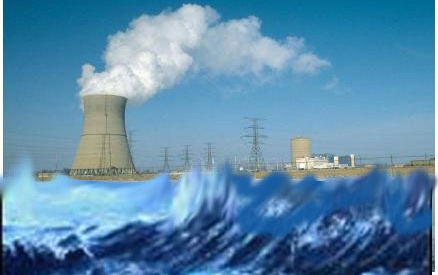
suggestions that Dungeness might become the site of a new nuclear power station featuring Small Modular Reactors (SMRs). The UK’s energy infrastructure, as noted by Peter Frankopan, is highly exposed to danger by even modest rises in sea levels, with all 19 of the country’s nuclear reactors located in coastal regions
As climate change increases the frequency and severity of storms, the inhabitants of low-lying Sussex coastal towns face potential danger
Rising Tides and Nuclear Solutions: the urgent call for coastal protection, byChris Wilmott, 16-12-2023
Born in the coastal town of Hastings, I was lucky to grow up in Sussex by the Sea. I recognise that being able to enjoy the proximity of the sound of the waves, with the many wild and warm variations of weather, was a fantastic benefit during my childhood. However, in recent years, my gaze has shifted somewhat towards a looming threat – the peril that coastal towns now face from climate change and the relentless rise of the tides and adverse weather.
I’ve been doing some research on this and according to NASA there is the potential for lunar cycles to start creating higher tides as soon as 2030, leaving low-lying areas vulnerable to the unforgiving turmoil and rage of the sea. This makes me very concerned for Dungeness, just across from Hastings in Kent, an iconic region situated in a famously low-lying area. In a recent article published by Sussex Bylines, Susan Kerrison posed the question The rising costs of sea defences – how prepared are we? In my opinion, we’re not prepared at all.
…………………………………………….Dungeness B is a nuclear power plant that even as far back as 2014 caused serious concerns over its safety and is now closed and in the process of de-fuelling. EDF privately acknowledged to the Office of Nuclear Regulation (ONR) that the shingle bank protecting the reactors from the sea was “not as robust as previously thought.” This revelation sparked worries among environmentalists, with Greenpeace’s Doug Parr highlighting the lack of transparency about serious safety concerns over flooding.
My interest in this site is heightened by suggestions that Dungeness might become the site of a new nuclear power station featuring Small Modular Reactors (SMRs). The UK’s energy infrastructure, as noted by Peter Frankopan, is highly exposed to danger by even modest rises in sea levels, with all 19 of the country’s nuclear reactors located in coastal regions – the UK Office for Science has acknowledged this threat.
Apart from the potential fall out of power stations failing, one must consider the localised impact of families having to relocate and businesses losing their premises, potentially at short notice. Hastings has suffered two floods so far this year, with sandbags a common sight and businesses forced to close.
Onwards and Upwards for the sea
Ocean scientist Eelco Rohling warns that the combination of global sea-level rise and increased storm intensities could spell doom for exposed coastal regions. The threat of flooding extremes looms large, even with a sea-level rise of 20 centimetres. Twenty centimetres may seem like a modest rise, the corresponding storm surge of two metres would cause considerable damage. Picture then a sea-level rise of say, 80 centimetres, and one can only imagine the destruction that would be caused by a corresponding storm surge of eight metres. ……………………………………………more https://sussexbylines.co.uk/news/environment/rising-tides-and-nuclear-solutions/—
COP28 — The End Of The 1.5°C Fantasy

what the world got from COP28 was more like an endorsement of the status quo that reflects the ongoing state of play rather than accelerating it.
We must not allow broiling temperatures, more powerful storms, more frequent wildfires, and the disappearance of rain forests to become the new normal.
https://cleantechnica.com/2023/12/16/cop-28-the-end-of-the-1-5-degree-c-fantasy/
In Paris at the end of 2015, the world rejoiced when the national representatives from around the planet agreed to try really, really hard to keep average global temperatures from increasing more than 1.5°C above pre-industrial levels. Of course, in the 1800s when the Industrial Revolution began, the amount of carbon dioxide in the atmosphere was around 300 parts per million. In 2015, carbon dioxide levels were on the verge of breaking the 400 ppm barrier. Today, with COP28 now in the rear view mirror, the world is experiencing carbon dioxide levels of 420 ppm.
In order for all the happy talk in 2015 to mean anything, CO2 levels should have been declining since then. The fact that they have risen instead means the promise of the Paris climate accords was a mirage. Pessimists at the time suggested the good news was an illusion and history, unfortunately, has proven those “the glass is half empty” types correct.
There was much celebrating in Dubai when the final communique from COP28 contained an historic phrase that proclaimed for the first time ever that the nations of the world should focus on “transitioning away from fossil fuels in energy systems, in a just, orderly and equitable manner.” That is the first time in 28 tries that the words “fossil fuels” have been included in such a statement, which is pretty astonishing when you realize these annual events are about global warming. It has taken 28 years and millions of written and spoken words to acknowledge that fossil fuels are the problem. A young activist from India may have helped as well.
Sultan Al Jaber is being celebrated for getting those words into the final document after they were omitted from a prior draft and for standing up to his oil-soaked colleagues who felt betrayed by that language. But David Wallace-Wells, a science and climate writer for the New York Times, is not one of those who is cheering. In fact, he says what the world got from COP28 was more like an endorsement of the status quo that reflects the ongoing state of play rather than accelerating it.
Global sales of internal combustion engine vehicles peaked in 2017, he writes, and investment in renewable energy has exceeded investment in fossil fuel infrastructure for several years running. In 2022, 83 percent of new global energy capacity was green.
“The question isn’t about whether there will be a transition, but how fast, global and thorough it will be. The answer is: not fast or global or thorough enough yet, at least on the current trajectories, which COP28 effectively affirmed. To limit warming to 1.5 degrees Celsius now requires entirely eliminating emissions not long after 2040, according to the Global Carbon Project, whose ‘carbon budget’ for 1.5 degrees Celsius will be exhausted in about five years of current levels of emissions. For 1.7 degrees Celsius, it’s just after 2050, and for 2 degrees Celsius, 2080. And despite Al Jaber’s claim that COP28 has kept the 1.5 degree goal alive, hardly anyone believes it’s still plausible.”
In fact, Wallace-Wells writes, most analysts predict a global peak in fossil fuel emissions at some point over the next decade, followed not by a decline but a long plateau — meaning that in every year for the foreseeable future, we would be doing roughly as much damage to the future of the planet’s climate as was done in recent years. The expected result will be that by the end of this century, average global temperatures will have risen by 2 to 3 degrees Celsius above pre-industrial levels.
“Not so long ago, this was a future that terrified us, but now we are not just coming to accept that future and, in some corners, applauding it as progress. Over the last several years, as decarbonization has made worst case scenarios seem much less likely, a wave of climate alarmism has given way somewhat to a new mix of accommodation and optimism.”
Imagining 3°C At COP28
At COP28, Bill Gates described anything below 3 degrees as a “fortunate” outcome. A few months earlier, former President Barack Obama struck a similar note in describing how he’d tried to talk his daughter Malia off the edge of climate despair by emphasizing what could still be saved rather than what had been lost already through global inaction. “We may not be able to cap temperature rise to 2 degrees Celsius, but here’s the thing, if we work really hard, we may be able to cap it at two and a half.” Scottish data scientist Hannah Ritchie gives a shot of optimism to those caught in a panic about warming and environmental degradation in a new book called “Not the End of the World.”
Wallace-Wells tries to remain guardedly optimistic but believes COP28 will be remembered as the moment the world finally gave up on the goal of limiting warming to degrees and encourages his readers to think what passing that threshold will mean.
“Global warming doesn’t proceed in large jumps, for the most part, and surpassing 1.5 degrees does not bring us immediately or inevitably to 2 degrees. But we know quite a lot about the difference between those two worlds — the one we had once hoped to achieve and the one that now looks much more likely. Indeed, in the recent past, a clear understanding of those differences was responsible for a period of intense and global climate alarm.”
The Intergovernmental Panel on Climate Change “Special Report on Global Warming of 1.5 Degrees Celsius,” published in 2018, collated all the scientific literature about the two warming levels. Between 1.5 and 2 degrees C, it estimated more than 150 million people will die prematurely from the air pollution produced by the burning of fossil fuels. Flooding events that used to arrive once a century will become annual events.
Most scientists believe that amount of warming would be a death sentence for the world’s coral reefs. And many believe that, in that range, the planet will lock in the permanent loss of many of its ice sheets, which could bring, over centuries, enough sea level rise to redraw the world’s coastlines.
If warming grows beyond those levels, so will its impacts. At 3 degrees, for instance, New York City could be hit by three 100 year flooding events each year and more than 50 times as many people in African cities would experience conditions of dangerous heat. Wildfires would burn twice as much land globally and the Amazon would cease to be a rain forest but become a grassland. Potentially lethal heat stress, almost unheard of at 1.5 degrees, would become routine for billions at 2 degrees, according to one recent study, and above 3 degrees would impact places like the American Midwest.
“In some ways, these projections may sound like old news, but as we find ourselves now adjusting to the possibility of a future shaped by temperature rise of that kind, it may be clarifying to recall that, almost certainly, when you first heard those projections, you were horrified. The era of climate reckoning has also been, to some degree, a period of normalization, and while there are surely reasons to move past apocalyptic politics toward something more pragmatic, one cost is a loss of perspective at negotiated, technocratic events like [COP28]”
Was 1.5°C Just An Attractive Fantasy?
Perhaps it was always somewhat fanciful to believe that it was possible to limit warming to 1.5 degrees Celsius. Wallace-Wells suggests. As Bill McKibben said recently, simply stating the goal did a lot to shape action in the years that followed the Paris climate accords by demanding we all look squarely at what the science told us about what it would mean to fail.
The Dubai consensus that renewable energy should triple by 2030 is one sign that, in some areas, impressive change is possible. “But for all of our temperature goals, the timelines are growing shorter and shorter, bringing the world closer and closer to futures that looked so fearsome to so many not very long ago,” Wallace -Wells cautions.
The Takeaway
We must not allow broiling temperatures, more powerful storms, more frequent wildfires, and the disappearance of rain forests to become the new normal. We need to keep the vision that emerged in Paris in 2015 alive and intact, even if it was largely a fantasy. We need to keep the pressure on governments and fossil fuel companies to sharply reduce their carbon emissions by honoring the spirit as well as the letter of closing statement from COP28.
The struggle is far from over. Every tenth of a degree of increase in average global temperatures prevented will avoid untold suffering for millions of humans.
There is another consideration here. Much of the turn toward extreme right wing governments around the world from the United States to the Netherlands, Italy, New Zealand, and the UK is directly connected to a desire to keep black and brown people from becoming unwelcome immigrants. It is in the selfish best interest of wealthy nations to control climate related migration by controlling global temperature increases. If we think climate migration is rampant now, we ain’t seen nothing yet.
Nuclear power – a ‘dangerous distraction’ from real climate action

A ‘dangerous distraction’ COP plot to triple nuclear power by 2050 decried
https://beyondnuclearinternational.org/2023/12/17/a-dangerous-distraction/–By Jon Queally, Common Dreams
Climate campaigners scoffed Saturday at a 22-nation pledge to triple nuclear power capacity by mid-century as a way to ward off the increasing damage of warming temperatures, with opponents calling it a costly and “dangerous” distraction from the urgent need for a fossil fuel phaseout alongside a rapid increase in more affordable and scaleable renewable sources such as wind and solar.
The Declaration to Triple Nuclear Energy—backed by the United States, Canada, France, the Czech Republic, and others—was announced as part of the Climate Action Summit taking place in Dubai as a part of the two-week U.N. climate talks known as COP28.
While the document claims a “key role” for nuclear energy to keep “a 1.5°C limit on temperature rise within reach” by 2050 and to help attain the so-called “net-zero emissions” goal that governments and the fossil fuel industry deploy to justify the continued burning of coal, oil, and gas, critics say the false solution of atomic power actually harms the effort to reduce emissions by wasting precious time and money that could be spent better and faster elsewhere.
“There is no space for dangerous nuclear power to accelerate the decarbonization needed to achieve the Paris climate goal,” said Masayoshi Iyoda, a 350.org campaigner in Japan who cited the 2011 Fukushima disaster as evidence of the inherent dangers of nuclear power.
Nuclear energy, said Iyoda, “is nothing more than a dangerous distraction. The attempt of a ‘nuclear renaissance’ led by nuclear industries’ lobbyists since the 2000s has never been successful—it is simply too costly, too risky, too undemocratic, and too time-consuming. We already have cheaper, safer, democratic, and faster solutions to the climate crisis, and they are renewable energy and energy efficiency.”
When word of the multi-nation pledge emerged last month, Mark Jacobson, professor of civil and environmental engineering at Stanford University and co-founder of The Solutions Project which offers a roadmap for 100% renewable energy that excludes nuclear energy, called the proposal the “stupidest policy proposal I’ve ever seen.”
Jacobson said the plan to boost nuclear capacity in a manner to avert the worst impacts of the climate crisis “will never happen no matter how many goals are set” and added that President Joe Biden was getting “bad advice in the White House” for supporting it.
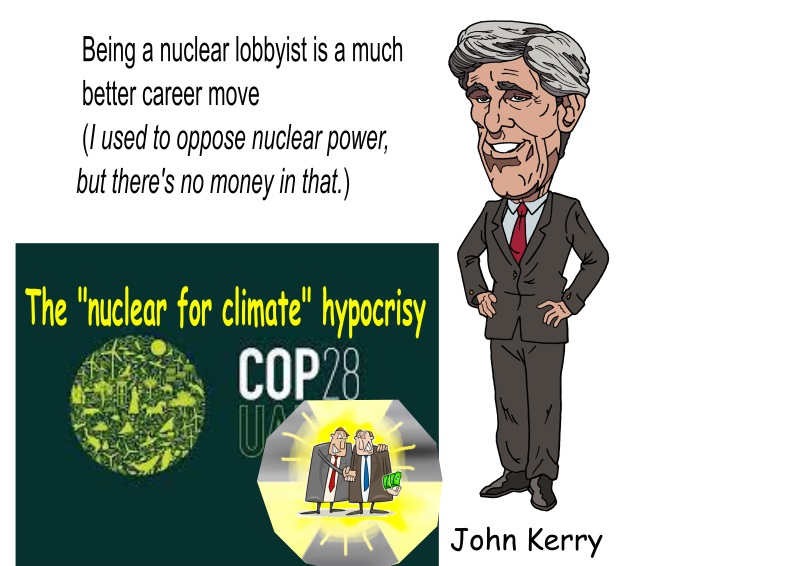
In comments from Dubai, U.S. climate envoy John Kerry said that while nuclear is not “going to be the sweeping alternative to every other energy source,” he claimed that “science and the reality of facts” shows the world “you can’t get to net-zero 2050 without some nuclear.”
Numerous studies and blueprints towards a renewable energy future, however, have shown this is not established fact, but rather the position taken by both the nuclear power industry itself and those who would otherwise like to slow the transition to a truly renewable energy system.
Pauline Boyer, energy transition campaign manager with Greenpeace France, said the scientific evidence is clear and it is not in favor of a surge in nuclear power.
“If we wish to maintain a chance of a trajectory of 1.5°C, we must massively reduce greenhouse gas emissions over the coming years, but nuclear power is too slow to deploy in the face of the climate emergency,” she said.
“The announcement of a tripling of capacities is disconnected from reality,” Boyer continued. Citing delays and soaring costs, she said the nuclear industry “is losing ground in the global energy mix every day” in favor of renewable energy options that are cheaper, quicker to deploy, and more accessible to developing countries.
In 2016, researchers at the University of Sussex and the Vienna School of International Studies showed that “entrenched commitments to nuclear power” were likely “counterproductive” towards achieving renewable energy targets, especially as “better ways to meet climate goals”—namely solar, wind, geothermal, and hydropower–were suppressed.
In response to Saturday’s announcement, Soraya Fettih, a 350.org campaigner from France, which relies heavily on nuclear power, said it’s simply a move in the wrong direction. “Investing now in nuclear energy is an inefficient route to take to reduce emissions at the scale and pace needed to tackle climate change,” said Fettih. “Nuclear energy takes much longer than renewable energy to be operational.”
Writing on the subject in 2019, Harvard University professor Naomi Oreskes and renowned author and psychohistorian Robert Jay Lifton observed how advocates of nuclear power declare the technology “clean, efficient, economical, and safe” while in reality “it is none of these. It is expensive and poses grave dangers to our physical and psychological well-being.”
“There are now more than 450 nuclear reactors throughout the world,” they wrote at the time. “If nuclear power is embraced as a rescue technology, there would be many times that number, creating a worldwide chain of nuclear danger zones—a planetary system of potential self-annihilation.”
COP 28 and the nuclear energy numbers racket
By Sharon Squassoni | December 13, 2023, https://thebulletin.org/2023/12/the-nuclear-energy-numbers-racket/
Nuclear energy made a big splash at the COP28 climate meeting in Dubai with a declaration by 22 countries calling for a tripling of nuclear energy by 2050. It seems like an impressive and urgent call to arms. On closer inspection, however, the numbers don’t work out. Even at best, a shift to invest more heavily in nuclear energy over the next two decades could actually worsen the climate crisis, as cheaper, quicker alternatives are ignored for more expensive, slow-to-deploy nuclear options.
Here’s what the numbers say:
22: That 22 countries signed the declaration may seem like a lot of support, but 31 countries (plus Taiwan) currently produce nuclear energy. Notably missing from the declaration are Russia and the People’s Republic of China. Russia is the world’s leading exporter of nuclear power plants and has the fourth largest nuclear energy capacity globally; China has built the most nuclear power plants of any country in the last two decades and ranks third globally in capacity. Thirteen other countries that have key nuclear programs are also missing from the declaration: five in Europe (Armenia, Belarus, Belgium, Switzerland and Spain), two in South Asia (India and Pakistan) three in the Americas (Argentina, Brazil and Mexico), South Africa (the only nuclear energy producer in Africa), and Iran.
5: Five of the countries signing the declaration do not have nuclear power—Mongolia, Morocco, Ghana, Moldova, and Poland. Only Poland’s electricity grid can support three or four large nuclear reactors—the rest would have to invest billions of dollars first to expand their grids or rely on smaller reactors that would not overwhelm grid capacity. Poland wants to replace its smaller coal plants with almost 80 small modular reactors (SMRs), but these “paper reactors” are largely just plans and not yet proven technology. One American vendor, NuScale, recently scrapped a six-unit project when cost estimates rose exponentially. In any event, none of these five countries is likely to make a significant contribution toward tripling nuclear energy in the next 20 years.
17: The 17 remaining signatories to the nuclear energy declaration represent a little more than half of all countries with nuclear energy, raising the issue of how much support there really is for tripling nuclear energy by 2050.
3x: The idea of tripling nuclear energy to meet climate change requirements is not new. In fact, it was one of eight climate stabilization “wedges” laid out in Science magazine in 2004 in a now-famous article by Robert Socolow and Stephen Pacala of Princeton University. A stabilization wedge would avoid one billion tons of carbon emissions per year by 2055. In the case of nuclear energy, this would require building 700 large nuclear reactors over the course of 50 years. (In 2022, there were 416 reactors operating around the world, with 374 gigawatts-electric of capacity). In 2005, to reach the one-billion-ton goal of emissions reduction would have meant building 14 reactors per year, assuming all existing reactors continued operating. (In fact, the build rate needed to be 23 per year to replace aging reactors that would need to be retired.) Given the stagnation of the nuclear power industry since then, the build rate now to reach wedge level would need to be 40 per year.
10: Average annual number of connections of nuclear power plants to the electricity grid, per year, over the entire history of nuclear energy. Between 2011 and 2021, however, the average annual number of nuclear power reactors connected to the grid was 5.
42 GWe: New nuclear energy capacity added from 2000 to 2020.
605 GWe: New wind capacity added from 2000 to 2020.
578 GWe: New solar capacity added from 2000 to 2020. Growth in renewables has vastly outpaced that of nuclear energy in recent years.
10: Average annual number of connections of nuclear power plants to the electricity grid, per year, over the entire history of nuclear energy. Between 2011 and 2021, however, the average annual number of nuclear power reactors connected to the grid was 5.
42 GWe: New nuclear energy capacity added from 2000 to 2020.
605 GWe: New wind capacity added from 2000 to 2020.
578 GWe: New solar capacity added from 2000 to 2020. Growth in renewables has vastly outpaced that of nuclear energy in recent years.
15 trillion: In US dollars, the cost to build enough NuScale reactors (9,738 77 megawatt-electric reactors) to triple nuclear energy capacity, assuming existing reactors continue to operate. There are less expensive SMRs, perhaps, but none further along in the US licensing process.
13: An unlucky number in some cultures, but this was the time from design to projected operation of the NuScale VOYGR plant. Nuclear power plants have to be “done right,” and cutting corners to speed deployment is in no one’s interests. The design-and-build phase for a country’s first nuclear reactor, according to the International Atomic Energy Agency, is 15 years. If the great expansion of nuclear energy is supposed to occur in more than the 22 countries that signed the declaration, this lead-time cannot be ignored.
The climate crisis is real, but nuclear energy will continue to be the most expensive and slowest option to reach net zero emissions, no matter how you cook the numbers.
Failure of Cop28 on fossil fuel phase-out is ‘devastating’, say scientists

“Cop28 is the fossil fuel industry’s dream outcome, because it looks like progress, but it isn’t.”
While the agreement’s call for the need to transition away from fossil fuels is welcome, it has numerous caveats and loopholes that risks rendering it meaningless.
Climate experts say lack of unambiguous statement is ‘tragedy for the planet and our future’
Damian Carrington Environment editor
in Dubai. Photograph: Peter Dejong/AP
Failure of Cop28 on fossil fuel phase-out is ‘devastating’, say scientists
Climate experts say lack of unambiguous statement is ‘tragedy for the planet and our future’
Damian Carrington Environment editor
@dpcarringtonFri 15 Dec 2023 04.00 AEDT
The failure of Cop28 to call for a phase-out of fossil fuels is “devastating” and “dangerous” given the urgent need for action to tackle the climate crisis, scientists have said.
One called it a “tragedy for the planet and our future” while another said it was the “dream outcome” for the fossil fuel industry.
The UN climate summit ended on Wednesday with a compromise deal that called for a “transition away” from fossil fuels. The stronger term “phase-out” had been backed by 130 of the 198 countries negotiating in Dubai but was blocked by petrostates including Saudi Arabia.
The deal was hailed as historic as it was the first citing of fossil fuels, the root cause of the climate crisis, in 30 years of climate negotiations. But scientists said the agreement contained many loopholes and did not match the severity of the climate emergency.
“The lack of an agreement to phase out fossil fuels was devastating,” said Prof Michael Mann, a climatologist and geophysicist at the University of Pennsylvania in the US. “To ‘transition away from fossil fuels’ was weak tea at best. It’s like promising your doctor that you will ‘transition away from doughnuts’ after being diagnosed with diabetes.”
Dr Magdalena Skipper, the editor in chief of the science journal Nature, said: “The science is clear – fossil fuels must go. World leaders will fail their people and the planet unless they accept this reality.”
An editorial in Nature said the failure over the phase-out was “more than a missed opportunity”, it was “dangerous” and ran “counter to the core goals laid down in the 2015 Paris climate agreement” of limiting global heating to 1.5C (2.7F) above preindustrial levels.
“The climate doesn’t care who emits greenhouse gases,” the editorial continued. “There is only one viable path forward, and that is for everybody to phase out almost all fossil fuels as quickly as possible.”
Sir David King, the chair of the Climate Crisis Advisory Group and a former UK chief scientific adviser, said: “The wording of the deal is feeble. Ensuring 1.5C remains viable will require total commitment to a range of far-reaching measures, including full fossil fuel phase-out.”
There was a chasm between the stark statement of the emissions cuts needed and the action proposed to deliver those reductions, he said: “The Cop28 text recognises there is a need for ‘deep, rapid and sustained reductions in greenhouse gas emissions’ to stay in line with 1.5C. But then it lists a whole bunch of efforts that don’t have a chance of achieving that.”
The scientists said the loopholes included the call to “accelerate” carbon capture and storage to trap emissions from burning fossil fuels, an option that can play a minor role at best.
Dr Friederike Otto, a climatologist at Imperial College London, said: “Until fossil fuels are phased out, the world will continue to become a more dangerous, more expensive and more uncertain place to live. With every vague verb, every empty promise in the final text, millions more people will enter the frontline of climate change and many will die.”
Prof Martin Siegert, a polar scientist and deputy vice-chancellor at the University of Exeter, said: “The science is perfectly clear. Cop28, by not making a clear declaration to stop fossil fuel burning is a tragedy for the planet and our future. The world is heating faster and more powerfully than the Cop response to deal with it.”
Prof Mike Berners-Lee, an expert on carbon footprinting at Lancaster University, said: “Cop28 is the fossil fuel industry’s dream outcome, because it looks like progress, but it isn’t.”
Dr Elena Cantarello, a senior lecturer in sustainability science at Bournemouth University, UK, said: “It is hugely disappointing to see how a very small number of countries have been able to put short-term national interests ahead of the future of people and nature.”
Dr James Dyke, an associate professor in earth system dynamics at the University of Exeter, said: “Cop28 needed to deliver an unambiguous statement. While the agreement’s call for the need to transition away from fossil fuels is welcome, it has numerous caveats and loopholes that risks rendering it meaningless…………………………………………………………. more https://www.theguardian.com/environment/2023/dec/14/failure-cop28-fossil-fuel-phase-out-devastating-say-scientists
COP 28 ‘s fundamentally weak agreement to “call on parties to contribute” to action on climate change
The president of COP28 is styling this as a moment in history. The point at
which the world changed course and began to really bear down on the
overwhelming source of the emissions warming our planet: coal, oil and gas.
And it really is significant progress that for the first time fossil fuels
and the need to “transition” away from them has been included in the
text.
Campaigners will say it is too little too late. But the world coming
together to acknowledge that fact will have consequences in the real world.
Would you want to bet your life savings on a new coal-fired power plant
after today?
But it is true that the agreement is fundamentally weak. Why?
Because the strongest language the UAE could get the world to agree was to
“call on parties to contribute” to a series of actions to tackle
climate change.
BBC 13th Dec 2023
1 This Month
19 February – VIRTUAL EVENT-Decision Time: AI and Our Nuclear Arsenal
12:45 p.m. Central / 1:45 p.m. Eastern
To see nuclear-related stories in greater depth and intensity – go to https://nuclearinformation.wordpress.com
-
Archives
- February 2026 (127)
- January 2026 (308)
- December 2025 (358)
- November 2025 (359)
- October 2025 (376)
- September 2025 (258)
- August 2025 (319)
- July 2025 (230)
- June 2025 (348)
- May 2025 (261)
- April 2025 (305)
- March 2025 (319)
-
Categories
- 1
- 1 NUCLEAR ISSUES
- business and costs
- climate change
- culture and arts
- ENERGY
- environment
- health
- history
- indigenous issues
- Legal
- marketing of nuclear
- media
- opposition to nuclear
- PERSONAL STORIES
- politics
- politics international
- Religion and ethics
- safety
- secrets,lies and civil liberties
- spinbuster
- technology
- Uranium
- wastes
- weapons and war
- Women
- 2 WORLD
- ACTION
- AFRICA
- Atrocities
- AUSTRALIA
- Christina's notes
- Christina's themes
- culture and arts
- Events
- Fuk 2022
- Fuk 2023
- Fukushima 2017
- Fukushima 2018
- fukushima 2019
- Fukushima 2020
- Fukushima 2021
- general
- global warming
- Humour (God we need it)
- Nuclear
- RARE EARTHS
- Reference
- resources – print
- Resources -audiovicual
- Weekly Newsletter
- World
- World Nuclear
- YouTube
-
RSS
Entries RSS
Comments RSS
 nuclear-news