Climate Goal “Will Be Dead Within a Few Years” Unless World Acts, UN Warns

The world is well on track to blow past a goal of limiting global warming to 1.5 degrees Celsius that many countries have put at the center of their climate efforts
By Sara Schonhardt & E&E News
Climate Goal “Will Be Dead Within a Few Years” Unless World Acts, UN
Warns. The world is well on track to blow past a goal of limiting global
warming to 1.5 degrees Celsius that many countries have put at the center
of their climate efforts. I
f current trends continue, “there is virtually
no chance” of limiting global warming over the past 170 years to 1.5
degrees, according to the latest emissions gap report from the United
Nations Environment Programme (UNEP). Even in the most optimistic
scenarios, where all countries deliver on their emission-cutting pledges,
“there remains about a 3-in-4 chance that warming will exceed 1.5C,” it
adds.
Scientific American 25th Oct 2024, https://www.scientificamerican.com/article/climate-goal-will-be-dead-within-a-few-years-unless-world-acts-un-warns/
‘We have emotions too’: Climate scientists respond to attacks on objectivity
Climate scientists who were mocked and gaslighted after speaking up about
their fears for the future have said acknowledging strong emotions is vital
to their work. The researchers said these feelings should not be suppressed
in an attempt to reach supposed objectivity. Seeing climate experts’
fears and opinions about the climate crisis as irrelevant suggests science
is separate from society and ultimately weakens it, they said. The
researchers said they had been subject to ridicule by some scientists after
taking part in a large Guardian survey of experts in May, during which they
and many others expressed their feelings of extreme fear about future
temperature rises and the world’s failure to take sufficient action. They
said they had been told they were not qualified to take part in this broad
discussion of the climate crisis, were spreading doom and were not
impartial.
Guardian 25th Oct 2024,
https://www.theguardian.com/environment/2024/oct/25/we-have-emotions-too-climate-scientists-respond-to-attacks-on-objectivity
‘Climate crunch time’: UN warns world risks over 3C warming without urgent action this decade.

Capping global warming at 1.5C remains technically
possible, but only with unprecedented action from governments around the
world to slash global greenhouse gas emissions by an average of 7.5 per
cent every single year over the next decade, the United Nations has warned.
Published today, the UN Environment Programme’s (UNEP) annual assessment
calculates the ’emissions gap’ between what scientists say must happen to
limit global warming to the 1.5C goal established by the Paris Agreement,
and the emissions reductions targeted and delivered by governments
worldwide.
As ever, the report underscores the rapidly closing window of
time to deliver the deep emissions reductions required this decade if the
goals of the Paris Agreements are to be met, warning that based on current
policies the world risks careering towards catastrophic temperature
increases of between 2.6C and 3.1C over the course of this century.
Business Green 24th Oct 2024
Nuclear lobby on track to sabotage COP29.

By Noel Wauchope | 24 October 2024, https://independentaustralia.net/environment/environment-display/nuclear-lobby-on-track-to-sabotage-cop29,19101
The nuclear lobby is on track to sabotage the COP29 UN Climate Change Conference next month in Azerbaijan — lobbying governments for support and investors for money, writes Noel Wauchope.
IT’S NOT SO LONG AGO that the global nuclear energy lobby used to deny the threat of climate change. Even as recently as 2020, a leading nuclear propagandist, Michael Shellenger, was downplaying climate change, while trashing renewable energy.
But that’s changed.
In the face of public anxieties about nuclear health and safety dangers – and above all, of nuclear costs – the propagandists desperately needed a new shtick.
The answer was — nuclear power to beat climate change!
COP28 UN Climate Change Conference in December 2023 — the global nuclear lobby trumpeted its “success”

But, in reality, only a tiny minority at COP28 agreed that nuclear power was needed to address global warming.
198 Parties (197 countries plus the European Union) attended this climate summit in Dubai in 2023. Only 22 agreed to the pro-nuclear declaration proposed by France’s President Emmanuel Macron — the Declaration to Triple Nuclear Energy Capacity by 2050, Recognizing the Key Role of Nuclear Energy in Reaching Net Zero.
And, 31 countries that do have nuclear power — why didn’t Russia and China sign up?
Thirteen other countries that have key nuclear programs were also missing from the declaration — five in Europe (Armenia, Belarus, Belgium, Switzerland and Spain), two in South Asia (India and Pakistan) three in the Americas (Argentina, Brazil and Mexico), South Africa (the only nuclear energy producer in Africa), and Iran.
COP29 United Nations Climate Change Conference November 2024, Baku, Azerbaijan
The global nuclear lobby is much better organised now — and will try again.
It’s well to keep in mind that the United Nations is beholden to the nuclear industry.
On 28th May 1959, the International Atomic Energy Agency (IAEA) – not yet two years old! – and The World Health Organisation (WHO) signed an agreement referred to as WHA 12-40. Though, it might, on paper, appear balanced and reciprocal, in practice the WHA 12-40 puts WHO in a subordinate position to the IAEA.

So, the United Nations (UN) is tethered to the nuclear industry. The IAEA is part of the UN system — and its brief is to promote the “peaceful” nuclear industry.
COP29 is all about the money
So, the global nuclear push is well prepared with the recent release of an IAEA report on Climate Change and Nuclear Power focussing on the need for investment.
‘The 2024 edition of the IAEA’s Climate Change and Nuclear Power report has been released, highlighting the need for a significant increase in investment to achieve goals for expanding nuclear power.’
According to the report, global investment in nuclear energy must increase to USD$125 billion annually – up from the around USD$50 billion invested each year from 2017-2023 – to meet the IAEA’s high case projection for nuclear capacity in 2050.
The more aspirational goal of tripling capacity – which more than 20 countries pledged to work towards at COP28 last year – would require upwards of USD$150 billion in annual investment.
IAEA Director General Rafael Mariano Grossi said:
“Across its near century-long lifetime, a nuclear power plant is affordable and cost-competitive. Financing the upfront costs can be a challenge however, especially in market-driven economies and developing countries, ….the private sector will increasingly need to contribute to financing, but so too will other institutions. The IAEA is engaging multilateral development banks to highlight their potential role in making sure that developing countries have more and better financing options when it comes to investing in nuclear energy.”
The new report also examines ways to unlock private-sector finance — a topic that is gaining increasing attention worldwide.
Last month, 14 major financial institutions including some of the world’s largest banks came together during a New York Climate Week event to signal a willingness to help finance nuclear newbuild projects.
On the sidelines of Climate Week in New York City, major banks, government representatives and industry executives met at the Financing the Tripling of Nuclear Energy Leadership Event.
Note that this event was sponsored by the IAEA and the Clean Energy Ministerial’s (CEM) Nuclear Innovation: Clean Energy Future (NICE) initiative. The CEM’s role is to run forums for propagandising the nuclear industry.
The IAEA report continues:
‘Nuclear power’s inclusion in sustainable financing frameworks, including the European Union (EU) taxonomy for sustainable activities, is having a tangible impact. In the EU, the first green bonds have been issued for nuclear power in Finland and France in 2023. Electricité de France (EDF) was one of the first recipients, with the award of €4 billion in green bonds and around €7 billion in green loans between 2022 and 2024.’
The report makes the case for policy reform and international partnerships to help bridge the financing gap and accelerate nuclear power expansion into emerging markets and developing economies — including for small modular reactors.
What does this mean for COP29?
Well, despite the IAEA hype, the nuclear push at COP28 was a bit of a flop.
Forcefully led by France, which is stuck with its unfortunate situation of nuclear monopoly on its energy system. The pro-nuclear declaration was not a global success.
The aim then was to get governments to promote the industry. And, that’s still the aim, despite the pleas for private investment.
But the two go together – lobbying governments to weaken safety regulations, assume the financial risk and provide tax breaks and incentives – while simultaneously encouraging investors about government support.
Ideally, like France, governments could nationalise the nuclear industry. After all, the taxpayer is the most reliable customer.
Sustainability campaigner and author, Jonathon Porritt, predicts COP 29 will be:
‘Baku will be worse than Dubai – as the capital of an even more corrupt, even more misogynistic, and more autocratic petrostate than the UEA.’
The polluting industries will be there in force to counter any real action — as they did in 2023.
In a happy partnership with them will be Rafael Grossi and his nuclear crew.
The much-touted nuclear resurgence – if it happens at all – will be so long coming that it will be irrelevant to the galloping global heating.
Meanwhile, the nuclear push will enable coal, oil and gas to rocket on — while investment in renewable energy will be stymied.
Climate is the big argument. That is for now.
If they win world acceptance that financing nuclear power is essential for climate action, the nuclear lobby can then go on to erase other lingering concerns — on health, safety, wastes, weapons proliferation, indigenous rights.
The world media has dutifully regurgitated the promotion of those mythical beasts — the small nuclear reactors (SMRs).
The digital age – so far – has enabled such myths to be widely promoted and widely accepted.
Ever-increasing AI is becoming accepted as essential — along with its ever-increasing lust for electricity.
I see the global belief in “nuclear for climate” as the first of many global successes in perpetrating lies.
TODAY. Behind the really nasty “NICE” nuclear energy push to control the November COP Climate Change Conference.
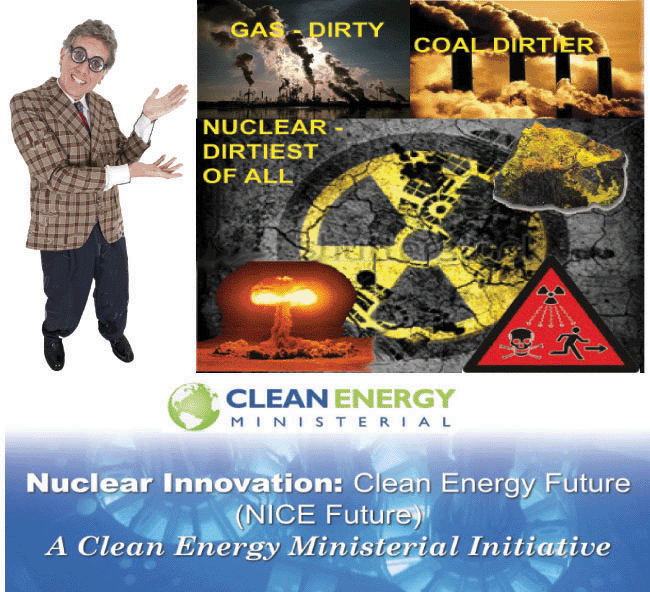
Prepare to be dangerously greenwashed.”
The billionaires and other manipulators have been planning this for years
Their goal is to direct United Nations policy, and the finances for climate action, towards the nuclear industry . Their motives are mixed, but MONEY is the big one.
The 2024 United Nations Climate Change Conference or Conference of the Parties of the UNFCCC, more commonly known as COP29, will be held in Baku, Azerbaijan from 11 to 22 November, 2024.
The nuclear push is led by a relatively small phalanx of wealthy, powerful individuals – not many in number, compared to the many thousands of people who have qualms about the nuclear lobby running the show at Azerbaijan . But of course, the nuke lobby will be helped along by the fossil fuel giants. If nuclear is accepted as the cure for climate change, there will be a delay of decades for nuclear power to get going again – which means that oil, gas, coal will have full sway.
Nuclear and fossil fuel energies are partners in this crime against our planet.

Even at the 2015 COP Paris Climate Agreement, nuclear ‘influencers’ like Ernest Moniz and Bill Gates were touting the plan – nuclear as the cheap way to fund climate action. A plan quickly taken up by Jeff Bezos (Amazon), Marc Benioff (Salesforce), Michael Bloomberg, Richard Branson, Jack Ma (Alibaba), David Rubenstein (Carlyle Group), Tom Steyer, George Soros, and Mark Zuckerberg – forming the Breakthrough Institute
Now it was time to really go for the tax-payers’ money, as Bill Gates launched Mission Innovation – to “increase government support” for new generation nuclear technologies. Mission Innovation involves 24 national governments, including the USA, Canada, China and India, the World Economic Forum, the International Energy Agency, and the World Bank.
Joyce Nelson has outlined the development of this “nuclear for climate” push, kicking off the new enthusiasm for small nuclear reactors, especially in Canada, around 2018. No surprise that the scandal-ridden company SNC-Lavalin jumped onto this bandwagon, forming a consortium the Canadian National Energy Alliance (CNEA)
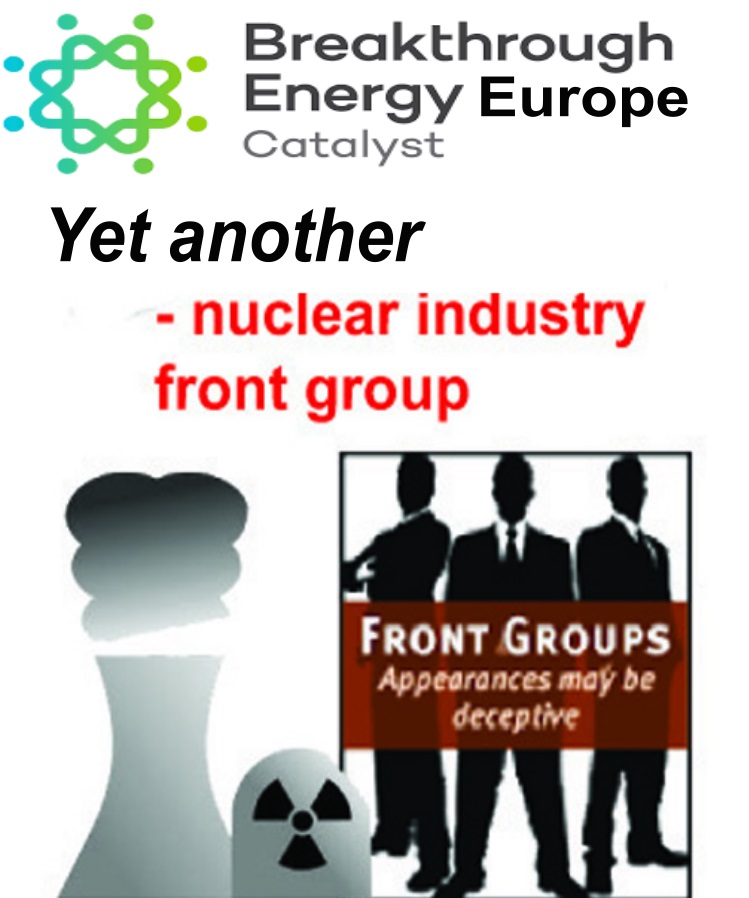
By 2018, Gates was launching Breakthrough Energy Europe, a collaboration with the European Commission. In 1919 Canada hosted the Clean Energy Ministerial/Mission Innovation summit launching NICE -the “Nuclear Innovation Clean Energy Future”
M.V. Ramana warned in advance of the summit, “Note to Ministers from 25 countries: Prepare to be dangerously greenwashed.”
I doubt that the COP 29 summit has any credibility with intelligent people. Held in Azerbaijan, one of the world’s worst petrochemical autocracies, this supposed climate action meeting will be one blatant front for the fossil fuel lobby, as well as the nuclear one.
Sad to have the United Nations sponsoring this pack of liars.
Cop29 host Azerbaijan set for major fossil gas expansion, report says
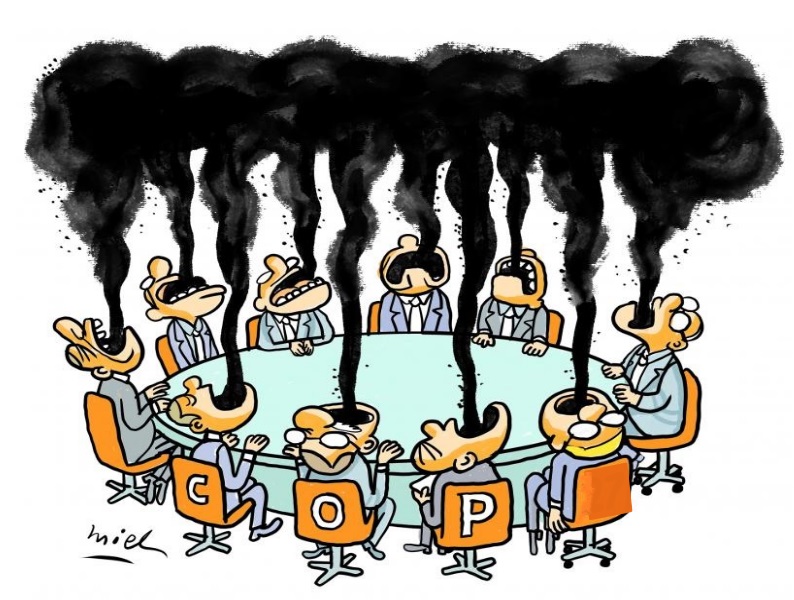
Exclusive: Those with ‘interest in keeping world hooked on fossil fuels’ should not oversee climate talks, say report authors
Guardian, Damian Carrington Environment editor, 23 Oct 24
Azerbaijan, the host of the Cop29 global climate summit, will see a large expansion of fossil gas production in the next decade, a new report has revealed. The authors said that the crucial negotiations should not be overseen by “those with a vested interest in keeping the world hooked on fossil fuels”.
Azerbaijan’s state-owned oil and gas company, Socar, and its partners are set to raise the country’s annual gas production from 37bn cubic metres (bcm) today to 49bcm by 2033. Socar also recently agreed to increase gas exports to the European Union by 17% by 2026.
The Cop29 summit, starting on 11 November, comes as scientists say that continued record carbon dioxide emissions means “the future of humanity hangs in the balance”. The International Energy Agency said in 2021 that no new fossil fuel exploitation should take place if CO2 emissions were to fall to zero by 2050.
But in 2023 Socar pushed 97% of its capital expenditure into oil and gas projects, the report found. The company launched a “green energy division” a few weeks after Azerbaijan was appointed as Cop29 host, promising investments in wind, solar and carbon capture technologies. But according to the report, Socar’s renewable operations remain insignificant.
Azerbaijan’s climate action plan was rated “critically insufficient” by Climate Action Tracker (CAT) in September. “Azerbaijan is among a tiny group of countries that has weakened its climate target [and] the country is doubling down on fossil fuel extraction,” said the CAT analysts.
Azerbaijan and Socar had also been accused of human rights violations, the report said. The authors said defeating the climate crisis required civil society to have freedom of speech and protected human rights.
“Given Socar’s pivotal role in Azerbaijan’s economy and its close ties to the country’s political elite, its influence will surely be felt throughout the climate negotiations in Baku,” said Regine Richter at the German NGO Urgewald, lead author of the report. “As we prepare for Cop29, we cannot but ask ourselves: did we put the fox in charge of the henhouse?”
Azerbaijan’s president, Ilham Aliyev, told a climate conference in April: “Having oil and gas deposits is not our fault. It’s a gift from God.” Aliyez appoints Socar’s management board and was vice-president of Socar until he succeeded his father as the country’s president in 2003. Azerbaijan’s ecology and natural resources minister, Mukhtar Babayev, will run Cop29. He previously worked for Socar for 26 years until 2018. Rovshan Najaf, the president of Socar, is part of the Cop29 organising committee.
………………………………………………………………………….. Socar works with some of the world’s biggest fossil fuel companies, including BP, TotalEnergies, the Russian oil giant Tatneft and the United Arab Emirates’ state oil company Adnoc. The CEO of Adnoc, Sultan Al Jaber, was president of Cop28 in Dubai, where nations failed to agree to “phase out” fossil fuels, as many wanted, instead choosing the weaker ambition of “transitioning away from fossil fuels”.
Socar also receives substantial financial backing from major international institutions, totalling $6.8bn in loans and underwriting between 2021 and 2023, according to research by the Banking on Climate Chaos coalition. https://www.theguardian.com/environment/2024/oct/23/cop29-host-azerbaijan-set-for-major-fossil-gas-expansion-report-says
The world’s top lying nuclear salesman is after your climate action money.
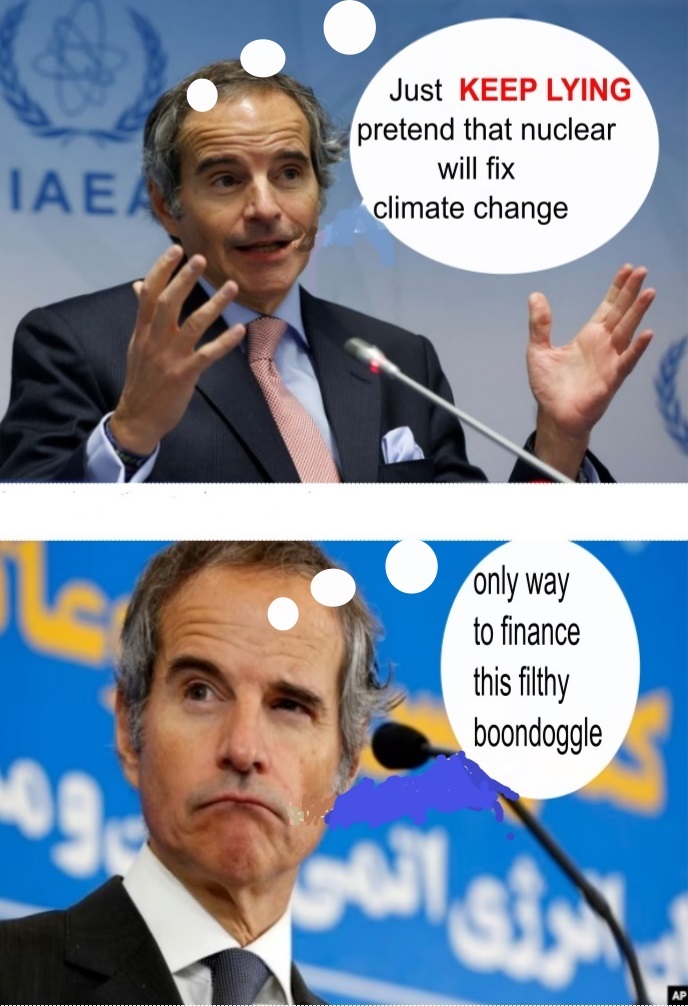
Do these highly paid leaders really believe what they’re saying? I guess their number 1 motive is to hang on to their lucrative jobs. And number 2 motive – to not look silly by telling the truth.
They all know damn well that the nuclear fuel chain increases greenhouse emissions, along with its radioactive emissions.
They all know that covering the planet with 1000s of small nuclear reactors could never be done in time, even if nuclear did work against climate change.
They all know that the real rationale for nuclear is not climate action – it’s nuclear weapons.
New IAEA Report on Climate Change and Nuclear Power Focuses on Financing.
International Atomic Energy Agency, Matt Fisher, IAEA Department of Nuclear Energy, 18 Oct 24
The 2024 edition of the IAEA’s Climate Change and Nuclear Power report has been released, highlighting the need for a significant increase in investment to achieve goals for expanding nuclear power. The new report was launched last week on the margins of the Clean Energy Ministerial (CEM) in Brazil.
……….global investment in nuclear energy must increase to 125 billion USD annually, up from the around 50 billion USD invested each year from 2017-2023………
“Across its near century-long lifetime, a nuclear power plant is [?] affordable and [?]cost competitive. Financing the upfront costs can be a challenge however, especially in market driven economies and developing countries,” said IAEA Director General Rafael Mariano Grossi “The private sector will increasingly need to contribute to financing, but so too will other institutions. The IAEA is engaging multilateral development banks to highlight their potential role in making sure that developing countries have more and better financing options when it comes to investing in nuclear energy.”
The new report also examines ways to unlock private sector finance, a topic that is gaining increasing attention worldwide. Last month, 14 major financial institutions including some of the world’s largest banks came together during a New York Climate Week event to signal a willingness to help finance nuclear newbuild projects.

The report was presented at a side event jointly organized by the Agency and the CEM’s Nuclear Innovation: Clean Energy Future (NICE) initiative on the margins of the 15th CEM in Brazil.
……………………………………………………………………………………………………. Nuclear power’s [!!!] inclusion in sustainable financing frameworks, including the European Union (EU) taxonomy for sustainable activities, is having a tangible impact. In the EU, the first green bonds have been issued for nuclear power in Finland and France in 2023. Electricité de France (EDF) was one of the first recipients, with the award of €4 billion in green bonds and around €7 billion in green loans between 2022 and 2024. …………………………………………….. https://www.iaea.org/newscenter/news/new-iaea-report-on-climate-change-and-nuclear-power-focuses-on-financing
Is it worse to have no climate solutions – or to have them but refuse to use them?

Rebecca Solnit, 16 Oct 2024 ,
https://www.theguardian.com/commentisfree/2024/oct/16/climate-crisis-technology-ai
Tech barons are forever predicting some amazing new technology to fix the climate crisis. Yet fixes already exist.
When it comes to some of the tech oligarchs, I suspect the sheer modesty of the solutions is not the kind of gee-whiz rocket science they love.’

There are so many ways to fiddle while Rome burns, or as this season’s weather would have it, gets torn apart by hurricanes and tornadoes and also goes underwater – and, in other places, burns. One particularly pernicious way comes from the men in love with big tech, who are forever insisting that we need some amazing new technology to solve our problems, be it geoengineering, carbon sequestration or fusion – but wait, it gets worse.
At an artificial intelligence conference in Washington DC, the former Google CEO Eric Schmidt recently claimed that “[w]e’re not going to hit the climate goals anyway because we’re not organized to do it” and that we should just plunge ahead with AI, which is so huge an energy hog it’s prompted a number of tech companies to abandon their climate goals. Schmidt then threw out the farfetched notion that we should go all in on AI because maybe AI will somehow, maybe, eventually know how to “solve” climate, saying: “I’d rather bet on AI solving the problem than constraining it.”
Eventually is not good enough. A distinguished group of scientists said in a paper published on 8 October: “We are on the brink of an irreversible climate disaster. This is a global emergency beyond any doubt. Much of the very fabric of life on Earth is imperiled. We are stepping into a critical and unpredictable new phase of the climate crisis.”
We need to pull back from that brink, but Schmidt is arguing for plunging over it, because guys like him are excited about AI. This is like arguing we should jettison the lifeboats and hang out on the sinking ship because what if there was eventually a totally awesome, new kind of lifeboat we can’t even imagine right now?
We have the lifeboats now – we have the solutions, and we have had them for a while, and they keep getting better, as in better-designed, more efficient, more affordable and adaptable. We just need to implement them, but they’re just not the solutions a lot of the rich and powerful like. Proposing we go for some false or nonexistent solution has become an excuse constantly deployed as an excuse for not supporting the solutions we have.
Delay is the new denial” became a slogan in the climate movement a few years ago, and maybe “decoy is the new denial” should be added to it, by which I mean proposing we ignore workable present-day solutions in favor of unworkable and nonexistent ones while continuing to burn fossil fuel.
One might think that Schmidt, whose net worth is estimated at around $23bn, would devote some time and resources to organizing us to reach our climate goals rather than excuse himself from acting with his dismissive defeatism. But overall billionaires and the very rich are part of the problem, with their outsized power and the dismal ways most of them use it. And their climate impact is obscene – the richest 1% of humanity is responsible for more carbon emissions than the poorest 66%.
Scientists and engineers have been telling us for a very long time what we need to do and how to do it, and most of us already know that what we need to do is make a swift transition away from burning fossil fuels. Protecting forests and other natural systems and redesigning how we live, travel and produce and consume also matter, but phasing out the extraction and burning of fossil fuels is the big one. Schmidt lives in California, where we’ve been getting more than 100% of our electricity needs met many days this year by sun, wind and water, and storing the surplus in immense battery systems. Obviously not everything in California runs on electricity, but this is a nice demonstration model of how rapidly a renewable system can scale up.
When it comes to some of the tech oligarchs, I suspect the sheer modesty of the solutions – that we should consume less, which means we can produce less, and make this energy transition to a renewable-powered world – is not the kind of gee-whiz rocket science they love. (Though solar and wind technologies are pretty amazing, particularly if you know how rapidly their design has improved, their cost has plummeted and their implementation has spread.) It is in many ways a social solution in which lots of us adjust how we live and how we power our devices, not a grand centralized invention that is super profitable for a few.
I do not know if it would be worse to live in a world in which we genuinely did not have the solutions, or to live in one where we have them but are not implementing them on the speed and scale we know we need to. But I know we have the solutions.
- Rebecca Solnit is a Guardian US columnist. She is the author of Orwell’s Roses and co-editor with Thelma Young Lutunatabua of the climate anthology Not Too Late: Changing the Climate Story from Despair to Possibility
The Atlantic Ocean’s currents are on the verge of collapse. This is what it means for the planet

The Atlantic Ocean’s currents are on the verge of collapse. This is what
it means for the planet. Scientists are concerned that the Atlantic
Ocean’s system of currents may be about to reach a tipping point. If it
does, it’ll have severe consequences for all of us.
BBC Science Focus 13th Oct 2024
https://www.sciencefocus.com/comment/atlantic-current-collapse
How carbon capture and storage and nuclear are adding little to decarbonisation compared to solar and wind
CCS, like nuclear is going not very far in terms of future increases in decarbonisation capacity, but it will be at very great cost to taxpayers.
David Toke, Oct 16, 2024
We’ve heard a lot in the news recently about how carbon capture and storage of carbon dioxide (CO2) is a major solution to decarbonisation. But the global figures suggest otherwise. The results so far are that this is having an almost insignificant effect on global decarbonisation. Rather it is looking like CCS funding from Governments is a good way of funneling money into the fossil fuel and chemicals industry with very little to show for combatting climate change. Indeed this CCS sector is eerily technologically redundant in many of the same ways as nuclear power.
You can see this in the chart below [on original]. This shows the respective global contributions to carbon dioxide abatement from three sources a) solar plus wind power, b) nuclear power and c) carbon capture and storage (CCS).
I have taken global capacity figures for CCS from the Global CCS Institute (HERE). They have data available for the period since 2010 showing how the global capacity for CO2 removal has changed. I have used data on carbon intensity of global electricity production drawn from Ember (See HERE) to determine how much CO2 is saved by each unit of nuclear, solar and wind generation. Then I combine this with data on nuclear, solar and wind electricity generation from the Energy Institute (See HERE).
The result is a calculation of the annual carbon dioxide saved by global solar plus wind generation, nuclear generation and CCS (since 2010). There is a notable caveat with regard to the CCS figures. Whilst I have confidence in the reported production figures from solar, wind and nuclear power, I have no information that the ‘capacity’ of CCS reported is actually being completely filled each year. Therefore the CCS annual capacity figures must each be regarded as a ‘maximum’.
It is apparent that whilst solar and wind are increasing rapidly, and nuclear production has stagnated, CCS contributes a very small amount to world carbon removal capacity by comparison. …………………………………………………………………………………………………………………..
Meanwhile, technologies, which do stand a chance of being optimised and do not involve fossil fuels or nuclear power are ignored. Recent UK Government announcements talk of around £20 billion being made available for CCS activities over the coming years. Yet there is no direct budget to develop deep underground or closed loop geothermal energy, new technologies, which have seen considerable technical interest in recent years (see HERE and HERE)………………………………………………This trend of low output compared to public money spent seems likely to continue for many years to come!
CCS – eerily like nuclear?
What is striking about CCS processes is that they are seriously dogged by environmental problems…………………………………….The technology starts off as an inferior commercial proposition to conventional fossil fuel commercial activities, and the pressures for improvements are going to increase costs, not reduce them. Have we heard this before? Well, yes.
This is actually much the same general problem that nuclear power has faced. Nuclear power is a mature technology relying on a low-productivity construction industry. On top of this its costs have increased since its inception because of the need to build-in safety requirements. New designs have tended to be made with safety in mind (eg ‘passive’ safety designs) rather than improvements in economic productivity. This, in general, is the same sort of problem that fossil fuel CCS faces. See my earlier blog post on nuclear’s productivity problems HERE. Like nuclear CCS is forced to pursue non-market objectives rather than improve productivity to reduce costs of production.
The contrast with solar and wind is staggering. These technologies can devote their efforts into reducing costs and improving productivity. Solar panels today are made with a small fraction of the polysilicon used in the past. The production lines are much longer and efficiently organised and the machines to make the panels are much better and cheaper etc etc. In the case of wind power the wind capture rates have been improved through computer-aided design of the turbine blades, making the machines of lighter material and also making them a great deal bigger etc etc.
CCS, like nuclear is going not very far in terms of future increases in decarbonisation capacity, but it will be at very great cost to taxpayers. No commercial operation is going to contract for the CCS ‘product’. There is a very limited market for CO2 itself and no commercial market for storing carbon dioxide outside of direct Government support. For how long can this drain on our public spending resources carry on?
https://davidtoke.substack.com/p/how-carbon-capture-and-storage-and
The climate crisis threatens societal collapse—how many more hurricanes will it take for us to wake up?
As a new scientific report warns that the world is on the ‘brink of an irreversible climate disaster’, why do politicians and the media seem so uninterested?

By Alan Rusbridger, October 11, 2024, https://www.prospectmagazine.co.uk/world/environment-news/climate-change/68197/how-many-more-hurricanes-before-we-wake-up-to-the-climate-crisis
It took a dangerous category 3 hurricane in Florida to force climate change onto some, but not all, newspaper front pages. Normally this is a subject for gentle condescension.
You’ll have read a dozen such pieces. Climate change is genuine—there’s no denying that—but let’s be real about so-called “net zero”. We need to be “financially prudent as well as environmentally responsible”, as the Times intoned this week in endorsing BP’s retreat from agreed targets. We must stand against the politicisation of the weather, as Florida governor Ron De Santis is fond of speechifying. Blah, blah, blah, as Greta Thunberg would say.
A mega storm lashing into Florida is difficult to ignore: well-off Americans as victims, lots of vivid film footage etc. And so Hurricane Milton will receive many more eyeballs and clicks than, say, the 1,700 people killed in 2022 when torrential flooding hit Pakistan, submerging a third of the country and affecting 33m people. For some reason this was considered not so newsworthy.
News judgements over such things can be fickle. The day before Milton made landfall a group of respected scientists issued a report which warned that “the future of humanity hangs in the balance” and that we could be facing “partial societal collapse”.
Now, it’s been some time since I worked in daily news, but this feels like what we call “a story”. Not just a story, but what is known in the trade as a “marmalade-dropper”—a story so gripping that it could lead to a distracted breakfast accident. The internal machinations of the Conservative party are important, sure, but how do they compare with the future of humanity?
The report was barely covered. Did any news editor deign to glance at this academic paper, in the journal Bioscience? If they had, they might have been struck by the very startling language of the scientists who wrote it.
“We are on the brink of an irreversible climate disaster,” it began. “This is a global emergency beyond any doubt. Much of the very fabric of life on Earth is imperilled. We are stepping into a critical and unpredictable new phase of the climate crisis.”
Let’s imagine a range of news desk reactions to this alarming news. The first might be a stifled yawn—as in “we’ve heard all this before, tell us something new.” The second might be to question: “Who are these so-called experts?”
There’s something in the first reaction: we have, indeed, heard dire warnings before—albeit not always in such stark terms. As to the second, the 14 authors are easily Googled: they come from top-notch universities around the world. The journal, published by Oxford University Press, comes from the American Institute of Biological Sciences. I think we can call this kosher.
But there are two deeper problems with the way the media thinks about climate change. The first is that it has become the subject of ideology more than science. Our imaginary news editor will have to factor in any prejudices his/her editor, or proprietor, may have in regard to the climate crisis. If the general newsroom feeling—arrived at by a process of mysterious osmosis—is that it’s all a load of overblown woke nonsense, then our news editor will ignore the story. The science doesn’t stand a chance.
The second problem is that journalism is most comfortable when looking in the rearview mirror. Something that happened yesterday is news: something that might, or might not, happen in 30 years’ time is prediction.
How can journalism adapt so that it can—with the assistance of experts—look forward as well as back? “I think journalism has to help us imagine and comprehend the true scale of what will happen if we don’t change course,” is how Wolfgang Blau, who created an Oxford University programme in climate journalism, puts it. It is sometimes referred to as “anticipatory journalism”.
But there are plenty of things in the here and now to be covered. One question might be, “Who is funding Kemi Badenoch?” The information is hiding in plain sight. Her register of interests shows that she’s accepted £10,000 for her leadership campaign from the chair of a climate science denial group.
Let’s make this really easy. Google the excellent research outfit desmog.com and you’ll find that climate campaigners have done the heavy lifting already, investigating the donation from Neil Record, a millionaire Tory donor and founder of the investment firm Record Financial Group. He is chair of Net Zero Watch (NZW), the campaign arm of the Global Warming Policy Foundation (GWPF).
“Based in 55 Tufton Street, Westminster, the GWPF is the UK’s leading climate science denial group,” reports desmog. The GWPF’s director Benny Peiser has suggested it would be “extraordinary anyone should think there is a climate crisis”, while the group has also expressed the view that carbon dioxide has been mischaracterised as pollution, when in fact it is a “benefit to the planet”.
What’s more, it turns out—and thanks to Bloomberg for this nugget of information—that Badenoch has been running her leadership campaign from Mr Record’s home. While she has declared the £10,000 donation from Mr Record, the use of the house has not been declared. A spokesman for the candidate suggested she had done nothing wrong.
Badenoch has previously criticised the UK’s climate targets, calling them “arbitrary” in a 2022 interview. Badenoch has previously suggested that she would be in favour of delaying the UK’s commitment to reach net zero by 2050. She argued that new fossil fuel licences were compatible with the UK’s climate targets.
Badenoch’s rival for the Tory leadership, Robert Jenrick, has also been examined by desmog, which found a growing record of attacks on climate action. He denounces “net zero zealotry” and has labelled the UK’s net zero target as “dangerous fantasy green politics unmoored from reality.” He has supported the opening of new coal mines.s previously critic.
Worth covering? Perhaps by the same newshounds who have so enthusiastically gone in search of the generous donors who have kept Labour’s top team in smart suits, Taylor Swift tickets and football freebies?
Hurricane Milton will soon be off the front pages. Normal service will resume. But it’s hard, once you’ve read it, to dislodge the spectre of “partial societal collapse” if we continue to pretend climate change isn’t an urgent threat to our way of life. We will all have to adapt—including politicians and journalists.
Alan Rusbridger is the editor of Prospect and the former head of Lady Margaret Hall, Oxford. He was editor of the Guardian from 1995 to 2015.
Revealed: EDF’s hidden plans for two huge 30 feet high flood barriers in the heart of East Suffolk’s Heritage Coast 04.10.24
As part of the much-criticised justification for issuing a nuclear site
licence for the controversial Sizewell C nuclear development, the UK’s
chief nuclear regulator, the Office for Nuclear Regulation (ONR), has
divulged hitherto hidden plans for two sea walls to be constructed in the
heart of East Suffolk’s Heritage Coast and the Suffolk & Essex Coast &
Heaths National Landscape, designed to provide additional flood protection.
Both walls are proposed to be up to 30 feet high. To the south of the
Sizewell C site, the wall will span the ‘Sizewell Gap’ joining Sizewell
A’s Sea defences to the cliffs south of Sizewell village. The northern
one will span the river in the Sizewell Marshes SSSI, joining Sizewell
C’s northern sea defences with higher ground inland at Goose Hill and
will be at least 100 metres in length but potentially much longer.
The ONR claims that Sizewell C Ltd, the site’s developer, is ‘committed’ to
installing these structures ‘should climate change be worse than is
reasonably foreseeable’, despite there being no mention of them in
EDF’s application for the Development Consent Order (DCO) for Sizewell C.
Therefore, they were absent from the plans approved by the Secretary of
State in July 2022 after he had overturned the Planning Inspectors’
recommendation for refusal.
TASC 4th Oct 2024
Greenpeace warns of flooding risks at France’s biggest nuclear plant
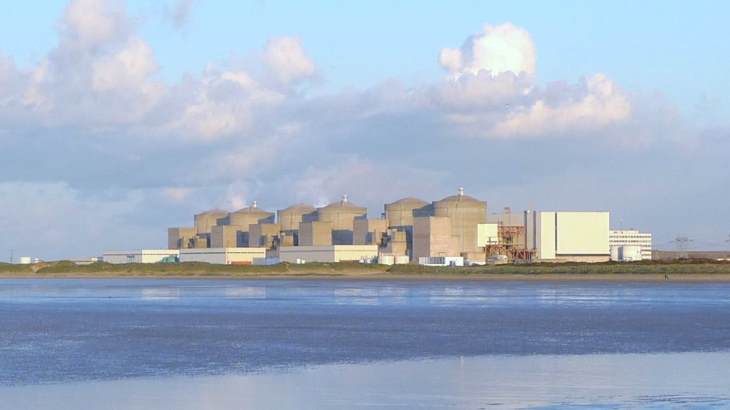
Greenpeace is urging French energy giant EDF to abandon its plans to build two new reactors at its Gravelines nuclear plant, citing the risk of flooding due to rising sea levels. The environmental group accuses the French nuclear industry of underestimating the threat to the coastal site.
04/10/2024 By:RFI
With six 900MW reactors, the Gravelines nuclear power plant on the Channel coast is already the most powerful in Western Europe.
EDF’s proposal to build two additional new generation pressurised water reactors (EPR2) of 1600 MW each is part of President Emmanuel Macron’s nuclear revival programme.
The new reactors are currently the subject of public debate. If they pass safety criteria laid down by France’s nuclear safety authority (ASN), construction would begin in 2031 and they could be on stream by 2040.
While they would be built on a 11-metre-high platform, Greenpeace claims there is a significant safety risk.
“The entire power plant site could find itself – during high tides and when there is a 100-year surge – below sea level” by 2100, it warned in a report published Thursday.
EDF refutes their calculations.
“The height of the platform chosen for the EPR2 reactors at Gravelines provides protection against “extreme” flooding, taking into account the effects of IPCC [Intergovernmental Panel on Climate Change] scenarios, which are among the most penalising with regard to sea-level rise”, EDF said in a statement to RFI.
Protective measures
Greenpeace argues that EDF’s calculations are outdated and do not fully account for the realities of global warming.
“We can’t think as if the current situation were going to remain stable and that sea levels were just going to rise a little”, says Pauline Boyer, Greenpeace’s energy transition campaigner.
The NGO has therefore based its projection on the IPCC’s most pessimistic scenario, which assumes that no action will be taken to reduce greenhouse gas emissions by 2100……………………….
Boyer believes a comprehensive risk study, factoring in climate change, “should govern the choice of site”, and be carried out before the public debate ends on 17 January.
While Greenpeace’s report centres on Gravelines, Boyer warned that climate change threatens other nuclear plants, with risks tied to rising temperatures and extreme weather events like storms.
She also pointed to potential conflicts over access to river water needed to cool reactors. https://www.rfi.fr/en/france/20241004-greenpeace-warns-of-flooding-risks-at-france-s-biggest-nuclear-plant
Jane Fonda: Nuclear power at Three Mile Island is no climate solution
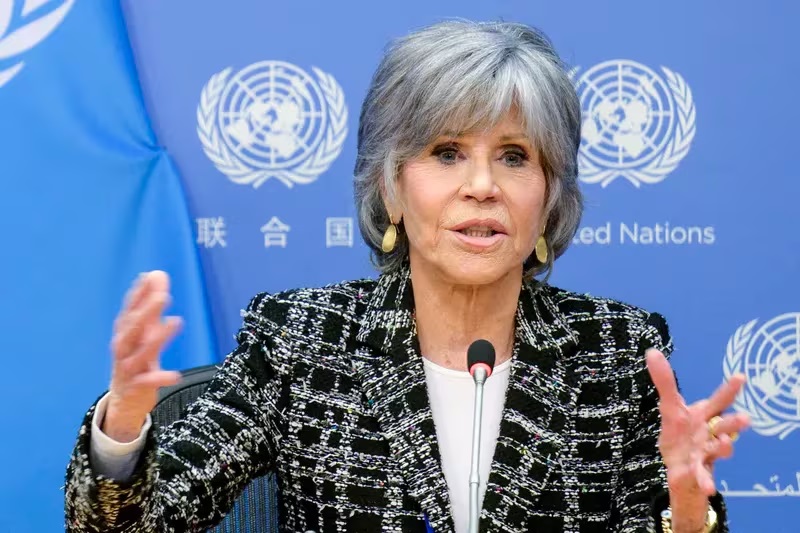
Nuclear power is slow, expensive — and wildly dangerous, the actor and activist writes. Why would anyone tempt fate by reactivating a facility that suffered the worst nuclear accident in U.S. history?
by Jane Fonda, For The Inquirer, Oct. 2, 2024,
The recent news about restarting the Three Mile Island nuclear power plant 75 miles west of Philadelphia hit me hard.
My heart sank as I thought back to The China Syndrome, a nuclear disaster movie I starred in with Jack Lemmon and Michael Douglas in 1979. Why, I wondered, would anyone tempt fate by reactivating a facility that suffered the worst nuclear accident in U.S. history?
The China Syndrome was about a nuclear power reactor potentially melting down and unleashing a cloud of deadly radioactivity across the surrounding region. Two weeks after the movie hit theaters, real life imitated art with a vengeance.
One of the two reactors at Three Mile Island suffered what investigators termed “a partial meltdown.” As industry officials and federal regulators tried to determine the extent of the damage and whether to evacuate people, a terrifying drama played out on TV screens across Pennsylvania and around the world.
I realize that today, some people regard nuclear power as a necessary tool in the fight against climate change. As someone who is devoting my life to that fight, I understand the temptation to embrace nuclear power. We absolutely need to phase out oil, gas, and coal — the fossil fuels overheating our planet — and fast. Any means of achieving that goal deserves consideration.
The latest sign of our climate peril came last week as Hurricane Helene, amped by super-hot sea water, battered Florida, Georgia, and the Carolinas. Helene’s destructiveness, however, is also a reminder that climate change can endanger nuclear power facilities.
As the Perry World House at the University of Pennsylvania has noted, “As temperatures rise and climate hazards, such as drought, sea level rise, and extreme precipitation intensify, nuclear infrastructure is put at risk.”…………………………………………………………………………………………………………….
Ironically enough, the main reason nuclear power is so expensive is also the main reason it isn’t much help against climate change. It’s simply too slow — no nuclear reactor of any kind has been built in less than 10 to 20 years. What’s more, that extra-long construction time translates into massive borrowing costs for the capital needed to finance the plants, boosting their eventual cost.
And yes, that’s true even of the new generation of smaller, modular reactors Bill Gates, Microsoft’s founder, is so fond of. Every time I speak in public about the climate crisis, someone asks if the modular reactors can’t be a solution. So I’ve spent time researching the issue because I think when celebrities presume to speak about public issues, we have an obligation to know the facts.
With climate change, we don’t have the kind of time needed to get a nuclear plant licensed, built, and supplying power to the grid. Scientists are clear: Humanity has to limit global warming to 1.5 degrees Celsius (about 2 degrees Fahrenheit) above the preindustrial level if we’re to avoid catastrophic destruction and human suffering.
That means, scientists say, emissions of heat-trapping pollution must fall by half over the next five years. So simply as a matter of timing, nuclear is not a good climate solution.
By contrast, solar plants take about four years to get up and running. Wind turbines about the same. And boosting energy efficiency — designing our buildings and vehicles so they use much less energy but deliver the same comfort and performance — is the fastest, most powerful tool of all for displacing fossil fuels.
None of these renewable energy sources risk a nuclear meltdown. None guzzle billions of gallons of fresh water like nuclear plants do — water whose supply will become ever more uncertain as climate change unleashes deeper droughts in the years ahead. None burden our descendants with vast amounts of waste that remains dangerously radioactive for hundreds of thousands of years, with a $400 million annual bill for disposal that the public must pay.
That radioactivity, by the way, is one reason why it’s simply inaccurate to call nuclear power “clean energy.” It may be non-carbon energy, but anything that stays fatally poisonous for millennia is not clean.
If people want to support genuine solutions to climate change, I invite them to help the Jane Fonda Climate PAC elect climate champions to local, state, and national offices in November.
In Philadelphia, my political action committee has endorsed Nikil Saval in Pennsylvania Senate District 1 and Andre Carroll in Pennsylvania House District 201. You’ll find a complete list of our candidates, in Pennsylvania and across the U.S., here: janepac.com/?home#endorsements.
All of our candidates shun campaign contributions from the fossil fuel industry. They work to accelerate the deployment of solar, wind, and other genuinely clean energy sources. And they oppose nuclear.
Like two people trying to get through a narrow doorway at the same time, there isn’t room for both nuclear and renewables in our energy future. It’s an obvious choice, no?
Jane Fonda is a veteran political activist, two-time Academy Award-winning actor, and the principal of the Jane Fonda Climate PAC. https://www.inquirer.com/opinion/commentary/three-mile-island-restart-nuclear-energy-microsoft-jane-fonda-20241002.html?fbclid=IwY2xjawFsioJleHRuA2FlbQIxMQABHbLqJVZNISHHrY1j7l9JH_V4zF1kKMk155YvjJxBjwMmDYUFQ7FylW0fIQ_aem_oGsEOADg7faINQnGbVTQ4w
Heatwaves caused cuts in France’s nuclear power production.
(Montel) Heatwaves in July and August provoked a 430 GWh cut in nuclear output at four EDF nuclear power plants – double last summer’s amount but slightly below the nine-year median, a French consultancy said on Tuesday.
EDF summer heat cuts double but below 9-year median
Reporting by: Sophie Tetrel, 01 Oct 2024 .
https://montelnews.com/news/70ed2eeb-e06c-4494-abca-42207139db11/edf-heat-cuts-double-from-summer-2023-but-stay-below-9-yr-median
This summer’s cut represented less than 1% of the country’s total atomic generation and was below the 600 GWh median recorded over the 2015-2023 period, said Thibault Laconde, head of analysis consultancy Callendar.
Last year’s climate-related cuts amounted to only 217 GWh due to several reactors being offline for maintenance, he added.
He said the noteworthy aspect of this year was that high temperature levels caused the outages, rather than a lack of water supply due to drought.
Production cuts or stoppages were concentrated between 29 July-3 August and 11-15 August, corresponding with the summer heatwaves, he said.
The cuts amounted to 279 GWh at Golfech, 93 GWh at Bugey, 55 GWh at St Alban and 7 GWh at Tricastin.
However, they were well below the 3 TWh record seen in 2020, Laconde added.
Many French nuclear plants use river water to cool reactors and EDF is required to reduce their output if river temperatures or low flows break legal limits.
1 This Month

26 September – International Day for the Total Elimination of Nuclear Weapons


PLEASE OPPOSE HR 8255 AND S.3639 – bills would accelerate satellite deployment, with no environmental review or safeguards – https://ncstd5li.quorum.us/campaign/169331/
To see nuclear-related stories in greater depth and intensity – go to https://nuclearinformation.wordpress.com
-
Archives
- September 2026 (206)
- August 2026 (330)
- July 2026 (355)
- June 2026 (287)
- May 2026 (306)
- April 2026 (356)
- March 2026 (251)
- February 2026 (267)
- January 2026 (308)
- December 2025 (358)
- November 2025 (359)
- October 2025 (375)
-
Categories
- 1
- 1 NUCLEAR ISSUES
- business and costs
- climate change
- culture and arts
- ENERGY
- environment
- health
- history
- indigenous issues
- Legal
- marketing of nuclear
- media
- opposition to nuclear
- PERSONAL STORIES
- politics
- politics international
- Religion and ethics
- safety
- secrets,lies and civil liberties
- spinbuster
- technology
- Uranium
- wastes
- weapons and war
- Women
- 2 WORLD
- ACTION
- AFRICA
- Atrocities
- AUSTRALIA
- Christina's notes
- Christina's themes
- culture and arts
- Events
- Fuk 2022
- Fuk 2023
- Fukushima 2017
- Fukushima 2018
- fukushima 2019
- Fukushima 2020
- Fukushima 2021
- general
- global warming
- Humour (God we need it)
- Nuclear
- RARE EARTHS
- Reference
- resources – print
- Resources -audiovicual
- Weekly Newsletter
- World
- World Nuclear
- YouTube
-
RSS
Entries RSS
Comments RSS
 nuclear-news