Economic dangers of climate change – The World Economic Forum (WEF) Global Risks Report 2013
Reports Reiterate Link Between Environment and Economy http://www.enn.com/ecosystems/article/45486 18 Jan 13, Two new reports reiterate the scientific veracity of anthropogenic climate change while reinforcing the interconnectedness of the economy and the environment. The World Economic Forum (WEF) Global Risks Report 2013 clearly points to the interrelationship between the environment and the economy. (Diagram on left illustrates the true basis of the economy – on the right, the false basis.)


A draft of the third National Climate Assessment Report indicates that climate change is both an environmental and economic issue.
The draft report was prepared by a Federal Advisory Committee known as the “National Climate Assessment and Development Advisory Committee” (NCADAC). The report was mandated by Congress in 1990 with the passage of the Global Change Research Act, which requires that a national climate assessment be conducted every four years and the results be issued to the President and Congress. As a consequence of the 1990 legislation, the US Global Change Research Program was formed, which is an inter-governmental body involving 13 federal agencies and departments.A draft of the third National Climate Assessment Report indicates that climate change is both an environmental and economic issue. The draft report was prepared by a federal committee and offers a comprehensive analysis of the latest and best peer-reviewed science on the extent and impacts of global warming on the US. The report restates the fact that climate change will have a wide range of impacts ranging from agriculture to water.
The 2013 NCADAC report, which engaged more than 240 authors, indicated that one of the salient reasons given for the rapidly changing climate is the copious burning of fossil fuels. Following two consecutive years of extreme weather, the report makes the connection between the increased incidence and severity of extreme weather and anthropogenic climate change. Continue reading
National governments are legislating to fight climate change
 Nations are taking action on climate change
http://www.newscientist.com/article/dn23079-nations-are-taking-action-on-climate-change.html
15 January 2013 by Fred Pearce
It may be climate change’s best-kept secret. While global talks
founder, national governments are passing legislation to curb
greenhouse gas emissions – a Plan B for fighting climate change that
was hatched at 2010 climate talks in Cancun.
This optimistic message is at the centre of a new London School of
Economics analysis, published by GLOBE International, a group of
environment-minded parliamentarians. Of 33 major economies, 32 have
now passed legislation to either combat climate change or improve
energy efficiency, the analysis suggests, with industrialising
countries like China, Mexico and South Korea at the forefront.
These national measures are not enough, of course – the World Bank
recently concluded that the world is still heading for 4 degrees of
warming by 2100 – but national measures may help enable a global
emissions-cutting deal in time for the 2015 UN target date.
“Only if national regulatory frameworks are in place will it be
possible to reach an agreement in 2015,” says GLOBE secretary Adam
Matthews. There is no Plan C.
Limiting global warming by cutting carbon emissions
Climate change damage can be limited by carbon cuts: study, SMH,
January 14, 2013 – The world could avoid much of the damaging effects of climate change this century if greenhouse gas emissions are curbed more sharply, research shows.The study, published in the journal Nature Climate Change, is the first comprehensive assessment of the benefits of cutting emissions to keep the global temperature rise to within 2 degrees Celsius by 2100, a level which scientists say would avoid the worst effects of climate change.
It found 20 to 65 per cent of the adverse impacts by the end of this century could be avoided.
“Our research clearly identifies the benefits of reducing greenhouse gas emissions – less severe impacts on flooding and crops are two areas of particular benefit,” said Nigel Arnell, director of the University of Reading’s Walker Institute, which led the study…….
The latest research involved scientists from British institutions including the University of Reading, the Met Office Hadley Centre and the Tyndall Centre for Climate Change, as well as Germany’s Potsdam Institute for Climate Impact Research.
It examined a range of emissions-cut scenarios and their impact on factors including flooding, drought, water availability and crop productivity. The strictest scenario kept global temperature rise to 2 degrees C with emissions peaking in 2016 and declining by 5 per cent a year to 2050.
Flooding
Adverse effects such as declining crop productivity and exposure to river flooding could be reduced by 40 to 65 per cent by 2100 if warming is limited to 2 degrees, the study said.
Global average sea level rise could be reduced to 30cm (12 inches) by 2100, compared to 47-55cm (18-22 inches) if no action to cut emissions is taken, it said.
Some adverse climate impacts could also be delayed by many decades. The global productivity of spring wheat could drop by 20 per cent by the 2050s, but the fall in yield could be delayed until 2100 if strict emissions curbs were enforced.
“Reducing greenhouse gas emissions won’t avoid the impacts of climate change altogether of course, but our research shows it will buy time to make things like buildings, transport systems and agriculture more resilient to climate change,” Arnell said.
About 190 nations are aiming to sign a deal by 2015 which will legally bind countries to make ambitious emissions cuts but it will not come into force until 2020.

Paladin, Malawi given 14 days to renegotiate uranium deal, by Charles Kufa, Nyasa Times, 14 Jan 13, Malawi’s opposition Peoples Transformation Party (Petra) has added its voice to the concerns raised by African Forum and Network on Debt and Development (AFRODAD) that the government of Malawi had made a bad choice of project given the absence of transparency and accountability in the deal.
PETRA president Kamuzo Chibambo tol d reporters in Blantyre on Monday that his party has given Paladin and President Joyce Banda’s administration 14 days to explain why the uranium mining deal can’t be renegotiated for the benefit of Malawians……
He demanded that the government should renegotiate for at least a 40% stake and selling rights in the next 14 days…..
He also asked the government to tell measures it has put in place to avoid pollution seeping into Lake Malawi…..
A representative of the CSOs Moses…
View original post 68 more words
NASA’s drones will explore climate change effects below the tropsphere
NASA To Use Drone For Climate Research, Information Week Government, Patience Wait, 11 Jan 13, NASA this month will begin using a drone capable of flying 12 miles above the Earth’s surface in an effort to understand how atmospheric changes affect climate…… NASA’s new project is called the Airborne Tropical Tropopause Experiment, or ATTREX. The tropopause is the atmospheric layer between the troposphere, which is the lowest portion of the atmosphere, and the stratosphere. “There are vortices in the atmosphere that spin off the North Pole over the Pacific,” said Don Sullivan, a NASA employee working on the IT portion of ATTREX. “A lot of stuff that originates in Asia winds up in North America. We don’t know if it’s original material” or chemically compounded in the atmosphere.
The Global Hawk is capable of flying at 65,000 feet and staying aloft for 30 hours, allowing for air sampling over an extended period. It has been outfitted with about a dozen scientific instruments and sensors to measure trace gases, temperature, water vapor, radiation and other cloud properties…..
Six ATTREX flights are scheduled to take place between mid-January and mid-March. Those will be followed by flights over Guam and Australia next year.
Drones are a cheaper way for NASA to pursue some aspects of its mission, compared to rocket launches. ATTREX is an example of the agency’s Venture-class projects, which are designed to be implemented rapidly and at lower costs…. http://www.informationweek.com/government/information-management/nasa-to-use-drone-for-climate-research/240146117
NASA explores stratosphere to learn effects of the warming planet Earth
NASA Chases Climate Change Clues Into The Stratosphere NASA, 9 Jan
13, WASHINGTON — Starting this month, NASA will send a remotely
piloted research aircraft as high as 65,000 feet over the tropical
Pacific Ocean to probe unexplored regions of the upper atmosphere for
answers to how a warming climate is changing Earth. Continue reading
Japan’s government gambling with climate/nuclear disaster risks
Japan’s Pro-Nuclear Cabinet Fight Future Disaster With Reformed
Policies, The International, By Abbie Saunders JANUARY 07,
2013“……..The American Nuclear Society suggests that “one of the
most effective ways to reduce global carbon-dioxide emissions in the
future is by making increasing use of nuclear energy to replace fossil
fuels”. But Kurt Kleiner for Nature Reports maintains a different
stance.
 Kleiner suggests that while the operation of a nuclear power plant
itself has “near-zero carbon emissions”, it is the initial
construction of these plants that damages their eco-friendly
reputation. He points to the sources of nuclear energy as the problem:
“uranium has to be mined, processed and transported, waste has to be
stored, and eventually the plant has to be decommissioned. All these
actions produce carbon emissions.”
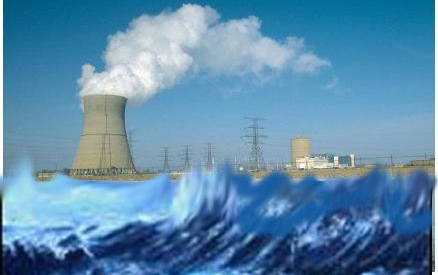 Whilst nuclear energy itself may be considered more eco-friendly than
exhaustible energy sources, renowned Japan correspondent Lucy
Birmingham points to the country’s history of natural disasters as a
potential danger. In November 2012, following the destruction of
Hurricane Sandy, she poignantly remarked that “nuclear power and
superstorms don’t mix”. She suggests that both floods and droughts can
severely damage nuclear reactors, causing them to release potentially
fatal radioactive materials.
It is this reality that prompts the Japanese population to protest.
Since Fukushima, the citizens of Japan have become increasingly
concerned about the dangers of nuclear energy. If the government’s
primary responsibility is the security of its citizens, is Shinzo
Abe’s attempt to bolster the economy and Japan’s carbon footprint one
risk too far for the environment and the welfare of the people
residing in potential risk areas?….”
Toshiba’s plan to put nuclear reactor under permafrost in Alaska
 Radio: New nuclear reactor to be buried 100 feet under permafrost in middle of Alaska? (AUDIO) http://enenews.com/radio-nuclear-reactor-be-buried-100-feet-permafrost-middle-alaska-audio
January 1st, 2013
Title: The New Normal Is No Normal
Source: Radio Ecoshock Show
Date: Jan 2, 2013
Toshiba is very interested in, it has been in talks with the mayor of Galena [Alaska] to build a, what they call a 4S Toshiba, it’s a liquid sodium reactor that they propose to bury under the permafrost — 100 feet under the permafrost, on the Yukon River floodplain.
So the last of the pristine rivers in the world, there’s been negotiations and machinations to put a liquid sodium reactor under the permafrost on the floodplain there in the middle of Alaska.
Full broadcast here
The world will pay dearly for delaying action on climate change
Delay climate action – and pay: report, SMH, January 3, 2013 An
agreement by almost 200 nations to curb rising greenhouse gas
emissions from 2020 will be far more costly than taking action now to
tackle climate change, according to research published on Wednesday.
Quick measures to cut emissions would give a far better chance of
keeping global warming within an agreed U.N. limit of 2 degrees
Celsius (3.6F) above pre-industrial times to avert more floods,
heatwaves, droughts and rising sea levels.
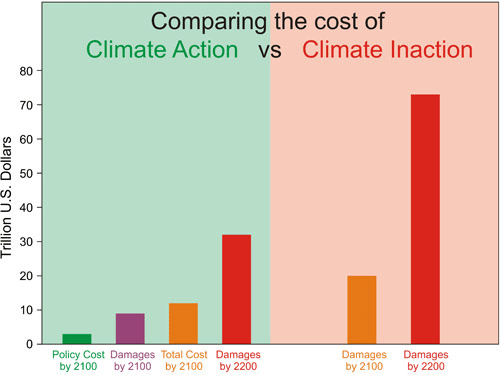
“If you delay action by 10, 20 years you significantly reduce the
chances of meeting the 2 degree target,” said Keywan Riahi, one of the
authors of the report at the International Institute for Applied
Systems Analysis in Austria. Continue reading
Human caused climate change is pretty clear – except to Americans
Only in the United States, among industrial nations, is the reality of
global warming or its causes questioned by large segments of the
population.
 2012 was a tough year for planet Columbus Dispatch 23 Dec 12This year
has brought plenty of concern to nature appreciators, those who
realize that, as nature goes, so eventually goes humankind:
Devastating storms erupted last spring in the wake of a mild winter,
drought and heat baked the land throughout the spring and summer, and
an epic November blow assaulted population centers. Weather-related
deaths reached 349 in the United States. The repair bill, the federal
government reported, will be the second-highest since 1980, behind
2005, a year that spawned four mainland hurricanes, including Katrina.
The upper Great Lakes and the Mississippi River have had news-making
low-water problems in the wake of widespread drought more intense than
anything seen since the 1930s.
The year is expected to go down as the warmest or second-warmest since
data has been recorded. The warmest occurred in 2008. Continue reading
USA’s Nuclear Regulatory Commission not keeping up with new flood dangers
 Nuclear power plant flood risk: Sandy was just a warm-up Remapping Debate, By Heather Rogers Dec. 20, 2012 “……..Are nuclear power plants becoming more exposed to flood risks?
While climate scientists, including Dr. Michael Oppenheimer, the director of the Program in Science, Technology and Environmental Policy at Princeton University, currently project that the frequency of tropical cyclones such as hurricanes will stay the same, or even decrease, the severity of these storms is expected to rise. This is the result of warming ocean surface temperature, due to increasing atmospheric temperatures. “There will be a shift from less intense, say, Category 1 and 2 hurricanes, toward more intense hurricanes,” Oppenheimer said.
Amplifying the effect of these more powerful storms will be a rise in sea level. “So there are two things expected to happen simultaneously which will increase surge levels in the future,” explained Oppenheimer. Consequently, he said, “Planning for any [nuclear] installations along the coast needs to keep that in mind.” Continue reading
Nuclear power: factor in all aspects, and it contributes to global warming
Wishful thinking on nuclear power
By Dr. Dale Dewar, The StarPhoenix December 21, 2012 Dewar is
executive director of the group Physicians for Global Survival.
” What’s to like about nuclear power?……….Is it green, as a Dec. 7 editorial suggests? Those who promote nuclear
as a rescue to global warming get mixed up about the proportion of the
world’s energy that is actually provided by nuclear power. The fact is
that nuclear power represents less than three per cent of the world’s
total energy use. Increasing its share of electricity production would
not make a dent in preventing climate warming.
Nuclear power accounts for only 11 per cent of the world’s total
electrical production, down from its peak in 1995 of 17 per cent. At
the current rate of new builds versus old power plants reaching their
end dates, the IAEA estimates a 2040 share of 6.7 per cent.
Factor in the mining, transportation, carbon costs of construction,
security, waste management and decommissioning all at the greatest
cost of any source and nuclear power is only green at best when it is
up and running at 90 per cent or better efficiency a figure rarely
reached by most reactors.

The cost to our pocketbooks and to the environment is incredibly
important. At a time when Saskatoon city council is trading off
improved bicycle paths for fixing potholes in streets, doesn’t it make
sense to invest in conservation and sustainable energy sources .
http://www.thestarphoenix.com/news/Wishful+thinking+nuclear+power/7729997/story.html#ixzz2FnvtztHi
Kyoto – a poor thing for global climate action, but it’s all we’ve got
 the Kyoto protocol covers only 15 per cent of the world’s emissions. Basically we’re back to the European Union and Australia operating with binding targets. Take in Ukraine, Switzerland and Norway and it’s a grand tally of 35 countries out of nearly 200. The
US is still not on board. And fellow non-signatories India and China, with 37 per cent of humanity, are industrialising their way back to the dominance they held in the world economy two centuries ago……
The road to a living planet still passes through Kyoto
http://www.smh.com.au/opinion/editorial/the-road-to-a-living-planet-still-passes-through-kyoto-20121216-2bhgo.html December 17, 2012 THE world won’t come to an end this Friday, despite the Mayans’ prognostications. Not only that, it will be reborn 11 days
later. Yes, on January 1, the second phase of the Kyoto protocol comes into force.
Kyoto is still the world’s only climate change treaty but, while only seven years old, it already looks a bit old hat…. Russia, Japan, Canada and New Zealand declined to agree to a second
commitment period under the protocol. Yes, even Japan doesn’t love Kyoto. Continue reading
Democratic and Republican lawmakers seek better tax code for renewable energy
US lawmakers to push tax code change for renewable energy in 2013 Climate Spectator, 13 Dec 2012 Reuters WASHINGTON, A group of U.S. lawmakers said on Wednesday that they plan to push ahead in the new year to change the tax code so renewable energy projects could qualify for beneficial tax structures commonly used by pipelines and other energy-related companies.
Democratic and Republican sponsors of proposed legislation said they think momentum is growing for their idea to allow wind, solar, biofuel and other renewable projects to structure as “master limited partnerships” (MLPs).
The structures allow companies to raise money in the stock market, while having income taxed only at the unit holder level, thus avoiding corporate income taxes.
“Small tweaks to the tax code could attract billions of dollars in private sector investment to renewable energy deployment,” the 29 lawmakers said in a letter to President Barack Obama, asking for the administration’s support…… http://www.climatespectator.com.au/news/us-lawmakers-push-tax-code-change-renewable-energy-2013
Climate Change Denialists twist and distort message of latest IPCC draft climate report
Professor Sherwood says research has effectively disproved the idea that sunspots are more responsible for global warming than human activity.
IPCC draft climate report leaked by sceptics
http://www.abc.net.au/news/2012-12-14/ipcc-draft-climate-report-leaked/4429036 A draft of the next report of the Intergovernmental Panel on Climate Change (IPCC) has been leaked on climate sceptic websites. Continue reading
Doha – a weak and ineffective agreement on Climate Change
“The solutions to climate change are becoming very good investments,” Jennifer Morgan, from the World Resources Institute, told RenewEconomy at the close of the conference. “Whether it is CSP or wind, you have incentive to invest in these technologies for a range of reasons. Then you can build the political Doha saved 250 trees, but it couldn’t save
the planet
Doha saved 250 trees, but it couldn’t save the planet http://reneweconomy.com.au/2012/doha-saved-250-trees-but-it-couldnt-save-the-planet-54848 REneweconomy, By Giles Parkinson 10 December 2012
DOHA: As the stalemate on the plenary floor in the climate change negotiations in Doha reached its tortuous 10th hour on Saturday evening, members of the French delegation gathered in a tight knot in the main aisle and expressed their alarm at the course of events. “We cannot allow this to happen in Paris in 2015,” I heard one of them say. “That would be a disaster.” Continue reading
1 This Month





PLEASE OPPOSE HR 8255 AND S.3639 – bills would accelerate satellite deployment, with no environmental review or safeguards – https://ncstd5li.quorum.us/campaign/169331/
To see nuclear-related stories in greater depth and intensity – go to https://nuclearinformation.wordpress.com
-
Archives
- October 2026 (29)
- September 2026 (339)
- August 2026 (330)
- July 2026 (355)
- June 2026 (287)
- May 2026 (306)
- April 2026 (356)
- March 2026 (251)
- February 2026 (267)
- January 2026 (308)
- December 2025 (358)
- November 2025 (359)
-
Categories
- 1
- 1 NUCLEAR ISSUES
- business and costs
- climate change
- culture and arts
- ENERGY
- environment
- health
- history
- indigenous issues
- Legal
- marketing of nuclear
- media
- opposition to nuclear
- PERSONAL STORIES
- politics
- politics international
- Religion and ethics
- safety
- secrets,lies and civil liberties
- spinbuster
- technology
- Uranium
- wastes
- weapons and war
- Women
- 2 WORLD
- ACTION
- AFRICA
- Atrocities
- AUSTRALIA
- Christina's notes
- Christina's themes
- culture and arts
- Events
- Fuk 2022
- Fuk 2023
- Fukushima 2017
- Fukushima 2018
- fukushima 2019
- Fukushima 2020
- Fukushima 2021
- general
- global warming
- Humour (God we need it)
- Nuclear
- RARE EARTHS
- Reference
- resources – print
- Resources -audiovicual
- Weekly Newsletter
- World
- World Nuclear
- YouTube
-
RSS
Entries RSS
Comments RSS

