The planet to heat faster, with record carbon in the atmosphere
 Carbon pollution hits highest point in 3 million years http://www.abc.net.au/news/2013-05-11/carbon-pollution-reaches-highest-point-in-3-million-years/4680276 By environment reporter Sarah Clarke Global greenhouse gases in the atmosphere have reached an ominous milestone that is unprecedented in human history.
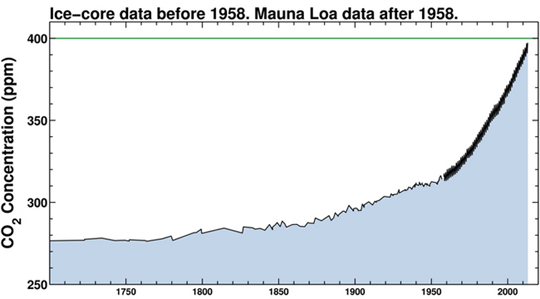
The world’s longest measure of carbon dioxide in the atmosphere has reached 400 parts per million (PPM) for the first time in three million years. The daily CO2 level is measured at the Mauna Loa Observatory in Hawaii, which tracks greenhouse gases in the Northern Hemisphere.
The level has been measured at Mauna Loa since 1958, with data before that taken from ice core samples. The last time it reached this level, temperatures rose by between three and four degrees and sea levels were between five and 40 metres higher than today.
The rise in greenhouse gases corresponds with the extra carbon dioxide known to have been emitted by humans through fossil fuels and clearing forests.
Climate Institute chief executive John Connor says greenhouse gas concentrations have increased by about 40 per cent since the industrial revolution. ”So there’s a clear trend and a dangerous trend in carbon pollution,” he said.
Mr Connor says the worrying trend puts the planet on a path towards dangerous climate change. ”This matters because the extra heat is loading the dice for even more dangerous weather extremes and climate risk,” he said. ”We’ve already seen a lot of those with a warming of around one degree warming of average levels. ”We’re heading towards two to three and four and if you think the weather extremes have been dangerous and unsafe, then you ain’t seen nothing yet.”
The leader in fighting climate change is China

 China leading in fight against climate change, argues report http://www.businessgreen.com/bg/news/2264526/china-leading-in-fight-against-climate-change-argues-report 29 Apr 2013 As United Nations leaders today gather in Bonn to again discuss global efforts to tackle climate change, a new report has revealed that while China remains the world’s largest greenhouse gas emitter it is also taking some of the most ambitious strides to curb environmental impacts.
The Australian government’s independent advisor, the Climate Commission, has today launched a report showing how global action to tackle carbon emissions progressed during the last nine months.Analysis by Australian government’s Climate Commission warns other countries from using Chinese emissions as an excuse for inaction
The report shows that in 2012 China reduced the carbon intensity of its economy more than expected and almost halved the rate of growth for electricity demand. China remains heavily dependent on coal and other fossil fuels, making it the world’s largest emitter of greenhouse gas emissions, but the report found that the rate of growth in coal use has flatlined.
Last year, China also cemented its position as a renewable energy powerhouse, expanding solar power capacity by 75 per cent, and investing more that $65bn in clean energy – 20 per cent more than in 2011 and far more than any other nation.
The report predicts China could see its emissions peak sooner than expected if investment continues to accelerate, driven by new initiatives such as the planned carbon markets that are due to launch from June in a number of cities.
The CC’s chief commissioner, Professor Tim Flannery, said the report showed other countries such as Australia could no longer use China’s vast carbon footprint as an excuse for inaction on climate change.
“China is vulnerable to a changing climate, but they are also motivated by reducing their air and water pollution and wanting to position themselves as the world’s renewable energy leader,” he said in a statement.
“Whatever the reason, the results speak for themselves. China is quickly moving to the top of the leader board on climate change.”
The report also noted that 98 countries have now committed to limit their greenhouse gas emissions, and that there are now 35 national emissions trading schemes in place around the world.
However, the report also warns that despite increased investment in clean technologies and the development of more ambitious climate policies, emissions continue to rise around the world, showing more action is needed to address the risk of rising temperatures.
USA Republicans waking up to climate change and renewable energy
 Ending the Debate: Most Republicans Actually Support Increased Renewable Energy Use http://www.triplepundit.com/2013/04/breaking-debate-republicans-actually-support-increased-renewable-energy/ By Mike Hower | April 4th, 2013 Apparently, the debate over global warming is not as big as the hard-liners at Fox News and on Capitol Hill would lead us to believe. A recent study released by Yale and George Mason University found that nearly 80 percent of Republicans and Republican-leaning Independents support increasing renewable energy use and more than 60 percent believe the United States should take action to address climate change.
Interestingly, the report also found that only a third of Republican respondents agree with the GOP’s position on climate change, which has changed dramatically since 2008. Continue reading
Sea levels, extreme weather, and the effects of climate cahnge
It turns out if you add up all the rain that occurred there, it is equivalent to taking 2.5mm out of the global ocean and dumping it on Australia. The consequence was there was a big lake that was formed in the middle of Australia which you call Lake Eyre. This is pretty remarkable that you can actually lower the global sea level by this amount just by dumping so much water on land.”
Trenbeth on extreme weather and its links to climate change
The lecture is well worth watching in full as Trenbeth explains changes in the climate system and impacts on extreme weather events.
Kevin Trenbeth on the 2011 sea level bump and Australia’s wettest 2 year period,Indymedia 1 April 13“……….Here is what Trenbeth had to say on the sea level bump and Australia’s rainfall in 2010 and 2011:
“…….sea level goes up with warming both because the ocean is expanding and because there is more ice on land melting going into the ocean to fill the ocean up. Overall it is going up at a rate of 3.1mm per year. So a steady rise overall for this record.”
“Something like 55mm since the record began and this is when we launched into space a series of satellites in the different colours here that are looking down making measurements of the global sea level to millimetre accuracy using an altimetre…….
“What actually happened in this period. Looking now at January to April of 2011 versus 2010…. all this rain that occurred in Australia. Continue reading
Global warming as the cause of harsher winters
 Global warming cause of harsher winters? http://main.omanobserver.om/node/158846, 30 March 2013 By Richard Ingham and Claire Snegaroff — Millions of people in northern Europe are still battling snow and ice, wondering why they are being punished with bitter cold when — officially — spring has arrived and Earth is in the grip of global warming. Yet some scientists, eyeing the fourth year in a row of exceptionally harsh late-winter weather in parts of Europe and North America, suggest warming is precisely the problem. Continue reading
USA science education standards now to include climate change?
Teach Your Children Well – About Climate Change http://www.enn.com/climate/article/45772 JENNIFER LUDDEN, NPR
March 27, 2013 By the time today’s K-12 students grow up, the challenges posed by climate change are expected to be severe and sweeping. Now, for the first time, new federal science standards due out this month will recommend that U.S. public school students learn about this climatic shift taking place.
“Only 1 in 5 [students] feel like they’ve got a good handle on climate change from what they’ve learned in school,” he says, adding that surveys show two-thirds of students say they’re not learning much at all about it. “So the state of climate change education in the U.S. is abysmal.”
We all learn the water cycle. But how many can draw a picture of the carbon cycle? It would include plants taking in carbon to grow, then dying, and eventually turning into fossil fuels like coal and oil, which then put carbon back into the atmosphere when burned.
Even when this is taught, McCaffrey says, climate is often sidelined. Why take Earth science, when what you need to get into college is biology and chemistry? A recent report on climate literacy recommends sweeping changes to address such issues.
On top of this, there’s the political battle over how climate change is taught. Last month, Colorado became the 18th state in recent years — including seven this year — to consider an “Academic Freedom Act.”
Climate change blackboard image via Shutterstock.
Read more at NPR.
Financial planning: New York cites climate change risks
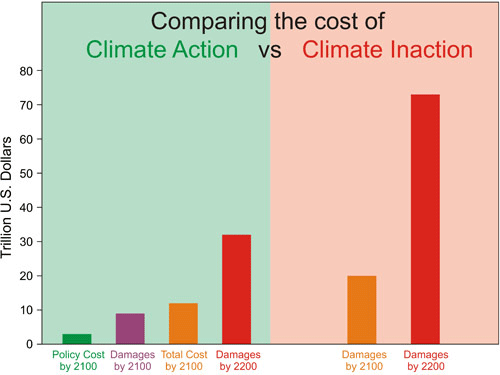
 NY cites climate change as a risk in Sandy’s wake, SMH, March 27 2013 New York is listing climate change as a risk for bondholders after Hurricane Sandy caused more than $US40 billion ($38 billion) in damage in the state and Governor Andrew Cuomo said better preparations are needed.
The state may be the first US state to inform investors of the danger posed by rising sea levels, flooding and erosion tied to climate change, said Rich Azzopardi, a Cuomo spokesman. The citation first appeared in budget documents in January and has since been included among fiscal risks mentioned in bond offering statements, Azzopardi said.
Sandy caused the worst flooding in the more than 100-year history of the New York City subway system, which is run by the state, and devastated coastal areas. The October hurricane knocked out power to more than 2 million residents and followed two 2011 tropical storms that caused severe flooding upstate.
“The extreme weather events of the last two years highlighted real and potential costs from extreme weather events,” Azzopardi said. “The state determined that the effects of climate change presented economic and financial risks.” Other stated risks include federal budget cuts and unsettled labor negotiations.
Be prepared
Cuomo, a 55-year-old Democrat, said after Sandy that the state needs to be better prepared for extreme weather. He has proposed a $US400 million program to buy waterfront homes to reduce the amount of property exposed to potential storm damage.
Offering statements on risk say investors should note the potential costs of storm-related preparation and rebuilding.
“Significant long-term planning and investment by the federal government, state and municipalities may be needed to adapt existing infrastructure to the risks posed by climate change,” the risk statement says.
Businesses have been taking climate projections into account when assessing risk for at least a decade and it’s “astonishing” that more public entities haven’t done so, said Steven Cohen, executive director at Columbia University’s Earth Institute in New York.
Prudent planning
“These are the kinds of things that prudent investors pay attention to and prudent governments set aside funds for,” said Cohen, a former US Environmental Protection Agency official. “This needs to be a part of your financial planning.”
UK does not need nuclear power for climate change obligations
 Non-nuclear future
http://www.guardian.co.uk/environment/2013/mar/28/non-nuclear-future
The Guardian, Professor David Elliott Open University 28 March 2013
I was dismayed by the statement by Professor John Beddington, the
government’s chief scientific adviser, that a nuclear energy-free
future for the UK is not something the coalition is thinking seriously
about (Report, 26 March). You quote him as adding: “We really can’t
see a future for the UK energy sector, if we are to meet our climate
change obligations and have resilience in the power sector, without a
significant component of nuclear.”
 The Department of Energy and
Climate Change has provided an extensive online energy modelling
system and invited interested people and organisations to use it. The
British Pugwash Group spent a year doing just that and recently
published the results asa set of 2050 energy Pathways. It included one
I helped with, which showed clearly that it was possible to meet the
UK’s energy needs at reasonable cost with no nuclear power, while
reducing emissions below current 2050 targets. Evidently we were wasting our time.
Scrap fossil fuel subsidies, says International Monetary Fund (IMF)
 IMF Urges Reining In Of Fossil Fuel Subsidies http://www.energymatters.com.au/index.php?main_page=news_article&article_id=3662 29 March 13, A new report from the International Monetary Fund (IMF) estimates that energy subsidies total $1.9 trillion worldwide – the equivalent of 2.5 percent of global GDP. Earlier this month, Earth Policy Institute (EPI) pegged the number at USD$620 billion; however the IMF’s figures are based on a post-tax basis that also factors in a range of negative externalities from energy consumption.
The IMF’s paper shows for some countries the burden of energy subsidies is becoming so great that it threatens the stability of those economies. Continue reading
Extreme weather – climate change is proving very costly for America
 $188 Billion Price Tag: Extreme Weather From 2011 To 2012 The Energy Collective, By Daniel J. Weiss and Jackie Weidman The United States was subjected to many severe climate-related extreme weather over the past two years. In 2011 there were 14 extreme weather events — floods, drought, storms, and wildfires — that each caused at least $1 billion in damage. There were another 11 such disasters in 2012. Most of these extreme weather events reflect part of the unpaid bill from climate change — a tab that will only grow over time.
CAP recently documented the human and economic toll from these devastating events in our November 2012 report “Heavy Weather: How Climate Destruction Harms Middle- and Lower- Income Americans.” Since the release of that report, the National Oceanic and Atmospheric Administration, or NOAA, has updated its list of “billion-dollar”-damage weather events for 2012, bringing the two-year total to 25 incidents.
From 2011 to 2012 these 25 “billion-dollar damage” weather events in the United States are estimated to have caused up to $188 billion in total damage. [1] The two costliest events were the September 2012 drought — the worst drought in half a century, which baked nearly two-thirds of the continental United States — and superstorm Sandy, which battered the northeast coast in late October 2012. The four recently added disastrous weather events were severe tornadoes and thunderstorms. Here is an update of vital extreme weather event data after the addition of these four events: Continue reading
The future with climate change, refugees, food scarcity, wars?
Wars in prospect as climate change stirs unrest, UN told, SMH, 16 Feb 13 Imagine India in 2033. It has overtaken China as the most populous nation. Yet with 1.5 billion citizens to feed, it’s been three years since the last monsoon. Without rain, crops die and people starve.
Imagine India in 2033. It has overtaken China as the most populous nation. Yet with 1.5 billion citizens to feed, it’s been three years since the last monsoon. Without rain, crops die and people starve.
The seeds of conflict take root. Continue reading
Koch brothers secretly undermine climate science
 “How the ‘Kochtopus’ Stifled Green Debate” Society for Environmental
Journalists, 27 Jan 13,
It’s not just that the billionaire Koch brothers have spent tens of
millions to undermine science and stifle debate on climate change.
It’s that they do it in secret.
“Even by the standards of the super-rich, Charles and David Koch are
extraordinarily wealthy. …The two brothers share a similar political
outlook. They are right-wing libertarians who believe in minimal
regulation of industry, smaller government, lower corporate taxes and
less generous social services. They are also closet ‘sceptics’ when it
comes to climate science. …
Together, the two brothers have given millions of dollars to
non-profit organisations that criticise environmental legislation and
support lower taxes for industry.
The Kochs have also contributed vast sums to promote scepticism
towards climate change, more even than the oil industry according to
some estimates. Greenpeace, for instance, has calculated that
ExxonMobil spent $8.9m on climate-sceptic groups between 2005 and
2008; over the same period the Koch brothers backed such groups to the
tune of nearly $25m.”…..
http://www.sej.org/headlines/how-kochtopus-stifled-green-debate
Collective responsibility to act on climate change
 However, neither governments nor vested interests would have been able to continue on the track leading toward a climate calamity had it not been for the majority who, aware of the risks, pay only lip service to the issue. Ultimately it is the collective foresight or lack of such, by our species which it will decide its future
Humanity’s scorched Earth program – where to now? The Conversation, Andrew Glikson, 24 Jan 13, The intensity and frequency of bush fires and firestorms around the globe, including recently in Australia, is a growing worry. Under conditions where mean land temperatures have increasedby ~1.5 degrees Celsius since 1750, the effects of fires under higher temperatures projected by the IPCC for later this century defy contemplation.
While there is scepticism from those who do not accept the scientific method nor empirical evidence, the laws of physics tell us atmospheric temperatures are largely regulated by greenhouse gases (GHG). The same applies to the connection between rising temperature and the spate of extreme weather events around the world. This includes increased climate variability, heat waves, fires, cold fronts, intensification of the hydrological cycle and consequent rise in floods and hurricanes experienced in Australia over the last few years andat present.
The failure to negotiate agreements for mitigation of GHG, through Kyoto, Copenhagen, Cancun, Durban and Doha now poses an existential risk around the world and in Australia.
Where does responsibility belong? Continue reading
Rapid climate change due to diminishing Arctic sea ice
Loss of Arctic Sea Ice Speeds Domino Effect of Warming Temperatures at High Latitudes http://www.sciencedaily.com/releases/2013/01/130123144044.htm
Melting Arctic sea ice is no longer just evidence of a rapidly warming planet — it’s also part of the problem.
Alan Werner, professor of geology at Mount Holyoke College, said that decreasing amounts of Arctic snow and ice in summer will lead to a greater degree of heat absorption at the North Pole.
The reason, Werner said, is because the loss of snow and ice makes Earth’s surface less reflective, meaning solar radiation. or heat — is absorbed in greater amounts by the exposed dark ocean or tundra.
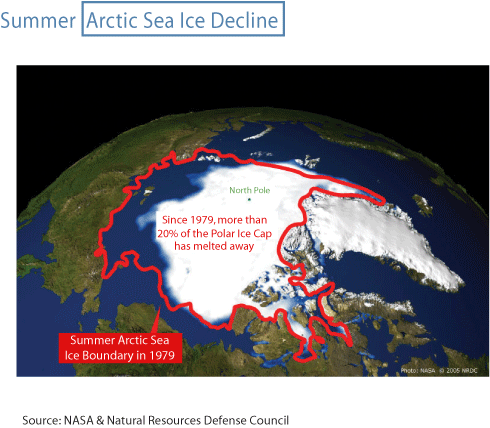
“That’s the thing that’s happening very abruptly, or at least in geologic time scales, very quickly,” Werner said. “That the high latitudes are warming at a much faster rate than the other latitudes.”
Werner’s observation follows the announcement in September by the National Snow and Ice Data Center that the surface area of Arctic sea ice had reached a new low in 2012, breaking a previous record reached in 2007.
What the new data suggests, Werner said, is that the Arctic Ocean will likely be free of sea ice during summer in the next few decades, which may trigger significant changes in climate across the globe.
“One thing about humans living on the planet is that we don’t do well with change,” Werner said. “The changes that we’re talking about are changes that are going to be difficult for humans to adapt to.”
What to do about runaway global warming?
Humanity’s scorched Earth program – where to now? The Conversation, Andrew Glikson, 24 Jan 13,”……….Where to now?Some scientists despair. Professor Guy McPherson writes “It seems no matter how dire the situation becomes, it only gets worse when I check the latest reports”. Others accept Pablo Casals‘ dictum “The situation is hopeless. We must take the next step”.
In themselves, efforts at reducing atmospheric CO2-emission are no longer sufficient to prevent further global warming. Along with sharply reducing carbon emissions, we need to undertake efforts to reduce atmospheric CO2 from the current level of near-400 ppm to well below 350 ppm. A wide range of technologies – many known as “geo-engineering” – have been proposed to do this job.
The concept of “geo-engineering” rings alarm bells for some, but it has been confused. Most people understand this concept in terms of solar injection of sulphur dioxide into the stratosphere. This is a Band-Aid at best; at worst it is a harmful measure causing further ocean acidification and the retardation of precipitation and of the monsoon.
By contrast, CO2 draw-down is a far-better option. It would attempt to reverse the deleterious consequences of the over 560 billion tons of carbon released from combustion and land clearing. Other measures such as NASA-applied outer space shade technology may buy time for such planetary defence effort.
The alternative does not bear contemplation. http://theconversation.edu.au/humanitys-scorched-earth-program-where-to-now-11525?utm_source=feedburner&utm_medium=feed&utm_campaign=Feed%3A+conversationedu+%28The+Conversation%29
1 This Month





PLEASE OPPOSE HR 8255 AND S.3639 – bills would accelerate satellite deployment, with no environmental review or safeguards – https://ncstd5li.quorum.us/campaign/169331/
To see nuclear-related stories in greater depth and intensity – go to https://nuclearinformation.wordpress.com
-
Archives
- October 2026 (29)
- September 2026 (339)
- August 2026 (330)
- July 2026 (355)
- June 2026 (287)
- May 2026 (306)
- April 2026 (356)
- March 2026 (251)
- February 2026 (267)
- January 2026 (308)
- December 2025 (358)
- November 2025 (359)
-
Categories
- 1
- 1 NUCLEAR ISSUES
- business and costs
- climate change
- culture and arts
- ENERGY
- environment
- health
- history
- indigenous issues
- Legal
- marketing of nuclear
- media
- opposition to nuclear
- PERSONAL STORIES
- politics
- politics international
- Religion and ethics
- safety
- secrets,lies and civil liberties
- spinbuster
- technology
- Uranium
- wastes
- weapons and war
- Women
- 2 WORLD
- ACTION
- AFRICA
- Atrocities
- AUSTRALIA
- Christina's notes
- Christina's themes
- culture and arts
- Events
- Fuk 2022
- Fuk 2023
- Fukushima 2017
- Fukushima 2018
- fukushima 2019
- Fukushima 2020
- Fukushima 2021
- general
- global warming
- Humour (God we need it)
- Nuclear
- RARE EARTHS
- Reference
- resources – print
- Resources -audiovicual
- Weekly Newsletter
- World
- World Nuclear
- YouTube
-
RSS
Entries RSS
Comments RSS

