US Dept of Energy warns on climate change damaging nuclear and coal plants
 Warming already taking toll on U.S. energy sector — DOE Hannah Northey, E&E reporter Greenwire: July 11, 2013 Rising temperatures, decreasing water availability, more severe storms and rising seas stemming from climate change are already affecting every part of the country’s energy sector, and those threats will only grow more severe in years to come, the Energy Department said today.
DOE in a new report outlines the effects a warming world with more chaotic and damaging 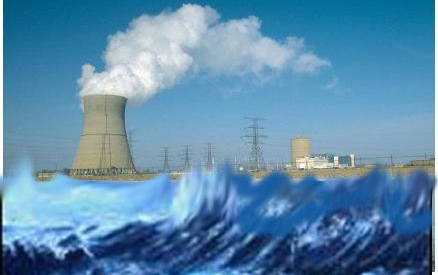 storms, wildfires and other natural disasters is having on oil and gas exploration, power plants, and an aging electric grid.
The outlook isn’t pretty.
The agency pointed to the unprecedented shutdown of a nuclear reactor because of rising seawater temperatures on the Connecticut coast last year, as well as the request by power plants to dump hotter-than-permitted water into nearby lakes and streams.
In another case, high temperatures and high demand last year caused a transformer and power line to trip in Arizona, triggering a cascading blackout that tripped the San Onofre nuclear plant offline, leaving millions of people without power.
Wildfires are threatening large swaths of the electric grid, and waning water resources are calling  into question just how much hydropower the United States can generate.
What the report also makes clear is that storms like Superstorm Sandy are only a taste of things to come……..
Coming years could bring more damage, DOE said, noting that last year was the warmest year since record keeping began in 1895 for the contiguous United States, and the hottest month for the nation was July 2012. Those higher temperature have ushered in heat waves, a longer wildfire season, decreased sea ice in the Alaskan Arctic sea and a longer growing season, DOE said.
 In many cases, historic drought conditions are combining with high temperatures to parch power plants throughout the country that need water to cool reactors, generate steam or produce hydroelectricity.
Higher temperatures are also putting pressure on the system in the form of demand as an increasing number of air conditioners pull power from the grid, causing even more devastating consequences during rolling blackouts and brownouts.
The report calls for a host of new, innovative methods to protect the grid, power plants, and oil and gas producers from the effects of climate change but doesn’t make specific recommendations or provide cost estimates…..http://www.eenews.net/stories/1059984249
U.S. government warns on climate change threat to nuclear and coal power plants
US power plants at risk from climate change, government says SMH, July 12, 2013 Power plants across the US are at increased risk of temporary shutdown and reduced power generation as temperatures and sea levels continue to rise and water becomes less available, the country’s Department of Energy said.
By 2030, there will be nearly $US1 trillion in energy assets in the Gulf region alone at risk from increasingly costly extreme hurricanes and sea-level rises, according to the Energy Department report on the impact of climate change on energy infrastructure.
“As President Obama said in his speech last month, climate change is happening,” said spokeswoman April Saylor in a statement. “As climate change makes the weather more extreme, we have a moral obligation to prepare the country for its effects.”
The report calls on federal, state and local governments to more urgently prepare critical infrastructure – particularly coal, natural gas and nuclear plants – for the compounded risks posed by floods, storms, wildfires and droughts…….
Greenpeace USA spokesman Robert Gardner said the administration’s focus should primarily be transitioning to wind and solar technology, not relying on fossil fuels and nuclear energy.
“The question is why the Department of Energy is really focusing on continuing the problem which has caused this tidal wave of global warming,” said Gardner. : http://www.smh.com.au/environment/climate-change/us-power-plants-at-risk-from-climate-change-government-says-20130712-2pv6h.html#ixzz2YxjjqAdb
Climate change increases Chernobyl’s risk of radioactive wildfires
Women in their 20s living just outside the zone face the highest risk from exposure to radioactive smoke, the 2011 study found: 170 in 100,000 would have an increased chance of dying of cancer. Among men farther away in Kiev, 18 in 100,000 20 year olds would be at increased risk of dying of cancer.
the greatest danger from forest fire for most people would be consuming foods exposed to smoke. Milk, meat and other products would exceed safe levels, the 2011 study predicts. The Ukrainian government would almost certainly have to ban consumption of foodstuffs produced as far as 150 kilometres from the fire
Watching for a radioactive forest fire JANE BRAXTON LITTLE, ABC Environment 8 JUL 2013 Tinder dry and radioactive: the forests around Chernobyl are an accident waiting to happen. For 27 years, forests around Chernobyl have been absorbing radioactive elements. A fire would send them skyward again – a growing concern as summers grow longer, hotter and drier. “…….Nikolay Ossienko patrols the forests surrounding the Chernobyl nuclear power plant,,,,,,, “Our number one job is to save the forest from fire,”…… It’s a job with international consequences.
For almost three decades the forests around the shuttered nuclear power plant have been absorbing contamination left from the 1986 reactor explosion. Now climate change and lack of management present a troubling predicament: If these forests burn, strontium 90, cesium 137, plutonium 238 and other radioactive elements would be released, according to an analysis of the human health impacts of wildfire in Chernobyl’s exclusion zone conducted by scientists in Germany, Scotland, Ukraine and the United States. Continue reading
Global temperature’s dramatic rise in 21st Century, already
The WMO says droughts affect more people than any other kind of natural disaster because of their large scale and long duration. The decade saw droughts across the world, with some of the longest and most severe in Australia (2002 and other years), East Africa (2004 and 2005, resulting in widespread loss of life) and the Amazon basin (2010)
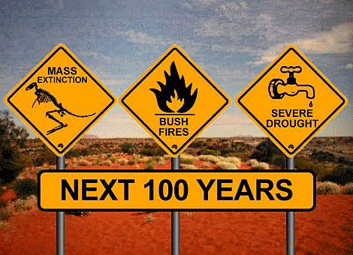
 Clear upward trend’ in global temperatures: WMO ABC News, ALEX KIRBY, 5 July 13, In the first decade of this century extreme weather, global temperatures and sea level all continued a trend in a “clearly upward direction”, says a new report from the World Meteorological Organisation.
If you think the world is warming and the weather getting nastier, you’re right, according to the United Nations agency committed to understanding weather and climate.
The World Meteorological Organisation says the planet “experienced unprecedented high-impact climate extremes” in the ten years from 2001 to 2010, the warmest decade since the start of modern measurements in 1850.
Those ten years also continued an extended period of accelerating global warming, with more national temperature records reported broken than in any previous decade. Sea levels rose about twice as fast as the trend in the last century.
A WMO report, The Global Climate 2001-2010: A Decade of Climate Extremes, analyses global and regional temperatures and precipitation, and extreme weather such as the heat waves in Europe and Russia, Hurricane Katrina in the US, tropical cyclone Nargis in Myanmar, droughts in the Amazon basin, Australia and East Africa, and floods in Pakistan. Continue reading
Man made greenhouse emissions caused Australia’s hottest summer
Manmade Emissions Led to the Heat Wave That Baked Australia Motherboard, By Jason Koebler, 27 June 13 Scientists are 90 percent sure this year’s Australian heat wave couldn’t have happened without manmade influence. Photo: CIA
Surprise, surprise: The record-breaking heat wave that plagued Australia earlier this year with temperatures that reached up to 121 degrees was almost certainly caused by humans, according to a new study.
The study, published in Geophysical Research Letters by scientists at the University of Melbourne and Australia’s ARC Centre of Excellence for Climate Systems Science, highlights how humans have heightened drought effects on the continent. According to the authors, “human contribution to the increased odds of Australian summer extremes like 2013 was substantial, while natural climate variations alone, including El Niño Southern Oscillation, are unlikely to explain the record temperature.”
The so-called “angry summer” was easily the hottest on record, with temperatures hitting more than 27 degrees above average in some parts of the country during the first week of January. When it was happening, meteorologists with the Australian government said that though “Australia has always experienced heat waves … the event affecting much of inland Australia has definitely not been typical.”…..”The model experiments also show that these types of extreme Australian summers will become more severe and more frequent in the future, with further global warming,” she said. ”Extreme summers occur 8 times more frequently in the climate model simulations that include human influences, such as greenhouse gases, compared to the climate model simulations with only natural climate variations.” http://motherboard.vice.com/blog/manmade-emissions-led-to-the-heat-wave-that-baked-australia-1#ixzz2XZtGQ5uR
Obama’s Climate Action Plan : the facts
 Fact box on Obama’s climate action plan http://www.smh.com.au/business/carbon-economy/fact-box-on-obamas-climate-action-plan-20130625-2ov92.html#ixzz2XMRTluIq June 25, 2013 The White House on Tuesday released a plan to cut global carbon pollution and address the effects of climate change in three broad ways: cutting carbon pollution domestically, preparing the country to be resilient to climate impacts, and leading international efforts to target climate change.
Below are key highlights of the administration’s “Climate Action Plan:” (Read full report here.) Continue reading
48 USA mayors pledge action to deal with climate chnage
US cities seek greater climate resilience http://www.smh.com. au/environment/climate-change/us-cities-seek-greater-climate-resilience-20130618-2of9f.html June 18, 2013US mayors pledged Monday to make their communities more resilient to increasingly severe floods, droughts, extreme storms and wildfires, which they said was more efficient and cost-effective than disaster clean-up afterwards.
Four dozen elected officials, from localities as diverse as Washington DC, Des Moines, Iowa and Santa Barbara County, California, released a one-page plan which laid out actions such as using more renewable energy and making buildings and infrastructure more energy-efficient.
The Resilient Communities for America Agreement was launched less than a week after New York Mayor Michael Bloomberg announced a $US20 billion plan to prepare his city for rising sea levels and hotter summers.
The actions by local officials took place as anticipation builds that the White House is planning a series of executive actions in July to address climate.
Federal action can help, but local officials are at the front lines of natural disasters, said Des Moines Mayor Frank Cownie. Iowa’s biggest city saw severe flooding in 2008, a trio of “500-year” floods in 2010, a drought in 2012 and the wettest year in 140 years of record-keeping so far in 2013.
“These extreme events are becoming more and more prevalent, and local government is really where it happens,” Cownie said.
Catholic Pope and other religions acting on climate change
Climate change gets religious SMH, 19 June 13 Few religious communities have gone as far in fighting climate change as a church in Queensland which has 24 solar panels bolted to the roof in the shape of a Christian cross. “It’s very effective. It’s inspired some members of our congregation to install panels on their homes,” Reverend David Lowry said of the “solar cross” mounted in 2009 on the Caloundra Uniting Church, which groups three Protestant denominations.
Many religions have been wary of moving to install renewable energy sources on their places of worship, from cathedrals to mosques – or of taking a strong stand on climate change in general – despite teachings that people should be custodians of nature.
But slowly, that may be changing, thanks to new religious leaders including Pope Francis, the head of the Roman Catholic Church.
Don’t miss this terrific climate change article
Climate-change summary and update, Nature Bats Last 14 June 2013
Humans have tinkered with the natural world since we appeared on the evolutionary stage. Our days may be numbered.
As the home team, Nature Bats Last, American actress Lily Tomlin is credited with the expression, “No matter how cynical you become, it’s never enough to keep up.” With respect to climate science, my own efforts to stay abreast are blown away every week by new data, models, and assessments. It seems no matter how dire the situation becomes, it only gets worse when I check the latest reports.
The response of politicians, heads of non-governmental organizations, and corporate leaders remains the same. They’re mired in the dank Swamp of Nothingness. These are the people who know about, and presumably could do something about, our ongoing race to disaster (if only to sound the alarm). Tomlin’s line is never more germane than when thinking about their pursuit of a buck at the expense of life on Earth.
Worse than the aforementioned trolls are the media. Fully captured by corporations and the corporate states, the media continue to dance around the issue of climate change. Occasionally a forthright piece is published, but it generally points in the wrong direction, such as suggesting climate scientists and activists be killed (e.g., James Delingpole’s 7 April 2013 hate-filled article in the Telegraph).
Even mainstream scientists minimize the message at every turn. As we’ve known for years,scientists almost invariably underplay climate impacts. I’m not implying conspiracy. Science selects for conservatism. Academia selects for extreme conservatism. These folks are loathe to risk drawing undue attention to themselves by pointing out there might be a threat to civilization. Never mind the near-term threat to our entire species (they couldn’t care less about other species). If the truth is dire, they can find another, not-so-dire version. The concept is supported by an article in the February 2013 issue of Global Environmental Change pointing out that climate-change scientists routinely underestimate impacts “by erring on the side of least drama.”
If you’re too busy to read the evidence presented below, here’s the bottom line: On a planet 4 C hotter than baseline, all we can prepare for is human extinction (from Oliver Tickell’s 2008 synthesis in the Guardian). Tickell is taking a conservative approach, considering humans have not been present at 3.5 C above baseline (i.e., the beginning of the Industrial Revolution, commonly accepted as 1850). According to the International Energy Agency’s November 2010 assessment, which does not include self-reinforcing feedback loops, global average temperature of Earth will hit the 3.5 C mark in 2035. To be fair, this assessment does not consider economic collapse, either…… http://guymcpherson.com/2013/01/climate-change-summary-and-update/
Dangerously high global temperatures
Global Temperature Nearing Dangerous Levels, Says Study
http://au.ibtimes.com/articles/478736/20130614/climate-change-global-warming-carbon-emissions.htm#.UbzW_-dwo6I
Greenhouse gas emissions are dangerously rising at an alarming level. The abnormally fast growth rate could push the Earth beyond the safe limit in terms of average global temperature. The report is based on the study conducted by the International Energy Agency (IEA). Rising temperatures have profound effects on economic growth, agriculture, water and energy supply, and public health.

According to the IEA, carbon emissions increased by 1.4 per cent. This means an additional 31.6 gigatons of carbon dioxide were released into the air. The IEA is a research group organised by industrialised nations to monitor climate change. Continue reading
Climate change on top of Marshall Islands’ nuclear disasters
Pacific islands’ deadly threat from climate change http://www.washingtonpost.com/opinions/pacific-islands-face-a-deadly-threat-from-climate-change/2013/05/30/86ff1956-c7a9-11e2-9245-773c0123c027_story.html By Phillip Muller, May 30 2013 Phillip Muller is foreign minister of the Marshall Islands.
For almost 70 years, my country, the Marshall Islands, has been fighting for its survival. Unfortunately, the threats we face are the result of forces we cannot control.

From 1946 to 1958, we endured the horror of 67 atmospheric nuclear tests. The most powerful was the “Bravo shot,” equivalent in power to 1,000 Hiroshima bombs. Now our residents are confronted by a different kind of atmospheric danger: the existential threat posed by climate change.
After a prolonged and unseasonable droughtthat began late last year, the severe lack of drinking water in our northern atolls led my government to declare a disaster area on May 7. This humanitarian crisis is climate-induced. Continue reading
It’s already happening: the effects of global warming
The Effects of Global Warming by Marc Lallanilla , LiveScience Staff Writer 31 May 2013 “……. global warming is having a measurable effect on the planet right now.
Increase in average temperatures
One of the most immediate and obvious impacts of global warming is the increase in temperatures around the world. The average global temperature has increased by about 1.4 degrees Fahrenheit (0.8 degrees Celsius) over the past 100 years, according to the National Oceanic and Atmospheric Administration (NOAA).
Since recordkeeping began in 1895, the hottest year on record for the 48 contiguous U.S. states was 2012. Worldwide, 2012 was also the 10th-warmest year on record, according to NOAA. And nine of the warmest years on record have occurred since 2000. Continue reading
France investigating effects of extreme weather on nuclear power plants

French nuclear plant research to include heatwave, tsunami analysis, http://www.platts.com/RSSFeedDetailedNews/RSSFeed/ElectricPower/26951912 Robin Sayles, newsdesk@platts
France is to invest Eur50 million ($64.2 million) in nuclear safety projects, taking into account knowledge gained from the Fukushima disaster in 2011, caused by an earthquake and huge tsunami.
In a document published late Friday, France’s energy ministry said it has selected over 20 research projects, ranging from operations management studies to disaster impact and radiation risk analyses.
Two of the accepted research projects are to analyze the risks of climate change and extreme weather occurrences. The SEEN project aims to “estimate the current and future climate risks for nuclear power production better,” including heatwaves, droughts and torrential downpours, the government said.
France’s 58 nuclear power reactors, operated by state-owned EDF, rely on river or sea water for cooling purposes.
Sustained hot and dry periods can prompt reactor shutdowns as water temperatures rise, while stormy weather can also release debris into rivers, such as tree branches, which must be filtered before the water is deemed safe for use.
The TANDEM project is to study the impact on France’s coastline of tidal waves, in particular the Atlantic and English Channel, where many of France’s nuclear power plants are situated.
The government did not give the specific leaders of the projects, but it has previously said that the projects would be carried out by academic and state-run nuclear bodies such as IRSN, the national radiological risk body.
Following the Fukushima disaster in 2011, EDF committed to carry out extra safety work recommended by nuclear watchdog ASN, which it said would cost around Eur10 billion.
Greenhouse gas emissions to be capped by China
China emissions cap proposal hailed as climate breakthrough REneweconomy, By Giles Parkinson on 22 May 2013 China, the world’s biggest polluter, is proposing to set a cap on greenhouse gas emissions as early as 2016 in a move that is being hailed as a potentially transformative step in the fight against climate change.
According to news reports from China, the powerful National Development and Reform Commission (NDRC) has proposed setting absolute caps that would divorce the growth on emissions from growth in the economy, and will also set a peak in its overall emissions in 2025, five years earlier than planned.
China has already pledged to cut its emissions intensity – the amount of Co2 it emits per economic unit – by up to 45 per cent by 2020. The significance of an absolute cap is that it promises to reign in emissions even if the economy grows faster than expected.
Furthermore, Point Carbon reports, at a recent NDRC meeting, its vice director Xie Zhenhua said China should set long-term emission targets for 2030 and 2050 in a bid to decarbonise its economy. China, like Australia is heavily dependent on carbon-intensive coal to generate electricity – just over 82 per cent. But it has also proposed a cap on coal consumption of 4 billion tonnes.
Lord Nicholas Stern, the chair of the Grantham Research Institute on Climate Change at the London School of Economics, described it as “exciting news”, and said it should encourage all countries, the US in particular, to take stronger action.
“And it improves the prospects for a strong international treaty being agreed at the United Nations climate change summit in 2015,” he told The Independent in the UK…….. http://reneweconomy.com.au/2013/china-emissions-cap-proposal-seen-as-climate-breakthrough-40529
Scientists almost unanimous – man-made global warming is really happening
Not much climate change doubt, science says : http://www.theage.com.au/environment/climate-change/not-much-climate-change-doubt-science-says-20130515-2jmup.html#ixzz2TV6hLn4F Peter Hannam Carbon economy editor, 16 May 13,
Having doubts over climate change and the role of humans? You’re unlikely to find many scientists who share your uncertainty. That is the finding of a University of Queensland-led study that surveyed the abstracts of almost 12,000 scientific papers from 1991-2011 and claims to be the largest peer-reviewed study of its kind. Of those who a stated a position on the evidence for global warming, 97.1 per cent endorsed the view that humans are to blame. Just 1.9 per cent rejected the view.
The report’s lead author, John Cook, a fellow at the University of Queensland’s Global Change Institute and founder of the website skepticalscience.com, said the scientific consensus was overwhelming, growing and had been around since the early 1990s.
He said that while the number of papers rejecting the consensus was “vanishingly small”, his research suggested the public was under the impression the debate was split 50-50. Continue reading
1 This Month





PLEASE OPPOSE HR 8255 AND S.3639 – bills would accelerate satellite deployment, with no environmental review or safeguards – https://ncstd5li.quorum.us/campaign/169331/
To see nuclear-related stories in greater depth and intensity – go to https://nuclearinformation.wordpress.com
-
Archives
- October 2026 (29)
- September 2026 (339)
- August 2026 (330)
- July 2026 (355)
- June 2026 (287)
- May 2026 (306)
- April 2026 (356)
- March 2026 (251)
- February 2026 (267)
- January 2026 (308)
- December 2025 (358)
- November 2025 (359)
-
Categories
- 1
- 1 NUCLEAR ISSUES
- business and costs
- climate change
- culture and arts
- ENERGY
- environment
- health
- history
- indigenous issues
- Legal
- marketing of nuclear
- media
- opposition to nuclear
- PERSONAL STORIES
- politics
- politics international
- Religion and ethics
- safety
- secrets,lies and civil liberties
- spinbuster
- technology
- Uranium
- wastes
- weapons and war
- Women
- 2 WORLD
- ACTION
- AFRICA
- Atrocities
- AUSTRALIA
- Christina's notes
- Christina's themes
- culture and arts
- Events
- Fuk 2022
- Fuk 2023
- Fukushima 2017
- Fukushima 2018
- fukushima 2019
- Fukushima 2020
- Fukushima 2021
- general
- global warming
- Humour (God we need it)
- Nuclear
- RARE EARTHS
- Reference
- resources – print
- Resources -audiovicual
- Weekly Newsletter
- World
- World Nuclear
- YouTube
-
RSS
Entries RSS
Comments RSS

