Nuclear Power Plants continuously emit Carbon 14 to the environment
 Carbon-14 in Terrestrial and Aquatic Environment of Ignalina Nuclear Power Plant:Sources of Production, Releases and Dose Estimates Jonas Mazeika Nature Research Centre Vilnius University Lithuania
New coal plants being cancelled twice as fast as ones being built
For Every New Coal Plant Being Built, Two Are Being Cancelled, Clean Technica, March 21st, 2015 Originally published on The Carbon Brief. By Sophie Yeo
The global coal boom has started to slow, a new report says, as more plans for new power plants are now being shelved than completed.
The number of cancelled coal projects across the world has outstripped those completed at a rate of two to one since 2010, according to Sierra Club and CoalSwarm – two campaign groups that have tracked the progress of 3,900 intended plants since 1 January 2010.
The findings update a 2012 report by the World Resources Institute, which estimated that 1,199 new coal-fired power plants, with a total capacity of 1,401 gigawatts, were in the pipeline for construction.
New figures suggest that, by 2014, this had shrunk by 23% to a proposed 1,083 gigawatts of new coal-fired capacity. The report puts this down to citizen opposition, competition from renewables, new policy initiatives and political scandals putting a freeze on the highly polluting projects………
Stranded assets
The current rate of coal project cancellations is already causing a headache for investors in the industry, Ted Nace, one of the report’s authors, tells Carbon Brief:
“The clearest example right now is in coal mining stocks like Peabody, Arch, and Alpha Natural Resources. Arch’s stock, for example, hit $75 per share in 2008 and now sells for 88 cents per share. An individual or an institutional investor that invested $75,000 in Arch stock in 2008 would have lost over $74,000 in the past seven years.”
The decline in the European and US coal fired capacity growth has been taking place for over a decade, but mining companies had hoped that exports to China and other Pacific Rim nations would help to make up the difference.
This has not happened. China’s coal consumption fell by 2.9% in 2014, while the use of existing coal plants dropped to 54% – a 35-year low.
Meanwhile, new renewable energy capacity exceeded new coal capacity in China for the first time in 2013, and then again in 2014 – although coal remains the dominant source of Chinese electricity.
The rate at which projects are being shelved in India has also had an impact on connected projects overseas, explains Nace:
“With capacity growth stalling in India, numerous overseas mega-projects such as mines, railroads, and terminals designed to increase imports of coal to India are now on turning into white elephants.”……..
The rate at which coal plants are being cancelled is an improvement upon previous estimates on the future growth of the industry.
But with international efforts targeted towards keeping global warming to below two degrees, the news that there is still 1,083 gigawatts of coal capacity in the pipeline is little cause for celebration. http://cleantechnica.com/2015/03/21/for-every-new-coal-plant-being-built-two-are-being-cancelled/
Anglican bishops speak out – call for divestment from fossil fuels
 Anglican bishops’ letter urging fossil fuel divestment Seventeen bishops and archbishops tell Anglican church investments in fossil fuel companies incompatible with a just and sustainable future Guardian 31 Mar 15“……..In different ways each of our own dioceses are deeply impacted by climate injustice and environmental degradation. We accept the evidence of science concerning the contribution of human activity to the climate crisis and the disproportionate role played by fossil-fuel based economies. Although climate scientists have for many years warned of the consequences of inaction there is an alarming lack of global agreement about the way forward.
There is a compelling need to listen to the voices of our youth who will inherit the challenges and catastrophes we fail to address and pre-empt. We believe we must be reconciled to Creation and to one another and that there is an urgency to this call. We believe the issue of climate change is a moral issue at its heart……….
We will develop and distribute educational resources for everyone (adults, youth and children) on climate change, climate justice, and the ethical and practical principles of sustainable living in global and local contexts……..
We encourage Anglicans everywhere to:……….
Implement energy conservation measures in church buildings and moving to renewable energy sources as quickly as possible…….
We call upon political, economic, social and religious leaders in our various constituencies to address the climate change crisis as the most urgent moral issue of our day. We urge them to:
· Work with all possible commitment and speed toward fair, ambitious, accountable and binding climate change agreements at national and international levels.
· Develop policies that genuinely assist environmental and climate refugees and promote mechanisms of intergovernmental co-operation that ensure their human rights, safety and resettlement………
25 times more carbon emissions from nuclear power than from wind energy
 Nuclear power results in 25 times more carbon emissions than wind. The man illuminating how dirty your energy really is
 Amy Kalafa MBA in Sustainability Candidate Bard College
Stephanie Milbergs Assistant director Bard MBA in Sustainability Rochelle J. March
Rochelle J. March Friday, March 13, 2015 Mark Z. Jacobson is director of Stanford University’s Atmosphere and Energy Program, as well as a professor of civil and environmental engineering. He is also a senior fellow of the Woods Institute for the Environment and of the Precourt Institute for Energy.
The main goal of Jacobson’s research is to better understand physical, chemical and dynamic processes in the atmosphere in order to solve atmospheric problems, such as global warming and urban air pollution, with improved scientific insight and more accurate predictive tools.
Jacobson also evaluates the atmospheric and health effects of proposed energy and transportation solutions to global warming and air pollution, maps renewable energy resources and studies optimal methods of integrating renewable electricity into the grid.
This Q&A is an edited excerpt from a Sustainable Business Fridays conversation Jan. 30 by the Bard MBA in Sustainability program, based in New York City. This twice-monthly dial-in conversation features sustainability leaders from across the globe…….
You just came out with a study, however, that states nuclear power results in 25 times more carbon emissions than wind. Can you explain these findings for us?
Jacobson: Sure, it’s rather straightforward. A life-cycle analysis of a wind turbine shows most of carbon outputs during its construction, practically zero when it’s in operation, and then, if you use today’s methods, during decommission a turbine outputs some carbon.
When you do the calculation, however, you find that wind power emissions are between 5 to 10 grams of carbon per kWh of electricity generated over the lifetime of the turbine. Using that as a baseline, you see over the lifetime of nuclear power, the carbon output is 70 grams per carbon per kWh.
This is from one, building of the nuclear power plant and then two, refining uranium, which is very energy-intensive. There is also timing involved: It takes on average in the U.S. 10 to 19 years for a nuclear power plant to get up and running, while a wind farm can be built on average in two to five years.
If we compare nuclear and wind from now, in two to five years you’ll have a wind farm up and start creating energy that’s clean, while with nuclear you have to wait 10 to 19 years to get that energy. If you add in these extra emissions, called opportunity cost emissions, you end up getting nine to 25 times more carbon in air pollution per kWh from nuclear than wind.
That is still better than coal or natural gas (60 to 120 times more), but other problems with nuclear power is of course 1.5 percent of plants have melted down, and the problems related to weapons proliferation with nuclear, radioactive waste, mining damage, etc. Not even mentioning the cost, which is very high and currently subsidized in the U.S. It’s not a viable option; it’s really the nuclear industry trying to push it to get more business.
The full recording of this conversation is also available. http://www.greenbiz.com/article/dirty-energy-source-stanford-prof-mark-jacobson-explains
Economics, employment, health – greatly helped by stopping global warming
Europe has promised a 40% emissions cut by 2030, compared to 1990 levels – and the report says this will bring real benefits, including 70,000 full-time jobs, the prevention of around 6,000 pollution-related deaths, and a €33bn cut in fossil fuel imports.
31 March is the deadline for developed countries to submit their climate pledges for the conference (so called Intended Nationally Determined Contributions, INDCs), but few have yet done so and nations such as Canada and Japan are expected to miss the bell.
“This report adds to the growing body of evidence that greater climate ambition means better health,” said Anne Stauffer, the deputy director of the Health and Environment Alliance.
“The massive health benefits expected from mitigation action not only include premature deaths avoided but also reduced healthcare costs and increased productivity. This should be welcome news for European decision-makers.”
In other parts of the world, the effects of increased climate ambition would be even more dramatic, according to the New Climate Institute’s (NCI) analysis which uses data from the International Energy Agency.
Comparable figures in the US for a 2C pathway would see 650,000 new jobs created and 27,000 deaths avoided………http://www.theguardian.com/environment/2015/mar/31/limiting-climate-change-economic-benefits-study-finds
Pakistan Climate Change Minister calls for tapping massive clean energy potential
Mushahid Ullah Khan calls for tapping massive clean energy potential, Business Recorder, Sunday, 29 March 2015 SLAMABAD: Federal Minister for Climate Change Senator Mushahid Ullah Khan has said that renewable energy, which is clean and environment-friendly, is future of Pakistan.
“Pakistan is abundantly replete with the renewable energy sources, which can help the country cope with deepening energy crises and pave the way for achieving sustainable development goals,” the minister underlined.
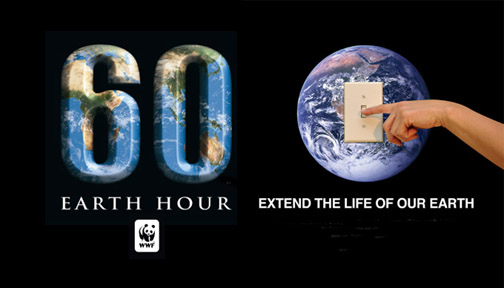 In a press statement issued here on Sunday in the context of the Earth Hour event observed across the world including Pakistan, he explained that renewable energy is generally defined as energy that comes from resources, which are naturally replenished on a human timescale such as sunlight, wind, rain, tides,waves and geothermal heat.
Highlighting the importance of marking the Earth Hour, the minister Mushahid Ullah Khan said that the global Earth Hour event, in fact, calls for the global climate action by investing in renewable energy technologies to free the world including Pakistan of reliance on fossil fuels for energy generation, which are unclean, unreliable and not environment-friendly………
“Above all, harnessing the sun’s power is deemed to be an attractive alternative. For, it is a renewable resource, which leads no pollution. In contrast to conventional fuels, its use requires no need for refining, transporting and conveying fuels and power over long distances,” the minister said.http://www.brecorder.com/pakistan/politics-a-policy/235421-mushahid-ullah-khan-calls-for-tapping-massive-clean-energy-potential.html
Catholic Church throws its weight behind action on climate change
VATICAN CITY (CNS) – The Catholic Church supports the efforts of scientists to study the causes and effects of climate change and insists governments and businesses must get serious about specific commitments for protecting the environment.But Pope Francis, like his predecessors, does not pretend to have a technical solution to the problem. However, he does feel a responsibility to remind Christians of their religious obligation to safeguard creation, beginning with human beings who are created in the image and likeness of God.
Clearing his calendar for a week in late March, Pope Francis rolled up his sleeves to put the final touches on an encyclical letter about the environment; building on what he and his predecessors have said, the document — planned for publication early in the summer — is expected to present ecology as the ultimate pro-life, pro-poor, pro-family issue.
For Pope Francis, like Pope Benedict XVI, safeguarding creation is not simply about protecting plants and animals, or just about ensuring the air, water and land will support human life for generations to come. Those things are part of the task……….
Coal plants funded by Japan’s money designated for fighting climate change

 Japan Uses Climate Cash for Coal Plants, Chem Info Karl Ritter & Aijaz Rahi, Associated Press (AP) 27 Mar 15 — Despite mounting protests Japan continues to finance the building of coal-fired power plants with money earmarked for fighting climate change, with two new projects underway in India and Bangladesh, The AP reported in December that Japan had counted $1 billion in loans for coal plants in Indonesia as climate finance, angering critics who say such financing should be going to clean energy like solar and wind power.
Japanese officials now say they are also counting $630 million in loans for coal plants in Kudgi, India, and Matarbari, Bangladesh, as climate finance. The Kudgi project has been marred by violent clashes between police and local farmers who fear the plant will pollute the environment. …….
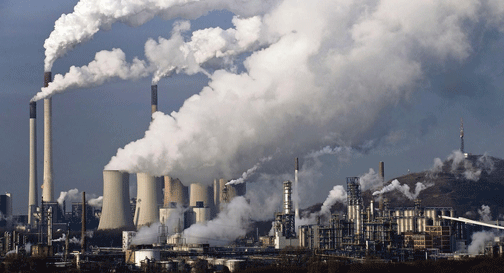
Environmental activists are demanding that at the very least, climate finance should exclude coal and other fossil fuels that scientists blame for warming the planet. “Japan’s support for new coal-fired power plants not only destroys the climate — it also displaces communities, is likely to cause untold local environmental damage, and primarily benefits Japanese companies instead of recipient countries,” said Brandon Wu of ActionAid. “This is unacceptable on its own, and the fact that it is being done in the name of ‘climate finance’ makes a farce of the entire concept,” he said.
….Climate finance is money promised by rich countries in U.N. climate talks to help poor countries limit their carbon emissions. Japan announced at a U.N. climate conference in Peru in December that it has provided $16 billion in climate finance since 2013. Yet the U.N. has no rules defining climate finance, meaning governments decide for themselves what projects to include in their accounting.Climate activists are now urging the recently created Green Climate Fund, which is supposed to become a key channel of climate finance, to explicitly ban funding for fossil fuel projects. The issue is likely to be discussed at the GCF’s board meeting this week in South Korea. The Matarbari plant is financed with a Japanese development loan agreed with the government of Bangladesh last June……..http://www.chem.info/news/2015/03/japan-uses-climate-cash-coal-plants
26 European mayors sign declaration for action on climate change
Full text of climate change statement signed by 26 European mayors. Declaration entitled: ‘In response to the challenge of global climate change, a European commitment and local solutions’
If climate change is global, solutions are first and foremost local. Because large cities are at the crossroads of these two levels, they are at the forefront of the fight against climate change.
This is why, we, the European capitals and metropolises that represent more than 60 million inhabitants and have significant investment capacity (€2tn GDP), have decided to join forces and strengthen the instruments that will lead us toward the energy and environmental transition……
http://www.theguardian.com/environment/2015/mar/26/full-text-of-climate-change-statement-signed-by-26-european-mayors &http://www.dailyclimate.org/t/8530597788433914637
France’s law on green or solar roofs for new commercial buildings
FRENCH LAW TO REQUIRE GREEN ROOFS OR SOLAR PANELS ON NEW COMMERCIAL BUILDINGS, ecosalon, by Sara Novak on March 24, 2015 France just passed a new law that will require all new buildings in commercial zones to be covered with green roofs or solar panels.
Environmental groups hope to reduce the energy costs of commercial buildings while creating an urban jungle in the world’s most beloved city of progress…..The law will change the face of the urban landscape in France by promoting more urban greenery.

While solar panels have an obvious purpose, the benefits of green roofsare less well known. Not only do they beautify buildings and create space for community gardens, they have a number of other environmental benefits.
In the summer, green roofs retain 70 to 90 percent of precipitation and in the winter they retain 25 to 40 percent of precipitation. This reduces runoff and decreases the stress on sewer systems. The daily dew and evaporation cycle along with the light absorbed by vegetation, help to cool buildings down. Green roofs also reduce smog by slowing the distribution of dust and particulate matter……..
The combination of solar panels and green roofs create dual environmental tools. Both help reduce the power demands on the national grid, especially when temperatures peak in the summer time.
Green roofs are popular in Germany, Australia, and parts of Canada. Since 2009, Toronto has had a similar mandatory law for green roofs on commercial buildings. But they’re also gaining traction in the U.S. New York City leads the pack in green roofs and it’s home to the largest roof top garden in the country. James Farley Post Office is topped with a greening system that saves the massive post office $30,000 per year in energy costs. Chicago, Washington, D.C., and Portland are all home to a number of green roofs.http://ecosalon.com/french-law-to-require-green-roofs-or-solar-panels-on-new-commercial-buildings/
Significant actions by President Obama to address climate change
 The Emergence and Importance of President Obama’s Climate Policy, Huffington Post
…federal agencies over the next decade to cut their emissions by an average of 40 percent compared with their levels when he won office in 2008, and to increase their use of electricity from renewable sources by 30 percent.
This move is wholly within the president’s power as the nation’s chief executive and will have a significant impact on the market for energy efficiency and renewable energy goods and services. The federal government is the nation’s largest organization. It employs more people and buys more goods and services than anyone else. It is also a powerful role model for the private sector. As Ms. Davis observes:
…because the federal government is the largest user of energy in the United States economy — encompassing 360,000 buildings, 650,000 fleet vehicles and $445 billion in annual spending on goods and services — it has the potential to influence private companies to step up their emissions-cutting targets.
When coupled with EPA’s slow and steady progress to regulate greenhouse gas emissions under the Clean Air Act, this change in government’s own operations begins to resemble a meaningful federal climate policy………http://www.huffingtonpost.com/steven-cohen/the-emergence-and-importa_b_6922614.html?utm_hp_ref=green
Mention climate change in Florida – and you lose your job!

 Florida environment official dismissed for mentioning climate change at work, Rt.com March 20, 2015 An employee from the Florida Department of Environmental Protection (DEP) has been suspended for mentioning climate change at work.
The complaint filed Thursday by the Public Employees for Environmental Responsibility (PEER) comes after reports that Employees from the Florida Department of Environmental Protection were told to avoid terms like “climate change” and “global warming” in official communications after Governor Rick Scott took office.
Barton Bibler is a long term employee of the DEP and until the recent disagreement with his superiors was in the position of Land Management Plan Coordinator in the division of State Lands.
He is in trouble for doing nothing more than talking about climate change at an official meeting and then making notes of that discussion in the minutes of the meeting.
During a session of the Florida Coastal Managers Forum on February 27 at which climate change and sea level were explicitly being discussed, Mr Bibler was told not to mention climate change.
He was then given a letter of reprimand and on March 9 was told not to return to work and that he would be charged for his personal leave time. Two days after this he received a medical release form requiring him to have a medical examination to look at his behavior and “medical condition” before being allowed to return to work.
Mr Bibler has no idea if he will ever be allowed to return to his job.
However, it seems that the actions of Florida Govenor Rick Scott and other state officials who operate a policy of rejecting climate change has backfired……..http://rt.com/usa/242425-florida-environment-worker-climate-change/
Cyclone Pam – forerunner to more climate disaster for Vanuatu and the world
the Guardian’s campaign for divestment from fossil fuels is so important. If you haven’t signed it already, do so for Vanuatu. http://www.theguardian.com/commentisfree/2015/mar/19/developed-nations-sow-wind-vanuatu-reaps-whirlwind
 Developed nations have sown the wind, Vanuatu has reaped the whirlwind, Guardian, 19 Mar 15 Andrew Simms As emissions alter weather patterns, island nations are the bellwethers that show what our future will be if we fail to tackle climate change……..joint work in 2011 by the National Oceanic and Atmospheric Administration in the US and the UK’s Met Office concluded that a Texas heatwave was 20 times more likely to be caused by climate change than by natural weather variation. A winter warm spell in Britain the same year was 62 times more likely than in the 1960s. The Met Office’s Hadley Centre now confidently states that it “can identify any changed risk of such events”.
In time, more analysis will be done on Cyclone Pam, but Lonsdale’s personal experience and gut reaction fits a pattern of expectations described in the most recent and most comprehensive collation of science on extreme events in theIPCC’s Fifth Assessment Report. It concluded that: “The frequency of the most intense storms will more likely than not increase in some basins. More extreme precipitation near the centres of tropical cyclones making landfall is projected in North and Central America, east Africa, west, east, south and southeast Asia as well as in Australia and many Pacific islands.”
So, while the present is pretty bad for Vanuatu, in a warming world the future looks set to worsen. For this island nation, that is bitterly ironic. . Vanuatu is an archipelago in the western Pacific, famous for having no regular military. When it topped the index in 2006 its ecological footprint per person was no higher than those in non-industrialised countries like Mali and Swaziland, life expectancy matched that in Turkey, and life satisfaction levels were considered as high as New Zealand’s. It is democratic, rich in natural wealth but, being remote, exports little, avoiding the scramble of competing in global markets. It is also hugely culturally diverse with more than 100 languages spoken across its islands.
Small island states tend to do very well in the index topped by Vanuatu. Over countless generations and in the face of geographical isolation, many Pacific islands developed more cooperative economies and highly resilient farming methods. In a warming world they are bellwethers, and carry lessons for us all. If climate change renders small island states unliveable, the international community will sooner or later have to learn to accept and support environmental refugees. Though this would be tragic, remote island populations can, at least, relocate. However, blue island-planet populations cannot.
We will seal our own fate if we fail to learn to share and live within our overall environmental thresholds. There is a long way to go. The World Bank recently tweeted that climate change exacerbates the risk of already costly disasters. It’s a shame then, that as recently as 2012-13 the World Bank Group increased lending to $2.7bn for fossil fuel projects, including toward new oil and gas exploration.
It’s one more reason why the Guardian’s campaign for divestment from fossil fuels is so important. If you haven’t signed it already, do so for Vanuatu. http://www.theguardian.com/commentisfree/2015/mar/19/developed-nations-sow-wind-vanuatu-reaps-whirlwind
UNPRECEDENTED – new book exposes climate denialism, and shows way to act on climate change
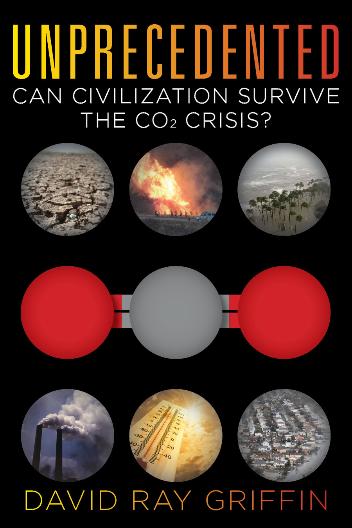 Everything you need to know about climate change and what can be done about it Clarity Press UNPRECEDENTED
Can Civilization Survive the CO2 Crisis?
By David Ray Griffin
ANNOTATED TABLE OF CONTENTS PART I: UNPRECEDENTED THREATS
Introduction: The basic issue is whether global warming, besides
leading to a hellish existence for our children and grandchildren,
will destroy civilization. Each chapter in Part I addresses 3
possible responses: Plan B (mobilization), Plan A (business as
usual), and Plan C (wait and see)……..
PART II: UNPRECEDENTED CHALLENGES AND FAILURES
11 Climate Change Denial: Worst in America, climate-change
denialism has resulted from a concentrated campaign by the
fossil-fuel industry to repudiate the scientific consensus and
promote public uncertainty. This chapter examines techniques
previously used by big business to impact public opinion in
relation to smoking, acid rain, CFCs, and the ozone layer,
showing how they are now being used by the fossil-fuel industry
to dispute the conclusion of virtually all climate scientists that
fossil fuels – coal, oil, and natural gas – are imperiling our planet.
The fossil-fuel industry, which knows its claims to be false, has
deceived many citizens into accepting its propaganda over the
evidence provided by climate scientists. This chapter debunks a
large number of the claims against climate science,
12 Media Failure: The fossil-fuel industry’s denialist strategy has
been forced upon, if not willingly embraced by, the major
American corporate media, leading to their failure to adequately
address either the science or the urgency of climate disruption.
Examined here are various media techniques geared to produce
public uncertainty on the issue: reduced coverage, inadequate
contextualization of extreme weather events, and false balance
(giving the opinions of propagandists paid by Big Oil as much
attention as the views of renowned climate scientists), and going
even beyond that to explicit denialism.
13 Political Failure: This chapter documents the historical record
of global failures to successfully address climate change and
explains reasons why. It demonstrates the extent to which
politicians have overruled the findings of science and analyzes
their motives. The record of US Presidents on climate change is
examined. Charting the Republican stampede toward absolute
climate change denial since 2011, it names specific malefactors
pursuing their selfish private interests to shed light on what
British journalist George Monbiot terms “the greatest political
failure the world has ever seen.” Continue reading
The industry of “doubt” promoted against climate science
 Doubt over climate science is a product with an industry behind it With its roots in the tobacco industry, climate science denial talking points can be seen as manufactured doubt Guardian, Graham Readfearn 5 Mar 15 It’s a product that you can find in newspaper columns and TV talk shows and in conversations over drinks, at barbecues, in taxi rides and in political speeches.
You can find this product in bookstores, on sponsored speaking tours, in the letters pages of local newspapers and even at United Nations climate change talks.
This product is doubt – doubt about the causes and impacts of climate change, the impartiality of climate scientists, the world’s temperature records, the height of the oceans and basic atmospheric physics. Continue reading
1 This Month





PLEASE OPPOSE HR 8255 AND S.3639 – bills would accelerate satellite deployment, with no environmental review or safeguards – https://ncstd5li.quorum.us/campaign/169331/
To see nuclear-related stories in greater depth and intensity – go to https://nuclearinformation.wordpress.com
-
Archives
- October 2026 (19)
- September 2026 (339)
- August 2026 (330)
- July 2026 (355)
- June 2026 (287)
- May 2026 (306)
- April 2026 (356)
- March 2026 (251)
- February 2026 (267)
- January 2026 (308)
- December 2025 (358)
- November 2025 (359)
-
Categories
- 1
- 1 NUCLEAR ISSUES
- business and costs
- climate change
- culture and arts
- ENERGY
- environment
- health
- history
- indigenous issues
- Legal
- marketing of nuclear
- media
- opposition to nuclear
- PERSONAL STORIES
- politics
- politics international
- Religion and ethics
- safety
- secrets,lies and civil liberties
- spinbuster
- technology
- Uranium
- wastes
- weapons and war
- Women
- 2 WORLD
- ACTION
- AFRICA
- Atrocities
- AUSTRALIA
- Christina's notes
- Christina's themes
- culture and arts
- Events
- Fuk 2022
- Fuk 2023
- Fukushima 2017
- Fukushima 2018
- fukushima 2019
- Fukushima 2020
- Fukushima 2021
- general
- global warming
- Humour (God we need it)
- Nuclear
- RARE EARTHS
- Reference
- resources – print
- Resources -audiovicual
- Weekly Newsletter
- World
- World Nuclear
- YouTube
-
RSS
Entries RSS
Comments RSS

