Paris Climate Talks will be the focus of the global nuclear lobby’s strategy

Christina Macpherson’s websites & blogs
The global nuclear lobby is getting a bit desperate, especially with nuclear’s ever-escalating costs and delays, and renewable energy’s rapidly declining costs, and speed of set-up.
This extract from an investment advisor shows us just what strategy the nuclear lobby is now adopting – a hypocritical story about nuclear power being “renewable” “clean” and the “answer to climate change”
Uranium’s Glow Still Smothered by Safety Concerns Wall Street Daily, Fri, May 15, 2015 | Shelley Goldberg, Commodity Strategist
“……..If you’re in the uranium market, it’s best to be short and nimble.
 The first thing to do is stay focused on the United Nations Climate talks later this year in Paris.While France will likely insist that nuclear reactors are the preferred, low-carbon source, the more important issue is whether or not they can demonstrate that modern nuclear power plants can be built on time, on budget, and convincingly address the issue of radioactive waste. As it stands now, the deck is stacked against them….
This is a tug-of-war between fossil fuels and clean energy. If clean proves to be a winner, it’ll then be a battle between the more traditional solar and wind power and nuclear……“http://www.wallstreetdaily.com/2015/05/15/uranium-commodity-concerns/
MY COMMENT on that strategy
All very well – except that nuclear energy is NOT clean.
For one thing – the total nuclear chain from uranium mining to the burial of dead reactors – emits large amounts of CO2 – and that’s without mentioning all the transport involved.
For another thing – while coal and other mining do emit radioactive isotopes, no industry other than nuclear produces virtually eternal highly carcinogenic radioactive wastes.
No other industry runs the risk, however small, of catastrophic accidents that make large areas of land unlivable for decades.
It’s not merely a joke to call nuclear energy “clean’. It’s a lie
Trans Pacific Partnership Versus The Environment
Here’s why. Continue reading
Australia’s right wing think tank uses tax breaks to promote climate change denialism
 IPA uses Australian tax breaks to help fund U.S. climate skeptic’s libel defence Independent Australia DeSmog Blog 16 May 2015 Environment charities like the ACF face having their Deductible Gift Recipient status stripped by the Abbott government, yet corporate mouthpiece, IPA, keep theirs to help fund U.S. climate skeptic Mark Steyn’s libel suit. Graham Readfearn fromDeSmogBlog reports.
WHEN THE facts on climate change become inconvenient or they start to rub your ideology or vested interest up the wrong way, then there are really only two options available.
Option one is to change your mind. Option two is to try and change, distort, misrepresent or just outright ignore the flood of scientific studies over decades showing the serious impacts of loading the biosphere with fossil fuel emissions.
Mark Steyn is a prominent conservative polemicist and writer in the United States and Canada who has chosen option two.
Australian “free market” think-tank The Institute of Public Affairs chose option two in the late 1980s and has stuck with it since.
Now a climate misinformation book produced by the IPA and paid for with the help of tax breaks in Australia is seemingly helping to finance Steyn in a high profile libel case.
So there are two stories to tell here – one about the libel case and the other about the book. The two meet up at the end…….. Continue reading
As Australia cuts back on Renewable Energy, its chief advisor attacks UN Climate officer Christiana Figueres
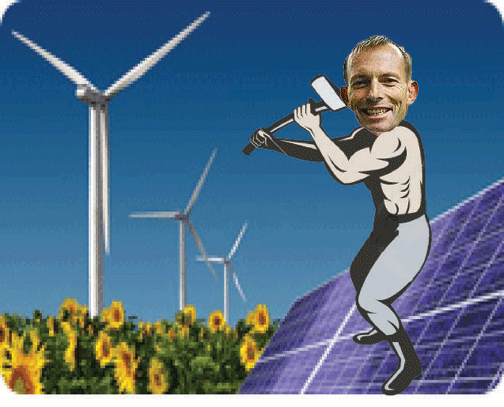 Government’s RET compromise guarantees uncertainty for renewables, Michelle Grattan, The Conversation 8 May 15 As the Abbott government prepares Australia’s post-2020 emissions targets for this year’s Paris conference, the chairman of the Prime Minister’s business advisory council has make an extraordinary intervention in the climate debate.
Maurice Newman, writing in the Australian, maintains it’s all a United Nations conspiracy – a power grab of massive proportions.
“This is not about facts or logic. It’s about a new world order under the control of the UN. It is opposed to capitalism and freedom and has made environmental catastrophism a household topic to achieve its objective.”
Newman claims that 95% of the climate models that we’re told prove the link between human emissions and global warming “have been found … to be in error”.
 In his article he targets Christiana Figueres, the executive secretary of the UN’s Framework on Climate Change, who has been visiting Australia. Newman writes that “there is a real chance Figueres and those who share her centralised power ambitions will succeed.
“As the UN’s December climate change conference in Paris approaches, Australia will be pressed to sign even more futile job-destroying climate change treaties.”…………..
The government was urged by a number of its own backbenchers with renewable energy enterprises in their electorates to get the issue sorted. Earlier this week business groups issued a joint statement calling for a deal at 33,000 GWh. The government had been stuck on 32,000, saying that was its last offer.
The industry was anxious the Coalition did a deal with Labor rather than the crossbench for a new RET because bipartisanship is needed to restore some confidence.
But the two-yearly review of the target would ensure that doubt remained in investors’ minds. The Clean Energy Council, representing a substantial part of the sector, said on Friday night that the issue was not worth resolving if the reviews continued every two years.
Labor promises that if it wins the 2016 election, it would revise the target up. But if the Coalition wins, would the target be cut again?
The government hopes the in-principle deal holds so it can see another barnacle scraped of the hull of the Abbott ship.
This has been a saga that, like so many other issues under this government, has been grossly mismanaged.
Listen to the latest politics with Michelle Grattan with guest, Greens co-deputy leader Larissa Waters. http://theconversation.com/governments-ret-compromise-guarantees-uncertainty-for-renewables-41524
Record CO2 in atmosphere – greatest in a million years
 Global CO2 in atmosphere highest in a million years, NOAA says http://www.smh.com.au/environment/climate-change/global-co2-in-atmosphere-highest-in-a-million-years-noaa-says-20150506-ggvufx.html May 7, 2015 Ehren Goossens The amount of heat-trapping carbon dioxide in the atmosphere averaged more than 400 parts per million globally for the first time ever in March, according to US government measurements.
The recording was based on air samples taken from 40 sites around the world, the National Oceanic and Atmospheric Administration said in a statement Wednesday. It’s the highest level of the gas in at least a million years.
Increasing CO2 emissions are blamed for global climate change that causes stronger storms, melting Arctic ice and rising sea levels, according to scientists. This is the first time the emissions have reached that level on a global basis — sites in the Arctic and Hawaii recorded CO2 concentrations over 400 ppm in 2012 and 2013, respectively.
“This marks the fact that humans burning fossil fuels have caused global carbon dioxide concentrations to rise more than 120 parts per million since pre-industrial times,” Pieter Tans, lead scientist for the agency’s Global Greenhouse Gas Reference Network, said in the statement. Half of that rise has occurred since 1980, he said.
As climate changes, flood danger to nuclear sites could bring meltdowns
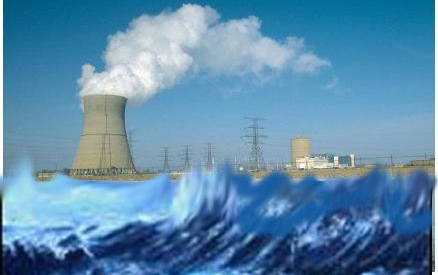
Flood risk to nuclear sites raises meltdown fears. http://www.dailyclimate.org/tdc-newsroom/2015/05/Flood-risk-to-nuclear-sites-raises-meltdown-fears Sea level rise, storm surges and bursting dams all pose an increasing danger to nuclear power stations as the climate changes. By Paul Brown Climate News Network LONDON – Safety checks following the Fukushima disaster in Japan in March 2011, when a 10 metre-high sea wall was overtopped by a tsunami, have shown that nuclear plants are at greater risk of catastrophic flooding as a result of climate change.
Why nuclear power will have no effect in combatting climate chnage
The arguments that nuclear power offers the solution to climate change are dead wrong for several reasons: [outlined further down in this article]
Even if we decided to replace all fossil-fuel plants with nuclear reactors – leaving cost issues aside – it would not be technically possible to build them quickly enough to meet even the modest targets of the Kyoto Protocol. In the U.S., up to 1,000 new reactors (nearly 10 times the current base) would be required at a cost of about $1.5 trillion to $2.0 trillion, based on industry estimates of $1,500-$2,000/KW for new nuclear plant construction. In fact, Alvin M. Weinberg, former director of Oak Ridge National Laboratory argues that, in order to make a serious dent in carbon emissions, it would take perhaps four times as many reactors as suggested by the MIT study, or up to 4,000 reactors .
 Nuclear Power: Totally Unqualified to Combat Climate Change BY RINALDO S. BRUTOCO , WORDL BUSINESS ACADEMY SEPTEMBER 14, 2014
An Open Letter from the World Business Academy to leading climatologist Dr. James Hansen regarding his advocacy of nuclear power as a solution to global warming.
My colleagues and I at the World Business Academy have followed climate activism for many years and its on-going campaign to restrain the coal and oil industries. Research, congressional testimony, and activism by numerous climatologists to address climate change has brought this very real global threat into the public consciousness and set the stage to develop a strategy for preserving human civilization as we know it. …….
With regard to nuclear energy, the IPCC made the following finding: “Nuclear energy is a mature low-GHG emission source of baseload power, but its share of global electricity generation has been declining (since 1993). Nuclear energy could make an increasing contribution to low carbon energy supply, but a variety of barriers and risks exist (robust evidence, high agreement). Those include: operational risks, and the associated concerns, uranium mining risks, financial and regulatory risks, unresolved waste management issues, nuclear weapon proliferation concerns, and adverse public opinion (robust evidence, high agreement).”[4]……..
The World Business Academy agrees with the substantive findings from these reports and is firmly committed to implementing the most expeditious path towards (i) eliminating or mitigating all sources of carbon and methane emissions and (ii) remediating ambient CO2 levels back to pre-industrial levels……….
Given the urgency of climate-related issues, we were nonetheless deeply vexed with the proposal by Dr. James E. Hansen and other climatologists to embrace nuclear power as a viable component in mitigatiing climate change. As delineated in a joint letter published on November 3rd by Dr. Hansen, Kenneth Caldeira, Kerry Emanuel, and Tom Wigley,[6] it appears that these climate experts may not be as fully informed about nuclear fission as they are about climate change.
A letter dated January 6, 2014 has already been sent to this group by The Civil Society Institute and Nuclear Information and Resource Service which was co-signed by over 300 organizations world-wide, rebutting the assumptions set forth in the November 3rd letter and presenting arguments against the use of nuclear power to mitigate climate change.[7] The World Business Academy was a contributing signatory to the CSI/NIRS letter and proposes in this communication to expand on those arguments and provide additional reference materials in support of our assertions………
the Academy has maintained a permanent research effort on virtually every aspect of nuclear power, has published very frequently on the subject, and has continuously sought solutions for society to mitigate the most harmful side effects of nuclear fission. We are hopeful that further elaboration of the challenges associated with nuclear power will persuade misguided climate activists to embrace more economic, more readily available, and more certain renewable energy technologies which will surpass the nuclear industry’s alleged ability to assist in mitigating climate change without any harmful side effects. Continue reading
Christian crusade for action on climate change
Believer among the skeptics: A Canadian’s crusade to convert Christians to climate change belief, National Post William Marsden | April 24, 2015 WASHINGTON — Climate scientist Katharine Hayhoe, a cheerful, Toronto-born evangelical Christian, has become the hottest ticket in the highly polarized U.S. debate over climate change.
Named in 2014 by Time magazine as one of the 100 most influential people in America, she is sought out by Hollywood stars, applauded by environmentalists and fellow scientists, and a huge draw on the Christian speaking circuit because she has opened the door, if only a crack, to the largest and single most stubborn community of climate skeptics in America — evangelicals.
She has essentially become a missionary among her own people. And in doing so she has single-handedly raised hopes of a potential breakthrough in U.S. climate politics. The reasoning is simple. If you can convince evangelicals of the reality of man-made climate change, the rest of the country will follow………
“So I realize that, sure, most of these people, if you polled them, they would say climate change isn’t real. But if you actually take the time and talk to them, only about 10 per cent of people are hardcore”……..
Climate science was not the issue, she said. The debate was over faith. She faced a wall of Christians who believed that God’s absolute power eclipsed anything that mankind could do to the planet.
Hayhoe countered with scripture stating that while God created the Earth, he gave mankind dominion over it and Christians have to play an active role as its protector and not just its exploiter. Add a pinch of basic climate science and that’s essentially her message.
“I had to be a whole person not just a scientist and I had to share with them why I cared about climate change,” she said. “And for me my faith was a big part of that and for people here their faith is a big part of that.”
The word got out and before long Hayhoe had to meet increasing demands to talk to evangelical and other Christian communities…….
“I see my responsibility not as changing people’s minds but as offering them the information they need to change their minds.”http://news.nationalpost.com/news/a-believer-among-the-skeptics-a-canadians-crusade-to-convert-christians-to-climate-change-belief
Sudden conversion of climate denialist US Senator as he jumps on pro nuclear bandwagon
 The Senate’s Top Climate Denier Redefines Chutzpah http://thinkprogress.org/climate/2015/04/24/3650610/americas-top-climate-denier-now-agrees-top-climate-scientist/ BY JOE ROMM APRIL 24, 2015 THE TRADITIONAL DEFINITION OF CHUTZPAH INVOLVES A GUY WHO KILLS HIS PARENTS, THEN PLEADS FOR MERCY BECAUSE HE IS NOW AN ORPHAN. THE MODERN DEFINITION OF CHUTZPAH INVOLVES … SEN. JAMES INHOFE (R-OK).
The chair of the Senate Environment and Public Works Committee has an Earth Day (!) op-ed arguing we should embrace carbon-free nuclear power because of the threat posed by global warming. You remember Inhofe, the guy who called global warming a hoax, the guy who for over a decade has trashed climate scientists, such as James Hansen, whom he called in 2006 a “NASA scientist and alarmist.”
Apparently, however, Inhofe no longer sees Hansen as radioactive. He writes, without a trace of irony:
How cool is it that Inhofe is now apparently on board with top climatologist Hansen on the urgent need “to avoid dangerous climate change” by accelerated deployment of zero-carbon technologies? Presumably he’ll soon be on board with Hansen’s call for a high and rising carbon dioxide fee (returned to the public as a dividend), and a World War II scale effort to return CO2 levels back to 350 parts per million from their current level of 400 ppm (and rising 2+ ppm a year).
As an aside, what’s holding nuclear power back is its exorbitant price. Indeed, just this week a panel of experts unanimously agreed that nukes have all but priced themselves out of the market. Perhaps Inhofe should have supported the climate bill that came out of the House of Representatives in 2009, since its carbon pricing mechanism would have been nuclear power’s best chance at a resurgence.
As for Inhofe’s bromancing of Hansen, I suspect it is unrequited, but then they say politics does make for strange bedfellows. Or at least for new definitions of chutzpah.
Exploding the myth of nuclear energy as a low carbon source
When it comes to nuclear power, the industry wants you to think of electricity generation in isolation
Every aspect of the nuclear fuel cycle—mining, milling, shipping, processing, power generation, waste disposal and storage—releases greenhouse gases,

Why Do People Claim that Nuclear Power is a Low-Carbon Source of Energy?, Washington’s Blog
Even well-known, well-intentioned scientists sometimes push bad ideas. ……..
some scientists are under the mistaken impression that nuclear power is virtually carbon-free, and thus must be pushed to prevent runaway global warming. (If you don’t believe in global warming, then this essay is not aimed at you … although you might wish to forward it to those who do.)
But this is a myth. Amory Lovins is perhaps America’s top expert on energy, and a dedicated environmentalist for close to 50 years. His credentials as an energy expert and environmentalist are sterling…….
Lovins says nuclear is not the answer:
Nuclear plants are so slow and costly to build that they reduce and retard climate protection.
Here’s how. Each dollar spent on a new reactor buys about 2-10 times less carbon savings, 20-40 times slower, than spending that dollar on the cheaper, faster, safer solutions that make nuclear power unnecessary and uneconomic: efficient use of electricity, making heat and power together in factories or buildings (“cogeneration”), and renewable energy. The last two made 18% of the world’s 2009 electricity, nuclear 13%, reversing their 2000 shares–and made over 90% of the world’s additional electricity in 2008.
Those smarter choices are sweeping the global energy market. Half the world’s new generating capacity in 2008 and 2009 was renewable. In 2010, renewables except big hydro dams won $151 billion of private investment and added over 50 billion watts (70% the total capacity of all 23 Fukushima-style U.S. reactors) while nuclear got zero private investment and kept losing capacity. Supposedly unreliable windpower made 43-52% of four German states’ total 2010 electricity. Non-nuclear Denmark, 21% wind-powered, plans to get entirely off fossil fuels. Hawai’i plans 70% renewables by 2025.
In contrast, of the 66 nuclear units worldwide officially listed as “under construction” at the end of 2010, 12 had been so listed for over 20 years, 45 had no official startup date, half were late, all 66 were in centrally planned power systems–50 of those in just four (China, India, Russia, South Korea)–and zero were free-market purchases. Since 2007,nuclear growth has added less annual output than just the costliest renewable–solar power –and will probably never catch up. While inherently safe renewable competitors are walloping both nuclear and coal plants in the marketplace and keep getting dramatically cheaper, nuclear costs keep soaring, and with greater safety precautions would go even higher. Tokyo Electric Co., just recovering from $10-20 billion in 2007 earthquake costs at its other big nuclear complex, now faces an even more ruinous Fukushima bill.
Since 2005, new U.S. reactors (if any) have been 100+% subsidized–yet they couldn’t raise a cent of private capital, because they have no business case. They cost 2-3 times as much as new windpower, and by the time you could build a reactor, it couldn’t even beat solar power. Competitive renewables, cogeneration, and efficient use can displace all U.S. coal power more than 23 times over–leaving ample room to replace nuclear power’s half-as-big-as-coal contribution too–but we need to do it just once.
(Read Lovins’ technical papers on the issue here.)
Alternet points out:
Mark Cooper, senior fellow for economic analysis at the Vermont Law School … found that the states that invested heavily in nuclear power had worse track records on efficiency and developing renewables than those that did not have large nuclear programs. In other words, investing in nuclear technology crowded out developing clean energy.
BBC notes:
Building the [nuclear] power station produces a lot of CO2 ….
Greenpeace points out:
When it comes to nuclear power, the industry wants you to think of electricity generation in isolation ….. And yet the production of nuclear fuel is a hugely intensive process. Uranium must be mined, milled, converted, enriched, converted again and then manufactured into fuel. You’ll notice the [the nuclear industry] doesn’t mention the carbon footprint of all steps in the nuclear chain prior to electricity generation. Fossil fuels have to be used and that means CO2 emissions.
An International Forum on Globalization report – written by environmental luminaries Ernest Callenback, Gar Smith and Jerry Mander – have slammed nuclear power as catastrophic for the environment:Nuclear energy is not the “clean” energy its backers proclaim. For more than 50 years, nuclear energy has been quietly polluting our air, land, water and bodies—while alsocontributing to Global Warming through the CO2 emissions from its construction, mining, and manufacturing operations. Every aspect of the nuclear fuel cycle—mining, milling, shipping, processing, power generation, waste disposal and storage—releases greenhouse gases, radioactive particles and toxic materials that poison the air, water and land. Nuclear power plants routinely expel low-level radionuclides into the air in the course of daily operations. While exposure to high levels of radiation can kill within a matter of days or weeks, exposure to low levels on a prolonged basis can damage bones and tissue and result in genetic damage, crippling long-term injuries, disease and death.
See this excellent photographic depiction of the huge amounts of fossil fuel which goes into building and operating a nuclear power plant.
Nature reported in 2008:
“You’re better off pursuing renewables like wind and solar if you want to get more bang for your buck.”……. http://www.washingtonsblog.com/2013/04/nuclear-is-not-a-low-carbon-source-of-energy.html
Australia’s PM Tony Abbott sacked real climate scientists, now funds dodgy Bjorn Lomborg
 Lomborg’s influence over key ministers in the Abbott government is quite well-known. He is seen to be at the centre of much of federal cabinet’s climate groupthink………
The real travesty of funding Lomborg’s newest franchise is that it comes from the same government that defunded the Climate Commission. This was composed of Australia’s best climate scientists, economists and energy experts, with an operating cost of A$1.5 million per year. This, more than even the most horrendous of storms, really exposes the parlous state of the Abbott government’s desertion of future generations
As such, one has to have some sympathy for Lomborg, who is a strange kind of “climate change refugee”. In 2012, the Danish government pulled all funding from his centre. Since, he has only set up shop in countries that have strong climate change-denying lobbies – both in the private sector and within mainstream media. He has enjoyed this in the US.
Lomborg operates by attaching himself to these centres as an adjunct professor, which will be his title at UWA, rather than a staff member. This offers the freedom to command remuneration well above a professorial salary – such as the US$775,000 he was paid in 2012 by the CCC and the US$200,484 paid for his work in 2013………
a book, The Lomborg Deception, that focuses solely on the lack of rigour in Lomborg’s books The Skeptical Environmentalist (2001) and Cool It (2007).
The Lomborg Deception’s author, Howard Friels, documented how footnote after footnote does not support anything that Lomborg says. In Cool It, Lomborg opens with a claim directly ignoring research by the International Union for the Conservation of Nature showing that polar bear numbers in the Arctic are in terminal decline. He is bold enough to suggest they are actually increasing.
The problem is that Lomborg’s sources consist of a blog and a study that nowhere mentions polar bears – not even the ones that are dead. Not much rigorous thought and analysis there.
The mere fact that Lomborg’s franchise-style “consensus” centre is here is an indictment on the climate politics environment in Australia. The centre subverts the term “consensus”, which is otherwise famous for the 97% of climate scientists who have verified the fact of global warming.
But, what is perhaps a new low for Australia is how the federal funding for Lomborg’s centre was not even subject to a competitive process. Instead, it was through negotiations personally held between Lomborg and Education Minister Christopher Pyne.
Lomborg’s influence over key ministers in the Abbott government is quite well-known. He is seen to be at the centre of much of federal cabinet’s climate groupthink………
The real travesty of funding Lomborg’s newest franchise is that it comes from the same government that defunded the Climate Commission. This was composed of Australia’s best climate scientists, economists and energy experts, with an operating cost of A$1.5 million per year. This, more than even the most horrendous of storms, really exposes the parlous state of the Abbott government’s desertion of future generations.http://theconversation.com/the-bjorn-supremacy-is-australia-getting-the-climate-advice-it-deserves-40716
Business realities are catching up with climate denialists
There’s even a fierce battle brewing in Florida between the Koch brothers and a free market Tea Party group pushing for solar power—a clear sign that, as with gay marriage, there is no longer just one single monolithic conservative position. Continue reading
Getting out of fossil fuel investment: Guardian media group takes that step
Guardian Media Group to divest its £800m fund from fossil fuels, Guardian, Damian Carrington, 2 Apr 15 @dpcarrington GMG becomes largest fund yet known to pull out of coal, oil and gas companies in a move chair Neil Berkett calls a ‘hard-nosed business decision’ justified on ethical and financial grounds. The Guardian Media Group (GMG) is to sell all the fossil fuel assets in its investment fund of over £800m, making it the largest yet known to pull out of coal, oil and gas companies.
The decision was justified on both financial and ethical grounds, said Neil Berkett, GMG chair: “It is a hard-nosed business decision, but it is influenced by the values of our organisation. It is a holistic decision taking into account all of those things.”
Berkett said fossil fuel assets had performed relatively poorly in recent years and were threatened by future climate change action, while an ethical fund already held by GMG had been a “stellar” performer and renewable energy was growing strongly. “This means we can adopt socially responsible investment criteria without putting at risk the core purpose of GMG’s investment funds: to generate long-term returns that guarantee the financial future and editorial independence of the Guardian in perpetuity,” he said.
A series of analyses have shown that current reserves of coal, oil and gas are several times greater than can be burned whilst limiting climate change to the internationally agreed limit of 2C. The fast-growing, UN-backed divestment campaign argues that the business models of fossil fuel companies, which continue to spend billions on searching for new reserves, are endangering the climate. The campaign also argues many fossil fuel assets could become worthless if the world’s governments act to curb global warming, a risk taken seriously by the World Bank and the Bank of England.
The Guardian’s Keep it in the Ground campaign is asking the world’s two biggest charitable funds – the Bill and Melinda Gates Foundation and the Wellcome Trust– to divest their endowments from all fossil fuels. Over 180 groups around the world have already taken this step, including Syracuse University, which on Tuesday committed to divesting its $1.18bn (£799m) endowment. Previously, the largest fund to divest from all fossil fuels was the Rockefeller Brothers Fund ($860m (£582m)), a fortune that originated from the company that became ExxonMobil. Others, including the world’s largest sovereign wealth fund, held by Norway, have divested from coal companies……..http://www.theguardian.com/environment/2015/apr/01/guardian-media-group-to-divest-its-800m-fund-from-fossil-fuels
Thousands of years for the oceans to recover from climate change
the abrupt fluctuations offer a glimpse at the duration of the effects of climate change driven by human activity pumping more planet-warming gases into Earth’s atmosphere, Moffitt said.
“What this shows us is that there are major biomes on this planet that are on the table, that are on the chopping block for a future of abrupt climate warming and unchecked greenhouse gas emissions,” Moffitt said. “We as a society and civilization have to come to terms with the things that we are going to sacrifice if we do not reduce our greenhouse gas footprint.
 Oceans might take thousands of years to recover from climate change, study suggests, SMH, April 2, 2015 Geoffrey Mohan Naturally occurring climate change lowered oxygen levels in the deep ocean, decimating a broad spectrum of seafloor life that took some 1,000 years to recover, according to a study that offers a potential window into the effects of modern warming.
Earth’s recovery from the last glacial period, in fact, was slower and more brutal than previously thought, according to the study, published online Monday in the journal Proceedings of the National Academy of Sciences.
Researchers deciphered that plotline from a 30-foot core of sea sediments drilled from the Santa Barbara Basin off the coast of California containing more than 5,000 fossils spanning nearly 13,000 years.
“The recovery does not happen on a century scale; it’s a commitment to a millennial-scale recovery,” said Sarah Moffitt, a marine ecologist at the University of California, Davis’ Bodega Marine Laboratory and lead author of the study. “If we see dramatic oxygen loss in the deep sea in my lifetime, we will not see a recovery of that for many hundreds of years, if not thousands or more.”………
beginning around 13,500 years ago, the seafloor community began a slow recovery with the rise of grazers that fed on bacterial mats. Recovery eventually was driven by a fluctuation back toward glaciation during the Younger Dryas period, a cooling sometimes called the Big Freeze.
“The biological community takes 1,000 years to truly recover to the same ecological level of functioning,” Moffitt said. “And the community progresses through really interesting and bizarre states before it recovers the kind of biodiversity that was seen prior to the warming.”……..
The climate changes chronicled in the study arose from natural cycles involving Earth’s orbit of the sun, and the oxygen declines that ensued were more extreme than those that have occurred in modern times, the study noted.
Still, the abrupt fluctuations offer a glimpse at the duration of the effects of climate change driven by human activity pumping more planet-warming gases into Earth’s atmosphere, Moffitt said.
“What this shows us is that there are major biomes on this planet that are on the table, that are on the chopping block for a future of abrupt climate warming and unchecked greenhouse gas emissions,” Moffitt said. “We as a society and civilization have to come to terms with the things that we are going to sacrifice if we do not reduce our greenhouse gas footprint.” http://www.smh.com.au/environment/climate-change/oceans-might-take-thousands-of-years-to-recover-from-climate-change-study-suggests-20150401-1md7qk.html
It’s time now for a tax on carbon
Why Now Is the Right Time for a Carbon Tax http://blogs.wsj.com/experts/2015/04/02/why-now-is-the-right-time-for-a-carbon-tax/ MARGARET WALLS: The current downturn in the oil and gas business, like the ups and downs of the cycles that came before it, is fundamentally a result of demand and supply. Weak economic activity in Europe, China and elsewhere has led to reduced demand at the same time that increased exploration and development, particularly from U.S. unconventional sources, has increased supply.
The low prices are creating winners and losers in the U.S., but the biggest loser may be the environment. As consumption of gasoline, diesel, jet fuel and other refined petroleum products rises in response to lower prices (and it will, mark my words), emissions of carbon dioxide and other greenhouse gases will rise, too, exacerbating the already dire projections for global climate change. The time couldn’t be better for implementing a carbon tax.
The timing is right for two important reasons. For one thing, low oil prices will dampen the blow. A tax of $25 a ton of CO2 would raise gasoline prices by about 25 cents a gallon, keeping pump prices still far below where they were a year ago. For another, a carbon tax might help to avert some capital investment decisions that would lock in higher emissions. Many observers are worried that low oil prices may lead households to increase purchases of SUVs and other gas guzzlers, cause manufacturers to back off from conversions of oil-fired boilers, and dampen plans for a variety of renewable-energy investments. A carbon tax would provide the right consumption and investment incentives.
As former Treasury Secretary Larry Summers put it in advocating for a carbon tax, “that which is not paid for is overused.” We pay a price for energy but that price reflects only its private costs and benefits and not the externalities associated with its use, the most serious of which is climate change. The call for a carbon tax is now coming from many quarters.
Former Secretary of State George Shultz has made an impassioned plea for a revenue-neutral carbon tax, an option many economists have supported for years. Coupling a carbon tax with reduced income or payroll taxes can improve the environment and the tax code. A lump sum per household annual “climate dividend” is another option.
Congress is gridlocked but a revenue-neutral carbon tax should have appeal to both political parties. And with oil prices at a five-year low, no time could be better.
Margaret Walls (@margaretwalls1) is research director and senior fellow at Resources for the Future, an independent nonprofit research organization in Washington, DC.
Read the latest Energy Report.
1 This Month





PLEASE OPPOSE HR 8255 AND S.3639 – bills would accelerate satellite deployment, with no environmental review or safeguards – https://ncstd5li.quorum.us/campaign/169331/
To see nuclear-related stories in greater depth and intensity – go to https://nuclearinformation.wordpress.com
-
Archives
- October 2026 (19)
- September 2026 (339)
- August 2026 (330)
- July 2026 (355)
- June 2026 (287)
- May 2026 (306)
- April 2026 (356)
- March 2026 (251)
- February 2026 (267)
- January 2026 (308)
- December 2025 (358)
- November 2025 (359)
-
Categories
- 1
- 1 NUCLEAR ISSUES
- business and costs
- climate change
- culture and arts
- ENERGY
- environment
- health
- history
- indigenous issues
- Legal
- marketing of nuclear
- media
- opposition to nuclear
- PERSONAL STORIES
- politics
- politics international
- Religion and ethics
- safety
- secrets,lies and civil liberties
- spinbuster
- technology
- Uranium
- wastes
- weapons and war
- Women
- 2 WORLD
- ACTION
- AFRICA
- Atrocities
- AUSTRALIA
- Christina's notes
- Christina's themes
- culture and arts
- Events
- Fuk 2022
- Fuk 2023
- Fukushima 2017
- Fukushima 2018
- fukushima 2019
- Fukushima 2020
- Fukushima 2021
- general
- global warming
- Humour (God we need it)
- Nuclear
- RARE EARTHS
- Reference
- resources – print
- Resources -audiovicual
- Weekly Newsletter
- World
- World Nuclear
- YouTube
-
RSS
Entries RSS
Comments RSS

