Obama props up a failing nuclear industry, with nuclear energy a centerpiece of his climate push!
 For starters, nuclear energy isn’t clean. Although nuclear fission is itself a low-carbon process, the lifecycle carbon cost of nuclear energy production is anything but, with greenhouse gas emissions stemming from uranium mining, milling, processing, enrichment, and transportation, not to mention the years-long—sometimes decades-long—process of actually constructing nuclear reactors.
Rather than prop-up a struggling industry, the Obama administration, and whichever administration follows, should eliminate nuclear from its all-of-the-above energy arsenal, relegating it to the category of dirty energies that, if we don’t curtail now, will leave future generations cleaning up our environmental mess.

Obama Sells Out Human Health and the Environment By Making Nuclear Energy a Centerpiece of Climate Policy http://www.globalresearch.ca/obama-sells-out-human-health-and-the-environment-by-making-nuclear-energy-a-centerpiece-of-climate-policy/5467030By Washington’s Blog Global Research, August 04, 2015
In reality, nuclear is NOT a low-carbon source of energy … and funding nuclear crowds out the development of better sources of alternative energy.
Mark Jacobson – the head of Stanford University’s Atmosphere and Energy Program, who has written numerous books and hundreds of scientific papers on climate and energy, and testified before Congress numerous times on those issues – notes that nuclear puts out much more pollution (including much more CO2) than windpower, and 1.5% of all the nuclear plants built have melted down. Jacobson alsopoints out that it takes at least 11 years to permit and build a nuclear plant, whereas it takes less than half that time to fire up a wind or solar farm. Between the application for a nuclear plant and flipping the switch, power is provided by conventional energy sources … currently 55-65% coal.
No wonder a former Commissioner for the U.S. Nuclear Regulatory Commission says that building nuclear plants to fight global warming is like trying to fight global hunger by serving everyone caviar. More information here, here and here.
Zoe Loftus-Farren explained in the New Republic in January
The EPA’s proposed power-plant regulation provides a carbon credit to states for maintaining nuclear energy production at current levels: in other words, a carbon subsidy for maintaining the nuclear status quo. Following the release of the draft rules, EPA administrator Gina McCarthy made clear that the credit is meant, in part, to help the struggling nuclear industry. “There are a handful of nuclear facilities that, because they are having trouble remaining competitive, they haven’t yet looked at re-licensing,” she said at a roundtable discussion with business leaders in Chicago. If nuclear energy plants begin closing, she warned, “It’s a lot of carbon reduction that needs to be made up for a long period of time.”
Maintaining nuclear power production at current levels isn’t the EPA’s only goal. “Nuclear power is part of an all-of-the-above, diverse energy mix and provides reliable baseload power without contributing to carbon pollution,” the EPA said in a emailed statement. “Nuclear power from current and future plants can help the U.S. meet its goals.”
***
Why is this worrying? In the fight against climate change, anything is better than dirty coal, right?
For starters, nuclear energy isn’t clean. Although nuclear fission is itself a low-carbon process, the lifecycle carbon cost of nuclear energy production is anything but, with greenhouse gas emissions stemming from uranium mining, milling, processing, enrichment, and transportation, not to mention the years-long—sometimes decades-long—process of actually constructing nuclear reactors. “From our perspective, the longstanding problems with nuclear waste, nuclear nonproliferation [and] safety really set nuclear apart from other low carbon energy sources,” says Matthew McKinzie, director of the Natural Resources Defense Council’s Nuclear Program.
***
Rather than prop-up a struggling industry, the Obama administration, and whichever administration follows, should eliminate nuclear from its all-of-the-above energy arsenal, relegating it to the category of dirty energies that, if we don’t curtail now, will leave future generations cleaning up our environmental mess.
The odds of a melt-down at a U.S. nuclear power plant are higher than you might assume.
And even a little radiation can be very harmful to your health. And see this.
Postscript: The Onion parodies Obama’s climate plan by pretending that it:
Creates $500 tax credit for homeowners who install rooftop nuclear reactors
President Obama’s Clean Power Plan does not support existing nuclear reactors
Final Clean Power Plan Drops Support For Existing Nuclear Plants, Forbes, Jeff McMahon, 3 Aug 15 vThe final version of President Obama’s Clean Power Plan does not include aid to existing nuclear power plants at risk of closing because they can’t compete with cheaper natural gas and renewables—a list that includes some of the nation’s most controversial reactors, including Indian Point and Three Mile Island.
In the draft version, EPA had proposed allowing states to count 6 percent of existing nuclear generation toward their clean energy goals, a provision designed to rescue the 6 percent of nuclear capacity considered at risk.
“On further consideration, we believe it is inappropriate to base the BSER (Best System of Emission Reduction) on elements that will not reduce CO2 emissions from affected electric generating units below current levels,” EPA states in the final rule.
“Existing nuclear generation helps make existing CO2 emissions lower than they would otherwise be, but will not further lower CO2 emissions below current levels. Accordingly… the EPA is not finalizing preservation of generation from existing nuclear capacity as a component of the BSER.”
Accordingly, states will not be able to meet their clean energy goals by extending the licenses of existing nuclear plants…………
In 2013, Morningstar identified six nuclear plants that could be next to shut down because of economic conditions:
2. Ginna, NY, Exelon
3. Fitzpatrick, NY, Entergy
4. Three Mile Island, PA, Exelon
5. Davis Beese, OH, FirstEnergy
6. Pilgrim, MA, Entergy
Exelon has also identified its Byron, Quad Cities, and Clinton plants in Illinois as at risk and has campaigned against tax credits for wind energy.
The nuclear industry had campaigned for stronger support for nuclear power in the Clean Power Plan…..http://www.forbes.com/sites/jeffmcmahon/2015/08/03/final-clean-power-plan-drops-support-for-existing-nuclear-plants/
Decommissioned sites need MORE protection against wildfires, not less!
 In Light of Fast Moving Wildfires; Evacuations, US Senators call on NRC to Stop Waiving Emergency Response Measures at Decommissioned Nuclear Sites (to no avail) miningawareness51 July 15
http://cdfdata.fire.ca.gov/incidents/incidents_current
 Despite calls by Senators in 2014 to stop elimination of emergency response measures at decommissioning nuclear reactors: “In June 2015, the Nuclear Regulatory Commission (NRC) approved elimination of off-site emergency planning for San Onofre, even though they know the waste is extremely dangerous. This means fewer emergency planning staff, reduced funding and less radiation monitoring. … The San Onofre fire staff has been reduced. The nuclear plant’s fire and rescue vehicles will be donated to new homes soon, according to Patrick Baughman, San Onofre fire marshal. San Onofre now has an agreement that makes the Camp Pendleton Fire Department the primary firefighting force for the nuclear plant. No details were provided about how this may affect ratepayers and local emergency services in this Southern California Edison July 9, 2015…” Read the rest here: http://sanonofresafety.org/emergency-planning-resources/ Learn more here: Sanonofresafety.org
Unfortunately, the Dry Cask Storage is not the miracle solution which the Senators and many others wish for. (See more at post bottom. [in original] )…..
Unfortunately, the Dry Cask Storage is not the miracle solution which the Senators and many others wish for. This is especially true due to the thin, flimsy nature of the inner, unvented, casks, which are also of questionable quality, and are set out unprotected on parking lots. Furthermore, Holtec requests NRC exemptions which impact safety and quality on a routine basis! For more info, do a search for Holtec within our blog, and consult Sanonofresafety.org Although most of the focus has been Holtec, the other licensed dry casks do not appear better. A Manhattan-like project for nuclear waste is needed. In the meanwhile, there appears need for adding more spent fuel pools to reduce crowding, and reinforcement of the existing ones, and somehow covering them (vented) against earthquake seiche. The spent fuel must spend some time in the pools anyway. A solution must be quickly implemented. https://wordpress.com/read/post/feed/4410547/767161082
Nuclear industry lobbying for tax=payer funding as a ‘carbon emissions cure’
U.S. nuclear operators try to save plants with carbon emission rule, Reuters, WASHINGTON | BY VALERIE VOLCOVICI , 31 July 15, The U.S. nuclear industry has made a last-minute push to urge the Obama administration to protect the country’s 100 nuclear units in its forthcoming carbon rule and prevent the early retirement of several plants.
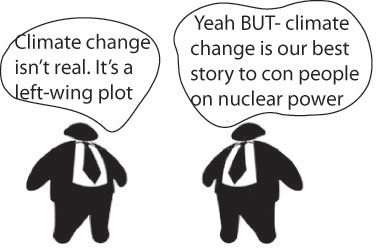
Representatives of the Nuclear Energy Institute met on July 21 with White House officials who are currently reviewing the final version of the Environmental Protection Agency’s Clean Power Plan. The industry contends the original version of the plan, released in mid-2014, fails to encourage states to keep some “at risk” plants from closing.
NEI and other industry officials said the final plan, which is expected as soon as Monday, should provide incentives for states to renew operating licenses and ramp up generation at nuclear plants.
The industry said eight plants – producing about 8,000 MW of generation – struggle to compete in competitive electricity markets. The lobby group argued that the loss of even one of these zero-carbon emission plants would be “a major blow to carbon reduction efforts.”
The details were posted on the White House Office of Management and Budget website.
The Clean Power Plan is the centerpiece of President Barack Obama’s climate change strategy, which seeks to slash power plant carbon emissions to 30 percent below 2005 levels by 2030……..
Fine – talk about nuclear power – but don’t pretend that it’s “low emissions”
The technology trap Could new types of nuclear power station solve the problem? “Fast breeder reactors” produce more nuclear fuel than they use and so would theoretically have much lower life-cycle CO2 emissions than existing “burner” reactors. But in practice breeders are even more complex, dangerous and expensive than burners. As a result they have been stuck at the demonstration stage for decades and even some nuclear proponents admit that breeders are unlikely to be commercialized for at least another two decades, if ever.
The government’s issues paper mentions the possibility of nuclear reactors based on the thorium fuel cycle, but these are also more complex than uranium-based nuclear energy and there are no commercial systems operating as yet.
To sum up, based on existing commercial technology, nuclear energy is not a solution to the global climate crisis, because it will soon become too emissions-intensive. It is also not a short-term solution, because it is a very slow technology to plan and construct. It is dangerous and very expensive.
Sure, let’s debate nuclear power – just don’t call it “low-emission”,
miningawareness Mark Diesendorf, UNSW Australia, 31 July 15 Nuclear power is back on Australia’s radar. In its recent issues paper released as a preface to September’s Energy White Paper, the Abbott government reopened the debate thus:
With environmental considerations constraining the further development of hydro-electric sources, nuclear technologies continue to present an option for future reliable energy that can be readily dispatched into the market.
This sentence appears in a passage dealing with the “move to low-emissions energy”, and although nuclear is not explicitly described as a low-emission option, it certainly looks as if the government is prepared to consider embracing nuclear power as part of an alleged move away from fossil fuels.
Is nuclear energy really low-emission?
Unfortunately, the notion that nuclear energy is a low-emission technology doesn’t really stack up when the whole nuclear fuel life cycle is considered.
In reality, the only CO2-free link in the chain is the reactor’s operation. All of the other steps – mining, milling, fuel fabrication, enrichment, reactor construction, decommissioning and waste management – use fossil fuels and hence emit carbon dioxide.
Several analyses by researchers who are independent of the nuclear industry have found that total CO2 emissions depend sensitively on the grade of uranium ore mined and milled. The lower the grade, the more fossil fuels are used, and so the higher the resulting emissions. Continue reading
Forget the politics: carbon taxing is the best way to limit greenhouse emissions
 Was carbon taxation ever given a fair go?……..
Pricing carbon: the simpler, the better..….. If we are to reduce carbon-emitting activities, the prices of those activities must be increased. Appropriate prices are the key here, and one way to make people happier about paying them is to make them as simple and transparent as possible. That’s what a carbon tax does
Politics aside, a simple carbon tax makes more sense than a convoluted emissions trading scheme, The Conversation, David Hodgkinson Associate Professor at University of Western Australia Rebecca Johnston Adjunct Lecturer, Law School at University of Notre Dame Australia July 31, 2015 Writing recently on The Conversation, Clive Hamilton correctly pointed out that an emissions trading scheme (ETS) can in no sense be called a tax – the two are fundamentally different. Under an ETS, the amount of emissions is fixed by the government and the market then sets the price; under a carbon tax, the price of emissions is fixed and polluters decide how much to emit.
In this sense, Hamilton is right to opine that “emissions trading is the opposite of a carbon tax”. But during Australia’s fractious debate about climate policy in recent years, the two have often been conflated together, and we have generally been starved of sober analysis of the contrasting merits of different policy instruments.
To put it more succinctly, what are the actual merits of a carbon tax, specifically as opposed to an ETS?
Start small
A carbon tax could begin at a relatively low level, to avoid economic disruption, and then could increase steadily and predictably over time. This would encourage affected companies to cut their emissions and to use energy more efficiently, in turn encouraging a move to lower-emission technology. As a result, companies that made better progress in cutting their emissions would have fewer costs to pass on to their consumers, leading to more competitive prices.
A carbon tax would provide government revenue which could then be used to reduce or offset other taxes, such as corporate and personal income tax. A carbon tax could be “revenue-neutral”, either through offsetting other taxes or by using the proceeds to subsidise alternative fuel industries and projects.
Taxes are relatively easy to understand, having been around for centuries in one form or another. For Yale University economist William Nordhaus, the advantages are even clearer when compared to the operation of an international ETS. He recently proposed redesigning climate treaties to adopt a “club model” in which participating states enact carbon taxes in concert with one another, which Nordhaus describes as “the easiest way” to deliver costly emissions reductions.
Price-based taxes capture revenue more cheaply and easily than quantitative instruments such as an ETS, not least because tax-collection infrastructure is already in place. Taxation has lower administrative and compliance costs than carbon trading.
Taxation is arguably more direct and transparent than emissions trading, and affords less opportunity for gaming, speculation or corruption; money moves from polluters directly to the government.
A carbon tax provides price certainty and stability (as opposed to the volatility of prices for tradable carbon permits) and a fixed price for carbon emissions across all economic sectors and markets. This price certainty allows corporations more easily to determine the viability of new, clean technology investments.
Finally, the argument for carbon taxation is concisely made by Harvard economist Richard Cooper:
Decisions to consume goods and services made with fossil fuels are made by over a billion households and firms in the world. The best and indeed only way to reach all these decision makers is through the prices they must pay. If we are to reduce CO2-emitting activities, we must raise the prices of those activities. Levying a [tax] … does that directly.
Was carbon taxation ever given a fair go?……..
Pricing carbon: the simpler, the better..….. If we are to reduce carbon-emitting activities, the prices of those activities must be increased. Appropriate prices are the key here, and one way to make people happier about paying them is to make them as simple and transparent as possible. That’s what a carbon tax does. https://theconversation.com/politics-aside-a-simple-carbon-tax-makes-more-sense-than-a-convoluted-emissions-trading-scheme-45433
Ecomigration happening as climate change already submerging islands
Vanishing Paradise Kiribati – A Case of Ecomigration : Dr Abe V Rotor http://avrotor2.blogspot.com.au/ 31 July 15 Kiribati main island is formerly Atoll Christmas, named by Captain Cook when he arrived on Christmas Eve in 1777. The island, like most islands in the region, faces irreversible submergence and sea water intrusion as a result of rising sea level brought about by global warming. The island was used as nuclear testing ground by the United States in the fifties and sixties.
Aerial view of the Kiribati group of islands. Rising sea level is forcing inhabitants to leave permanently their home islands, a classical example of modern day exodus – ecomigration. Displaced inhabitants are being settled mainly in Australia, New Zealand and Papua New Guinea.

Kiribati (pronounced /ˈkɪrɨbæs/ ( listen) KIRR-i-bas;[4] Gilbertese: [ˈkiɾibas]), composed of 32 atolls and one raised coral island, dispersed over 3.5 million square kilometres, (1,351,000 square miles) straddling the equator, and bordering the International Date Line at its easternmost point. Kiribati is the only country in the world located on both hemispheres and lying on both sides of the 180th meridian.
The groups of islands are:
* Banaba: an isolated island between Nauru and the Gilbert Islands
* Gilbert Islands: 16 atolls located some 930 miles (1,500 km) north of Fiji
* Phoenix Islands: 8 atolls and coral islands located some 1,100 miles (1,800 km) southeast of the Gilberts
* Line Islands: 8 atolls and one reef, located about 2,050 miles (3,300 km) east of the Gilberts.
Caroline Atoll channel between west side of Long Island and Nake Island.
Used for nuclear testing in the 1950s and 1960s, the island is now valued for its marine and wildlife resources. It is particularly important as a seabird nesting site—with an estimated 6 million birds using or breeding on the island, including several million Sooty Terns.
According to the South Pacific Regional Environment Program, two small uninhabited Kiribati islets, Tebua Tarawa and Abanuea, disappeared underwater in 1999. The islet of Tepuka Savilivili no longer has any coconut trees due to salination. The UN Intergovernmental Panel on Climate Change predicts that sea levels will rise by about half a metre (20 in) by 2100 due to global warming and a further rise would be inevitable. It is thus likely that within a century the nation’s arable land will become subject to increased soil salination and will be largely submerged.
Rising level level is also being felt in many countries, particularly island-countries like the Philippines.
Ocean food chain affected as acidity impacts phytoplankton
 Ocean acidification is impacting phytoplankton now http://www.enn.com/wildlife/article/48810 Steve Williams, Care2, July 26, 2015 Scientists are warning that ocean acidification is impacting microorganisms in our ocean known as phytoplankton and, as they pay a key role in ocean habitats, any future loss or change in species numbers could impact marine life in a big way.
Ocean acidification isn’t always mentioned in conjunction with phytoplankton blooms, and the U.S. Government has been slow to link the two, but MIT researchers say acidification of our oceans could impact phytoplankton in a big way, and that will be bad news for our marine life.
Publishing in the journal Nature Climate Change, the scientists say their research shows that ocean acidification–where our oceans absorb gasses like carbon dioxide and sulphor dioxide that are released during the burning of fossil fuels–will increase to such an extent that by 2100 several species of phytoplankton will die out, robbing several larger marine species of a vital food source, while other phytoplankton species will rapidly increase in number, threatening the delicate balance of marine habitats and even potentially threatening the bird populations that depend on marine life.
According to the National Ocean Service (NOAA), phytoplankton are organisms that function in much the same way as the plants we see around us. They contain chlorophyl and depend on sunlight. For that reason they tend to float close to the surface of the water where they can get as much sunlight as possible. They also take in nutrients like nitrates, phosphates and sulfur.
In marine environments phytoplankton play a key role and are a food source for a number of species, from tiny animals like shrimp and snails, all the way up to jellyfish and even whales.
Simpler climate document for UN Paris negotiations

 New UN document seeks to simplify Paris climate negotiations http://www.abc.net.au/news/2015-07-28/new-un-document-seeks-to-simplify-paris-climate/6653016 The United Nations has released a streamlined negotiating text in a bid to help nations agree on a climate deal during talks in Paris later this year.
UN officials say the 83-page document delivers a clearer picture of a possible agreement, by offering an insight into which parts of a treaty could be enshrined in international law.
But while some organisations say the move will help to cut through red tape, others say the UN paper failed to address human rights.
Oxfam Australia is one organisation that’s examined the plan, and its Food, Climate and Humanitarian Advocacy manager Kelly Dent says while some aspects of the paper are positive, there is not enough mention of climate adaptation – an increasingly important issue for the Pacific.
If South Australia gets nuclear facilities, they’ll be endangered by increasing wildfires
If the radiation leak lasts more than a few hours, there is no viable safe plan. If the radiation plume passes, the ground will probably still be contaminated
Wildfires also threaten Nuclear Waste and Nuclear Waste Shipments
 Wildfires and Nuclear Don’t Mix: Lessons from San Onofre and Chernobyl to Australia https://wordpress.com/read/post/feed/4410547/762849951 [good
photos] miningawareness 27 July 15 As the deadline looms (3 Aug.) for comments regarding the risks of the nuclear fuel chain for South Australia – whether uranium mining, which is already occurring, or any proposed additions (uranium enrichment, nuclear energy, nuclear waste), foremost in everyone’s minds should be the
risk of Bushfires (Wildfires), as well as endangerment to the Great Artesian Basin (GAB) aquifer, upon which so much of Australia is dependent for water, and which is being depleted, and most assuredly contaminated, by uranium and other mining:https://miningawareness.wordpress.com/2015/07/25/nuclearcommissionsaust-have-your-say-for-the-future-of-south-australia-submissions-close-soon-july-theme/ (Australia’s uranium mining “generates less than 0.2 per cent of national export revenue and accounts for less than 0.02 per cent of jobs in Australia.”http://www.conservationsa.org.au/images/Nuclear_Royal_Commission_issues.pdfMeanwhile it is laying waste to the land and provided nuclear fuel for Fukushima)
“The Australian climate is generally hot, dry and prone to drought. At any time of the year, some parts of Australia are prone to bushfires with the widely varied fire seasons reflected in the continent’s different weather patterns. For most of southern Australia, the danger period is summer and autumn.” http://www.ga.gov.au/scientific-topics/hazards/bushfire/basics/where
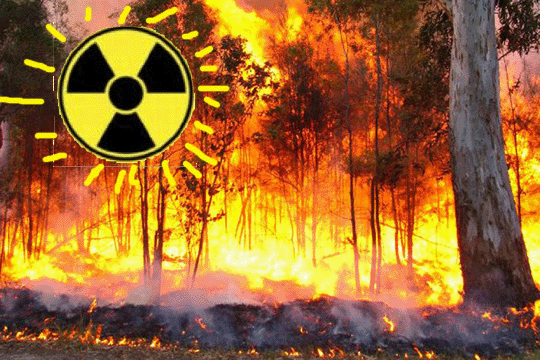
2015 Wildfires Near Chernobyl http://www.mns.gov.ua/news/40286.html
In April of this year, and again from the end of June into mid July, hundreds of firefighters in the Ukraine bravely battled fires in the area of the Chernobyl nuclear power station. Smoldering peat fires were the hardest to put out.
http://www.mns.gov.ua/news/40286.html
While this represents a serious danger to Europe, it received shockingly little media coverage. Continue reading
Climate change danger hangs over China’s coastal cities (and their nukes!)
Climate change threatens China’s booming coastal cities, says expert, Guardian, Peng Yining , 25 July 15
With an ageing society and more people living by the coast, China faces a challenge coping with climate change, reports China Daily A recent study led by Georgina Mace, ecosystem professor at University College London, indicated that governments across the world have failed to grasp the risk that population booms in coastal cities pose as climate change continues to cause rises in sea levels and extreme weather events. Mace is director of the UCL Centre for Biodiversity and Environment Research.
Mace says population growth in coastal areas can lead to big increases in exposure to extreme weather. The biggest direct effect of projected climate change is heat waves. The number of people dying from extreme heat could increase twelvefold by the end of this century, as a result of global warming combined with increasing numbers living in affected areas.
“People are increasingly living in the wrong places, and the demographic shift in China is enormous. China has a lot of old people who are vulnerable to extreme weather,” says Mace………

The commission also released a report in July indicating that by 2030, China will have 230 million rural residentswho have relocated to urban areas and the urbanisation rate will reach 70%.
Increased urbanisation will also exacerbate the effects of climate change, particularly among elderly citizens who are more vulnerable to extreme weather, Mace said recently at the release of the latest climate change report commissioned by the UK Foreign and Commonwealth Office.
The report, drawn up by experts from UK, the United States, China and India, demonstrated risks triggered by climate change, including extreme weather and social instability, and also stressed the potential impact on coastal areas caused by rising sea levels
“The reason we chose to work with China is very much because of the population factor. The eastern coastal region is highly populated, and the sea level is rising. That could be a big challenge,” says David King, the UK foreign secretary’s special representative for climate change, who led the project……… http://www.theguardian.com/environment/2015/jul/25/climate-change-threatens-chinas-booming-coastal-cities-says-expert
Draft for UN climate deal needs to be shorter and clearer
U.N. climate deal draft must be shorter, clearer: minister BY MEGAN ROWLING LONDON (Thomson Reuters Foundation) 23 July 15 – Ministers working towards a new U.N. deal to tackle climate change, due in December, need a negotiating text that is shorter and more manageable than the current draft, the Marshall Islands’ foreign minister said after informal talks in Paris.“It should be something that people can understand, be able to work with and negotiate from,” chief diplomat Tony de Brum told the Thomson Reuters Foundation by phone from France.
The current version of the draft text is a bewildering 85-page list of options, incorporating the demands of the nearly 200 nations participating in the process.
At the last round of formal U.N. talks in June, negotiators slimmed the document down by only a few pages and tasked the co-chairs with preparing a new version, to be published on Friday.
This unofficial document is expected to streamline the text, and may provide more structure aimed at sorting the elements of the draft into a potential core legal agreement and an accompanying set of decisions.
The message from this week’s two-day gathering in Paris of around 40 countries’ delegations, including 26 with ministers, and an earlier meeting of the world’s major economies was that the negotiating text should be short – around 40 pages – and ambitious, de Brum said………….
(Reporting by Megan Rowling; editing by Tim Pearce; Please credit the Thomson Reuters Foundation, the charitable arm of Thomson Reuters, that covers humanitarian news, women’s rights, trafficking, corruption and climate change. Visit www.trust.org) http://www.reuters.com/article/2015/07/22/us-climatechange-un-paris-idUSKCN0PW1NR20150722
Congo’s forgotten uranium mine
In Congo, silence surrounds forgotten mine that fuelled first atom bombs, Aljazeera America
The US sourced uranium for the weapons used on Japan from Shinkolobwe; though the site is closed, locals mine illegally July 23, 2015 by Tom Zoellner One of the manifest ironies of the nuclear age is just how primitive it all is. A complicated war was brought to an end within a week by a pair of indiscriminate hammer blows. The logic behind the next 45 years of Cold War military strategy — hit us and we both die — was as simplistic as it was problematic. And driving everything was a bomb fashioned out of dirt.
A particular kind of dirt, of course, and one that required a lavish industrial process before it could be made into a fissile device. That dirt is uranium, and it lies all around the world in abundant quantities. A place where it was concentrated to levels of freakish purity is now just a curious footnote of the nuclear age, but at one time, it was treated with intense secrecy.
Shinkolobwe was a small settlement in the Katanga province of what was then the Belgian Congo……….
The mine produced uranium for U.S. nuclear weapons until 1960, when enough uranium mines had opened up in the American Southwest to meet the nuclear hunger, and Shinkolobwe was closed. The Belgians poured concrete down the mineshaft and closed off the pit.
I visited Shinkolobwe in 2007, 120 miles from the city of Lubumbashi over disintegrating roads through the rain forest. A permit to go there cost $80, payable to a member of the presidential staff. We had to walk the last several kilometers until we reached a decrepit fence overgrown with vines.
Sharp’s hill had given way to an immense pit, which had been chewed over for decades by local freelance miners. The mineshaft the Belgians built and then filled with concrete had been dug away to a depth of about 100 feet and fallen over. The scene was disquietingly peaceful. Though we had been told it was heavily guarded, no soldiers or police were there to challenge us.
The birthplace of the Bomb has been forgotten by the outside world but not by everyone. Teams of Congolese miners kept slipping inside the old pit to dig out residual supplies of copper and cobalt, which they sell on the black market. There have been persistent rumors — and some occasional instances — of local businessmen selling uranium to outside parties. There is also evidence that some of the Shinkolobwe uranium has found its way into Iranian centrifuges, though this remains publicly unconfirmed by Western intelligence agencies…….http://america.aljazeera.com/articles/2015/7/23/in-congo-silence-surrounds-forgotten-mine-that-fueled-first-atomic-bombs.html
Stephen Harper, Canada’s PM blocking action on climate change

 Canada’s PM blocking climate reform, says Ontario premier Kathleen Wynne, Guardian, Suzanne Goldenberg , 21 July 15 Leader of country’s biggest province condemns Stephen Harper ahead of elections: ‘There isn’t a collaborative process around any of this’ The leader of Canada’s biggest province has escalated her feud with the country’s prime minister, accusing Stephen Harper of obstructing efforts to fight climate change and calling on Canadians to make global warming a decisive issue in the coming elections.
In an interview with the Guardian, Kathleen Wynne, the Liberal premier of Ontario, brought long-simmering tensions with Harper over energy and economic policy to a rollicking boil, repeatedly calling out the Conservative prime minister for blocking efforts to cut carbon pollution.
When it came to fighting climate change, Harper was an obstruction rather than a help, she said……….
Wynne called on Canadians to vote on climate change in the October elections. “I hope that climate change and taking action on climate change is an election issue,” she said.
As premier, Wynne has championed the efforts of Ontario and other provinces to deal with climate change. Last week’s meeting of 22 states, provinces and territories called for setting a price on carbon.
Ontario won positive attention when it phased out the use of coal in its power plants last year.
But the environmental commissioner said on 7 July that theprovince would have to do much more to meet its 2020 target for cutting greenhouse gas emissions.
Wynne’s advisers said she hoped to cut carbon pollution from transport by investing in public transit and easing congestion.
Climate change looms even larger over Harper, who faces increasing criticism at home and abroad tying Canada’s economic future to the development of the tar sands.
At international climate conferences, the Harper government now is routinely handed out mock “fossil” awards for its failure to deal with climate change. Campaigners have accused Harper of treading on the rights of government scientists……..
Wynne said Canada should have put forward a more ambitious climate pledge ahead of the UN negotiations in Paris.
Canada will not meet its 2020 target for cutting emissions because of the tar sands, and it has retreated still further from those earlier promises in its pledge ahead of the Paris climate talks……..http://www.theguardian.com/world/2015/jul/21/canada-climate-change-kathleen-wynne-stephen-harper-ontario
Australia’s Cardinal George Pell criticises Pope Francis for his stand on climate change

Christina Macpherson’s websites & blogs
I thought we had enough to worry about with our government leader Tony Abbott. Now our religious heavy is out to dceny climate change. I’m ashamed to be Australian!
Cardinal George Pell criticises Pope Francis over climate change stance , SMH, July 19, 2015 Kerrie Armstrong Cardinal George Pell has publicly criticised Pope Francis’ decision to place climate change at the top of the Catholic Church’s agenda.
Cardinal Pell, a well-known climate change skeptic, told the Financial Times the church had “no particular expertise in science”.
“The church has got no mandate from the Lord to pronounce on scientific matters,” he said,
“We believe in the autonomy of science.”
1 This Month





PLEASE OPPOSE HR 8255 AND S.3639 – bills would accelerate satellite deployment, with no environmental review or safeguards – https://ncstd5li.quorum.us/campaign/169331/
To see nuclear-related stories in greater depth and intensity – go to https://nuclearinformation.wordpress.com
-
Archives
- October 2026 (19)
- September 2026 (339)
- August 2026 (330)
- July 2026 (355)
- June 2026 (287)
- May 2026 (306)
- April 2026 (356)
- March 2026 (251)
- February 2026 (267)
- January 2026 (308)
- December 2025 (358)
- November 2025 (359)
-
Categories
- 1
- 1 NUCLEAR ISSUES
- business and costs
- climate change
- culture and arts
- ENERGY
- environment
- health
- history
- indigenous issues
- Legal
- marketing of nuclear
- media
- opposition to nuclear
- PERSONAL STORIES
- politics
- politics international
- Religion and ethics
- safety
- secrets,lies and civil liberties
- spinbuster
- technology
- Uranium
- wastes
- weapons and war
- Women
- 2 WORLD
- ACTION
- AFRICA
- Atrocities
- AUSTRALIA
- Christina's notes
- Christina's themes
- culture and arts
- Events
- Fuk 2022
- Fuk 2023
- Fukushima 2017
- Fukushima 2018
- fukushima 2019
- Fukushima 2020
- Fukushima 2021
- general
- global warming
- Humour (God we need it)
- Nuclear
- RARE EARTHS
- Reference
- resources – print
- Resources -audiovicual
- Weekly Newsletter
- World
- World Nuclear
- YouTube
-
RSS
Entries RSS
Comments RSS


