New Climate Institute report: The Global Climate Leadership Review 2015: What the Paris negotiations mean for Australia and our economy September 18, 2015. The Global Climate Leadership Review 2015: What the Paris negotiations mean for Australia and our economy summarises global climate developments in the lead up to the Paris climate negotiations in late 2015. It explores what success in Paris would look like and also the impact of the agreement on the global and Australian economies.
The report is also part of the broader project, Focus on Paris & Beyond, that The Climate Institute has conducted throughout 2015. Reports, factsheets, infographics and other content can be accessed here on the project page.
(And check out other recent Climate Institute reports and projects, media releases and briefs and multimedia available at:http://www.climateinstitute.org.au/)
Ending US subsidies would lead to cuts in coal use equivalent to shutting up to 32 coal-fired power stations, according to the report. Damian Carrington, 16 Sept 15
Ending subsidies, that amount to almost a quarter of the sale price in some cases, would hugely reduce carbon emissions, new research reveals
Coal subsidies are costing US and Australian taxpayers billions of dollars a year, according to a new report.
The research examined the subsidies given to coal production in the US’s largest coal field, the Powder River Basin, and found they totalled $2.9bn (£1.9bn) a year. This equates to $8 per tonne, almost 25% of the sale price.
Ending the subsidies would lead to cuts in coal use equivalent to shutting up to 32 coal-fired power stations, the researchers found, leading to a large reduction in carbon emissions.
The report also analysed Australia’s exporting of coal for power stations in Asia and found these came to $1.3bn a year, or $4 a tonne. Ending these subsidies would cut demand by up to 7%, a smaller impact than in the US because coal users could buy supplies from other countries.
“The fossil fuel industry has gamed energy market consumers, with numerous subsidies evident over the long term,” said Tim Buckley, at the Institute forEnergy Economics and Financial Analysis, who worked on the report. “Any discussion of cost competitiveness of renewable energy and energy efficiency needs to take into account the decades of extensive subsidies evident for the coal industry and that, in many cases, remain in place today.”
Luke Sussams, senior researcher at Carbon Tracker Initiative, also part of the research team, said: “Policy makers concerned about climate change and a level playing field in energy markets should look to take coordinated action to remove the distortions to production these subsidies create.”
The subsidies given to coal companies included tax breaks, cheap leases, government-funded infrastructure including railways and ports and allowing inadequate funding of clean-up operation after mining ends.
The G20 nations pledged to end fossil fuel subsidies in 2009, but little action has been taken. However, falling oil and coal prices in the last year have seen some countries starting to reduce subsidies.
A recent study by the International Monetary Fund (IMF) took into account not just direct subsidies but also the cost to nations of the damage caused by air pollution and global warming. It estimated coal, oil and gas were being subsidised by $5.3trn a year, more than the total health spending of all the world’s governments. Much of the cost is due to the illness and death caused by air pollution.
“Eliminating coal subsidies in the Powder River Basin and throughout the world, is an obvious, no-regrets climate strategy,” said Doug Koplow, of Earth Track and another member of the research team.
The new report, called Assessing Thermal Coal Production Subsidies, was produced by the Carbon Tracker Initiative, Energy Transition Advisors, the Institute for Energy Economics and Financial Analysis and Earth Track.
The American Legislative Exchange Council (ALEC) connects state lawmakers with corporate
lobbyists to create model legislation. Koch foundations also fund ALEC. The corporate “bill mill” has approved model legislation to repeal or weaken renewable energy standards, eliminate solar net metering policies, and restrict markets for solar power.
How Charles Koch Prevents Clean Energy Businesses From Succeeding, TruthOut 02 September 2015 By Matthew Kasper, Republic Report| News Analysis Last week, President Obama correctly singled out the Koch brothers – Charles and David – and the Koch-funded network for standing in the way of America’s clean energy Continue reading →
THE WORLD IS LIKELY TO SEE A RETURN TO RAPID WARMING IN THE NEXT COUPLE OF YEARS, SCIENTISTS SAID, IN WHAT COULD SIGNAL THE END OF THE “PAUSE” IN RISING GLOBAL TEMPERATURES.
Experts said big changes were under way in the earth’s climate system, with a natural phenomenon known as El Nino combining with the impact of greenhouse gases to push global temperatures to record highs.
But other changes in the Atlantic Ocean over the coming decades could make relatively cooler and possibly drier summers in the UK and northern Europe more likely.
Globally, the Earth’s climate system was at a “turning point”, with a number of major changes happening at once, the Met Office’s Professor Adam Scaife said.
In the run-up to key United Nations talks in Paris, at which it is hoped a new international agreement to tackle climate change can be agreed, “the signal is very clear” that global warming is happening.
The world has witnessed a slowdown or “pause” in rising temperatures in recent years, which sceptics pointed to as contradicting evidence of ongoing climate change.
The new report from the Met Office, which has been peer-reviewed by the University of Reading’s Professor Rowan Sutton, suggests the world is warming again.
Prof Scaife said experts could not be sure it was the end of the slowdown.
However, rates of warming averaged over decades were likely to reach the high levels seen at the end of the 20th century, when the world was warming rapidly, within two years.
The years 2014, 2015 and 2016 are all likely to be at or near record levels, in part due to the influence of the El Nino phenomenon of surface warming in the Pacific Ocean.
Scientists are very confident there is now a major El Nino under way, which is set to peak this winter, on the scale of an El Nino event in 1998 which helped drive global temperatures to record highs.
But Prof Scaife said natural variations such as El Nino were just the “icing on the cake” on top of human activity which is putting greenhouse gases into the atmosphere and driving climate change.
Tony Abbott faces down Pacific island nations’ calls for tougher action on climate change ABC Radio AM By Eric Tlozek in Port Moresby, 11 Sept 15 Prime Minister Tony Abbott has held his Government’s line on climate change despite pleas from low-lying Pacific island nations for a stronger stance on emissions and temperature rises.
Both Mr Abbott and New Zealand prime minister John Key refused to go further than their existing commitments on global warming at the Pacific Islands Forum in Port Moresby.
Some Pacific island leaders say they are disappointed in the leaders for putting economic growth ahead of the survival of communities in small Pacific nations.
“Australia and New Zealand have made no additional commitments when it comes to climate change,” Mr Abbott told reporters after the meeting last night……….
Pacific island nations had said the meeting was their last chance to highlight the threat they face from climate change, before the UN Climate Conference in Paris.The Australian response disappointed leaders who say some people are already being forced out of their homes by rising salinity, lack of water, or damage from severe storms or high tides………http://www.abc.net.au/news/2015-09-11/pacific-leaders-fail-to-reach-consensus-on-climate-change/6767038
Japan’s torrential downpour overwhelmed Fukushima’s drainage pumps sending hundreds of tonnes of contaminated water flowing into the Pacific! Japanese flooding update, The Big Wobble , 10 Sept 15
Rainfall reached 600 millimetres in the area around Joso, with weather officials expecting at least 200mm more in parts of eastern Japan, including Fukushima, the site of the nuclear reactor crippled in 2011, before the downpour stops on Friday.
Report Says Floods May Pose Threat To Radiation Under Fukushima
The torrential downpour has exacerbated a contaminated water problem at the Fukushima nuclear plant as it overwhelmed the site’s drainage pumps, sending hundreds of tonnes of contaminated water flowing into the ocean, a spokesman for operator Tokyo Electric Power (TEPCO) said.
The continuous torrent of rain water is complicating the already difficult situation in Fukushima where, according to an operator of the Tokyo Electric Power (Tepco), the drainage pumps are not able to evacuate all the water that is pouring into the plant, becoming contaminated and damaging the ‘surrounding environment.
Since 2011, the Tempco has been in charge of storing tons of radioactive water used to cool the reactors at the plant, destroyed by the tsunami……..TEPCO is storing huge volumes of water used to cool reactors that were sent into meltdown when a tsunami hit Japan in 2011……..
waist-high floods in some areas left rescuers scrambling to pluck people to safety as a wide area was deluged in the wake of Typhoon Etau.
“This is a scale of downpour that we have not experienced before.
Grave danger could be imminent,” forecaster Takuya Deshimaru told an emergency press conference. Etau, which smashed into Japan on Wednesday, moved out into the Sea of Japan (East Sea) by the end of the day, but a wall of rain continued to lash the country……http://www.thebigwobble.org/2015/09/japans-torrential-downpour-overwhelmed.html
Mainichi: Typhoon causes injuries, cancelled trains and flights, radioactive water leak… [TEPCO] announced on Sept. 9 that rainwater contaminated with radioactive materials had leaked from the plant’s drainage system into the ocean. The heavy rains brought on by Typhoon Etau exceeded the capacity of a transfer pump… This is the seventh time of possible or confirmed leaks of radiation-contaminated water since the utility began transferring the water from canal to canal in April… TEPCO says it does not know how much contaminated water leaked into the ocean, and is currently analyzing the concentration of the radioactive matter in the leaked water.
ABC News transcript: Epic flooding in Japan threatening the Fukushima plant… Serious concern this morning about a nuclear power plant in the flood zone… Torrential downpours [are] raising concerns about the Fukushima power plant… Reports that these heavy rains may overwhelm the site’s drainage pumps.
Reuters: A spokesman for operator Tokyo Electric Power (TEPCO) told the Guardian hundreds of tonnes of contaminated water have flowed into the ocean from the Fukushima nuclear plant… Rainfall reached 500 mm around Joso, NHK said, with weather officials expecting at least 200 mm more in parts of eastern Japan, including Fukushima, the site of the nuclear reactor crippled in 2011, before the downpour stops on Friday.
AFP: Japan flags grave danger from floods and water tainted by Fukushima nuke plant radiation— Tens of thousands of people were ordered to evacuate across Japan today as heavy rain pounded the country, sending radiation-tainted waters into the ocean at the crippled Fukushima nuclear plant… The torrential downpour has also exacerbated a contaminated water problem at the Fukushima nuclear plant as it overwhelmed the site’s drainage pumps, a spokesman for operator Tokyo Electric Power said.
Weather Channel: JMA issued landslide warnings parts of Miyagi and Fukushima prefectures, including areas near the Fukushima Daiichi nuclear power plant that suffered a catastrophic meltdown after the 2011 Tohoku earthquake and tsunami. According to the Mainichi Shimbun, a national newspaper, the heavy rain caused contaminated water from the site to run off into the Pacific Ocean for several hours early Wednesday.
UPI: More radioactive water has leaked out from the Fukushima Daiichi nuclear power plant… The heavy rain has caused additional leaks at the damaged Fukushima Daiichi nuclear power plant, where the site’s drainage pumps were overwhelmed — causing radioactive water to leak into the Pacific Ocean.
Telegraph: The huge rains also exacerbated a contaminated water problem at the crippled Fukushima nuclear plant as it overwhelmed the site’s drainage pumps, sending radiation-tainted water into the ocean.
Guardian: The heavy rain, which is expected to spread north on Friday, has also caused additional leaks of radioactive water at the stricken Fukushima Daiichi nuclear power plant… The meteorological agency warned that heavy rain would continue in the northeast, including Fukushima prefecture, until early Friday morning.
Bloomberg: The storm caused contaminated water from the wrecked Fukushima nuclear plant to leak into the ocean… Contaminated water at Tokyo Electric Power Co.’s Fukushima Dai-Ichi facility leaked into the Pacific Ocean at about 12:30 a.m. on Wednesday, company spokesman Tatsuhiro Yamagishi said by phone, adding that company is still investigating the leak.
ABC Australia: Fukushima tainted water flows into ocean… weather officials [are] expecting at least 200mm more in parts of eastern Japan, including Fukushima, the site of the nuclear reactor crippled in 2011, before the downpour stops on Friday. The torrential downpour has exacerbated a contaminated water problem at the Fukushima nuclear plant as it overwhelmed the site’s drainage pumps, sending hundreds of tonnes of contaminated water flowing into the ocean, a spokesman for operator Tokyo Electric Power (TEPCO) said.
ABC News: In addition to the clear danger facing residents, Japanese authorities are particularly concerned about the flooding, given its proximity to one of the country’s biggest nuclear power plants, Fukushima — damaged by the 2011 earthquake and subsequent tsunami… “The torrential downpour is threatening safety at the Fukushima nuclear plant, closed since the 2011 disaster, as it has overwhelmed drainage pumps at the site’s contaminated water treatment facility,” a Japanese government official told ABC News.
NPR: Floodwaters also “overwhelmed the drainage pumps at the Fukushima nuclear plant,” Japan Times reports, citing a Tokyo Electric Power Co. spokesman who said the flooding sent “hundreds of tons of contaminated water” into the ocean.
Prensa Latina, Sep 10, 2015: Typhoon Etau Causes Leak of Radioactive Water in Fukushima — Typhoon Etau originated leaks of radioactive water from the Fukushima plant in Japan… Leaks occurred in dams located around the tanks storing liquid used to cool the reactors. With this leak, there have been seven detected since last April when a pumping system was implemented to prevent radioactive waste emanating from the reactor to flow in a place away from the plant.
EFE: Contaminated water from Fukushima leaks into sea due to typhoon Etau — The Fukushima plant… has been found to be leaking contaminated water into the sea following heavy rainfall in the region caused by typhoon Etau, a spokesperson of Fukushima’s operator confirmed to EFE Thursday… The leaks have been caused in the embankments around the tanks where highly radioactive water is stored after they are used to cool the reactors…
USA Today: Tens of thousands of people are ordered to flee homes across Japan as heavy rain pounded the country, sending radiation-tainted waters into the ocean at the crippled Fukushima nuclear plant.
Kyodo: Heavy rains whose severity was described as occurring once in 50 years were observed in… Fukushima Prefecture.
CNN: Fukushima prefecture, which was devastated by the 2011 tsunami, saw more than 30 centimeters (1 foot) of rain in 48 hours — the heaviest downpour there in 50 years, NHK said.
Australia’s inaction on climate change set to dominate Pacific Island talks, Guardian, 6 Sept 15Australia and New Zealand are expected to face strong criticism from Pacific Island leaders disappointed the nations are not doing more to combat climate change.
The issue will likely dominate this week’s Pacific Islands Forum leaders summit in Port Moresby, ahead of the United Nations climate change conference in Paris later in the year.
Pacific leaders want the world to work on restricting the global warming temperature rise to 1.5C, fearing a 2C target will risk the survival of many tiny islands.
Massive wildfires transform Siberian paradise into disaster area Mashable, Andrew Freeman 25 Aug 15Dozens of large wildfires are burning out of control around Lake Baikal in Siberia, which is the world’s largest freshwater lake by volume and the deepest lake, at more than 5,300 feet deep. The Lake Baikal area is a popular recreational area during the summer, with campgrounds and cottages surrounding the shoreline.
Because of the composition of the soil in this part of the world, these fires are spewing unusually high amounts of carbon into the atmosphere, thereby contributing to global warming.
The region has seen drier and milder than average weather this year, and a combination of natural and manmade fires have led to a cataclysmic scene, with thick smoke seen from space and orange-tinted skies on the ground.
In July, the Lake Baikal area was one of the most unusually mild areas on Earth, according to NASA data as well as information from the National Oceanic and Atmospheric Administration (NOAA).
Fires have been burning off and on in this area since April, when farmers traditionally burn dried grass to help fertilize the soil. However, this year, many agricultural fires in this region got out of control, killing at least two dozen people and destroying several villages.
Youth Sue Obama Administration For Allowing Climate Change, Violating Constitutional Rights
“We have a moral obligation to leave a healthy planet for future generations.” Huffington Post, 08/12/2015
Twenty-one young people from around the country filed a lawsuit against the Obama administration on Tuesday accusing the federal government of violating their rights by contributing to climate change through the promotion of fossil fuels.
The plaintiffs, who range in age from 8 to 19, filed their complaint in U.S. District Court in Oregon. The complaint lists numerous defendants, including President Barack Obama, Secretary of State John Kerry, the Department of Energy, the Department of the Interior, the Department of Transportation, the Department of Agriculture, the Department of Defense and the Environmental Protection Agency.
“Defendants have for decades ignored their own plans for stopping the dangerous destabilization of our nation’s climate system,” the plaintiffs said in their complaint, which was filed with the help of the Oregon-based nonprofit Our Children’s Trust. “Defendants have known of the unusually dangerous risk of harm to human life, liberty, and property that would be caused by continued fossil fuel use and increase [carbon dioxide] emissions.”
While setting new policies to reduce carbon emissions, the Obama administration has often touted an “all of the above” approach to energy policy that includes oil, natural gas, coal and renewable energy, the complaint continues. By continuing to promote the development and use of fossil fuels, the federal government violated their constitutional rights, the young plaintiffs allege.
“What we are providing is an opportunity for them to participate in the civic democratic process and go to the branch of government that can most protect their rights,” said Julia Olson, the lead counsel on the case………
“We’re the first generation to feel the effects of climate change and the last generation that can do something about it,” the president told an audience at an event in the White House’s East Room, where he unveiled new regulations on emissions from power plants.
But in the eyes of Olson and the plaintiffs, that’s not enough. They are asking for a court orderto force Obama to immediately implement a national plan to decrease atmospheric concentrations of carbon dioxide to 350 parts per million — a level many scientists agree is thehighest safe concentration permissible — by the end of this century. The concentration of carbon dioxide in the atmosphere has already hit 400 parts per million.
“It’s really important that the court step in and do their jobs when there’s such intense violation of constitutional rights happening,” Olson said.
Rising seawater temperatures force Pilgrim to reduce power, Cape Cod Times, 11 Aug 15, Rising temperatures in bay force reduction in power
It was only the second summer in the nuclear plant’s 43-year history that the temperature of the water used to cool the reactor exceeded the federal limit.
To cool its reactors, Pilgrim Nuclear Power Station draws up to 500 million gallons of saltwater a day from Cape Cod Bay through an inlet created by two breakwaters. Merrily Cassidy/Cape Cod Times FileBy Christine Legere clegere@capecodonline.com
PLYMOUTH — The owner of Pilgrim Nuclear Power Station had been planning to ask for a license adjustment that would allow the plant to draw warmer water from Cape Cod Bay than is currently allowed.But the request was not made soon enough.Pilgrim operators were forced to begin preparation for a shutdown late Sunday afternoon, when the temperature of the seawater used to cool the reactor edged above the 75-degree limit set by the Nuclear Regulatory Commission…….
Millstone Nuclear Power Plant in Connecticut, which draws water from Long Island Sound, was the first in the Northeast to shut down because of rising water temperatures, which have become an issue in this region within the past five years. The plant has since secured a maximum intake temperature of 80 degrees on its operating license.“Pilgrim is still looking to increase the maximum saltwater temperature to a higher value, but the supporting analysis is not yet complete,” Lauren Burm, spokeswoman for Entergy Corp., the plant’s owner-operator, said.Last week’s hot spell likely contributed to the rise in the bay’s water temperature, but a spokesman for the Nuclear Regulatory Commission said the plant’s discharge of hot water into the bay also may have been a contributing factor.
“The ballpark estimate on water discharge temperatures at Pilgrim (Sunday) would be about 95 degrees Fahrenheit,” Neil Sheehan said in an email.Under its license, water discharged from the plant may be no hotter than 102 degrees, a level set by the Environmental Protection Agency as part of a water discharge permit…….
Pilgrim draws up to 500 million gallons of saltwater daily from Cape Cod Bay through an inlet created by two breakwaters. The water is circulated through the plant’s condenser via a network of thousands of tubes, cooling down the steam from the reactor and returning it to its water form, Sheehan said.“The higher water temperature affects the efficiency of the heat removal,” Sheehan said.http://www.capecodtimes.com/article/20150811/NEWS/150819916
Three people were killed by a mudslide and one was missing after being swept away by floods in Ningde, in the eastern province of Fujian, the Fujian Daily reported.
In neighbouring Zhejiang province 14 were killed and four were missing, the official news agency Xinhua said earlier, quoting local officials as saying that the dead and missing may have been washed away by floods or buried under ruined homes.
The total direct economic losses in the two provinces were estimated at around eight billion yuan ($1.31 billion), figures from state media showed.
Billed as the biggest typhoon of the year last week with winds of up to 230 kilometres (140 miles) an hour, Soudelor — named for a Micronesian chief — has since weakened.
It made landfall in Fujian on Saturday night after leaving six people dead in Taiwan — including two twin sisters and their mother, who had all been swept out to sea.
It also knocked out power to a record four million households on the island. [Taiwan’s nukes in danger from typhoon,too]
Some 379 people were injured by the storm in Taiwan, which saw rivers break their banks under torrential rain and towering waves pound the coastline.
The China Meteorological Administration lifted its typhoon warning Monday as the storm weakened and moved further inland.
Chernobyl exclusion zone on fire again http://www.rt.com/news/311976-chernobyl-exclusion-
zone-fire/9 Aug, 2015 As many as 32 hectares of new wildfires have been registered in the exclusion zone close to the Chernobyl nuclear power plant, report Ukraine’s emergency services report. Firefighters are battling new fires that have flared up in the Kiev region.
The fires started in three locations close to the villages of Zamostye and Kovshilovka in the Ivankovsky area. As of 7am on Sunday, the fires have been reportedly localized, with firefighters continuing to extinguish burning dry grass and forest cover.
Shortly afterwards, Ukraine’s Ministry of Emergency Situations reported that another forested area, known as Chernobylskaya Pushcha, had caught fire.
“The fire has spread to the abandoned villages of Kovshilovka and Buda Varovichi, located in the exclusion and unconditional (mandatory) resettlement zones,” the ministry said on their website.
The situation has now been brought under control.
Forest fires in Chernobyl’s exclusion zone began in April this year. The head of the State Emergency Service of Ukraine Nikolay Chechetkin said that up to 70 percent of all the wildfires in Chernobyl exclusion zone are due to arson.
Experts warned that radioactive nuclides absorbed by the foliage around Chernobyl nuclear power plant from the soil contaminated as a result of the 1986 disaster can easily be released into the air and have a cumulative negative effect on the health of those who breathe in particles.
While firefighters were dealing with wildfires near Chernobyl from April through to July, the Kiev authorities gave assurances that there was no radiation threat. Territory engulfed by fires in the exclusion zone had reached 400 hectares by the beginning of May.
However, locals recalling the 1986 catastrophe fear that just as then officials are concealing the truth.
If the trees, which have been absorbing radioactivity for almost 30 years, are on fire, then radioactive elements “may spread with wind over long distances,” Yury Bandazhevsky, a scientist working on the sanitary consequences of the Chernobyl disaster, said in May.
The record hot air temperatures have come on due to a combination of factors. First, the ocean around Japan is abnormally warm. Recently, near-Japan sea surface temperatures have ranged from 2-5 degrees Celsius above established averages. That’s excessively hot water, especially when one considers that El Nino will typically draw the warm waters south and eastward. But this year is not at all typical with unusual-to-record heat now ranging much of the Pacific Ocean basin.
(Extreme sea surface temperatures and a heat dome high pressure system are setting the stage for record heatwaves and tragic heat injuries in Japan. Ocean temperatures in the region have ranged up to 5-6 C above average for this time of year. Image source: Earth Nullschool.)
Near Japan, the added ocean warmth lends both heat and humidity to the air about the archipelago land mass. A combination that can push wet bulb readings into ranges that are ever more difficult for human bodies to manage.
Concordant with the exceptionally hot waters surrounding Japan is a heavy heat dome high pressure system dominating the atmosphere above it. This heat dome, as with many weather systems under the regime of human-caused climate change, has been doggedly persistent. Setting up an excessively long-lasting period of record heat that has now continued off and on for weeks.
Multiple Heatwave Mass Casualty Events for Record Hot 2015
Under human-forced climate change it’s a sad fact that heatwaves proliferate. We are now four times more likely to experience a heatwave on any part of the globe than we were back during the 1880s. Before our fossil fuel burning warmed the global climate by 1 degree Celsius. And as maximum temperatures and humidity push toward and past the wet bulb limit of 35 C, we are unfortunately likely to see more and more of these heatwave mass casualty events.
The Point of No Return: Climate Change Nightmares Are Already Here
The worst predicted impacts of climate change are starting to happen — and much faster than climate scientists expected, Rolling Stone, By Eric Holthaus August 5, 2015 Historians may look to 2015 as the year when shit really started hitting the fan. Some snapshots: In just the past few months, record-setting heat waves in Pakistan and India each killed more than 1,000 people. In Washington state’s Olympic National Park, the rainforest caught fire for the first time in living memory. London reached 98 degrees Fahrenheit during the hottest July day ever recorded in the U.K.; The Guardian briefly had to pause its live blog of the heat wave because its computer servers overheated. In California, suffering from its worst drought in a millennium, a 50-acre brush fire swelled seventyfold in a matter of hours, jumping across the I-15 freeway during rush-hour traffic. Then, a few days later, the region was pounded by intense, virtually unheard-of summer rains. Puerto Rico is under its strictest water rationing in history as a monster El Niño forms in the tropical Pacific Ocean, shifting weather patterns worldwide.
On July 20th, James Hansen, the former NASA climatologist who brought climate change to the public’s attention in the summer of 1988, issued a bombshell: He and a team of climate scientists had identified a newly important feedback mechanism off the coast of Antarctica that suggests mean sea levels could rise 10 times faster than previously predicted: 10 feet by 2065. The authors included this chilling warning: If emissions aren’t cut, “We conclude that multi-meter sea-level rise would become practically unavoidable. Social disruption and economic consequences of such large sea-level rise could be devastating. It is not difficult to imagine that conflicts arising from forced migrations and economic collapse might make the planet ungovernable, threatening the fabric of civilization.”
Eric Rignot, a climate scientist at NASA and the University of California-Irvine and a co-author on Hansen’s study, said their new research doesn’t necessarily change the worst-case scenario on sea-level rise, it just makes it much more pressing to think about and discuss, especially among world leaders. In particular, says Rignot, the new research shows a two-degree Celsius rise in global temperature — the previously agreed upon “safe” level of climate change — “would be a catastrophe for sea-level rise.”
Hansen’s new study also shows how complicated and unpredictable climate change can be. Even as global ocean temperatures rise to their highest levels in recorded history, some parts of the ocean, near where ice is melting exceptionally fast, are actually cooling, slowing ocean circulation currents and sending weather patterns into a frenzy. Sure enough, a persistently cold patch of ocean is starting to show up just south of Greenland, exactly where previous experimental predictions of a sudden surge of freshwater from melting ice expected it to be. Michael Mann, another prominent climate scientist, recently said of the unexpectedly sudden Atlantic slowdown, “This is yet another example of where observations suggest that climate model predictions may be too conservative when it comes to the pace at which certain aspects of climate change are proceeding.”
Since storm systems and jet streams in the United States and Europe partially draw their energy from the difference in ocean temperatures, the implication of one patch of ocean cooling while the rest of the ocean warms is profound. Storms will get stronger, and sea-level rise will accelerate. Scientists like Hansen only expect extreme weather to get worse in the years to come, though Mann said it was still “unclear” whether recent severe winters on the East Coast are connected to the phenomenon.
And yet, these aren’t even the most disturbing changes happening to the Earth’s biosphere that climate scientists are discovering this year.
For that, you have to look not at the rising sea levels but to what is actually happening within the oceans themselves.
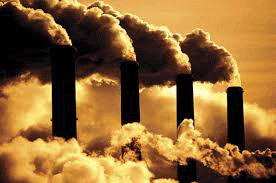 US and Australian taxpayers pay billions a year to fund coal – report, http://www.theguardian.com/environment/2015/sep/16/us-australian-taxpayers-pay-billions-fund-coal