Climate change action can be stopped by Trans Pacific Partnership
 How TPP threatens our progress on climate change http://www.sfchronicle.com/opinion/openforum/article/How-TPP-threatens-our-progress-on-climate-change-9223661.php By Van Jones September 14, 2016
In the past month, wildfires forced tens of thousands of people across California to evacuate their homes. Over the same period, historic floods in Louisiana destroyed or damaged more than 60,000 homes, uprooting families and ruining lives.
This fall, Congress is likely to vote on the Trans-Pacific Partnership — an agreement among 12 nations along the Pacific Rim. While billed as a “free trade” deal, most of the TPP is actually about creating new rights for multinational corporations, including the big polluters most responsible for the climate emergency.
Under the TPP, the biggest global firms — including many responsible for offshore drilling and fracking — would be able to sue American taxpayers over laws and regulations that are meant to protect public health and the environment. Rather than suing in regular courts, these corporations would, through the TPP, be able to sue before unaccountable arbitration panels — each panel made up of three corporate lawyers — who could award unlimited cash compensation. Similar rules in other trade deals have already made possible nearly 700 such lawsuits — including efforts to challenge the U.S. rejection of the Keystone XL pipeline and a moratorium on fracking in Quebec.
What does this mean for California?
TPP would allow multinational corporations that own gas-fired power plants from Alameda County to San Diego County to threaten state restrictions on carbon emissions — including some of the new world-leading standards recently passed in Sacramento. The deal would also vastly increase the number of fracking firms and offshore drilling companies that could challenge our protections.
But it’s not about just dirtier air and water or more susceptibility to climate risks. It’s also about jobs.
Because TPP would threaten a successful California rebate program for green technologies that are made in-state, the deal could result in the elimination of good-paying green jobs in fields like solar and wind manufacturing and energy efficiency. Green jobs employ all kinds of people — truck drivers, welders, secretaries, scientists — all across the state. These jobs can pull people out of poverty while protecting the planet.
Given that California has lost an estimated 413,000 manufacturing jobs since America entered NAFTA and the World Trade Organization, we can’t afford to pass a new trade deal and again undermine people’s livelihoods.
But there’s good news. Labor, environmental and social justice leaders now oppose the TPP, as do both major presidential nominees, House Democratic Leader Nancy Pelosi, and Senate Democratic Leader Harry Reid.
Still, some in Washington are scheming to pass the TPP during Congress’s “lame duck” session after the election. While most members of California’s Congressional delegation firmly oppose the deal, some remain on the fence.
As the consequences of climate change get clearer, the case against the TPP gets stronger.
Van Jones is president and founder of the Dream Corps, and is a regular CNN contributor.
Weigh in
You can reach Congress directly by calling (888) 701-6507 and let your representative know that you oppose TPP.
Nuclear power a hindrance, not a help, to climate change action
 Is nuclear crucial to climate change targets?, Japan Times, AFP-JIJI, AP SEP 16, 2016
  PARIS – As Britain greenlights its first new nuclear power plant in more than 20 years, experts diverge on the role of nuclear energy in the quest to cap global warming at less than 2 degrees Celsius.
The broad challenge in meeting that goal — the cornerstone of the Paris Agreement inked in December by 195 nations — is decarbonizing the world economy as quickly as possible.
“We need a global transition to primarily zero carbon energy sources by midcentury,” said Rachel Cleetus, lead economist and climate policy manager for the Washington-based Union of Concerned Scientists (UCS).
Along with other think tanks and advocacy groups sounding the climate change alarm, the UCS is not a champion of nuclear power……
Not all climate and energy experts, however, are convinced that nuclear is crucial for keeping a lid on global warming.
“In fact, it’s a barrier,” said Tom Burke, chairman of London-based E3G, a climate change think tank. “It takes away capital from things that would deliver faster, cheaper and smarter low carbon electricity systems,” he said. It also runs counter, he added, to a wider trend toward decentralized, flexible power generation.
For climate analyst Martin Kaiser of Greenpeace International, “the only feasible and secure way to keep global warming well below 2 degrees Celsius is a massive swing toward renewables.” A “100 percent” renewable energies revolution is still possible, he insisted.
For Williams, potential climate catastrophe trumps the risks associated with nuclear power — radioactive waste, accidents such as happened in Fukushima and Chernobyl — only with strict regulatory oversight in place.
He highlighted the contrast between gold-standard Switzerland and China, which has 30 nuclear plants built or under construction, and another 20 in the pipeline.
“China has relatively understaffed and undertrained regulatory authorities — that is worrisome,” he said.“Would I live next to a nuclear power plant if I thought that was really important to mitigate climate change? “In the first case (Switzerland) I would, but in the second I wouldn’t.” http://www.japantimes.co.jp/news/2016/09/16/business/nuclear-crucial-climate-change-targets/#.V9yIWVt97Gg
Low Arctic sea ice in 2016 – close to record low level
These Images Show Near-Record Low 2016 Arctic Sea Ice, Climate Central , By Brian Kahn September 15th, 2016 Arctic sea ice is one of the grandaddy’s of climate indicators. And this grandaddy isn’t doing so good these days.This year’s sea ice extent has bottomed out as the second lowest on record, according to the National Snow and Ice Data Center. It continues a troubling trend as rapidly warming air and water eats away at the briny, frozen mantle on the top of the planet.
2016’s Arctic Sea Ice Melt Season in 9 Seconds
This year has been exceptional by many standards. March saw the lowest sea ice maximum ever recorded followed by a string of record low months. The Northwest Passage opened up, allowing a luxury cruise ship to travel from Anchorage to New York. And a freak storm in August turned ice thin and brittle near the North Pole.
Satellites show the last seven months of sea ice and reveal its steep decline this year. The late August breakup is particularly notable. Grist’s Amelia Urry compared the texture of sea ice near the North Pole to curdled milk or an exploded pillow (I’d go with broken glass personally, but to each their own)………
Most of what we tend to talk about with Arctic sea ice comes courtesy of satellites since they’re the most reliable way to monitor such a remote region. Recent research has reconstructed Arctic sea ice data back to 1850 using old ship logs, airplane survey and military records among other sources to provide a longer record than satellite data (though it does come with a little bit more uncertainty). What is certain is that there’s nothing in modern history like the recent string of low Arctic sea ice years we’ve seen.
Sea ice has declined precipitously across the Arctic, but particularly in the Beaufort and Chukchi Sea regions. In the coming decades, sea ice extent is only likely to keep shrinking and could reshape the region’s ecology, economy and ways of life for the plants, animals and people that call the region home. http://www.climatecentral.org/news/2016-low-arctic-sea-ice-20702
Marshall Islanders culture threatened: emigration as sea level rises
 Lives in the balance: climate change and the Marshall Islands [excellent video]
The numerous atolls that make up the island nation are now regularly swamped due to sea level rise. But as more people flee for the US, many fear their culture will be lost to a country that has already taken so much from them, Guardian, by Oliver Milman and Mae Ryan in Majuro, Marshall Islands, and Springdale, Arkansas, 15 Sept 16
There may be music in the roar of the sea, as Byron eulogized, but the waves can also bring creeping unease. On low-lying fragments of land like the Marshall Islands, the tides are threatening to take away what they previously helped support: life.
Hilda Heine surveys the latest temporary sea wall that cleaves her property from the waves. It has been knocked down twice since February by floods and she frets about her plants that will probably face a salty demise.
Her vista would, sadly, be unremarkable in the Marshall Islands were it not for the policeman languidly guarding the corrugated metal wall – Heine is the president of the Pacific island nation. Here, no one is spared the rising seas.
“I need a better wall, one with rocks,” Heine mutters. Her presidency will probably be defined by climate change. Heine took charge in January and immediately declared a state of emergency over a drought so dire that water was rationed in the capital, Majuro. The nation also faces the existential threat of sea level rise and, with it, the potential exodus of its population.
“The numbers are increasing, of people leaving,” Heine says. “We see that almost every day. It concerns us. I think to a certain extent there are people who are thinking about the sea level rise and they’re wanting to make sure they’re on secure land.”
Better job prospects and a college education are major pulls, but climate change is now elbowing its way on to the list of considerations. A third of the Marshall Islands’ 60,000-strong population now resides in the US and some of those left behind fret that many more will follow, with the archipelago’s unique culture blemished by each departure. The Marshallese government has openly worried “about massive outmigration in recent years” – a fifth of the population left between 1999 and 2011.
As the seas rise, the pathway to the US could be closing. A compact of free association, which allows Marshallese people to live and work in the US without a visa, ends in 2023 and there are no guarantees it will be extended. Those already living in the US would be able to stay but, if the agreement isn’t extended, those living in the Marshall Islands will be treated like hopeful migrants from any other country……..
In 2014, after five-meter swells inundated Majuro for the third time in a year (historically, something that only happened once every few decades), the US Geological Survey released sobering research that shows that a mix of sea level rise and marauding waves means “many atoll islands will be flooded annually, salinizing the limited freshwater resources and thus likely forcing inhabitants to abandon their islands in decades, not centuries, as previously thought”.
The escape route is there, for now, but it has come at a cost. The option of moving to the US was born from the Marshall Islands’ misfortune of being under US administration during the cold war.
Between 1946 and 1958, the US conducted nuclear weapons testing on the islands, peppering Bikini atoll alone with 23 bombs. The largest, known as the Bravo shot, was 1,000 times more powerful than the Hiroshima bomb and vaporized three small islands.
While Bikini was evacuated, the wind blew radioactive detritus on to the inhabited atolls of Rongelap and Utrik. “Within hours, the atoll was covered with a fine, white, powder-like substance,” says Jeton Anjain, who led the eventual evacuation of Rongelap. “No one knew it was radioactive fallout. The children played in the snow. They ate it.”
Cancers, particularly of the thyroid, riddled many of those who came into contact with this radioactivity. But the wounds of dispossession are the ones that run deepest, 70 years on. https://www.theguardian.com/environment/2016/sep/15/marshall-islands-climate-change-springdale-arkansas
Polar bears losing habitat as sea ice melting earlier, and refreezing later
Polar bears losing crucial sea ice: study, Guardian,14 Sept 16 Life-sustaining sea ice needed for hunting, resting and breeding is declining in all 19 regions of the Arctic inhabited by the species Polar bears are losing life-sustaining sea ice crucial for hunting, resting and breeding in all 19 regions of the Arctic they inhabit, a study warned on Wednesday.
As climate change pushes up Arctic temperatures, ice is melting earlier in spring and refreezing later in autumn, a team of researchers reported in the Cryosphere, a journal of the European Geosciences Union.
Satellite data revealed that the total number of ice-covered days across the 19 regions declined at a rate of seven to 19 days per decade from 1979 to 2014, the researchers said.
“Their dependence on sea ice means that climate warming poses the single most important threat to (polar bears’) persistence,” wrote the team……..
Scientists say the Arctic is warming at nearly double the global rate as a result of climate change fuelled by mankind’s burning of fossil fuels, a process that emits heat-trapping greenhouse gases.
With longer iceless periods, polar bears have to swim further and further to find solid ground.
Last year, the International Union for the Conservation of Nature (IUCN) said the creatures could see their numbers dwindle by nearly a third by mid-century…….https://www.theguardian.com/environment/2016/sep/14/polar-bears-losing-crucial-sea-ice-study-arctic
Extreme drought: the impact of climate change and El Nino on the Amazon rainforest
El Niño, global warming combine to cause extreme drought in Amazon rainforest, Science daily September 14, 2016 Source: Asociación RUVID
- Summary:
- The impact the current 2015/2016 El Niño is having in Amazonia has been revealed by new research. Areas of extreme drought and changes to their typical distribution in the region are among the most evident consequences.
- A study led by researchers at the Global Change Unit at the Universitat de València (UV) shows the impact the current 2015/2016 El Niño is having in Amazonia. Areas of extreme drought and changes to their typical distribution in the region are among the most evident consequences.
- The El Niño effect is part of a cycle of global heating and cooling associated with the changing temperatures of a band of ocean water in the central and east-central equatorial Pacific ocean. Repeating every three to five years, it is one of the main drivers of climate variability. Although its consequences are felt at the global level, its impact on tropical forests — particularly the Amazon rainforests — are considered particularly significant, since this ecosystem is considered one of the planet’s main carbon sinks……
- The study, by researchers at the Universitat de València and published in Scientific Reports, shows how the current El Niño event is associated with an unprecedented heating of Amazonia, reaching the highest temperature in the last forty years and, probably, the last century. Additionally, extreme drought has hit a much larger area of this region than usual and is distributed atypically, with extremely dry conditions in the northeast and unusual wetting in the southeast (something which occurred in 2009/2010, though to a lesser extent).According to the UV scientists, this fact, not observed in the 1982/1983 and 1997/1998 events, implies that, the more the central equatorial Pacific is heated, the more marked the difference between and distribution of the wet zones and areas of extreme drought in the Amazon rainforest………https://www.sciencedaily.com/releases/2016/09/160914090454.htm
Brazil’s increase in fires in Amazon region – alarming news
The alarming number of fires in the Brazilian Amazon, Mongabay, 8 September 2016 / Commentary by Natália Girão Rodrigues de Mello
For three months, from September to December 2015, Manaus was engulfed in smoke, resembling Beijing. That was an unusual scene, and an undeniable sign that predatory exploration in the Brazilian Amazon has not yet been properly tackled.
- The sharp decrease in the annual rates of forest loss in the Brazilian Amazon is celebrated worldwide. The trend started in 2005 after a peak in deforestation the year before.
- However, the figures are not so bright when it comes to forest fires, and few people are talking about that.
- The number of fires in the Brazilian Amazon is alarming, and that was especially true in 2015, when a sharp increase in forest fires occurred………
- Natural factors alone fail to explain this recent increase, as similar climatic conditions in the past were not associated with the same amount of forest fires.
Forest fires and precipitation are strongly correlated in the Brazilian Amazon; in dry years, more forest fires occur. 2015 was a dry year, but not as dry as 2010 or 2005 were – years when the region faced anomalous droughts. Nevertheless, in 2015, forest fires increased 115.6 percent and 105.5 percent compared to 2005 and 2010, respectively. Hence it is safe to say that the peak observed last year was strongly associated with unregulated anthropogenic activities in the forest.
In the region, using fire in order to clear large areas is a common practice. The expansion of roads, settlements, croplands and cattle ranches has been leading fires to reach ever-wider areas of the forest.
The consequences associated with this issue are vast. They are felt locally, regionally and globally. Forest fires contribute to climate change due to the emission of three greenhouse gases: carbon dioxide, methane, and nitrous oxide. As the forest burns, health-damaging gases – carbon monoxide, non-methane hydrocarbons, methyl chloride, and methyl bromide – are also emitted, as well as volatile organic compounds (VOCs) and aerosols. VOCs interact with nitrous oxides to form ozone, a phytotoxic gas. Aerosols cause the suppression of cloud formation and the decrease of precipitation efficiency. Moreover, a positive feedback between fire-induced death of trees and increased solar penetration in the forest occurs, resulting in the intensification of successive fires…….https://news.mongabay.com/2016/09/the-alarming-number-of-fires-in-the-brazilian-amazon/?utm_content=buffer4318b&utm_medium=social&utm_source=twitter.com&utm_campaign=buffer
Climate change is a threat to nuclear power, with reactors over-heating and high water demand
 Amid climate concerns, nuclear plants feel the heat of warming water , Midwest Energy
  News, Kari Lydersen, 10 Sept 16 Nuclear power proponents say the energy source is crucial to reducing the impact of climate change.
But ironically, “We’ll have to solve global warming if we want to keep using nuclear power,” says Union of Concerned Scientists nuclear safety expert Dave Lochbaum.
That’s because nuclear power plants need large amounts of water for cooling, and overheating can present a major safety risk. As the lakes and rivers that typically supply cooling water become hotter thanks to climate change — and as droughts dry up some water bodies — nuclear power plants face problems, researchers say.
They may need to temporarily shut down or scale back their generation on hot days, which is just when their power is needed most.
This challenge is the focus of ongoing research spearheaded by Oak Ridge National Laboratory and also involves the national laboratories at Sandia, Los Alamos and Argonne. Researchers are modeling predictions about population, temperature, electricity demand, precipitation, land use and other factors to predict the water-related stress on power plants.
“You need to have enough water to cool the power plants and have drinking water and water for agriculture and other industries,” said Melissa Allen, a leader of the team effort and a post-doctoral researcher at Oak Ridge’s Climate Change Science Institute.……..
Hitting limits
The Nuclear Regulatory Commission sets limits on how warm the cooling water can be for each nuclear plant.
The owners of the Millstone plant in Connecticut, Turkey Point in Florida andBraidwood in Illinois have sought and obtained permission from the NRC to increase the maximum temperature limit for their cooling water, Lochbaum noted.
“Millstone uses the Atlantic Ocean, Turkey Point uses a canal system supplemented by water from the Atlantic Ocean, and Braidwood uses river water,” he said. “As global warming increases the temperature of oceans, lakes and rivers, they will hit these limits more often. There are two choices: to reduce power because you can’t exceed those limits. Or do what Turkey, Braidwood and Millstone did — do the homework to get the limit raised.”
Lochbaum analyzes reports from the NRC showing when nuclear plants scale back generation because of warm water.
In June, nuclear plants in Georgia, South Carolina and Pennsylvania scaled back their generation multiple times because of hot temperatures warming their cooling water. The Limerick power plant on the Schuylkill River near Philadelphia has scaled back because of high temperatures frequently over the past decade, according to the reports.
The Dresden and Quad Cities plants in Illinois had to scale back because of high water temperatures multiple times over the past five years. The Duane Arnold plant in Iowa and the Monticello plant in Minnesota also reported scaling back generation because of temperatures.
When cooling water is warmer, greater volumes are needed to cool the reactor. Plants also typically need approval from the NRC to increase the amount of water they use for cooling or to install new technology — like larger pumps — in order to deal with warmer conditions.
Such changes cost money, and scaling back generation means less profit.
“With plants in the Midwest and Northeast facing competition from natural gas and so on, it’s difficult to find the money even if you can make the justification that the money [invested in new cooling systems] would pay off in two years,” said Lochbaum……..http://midwestenergynews.com/2016/09/09/nuclear-plants-feel-the-heat-of-warming-water/
Closure of Japan’s nuclear reactors in 2011 did not result in a boom for fossil fuels
Japan’s lurch away from nuclear hasn’t caused fossil fuels to boom http://arstechnica.com/science/2016/09/japans-lurch-away-from-nuclear-hasnt-caused-fossil-fuels-to-boom/
The emergency shutdown of nuclear reactors hasn’t been an emissions disaster. JOHN TIMMER –
9/10/2016, In the wake of the meltdown of the Fukushima Daiichi nuclear reactors, Japan shut down its entire nuclear fleet in order to develop more rigorous safety standards and inspect the remaining plants. As of now, plants are only beginning to come back online.
Given that Japan had recently relied on nuclear for over a quarter of its electricity, the expectation is that emissions would rise dramatically. But that hasn’t turned out to be the case. While coal use has gone up, it hasn’t risen by more than 10 percent. And a heavy dose of conservation has cut Japan’s total electricity use to below where it was at the end of last decade The data indicates that nuclear was playing a decreasing role in Japan’s energy mix even prior to Fukushima, being displaced in part by natural gas and in part by petroleum. By 2012, however, nuclear was mostly gone. Conservation had already dropped Japan’s electricity use below a PetaWatt-hour, and further efforts have turned the drop in electricity use into an ongoing trend.
Fossil fuel use has gone up, but not by as much as might be expected. Coal rose by eight percent, and natural gas (transported in its liquefied form) rose by nine percent. These have largely reversed the expansion of petroleum use that began prior to the meltdown at Fukushima. Non-hydro renewables have also more than doubled their electrical production since that time. Combined with hydroelectric plants, they now provide more electricity than petroleum.
The net result of all of this? Carbon emissions have been relatively flat and have not exceeded the nation’s record year back in 2007
Effect of Global Warming on World’s Ocean Circulation – an unknown quantity
A single Atlantic Ocean current system accounts for up to a quarter of the planet’s heat flux.
For now, everyone awaits more data to see whether the AMOC is slowing down and, if so, what that will mean for the planet
How Climate Change Could Jam The World’s Ocean Circulation, 06 SEP 2016: ANALYSIS Scientists are closely monitoring a key current in the North Atlantic to see if rising sea temperatures and increased freshwater from melting ice are altering the “ocean conveyor belt” — a vast oceanic stream that plays a major role in the global climate system.
Environment 360, by nicola jones Susan Lozier is having a busy year. From May to September, her oceanographic team is making five research cruises across the North Atlantic, hauling up dozens of moored instruments that track currents far beneath the surface. The data they retrieve will be the first complete set documenting how North Atlantic waters are shifting — and should help solve the mystery of whether there is a long-term slowdown in ocean circulation. “We have a lot of people very interested in the data,” says Lozier, a physical oceanographer at Duke University.
A similar string of moorings across the middle of the Atlantic, delving as deep as 3.7 miles from the Canary Islands to the Bahamas, has already detected a disturbing drop in this ocean’s massive circulation pattern. Since those moorings were installed in 2004, they have seen the Atlantic current wobble and weaken by as much as 30 percent, turning down the dial on a dramatic heat pump that transports warmth toward northern Europe. Turn that dial down too much and Europe will go into a deep chill.
Researchers have been worried about an Atlantic slowdown for years. The Atlantic serves as the engine for the planet’s conveyor belt of ocean currents: The massive amount of cooler water that sinks in the North Atlantic stirs up that entire ocean and drives currents in the Southern and Pacific oceans, too. “It is the key component” in global circulation, says Ellen Martin, a paleoclimate and ocean current researcher at the University of Florida. So when the Atlantic turns sluggish, it has worldwide impacts: The entire Northern Hemisphere cools, Indian and Asian monsoon areas dry up, North Atlantic storms get amplified, and less ocean mixing results in less plankton and other life in the sea.
A single Atlantic Ocean current system accounts for up to a quarter of the planet’s heat flux.
Modelers have tried to predict how human-caused climate change might impact the Atlantic current, and how its slowdown might muck with the world’s weather even more. But years of intensive peering at this question haven’t yet provided much clarity.
Now, debate is raging about whether the recent Atlantic slowdown has been triggered by climate change, or is just part of a normal cycle of fast and slow currents. New studies in the last few years and months have come out supporting both prospects. The new data from the north, Lozier and others hope, might help to sort things out.
If the North Atlantic current slows dramatically, then the entire Northern Hemisphere would cool; a complete collapse of the current could even reverse global warming for about 20 years. But the heat that ocean currents fail to transport northwards would make parts of the Southern Hemisphere even hotter. And a cooler north isn’t necessarily good news.
The jury is still out. Weakening is a possibility, but it hasn’t been proven yet,’ says one scientist.
Should the AMOC shut down, models show that changes in rainfall patterns would dry up Europe’s rivers, and North America’s entire Eastern Seaboard could see an additional 30 inches of sea level rise as the backed-up currents pile water up on East Coast shores.
But to pin down what the AMOC is going to do, researchers need to better understand what it’s doing right now. And that is proving tricky. ………
The world had better pay attention NOW – to soaring ocean temperatures
Soaring ocean temperature is ‘greatest hidden challenge of our generation’
IUCN report warns that ‘truly staggering’ rate of warming is changing the behaviour of marine species, reducing fishing zones and spreading disease, Guardian, Oliver Milman. 6 Sept 16, The soaring temperature of the oceans is the “greatest hidden challenge of our generation” that is altering the make-up of marine species, shrinking fishing areas and starting to spread disease to humans, according to the most comprehensive analysis yet of ocean warming.
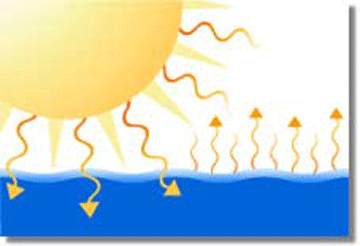
The oceans have already sucked up an enormous amount of heat due to escalating greenhouse gas emissions, affecting marine species from microbes to whales, according to an International Union for Conservation of Nature (IUCN) reportinvolving the work of 80 scientists from a dozen countries.
The profound changes underway in the oceans are starting to impact people, the report states. “Due to a domino effect, key human sectors are at threat, especially fisheries, aquaculture, coastal risk management, health and coastal tourism.”…..
The scale of warming in the ocean, which covers around 70% of the planet, is “truly staggering”, the report states. The upper few metres of ocean have warmed by around 0.13C a decade since the start of the 20th century, with a 1-4C increase in global ocean warming by the end of this century.
The ocean has absorbed more than 90% of the extra heat created by human activity. If the same amount of heat that has been buried in the upper 2km of the ocean had gone into the atmosphere, the surface of the Earth would have warmed by a devastating 36C, rather than 1C, over the past century.
At some point, the report says, warming waters could unlock billions of tonnes of frozen methane, a powerful greenhouse gas, from the seabed and cook the surface of the planet. This could occur even if emissions are drastically cut, due to the lag time between emitting greenhouse gases and their visible consequences.
Warming is already causing fish, seabirds, sea turtles, jellyfish and other species to change their behaviour and habitat, it says. Species are fleeing to the cooler poles, away from the equator, at a rate that is up to five times faster than the shifts seen by species on land.
Even in the north Atlantic, fish will move northwards by nearly 30km per decade until 2050 in search of suitable temperatures, with shifts already documented for pilchard, anchovy, mackerel and herring.
The warming is having its greatest impact upon the building blocks of life in the seas, such as phytoplankton, zooplankton and krill. Changes in abundance and reproduction are, in turn, feeding their way up the food chain, with some fish pushed out of their preferred range and others diminished by invasive arrivals.
With more than 550 types of marine fishes and invertebrates already considered threatened, ocean warming will exacerbate the declines of some species, the report also found…….
Ocean acidification, where rising carbon dioxide absorption increases the acidity of the water, is making it harder for animals such as crabs, shrimps and clams to form their calcium carbonate shells.
The IUCN report recommends expanding protected areas of the ocean and, above all, reduce the amount of heat-trapping gases pumped into the atmosphere.
“The only way to preserve the rich diversity of marine life, and to safeguard the protection and resources the ocean provides us with, is to cut greenhouse gas emissions rapidly and substantially,” said Inger Andersen, director general of the IUCN.https://www.theguardian.com/environment/2016/sep/05/soaring-ocean-temperature-is-greatest-hidden-challenge-of-our-generation
More frequent, more powerful Super Typhoons, with climate change
 Is not the push for nuclear reactors in East Asia (almost always located on coast) a dangerous trend, in view of increasing typhoons?
Super typhoons becoming more powerful and more frequent, new study finds, SMH, Peter Hannam 6 Sept 16 The most destructive categories of tropical storms to strike the heavily populated regions of east Asia are becoming more intense and increasing as much as four-fold in frequency because of climate change, according to new research by US-based scientists.

Since the late 1970s, typhoons making land in a region stretching from Vietnam and the Philippines to Korea and Japan have become 12 per cent to 15 per cent more intense.
Those hitting south-east Asia with a category 4 or 5 strength have more than doubled in number, with the increase even more for China and Taiwan and regions north, the paper published in Nature Geoscience on Tuesday found.
The increase in sea-surface temperature is key to providing extra energy to tropical storms, with the outcome for the megacities of the region looking grimmer……..
“The intensification is strongest for typhoons that tend to make landfall because of the stronger warming of the coastal waters near east and south-east Asia,” said Wei Mei, a researcher in the department of marine sciences at the University of South Carolina and co-author of the paper.
Additional warming is expected to intensify the storms, particularly in some of east Asia’s main economic centres, Dr Mei said: “The typhoons striking mainland China, Taiwan, Japan, and Korea will intensify further because of the faster warming of waters of 20 degrees north.”…….
The north-west Pacific basin has both the largest data set of super typhoon-strength storms and the clearest trend towards intensification as the planet warms, Steve Turton, an adjunct professor at the Central Queensland University, said.
This year has also been an active one for the region………http://www.smh.com.au/environment/climate-change/super-typhoons-becoming-more-powerful-and-more-frequent-new-study-finds-20160905-gr8rch.html
Flooding – a dire hazard to nuclear power stations
 Nuclear Reactors and Flood Protection DAVE LOCHBAUM, DIRECTOR, NUCLEAR SAFETY PROJECT | SEPTEMBER 6, 2016 DISASTER BY DESIGN/ SAFETY BY INTENT #48 Safety by Intent Oconee Flood Protection Issue

In August 2006, NRC inspectors identified a deficiency in a flood protection measure at the Oconee Nuclear Station in South Carolina. Specifically, the inspectors discovered that workers removed a 6-inch by 10-inch panel in the 5-foot tall flood wall around the Standby Shutdown Facility (SSF) to allow temporary cables to be used during a modification. When the work was completed and the cables removed, the panel was not re-installed.
The SSF houses power supplies and emergency equipment that provide core cooling for all three Oconee reactors during certain accidents. The opening in the flood wall could have allowed water to enter the SSF and submerge the equipment, disabling it. The NRC’s preliminary determination was that the problem warranted a white finding.
The owner contested the white finding in October 2006 on grounds that the lower end of the opening is 4.71 feet above the ground and no credible flood could cause water to rise high enough to flow through the opening to threaten the equipment inside the SSF. The NRC considered the argument, then decided against it and issued the white finding in November 2006.
The owner appealed the white finding in December 2006 on largely the same grounds that the NRC had considered and rejected. The NRC formed a five-member panel to review the owner’s appeal. In February 2007, the NRC panel recommended that the appeal be denied. The NRC notified the owner on March 1, 2007, that the appeal was denied.
The owner appealed the denial of the first appeal in May 2007 on largely the same grounds that it had unsuccessfully trod twice before. Once again, the NRC formed another panel to handle the appeal.
The flood of appeals forced the NRC to closely examine the design basis flood event for Oconee. Included in the mix of things that could inundate the Oconee site was the failure of the Jocassee Dam, upriver about 20 miles. The NRC discovered that the owner made a mistake when calculating the probability of the dam’s failure—the dam’s failure was more than 10 times more likely than the owner had calculated. The NRC denied the second appeal in November 2007 to let the white finding stand.
But the owner’s failed appeals resulted in far more than a white finding. Along the way, the NRC discovered a larger problem than a 6-inch by 10-inch opening in a 5-foot tall flood wall. The NRC learned of a study completed in the early 1990s showing that Jocassee Dam’s failure could inundate the Oconee site up to 16.8 feet and cause the meltdown of all three reactors, rendering the presence or absence of a hole in a 5-foot tall flood wall somewhat moot. The NRC mandated in August 2008 that the owner respond, under oath or affirmation, with information explaining how Oconee is adequately protected against floods. The owner responded to the NRC’s mandate in September 2009.
The NRC sat down with the owner in November 2008 about flood protection deficiencies at Oconee. The NRC informed the owner that its response to the NRC’s mandate was “insufficient.” The NRC seemed more than a little perturbed by the owner’s insistence that Oconee could not possibly be inadequately protected against flooding caused by failure of the Jocassee Dam, because Oconee did not legally have to be protected against dam failures.
The owner and the NRC discussed/debated the matter until they agreed upon 15 compensatory measures to be taken at Jocassee and Oconee to reduce the chances of the dam’s failure and increase the chances of Oconee surviving a flood……….
Fort Calhoun Flood Protection Issue
As described in an All Things Nuclear post, the NRC identified in July 2010 several deficiencies in protective measures against flooding at the Fort Calhoun nuclear plant (Nebraska). The owner attempted to justify the configuration as-is, largely on grounds that the plant had operated for over three decades without experiencing a flood requiring the protections the NRC deemed inadequate. The NRC considered that argument, then decided against it and issued a yellow finding in October 2010. (For context, the NRC issued 827 findings to plant owners during 2010 and only two were yellow in the green, white, yellow, and red hierarchy; it issued no red findings that year). The NRC pointed out that the flood barriers and related measures were installed for protection against the postulated failure of upriver dams, and the fact that the dams had not yet failed had little relevancy on the acceptability of deficient barriers.
The NRC’s identification of the flood protection deficiencies and their strong inducement for the owner to remedy them expeditiously came in handy when Fort Calhoun literally became an island in the Missouri River in June 2011.
Nationwide Flood Protection Issues
Prior to a flood in March 2011 causing three reactors at Fukushima Daiichi in Japan to melt down, the NRC discovered from Oconee, Bellefonte, and Fort Calhoun that protection against flooding hazards might not be as reliable and robust as necessary. On July 19, 2010, the NRC initiated Generic Issue 204 (GI-204), “Flooding of Nuclear Power Plant Sites Following Upstream Dam Failures.” The NRC was conducting due diligence for GI-204 (i.e., researching postulated floods and associated protections to assess which reactors might have what vulnerabilities) when Fukushima happened. The NRC finished its screening study for GI-204 in July 2011and accepted GI-204 as a generic issue in February 2012. The GI-204 effort helped inform the NRC’s decision-making about steps to be taken to reduce flooding vulnerabilities, the potential consequences of which had been vividly revealed by the Fukushima disaster………
Disaster by Design
Floods pose dire hazards to nuclear power plant safety for two reasons. First, flood waters can submerge and disable primary safety systems and their backups. Flooding can thus breach multiple barriers in the defense-in-depth approach to safety. Second, flood waters can impair efforts by workers to compensate for disabled systems and breached barriers.
The one-two punch of knocking out installed systems and impairing manual compensatory measures make floods a genuine risk to be reckoned with.
UCS’s Disaster by Design/ Safety by Intent series of blog posts is intended to help readers understand how a seemingly unrelated assortment of minor problems can coalesce to cause disaster and how effective defense-in-depth can lessen both the number of pre-existing problems and the chances they team up. http://allthingsnuclear.org/dlochbaum/nuclear-reactors-and-flood-protection
Australia, the Pacific pariah on climate change
It is the world’s largest coal exporter, and both major political parties are financially backed by the coal lobby. Rather than move away from coal, the government is seeking to expand exports dramatically, with public subsidies and taxpayer-funded infrastructure.
The contrast could not be starker. While Pacific leaders are praised for their efforts to develop global climate solutions, Australia faces ignominy. Unless Australia changes direction, it will continue to be seen as an irresponsible middle power – a rogue state undermining global efforts to tackle climate change.
 Pacific pariah: how Australia’s love of coal has left it out in the diplomatic cold, https://theconversation.com/pacific-pariah-how-australias-love-of-coal-has-left-it-out-in-the-diplomatic-cold-64963 The Conversation, Wesley Morgan, 7 Sept 16, Australia’s Prime Minister Malcolm Turnbull will have some explaining to do when he attends the Pacific Islands Forum leaders’ meeting in Pohnpei, Micronesia, this week.
Australia’s continued determination to dig up coal, while refusing to dig deep to tackle climate change, has put it increasingly at odds with world opinion. Nowhere is this more evident than when Australian politicians meet with their Pacific island counterparts.
It is widely acknowledged that Pacific island states are at the front line of climate change. It is perhaps less well known that, for a quarter of a century, Australia has attempted to undermine their demands in climate negotiations at the United Nations.
The Pacific Islands Forum (PIF) – organised around an annual meeting between island leaders and their counterparts from Australia and New Zealand – is the Pacific region’s premier political forum. But island nations have been denied the chance to use it to press hard for their shared climate goals, because Australia has used the PIF to weaken the regional declarations put forward by Pacific nations at each key milestone in the global climate negotiation process. Continue reading
Once Again, Australia is the laggard on climate change action
US-China ratification of Paris Agreement ramps up the pressure on Australia, The Conversation, Peter Christoff September 5, 2016, When President Barack Obama and President Xi Jinping announced their countries’ ratification of the Paris climate agreement ahead of last weekend’s G20 meeting in Hangzhou, they boosted its chances of coming into force by the end of this year, some 12 months after the deal was brokered last December.
To enter into force, the Paris Agreement requires ratification by at least 55 nations which together account for at least 55% of global greenhouse emissions. It will then become legally binding on those parties that have both signed and ratified it. These thresholds ensure that the deal has broad legitimacy among states, but are also low enough to limit the opportunities for blocking by states that may oppose its progress.
Aside from China and the United States – the world’s two largest emitters, which together produce 39% of the world’s emissions – another 24 countries have ratified the agreement.
To get over the threshold, it now only needs the support of a handful of major emitters like the European Union (a bloc of 27 countries producing some 10% of global emissions), India, Russia or Brazil. Ratification by countries such as Australia, South Africa and the United Kingdom (each of which contributes about 1.5% of emissions) would also contribute significantly to this momentum………
Australia left as a laggard
The US-China announcement not only increases the momentum for ratification, but also increases pressure on Australia. With the Kyoto Protocol, Australia loyally supported the United States and refused to ratify until 2007. This time, similar recalcitrance is likely to be met with strong international disapproval.
However, ratification is only the beginning. Australia will then be required to revise and toughen its targets for 2030 and beyond. Its weak 2030 mitigation target is accompanied by policies inadequate to meet this goal.
The Paris Agreement, once in force, will require a more robust Australian target to be announced by 2023 at the latest. This in turn will further highlight the gap between current and sufficient implementation measures.
The US-China ratification announcement is the next step along a path that must see Australia climb – or be dragged – out of its current climate policy torpor. https://theconversation.com/us-china-ratification-of-paris-agreement-ramps-up-the-pressure-on-australia-64821
1 This Month





PLEASE OPPOSE HR 8255 AND S.3639 – bills would accelerate satellite deployment, with no environmental review or safeguards – https://ncstd5li.quorum.us/campaign/169331/
To see nuclear-related stories in greater depth and intensity – go to https://nuclearinformation.wordpress.com
-
Archives
- October 2026 (10)
- September 2026 (339)
- August 2026 (330)
- July 2026 (355)
- June 2026 (287)
- May 2026 (306)
- April 2026 (356)
- March 2026 (251)
- February 2026 (267)
- January 2026 (308)
- December 2025 (358)
- November 2025 (359)
-
Categories
- 1
- 1 NUCLEAR ISSUES
- business and costs
- climate change
- culture and arts
- ENERGY
- environment
- health
- history
- indigenous issues
- Legal
- marketing of nuclear
- media
- opposition to nuclear
- PERSONAL STORIES
- politics
- politics international
- Religion and ethics
- safety
- secrets,lies and civil liberties
- spinbuster
- technology
- Uranium
- wastes
- weapons and war
- Women
- 2 WORLD
- ACTION
- AFRICA
- Atrocities
- AUSTRALIA
- Christina's notes
- Christina's themes
- culture and arts
- Events
- Fuk 2022
- Fuk 2023
- Fukushima 2017
- Fukushima 2018
- fukushima 2019
- Fukushima 2020
- Fukushima 2021
- general
- global warming
- Humour (God we need it)
- Nuclear
- RARE EARTHS
- Reference
- resources – print
- Resources -audiovicual
- Weekly Newsletter
- World
- World Nuclear
- YouTube
-
RSS
Entries RSS
Comments RSS

