UN climate chief calls for clear report on ‘feasibility’ of 1.5C climate goal,
 IPCC special report to scrutinise ‘feasibility’ of 1.5C climate goal, Skeptical Science,
27 September 2016 This is a re-post from Carbon Brief by Roz Pidcock The head of the United Nation’s climate body has called for a thorough assessment of the feasibility of the international goal to limit warming to 1.5C.
Dr Hoesung Lee, chair of the Intergovernmental Panel on Climate Change (IPCC), told delegates at a meeting in Geneva, which is designed to flesh out the contents of a special report on 1.5C, that they bore a “great responsibility” in making sure it meets the expectations of the international climate community.
To be policy-relevant, the report will need to spell out what’s to be gained by limiting warming to 1.5C, as well as the practical steps needed to get there within sustainability and poverty eradication goals.
More than ever, urged Lee, the report must be easily understandable for a non-scientific audience. The IPCC has come under fire in the past over what some have called its “increasingly unreadable” reports.
Feasibility
In between the main “assessment reports” every five or six years, the IPCC publishes shorter “special reports” on specific topics. Past ones have included extreme weatherand renewable energy.
The IPCC was “invited” by the United Nations Convention on Climate Change (UNFCCC) to do a special report on 1.5C after the Paris Agreement codified a goal to limit global temperature rise to “well below 2C” and to “pursue efforts towards 1.5C”. Continue reading
Forest fire risk in Canada much greater due to climate change
 Changing climate is raising forest fire risk, says NRCan annual report, Vancouver Sun BRUCE CHEADLE September 28, 2016 OTTAWA — A new government report says that by the end of this century, a changing climate is expected to at least double the area burned each year by forest fires in Canada.
Dutch climate plan includes shutdown of new coal-fired plants
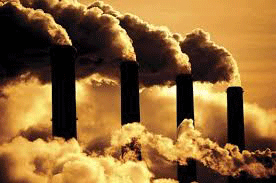 Ambitious Dutch climate plan includes shutdown of new coal-fired plants, CBC radio AS It Happaens 29 Sep 16 The Netherlands has voted to adopt some of Europe’s most drastic measures to cut carbon emissions.
In a close vote last week, the Dutch parliament pledged a 55 per cent cut in cut C02 by 2030. That would include a shutdown of the country’s five remaining coal power plants, including three that opened just last year.
“Even if it feels a bit weird to close down literally brand new coal-fired power plants, all alternative measures are far more expensive.”– Stientje van Veldhoven, Dutch politician
Stientje van Veldhoven, a Dutch politician with the Democrats 66 party, spoke to As It Happens host Carol Off. Van Veldhoven was in Paris last year during negotiations for an international deal on goals to mitigate climate change. She voted to support the plan……..http://www.cbc.ca/radio/asithappens/as-it-happens-wednesday-edition-1.3782437/ambitious-dutch-climate-plan-includes-shutdown-of-new-coal-fired-plants-1.3782537
Complexity of climate effects on Antarctic’s sea ice
Record high to record low: what on earth is happening to Antarctica’s sea ice? https://theconversation.com/record-high-to-record-low-what-on-earth-is-happening-to-antarcticas-sea-ice-66114September 29, 2016 2016 continues to be a momentous year for Australia’s climate, on track to be the new hottest year on record.
To our south, Antarctica has also just broken a new climate record, with record low winter sea ice. After a peak of 18.5 million square kilometres in late August, sea ice began retreating about a month ahead of schedule and has been setting daily low records through most of September.
It may not seem unusual in a warming world to hear that Antarctica’s sea ice – the ice that forms each winter as the surface layer of the ocean freezes – is reducing. But this year’s record low comes hot on the heels ofrecord high sea ice just two years ago. Overall, Antarctica’s sea ice has been growing, not shrinking.
So how should we interpret this apparent backflip? In our paper published today in Nature Climate Change we review the latest science on Antarctica’s climate, and why it seems so confusing.
Antarctic surprises
First up, Antarctic climate records are seriously short.
The International Geophysical Year in 1957/58 marked the start of many sustained scientific efforts in Antarctica, including regular weather readings at research bases. These bases are mostly found on the more accessible parts of Antarctica’s coast, and so the network – while incredibly valuable – leaves vast areas of the continent and surrounding oceans without any data.
In the end, it took the arrival of satellite monitoring in the 1979 to deliver surface climate information covering all of Antarctica and the Southern Ocean. What scientists have observed since has been surprising.
Overall, Antarctica’s sea ice zone has expanded. This is most notable in the Ross Sea, and has brought increasing challenges for ship-based access to Antarctica’s coastal research stations. Even with the record low in Antarctic sea ice this year, the overall trend since 1979 is still towards sea ice expansion.
The surface ocean around Antarctica has also mostly been cooling. This cooling masks a much more ominous change deeper down in the ocean, particularly near the West Antarctic Ice Sheet and the Totten glacier in East Antarctica. In these regions, worrying rates of subsurface ocean warming have been detected up against the base of ice sheets. There are real fears that subsurface melting could destabilise ice sheets, accelerating future global sea level rise.
In the atmosphere we see that some parts of the Antarctic Peninsula and West Antarctica are experiencing rapid warming, despite average Antarctic temperatures not changing that much yet.
In a rapidly warming world these Antarctic climate trends are – at face value – counterintuitive. They also go against many of our climate model simulations, which, for example, predict that Antarctica’s sea ice should be in decline.
Winds of change
The problem we face in Antarctica is that the climate varies hugely from year to year, as typified by the enormous swing in Antarctica sea ice over the past two years.
This means 37 years of Antarctic surface measurements are simply not enough to detect the signal of human-caused climate change. Climate models tell us we may need to monitor Antarctica closely until 2100 before we can confidently identify the expected long-term decline of Antarctica’s sea ice.
In short, Antarctica’s climate remains a puzzle, and we are currently trying to see the picture with most of the pieces still missing.
But one piece of the puzzle is clear. Across all lines of evidence a picture of dramatically changing Southern Ocean westerly winds has emerged. Rising greenhouse gases and ozone depletion are forcing the westerlies closer to Antarctica, and robbing southern parts of Australia of vital winter rain.
The changing westerlies may also help explain the seemingly unusual changes happening elsewhere in Antarctica.
The expansion of sea ice, particularly in the Ross Sea, may be due to the strengthened westerlies pushing colder Antarctic surface water northwards. And stronger westerlies may isolate Antarctica from the warmer subtropics, inhibiting continent-scale warming. These plausible explanations remain difficult to prove with the records currently available to scientists.
Australia’s unique climate position
The combination of Antarctica’s dynamic climate system, its short observational records, and its potential to cause costly heatwaves, drought and sea-level rise in Australia, mean that we can’t afford to stifle fundamental research in our own backyard.
Our efforts to better understand, measure and predict Antarctic climate were threatened this year by funding cuts to Australia’s iconic climate research facilities at the CSIRO. CSIRO has provided the backbone of Australia’s Southern Ocean measurements. As our new paper shows, the job is far from done.
A recent move to close Macquarie Island research station to year-round personnel would also have seriously impacted the continuity of weather observations in a region where our records are still far too short. Thankfully, this decision has since been reversed.
But it isn’t all bad news. In 2016, the federal government announced new long-term funding in Antarctic logistics, arresting the persistent decline in funding of Antarctic and Southern Ocean research.
The nearly A$2 billion in new investment includes a new Australian icebreaking ship to replace the ageing Aurora Australis. This will bring a greater capacity for Southern Ocean research and the capability to push further into Antarctica’s sea ice zone.
Whatever the long-term trends in sea ice hold it is certain that the large year-to-year swings of Antarctica’s climate will continue to make this a challenging but critical environment for research.
Climate change will expose top-secret US nuclear project in Greenland
Greenland’s receding icecap to expose top-secret US nuclear project Camp Century – part of Project Iceworm – is underground cold war network that had been thought buried forever, until climate change made that highly unlikely, Guardian, Jon Henley, 28 Sept, A top-secret US military project from the cold war and the toxic waste it conceals, thought to have been buried forever beneath the Greenland icecap, are likely to be uncovered by rising temperatures within decades, scientists have said.

The US army engineering corps excavated Camp Century in 1959 around 200km (124 miles) from the coast of Greenland, which was then a county of Denmark.
Powered, remarkably, by the world’s first mobile nuclear generator and known as “the city under the ice”, the camp’s three-kilometre network of tunnels, eight metres beneath the ice, housed laboratories, a shop, a hospital, a cinema, a chapel and accommodation for as many as 200 soldiers………
Project Iceworm, presented to the US chiefs of staff in 1960, aimed to use Camp Century’s frozen tunnels to test the feasibility of a huge launch site under the ice, close enough to fire nuclear missiles directly at the Soviet Union.
At the height of the cold war, as the US and the USSR were engaged in a terrifying standoff over the deployment of Soviet missiles in Cuba, the US army was considering the construction of a vast subterranean extension of Camp Century.
A system of about 4,000 kilometres of icy underground tunnels and chambers extending over an area around three times the size of Denmark were to have housed 600 ballistic missiles in clusters six kilometres apart, trained on Moscow and its satellites.
Eventually the engineers realised Iceworm would not work. The constantly moving ice was too unstable and would have deformed and perhaps even collapsed the tunnels.
From 1964 Camp Century was used only intermittently, and three years later it was abandoned altogether, the departing soldiers taking the reaction chamber of the nuclear generator with them.
They left the rest of the camp’s infrastructure – and its biological, chemical and radioactive waste – where it was, on the assumption it would be “preserved for eternity” by the perpetually accumulating snow and ice……..
Greenland’s temperatures broke new records this spring and summer, hitting 24C (75F) in the capital, Nuuk, in June – a figure that shocked meteorologists so much they had to recheck their measurements.
Between 2003 and 2010, the ice that covers much of the island melted twice as fast as during the whole of the 20th century. This year it began melting a month earlier than usual.
The researchers studied US army documents and drawings to work out how deep the camp and its waste – estimated to include 200,000 litres of diesel fuel, similar quantities of waste water and unknown amounts of radioactive coolant and toxic organic pollutants such as PCBs – were buried………
The Pentagon has said it “acknowledges the reality of climate change and the risk it poses” for Greenland, adding that the US government has pledged to “work with the Danish government and the Greenland authorities to settle questions of mutual security”. https://www.theguardian.com/world/2016/sep/27/receding-icecap-top-secret-us-nuclear-project-greenland-camp-century-project-iceworm
Nuclear power a drastically wrong answer to climate change. Solar power holds the key
 a nuclear power plant gives off twice as much energy by way of waste heat than it generates. The environment — whether the atmosphere, oceans, or rivers — would be unable to absorb that much extra heat without drastic climatic consequences
Small Sliver Of Sahara Desert Could Power Entire World With Solar Energy NYT September 24th, 2016 by Steve Hanley How big of a solar farm would you need to power the entire world with renewable energy? That’s a question addressed recently on Quora, the website that specializes in providing in depth, well researched answers to important questions. Actually, the original question was quite different. The discussion started  this way. “Could the world feasibly switch to all-nuclear power generation? If so, would that be a good counter to global warming?” For an answer, Quora turned to Mehran Moalem, PhD, a professor at UC Berkeley and expert on nuclear materials and the nuclear fuel cycle.
Professor Moalem began with this brief biographical information. “I have taught courses in nuclear engineering and a few seminar courses in alternative energies. I also worked for two years starting up six solar factories around the globe. In spite of my personal like for nuclear engineering, I have to admit it is hard to argue for it. Here is the simplified math behind it.”
Moalem then calculated that the world uses approximately 17.3 terawatts of continuous power each year. Sounds like a lot, doesn’t it? Actually it is. But, he says, a solar farm just 43,000 miles square would produce just about that amount of power. Moalem says the Sahara Desert covers 3.6 million square miles. If you’re into math, that means covering just 1.2% of the Sahara with solar power could provide the entire world with all its electrical needs.
It turns out the Sahara is also an ideal site for solar power. Because it is on the Equator, it receives 12 hours of sunlight virtually every day of the year. Also because of its location, that sunlight tends to shine directly down, meaning solar panels located there can be two to three times more efficient than those located in higher latitudes, like Europe and North America.
Moalem puts the price of such a system at $5 trillion dollars. Wow! That’s a lot of money, right? Actually, no it’s not, the professors says. Its less than the US spent to bail out banks 8 years ago. It’s about 10% of world GDP. The cost of building a nuclear power plant with a similar capacity would be more than 10 times as much.
He points out that this is a one time cost. Once such a facility gets built, the energy it produces is free. There are no ongoing costs for fuel, no generators to spin, to boilers to make steam. Moalen thinks that’s a pretty cheap price for something that could replace every other power source on earth, especially those that spew deadly pollution into the air.
Even though he is nuclear power engineer, Moalem says nuclear is not the way to meet world energy needs. One important reason is that a nuclear power plant gives off twice as much energy by way of waste heat than it generates. The environment — whether the atmosphere, oceans, or rivers — would be unable to absorb that much extra heat without drastic climatic consequences…….http://solarlove.org/sahara-desert-power-world-solar-energy/
Contradictory and confusing statements by climate science deniers
 How climate science deniers can accept so many ‘impossible things’ all at once 23 September 2016 by Guest Author,
http://www.skepticalscience.com/how-deniers-accept-so-many-impossible-things-at-once.html Sometimes, climate science deniers will tell you that we can’t predict global temperatures in the future. Sometimes, they’ll say we’re heading for an ice age.
Occasionally, contrarians will say that no single weather event can prove human-caused global warming. But then they’ll point to somewhere that’s cold, claiming this disprovesclimate change.
Often, deniers will tell you that temperature records show that global warming stopped at some point around 1998. But also they’ll insist that those same temperature records can’t be relied on because Nasa and the Bureau of Meteorology are all communist corruption monkeys. Or something.
Black is also white. Round is also flat. Wrong is also right?
A new research paper published in the journal Synthese has looked at several of these contradictory arguments that get thrown around the blogosphere, the Australian Senate and the opinion pages of the (mostly) conservative media.
The paper comes with the fun and enticing title: “The Alice in Wonderland mechanics of the rejection of (climate) science: simulating coherence by conspiracism.”
Why Alice? Because, as the White Queen admitted: “Why, sometimes I’ve believed as many as six impossible things before breakfast.”
The three authors, including Dr John Cook, of the University of Queensland, look at both rhetorical and scientific arguments put by deniers.
One example is the popular theme that casts “sceptics” as “dissenting heroes” who bravely oppose “political persecution and fraud”. You know, like modern-day Galileos.
But the authors write that deniers will also try and convince the public that there is no consensus among scientists about the causes of climate change (there is and it’s us). They write:
Either there is a pervasive scientific consensus in which case contrarians are indeed dissenters, or there is no consensus in which case contrarian opinions should have broad support within the scientific community and no fearless opposition to an establishment is necessary.
The authors unleash similar jujitsu-style logic on other contradictory arguments and give examples of where the same individuals have apparently argued against themselves.
One of the authors’ examples of incoherent logic comes from the Australian geologist and mining industry figure Prof Ian Plimer and his 2009 book, Heaven and Earth – a book favourably cited by the likes of the former prime minister Tony Abbott and Cardinal George Pell.
On page 278, Plimer writes that “temperature and CO2 are not connected” but, on page 411, writes that “CO2 keeps our planet warm”.
According to the authors, their examples of “incoherence” only hold together in the minds of the deniers if you apply types of glue known as “conspiracist ideation” and “identity-protective cognition”.
So what’s that all about?
Conspiracist ideation, or conspiratorial thinking, is the tendency to entertain suggestions: for example that Nasa and the Bureau of Meteorology are conspiring to deliberately manipulate temperature data just to make global warming seem worse than it really is, rather than to correct for known issues.
An example of “identity-protective cognition” in this case, the authors explain, is where people who advocate for small governments and “free markets” face a dilemma.
Accepting the scientific consensus would likely see increased levels of regulation, which challenges their identity as free-market advocates. So instead, the authors argue, the only options open are to either deny the consensus or try and discredit it.
Because cutting GHG emissions requires interventions – such as regulation or increased taxation – that interfere with laissez-faire free-market economics, people whose identity and worldview centres around free markets are particularly challenged by the findings from climate science.
Lead author Prof Stephan Lewandowsky, an expert in cognitive psychology at the University of Bristol, has written several research papers finding links between the rejection of science, “conspiracist ideation” and the belief in free market economic principles.
One argument that deniers may try with this Synthese paper is that climate scientists also contradict each other and have offered several explanations for the supposed global warming “pause” or “slowdown” (this was never really a thing).
Lewandowsky told me:
Click here to read the rest from Graham Readfearn in the Guardian
Worldwide, communities are already being destabilised by climate change
U.S. intelligence community warns climate change is already destabilizing communities worldwide, Mashable, 23 Sept 16 The U.S. intelligence community on Wednesday released a new report finding that global warming is already acting as a destabilizing force worldwide, with more serious ramifications to come in the next two decades.
The report also states that during the next five years, which will largely fall within the timeframe of the next presidential administration, climate change will cause growing security risks for the U.S. that “will arise primarily from distinct extreme weather events and from the exacerbation of currently strained conditions, like water shortages.”
The new intelligence report starkly warns of climate instability-driven migrations in the next two decades and was released the same week world leaders have been meeting in New York City to consider how to increase support for refugees streaming out of war-torn Syria, Somalia, Libya and other countries.
Over 20 years, the net effects of climate change on the patterns of global human movement and statelessness could be dramatic, perhaps unprecedented. If unanticipated, they could overwhelm government infrastructure and resources, and threaten the social fabric of communities
The report is illustrated with examples of climate-related security developments that have already occurred, such as insurgents’ exploitation of drought-enhanced desertification in a “food for Jihad” movement in northern Mali during 2015.
The report also comes as the White House announced a new policy framework requiring federal agencies to take the impacts of climate change into account when making national security-related policies and plans. President Obama established this framework through a presidential memorandum.
The NIC report provides more detailed information on how climate change will likely pose national security challenges for the U.S. during the next 20 years, raising the possibility that climate change-related impacts could cause entire countries to collapse. ………
The NIC report also considers the possibility of abrupt climate change from unanticipated tipping points in the climate system.
“The national security implications of such changes could be severe.” http://mashable.com/2016/09/21/national-security-climate-change-risk-obama/#Zad7clZR2OqW
In 10 years or less, climate change could pass the 1.5 degrees Celsius rise
 Climate change could cross key threshold in a decade: scientists By Laurie Goering 23 Sept 16, OXFORD, England (Thomson Reuters Foundation) – The planet could pass a key target on world temperature rise in about a decade, prompting accelerating loss of glaciers, steep declines in water availability, worsening land conflicts and deepening poverty, scientists said this week.
Last December, 195 nations agreed to try to hold world temperature rise to “well below” 2 degrees Celsius, with an aim of 1.5 degrees Celsius.
But the planet is already two-thirds of the way to that lower and safer goal, and could begin to pass it in about a decade, according to Richard Betts, head of climate impacts research at the UK Met Office’s Hadley Centre.
With world emissions unlikely to slow quickly enough to hit that target, it will probably be necessary to remove some carbon pollution from the atmosphere to stabilize the planet, scientists said at a University of Oxford conference on how to achieve the 1.5 degree goal.
That could happen by planting forests or by capturing and then pumping underground emissions from power plants. Or countries could turn to controversial “geoengineering” techniques, such as blocking some of the sunlight arriving on the planet, to hold down temperatures, they said.
“Negative emission technologies are likely to be needed, whether we like them or not,” said Pete Smith, a plant and soil scientist at the University of Aberdeen.
But other changes – such as reducing food waste and creating more sustainable diets, with less beef and fewer imported greenhouse vegetables – could also play a big role in meeting the goal, without so many risks, he said.
“There are lots of behavioral changes required, not just by the government … but by us,” Smith said……..http://www.reuters.com/article/us-climatechange-impacts-conference-idUSKCN11S1FE
Nuclear power in no way a cure for climate change: in fact it’s a CAUSE of climate change
How Nuclear Power Causes Global Warming, The Progressive, September 21, 2016 Harvey Wasserman
Supporters of nuclear power like to argue that nukes are the key to combatting climate change. Here’s why they are dead wrong.
 Every nuclear generating station spews about two-thirds of the energy it burns inside its reactor core into the environment. Only one-third is converted into electricity. Another tenth of that is lost in transmission. According to the Union of Concerned Scientists:
Nuclear fission is the most water intensive method of the principal thermoelectric generation options in terms of the amount of water withdrawn from sources. In 2008, nuclear power plants withdrew eight times as much freshwater as natural gas plants per unit of energy produced, and up to 11 percent more than the average coal plant.
Every day, large reactors like the two at Diablo Canyon, California, individually dump about 1.25 billion gallons of water into the ocean at temperatures up to 20 degrees Fahrenheit warmer than the natural environment.
Diablo’s “once-through cooling system” takes water out of the ocean and dumps it back superheated, irradiated and laden with toxic chemicals. Many U.S. reactors use cooling towers which emit huge quantities of steam and water vapor that also directly warm the atmosphere.
These emissions are often chemically treated to prevent algae and other growth that could clog the towers. Those chemicals can then be carried downwind, along with radiation from the reactors. In addition, hundreds of thousands of birds die annually by flying into the reactor domes and towers.
The Union of Concerned Scientists states:
The temperature increase in the bodies of water can have serious adverse effects on aquatic life. Warm water holds less oxygen than cold water, thus discharge from once-through cooling systems can create a “temperature squeeze” that elevates the metabolic rate for fish. Additionally, suction pipes that are used to intake water can draw plankton, eggs and larvae into the plant’s machinery, while larger organisms can be trapped against the protective screens of the pipes. Blocked intake screens have led to temporary shut downs and NRC fines at a number of plants.
And that’s not all.
All nuclear reactors emit Carbon 14, a radioactive isotope, invalidating the industry’s claim that reactors are “carbon free.” And the fuel that reactors burn is carbon-intensive. Themining, milling, and enrichment processes needed to produce the pellets that fill the fuel rods inside the reactor cores all involve major energy expenditures, nearly all of it based on coal, oil, or gas.
And of course there’s the problem of nuclear waste. After more than a half-century of well-funded attempts, we’ve seen no solution for the management of atomic power’s intensely radioactive waste. There’s the “low-level” waste involving enormous quantities of troublesome irradiated liquids and solid trash that must be dealt with outside the standard civilian waste stream. And that handling involves fossil fuels burned in the process of transportation, management, and disposal as well ………
There are no credible estimates of the global warming damage done by the intensely hotexplosions at the four Fukushima reactors, or at Chernobyl, or at any other past and future reactor meltdowns or blowups. …..
Overall, the idea that atomic power is “clean” or “carbon free” or “emission free” is a very expensive misconception, especially when compared to renewable energy, efficiency, and conservation. Among conservation, efficiency, solar and wind power technologies, there are no global warming analogs to the heat, carbon, and radioactive waste impacts of nuclear power. No green technology kills anywhere near the number of marine organisms that die through reactor cooling systems.
Rooftop solar panels do not lose ten percent of the power they generate to transmission, as happens with virtually all centralized power generators. S. David Freeman, former head of numerous large utilities and author of All Electric America: A Climate Solution and the Hopeful Future, says: “Renewables are cheaper and safer. That argument is winning. Let’s stick to it.”
No terrorist will ever threaten one of our cities by blowing up a solar panel. But the nuclear industry that falsely claims its dying technology doesn’t cause global warming does threaten the future of our planet.
Harvey Wasserman wrote SOLARTOPIA! OUR GREEN-POWERED EARTH. He editsnukefree.org. You can find his GREEN POWER & WELLNESS SHOW at www.prn.fm
Warning from 375 top scientists of ‘real, serious, immediate’ climate threat
375 top scientists warn of ‘real, serious, immediate’ climate threat http://www.skepticalscience.com/375-nas-warn-climate-threat.html 21 September 2016 by John Abraham
Yesterday, 375 of the world’s top scientists, including 30 Nobel Prize winners, published an open letter regarding climate change. In the letter, the scientists report that the evidence is clear: humans are causing climate change. We are now observing climate change and its affect across the globe. The seas are rising, the oceans are warming, the lower atmosphere is warming, the land is warming, ice is melting, rainfall patterns are changing and the ocean is becoming more acidic.
These facts are incontrovertible. No reputable scientist disputes them. It is the truth.
Despite these facts, the letter reports that the US presidential campaign has seen claims that the earth isn’t warming, or it is only a natural warming, or that climate changeis a hoax. These claims are false. The claims are made by politicians or real estate developers with no scientific experience. These people who deny the reality of climate change are not scientists.
These claims aren’t new. We see them every election cycle. In fact, for the Republican Party, they are a virtual litmus test for electability. It is terribly sad that the party of Lincoln (the president who initiated the National Academy of Sciences) has been rebuked by the National Academy today. It is sad that the party of Teddy Roosevelt, who created the National Park System, is acting in a way antithetical to his legacy. It is also sad that the party of Nixon, who created the Environmental Protection Agency, now is trying to eliminate that very organization.
What is perhaps most sad is that the party of “fiscal conservatism” is leading us on a path that will result in higher economic and social costs for all of us. What we don’t know is what the future will bring. Will the warming be gradual or sudden? Will ocean rise increase at a faster rate or not? Will we continue to see major ice shelfcollapse? Increased droughts and heat waves? Will we be able to adapt?
A rational decision maker would take action to manage the risks from climate change. This threat is to our health, our communities, and our economies. A changing climate with warming seas and an acidifying ocean will cause real economic losses for our generation and for the future.
In the letter, the scientists venture deeper into politics than scientists are generally willing to tread. They describe the inane Republican platform and the foolish position of the Republican nominee Donald Trump. Basically, Trump wishes to scrap our environmental agreements, which have resulted in reductions to our own emissions as well as very strong agreements to reduce global warming through international agreements.
Despite the excellent work over the past 7 years, we have not seen the increase in energy prices that the denialists claimed would occur. Instead, we’ve seen huge reductions in the cost of wind, solar, and other renewable energy sources.
We were right, they were wrong. We can deliver reliable energy to the USA at a low cost, with less pollution.
We scientists have warned the country and the world about the dangers of climate changefor decades. We are now seeing our predictions come true. There are no longer any reputable scientists who disagree that humans are the major factor changing the climate. Click here to read the rest
Factor climate into national security policy – executive direction by President Obama
For the first time, Obama requires U.S. government to factor climate into national security policy,WP By Juliet Eilperin September 21 President Obama signed a presidential memorandum Wednesday establishing that climate-change impacts must be factored into the development of all national security-related doctrine, policies and plans.
The move signals Obama’s determination to exercise his executive authority during his final months in office to elevate the issue of climate in federal decision-making, even though it remains unclear whether his successor will embrace this approach.
Under the directive, 20 federal agencies and offices that work on climate science, intelligence and national security must “collaborate to ensure the best information on climate impacts is available to strengthen our national security” through the new Federal Climate and National Security Working Group. That group must release a climate change and national security action plan in 90 days. All the relevant agencies must then identify steps to implement it.
Speaking to reporters on a conference call, White House officials said this would spur a more specific and focused strategy when it comes to both identifying how different regions of the world would be affected by climate change and how to respond……..https://www.washingtonpost.com/news/energy-environment/wp/2016/09/21/for-the-first-time-obama-requires-u-s-government-to-factor-climate-into-national-security-policy/?utm_term=.a5aae6b8a2bf
Global atmospheric temperature rise already predicted to be above 1.5 °C
 The oil and gas we have already tapped will take us past 1.5 °C https://www.newscientist.com/article/2106758-the-oil-and-gas-we-have-already-tapped-will-take-us-past-1-5c/ By Fred Pearce
When you’re in a hole, stop digging. If the world is to have any chance to halt warming below 2 °C, as agreed at the UN’s climate summit in Paris, we cannot develop any more oil wells, coal mines or gas fields.
In fact, we need to go further and start phasing out existing projects, according to the first study of the likely carbon emissions from current fossil fuel extraction.
As more world leaders this week ratify the Paris Agreement at the UN General Assembly in New York, the study finds that “potential carbon emissions from developed reserves – where the wells are already drilled, the pits dug, and the pipelines, processing facilities, railways and export terminals constructed – will take us just beyond the Paris Agreement’s two degrees Celsius warming limit”
Developed reserves of oil and gas alone, even if coal were phased out immediately, would threaten the agreement’s preferred lower target of 1.5 °C, says the study from Oil Change International, a US think tank that opposes fossil fuels.
But the report’s author, Greg Muttitt, used industry data to calculate that developed reserves of coal, oil and gas will deliver emissions of 941 billion tonnes.
“There is no room in the atmosphere. No new fossil fuel infrastructure should be built,” says Muttitt. “This means no fracking for gas in the UK or any other new country, and a fairly rapid winding down of existing fracking in the US. All energy development needs to be focused on clean energy from now on.”
Energy analysts say that investment in new fossil fuel resources is already waning in the wake of the Paris Agreement.
Anthony Hobley of the Carbon Tracker Initiative, a think tank set up by former investment analysts, said Muttitt’s hopes of an end to investment in new coal mines could be imminent. Coal burning has been in decline since 2013. As a result, the industry was stuck with assets worth $200 billion that had “no prospect of paying back their investment cost if the world is serious about the two-degree ceiling”.
Last year, Goldman Sachs said it believed that, led by China, the world reached “peak coal” production in 2013.
New York congressman questions impact of climate change on nuclear facilities
NY congressman questions impact of climate change on nuclear facilities https://www.snl.com/Interactivex/article.aspx?CdId=A-33809939-10283 By Matthew Bandyk, 9 Sept 16
Citing a recent incident at Entergy Corp.‘s Pilgrim plant in Massachusetts, Tonko questioned the four members of the U.S. Nuclear Regulatory Commission about what should be done about this potential problem as they testified at a Sept. 9 hearing held by the committee’s Energy and Power and Environment and the Economy subcommittees.Rising water temperatures caused by climate change could force more nuclear plants to shut down, Rep. Paul Tonko, D-N.Y., said during a hearing by two subcommittees of the House Energy and Commerce Committee.
 On one day this August, the Pilgrim plant had to cut power by 10% as the water the facility pulls in from Cape Cod Bay for cooling hit 75.09 degrees, only the fourth time in the plant’s history that intake water exceeded the NRC’s 75-degree limit, The Boston Globe reported Aug. 11. The other three times all occurred in the summer of 2013.
A scientist at the Gulf of Maine Research Institute told the newspaper that Cape Cod Bay has been getting demonstrably warmer over time and that nuclear plants should consider modifying their intake pipes in response. But Entergy said the hot temperatures that day were an unusual, specific incident caused by winds and tides.
Tonko pointed to National Oceanic and Atmospheric Administration data that found that 2014 was the hottest year on record, and noted that the August Pilgrim incident was not the first time a plant had to be curtailed due to excessive water temperature.
“What is the NRC doing to ensure plants will have sufficient water to operate?” he asked the NRC commissioners.
Commissioner Jeff Baran said that while there have been several instances of cooling water getting too hot, the NRC evaluates those on a case-by-case basis.
As for whether or not there is a recurring issue caused by climate change, “I don’t know if we have looked at any particular trend,” NRC Chairman Stephen Burns told Tonko.
“The NRC doesn’t have any studies or rulemaking processes under way that would look explicitly at the effect of climate change on plant operations,” NRC spokesman Neil Sheehan said in an email after the hearing.
In 2014, the NRC signed off on a request from Dominion Resources Inc.‘s Millstone nuclear plant in Connecticut to allow it to draw water up to 80 degrees instead of 75. Entergy, however, has not yet asked the NRC for a license amendment request to change its temperature limit.
The NRC recently stepped up its oversight of the Pilgrim plant in response to several unplanned shutdowns at the facility. The shutdown that most grabbed the agency’s attention, however, had nothing to do with high temperatures. After a winter storm in January triggered a shutdown, the NRC found that some backup functions required to depressurize the reactor in case of an unplanned shutdown were not operational at the time of the storm, and that Entergy failed to fix a safety relief valve needed for depressurization.
The NRC regulates the water intake temperature at nuclear plants because high temperatures can hurt the efficiency of a plant’s condenser, which uses water to cool down steam produced by the reactor to turn the plant’s turbine, according to Sheehan. Cooling water is also used for heat exchangers that help key plant systems like emergency diesel generators and the spent fuel pool operate, so there is also a safety element, he said.
Donald Trump, geopolitics, Brexit, and climate catastrophe
Why a Donald Trump Victory Could Make Climate Catastrophe Inevitable, Michael Klare on the forces moving us toward an uninhabitable planet. Mother Jones, MICHAEL KLARE, SEP. 17, 2016 “……., the fate of the planet rests on the questionable willingness of each of those countries to abide by that obligation, however sour or bellicose its relations with other signatories may be. As it happens, that part of the agreement has already been buffeted by geopolitical headwinds and is likely to face increasing turbulence in the years to come.
That geopolitics will play a decisive role in determining the success or failure of the Paris Agreement has become self-evident in the short time since its promulgation. While some progress has been made toward its formal adoption—the agreement will enter into force only after no fewer than 55 countries, accounting for at least 55 percent of global greenhouse gas emissions, have ratified it—it has also encountered unexpected political hurdles, signaling trouble to come…….
Great Britain’s astonishing Brexit vote has complicated the task of ensuring the European Union’s approval of the agreement, as European solidarity on the climate issue—a major factor in the success of the Paris negotiations—can no longer be assured. “There is a risk that this could kick EU ratification of the Paris Agreement into the long grass,” suggests Jonathan Grant, director of sustainability at PricewaterhouseCoopers.
The Brexit campaign itself was spearheaded by politicians who were also major critics of climate science and strong opponents of efforts to promote a transition from carbon-based fuels to green sources of energy. For example, the chair of the Vote Leave campaign, former Chancellor of the Exchequer Nigel Lawson, is also chairman of the Global Warming Policy Foundation, a think tank devoted to sabotaging government efforts to speed the transition to green energy. Many other top Leave campaigners, including former Conservative ministers John Redwood and Owen Paterson, were also vigorous climate deniers.
In explaining the strong link between these two camps, analysts at the Economistnoted that both oppose British submission to international laws and norms: “Brexiteers dislike EU regulations and know that any effective action to tackle climate change will require some kind of global cooperation: carbon taxes or binding targets on emissions. The latter would be the EU writ large and Britain would have even less say in any global agreement, involving some 200 nations, than in an EU regime involving 28.”……..
In his first major speech on energy, delivered in May, Trump—who has called global warming a Chinese hoax—pledged to “cancel the Paris climate agreement” and scrap the various measures announced by President Obama to ensure US compliance with its provisions. Echoing the views of his Brexit counterparts, hecomplained that “this agreement gives foreign bureaucrats control over how much energy we use on our land, in our country. No way.” He also vowed to revive construction of the Keystone XL pipeline (which would bring carbon-heavy Canadian tar sands oil to refineries on the Gulf Coast), to reverse any climate-friendly Obama administration acts, and to promote the coal industry. “Regulations that shut down hundreds of coal-fired power plants and block the construction of new ones—how stupid is that?” he said, mockingly……..
nationalistic exceptionalism could become something of the norm if Donald Trump wins in November, or other nations join those already eager to put the needs of a fossil-fuel-based domestic growth agenda ahead of global climate commitments. With that in mind, consider the assessment of future energy trends that the Norwegian energy giant Statoil recently produced. In it is a chilling scenario focused on just this sort of dystopian future………
Indeed, the future pace of climate change will be determined as much by geopolitical factors as technological developments in the energy sector. While it is evident that immense progress is being made in bringing down the price of wind and solar power in particular—far more so than all but a few analysts anticipated until recently—the political will to turn such developments into meaningful global change and so bring carbon emissions to heel before the planet is unalterably transformed may, as the Statoil authors suggest, be dematerializing before our eyes. If so, make no mistake about it: We will be condemning Earth’s future inhabitants, our own children and grandchildren, to unmitigated disaster…….
To avoid an Eaarth (as both Bill McKibben and the Statoil authors imagine it) and preserve the welcoming planet in which humanity grew and thrived, climate activists will have to devote at least as much of their energy and attention to the international political arena as to the technology sector. At this point, electing green-minded leaders, stopping climate deniers (or ignorers) from capturing high office, and opposing fossil-fueled ultranationalism is the only realistic path to a habitable planet.
Michael T. Klare is a professor of peace and world security studies at Hampshire College and the author, most recently, of The Race for What’s Left. http://www.motherjones.com/environment/2016/09/donald-trump-brexit-paris-accord-climate-change
1 This Month





PLEASE OPPOSE HR 8255 AND S.3639 – bills would accelerate satellite deployment, with no environmental review or safeguards – https://ncstd5li.quorum.us/campaign/169331/
To see nuclear-related stories in greater depth and intensity – go to https://nuclearinformation.wordpress.com
-
Archives
- October 2026 (10)
- September 2026 (339)
- August 2026 (330)
- July 2026 (355)
- June 2026 (287)
- May 2026 (306)
- April 2026 (356)
- March 2026 (251)
- February 2026 (267)
- January 2026 (308)
- December 2025 (358)
- November 2025 (359)
-
Categories
- 1
- 1 NUCLEAR ISSUES
- business and costs
- climate change
- culture and arts
- ENERGY
- environment
- health
- history
- indigenous issues
- Legal
- marketing of nuclear
- media
- opposition to nuclear
- PERSONAL STORIES
- politics
- politics international
- Religion and ethics
- safety
- secrets,lies and civil liberties
- spinbuster
- technology
- Uranium
- wastes
- weapons and war
- Women
- 2 WORLD
- ACTION
- AFRICA
- Atrocities
- AUSTRALIA
- Christina's notes
- Christina's themes
- culture and arts
- Events
- Fuk 2022
- Fuk 2023
- Fukushima 2017
- Fukushima 2018
- fukushima 2019
- Fukushima 2020
- Fukushima 2021
- general
- global warming
- Humour (God we need it)
- Nuclear
- RARE EARTHS
- Reference
- resources – print
- Resources -audiovicual
- Weekly Newsletter
- World
- World Nuclear
- YouTube
-
RSS
Entries RSS
Comments RSS

