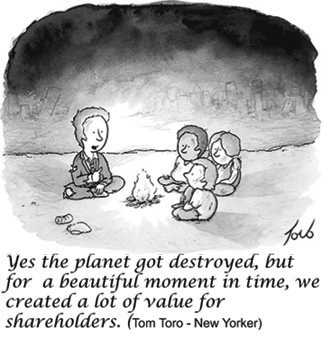
U.S. companies tout climate policies, fund climate skeptics. Reuters, 6 Sept 16, By Richard Valdmanis and Grant Smith | BOSTON/NEW YORK
U.S. companies that have expressed the most fervent public support for President Barack Obama’s environmental agenda are also funding its biggest enemies – the scores of U.S. lawmakers who are climate change skeptics and oppose regulation to combat it, according to a Reuters review of public records.
Ahead of the Nov. 8 presidential and congressional elections, the donations from companies including PepsiCo, Dupont, and Google reveal a disconnect between how these companies present themselves to the public on environmental issues, and how they manage their political contributions to support business-friendly policy.
Many companies active in U.S. politics spread their political donations broadly on both sides of the aisle and consider multiple issues when deciding whom to support.
But inconsistency between a company’s environmental positions and its political giving may point up a need for better oversight, according to Jon Lukomnik, head of the Investor Responsibility Research Center Institute.
“There really needs to be a process that looks at these issues … at C-suite and board levels on a periodic basis,” Lukomnik said.
The Reuters review covered donations made during the 2016 election cycle by the political action committees (PACs) of 30 of the biggest publicly traded U.S. companies that signed Obama’s “American Business Act on Climate Change Pledge” in 2015, a public promise to enact climate-friendly corporate policies and support strong climate change oversight like the global climate accord signed in Paris.
The review found that 25 of the 30 companies are funding the campaigns of lawmakers featured on a “climate deniers” list that was put together by Organizing For Action, a non-profit created by former Obama campaign aides to advocate his agenda.
The list includes more than 130 members of Congress, nearly all Republicans, and is a who’s who of the biggest opponents of Obama’s plan to combat climate change. Some of those on the list dispute the label “denier” and describe themselves as climate change “skeptics”.
The list includes Republican Congressman Kevin Cramer of North Dakota, an energy advisor to presidential candidate Donald Trump who once argued the Earth was cooling not warming, and Republican U.S. Senator Jim Inhofe of Oklahoma, who last year held up a snowball on the Senate floor as evidence global warming does not exist.
The review found PepsiCo and DuPont’s political action committees gave about half or more of the money from their top donations in support of senators and congressmen on the list. That amounted to $56,500 from the Pepsi PAC’s 29 donations of $2,500 and above, and $40,000 from the DuPont PAC’s 19 donations of $2,000 and above.
Other signatories to the American Business Act on Climate Change Pledge that gave more than a third of their top political contributions to lawmakers on the list include Google, AT&T, GE, Verizon, and Mondelez, according to the review.
Those levels of donations given to climate skeptics are relatively high given that the list covers about a quarter of U.S. Congress members……… http://www.reuters.com/article/us-usa-election-climate-donations-idUSKCN11C0ED
September 7, 2016
Posted by Christina Macpherson |
climate change, secrets,lies and civil liberties, USA |
Leave a comment
EurekAlert, 6 Sept 16 UNIVERSITY OF ILLINOIS AT URBANA-CHAMPAIGN, CHAMPAIGN, ILL. — An eight-year study of soybeans grown outdoors in a carbon dioxide-rich atmosphere like that expected by 2050 has yielded a new and worrisome finding: Higher atmospheric CO2 concentrations will boost plant growth under ideal growing conditions, but drought – expected to worsen as the climate warms and rainfall patterns change – will outweigh those benefits and cause yield losses much sooner than anticipated.
The new discovery, reported in the journal Nature Plants, contradicts a widely accepted hypothesis about how climate change will affect food production, said University of Illinois plant biology professor Andrew Leakey, who led the new research…….http://www.eurekalert.org/pub_releases/2016-09/uoia-sfd090116.php
September 7, 2016
Posted by Christina Macpherson |
climate change, USA |
Leave a comment


 US joins China in ratifying Paris climate agreement in ‘turning point’ for planet , ABC News 4 Sept 16 America and China have formally joined the Paris climate change agreement, with US President Barack Obama hailing the accord as the “moment we finally decided to save our planet”.
The move by the world’s two biggest polluters is a major step forward for the 180-nation deal, which sets ambitious goals for capping global warming and funnelling trillions of dollars to poor countries facing climate catastrophe.
Mr Obama and his Chinese counterpart Xi Jinping handed ratification document to United Nations chief Ban Ki-moon, who said he was now optimistic the agreement will be in force by the end of the year.
Mr Ban described the two leaders as far-sighted, bold and ambitious.
“China and the United States represent nearly 40 per cent of global greenhouse gas emissions,” he said.
“Now by formally joining the Paris agreement your have added powerful momentum to the drive for the agreement to enter into force this year.”
Mr Obama said history would show that the Paris deal would “ultimately prove to be a turning point, the moment we finally decided to save our planet”……..http://www.abc.net.au/news/2016-09-04/us-joins-china-in-ratifying-paris-climate-agreement/7812366
September 5, 2016
Posted by Christina Macpherson |
China, climate change, USA |
Leave a comment
China has ratified Paris climate agreement, state media says, ABC News 3 Sep 16 China has ratified the Paris agreement on climate change, according to state media, a key move by the world’s biggest polluter that brings the deal a major step closer to coming into force.
The National People’s Congress legislature voted to adopt “the proposal to review and ratify the Paris Agreement”, the official Xinhua news agency said.
The Paris pact calls for capping global warming at well below two degrees Celsius, and 1.5C if possible, compared with pre-industrial levels.
China is responsible for about 25 per cent of global carbon emissions, with the US in second place on about 15 per cent, making their efforts crucial in the fight against warming.
The Paris deal will come into force 30 days after at least 55 countries, accounting for 55 per cent of global greenhouse gas emissions, have ratified it……..http://www.abc.net.au/news/2016-09-03/china-ratifies-paris-climate-agreement3a-xinhua/7811778?section=environment
September 5, 2016
Posted by Christina Macpherson |
China, climate change |
Leave a comment
 Sadiq Khan and megacity mayors urge G20 climate change action, https://www.theguardian.com/environment/2016/sep/02/sadiq-khan-and-megacity-mayors-urge-g20-climate-change-action
30 mayors from cities including London, Paris, Tokyo, Sydney, New York, Cape Town and Rio de Janeiro call for rapid ratification of Paris climate deal, Guardian, 2 Sept 16, London Mayor Sadiq Khan has joined forces with city leaders from around the world to call on governments to take urgent action on climate change.
Ahead of a meeting of the G20 group of leading nations in Hangzhou, China, 30 mayors from cities including London, Paris, Tokyo, Sydney, New York, Cape Town and Rio de Janeiro called on national leaders to work with them to “build a low carbon, climate safe world”.
They welcomed government moves to secure the Paris Agreement, the world’s first comprehensive global deal to tackle climate change, in December last year, and efforts to ratify it as soon as possible so it could come into force rapidly.
But they warned “this is only the first step along the road towards our low carbon, climate safe future”.
In an open letter, the mayors from the C40 group of cities championing climate action said: “To limit the global temperature increase to 1.5C above pre-industrial levels, global greenhouse gas emissions need to peak by 2020.
“Achieving such a rapid shift is probably one of the greatest political, economic and practical challenges faced by every national leader, but you do have great allies in this task: we, the mayors of the megacities of the world.”
They said they were already dealing with the consequences of climate change in their cities, battling floods to heatwaves.
But city leaders were also taking action such as banning the most polluting cars, rolling out fleets of electric buses and improving energy efficiency, which also had benefits for health, well-being and economic growth, they said.
“For the major cities of the world it is already clear that the faster we move to a low carbon economy, the greater will be the improvement in urban citizens’ standards of living, and the stronger and more sustained will be the economic development that makes that possible.”
The leaders have committed to setting out concrete plans for how they will deliver the greenhouse gas cuts in their cities needed to help meet the goals of the Paris Agreement to avoid dangerous climate change.
“We want our citizens, markets and other political leaders to know that we are serious about making the Paris Agreement a reality. We call on the heads of states from our respective nation states to do the same,” they said.
September 3, 2016
Posted by Christina Macpherson |
2 WORLD, climate change |
Leave a comment
global warming has joined God, guns, gays, and abortion as core elements of Republican identity, and this will be hard to change.
Americans Now More Politically Polarized On Climate ChangeThan Ever Before, Analysis  Finds http://www.skepticalscience.com/americans-more-polarized-on-climate-change.html
American voters and politicians are now more polarized than ever before across all aspects of climate change — from the cause, to the science and the impacts — a major new analysis has found.
Campaigns funded by vested fossil fuel interests and pushed by a network of ideological think tanks, many linked to the oil billionaire Koch brothers, have helped to widen the gap, pushing Republican politicians, elites and voters away from action ongreenhouse gas emissions.
Tracking Gallup opinion poll surveys going back to 2001 and congress voting patterns from 1970 onwards, the analysis authors warn that as the November election approaches, Americans are faced with a stark political choice.
The analysis is published in the respected journal Environment and comes from sociologists Associate Professor Aaron McCright of Michigan State University, Professor Riley Dunlap of Oklahoma State University, and PhD researcher Jerrod Yarosh also at Oklahoma.
The researchers found the widest gaps between Democrats and Republicans come when they are asked about the causes of climate change and if the media exaggerates the seriousness of the issue.
While virtually all climate scientists and the world’s leading scientific academies have long agreed that the burning of fossil fuels is causing climate change, only about half Republicans accept the science.
A Republican controlled Congress, the article says, would be a “huge step backward in our nation’s efforts to reduce greenhouse gas emissions” and could also undermine international cooperation, especially if Republican nominee Donald Trump won the Presidency.
“Whether, and how, individual Americans vote this November may well be the most consequential climate-related decision most of them will have ever taken,” the authors conclude.
Stark Choices
Dunlap told DeSmog the choice facing US voters was glaring.
“Looking back, Gore versus Bush was stark, although Bush hid his denial for a bit. But now the partisan differences on climate change are out in the open, and the choices from the top down are stark.”
The Koch brothers had led a network of “conservative mega-donors” that had created a “shadow GOP” that had managed to reduce the influence of the Republican National Committee, the analysis argues.
These efforts, the article explains, have blocked legislation, limited international negotiations and made rejection of climate science “normative” among Republican elites and activists.
Widening Gaps
Dunlap, McCright and Yarosh looked at how elected Democrats and Republicans had voted on environment and climate bills in both houses of Congress since 1970, using data from the League of Conservation Voters. The researchers found:
What was once a modest tendency for Congressional Republicans to be less pro-environmental than their Democratic counterparts has become a chasm—with Republicans taking near-unanimous anti-environmental stances on relevant legislation in recent years, especially 2015.
Since 2001 polling company Gallup has been asking US voters for their views on aspects of climate change, such as if they think it’s happening, if it’s caused by humans and if they are concerned about it.
In 2001, 53 percent of Republican voters agreed that global warming was caused by humans, compared with 70 percent of Democrats — a gap of 17 percentage points. But by 2016, this gap had blown out to 41 percentage points, with only 43 percent of Republican voters accepting climate change is human-caused.
These “partisan gaps” had widened across all areas since 2008, except when voters were asked if they thought global warming had already started, where the gap remained at 34 percentage points.
Bridging the Gap?
Alongside the analysis, the authors look at various attempts to bring Republicans closer to accepting the realities of climate change, such as changing communication strategies. The writers claim:
Does any persuasive framing strategy hold special promise for penetrating Republicans’ partisan/ideological identities? The evidence so far gives little basis for optimism.
The sociologists say one major reason why attempts to better communicate the realities of climate change to conservatives have failed is down to “motivated cognition” — described as the tendency for people to only accept information that reinforces their existing political beliefs and their views on the world.
Even when Republicans experience extreme weather events, there was little evidence that this was enough for those voters to change their views. Dunlap told DeSmog:
“I fear polarization will be difficult to overcome because Republican reluctance to accept the reality and seriousness of human-caused climate change is in a self-reinforcing loop.
There are top-down cues from Republican political elites and their supporters from conservative think tanks to conservative media — especially the Murdoch media— that influence voters, as well as bottom-up pressure from party activists such as Tea Party supporters who act as ‘enforcers’ of party principles, especially in primary elections to select Republican candidates.
The result is that global warming has joined God, guns, gays, and abortion as core elements of Republican identity, and this will be hard to change.”
Since 2001 polling company Gallup has been asking US voters for their views on aspects of climate change, such as if they think it’s happening, if it’s caused by humans and if they are concerned about it.
In 2001, 53 percent of Republican voters agreed that global warming was caused by humans, compared with 70 percent of Democrats — a gap of 17 percentage points. But by 2016, this gap had blown out to 41 percentage points, with only 43 percent of Republican voters accepting climate change is human-caused.
These “partisan gaps” had widened across all areas since 2008, except when voters were asked if they thought global warming had already started, where the gap remained at 34 percentage points.
Bridging the Gap?
Alongside the analysis, the authors look at various attempts to bring Republicans closer to accepting the realities of climate change, such as changing communication strategies. The writers claim:
Does any persuasive framing strategy hold special promise for penetrating Republicans’ partisan/ideological identities? The evidence so far gives little basis for optimism.
The sociologists say one major reason why attempts to better communicate the realities of climate change to conservatives have failed is down to “motivated cognition” — described as the tendency for people to only accept information that reinforces their existing political beliefs and their views on the world.
Even when Republicans experience extreme weather events, there was little evidence that this was enough for those voters to change their views. Dunlap told DeSmog:
“I fear polarization will be difficult to overcome because Republican reluctance to accept the reality and seriousness of human-caused climate change is in a self-reinforcing loop.
There are top-down cues from Republican political elites and their supporters from conservative think tanks to conservative media — especially the Murdoch media— that influence voters, as well as bottom-up pressure from party activists such as Tea Party supporters who act as ‘enforcers’ of party principles, especially in primary elections to select Republican candidates.
The result is that global warming has joined God, guns, gays, and abortion as core elements of Republican identity, and this will be hard to change.”
September 3, 2016
Posted by Christina Macpherson |
climate change, politics, USA |
Leave a comment
 Whales, seals and penguins could be hurting as this tiny creature–fundamental to the food web–declines, Scientific American By Andrea Thompson, Climate Central on August 29, 2016
They may be small, but krill—tiny, shrimp-like creatures—play a big role in the Antarctic food chain. As climate change warms the Southern Ocean and alters sea ice patterns, though, the area of Antarctic water suitable for krill to hatch and grow could drop precipitously, a new study finds.
Most Antarctic krill are found in an area from the Weddell Sea to the waters around the Antarctic Peninsula, the finger of land that juts up toward South America. They serve as an important source of food for various species of whales, seals and penguins. While those animals find other food sources during lean years, it is unclear if those alternate sources are sustainable long-term.
Over the past 40 years, populations of adult Antarctic krill have declined by 70 to 80 percent in those areas, though researchers debate whether that drop is due to the effects of climate change, a rebound in whale populations after the end of commercial whaling or some combination of those pressures.
Because of its key role in the regional food chain, scientists are concerned about the impacts that future climate change may have on the krill population and the larger Antarctic ecosystem.
In the new study published in the journal Geophysical Research Letters, Andrea Piñones and Alexey Fedorov examined how expected changes in ocean temperatures and sea ice coverage might affect krill during their earliest life stages when they are most vulnerable to environmental conditions.
Krill has a complex, regimented life cycle that requires a delicate balance of conditions. …..
While warmer ocean temperatures help the krill hatch faster, declines in sea ice area, delayed sea ice formation, and a drop in phytoplankton populations meant that overall, the habitat suitable for young krill could decline by up to 80 percent, they found………http://www.scientificamerican.com/article/krill-are-disappearing-from-antarctic-waters/
September 3, 2016
Posted by Christina Macpherson |
ANTARCTICA, climate change, oceans |
Leave a comment
The report notes that if every country emulated Australia’s level of ambition, global warming would likely exceed 4C.
It also said that Australia’s currently implemented policy measures were not set to achieve even those inadequate targets and instead would rise to about 27% above 2005 levels by 2030, rather than the targeted 26 to 28% below 2005 levels.
 Australia worst among G20 when it comes to action on climate change, report finds
Australia the only country to receive a rating of ‘very poor’ in a majority of categories in Climate Transparency scorecard, Guardian, Michael Slezak, 1 Sept 16, Australia is the worst country among the G20 when it comes to action on climate change, according to a comprehensive assessment before the G20 summit in China.
Under China’s leadership, this weekend’s G20 in the eastern city of Hangzhou has had a strong focus on climate-related issues.
By analysing the policies and actions of each of the 20 countries, which together produce 75% of the world’s greenhouse gas emissions, Climate Transparency produced a report, scorecard and series of country profiles detailing their findings, revealing Australia was not pulling its weight.
On the scorecard, Australia was the only country to receive a rating of “very poor” in a majority of categories.
Australia was given the worst possible rating of “very poor” for its performance on emissions trends, carbon intensity, share of renewables in its energy supply and overall climate policy.
It was rated as “poor” in every other category: for its energy intensity, share of coal in energy supply and electricity emissions intensity.
Alvaro Umaña, co-chair of Climate Transparency and a former Costa Rican environment minister, said: “The G20 has proven that it can be nimble and take action on economic issues, so we are looking to these countries to do the same for the climate.”
Along with half the other G20 nations, Australia’s 2030 emissions reduction targets committed to at Paris – making up Australia’s intended nationally determined contribution – were given the worst possible rating of “inadequate”.
However, none of the 20 nations’ commitments were labelled as “sufficient” or “role model”, with the remaining 10 scored as “medium”.
The report notes that if every country emulated Australia’s level of ambition, global warming would likely exceed 4C.
It also said that Australia’s currently implemented policy measures were not set to achieve even those inadequate targets and instead would rise to about 27% above 2005 levels by 2030, rather than the targeted 26 to 28% below 2005 levels.
The report comes one day after Australia’s Climate Change Authority produced its long-awaited “special review”, recommending that the country should institute two emissions trading schemes…..
Last week international investors controlling $13tn worth of fundsurged the G20 to accelerate investment in clean energy, saying countries that ratified the Paris agreement early would benefit by attracting investment in low-carbon technology.
Those calls were particularly timely, coming as the the Australian parliament considers the effective abolition of the Australian Renewable Energy Agency, and one day after Guardian Australia revealed that new uncertainty had already caused at least two renewable energy projects to be suspended. https://www.theguardian.com/environment/2016/sep/01/australia-worst-among-g20-when-it-comes-to-action-on-climate-change-report-finds
September 2, 2016
Posted by Christina Macpherson |
AUSTRALIA, climate change |
Leave a comment
 Nasa: Earth is warming at a pace ‘unprecedented in 1,000 years’ Records of temperature that go back far further than 1800s suggest warming of recent decades is out of step with any period over the past millennium, Guardian, Oliver Milman, 30 Aug 16, The planet is warming at a pace not experienced within the past 1,000 years, at least, making it “very unlikely” that the world will stay within a crucial temperature limit agreed by nations just last year, according to Nasa’s top climate scientist.
This year has already seen scorching heat around the world, with the average global temperature peaking at 1.38C above levels experienced in the 19th century, perilously close to the 1.5C limit agreed in the landmark Paris climate accord. July was the warmest month since modern record keeping began in 1880, with each month since October 2015 setting a new high mark for heat.
But Nasa said that records of temperature that go back far further, taken via analysis of ice cores and sediments, suggest that the warming of recent decades is out of step with any period over the past millennium.
“In the last 30 years we’ve really moved into exceptional territory,” Gavin Schmidt, director of Nasa’s Goddard Institute for Space Studies, said. “It’s unprecedented in 1,000 years. There’s no period that has the trend seen in the 20th century in terms of the inclination (of temperatures).”……..https://www.theguardian.com/environment/2016/aug/30/nasa-climate-change-warning-earth-temperature-warming
August 31, 2016
Posted by Christina Macpherson |
2 WORLD, climate change |
Leave a comment
California has urged President Obama and Congress to tax carbon pollution Skeptical Science 29 August 2016 by dana1981 Last week, the California state senate passed Assembly Joint Resolution 43, urging the federal government to pass a revenue-neutral carbon tax:
WHEREAS, A national carbon tax would make the United States a leader in mitigating climate change and the advancing clean energy technologies of the 21st Century, and would incentivize other countries to enact similar carbon taxes, thereby reducing global carbon dioxide emissions without the need for complex international agreements; now, therefore, be it Resolved by the Assembly and the Senate of the State of California, jointly, That the Legislature hereby urges the United States Congress to enact, without delay, a tax on carbon-based fossil fuels; and be it further Resolved … That all tax revenue should be returned to middle- and low-income Americans to protect them from the impact of rising prices due to the tax
Copies of the Resolution were sent to President Obama, Vice President Biden, House Speaker Ryan, Senate Majority Leader McConnell, and to all members of Congress representing California. The document specifically calls for the type of revenue-neutral carbon tax advocated by the grassroots organization Citizens’ Climate Lobby. Studies have shown that a rising carbon tax with all revenue returned to taxpayers would have a modestly beneficial impact on the economy, while cutting carbon pollution at faster rates than current policies.
California exerts its climate leadership
California has become the US leader in tackling global warming. 10 years ago, the state passed the Global Warming Solutions Act, requiring that its greenhouse gas emissions in 2020 be no higher than 1990 levels. California achieved that goal in 2010, 10 years early, and is among the lowest per-capita carbon polluting states.
On the same day last week, the state legislature also passed a bill expanding the Global Warming Solutions Act, requiring a 40% cut in California’s carbon pollution from 1990 levels by 2030. In other words, California isn’t just calling on the federal government to take action on climate change; the state is leading the way…….http://www.skepticalscience.com/ca-urged-federal-carbon-tax.html
August 31, 2016
Posted by Christina Macpherson |
climate change, politics, USA |
Leave a comment
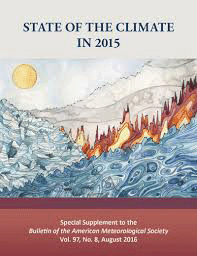 The 10 most startling facts about climate in 2015 — the warmest year on record [excellent maps and graphs] WP, By Jason Samenow August 2 Last year was unequivocally the warmest year on record for Earth. The National Oceanic and Atmospheric Administration Tuesday released a 300-page report documenting the historic warmth as well as scores of other aspects of 2015’s climate.
The hefty report, State of the Climate in 2015, was produced by more than 450 scientists from 62 countries around the world — more than any previous edition.
Every single direct indicator of temperature described in the report leaves no doubt that 2015’s global surface temperature towered over any year preceding it. Numerous other climate indicators related to temperature exhibited characteristics consistent with such historic warmth.
2015’s exceptional warmth was fueled by a record-challenging El Niño event, in which warmer-than-normal tropical Pacific Ocean waters infused heat into the atmosphere, and by record-setting concentrations of heat-trapping gases from human activity.
Here are the 10 most impressive findings from this report:
1. The global temperature was the highest on record…….
2. The average ocean surface temperature was warmest on record…..
3. Upper ocean heat content was highest on record…..
4. Global sea level was highest on record…..
5. The El Niño event was among the strongest on record……
6. Greenhouse gases were highest on record……
7. Record number of major tropical cyclones in Northern Hemisphere…….
8. Arctic sea ice had its lowest maximum extent……
9. Glaciers continued shrinking….
10. Extreme temperatures were most extreme on record……
The report is available online and will be published by the Bulletin of the America Meteorological Society. https://www.washingtonpost.com/news/capital-weather-gang/wp/2016/08/02/the-10-most-startling-facts-about-climate-in-2015-the-warmest-year-on-record/
August 29, 2016
Posted by Christina Macpherson |
2 WORLD, climate change |
Leave a comment
Report Shows Whopping $8.8 Trillion Climate Tab Being Left for Next Generation
26 August 2016 http://www.skepticalscience.com/9-trillion-climate-tab.html This is a re-post from Common Dreams by Lauren McCauley
“We do not inherit the Earth from our ancestors, we borrow it from our children,” is an oft-quoted proverb, frequently used to explain the importance of environmental preservation. Unsaid, however, is how much it will impact the next generation if the Earth is bequeathed in a lesser state.
Environmental campaigners NextGen Climate and public policy group Demos published a new study that attempts to quantify the true cost of not addressing climate change to the millennial generation and their children.
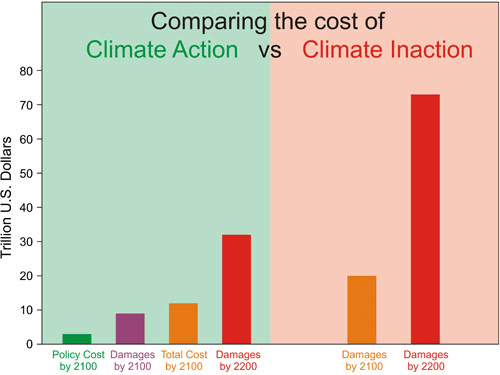
The Price Tag of Being Young: Climate Change and Millennials’ Economic Future (pdf) compares some of the high costs millennials will face in the “new inequality economy”—such as student debt, child care costs, stagnant wages, as well as financial and job insecurity—against the fiscal impacts of unmitigated global warming.
“The fact is,” the report states, “unchecked climate change will impose heavy costs on millennials and subsequent generations, both directly in the form of reduced incomes and wealth, and indirectly through likely higher tax bills as extreme weather, rising sea levels,drought, heat-related health problems, and many other climate change-related problems take their toll on our society.”
The impacts from climate costs alone, the report finds, are “comparable to Great Depression-era losses.” The study employs a model developed by researchers from Stanford University and University of California at Berkeley that measures the effects of rising temperatures on long-term economic growth and national productivity drawing on 50 years of data from 166 countries.
“no climate action” scenario found that by 2100 global per capita GDP will shrink by 23 percent relative to a scenario without climate change. The U.S. is estimated to take a 5 percent hit by 2050 that jumps to 36 percent by 2100 should no climate action occur.
This adds up to a loss of nearly $8.8 trillion in lifetime income for millennials and tens of trillions for their children.
“For the millennial generation, today’s status quo on climate and inequality is not only unjust but it is also unsustainable.”
In comparison, the cost of climate inaction overshadows the significant losses from other economic burdens, such as student debt. The report states:
According to Demos calculations, for a median- earning college graduate with median student debt, the lifetime wealth loss due to student debt is approximately $113,000, which is 40 percent less than the $187,000 lifetimewealth loss of a college- educated, median-earning 21-year-old if we fail to act on climate change.
But when these myriad forces are stacked together, they add up to a staggering burden. The report further highlights how climate inaction only exacerbates preexisting inequality:
Communities of color and low-income communities will be hit the hardest, as these communities have fewer resources to deal with the impacts of climate change […]. Further, these same communities have always had the highest exposure to coal-burning power plants and other sources of fossil fuel pollution, with sharply negative health impacts […]
If the transition to a clean energy economy is delayed, or if it is implemented unequally in keeping with historical patterns of racial exclusion, the fossil fuel economy will only deepen its toll on the health and well-being of America’s poorest and most vulnerable communities.
What’s more, the report notes, “the economic risks are compounded even further since inaction on climate change means that we are missing out on a major opportunity for much-needed new investment and millions of new jobs by transitioning to clean energy.”
August 29, 2016
Posted by Christina Macpherson |
2 WORLD, business and costs, climate change |
Leave a comment
Can progress on climate change keep up with its quickening pace? WP, By Tom Steyer August 26 Tom Steyer is founder of the advocacy group NextGen Climate. July was the hottest month in recorded history, by a lot, and August isn’t looking any better. So how do we interpret that? What does it mean?
…. global climate change… may be happening faster than scientists previously predicted. Monthly global average temperatures have set records in each of the past 15 months . The concomitant climate events have been extreme: from wildfires burning in California to floods in Baton Rouge after rainfall of historic proportions to neurotoxic algae bloomschoking Florida beaches. Even the beloved moose of New Hampshire have been decimated by ticks that thrive in a warmer world……If the new analyses imply an unpredictable and riskier world, that will necessitate a more urgent, and more difficult, response. Based on initial data, it now appears possible that the climate will warm by 2 degrees Celsius over pre-industrial levels — an amount of warming that scientists consider the danger zone — not by 2050, as once predicted, but years earlier. If further analysis supports this conclusion, this would be an enormous, and scary, change…..
if scientists start to project a dramatically shorter timeline for the impacts of climate change, any comfortable replacement scenario becomes something much more daunting. If we don’t have the decades needed for the vast bulk of our productive capacity to be replaced in the normal course, we would need to replace assets that had not reached the end of their usable lives — and that would affect industries beyond purely oil and gas.
Regardless of the scientific projections, we cannot afford to repeat the painfully slow and politically motivated dance of the past 10 years. As new data and analysis become available over the next year or so, we must be prepared to act decisively even though the cautious critics will want to wait for more definitive information. We will never have 100 percent certainty, except in hindsight. …..
Even cautious scientists are debating whether the previously accepted climate timelines are overly conservative. Meanwhile, Mother Nature has a timeline of her own. And she calls the tune. https://www.washingtonpost.com/opinions/can-progress-on-climate-change-keep-up-with-its-quickening-pace/2016/08/26/f5934118-68b8-11e6-8225-fbb8a6fc65bc_story.html?utm_term=.5d5c88ee5f7b
August 29, 2016
Posted by Christina Macpherson |
2 WORLD, climate change |
Leave a comment
 The snow-covered Himalaya-Hindu Kush mountains and the Tibetan Plateau, spanning a broad area in Central and East Asia, together contain the largest ice mass on the planet outside of the polar regions. In fact, it’s earned itself the nickname of the “Third Pole.” But as in Greenland and Antarctica, there’s trouble afoot: Glaciers in the Third Pole are also shrinking.
According to remote sensing data collected and analyzed by the Chinese Academy of Sciences, about 18 percent of China’s glaciers alone have disappeared over the past 50 years. And that’s a big problem because meltwater from these glaciers feeds a network of rivers that supply water, directly or indirectly, to more than a billion people downstream.
Rising temperatures, the product of global warming, are certainly one threat facing the glaciers, said Shichang Kang, a professor at the Chinese Academy of Sciences’ Institute of Tibetan Plateau Research. But air pollution in the region is also helping to accelerate the melting. And now, Kang and a group of colleagues have helped shed some new light on where all this pollution is coming from and how it could be stopped.
In a new study, published Tuesday in the journal Nature Communications, the researchers collected samples of black carbon — a particulate matter created through the burning of fossil fuels and biomass — throughout the Third Pole and analyzed them using a special chemical “fingerprinting” process that identifies what kind of burning produced them and where they originated.
Black carbon might be most famous for the range of adverse health effects it’s believed to cause, including respiratory and cardiovascular problems and even premature death. But in terms of its effects on glaciers, it’s known to cause snow and ice melt in a number of different ways. First, black carbon floating in the atmosphere is able to absorb sunlight and cause at least temporary regional warming as a result, Kang noted. Additionally, when black carbon deposits itself on snow and ice masses, it tends to darken their surfaces, causing them to absorb more sunlight and melt faster.
Until now, scientists have had trouble pinpointing which places are contributing pollution to which regions of the Himalayas and the Tibetan Plateau and which types of sources are causing the most damage. That’s important information, not only for constructing accurate ice models to predict how the glaciers might change in the future, but also for writing new policies aimed at cutting pollution in the places that need it most.
In their new study, the researchers found evidence that both the burning of fossil fuels and the burning of biomass — materials such as plant matter and animal dung — have contributed to the black carbon that ended up in the Third Pole. In the Himalayas, it was split about evenly between the two sources, with most of it coming from the Indo-Gangetic Plain in northern India, while in the northern part of the Tibetan Plateau, most of the black carbon came from fossil fuel burning in China.
But in the inner, central part of the plateau, about two thirds of the sampled black carbon came from biomass burning rather than fossil fuels — a finding that Kang noted is “very surprising.” This suggests that internal Tibetan fuel-burning practices, such as burning yak dung for daily cooking and heating, are contributing more pollutants to certain parts of the Third Pole than experts previously suspected.
This is valuable data that can better inform the models used to simulate ice melt in the Third Pole and make predictions about what the region’s future might look like. But according to Kang, “the most important thing is that we can provide mitigation [advice] to policymakers.”
Because most biomass burning on the Tibetan Plateau is used for home energy, including cooking and heating, government investments in improving the efficiency of stoves and expanding the availability of cleaner energy sources to households in the region could make a big difference, Kang noted.
This advice isn’t meant to overshadow efforts to reduce fossil fuel burning, which also has big implications for the fight against global climate change. And wider efforts to address the burning of fossil fuels in Central and East Asia are already under way in some places. In China, for instance, coal-burning still remains the country’s dominant power source — but reports suggest that coal consumption hasn’t grown since 2013 and may have even declined in the last year, while the government has also placed a moratorium on new coal mine approvals for at least the next three years.
The study’s results may have helped reveal some new ways governments can add to or prioritize their current efforts to cut down on black carbon production. In the meantime, careful monitoring of the Third Pole’s glaciers will be critical, Kang said, especially when it comes to keeping an eye on the region’s water resources and making projections for the future.
“In the future, we’re definitely going to see glaciers shrink, but different regions with different climate regimes have different responses,” Kang said. “This is what we want to try to figure out.”
August 29, 2016
Posted by Christina Macpherson |
China, climate change |
Leave a comment
Smoke from Indonesian fires hits ‘unhealthy’ levels in Singapore as authorities push to hunt offenders http://www.abc.net.au/news/2016-08-26/smoke-from-indonesian-fires-hits-unhealthy-level-in-singapore/7790370?section=environmentAir pollution in Singapore has risen to the “unhealthy” level as acrid smoke drifted over the island from fires on Indonesia’s Sumatra island, the city-state’s National Environment Agency (NEA) said, in a repeat of an annual crisis.
Every dry season, smoke from fires set to clear land for palm oil and pulp and paper plantations in Indonesia clouds the skies over much of the region, raising concern about public health and worrying tourist operators and airlines.
The 24-hour Pollution Standards Index (PSI), which the NEA uses as a benchmark, rose as high as 105 in the afternoon — a level above 100 is considered “unhealthy”.
The NEA said it planned a “daily haze advisory” as “a burning smell and slight haze were experienced over many areas” in Singapore.
Indonesia repeatedly vows to stop the fires but each year they return.
This year, Indonesia has arrested 454 people in connection with the smoke pollution. When heavy, the choking smog closes airports and schools and prompts warnings to residents to stay indoors.
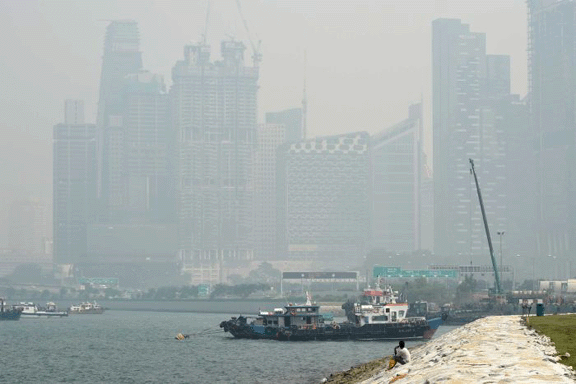
Pollution levels in neighbouring Malaysia were normal on Friday.
Singapore has pushed Indonesia for information on companies suspected of causing pollution, some of which are listed on Singapore’s stock exchange.
A forest campaigner for the environmental group Greenpeace Indonesia, Yuyun Indradi, said the Government was struggling to enforce laws to prevent the drainage of peatland for plantations and the setting of fires to clear land.
“It has become a challenge for the Government to enforce accountability among concession holders, to enforce its directives on blocking canals, and push companies to take part in efforts to restore peatland and prevent fires,” Mr Indradi said. “Now is the time for the Government to answer this challenge. It is in the law.” Greenpeace said, according to its satellite information, there were 138 fires across Indonesia on Friday.
August 27, 2016
Posted by Christina Macpherson |
climate change, Indonesia |
Leave a comment