Climate change could spark the world’s next financial crisis
Businesses should expect more regulation due to climate change, Emily Cadman, http://www.bloomberg.com/news/articles/2016-10-24/climate-change-may-trigger-next-financial-crisis-fisher-says Climate change could spark the world’s next financial crisis, according to Paul Fisher, who retired this year as deputy head of the Bank of England body which supervises the country’s banks.
“It is potentially a systemic risk,” Fisher said Monday in an interview in Sydney. A sudden repricing of assets as a result of climate change “could be the trigger for the next financial crisis,” he added.
Fisher, a 26-year-veteran of the U.K. central bank, pointed to the renewed fall in sterling earlier this month, after the government set out a timetable for leaving the European Union, as an example of the way that prices can shift suddenly. “That is exactly the sort of event you might get with climate change,” said Fisher, formerly deputy head of the U.K.’s Prudential Regulation Authority.
China and the U.S. agreed at the Group of 20 meeting in Hangzhou last month to ratify the Paris accord designed to limit global warming, bringing two of the world’s largest emitters of carbon pollution on board with an agreement to control temperature increases. A paper presented to the Hangzhou G-20 meeting by the U.K.’s Cambridge Centre for Sustainable Finance urged financial institutions to improve the way they assess climate risks.
“You don’t need to believe in climate change, you don’t need to believe that it is man-made,” Fisher said. “You just need to believe that governments are going to do stuff and that is going to affect your business. And then it is a material risk.”
Risks associated with climate change come both from the effect on valuations of the transition toward a lower carbon economy, as well as from the cost of adapting if global warming isn’t checked, according to Andrew Gray, an investment manager at AustralianSuper, the country’s largest pension fund. “Climate change is a genuine investment risk,” Gray said at a Citigroup Inc. conference in Sydney last week.
The hottest year on record? It will be 2016
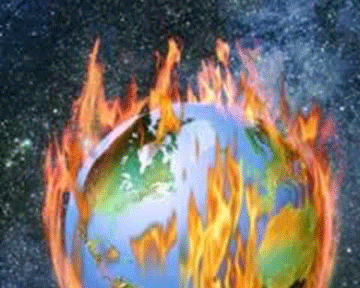 Global warming continues; 2016 will be the hottest year ever recorded http://www.skepticalscience.com/gw-continues-2016-hottest-year.html 21 October 2016 by John Abraham
We know the world is warming – no factor can explain it aside from human emissions ofgreenhouse gases. Despite this, people who deny the basic facts of climate change have tried to argue that the Earth is either not warming or is only slowly heating. Well that just isn’t true anymore. The last three years are the nail in the coffin of the deniers of climate change. We have enough data this year to call 2016 as the hottest year ever record – and we have three more months left to go.
So, just how hot is 2016? Well my early predictions are shown in the graph below. I have taken temperature data from NASA and superimposed my predictions for 2016 – it isn’t even close. And by the way, it doesn’t matter whose data you use (NASA, NOAA, JMA, Hadley Centre) the results are the same. 2016 is going to blow 2015 out of the water.
A few things to note. First, these temperatures are surface temperatures that are taken across the globe. But, you can measure temperatures elsewhere and see the same result. Most importantly, measurements in the oceans, where 93% of the extra heat is stored are the best proof of global warming. I recently coauthored an open-access paper on this very topic which interested readers can get here.
You can measure sea level rise as the heated water expands, you can measure ice loss across the globe, you can measure temperatures in the lower part of the atmosphere. It doesn’t matter where; the story is the same.
What is the big deal? Well first of all, 2016 blows away 2015 which was previously the hottest year ever and that had beaten 2014 as the hottest year ever – call this a three-peat. Three records in a row and the last two are by large margins. Does this mean global warming all of a sudden has gotten worse?
No, surface temperatures fluctuate a lot – you can see that in the figure. Temperatures will go up or down from year to year without apparent reason. This is why we are interested in the long term trends. This is also why we are interested in looking at other measures of warming (especially in the oceans). All of our measurements agree with each other – we know the Earth was warming long before this set of records began falling in 2014.
One thing these temperatures can do is enable us to compare computer models with measurements. We’ve seen that models have done an excellent job of correctly predicting the rate of heating of the Earth. My own research shows that in the oceans, the models are slightly under-predicting the rate of heating.
To compare models and measurements at the Earth’s surface, I’ve borrowed a figure from Dr. Gavin Schmidt of Nasa and I’ve overlaid the 2016 surface temperatures. A star shows where 2016 will be. The star should be compared to the three heavy dashed lines in the figure. The upper and lower dashed lines show the uncertainty in the models and the middle dashed line shows the average.
Climate change and ocean deoxygenation on the way to suffocating the oceans
A Horrifying New Study Found that the Ocean is on its Way to Suffocating by 2030, The Inertia, Alexander Haro MAY 2, 2016 It seems that every week, a new study comes out showing just how much damage we’re doing to our planet. This last one’s a doozy, though: according to Matthew Long, an oceanographer at the National Center for Atmospheric Research, if we continue along the road we’re on, the ocean could begin to suffocate in about 15 years. Actually.
The study was published a few days ago in Global Biogeochemical Cycles, which is not The National Enquirer and is a publication entirely based on science. Long’s not some quack, either. He’s a dyed-in-the-wool scientist with a Ph.D. in Oceanography from Stanford University, an M.S. in Environmental Engineering (Hydrology) from Tufts University, and a B.S in Environmental Engineering. That is a man who likes facts.
According to Ocean Scientists for Informed Policy, “ocean deoxygenation refers to the loss of oxygen from the oceans due to climate change.” It’s not up for debate, either: it is a cold and hard fact that both climate change and ocean deoxygenation are happening, and no amount of climate change deniers stamping their feet will change it.
“Long-term ocean monitoring shows that oxygen concentrations in the ocean have declined during the 20th century, and the new IPCC 5th Assessment Report (AR5 WG1) predicts that they will decrease by 3-6% during the 21st century in response to surface warming,” the website explains. “While 3-6% doesn’t seem like much, this decrease will be felt acutely in hypoxic and suboxic areas, where oxygen is already limiting. […] To put this in context, a highly optimistic emissions scenario of atmospheric CO2 levels of 550 ppm by 2100 would lead to a 1.2°C warming of the upper ocean. Therefore, these declines in oxygen are changes we should be prepared to see.”
So how does climate change affect the ocean? Well, the ocean is warming up, and a warm ocean doesn’t take in as much oxygen from the atmosphere, for starters. There’s the whole sea level rising issue, which is just way too big to go into here. But possibly the most concerning part of the whole thing has to do with phytoplankton, which are one of the smallest, most prolific, and really fucking important creatures on earth. If you believe National Geographic, “fish, whales, dolphins, crabs, seabirds, and just about everything else that makes a living in or off of the oceans owe their existence to phytoplankton, one-celled plants that live at the ocean surface. Phytoplankton are at the base of what scientists refer to as oceanic biological productivity, the ability of a water body to support life such as plants, fish, and wildlife.”
Warmer water doesn’t mix well with colder water. As the surface warms, the phytoplankton that float around up there most of the time don’t get down deep as often, and those little guys are responsible for about half of the oxygen in the ocean……….
According to the predictive study, vast portions of the Pacific–Hawaii and the western edge of the Americas included–will be seriously deprived of oxygen somewhere between 2030 and 2040, which would most likely mean massive die-offs of very important creatures.
Although Long’s study is far more telling than any other before it, it’s not really anything all that new. Back in 2010, Scripps Institution of Oceanography warned about the dangers of something called “oxygen minimum zones”, which are exactly what they sound like: large portions of the ocean, usually very deep, that don’t have enough oxygen to really sustain much life. “A major concern is that these so-called oxygen minimum zones (OMZs) will expand in the future as the upper ocean warms and becomes more stratified,” wrote Scripps scientist Ralph Keeling.
What does it all come down to? Well, more and more, it seems we’re already too far gone. Every day, we’re passing tipping points. Long, who seems a little frustrated that no one in charge is listening to him or anyone else that has been screaming about a host of environmental issues, made his point very clear. “This inexorable force of human-induced warming will clearly result in widespread ocean deoxygenation in the future,” he said.
And like it or not, our lust for carbon is causing it. “This latest study adds one more item to the list of insults we are inflicting on the oceans through our continued burning of fossil fuels,” said Michael Mann, a climate scientist at Penn State University. “Ocean life and marine ecosystems must now simultaneously contend with the triple threat of warming waters, increased acidity, and now, we’re learning, lower oxygen levels. Any one of these challenges alone would be daunting. “We have yet another reason to be gravely concerned about the health of our oceans, and yet another reason to prioritize the rapid decarbonization of our economy.” http://www.theinertia.com/environment/a-horrifying-new-study-found-that-the-ocean-is-on-its-way-to-suffocating-by-2030/
Can we afford to just laugh off the absurdities of Trumpism in this age of the Anthropocene?
The fervent Trump supporter has told his viewers that the both US president, Barack Obama, and the Democrat nominee, Hilary Clinton, were “literal demons” who smelt of sulphur. I kid you not.
In Australia, we have a senator who similarly sees climate change as a thing made up by the UN. Our top-rating radio host, Alan Jones (no relation), has said climate science is “witchcraft”.
There’s now a whole media ecosystem that climate science denialism can exist inside, where there’s little scrutiny of the views of deniers. US-based sites like the Drudge Report, Infowars, Breitbart and Daily Caller are part of that ecosystem.
For a while, maybe the Trumpocene and the Anthropocene can coexist.
But even though they exist on separate plains, can we really afford to dismiss the impact of either of them?
 We are approaching the Trumpocene, a new epoch where climate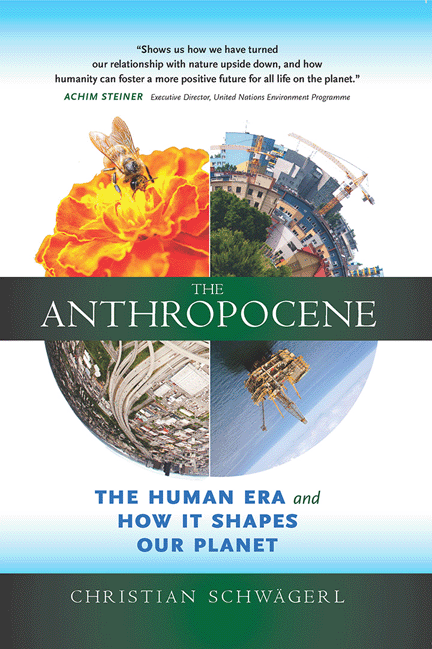
change is just a big scary conspiracy https://www.theguardian.com/environment/planet-oz/2016/oct/21/we-are-approaching-the-trumpocene-a-new-epoch-where-climate-change-is-just-a-big-scary-conspiracy Graham Readfearn
Websites pushing climate science denial are growing their audience in an era where populist rhetoric and the rejection of expertise is gaining traction For years now geologists have been politely but forcefully arguing over the existence or otherwise of a new epoch – one that might have started decades ago.
Some of the world’s most respected geologists and scientists reckon humans have had such a profound impact on the Earth that we’ve now moved out of the Holocene and into the Anthropocene.
It’s not official. But it’s close.
Dropping nuclear bombs and burning billions of tonnes of fossil fuels will do that to a planet, as will clearing swaths of forests to make way for food production and supermarket car parks and the like.
That’s all in the real world though, and sometimes you might get the horrible, chilling idea that when it comes to the production of our thoughts and ideas, that’s not the place a lot of us live anymore.
So I’d like to also propose the idea of an impending new epoch – the Trumpocene – that in the spirit of the era itself is based solely on a few thoughts held loosely together with hyperlinks and a general feeling of malaise.
In the Trumpocene, the epoch-defining impacts of climate change are nothing more than a conspiracy. Even if these impacts are real, then they’re probably good for us.
The era is named, of course, for the phenomenon that is Donald Trump, the Republican pick for US president whose candidacy has been defined by a loose grasp of facts, jingoistic posturing, populist rhetoric, his amazing hair and his treatment of women.
So what are the things that might define the Trumpocene?
Is it the point at which large numbers of people started to reject the views of large groups of actual experts – people with university qualifications and things – in exchange for the views of anyone who agrees with them? (Brexit, anyone?) Continue reading
East Africa’s water resources drying up as a result of climate change
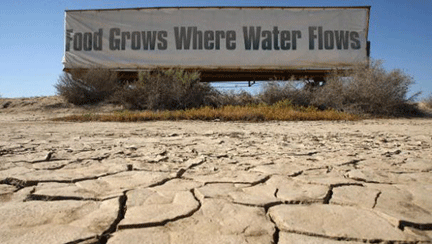 Climate change killing East Africa’s water resources, UN warns, Daily Nation OCTOBER 20 2016 BY KEVIN J. KELLEY
One of East Africa’s (EA) most important sources of water is drying up due to the impact of climate change on Mt Kilimanjaro, the United Nations Environment Programme (Unep) warned on Wednesday.
Climate Change and Renewable Energy policies – Hillary Clinton

 The Hillary Clinton Environmental Scorecard The former Secretary of State could inherit a number of ambitious eco-commitments established by President Obama. Here’s where she stands on each one. Outside By: Juliet Eilperin Oct 17, 2016 “…….
Climate Change and Renewable Energy
In contrast to Obama, who barely mentioned the issue when he was running for reelection in 2012, Clinton has made tackling climate change a major theme in her campaign. She’s mentioned it during both the primary and general election debates, mocking Trump during the first debate by saying, “Donald thinks that climate change is a hoax perpetrated by the Chinese. I think it’s real.” Trump replied, “I did not. I did not. I do not say that.” (He actually did tweet that, and he has also questioned whether global warming is even underway.)
Clinton has vowed to cut U.S. greenhouse gas emissions by as much as 30 percent below 2005 levels by 2025, and 80 percent by mid-century. She’s also pledged to cut U.S. oil consumption by a third, ensure that half a billion solar panels will be installed by 2020, and carry out a ten-fold increase in renewable energy production on public lands. On top of that, she aims to provide $60 billion to state and city officials through a “clean energy challenge fund” so they can reduce their carbon output and enhance their resilience to climate impacts, along with another $30 billion to struggling coal communities.
Such ideas make Clinton attractive to environmentalists. “It’s probably fair to say that, by the time his term is over, President Obama will be regarded as the most environmental president we’ve ever seen, and yet we’re confident Secretary Clinton will build on this record, and even do more,” says League of Conservation Voters President Gene Karpinski, whose group is pouring $10 million into the presidential race this cycle.
Clinton’s 2020 overall emissions target is more aggressive than what Obama has pledged under the Paris climate agreement. Her solar plan, for example, suggests that the U.S. will have 140 gigawatts of installed solar by the end of 2020, compared to the 100 gigawatts that’s now projected. But the question of whether she can deliver on her promises remains—especially since she has yet to embrace the idea of imposing a sweeping carbon tax, and it’s unlikely that Congress would hand over tens of billions of dollars to her administration if she’s elected. While Clinton has vowed to defend federal regulations limiting the carbon output of existing power plants, which are currently being challenged in court, she will have to do much more than that in order to meet her professed goals. …….http://www.outsideonline.com/2125806/hillary-clinton-environmental-scorecard
Consequences from Antarctica climate change
EurekAlert, 13 Oct 16 Extreme Antarctica ice melt provides glimpse of ecosystem response to global climate change
PORTLAND STATE UNIVERSITY New research led by Portland State University glacier scientist Andrew Fountain reveals how a single warming event in Antarctica may be an indication of future ecosystem changes.
In the scientific paper, “The Impact of a Large-scale Climate Event on Antarctic Ecosystem Processes,” published in a special section Thursday in Bioscience, Fountain and his team detail the climate event and summarize the cascading ecological consequences over the last 15 years caused by a single season of intense melting in Antarctica between 2001 and 2002……..https://www.eurekalert.org/pub_releases/2016-10/psu-cfa101216.php
Lord Stern – Indigenous land rights fundamental to climate safety
Indigenous land rights fundamental to climate safety – Lord Stern Climate Home 10/10/2016,
Forests and grasslands would store more carbon if communities’ rights were protected, according to research from the leading climate economist By Karl Mathiesen
Honouring the land rights of indigenous peoples would lead to a safer climate for everybody, according to leading economist Lord Nicholas Stern.
The world must become “zero net carbon” by 2070-80 if it wants to stay within the 2C limit set by the Paris climate agreement, said Stern, or “much earlier for 1.5C”. But some industries – including aviation – are expected to continue emitting carbon late into the century.
“If there are going to be some that are [carbon] positive,” Stern told an audience at a World Resources Institute (WRI) event in Washington, DC, “there have got to be some that are negative and it’s the forests and the grasslands that are the big potential source there.”
Stern was speaking on Friday at the launch of a WRI study that found that securing indigenous land tenure in Colombia, Brazil and Bolivia could avoid the release of an estimated 42.8–59.7 Mt CO2 per year through avoided deforestation. This is equivalent to taking between 9 and 12.6m cars off the road………. The argument went beyond the economy and the environment, Stern added. Indigenous peoples in the Amazon and across the world are being dispossessed by development. In some cases, their rights are being considered. A massive dam project in the Brazilian Amazon was suspended in April over concerns about the impact on local tribes.
“We are talking about justice here, we ought to be very clear about that… If you haven’t got those rights, you’re much more vulnerable to outsiders… If you’re vulnerable to outsiders it’s theft. Its solid rights that protect you against that.”http://www.climatechangenews.com/2016/10/10/indigenous-land-rights-fundamental-to-climate-safety-lord-stern/
Oil and gas exploration in the Arctic – how it impacts the Inuit
On Melting Ice: Inuit Struggle Against Oil and Gas in the Arctic Tuesday, 11 October 2016 By Chris Williams, Truthout | News Analysis The Inuit in the Canadian Arctic are engaged in a centuries-old fight to retain their culture and reestablish self-determination and genuine sovereignty. In particular, Inuit in the autonomous territory of Nunavut are resisting what American Indian studies scholar Daniel R. Wildcat has described as a “fourth removal attempt” of Indigenous people, coming on the heels of failed efforts at spatial, social and psycho-cultural deletion.
The common discourse on climate change focuses on the physical world: inexorably rising atmospheric concentrations of carbon dioxide and the impact on sea-ice extent; melting glaciers; and roiling, unpredictable perturbations in weather patterns. But these are but the physical manifestations of political decisions made in the social world. The questions behind them include: Who produced all that extra CO2? For what purposes? And which sets of people are paying the most immediate price?
In both realms, the Arctic, one of the regions least responsible for causing climate change, is bearing the most immediate brunt; though as Inuit activist, Nobel Prize nominee and author Sheila Watt-Cloutier warns in her book, The Right to Be Cold, “whatever happens in the poles will eventually happen everywhere else.”
To frame climate change in the Arctic as simply a story of liquefying dihydrogen monoxide is deceptive. The ice-filled north is first and foremost a human story, a story about home and the struggle to preserve it against outside forces. It is about a culture that quite literally rests on knowledge of ice, ocean and the animals that live on top and underneath it.
James Qillaq, mayor of Clyde River in Nunavut, explained, “That connection to the land, that’s our life … that’s the reason why we stand: our connection to the land and water, of something that is ours, that’s it. That’s it and nothing else. That’s our everything — our connection to the land.”…….
Climate Change and Arctic Amplification The most recent displacement attempt against Inuit is related to the fact that the Arctic is warming at twice the rate of lower latitudes. Over the last five decades, sea ice has vanished from an area twice the size of Alaska. The remaining ice is 50 percent thinner. The last nine years have all had the lowest sea-ice extents measured, with February 2015 showing the lowest in 37 years of satellite data. Over 50 percent of the gigantic ice sheet that blankets Greenland was melting during the summer of 2015, contributing to the 36th consecutive year of global glacier loss.
Going further back in time, recent research based on a compendium of historical data shows, “there is no point in the past 150 years where sea ice extent is as small as it has been in recent years,” ……… http://www.truth-out.org/news/item/37921-on-melting-ice-inuit-struggle-against-oil-and-gas-in-the-arctic
Climate Change’s fearful threat to Vietnam’s Mekong Delta
WILL CLIMATE CHANGE SINK THE MEKONG DELTA?, Mongabay News, 3 October 2016 / David Brown
No delta region in the world is more threatened by climate change. Will Vietnam act in time to save it?
- Scientists say the 1-meter sea level rise expected by century’s end will displace 3.5-5 million Mekong Delta residents. A 2-meter sea level rise could force three times that to higher ground.
- Shifting rainfall and flooding patterns are also threatening one of the most highly productive agricultural environments in the world.
- The onus is now on Vietnam’s government in Hanoi to approve a comprehensive adaptation and mitigation plan.
- This is the first article of an in-depth, four-part series exploring threats facing the Mekong Delta and how they might be addressed. Read the second installment here.
IIt’s a sad fact that several decades of talk about climate change have hardly anywhere yet led to serious efforts to adapt to phenomena that are virtually unavoidable. Neuroscientists say that’s because we’re humans. We aren’t wired to respond to large, complex, slow-moving threats. Our instinctive response is apathy, not action.
That paradox was much on my mind during a recent visit back to Vietnam’s fabulously fertile Mekong Delta, a soggy plain the size of Switzerland. Here the livelihood of 20 percent of Vietnam’s 92 million people is gravely threatened by climate change and by a manmade catastrophe, the seemingly unstoppable damming of the upper reaches of the Mekong River.
Samuel Johnson famously said that “nothing concentrates the mind so well as the prospect of imminent hanging.” It’s been nine years since a World Bank study singled out the Mekong Delta as one of the places on our planet that is most gravely threatened by sea level rise. There if anywhere, I imagined, I’d find a sense of urgency. I’d find adaptive measures well advanced.
I was wrong. Vietnamese government ministries, provincial administrations, experts from Vietnamese universities and thinktanks, experts deployed by the World Bank, the Asian Development Bank and foreign governments: all have been pushing plans and policies. The problem has been to sort out the best ideas, make appropriate decisions and find the resources needed to implement them in a timely, coherent way.
Things may be coming together at last, I concluded after talking with dozens of local officials, professors, journalists and farmers in mid-June. None denied the reality of the problem. Many connected the question of what to do about climate change to older arguments over the best ways to grow more and better crops………
- No delta area, not the mouths of the Ganges, the Nile or the Mississippi, is more vulnerable than the Mekong estuary to the predictable impacts of climate change. The 1-meter sea level rise expected by the end of the 21st century, all else being equal, will displace 3.5-5 million people. If the sea instead rose by 2 meters, lacking effective countermeasures, some 75 percent of the Delta’s 18 million inhabitants would be forced to move to higher ground.
Already, said Professor Ni, there’s been a significant decrease in rainfall in the first part of the annual rainy season, and more rain toward the end. The Mekong’s annual flood peak has fallen by a third since 2000. The waters from upstream carry less silt to replenish the Delta floodplain. Also, the volume of fresh water is falling while the sea level rises. This allows salt-laden tidal water to penetrate further and further into Delta estuaries and swampy coastal areas during the dry season.
Modeling of current trends suggest that average temperatures in the Mekong Delta will rise by more than 3 degrees Celsius toward the end of the century. Annual rainfall will decrease during the first half of the century, and then rise well above the 20th century average. The area that’s flooded each autumn won’t change substantially, but the floods won’t last as long.
- All things being equal, rice yields will plummet as temperatures rise. Lighter rains in the early months of the wet season will challenge farmers’ ingenuity. Rising seas and reduced river flows will severely test the system of sea dikes. Riverbanks and the Delta coast are already crumbling; this will accelerate. Farmers who are unable to cope will head north to seek industrial and construction jobs.
That’s not all. At slide 70 (of 86) of the DRAGON presentation, attention shifts to upstream dam construction on Delta water regimes.For China, Laos and Thailand, the hydroelectric potential of the upper Mekong is a seemingly irresistable development opportunity. It may be that not all the dams they plan will be built across the Mekong mainstream. Whether a few or many, their impact on agriculture in Vietnam and Cambodia will be profoundly negative, Professor Ni, his colleagues at Can Tho University, and experts at other institutes in southern Vietnam have pounded the alarm gongs for years. The dam cascade is a nearer and more present danger, and apparently just as unstoppable as climate change.
DRAGON Institute’s slideshow concludes with a call to action. The future is bleak but not hopelessly so if appropriate adaptation and mitigation strategies are launched. What the Delta needs is revealed: sustainable development based on a triply effective foundation of water source security, food security and social security. https://news.mongabay.com/2016/10/will-climate-change-sink-the-mekong-delta/
America’s enormous splurge on Defense leaves little funding for Climate Change action
We Have Money to Fight Climate Change. It’s Just That We’re Spending It on Defense, Reader Supported News , By Kenneth Pennington, Guardian UK,08 October 16
Stopping one fighter plane program would save enough to build wind farms to power 320,000 homes. We need to drastically reassess our priorities
One year ago this week, I was sitting in a cramped hotel room with 15 other staffers in Las Vegas for Bernie Sanders’ first debate for the presidential nomination. The question came from CNN: “What is the greatest national security threat?” Pundits criticized and mocked him for weeks after he answered “climate change”. But he was right.
And it’s not just Sanders pointing out the imminent threat posed by climate change to global and national security. CIA analysts and our nation’s military strategists are rightfully naming it as a contributor to refugee flows, the spread of disease, and conflicts over basic resources like food and water.
In 2014, 17.5 million people were displaced by climate-related disasters. Those numbers will continue to rise dramatically in the coming decades, according to climate displacement program manager Alice Thomas of Refugees International.
Our nation’s defense officials know global warming’s destructive forces could undermine fragile governments in unstable regions of the world where extremist ideologies can take root. Yet mainstream Republican avoidance of reality on the science of climate change impedes the necessary reassignment of resources to meet the challenges posed.
Now a new report from the Institute of Policy Studies provides the most accurate calculation of government spending on climate security to date. The picture isn’t pretty. We’re spending 28 times as much on military security than climate security. A public sector investment of $55bn per year is required to meet the challenge, according to the study. With $21bn in the 2017 budget, a shortfall of $34bn is left.
That may seem like an insurmountable hill to climb. It’s not! As the IPS report points out, plenty of money lies untouched in the nation’s bloated military budget……….
Republicans should take heed of former GOP President Dwight Eisenhower’s words of wisdom:
Every gun that is made, every warship launched, every rocket fired signifies, in the final sense, a theft from those who hunger and are not fed, those who are cold and are not clothed. This world in arms is not spending money alone. It is spending the sweat of its laborers, the genius of its scientists, the hopes of its children.
Let’s steward our resources wisely. Let’s choose climate over combat. http://readersupportednews.org/news-section2/318-66/39569-we-have-money-to-fight-climate-change-its-just-that-were-spending-it-on-defense
Icelandic capital aims to go carbon neutral
Reykjavík: the geothermal city that aims to go carbon neutral
Icelandic capital plans to reduce its greenhouse gas emissions to zero by 2040 by reversing urban sprawl and promoting walking, cycling and public transport, Guardian, Senay Boztas, 3 Oct 16, Reykjavík used to be marketed as a place of “pure energy”, run on geothermal power – and now Iceland’s capital is trying to become the world’s first carbon neutral city.
Last month, Iceland became one of the first countries to ratify the Paris climate deal with a unilateral parliamentary vote, shortly after Reykjavik announced its aim to be carbon neutral by 2040.
It wants to reduce its greenhouse gas emissions from 2.8 tonnes per person in 2013 to zero – largely by changing the shape of the city to reverse urban sprawl and encouraging Icelanders out of their beloved cars to walk, cycle or use public transport.
The city already has a head-start thanks to its reliance on geothermal energy. The US, for example, has a greenhouse gas footprint of 16.5 tonnes per person………https://www.theguardian.com/sustainable-business/2016/oct/03/reykjavik-geothermal-city-carbon-neutral-climate
Climate change is disastrous for poor nations. Will the rich nations step up and help?
Oxfam called on countries to target 35% of funding by 2020, and 50% by 2025. “The share is not only too low, it is also declining. It was 21% in 2013. No share or specific amount has been agreed for vulnerable countries in the Paris agreement,” the spokeswoman said
Poor countries urge fast action on Paris deal to stop catastrophic warming As the climate agreement is ratified, developing nations warn that money pledged is still nowhere near enough to adapt to expected sea level rises, Guardian, John Vidal, 7 Oct 16, UN back-slapping for the record speed at which the Paris agreement on climate change has been ratified this week has been tempered by the reality that the new treaty will not stop catastrophic warming as it stands, and that the money so far pledged by rich countries is nowhere near enough to allow developing countries to adapt to expected sea level rises and more extreme weather.

The agreement, which will come into force on 4 November, is hoped to hold temperatures to a maximum 2C rise, and for the first time commits both rich and poor countries to reduce greenhouse gas emissions.
A UN report calculated that the cost for all developing countries to adapt to climate change could go as high as $500bn a year by 2050 – four to five times higher than previous estimates.
Where the money is going to come from is uncertain. Rich countries have agreed to “mobilise” $100bn a year from 2020 onwards but the details are still vague. Much of the money is expected to be channelled through the Green Climate Fund, which has been set up and has attracted nearly $10bn, but is said by developing countries to be bureaucratic, slow and inaccessible.………
Oxfam called on countries to target 35% of funding by 2020, and 50% by 2025. “The share is not only too low, it is also declining. It was 21% in 2013. No share or specific amount has been agreed for vulnerable countries in the Paris agreement,” the spokeswoman said. https://www.theguardian.com/global-development/2016/oct/07/poor-countries-urge-fast-action-paris-climate-deal-to-stop-catastrophic-warming
Intensity of hurricanes is increased by global warming
Dahr Jamail | Record Heating of Earth’s Oceans Is Driving Uptick in Hurricanes http://www.truth-out.org/news/item/37877-record-heating-of-earth-s-oceans-is-driving-uptick-in-hurricanes Thursday, 06 October 2016 By Dahr Jamail, Truthout | Report As Hurricane Matthew impacts the East Coast of the US this week, it is important to consider how rising ocean temperatures are contributing to the intensification of storms worldwide.
Earlier this year, a scientific study titled “Industrial-era global ocean heat uptake doubles in recent decades” was published in the journal Nature Climate Change. The study showed that half of the total global ocean heating increase that has happened since 1865 has occurred in just the last 20 years.
Given that oceans absorb more than 90 percent of Earth’s excess heat generated by anthropogenic climate disruption (ACD), the fact that the oceans are warming at a non-linear pace is, while not surprising, extraordinarily troubling.
To see more stories like this, visit “Planet or Profit?”
This ongoing trend is showing no signs of changing for the better.
This July, the US National Oceanic and Atmospheric Administration’s (NOAA)monthly global analysis report showed that the worldwide ocean surface temperature for that month was .79 degrees Celsius (1.42 degrees Fahrenheit) above the 20th century average, which, according to NOAA, was “the highest global ocean temperature for July in the 137-year record.” The previous record had been set just the year before. Moreover, this July was the 40th consecutive July that saw global ocean temperatures above the 20th century average. NOAA reported, “The 13 highest monthly global ocean temperature departures have all occurred in the past 13 months.” July saw record-high sea surface temperatures across portions of the western, southwestern, central and southeastern Pacific, the southern and western Atlantic, and the northeastern Indian Ocean, according to NOAA.
n August, which is at the time of this writing the most current month of NOAA’s global analysis report, oceanic surface temperatures were nearly as high as July’s, and were the second highest August temperatures on record — only .04 degrees Fahrenheit less than 2015’s record. As in July, large areas of the Atlantic, Pacific and Indian Oceans’ all saw record warm temperatures persisting.
In 2014, US government climate scientists stated that the warming of oceans due to ACD was unstoppable. At that time scientists warned that the impacts of the warming ocean temperatures would be felt for centuries to come, even if there were immediate and dramatic efforts to cut CO2 emissions globally.
Needless to say, nothing like those types of cuts have occurred. Emissions have continued to slowly increase or stay at roughly the same levels that have caused the crisis we are in, and dramatic impacts from rising oceanic water temperatures are on the rise.
Record-Breaking Storms and Rainfall
Warmer-than-normal tropical waters are one of the key factors in the formation ofHurricane Matthew, which is now easily one of the most powerful Atlantic hurricanes in the last decade. At the time of this writing, the massive storm had lashed Haiti with 145 mph winds, driving rains and claimed at least 17 lives.
Record-Breaking Storms and Rainfall
Warmer-than-normal tropical waters are one of the key factors in the formation ofHurricane Matthew, which is now easily one of the most powerful Atlantic hurricanes in the last decade. At the time of this writing, the massive storm had lashed Haiti with 145 mph winds, driving rains and claimed at least 17 lives.
Current models show the hurricane on track to scour much of the eastern seaboard of the US, with the storm still being a Category 3 hurricane by the time it reaches Florida on Friday.
Across the Pacific, Typhoon Megi, the equivalent of a Category 4 hurricane, became the third tropical cyclone of the season to pummel Taiwan, knocking out power to 3 million people across the country while dumping an incredible three feet of rain over parts of the island.
Meanwhile, major flooding events in the US have been coming in quick succession. August saw record floods across much of Louisiana, in what became the worst flooding since Hurricane Sandy, according to the Red Cross. That is only one example of many, as at least 18 major flooding events have struck Texas, Louisiana, Oklahoma and Arkansas since March 2015, according to The Weather Chanel.
Marine Life Impacted
The impacts of warming ocean waters on marine life are far too numerous and vast to detail here. However, some broad-brushstrokes include, according to a National Environmental Education Foundation report from earlier this year:
- More than 80 percent of Earth’s marine life is migrating to different places and changing their breeding and feeding patterns due to warming waters.
- Ocean species are migrating in response to climate change 10-times faster than land species.
- Some marine species have migrated as much as 600 miles from where they were abundant just a few decades ago.
Warming waters cause certain nutrients to be more or less available, which causes redistributions of global marine species, which then opens the migrating species to new diseases, new predators and other issues.
A recent example of this is evident in a study, released in September, that showed that baby lobsters are struggling to survive when they are reared in water 5 degrees Fahrenheit warmer than the temperatures that are currently typical of the western Gulf of Maine. “The UN’s [Intergovernmental Panel on Climate Change (IPCC)] expects the Gulf of Maine’s temperature to warm by [5 degrees Fahrenheit] by the year 2100,” Truthout recently reported. “Keep in mind, too, that thus far, the IPCC’s temperature predictions have consistently been too low.”
The entire food web of the oceans is being disrupted, and many global fisheries are undergoing dramatic, deleterious changes.
As we watch the weather worsen, we must not forget the links between weather and climate — and how warming oceans affect us all.
Nuclear reactors in Florida in the path of Hurricane Matthew
Safety fears as Hurricane Matthew hits TWO nuclear reactors: Storm also sweeps past heads Cape Canaveral and Trump’s Mar-a-Lago resort Hurricane Matthew started hitting Florida early this morning with heavy rain and strong winds
The St Lucie nuclear reactor was right in the storm’s path while Turkey Point in southern Florida was also affected by high winds.
The Department of Energy said: ‘Some reactors were shut as a precaution to protect equipment from the storm; others were forced to shut down or reduce power output due to damage to plant facilities or transmission infrastructure serving the plant.’………
The strongest winds of 120 mph were just offshore, but Matthew’s wrath still menaced more than 500 miles of coastline and 26 million Americans.
Government officials declared a state of emergency in several states in an effort to plan ahead since the deadly Category Three storm is expected to wreak havoc with its 120mph winds.
Two million people across the Southeast have been warned to flee inland as tens of millions along 500 miles of coastline battened down the hatches. ……..http://www.dailymail.co.uk/news/article-3826653/Safety-fears-Hurricane-Matthew-heads-TWO-nuclear-reactors-Storm-set-hit-Cape-Canaveral-Trump-s-Mar-Lago-resort.html
1 This Month





PLEASE OPPOSE HR 8255 AND S.3639 – bills would accelerate satellite deployment, with no environmental review or safeguards – https://ncstd5li.quorum.us/campaign/169331/
To see nuclear-related stories in greater depth and intensity – go to https://nuclearinformation.wordpress.com
-
Archives
- October 2026 (10)
- September 2026 (339)
- August 2026 (330)
- July 2026 (355)
- June 2026 (287)
- May 2026 (306)
- April 2026 (356)
- March 2026 (251)
- February 2026 (267)
- January 2026 (308)
- December 2025 (358)
- November 2025 (359)
-
Categories
- 1
- 1 NUCLEAR ISSUES
- business and costs
- climate change
- culture and arts
- ENERGY
- environment
- health
- history
- indigenous issues
- Legal
- marketing of nuclear
- media
- opposition to nuclear
- PERSONAL STORIES
- politics
- politics international
- Religion and ethics
- safety
- secrets,lies and civil liberties
- spinbuster
- technology
- Uranium
- wastes
- weapons and war
- Women
- 2 WORLD
- ACTION
- AFRICA
- Atrocities
- AUSTRALIA
- Christina's notes
- Christina's themes
- culture and arts
- Events
- Fuk 2022
- Fuk 2023
- Fukushima 2017
- Fukushima 2018
- fukushima 2019
- Fukushima 2020
- Fukushima 2021
- general
- global warming
- Humour (God we need it)
- Nuclear
- RARE EARTHS
- Reference
- resources – print
- Resources -audiovicual
- Weekly Newsletter
- World
- World Nuclear
- YouTube
-
RSS
Entries RSS
Comments RSS

