Pope Francis urges national leaders not to wreck the climate change pact
 Don’t wreck climate change pact: Pope
 http://www.heraldsun.com.au/news/breaking-news/dont-wreck-climate-change-pact-pope/news-story/a5c36744202997ae0318066349855400 Philip Pullella, Reuters November 29, 2016 Pope Francis has urged national leaders to implement global environmental agreements without delay, a message that looked to be squarely aimed at US President-elect Donald Trump.
Addressing a group of scientists that included theoretical physicist Stephen Hawking, the pope gave his strongest speech on the environment since the election of Trump, who has threatened to pull out of the 2015 Paris Agreement on climate change.
“The ‘distraction’ or delay in implementing global agreements on the environment shows that politics has become submissive to a technology and economy which seek profit above all else,” Francis said.
Francis, who wrote an encyclical, or papal letter, on the environment last year, took a swipe at those who dispute that climate change is caused by human activity, criticising “the ease with which well-founded scientific opinion about the state of our planet is disregarded”.
During the campaign, Trump called climate change a hoax.
Last week he appeared to soften his stance, telling The New York Times he was keeping “an open mind” and that there might be “some connectivity” between human activity and global warming.
But days later, Reince Priebus, Trump’s designated White House chief-of-staff, told Fox News that the president-elect still believed climate change was mostly “a bunch of bunk”.
In his speech, the Pope said scientists should “work free of political, economic or ideological interests, to develop a cultural model which can face the crisis of climatic change and its social consequences”.
A US withdrawal from the pact, agreed to by almost 200 countries, would set back international efforts to limit rising temperatures that have been linked to the extinction of animals and plants, heat waves, floods and rising sea levels.
Francis called for “an ecological conversion capable of supporting and promoting sustainable development”.
He said humans could not consider themselves “owners and masters of nature, authorised to plunder it without any consideration of its hidden potential and laws of development”.
n his encyclical last year to the world’s 1.2 billion Roman Catholics, the Pope called for swift action to save the planet from environmental ruin and urged world leaders to hear “the cry of the earth and the cry of the poor”.
UN General Assembly climate meetings ignored the oceans – the primary drivers of climate.
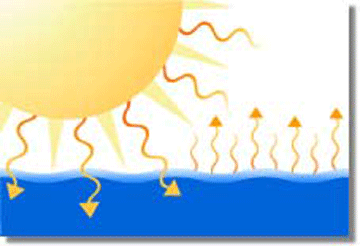 The Big Blue Elephant in the Room, A Medium Corporation Dr. Sylvia A. Earle & John Bridgelan, 26 Nov 16
Although the recent UN General Assembly meetings in New York City included the largest gathering of world leaders ever to address climate change, the largest factor in our climate cycle was missing from the discussions — the ocean.
Disregard for the ocean as the primary driver of climate and weather might be forgiven 50 years ago, but now we know: the living ocean governs planetary chemistry; regulates temperature; generates most of the oxygen in the sea and atmosphere; powers the water, carbon, and nitrogen cycles; and holds 97 percent of Earth’s water and 97 percent of the biosphere. Quite simply, no ocean, no life. No blue, no green. If not for the ocean, there would be no climate to discuss or anyone around to debate the issues……
Whatever the rationale, it is not rational that Earth’s dominant feature is not sufficiently addressed in important policy discussions about energy, the environment, economy, health, and security. It is especially perplexing that the ocean is getting short shrift in the current climate policy discussions.
Much attention is given to the impact of burning of fossil fuels on accelerated warming, inundated shorelines, and adaptation strategies for where and how people will live in the future. Far less note is being accorded to the changes in ocean chemistry as excess carbon dioxide absorbed by the ocean is increasing the acidity of the water. This is why it is so important to have Years of Living Dangerously helping to document the climate change impacts in our oceans and sharing it with the public. In Episode 5, Joshua Jackson travels to Australia’s Great Barrier Reef to look at the devastating impacts of ocean warming on the world’s largest reef system, and he explores the predicted impact of ocean acidification. In the Philippines, he looks at the impact of climate change in a place where hundreds of millions of people rely on healthy reefs for food, income and protection from storms……..https://medium.com/@yearsoflivingdangerously/the-big-blue-elephant-in-the-room-29d1a0c5f423#.p6e58alfv
Climate change in action: Bolivia’s fast-melting glaciers
 We must be prepared for the impact of Bolivia’s fast-melting glaciers
The country’s glaciers are leaving behind lakes that could cause catastrophic flooding of vast metropolitan areas. Simon Cook considers the impact on communities living below the waters, The Independent, Simon Cook Thursday 27 October 2016 Bolivia’s glaciers have shrunk by more than 40 per cent in the past few decades. This puts further pressure on an already stressed water supply, while the meltwater lakes left behind risk collapsing in sudden and catastrophic outburst floods. That’s the conclusion of a new study of the country’s glaciers I conducted with colleagues based in the UK and Bolivia. Our results are published in the journal The Cryosphere.
Although Bolivia sits in the tropics, the Andes run through the country like a spine. Many mountains exceed 6,000 metres, among the highest outside of south and central Asia, meaning that glaciers can exist here. Indeed, Bolivia contains around 20 per cent of the world’s so-called “tropical glaciers”. But these glaciers are very sensitive to the effects of a warming climate. Our study shows that Bolivian glaciers have shrunk by around 43 per cent since the mid-1980s – a period marked by increasing temperatures. We estimate that these glaciers will be much diminished by the end of the century.
Climate change in action – California’s six-year drought has killed 102 Million Trees
 102 Million Trees Have Died in California’s Drought http://www.enn.com/wildlife/article/50164 California’s six years of drought has left 102 million dead trees across 7.7 million acres of forest in its wake, the U.S. Forest Service (USFS) announced following an aerial survey. If that is not horrendous enough, 62 million trees died in the year 2016 alone—an increase of more than 100 percent compared to 2015.
“The scale of die-off in California is unprecedented in our modern history,” Randy Moore, a forester for the U.S. Forest Service, told the Los Angeles Times, adding that trees are dying “at a rate much quicker than we thought.”
“You look across the hillside on a side of the road, and you see a vast landscape of dead trees,” added Adrian Das, a U.S. Geological Survey ecologist whose office is located in Sequoia National Park. “It’s pretty startling.”
Most of the dead trees are located in 10 counties in the southern and central Sierra Nevada region.
“Five consecutive years of severe drought in California, a dramatic rise in bark beetle infestation and warmer temperatures are leading to these historic levels of tree die-off,” the USFS said.
Continue reading at ENN affiliate, Care2
Nuclear power to fix climate change? The numbers don’t stack up.
NuClearNews No 90 3. 26 Nov 16
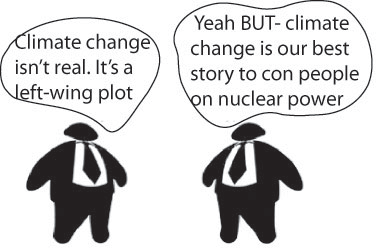 The kind of analysis pioneered by No2NuclearPower in 2005 on the contribution nuclear power might make to tackling climate change (1) has been updated by Fairewinds Associates.
The World Nuclear Association industry trade group estimates that an additional 1.1 Gigatonnes of CO2 would have been created in 2015 if natural gas plants supplied the electricity instead of 438 nuclear stations. That’s 1.1 additional Gt out of 36 Gt – only a 3% difference. Put another way, each of the 438 individual nuclear plants contribute less than seven thousandths of one percent to CO2 reduction. (2)
The World Nuclear Association (WNA) has a plan to build 1,000 new nuclear plants by 2050 (1,000GW) – that means commissioning a new plant on average every 12 days for the next 33 years. It says this is what we need to mitigate global warming. MIT says annual emissions will increase to 64Gt per year by 2050 even if Paris is implemented successfully.
If we build 1,000GW of nuclear capacity we could decrease CO2 emissions by 6.15%
For humanity the $8.2 trillion represents an opportunity cost. Precious time and money wasted. CO2 concentrations will grow by 34ppm in the atmosphere by 2050 while we’re waiting for those nuclear plants to come on line. The 6.15% offset will never be enough to reduce CO2 in the atmosphere by 34ppm. Solar costs have dropped from about 7c/kWh to 3c/kWh since 2013. Electricity from Hinkley Point C will cost about 12c/kWh
Constructing these reactor would cost $8,200,000,000,000 = $8.2 trillion
For humanity the $8.2 trillion represents an opportunity cost. Precious time and money wasted. CO2 concentrations will grow by 34ppm in the atmosphere by 2050 while we’re waiting for those nuclear plants to come on line. The 6.15% offset will never be enough to reduce CO2 in the atmosphere by 34ppm.
Solar costs have dropped from about 7c/kWh to 3c/kWh since 2013. Electricity from Hinkley Point C will cost about 12c/kWh
Lazard Financial Advisory and Asset Management, with no dog in the fight, says the $8.2 TRILLION could be better spent on less expensive alternatives to get more bang for the buck! Lazard also estimates that solar or wind would be 80% less expensive for the equivalent amount of peak electric output. (3) http://www.no2nuclearpower.org.uk/nuclearnews/NuClearNewsNo90.pdf
Global irreversible climate change could be set off by rapid Arctic ice melt
The report, billed as the first comprehensive study of ecosystems and societies in the region, found: “The potential effects of Arctic regime shifts [or tipping points] on the rest of the world are substantial, yet poorly understood. Human-driven climate change greatly increases the risk of Arctic regime shifts, so reducing global greenhouse gas emissions is crucial to reducing this risk.”
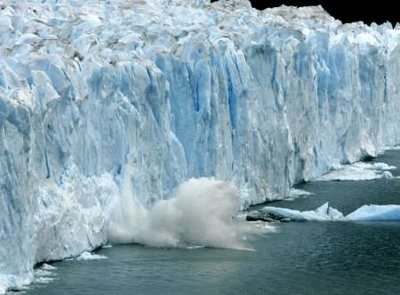 Arctic ice melt could trigger uncontrollable climate change at global levelhttps://www.theguardian.com/environment/2016/nov/25/arctic-ice-melt-trigger-uncontrollable-climate-change-global-level
Scientists warn increasingly rapid melting could trigger polar ‘tipping points’ with catastrophic consequences felt as far away as the Indian Ocean, Guardian, Fiona Harvey, 25 Nov 16, Arctic scientists have warned that the increasingly rapid melting of the ice cap risks triggering 19 “tipping points” in the region that could have catastrophic consequences around the globe.
The Arctic Resilience Report found that the effects of Arctic warming could be felt as far away as the Indian Ocean, in a stark warning that changes in the region could cause uncontrollable climate change at a global level.
Temperatures in the Arctic are currently about 20C above what would be expected for the time of year, which scientists describe as “off the charts”. Sea ice is at the lowest extent ever recorded for the time of year.
“The warning signals are getting louder,” said Marcus Carson of the Stockholm Environment Institute and one of the lead authors of the report. “[These developments] also make the potential for triggering [tipping points] and feedback loops much larger.”
Climate tipping points occur when a natural system, such as the polar ice cap, undergoes sudden or overwhelming change that has a profound effect on surrounding ecosystems, often irreversible
In the Arctic, the tipping points identified in the new report, published on Friday, include: growth in vegetation on tundra, which replaces reflective snow and ice with darker vegetation, thus absorbing more heat; higher releases of methane, a potent greenhouse gas, from the tundra as it warms; shifts in snow distribution that warm the ocean, resulting in altered climate patterns as far away as Asia, where the monsoon could be effected; and the collapse of some key Arctic fisheries, with knock-on effects on ocean ecosystems around the globe.
The research, compiled by 11 organisations including the Arctic Council and six universities, comes at a critical time, not only because of the current Arctic temperature rises but in political terms.
Aides to the US president-elect, Donald Trump, this week unveiled plans to remove the budget for climate change science currently used by Nasa and other US federal agencies for projects such as examining Arctic changes, and to spend it instead on space exploration.
“That would be a huge mistake,” said Carson, noting that much more research needs to be done on polar tipping points before we can understand the true dangers, let alone hope to tackle them. “It would be like ripping out the aeroplane’s cockpit instruments while you are in mid-flight.”
He added: “These are very serious problems, very serious changes are happening, but they are still poorly understood. We need more research to understand them. A lot of the major science is done by the US.”
Scientists have speculated for some years that so-called feedback mechanisms – by which the warming of one area or type of landscape has knock-on effects for whole ecosystems – could suddenly take hold and change the dynamics of Arctic ice melting from a relatively slow to a fast-moving phenomenon with unpredictable and potentially irreversible consequences for global warming. For instance, when sea ice shrinks it leaves areas of dark ocean that absorb more heat than the reflective ice, which in turn causes further shrinkage, and so on in a spiral.
The Arctic ice cap helps to cool sea and air temperatures, by reflecting much of the sun’s radiation back into space, and acting as a global cooler when winds and ocean currents swirl over and under it. It has long been known to play a key part of the global climate system, but the difficulty and expense of close monitoring have meant that scientists have only in recent years been able to make detailed assessments.
The report, billed as the first comprehensive study of ecosystems and societies in the region, found: “The potential effects of Arctic regime shifts [or tipping points] on the rest of the world are substantial, yet poorly understood. Human-driven climate change greatly increases the risk of Arctic regime shifts, so reducing global greenhouse gas emissions is crucial to reducing this risk.”
The authors also warned that people living in and near the Arctic would be badly affected, and called for communities to be provided with equipment and skills to survive. They took evidence from a variety of settlements in the region, finding many signs of stark changes already under way.
Joel Clement, co-chair of the project and director of the office of policy analysis at the US Department of the Interior, said: “This groundbreaking report is an unprecedented effort to gain insight from what is happening on the ground. The findings are foundational to a more informed, coordinated response to building resilience across the region.”
Property values getting threatened by sea level rise. Climate change IS looking serious!
 Perils of Climate Change Could Swamp Coastal Real Estate [compelling photos] Homeowners are slowly growing wary of buying property in the areas most at risk, setting up a potential economic time bomb in an industry that is struggling to adapt.

NYT, By IAN URBINANOV. 24, 2016 MIAMI — Real estate agents looking to sell coastal properties usually focus on one thing: how close the home is to the water’s edge. But buyers are increasingly asking instead how far back it is from the waterline. How many feet above sea level? Is it fortified against storm surges? Does it have emergency power and sump pumps?
Rising sea levels are changing the way people think about waterfront real estate. Though demand remains strong and developers continue to build near the water in many coastal cities, homeowners across the nation are slowly growing wary of buying property in areas most vulnerable to the effects of climate change.
A warming planet has already forced a number of industries — coal, oil, agriculture and utilities among them — to account for potential future costs of a changed climate. The real estate industry, particularly along the vulnerable coastlines, is slowly awakening to the need to factor in the risks of catastrophic damage from climate change, including that wrought by rising seas and storm-driven flooding.
But many economists say that this reckoning needs to happen much faster and that home buyers urgently need to be better informed. Some analysts say the economic impact of a collapse in the waterfront property market could surpass that of the bursting dot-com and real estate bubbles of 2000 and 2008.
The fallout would be felt by property owners, developers, real estate lenders and the financial institutions that bundle and resell mortgages.
Over the past five years, home sales in flood-prone areas grew about 25 percent less quickly than in counties that do not typically flood, according to county-by-county data from Attom Data Solutions, the parent company of RealtyTrac. Many coastal residents are rethinking their investments and heading for safer ground.
“I don’t see how this town is going to defeat the water,” said Brent Dixon, a resident of Miami Beach who plans to move north and away from the coast in anticipation of worsening king tides, the highest predicted tide of the year. “The water always wins.”
These concerns have taken on a new urgency since the presidential election of Donald J. Trump, who has long been a skeptic of global warming, claiming in 2012 that it was a concept “created by and for the Chinese in order to make U.S. manufacturing noncompetitive.”
A real estate developer, Mr. Trump is also the owner of several South Florida properties, including Mar-a-Lago, a 20-acre site that stretches between the Atlantic Ocean and the Intracoastal Waterway in Palm Beach.
Mr. Trump’s recent selection of Myron Ebell to lead his Environmental Protection Agency transition team intensified these worries in Florida and among many climate scientists. Mr. Ebell has helped lead the charge against the scientific consensus that global warming exists and is caused by people.
State lawmakers in Massachusetts and New Jersey are pushing to impose new rules on real estate agents and others, obligating them to disclose climate-related damage like previous flooding.
Banks and insurers need to protect their collateral and investors more by improving their methods for estimating climate-change risks and creating more standardized rules for reporting them publicly, economists warn.
In April, Sean Becketti, the chief economist for Freddie Mac, the government-backed mortgage giant, issued a dire prediction. It is only a matter of time, he wrote, before sea level rise and storm surges become so unbearable along the coast that people will leave, ditching their mortgages and potentially triggering another housing meltdown — except this time, it would be unlikely that these housing prices would ever recover.
“Some residents will cash out early and suffer minimal losses,” he wrote. “Others will not be so lucky.”
Bull’s-Eye for Property Damage
Much of the uncertainty surrounding climate change focuses on the pace of the rise in sea levels. But some argue that this misses the point because property values will probably go under water long before the properties themselves do.
What is often called “nuisance” flooding — inundation caused more by tides than weather — is already affecting property values. Often just a foot or two deep, this type of flooding can stop traffic, swamp basements, damage cars and contaminate groundwater.
Florida has six of the 10 American urban centers most vulnerable to storm surge, according to a 2016 report from CoreLogic, a real estate data firm. Southeast Florida experiences about 10 tidal floods per year now. That number is likely to be around 240 floods per year by 2045, according to climate researchers……..http://www.nytimes.com/2016/11/24/science/global-warming-coastal-real-estate.html?_r=0
Climate action in America’s cities, despite Donald Trump
 How Cities Plan to Fight Climate Change in the Trump Years Local leaders learned how to take action when Washington couldn’t. Now they’re betting those efforts can survive an age of science-denying federal overlords. City Lab, JOHN METCALFE and LAURA BLISS Nov 22, 2016 What impact will Donald Trump’s league of global-warming deniers and fossil-fuel boosters have on U.S. climate action? The short-term prognosis might not be as damaging as some fear, but the broader implications aren’t good. The president-elect has proposed slashing federal funding for clean energy development, resurrecting the coal industry, backing out of the Paris agreement, and essentially ditching the EPA. Trump won’t be able to do it all, but it seems safe to assume that for the next four years, domestic climate policy will be in the deep freezer—while the rest of us heat up.
Yet local leaders across the U.S. don’t need to be persuaded of the devastating impacts of climate change—environmentally, socially, and financially speaking—even if Trump and his top advisers do. Global warming’s effects are perhaps easiest to see on the local scale, with rising tides, melting snowcaps, and drier summers. A significant part what’s causing these changes lies in urban centers, which generate an estimated 70 percent of global greenhouse gas emissions, and house more than 50 percent of the population.
And U.S. cities have the power to shrink that footprint and prepare for the worst, even in the absence of financial or regulatory support from the federal government. Congress has long stalled on advancing climate policies, anyways—while cities have taken control of crucial variables that determine emissions and sustainability: renewable-energy programs, bus-rapid transit and rail, shared mobility, protections against flooding and the ever-rising seas.
Many local leaders say that this work has become more important than ever. Here are five American cities that have made real climate progress in ways that they plan to continue in the years of a Trump administration and Republican-controlled Congress.
Miami Beach…..
San Antonio…..
San Diego….
Los Angeles….
Climate emergency in Peru, with huge forest fires
 Peru declares state of emergency over deadly forest fires Blazes have burnt 12,000 hectares, including five protected natural areas Endangered species under threat from fires that ‘took us by surprise’, Guardian, Dan Collyns , 24 Nov 16, Peru has declared a state of emergency in seven districts in the north of the country where forest fires have killed two, injured four and burnt nearly 12,000 hectares (30,000 acres) of land, including five protected natural areas.
Wildfires have spread to 11 regions across the country, according to Peru’s civil defence institute, in what scientists say may be the worst drought in more than a decade.
Peru’s environment minister, Elsa Galarza, said a special brigade of firefighters had been deployed to the worst-affected areas in the north. The 31 firefighters are normally stationed in the Inca citadel Machu Picchu, the country’s top tourist attraction.
Endangered animal species such as the spectacled bear – which inspired the Paddington Bear children’s stories – and the white-winged guan are under threat from the blazes. Other rare species such as jaguars, howler monkeys and the collared anteater, are seeing their habitat destroyed inside the protected areas, which include the Amotape mountain range and Cutervo national park.
Peru’s prime minister, Fernando Zavala, travelled to the affected areas and said the state of emergency would allow the government to “continue mobilising people, resources and diverse equipment in order to confront these fires”.
“The ferocity and speed of the fires took us by surprise,” said Joel Córdoba, chief at the Paigabamba protected forest in Cajamarca, one of the worst-affected regions. …… https://www.theguardian.com/environment/2016/nov/24/peru-forest-fires-state-of-emergency-drought
Alarm among scientists at ‘Extraordinarily hot’ Arctic temperatures
‘Extraordinarily hot’ Arctic temperatures alarm scientists Danish and US researchers say warmer air and sea surface could lead to record lows of sea ice at north pole next year, Guardian, John Vidal, 22 Nov 16 The Arctic is experiencing extraordinarily hot sea surface and air temperatures, which are stopping ice forming and could lead to record lows of sea ice at the north pole next year, according to scientists.
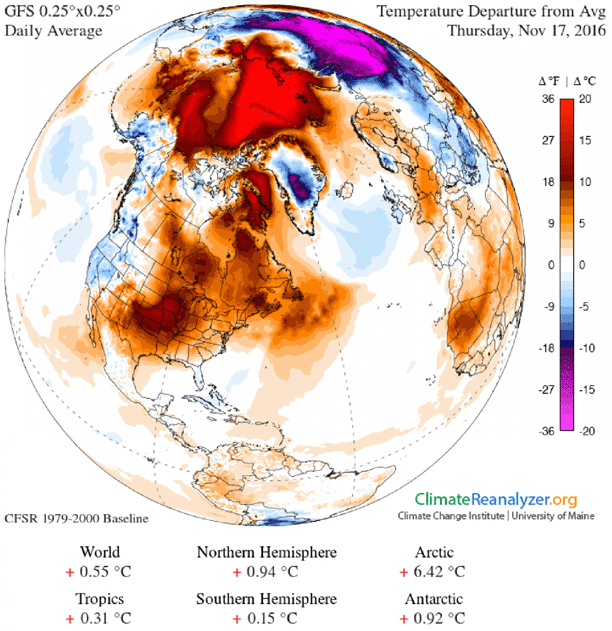
Danish and US researchers monitoring satellites and Arctic weather stations are surprised and alarmed by air temperatures peaking at what they say is an unheard-of 20C higher than normal for the time of year. In addition, sea temperatures averaging nearly 4C higher than usual in October and November.
“It’s been about 20C warmer than normal over most of the Arctic Ocean, along with cold anomalies of about the same magnitude over north-central Asia. This is unprecedented for November,” said research professor Jennifer Francis of Rutgers university.
Temperatures have been only a few degrees above freezing when -25C should be expected, according to Francis. “These temperatures are literally off the charts for where they should be at this time of year. It is pretty shocking. The Arctic has been breaking records all year. It is exciting but also scary,” she said…….https://www.theguardian.com/environment/2016/nov/22/extraordinarily-hot-arctic-temperatures-alarm-scientists
Stark choices face communities in drought afflicted Africa
 Battle of the Desert (I): To Fight or to Flee? http://www.ipsnews.net/2016/11/battle-of-the-desert-i-to-fight-or-to-flee/
“After the rains failed for a few years, some neighbours claimed our trees were drawing too much water from the ground. We cut them down. Our harvests fell. My mother closed her stall at the local market. That is when my father and I moved from the midlands to the Ruvu Mferejini river valley.”
Maria, whose dramatic story has been told by the United Nations organization leading in combating desertification, goes on to say: “My brother quit school to help the family. He went to find work but he does not earn enough. My mother stayed in Bangalala so that my daughter could go to school because there are no schools in the valley.”
“But where we moved to, my crop also failed last year. That is why early this year I moved yet again, but I left my father behind. I hope to farm here much longer, as I am sure the people I left behind with my father will have to move too. But when will this moving end? I cannot afford it anymore.”
This is not an isolated case–Maria is in the same situation that women in Darfur, Mali, Chad or Afghanistan were in before local conflicts over water or land turned into civil wars, sexual violence or genocide, reports the United Nations Convention to Combat Desertification (UNCCD).
“Nor is this situation unique to sub-Saharan Africa where half a billion inhabitants are rural, a majority lives off the land and desertification is a constant threat to their livelihoods,” it alerts in its report Desertification, the Invisible Frontline.
According to the Bonn-based UNCCD, more than 1.5 billion people in the world depend on degrading land, and 74 per cent of them, like Maria, are poor.
Desertification is a silent, invisible crisis that is destabilising communities on a global scale, says this international legal framework for tackling desertification, land degradation and drought, 169 of its 194 Parties have declared they are affected by desertification.
The consequences are dire. “As the effects of climate change undermine livelihoods, inter-ethnic clashes are breaking out within and across states and fragile states are turning to militarisation to control the situation.”
The effects of desertification are increasingly felt globally as victims turn into refugees, internally displaced people and forced migrants or they turn to radicalisation, extremism or resource-driven wars for survival, UNCCD continues.
“If we are to restore peace, security and international stability in a context where changing weather events are threatening the livelihoods of more and more people, survival options are declining and state capacities are overburdened, then more should be done to combat desertification, reverse land degradation and mitigate the effects of drought.’
Otherwise, many small-scale farmers and poor, land-dependent communities face two choices: fight or flight.
UP to 30% of World’s Land Affected by Desertification
For its part, the United Nations Environment Programme (UNEP) estimates that desertification currently affects approximately twenty-five to thirty per cent of the world’s land surface area. About 1,2 billion people in at least 100 states are at risk.
Over 42 billion dollars in lost productivity or human support occurs each year on account of it. According to UNEP, the global rate of desertification is increasing, although the local rates vary by region.
“Africa, with around sixty-six per cent of its land either desert or drylands, is particularly affected by desertification. Already, a number of large-scale famines have occurred in the Sahelian region, resulting in migration of people towards more hospitable lands.”
Desertification occurs mainly through over-cropping, over-grazing, improper irrigation practices, and deforestation. These activities arise from poor land management, which, in turn, stems from the socio-economic conditions in which the farmers live.
Monique Barbut, UNCCD Executive Secretary, gives specific figures.
“Globally, only 7.8 billion hectares of land are suitable for food production. About 2 billion hectares are already degraded, and of these 500 million hectares have been totally abandoned. These lands could be restored to fertility for future use.”
With 99.7 per cent of our food calories coming from the land –Barbut underlines– land degradation is a threat to our food security. But its effects are especially harsh for the poorest people who rely directly on the land for survival – food, employment and water. When their lands cannot produce any more, they have little choice but to migrate or fight over what little is left.
“Unless we change our approach, when drought comes and the rains fail, the future of the 400 million African farmers who rely on rain fed subsistence agriculture, for example, is put in jeopardy,” Barbut wroteon IPS.
Rain-fed agriculture accounts for more than 95 per cent of farmed land in sub-Saharan Africa. And water scarcity alone could cost some regions 6 per cent of their Gross Domestic Product, she added.
“Unless we change our approach, people are going to be increasingly forced to decide whether to ride out a drought disaster and then rebuild. Or simply leave.”
According to Barbut, “It is a form of madness that we force our people to make these difficult choices.”
Food Insecurity Triggering Riots
In 2008, food insecurity triggered riots in over 30 countries, ccording to the UNCCD. But it is rural communities like those of Bangalala, who depend on rainfed agriculture that contribute to global food security.
The livelihoods of over 2 billion people worldwide depend on 500 million small-scale farmers. Drylands, which make up nearly 34 per cent of the land mass and are a major source of food security especially for the poor, are being degraded day-by-day, it adds.
“Desertification does not always lead to conflict. But it is an amplifier of displacement, forced migration, radicalisation, extremism and violence.”
The US National Security Strategy refers to climate change as a key global challenge that will lead to conflicts over refugees and resources, suffering from drought and famine, catastrophic natural disasters, and the degradation of land across the globe, it reminds.
Therefore, “investing in practical solutions that transform lives and reduce the vulnerability of communities like Maria’s would be cheaper and work better than investing in walls, wars and relief.”
Pacific Island Nations appeal to USA to save them from global warming
The participants also agreed the Marrakech Proclamation, a statement re-affirming the intentions of all 197 signatories to the Paris deal.Seen as show of unity on the issue in the light a possible US withdrawal, countries stated they would live up to their promises to reduce emissions. The proclamation also called on all states to increase their carbon cutting ambitions, urgently.
Some of the poorest nations in the world announced that they were moving towards 100% green energy at this meeting.
The Climate Vulnerable Forum said that the 47 member countries, including Bangladesh, Ethiopia and Yemen, would achieve this goal between 2030 and 2050. And they challenged richer countries to do the same.
Despite these steps forward there were still some areas of significant difference between the parties, especially over money. The talks will continue in 2017 with a new US delegation picked by the Trump administration.
Climate talks: ‘Save us’ from global warming, US urged http://www.bbc.com/news/science-environment-38034171 19 November 2016 The next head of the UN global climate talks has appealed for the US to “save” Pacific islands from the impacts of global warming.
Fijian Prime Minister Frank Bainimarama said that the islands needed the US now as much as they did during World War Two. He was speaking as global climate talks in Marrakech came to an end.
Mr Bainimarama said that climate change was not a hoax, as US President-elect Donald Trump has claimed. Mr Trump has promised to pull the US out of the Paris Climate Agreement and scrap all payments for UN global warming projects.
But as he accepted the role of president of the Conference of the Parties for the year ahead, the Fijian leader took the opportunity to call on to the next US president to step away from his scepticism.
“I again appeal to the President-elect of the US Donald Trump to show leadership on this issue by abandoning his position that man-made climate change is a hoax,” said Mr Bainimarama.
“On the contrary, the global scientific consensus is that it is very real and we must act more decisively to avoid catastrophe.” He also made a direct call to the American people to come to their aid in the face of rising seas, driven by global warming. Continue reading
Killings of climate activists
The deadly business of grassroots climate activism New Internationalist, 20 Nov 16 A recent report found that 2015 was the deadliest year on record for environmental activists, raising concerns for those who continue to fight on the frontline, writes Liam Turner. It’s 2015, and Honduran campaigner Berta Cáceres has just won the Goldman Environmental Prize for grassroots environmentalism in South and Central America. The crowd claps as she walks up to the podium in her silver-sequined dress, a slight smile on her face. Then the room goes quiet, and Berta adopts a much more serious tone.
She speaks of her people, the Lenca, and their constant battle to protect their land. She speaks of how the world must break free from the grasp of ‘rapacious capitalism, racism and patriarchy’ that will ultimately lead to its self-destruction. She speaks of how her people’s sacrifice is not just for them, but for the world and everyone in it. She ends by dedicating the award to the martyrs who have given their lives in the struggle to defend our natural resources.
Less than a year later, armed men would break into her house in the middle of the night and murder her in cold blood, making her the latest to die for her cause. She was 44.
The Truth Behind the Paris Climate Deal
Climate activism has always been risky. Not only are there hazards that come from protesting at large, industrial sites, there is also the danger that comes from conflict with people whose interests lie with extractivist transnational companies. Ultimately, those who make a stand put themselves in harm’s way one way or another.
In fact, there’s evidence to suggest that climate activism is now more dangerous than ever. In June, a report by Global Witness revealed that 2015 was the deadliest year for environmental activists. It had recorded a total of 186 killings across 16 different countries, an increase of 59 per cent from the previous year. Global Witness also believes this number should actually be much higher, as a lack of reliable data meant that they weren’t able to record all fatal incidents.
An increasing threat
In a postscript to the Global Witness report – entitled ‘On Dangerous Ground’ – campaign leader Billy Kyte said: ‘As demand for products like minerals, timber and palm oil continues, governments, companies and criminal gangs are seizing land in defiance of the people who live on it. Communities that take a stand are increasingly finding themselves in the firing line of companies’ private security, state forces and a thriving market for contract killers.’
The report revealed that activists in Brazil were the worst hit, with a total of 50 recorded deaths. The Philippines was the next highest, with 36 deaths……… https://newint.org/features/web-exclusive/2016/11/15/the-deadly-business-of-grassroots-climate-activism/
Yes, you read it right! North Pole is 36 degrees warmer than normal!
The North Pole is an insane 36 degrees warmer than normal as winter descends, WP, Political people in the United States are watching the chaos in Washington in the moment. But some people in the science community are watching the chaos somewhere else — the Arctic.
It’s polar night there now — the sun isn’t rising in much of the Arctic. That’s when the Arctic is supposed to get super-cold, when the sea ice that covers the vast Arctic Ocean is supposed to grow and thicken.
But in fall of 2016 — which has been a zany year for the region, with multiple records set for low levels of monthly sea ice — something is totally off. The Arctic is super-hot, even as a vast area of cold polar air has been displaced over Siberia.
At the same time, one of the key indicators of the state of the Arctic — the extent of sea ice covering the polar ocean — is at a record low. The ice is freezing up again, as it always does this time of year after reaching its September low, but it isn’t doing so as rapidly as usual.
In fact, the ice’s area is even lower than it was during the record-low 2012:
Twitter’s expert Arctic watchers also are stunned. Zack Labe, a PhD student at the University of California at Irvine who studies the Arctic, tweeted out an image on Wednesday from the Danish Meteorological Institute showing Arctic temperatures about 20 degrees Celsius higher than normal above 80 degrees North Latitude.
“Today’s latest #Arctic mean temperature continues to move the wrong direction . . . up. Quite an anomalous spike!,” Labe wrote. Here’s the figure: [on original]
“Despite onset of #PolarNight, temperatures near #NorthPole increasing. Extraordinary situation right now in #Arctic, w/record low #seaice,” added Daniel Swain, a climate scientist at UCLA.
This is the second year in a row that temperatures near the North Pole have risen to freakishly warm levels. During 2015’s final days, the temperature near the Pole spiked to the melting point thanks to a massive storm that pumped warm air into the region.
So what’s going on here?
“It’s about 20C [36 degrees Fahrenheit] warmer than normal over most of the Arctic Ocean, along with cold anomalies of about the same magnitude over north-central Asia,” Jennifer Francis, an Arctic specialist at Rutgers University, said by email Wednesday…….https://www.washingtonpost.com/news/energy-environment/wp/2016/11/17/the-north-pole-is-an-insane-36-degrees-warmer-than-normal-as-winter-descends/
President of the COP22 climate summit urges Trump to join world action on climate chnage
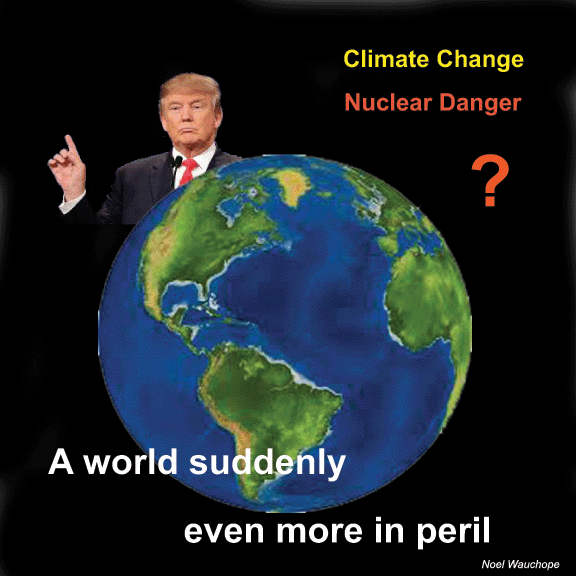 Climate summit chief pleads with Trump not to ditch Paris treaty
Marrakech COP22 president urges US president-elect to join battle against global warming for sake of humanity, Guardian, Arthur Neslen, 19 Nov 16, The president of the COP22 climate summit in Marrakech has made a direct plea to the incoming US president Donald Trump to join the struggle against global warming for the sake of humanity and the planet.
Salaheddine Mezouar, who is also the Moroccan foreign minister, had spent most of the week-long summit diplomatically trying to steer clear of questions about Trump, telling reporters at one point that “no one can stop history”.
But asked for a direct message to the president-elect in the last question of the summit’s final press conference, Mezouar issued a heartfelt plea. “We count on your pragmatism as well as your commitment to the spirit of the international community, in a huge struggle for our future, for the planet, for humanity and the dignity of millions and millions of people,” he said.
“This is about what our planet is going to be tomorrow, and what we are going to leave behind,” he added.
Trump was a spectre haunting much of the COP proceedings and a final “Marrakech call” by nearly 200 nations yesterday affirmed their “highest political commitment” to combating climate change, in a thinly coded warning to the far-right tycoon.
But his election did not prevent some of the world’s poorest countries from announcing a major emissions-cutting initiative before delegates boarded their planes home. In total, 48 nations promised to cut their carbon emissions dramatically and rapidly move to 100% renewable power as the UN climate summit in Marrakech drew to a close on Friday.
Bangladesh, Ethiopia and the Philippines were among the countries which said they would now file plans for becoming zero-carbon societies by the middle of the century, in line with the Paris deal’s aspiration of limiting global warming to 1.5C……. https://www.theguardian.com/environment/2016/nov/18/poor-nations-pledge-deep-emissions-cuts-at-marrakech-climate-change-summit
1 This Month





PLEASE OPPOSE HR 8255 AND S.3639 – bills would accelerate satellite deployment, with no environmental review or safeguards – https://ncstd5li.quorum.us/campaign/169331/
To see nuclear-related stories in greater depth and intensity – go to https://nuclearinformation.wordpress.com
-
Archives
- October 2026 (10)
- September 2026 (339)
- August 2026 (330)
- July 2026 (355)
- June 2026 (287)
- May 2026 (306)
- April 2026 (356)
- March 2026 (251)
- February 2026 (267)
- January 2026 (308)
- December 2025 (358)
- November 2025 (359)
-
Categories
- 1
- 1 NUCLEAR ISSUES
- business and costs
- climate change
- culture and arts
- ENERGY
- environment
- health
- history
- indigenous issues
- Legal
- marketing of nuclear
- media
- opposition to nuclear
- PERSONAL STORIES
- politics
- politics international
- Religion and ethics
- safety
- secrets,lies and civil liberties
- spinbuster
- technology
- Uranium
- wastes
- weapons and war
- Women
- 2 WORLD
- ACTION
- AFRICA
- Atrocities
- AUSTRALIA
- Christina's notes
- Christina's themes
- culture and arts
- Events
- Fuk 2022
- Fuk 2023
- Fukushima 2017
- Fukushima 2018
- fukushima 2019
- Fukushima 2020
- Fukushima 2021
- general
- global warming
- Humour (God we need it)
- Nuclear
- RARE EARTHS
- Reference
- resources – print
- Resources -audiovicual
- Weekly Newsletter
- World
- World Nuclear
- YouTube
-
RSS
Entries RSS
Comments RSS


