
 Why America is still on the right path for climate change, By Kalpana Sutaria – American Statesman, 9 Jul 17 “…… States, cities, counties, universities, corporations, businesses, manufacturers, and social and religious organizations have climate action plans to lower emissions. I worked on the city of Austin’s Climate Action Plan and experienced positive environmental impacts. Many leaders around the country have affirmed their conviction to continue with the goals of Paris accord, which included national pledges to reduce emissions.
It may seem difficult to see how we get there when the leaders at the top do not accept that human activities are major contributor to climate change. In the absence of the federal government’s support, cities, states, corporations and manufacturing companies are determined to work towards meeting those temperature targets. Seven states have bills filed on carbon pricing.
Texas has been a leader in producing renewable energy and has its institutions and workforce moving forward with innovative, low-carbon technologies. Texans want that. Some other recent developments in the U.S. are encouraging:
• The Climate Solutions Caucus in the U.S. House is a bipartisan group that will address the impacts, causes and challenges of our changing climate. “The caucus will serve as an organization to educate members on economically viable options to reduce climate risk and protect our nation’s economy, security, infrastructure, agriculture, water supply and public safety,” according to an announcement from the Committee on House Administration. It has 42 members: 21 Republicans and 21 Democrats. They must join in pairs.
•. Climate Leadership Council was formed this year by conservative Republican leaders and others who make a case for carbon dividends and how a new climate strategy can strengthen our economy, reduce regulation, help working-class Americans, shrink government and promote national security.
• More than six in 10 Trump voters support taxing or regulating the pollution that causes global warming, according to national survey of Trump voters done shortly after the election by the Yale Program on Climate Change Communication. They support variety of clean energy policies.
The Citizens’ Climate Lobby has a proposal of a carbon fee and dividend that is studied and supported by prominent economists. It is a market-based solution that will reflect true cost of carbon to the society, steer the economy away from fossil fuels to clean energy sources, and create millions of jobs while protecting the environment. Market will be a key element in spurring innovations. With the dividend, most low-income and middle-income families would come out ahead.
Every year, thousands of Citizens’ Climate Lobby members gather in Washington, D.C., to meet with representatives in the House and Senate to ask for their support of a carbon fee and dividend. Anyone concerned about global warming should ask their lawmakers to join the Climate Solutions Caucus.
Sutaria is an architect and project manager for the city of Austin.
July 10, 2017
Posted by Christina Macpherson |
climate change, USA |
Leave a comment
Historic First: Solar Plant Illuminates Syrian Refugee Camp, Vastly Improving Quality of Life, http://www.environews.tv/world-news/historic-1st-solar-plant-illuminates-syrian-refugee-camp-vastly-improving-quality-life/ (EnviroNews World News) by Julia Travers May 27, 2017 — Azraq, Jordan — The newly activated two-megawatt solar photovoltaic power plant at the Azraq refugee camp in Jordan is the first refugee camp in the world to be powered by a renewable energy facility. The plant started running May 17, 2017, and will provide free energy to about 20,000 of the 36,000 refugees in the area – all victims of the Syrian conflict, now in its seventh year.
There are close to 15 million refugees in the world, and the integration of free renewable energy into their stressful lives is invaluable. “Lighting up the camp is not only a symbolic achievement; it provides a safer environment for all camp residents, opens up [livelihood] opportunities, and gives children the chance to study after dark. Above all, it allows all residents of the camps to lead more dignified lives,” said United Nations High Commission for Refugees (UNHCR) Deputy High Commissioner, Kelly T. Clements.
“Before this, when we cooked a meal we had to throw the leftovers away because there was no safe way to store food. When we got too hot, we had to pour water on our clothes to keep cool. Now we can listen to music or have a cold glass of water, and daily life no longer ends when the sun sets,” Fatima, a 52-year-old from Damascus who lives in the camp with her two adult sons, told the UNHCR.
UNHCR partnered with the Government of Jordan, Jordanian solar company Mustakbal, and IKEA to build this camp. The IKEA Foundation is UNHCR’s largest private sector partner and fully funded the solar installation through their “#BrighterLives4Refugees” campaign. The endeavor raised $9.6 million for the cause by donating a portion of IKEA’s LED light sales in 2015.
20,000 of the individuals now living in the desert camp have had some access to non-renewable electricity since January 2017, and they now receive additional power from the sun. The new solar station is connected to Jordan’s grid and is intended to provide electricity to the remaining 16,000 refugees at Azraq by early 2018. The solar initiative will save UNHCR $1.5 million a year, which it can devote to other refugee services, while reducing annual CO2 emissions by roughly 2,370 tons.
The 500 new solar LED streetlights make the camp safer at night, which was especially concerning for women and girls, UNHCR relayed. Mustakbal also provided training and employment to over 50 refugees. “I wasn’t able to finish my education because of the war and then exile, but this has given me a practical skill that I can hopefully use in the future. If we return to Syria, the infrastructure is all destroyed, but this is a technology that we could use to rebuild,” said Mohammad, 20, who was forced to leave school at age 14.
July 10, 2017
Posted by Christina Macpherson |
climate change, Jordan, renewable |
Leave a comment
Last month, Brown discussed climate change with Chinese President Xi Jinping in Beijing, an unusual level of engagement between the Chinese head of state and a governor. (Energy Secretary Rick Perry, by contrast, did not meet with Xi in a recent trip to China).
“He wants to make clear that if you can’t look to Washington, you can look to California on progressive environmental policy,” said Ann Carlson, professor of environmental law at UCLA
 Gov. Brown unveils plan for global climate summit, further undercutting Trump’s agenda, Melanie Mason, Evan Halper and Patrick McGreevyContact Reporters, 6 Jul 17, In a rebuke to President Trump’s disengagement from worldwide climate change efforts, Gov. Jerry Brown told an international audience Thursday the president “doesn’t speak for the rest of us” and unveiled plans for a global environmental summit in San Francisco next year.
The announcement, at a convening of climate activists in Hamburg, Germany, coinciding with Trump’s arrival there for the G-20 summit of world leaders, signals once more how Brown and other American leaders aim to galvanize continued efforts against climate change, even as the federal government moves in the opposite direction.
“It’s hard to grasp the mortal danger that climate change represents,” Brown said in an interview with The Times. “I believe that California, New York, France and Germany and the other countries — we have to get our act together, strengthen our commitment and bring as many nations along as we can.”
Whether Brown and his American cohorts, including Los Angeles Mayor Eric Garcettiand former New York Mayor Michael Bloomberg, will ultimately be able to take sufficient action to curb global warming is uncertain, but they are already succeeding in undercutting the authority of the White House to set the U.S. agenda on climate. Since Trump quit the Paris accord on climate change, California and a dozen other states have vowed to not only stick with the agreement, but also step up their emission reduction efforts to push the rest of the country along. A coalition of cities committed to the climate action outlined in Paris — led by Garcetti — has swollen from a few dozen members to 331 in the last few weeks.
Brown and other American climate crusaders see the G-20 meeting as a crucial moment. Several world leaders who will attend the summit have already signaled that they will confront Trump on climate issues during its proceedings, and a move is afoot to conclude the meeting with a written reaffirmation of commitment to the Paris guidelines that would ostensibly be signed by every G-20 every nation except the U.S. — underscoring how far out of alignment with the rest of the world Trump is on the issue.
But even before the summit began, unity among the other countries was already starting to fray. While Western European leaders vowed to push the issue, countries such as Russia, Indonesia and Turkey were expressing less bombast. Saudi Arabia — which is still bullish on climate action but is also eager to remain in good diplomatic standing with the U.S. amid its dispute with fellow American ally Qatar — is also hedging.
With his video announcement Thursday to attendees of the Global Citizen Festival in Hamburg, Brown aimed to shore up opposition to Trump’s climate moves and send a signal that the U.S. can maintain a leadership role despite the president.
“It’s up to you and it’s up to me and tens of millions of other people to get it together to roll back the forces of carbonization and join together to combat the existential threat of climate change,” Brown said in his video, appearing in a leafy setting with a blazer and no tie. “Yes, I know President Trump is trying to get out of the Paris agreement, but he doesn’t speak for the rest of America…. We in California and in states all across America believe it’s time to act, it’s time to join together and that’s why at this climate action summit we’re going to get it done.”
Host of next United Nations climate conference turns to California in the global warming battle »
Brown’s message was projected into the arena, and the audience burst out in applause when the governor said Trump doesn’t speak for the rest of the U.S.
Trump was not invited to speak at the festival because his policies don’t align with its goal of supporting global health, climate and gender equality, said a source involved in organizing the festival. Canadian Prime Minister Justin Trudeau, Argentinian President Mauricio Macri and other leaders took the stage to speak about climate change and education to the crowd of 12,000.
The planned 2018 California summit, Brown told The Times, would signify “the biggest state in the union is the venue for a worldwide convocation of states, regions and entrepreneurs and others who want to do something serious about climate change.”……
Last month, Brown discussed climate change with Chinese President Xi Jinping in Beijing, an unusual level of engagement between the Chinese head of state and a governor. (Energy Secretary Rick Perry, by contrast, did not meet with Xi in a recent trip to China).
“He wants to make clear that if you can’t look to Washington, you can look to California on progressive environmental policy,” said Ann Carlson, professor of environmental law at UCLA………http://www.latimes.com/politics/la-pol-sac-jerry-brown-climate-summit-20170706-story.html
July 8, 2017
Posted by Christina Macpherson |
climate change, USA |
Leave a comment
 New Survey Shows Majority Of Americans Believe Climate Change Is Real And Caused By Human Activity https://www.desmogblog.com/2017/07/06/new-survey-shows-majority-americans-believe-climate-change-real-and-caused-human-activity?utm_source=dsb%20newsletter By Farron Cousins • Thursday, July 6, 2017 The current leadership in the United States — the U.S. House of Representatives, the Senate, and the White House — have a hostile relationship with climate change science. Not only has current President Donald Trump suggested that the entire concept is a hoax perpetrated by the Chinese, but the Legislative Branch of government is populated with a majority of representatives who do not accept the scientific consensus regarding climate change. Not only are these views dangerous for the future of the planet, but a new poll shows that these views are entirely out of sync with a majority of the U.S. population.
According to a new report by the Yale Program on Climate Change Communication, a majority of people in the United States believe that climate change is real and that it is mostly the result of human activities. The survey shows that 58% of the public now accepts that climate change is mostly caused by human activity, which is the highest level ever recorded of public acceptance of the human role in climate change since Yale began conducting these studies in 2008.
Here are a few key findings from the new report:
Over half of Americans (58%) understand that global warming is mostly human caused, the highest level since our surveys began in November 2008. By contrast, three in ten (30%) say it is due mostly to natural changes in the environment – the lowest level recorded since 2008.
Only about one in eight Americans (13%) understand that nearly all climate scientists (more than 90%) are convinced that human-caused global warming is happening.
Over half of Americans (57%) say they are at least “somewhat worried” about global warming. About one in six (17%) are “very worried” about it.
About one in three Americans (35%) think people in the U.S. are being harmed by global warming “right now.”
By a large margin, Americans say that schools should teach children about the causes, consequences, and potential solutions to global warming (78% agree vs. 21% who disagree).
One particularly intriguing finding from the Yale report is that the majority believe that the threats of climate change are things that will either happen in the distant future, or that they will not happen to the individuals polled or their families:
Most Americans think global warming is a relatively distant threat – they are most likely to think that it will harm future generations of people (71%), plant and animal species (71%), the Earth (70%), people in developing countries (62%), or the world’s poor (62%). They are less likely to think it will harm people in the U.S. (58%), their own grandchildren (56%) or children (50%), people in their community (48%), their family (47%), themselves (43%), or members of their extended family living outside the U.S. (41%).
The fact that most Americans either believe the threat is something that will happen in the distant future or that it won’t happen to them is one possible reason so many people are willing to vote for politicians who either outright deny the existence of climate change or who refuse to act on the issue. Currently, a majority of members of both the U.S. House and the U.S. Senate fall into one of those categories, with 53 out of 100 U.S. Senators counted as climate change deniers and 232 out of 435 House members listed as deniers.
But the truth is that climate change is not a far-off threat for Americans. Rising sea levels are already threatening drinking water in South Florida, as salt water is seeping into aquifers. Elsewhere, rising temperatures, rising sea levels, changes in precipitation patterns, and extreme weather events that have been linked to climate change are wreaking havoc. So one of the main focuses of climate science advocates needs to be educating people about the timeline so they stop viewing climate change as a problem that can be put on the back burner. It is happening right now.
Nevertheless, the fact that a majority of U.S. citizens understand the realities of climate change while our elected leaders refuse to accept the science indicates that they have become too far removed from the values, desires, and concerns of their constituents. That’s likely due in part to the massive amounts of money that fossil fuel companies spend on lobbying and direct campaign contributions which totaled $120+ million and $103 million in 2016, respectively.
July 8, 2017
Posted by Christina Macpherson |
climate change, Reference, USA |
Leave a comment
Guardian 5th July 2017,The G20 nations provide four times more public financing to fossil fuels
than to renewable energy, a report has revealed ahead of their summit in
Hamburg, where Angela Merkel has said climate change will be at the heart
of the agenda.
The authors of the report accuse the G20 of “talking out of
both sides of their mouths” and the summit faces the challenge of a
sceptical US administration after Donald Trump pulled out of the global
Paris agreement
The public finance comes in the form of soft loans and
guarantees from governments, and, along with huge fossil fuel subsidies,
makes coal, oil and gas plants cheaper and locks in carbon emissions for
decades to come.
But scientists calculate that to keep global warming below 2C, most fossil fuel reserves must be kept in the ground, requiring a major shift of investment to clean energy. The new report by a coalition of NGOs
found that the G20 countries provided $71.8bn of public finance for fossil-fuel projects between 2013-2015, compared with just $18.7bn for renewable energy. Japan provided the most at $16.5bn, which was six times
more than it allotted for renewables. https://www.theguardian.com/world/2017/jul/05/g20-public-finance-for-fossil-fuels-is-four-times-more-than-renewables
July 7, 2017
Posted by Christina Macpherson |
2 WORLD, climate change |
Leave a comment
Morning Star 1st July 2017, A BUNGLING Brexit bureaucrat has blown the lid on the government’s
“shocking attitude towards climate change,” official documents seen by
the Star reveal today. The files were part of a bundle of “sensitive”
papers seen by a Star reporter travelling on the Eurostar to Brussels on
Thursday morning.
They revealed how negotiators “have not yet engaged
with the EU Commission” on climate change and indicated that agreed
targets to reduce carbon emissions could be used as “political and
bureaucratic capital for bigger issues in the exit negotiations.”
GreenMP Caroline Lucas said the documents “appear to reveal a shocking
attitude towards climate change at the heart of government” and warned
that the government’s failure to take the issue seriously was a “dark
stain on their already tainted record.”
The papers suggest that on Britain’s exit, should Britain decide to no longer act jointly with the
EU on climate change, the EU will be faced with a decision of either
meeting the Paris Agreement by increasing remaining members’ targets or
setting a lower target overall — “both of which are politically
difficult.” http://www.morningstaronline.co.uk/a-b7f9-Sensitive-Documents-Reveal-Climate-Deals-are-at-Risk-Following-Brexit
July 5, 2017
Posted by Christina Macpherson |
climate change, UK |
Leave a comment
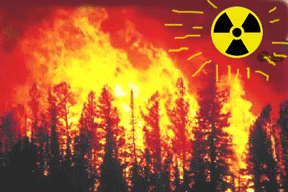 Ukrainian Firefighters Battle Forest Fire Near Chernobyl Nuclear Plant, https://www.rferl.org/a/firefighters-battle-forest-fire-near-chernobyl/28588006.html June 30, 2017 RFE/RL’s Ukrainian Service, Ukrainian firefighters are battling to contain a forest fire inside the irradiated exclusion zone around the Chernobyl nuclear plant, officials say.
The fire erupted around midday on June 29 during tree cutting works at the Lubyanskoye Forestry and spread to an area of some 25 hectares by early June 30, the emergency services said.
More than 100 firefighters and scores of trucks and aircraft were dispatched to the area, a statement said.
It is not the first wildfire to break out near the site of the 1986 reactor explosion and fire, the world’s worst civilian nuclear disaster. In 2015 alone, fires engulfed some 400 hectares of forests in the exclusion zone.
July 1, 2017
Posted by Christina Macpherson |
climate change, safety, Ukraine |
Leave a comment
By 2060, around 1.4 bn people could be climate refugees, driven from low-lying coastal cities by sea level rise. By 2100, as the global population may have reached 11bn, there could be 2bn climate refugees.
To feed those 9 to 11 bn people expected in the second half of the century, farmers will have to grow as much food in 40 years as they have grown in the last 8,000 or so.

And in a world of accelerating sea level rise and climate change, in which farmland is being degraded and turned to desert, in which ever more land is set aside for carbon storage in the form of forest, and in which the strains of survival increase social divisions and social conflict, there is a new challenge: where will the 2bn climate refugees find new homes?
“The colliding forces of human fertility, submerging coastal zones, residential retreat, and impediments to inland resettlement are a huge problem,” said Charles Geisler, professor emeritus of development sociology at Cornell University, in New York state.
“We offer preliminary estimates of the lands unlikely to support new waves of climate refugees due to the residues of war, exhausted natural resources, declining net primary productivity, desertification, urban sprawl, land concentration, ‘paving the planet’ with roads, and greenhouse gas storage zones offsetting permafrost melt.”
Although reclaiming land from oceans has been an important human project for millennia, it seems that oceans are now ‘reclaiming’ the land”
In any concerted attempts to contain climate change and limit global warming, climate scientists have to consider two big things. One is: how to drastically reduce fossil fuel use. The other is: how to use the land surface so that it takes up atmospheric carbon dioxide most efficiently.
Professor Geisler and his co-author Ben Currens, an earth and environmental scientist at the University of Kentucky, look at the big picture of land use in the long term.
They report in the journal Land Use Policy that they considered the implications of an ever faster rate of global sea level rise, as atmospheric temperatures warm and glaciers melt.
A study in Nature Climate Change has just confirmed that the seas that in the last century were rising by on average 2.2mm a year are now rising by 3.3mm a year. “Although reclaiming land from oceans has been an important human project for millennia,” write Geisler and Currens in their study, “it seems that oceans are now ‘reclaiming’ the land.”
They start from the premise that global mean sea level rise will continue beyond 2100, and from the prediction that for every 1°C of climate warming, humans should expect an eventual 2.3 metre rise in sea levels.
Losing land
In 2000, around 630 million people lived in low-lying coastal zones. By 2060, this number could have risen to 1.4bn. In the worst case scenario, the two scientists reason, almost all who dwell on the low-lying coasts will become climate refugees.
But the land that could be used to resettle those refugees is dwindling: between 1981 and 2003, around 35 million square kilometres of the planet became “degraded” and now make up almost one fourth of the world’s drylands.
Permafrost, described in the study as “a vast and cost-free warehouse” for greenhouse gases, is thawing: as it melts, it could double the current levels of atmospheric carbon and feed back into ever-faster climate change.
Were global forests to be planted in a bid to absorb this extra carbon, they would take up more than 42 million sq km or 28% of the planet’s land surface.
No entry
The two scientists then considered the barriers that climate refugees could face as they moved from the coasts. They defined what they called depletion zones – drylands, thawing permafrost and degraded land – that would be unlikely to support human existence. They identified what they call “win-lose” zones that because of urban sprawl, landfill needs and mushrooming roadways could help in some ways but not in others.
And they listed a set of what they call “no trespass zones”, from which refugees would be excluded either legally, or by violence, or by the risk of landmines or radioactive pollution.
They considered case studies, in China and in Florida in the US, where state officials have begun to plan for weather-induced population shifts.
And, although President Trump has declared climate change a hoax and is to take the US out of the Paris Agreement of 2015 in which the world’s nations undertook to reduce fossil fuel use and contain global warming to less than 2°C, the two authors think there is no other answer.
“The pressure is on us to contain greenhouse gas emissions at present levels. It’s the best ‘future proofing’ against climate change, sea level rise and the catastrophic consequences likely to play out on coasts, as well as inland, in the future,” said Professor Geisler. – Climate News Network
July 1, 2017
Posted by Christina Macpherson |
2 WORLD, climate change |
Leave a comment

 Angela Merkel promises to tackle Donald Trump on climate change at G20 summit, ‘We cannot wait to act until the science has convinced every last doubter’, The Independent, Samuel Osborne @SamuelOsborne93 30 June 17, German Chancellor Angela Merkel said the EU is “more determined than ever” to make the Paris accord against climate change a success following the US decision to withdraw from the agreement, and insisted she would not “overlook tensions” with America on Donald Trump’s first attendance at the G20.
Ms Merkel stressed in a speech to the German parliament that the EU stands fully behind its commitment to the agreement.
“We cannot expect easy discussions on climate change at the G20 summit,” she said. “Our differences with the US are clear.””
She added that “the Paris agreement is irreversible and it is not negotiable.” The German Chancellor will host the summit of leaders of the Group of 20 economic powers in Hamburg on 7 and 8 July.
Ahead of that summit, she is hosting a meeting of the European leaders who will take part in the summit later on Thursday at the chancellery in Berlin.
“We are convinced that climate change is one of the greatest challenges facing humanity, an existential challenge,” she told the German parliament. “We cannot wait to act until the science has convinced every last doubter.”
She said she had agreed a plan with France’s newly elected President Emmanuel Macron to deepen cooperation in the European Union and the Eurozone, adding that the EU needed to take on more responsibility for tackling security concerns it faced, including a threat from “terrorism”.
The bloc’s remaining members would remain united in their negotiations with Britain over its planned departure from the EU, she added in Thursday’s speech to lawmakers……http://www.independent.co.uk/news/world/europe/angela-merkel-donald-trump-g20-summit-climate-change-germany-chancellor-us-president-trade-wilbur-a7813716.html
July 1, 2017
Posted by Christina Macpherson |
climate change, EUROPE |
Leave a comment
Independent 29th June 2017, The Government has been strongly criticised for its lack of action on
climate change by its own independent advisers, who warned that global
warming was “happening, not waiting” and it was “neither justifiable nor
wise to delay further”.
While the UK has been at the forefront of the world’s efforts to combat the risks from the rising temperatures, the
Committee on Climate Change – chaired by former Conservative Cabinet
Minister John Gummer, now Lord Deben – said there was now a “risk of
stalling” just when the economy was poised to take advantage of the shift
to a low-carbon economy.
A new Clean Growth Plan setting out how Britain
will cut carbon emissions in the late 2020s and early 2030s was now
“urgently needed”. Such a plan was legally required to be published as soon
as possible after the Government announced new targets last year, but is
not now expected until September.
One leading environmentalist said the
CCC’s report raised a “very serious red flag” about Ministers’ inaction,
while the Government admitted “there is a need to do more”. Claire Perry,
the newly appointed Climate Change Minister, told Parliament this week that
she wanted the Clean Growth Plan to be “as ambitious, robust and clear” as
possible, describing the document as “vitally important”. The CCC’s
report said many existing Government policies were “running out” and
new ones were needed. It recommended a string of different measures
including policies to boost electric vehicle ownership, which the report
said should make up around 60 per cent of new car and van sales by 2030. To
achieve those targets, the Government needed to provide some financial
support, preferential tax rates and ensure the “effective roll-out of
charging infrastructure”. Other measures included helping to develop a
carbon capture and storage system, looking for ways to remove carbon from
the atmosphere, having a contingency plan to delays to planned project –
“for example of new nuclear power plants” – and the tight regulation
of fracking operations to ensure a rapid response to leaks.
http://www.independent.co.uk/environment/government-climate-change-experts-unjustifiable-lack-action-environment-global-warming-fossil-fuels-a7813741.html
July 1, 2017
Posted by Christina Macpherson |
climate change, UK |
Leave a comment
Guardian 29th June 2017, The government must reverse its opposition to new building regulations that
ensure homes, hospitals and schools do not overheat as the number of deadly
heatwaves rises, according to its official climate change advisers. The
Committee on Climate Change (CCC) recommended the new regulations in 2015
but ministers rejected the advice, citing a commitment to “reduce net
regulation on homebuilders”.
Without action, the number of people dying as
a result of heat is expected to more than triple to 7,000 a year by 2040,
the CCC warns in its annual report on the UK’s pr ogress on tackling global
warming. Earlier in June, Britain experienced its longest period with
temperatures above 30C since 1976. Heatwaves are known killers in the UK
and the number of hot days is rising. On the hottest day of the year in
2016 there were almost 400 extra deaths, while a heatwave in 2006 led to
680 people dying and another in 2003 contributed to the deaths of about
2,000 people.
https://www.theguardian.com/environment/2017/jun/29/failure-to-update-building-regulations-could-triple-heatwave-deaths-by-2040
July 1, 2017
Posted by Christina Macpherson |
climate change, health, UK |
Leave a comment
Independent 29th June 2017,More than 7,400 cities and local councils have signed up to a ‘Global
Covenant of Mayors’ to fight climate change, galvanised by Donald Trump’s
dismissal of scientists’ concerns for the future. “What President Trump has
done is he has – unintentionally as he does with so many things – organised
and focussed people who have been doing a number of good things in hundreds
of different places.
“Now mayors are communicating and working in a fashion
that I have not seen during my seven years in office. Mr Reed said Atlanta
had committed to be powered by 100 per cent renewable energy by 2035, among
a raft of other measures designed to reduce greenhouse gas emissions. And
he said, regardless of Mr Trump’s policies, American cities had the power
to meet the carbon targets laid out in the Paris Agreement, which was
ratified by Barack Obama.
http://www.independent.co.uk/environment/donald-trump-climate-change-7400-cities-action-global-warming-environment-paris-agreement-us-a7814256.html
July 1, 2017
Posted by Christina Macpherson |
2 WORLD, climate change |
Leave a comment
 World has three years to prevent dangerous climate change, warn experts Since the 1880s, the world’s temperature has risen by about 1C because of greenhouse gases resulting from human activity http://www.independent.co.uk/environment/world-climate-change-save-humanity-experts-global-warming-rising-sea-levels-food-a7813251.html, Ian Johnston Environment Correspondent @montaukian 29 June 17 The world has three years to start making significant reductions in greenhouse gas emissions or face the prospect of dangerous global warming, experts have warned in an article in the prestigious journal Nature.
Calling for world leaders to be guided by the scientific evidence rather than “hide their heads in the sand”, they said “entire ecosystems” were already beginning to collapse, summer sea ice was disappearing in the Arctic and coral reefs were dying from the heat.
The world could emit enough carbon to bust the Paris Agreementtarget of between 1.5 to 2 degrees Celsius in anything from four to 26 years if current levels continue, the article said.
Global emissions had been rising rapidly but have plateaued in recent years. The experts, led by Christiana Figueres, who as Executive Secretary of the United Nations Framework Convention on Climate Change played a key role in the Paris Agreement, said they must start to fall rapidly from 2020 at the latest.
“The year 2020 is crucially important for another reason, one that has more to do with physics than politics,” they said.
Citing a report published in April, they added: “Should emissions continue to rise beyond 2020, or even remain level, the temperature goals set in Paris become almost unattainable.
“Lowering emissions globally is a monumental task, but research tells us that it is necessary, desirable and achievable.”
The article was signed by more than 60 scientists, such as Professor Michael Mann of Pennsylvania State University, politicians, including former Mexican President Felipe Calderon and ex-Irish President Mary Robinson, businesspeople like Paul Polman, chief executive of Unilever, investment managers, environmental campaigners and others.
Since the 1880s, the world’s temperature has risen by about 1C because of greenhouse gases resulting from human activity – a process predicted by a Swedish Nobel Prize-winning scientist in 1895.
The Nature article laid out the effect of this sudden increase on the planet. “Ice sheets in Greenland and Antarctica are already losing mass at an increasing rate,” it said.
“Summer sea ice is disappearing in the Arctic and coral reefs are dying from heat stress – entire ecosystems are starting to collapse.”
And it added: “The social impacts of climate change from intensified heatwaves, droughts and sea-level rise are inexorable and affect the poorest and weakest first.”
Humanity is currently emitting about 41 gigatonnes of carbon dioxide a year, but if the Paris target is to be met it only has a carbon ‘budget’ of between 150 and 1,050 gigatonnes.
“If the current rate of annual emissions stays at this level, we would have to drop them almost immediately to zero once we exhaust the budget. Such a ‘jump to distress’ is in no one’s interest. A more gradual descent would allow the global economy time to adapt smoothly,” the experts wrote.
But they urged people not to abandon hope.
“The good news is that it is still possible to meet the Paris temperature goals if emissions begin to fall by 2020,” they said.
Donald Trump, the US President and climate science-denier, has pledged to withdraw the US from the Paris Agreement, which will take until 2020.
The Nature article urged world leaders to take the opposite approach by using science to guide policy and defending scientists.
“Those in power must stand up for science,” it said.
“French President Emmanuel Macron’s Make Our Planet Great Again campaign [a deliberate play on Mr Trump’s Make America Great Again slogan] is a compelling example.
“He has spoken out to a global audience in support of climate scientists, and invited researchers to move to France to help accelerate action and deliver on the Paris agreement.”
Any delay would pose a threat to human prosperity.
“With no time to wait, all countries should adopt plans for achieving 100 per cent renewable electricity production, while ensuring that markets can be designed to enable renewable-energy expansion,” the experts wrote.
Optimism was also important.
“Recent political events have thrown the future of our world into sharp focus,” they said. “But as before Paris, we must remember that impossible is not a fact, it’s an attitude. It is crucial that success stories are shared.
“There will always be those who hide their heads in the sand and ignore the global risks of climate change.
“But there are many more of us committed to overcoming this inertia. Let us stay optimistic and act boldly together.”
June 30, 2017
Posted by Christina Macpherson |
2 WORLD, climate change |
Leave a comment
 Paris deal ‘non-negotiable’: Merkel, Herald Sun ,Deutsche Presse Agentur, June 29, 2017
The Paris climate agreement is “irreversible and non-negotiable,” Chancellor Angela Merkel says, ahead of the Group of 20 summit in Hamburg.
The European Union’s remaining 27 members have expressed their “unequivocal” commitment to the accord despite the United States’ decision to leave, Merkel told the Bundestag.
President Donald Trump announced earlier this month that the US would cease participation in the 2015 agreement to halt climate change.
In an implicit reference to Trump, Merkel said that those “who believe the problems of this world can be solved though isolationism and protectionism are sorely mistaken – only together will we manage to find the right answers to the central questions of our time.”……
Merkel is hosting the G20 summit on July 7-8, which will bring together leaders including Trump, Russian President Vladimir Putin and Turkish President Recep Tayyip Erdogan. http://www.heraldsun.com.au/news/breaking-news/paris-deal-nonnegotiable-merkel/news-story/3c17b77023b201e41fcc16d9a7c2e1a9
June 30, 2017
Posted by Christina Macpherson |
2 WORLD, climate change, politics international |
Leave a comment
 Sea level rise isn’t just happening, it’s getting faster, WP, By Chris Mooney June 26 17
 In at least the third
such study published in the past year, scientists have confirmed seas are rising, and the rate of sea level rise is increasing as time passes — a sobering punchline for coastal communities that are only now beginning to prepare for a troubling future.
What was a 2.2 millimeter per year rise in 1993 was a 3.3 millimeter rise in 2014, based on estimates of the mass changes of a number of key components of sea level rise, such as the melting of the Greenland and Antarctic ice sheets, the study in Nature Climate Change found. That’s the difference between 0.86 and 1.29 inches per decade — and the researchers suggest further sea level acceleration could be in store.
The chief cause of the acceleration was the melting of the Greenland ice sheet, which went from contributing under 5 percent of all sea level rise in 1993 to contributing over 25 percent in 2014, the study found. The loss of ice in Antarctica and smaller glaciers over the same time period also contributed to quicker sea level rise.
The increase in the rate of sea level rise “highlights the importance and urgency of mitigating climate change and formulating coastal adaptation plans to mitigate the impacts of ongoing sea level rise,” write Xianyao Chen of the Ocean University of China and Qingdao National Laboratory of Marine Science and Technology, and colleagues. Chen’s co-authors hailed from institutions in China, Australia and the United States……
The key components of sea level rise in this equation include thermal expansion of ocean water as it heats up — previously the dominant component but, as the study notes, not any more — and the melting of Greenland, Antarctica and smaller glaciers distributed across the globe. Finally, there is terrestrial water storage or loss if, due to rainfall or other factors, the continents end up storing more water on their surfaces, or alternatively, lose it to the ocean.
The new study finds that losses of ice, and from Greenland in particular, are now becoming a bigger contributor to sea level rise than thermal expansion. And it notes rather pointedly that this contrasts with what the United Nations’ Intergovernmental Panel on Climate Change, the top authority on climate science, predicted would unfold across the course of the century in 2013. The more Greenland and Antarctica contribute to sea level rise, the higher it can go, since these are the two largest sources of land-based ice on the planet.
For coastal communities, Harig said, the significance of the paper is that there’s no way to avoid the reality that sea level rise acceleration, which was already expected to occur based on scientific projections, is now here.
“It’s no longer a projection, it’s now an observation,” he said. “It’s not something that they can continue to put off into the future.” https://www.washingtonpost.com/news/energy-environment/wp/2017/06/26/sea-level-rise-isnt-just-happening-its-getting-faster/?utm_term=.6609e7fa5219
WP, By Chris Mooney June 26 17 In at least the third such study published in the past year, scientists have confirmed seas are rising, and the rate of sea level rise is increasing as time passes — a sobering punchline for coastal communities that are only now beginning to prepare for a troubling future.
What was a 2.2 millimeter per year rise in 1993 was a 3.3 millimeter rise in 2014, based on estimates of the mass changes of a number of key components of sea level rise, such as the melting of the Greenland and Antarctic ice sheets, the study in Nature Climate Change found. That’s the difference between 0.86 and 1.29 inches per decade — and the researchers suggest further sea level acceleration could be in store.
The chief cause of the acceleration was the melting of the Greenland ice sheet, which went from contributing under 5 percent of all sea level rise in 1993 to contributing over 25 percent in 2014, the study found. The loss of ice in Antarctica and smaller glaciers over the same time period also contributed to quicker sea level rise.
The increase in the rate of sea level rise “highlights the importance and urgency of mitigating climate change and formulating coastal adaptation plans to mitigate the impacts of ongoing sea level rise,” write Xianyao Chen of the Ocean University of China and Qingdao National Laboratory of Marine Science and Technology, and colleagues. Chen’s co-authors hailed from institutions in China, Australia and the United States……
The key components of sea level rise in this equation include thermal expansion of ocean water as it heats up — previously the dominant component but, as the study notes, not any more — and the melting of Greenland, Antarctica and smaller glaciers distributed across the globe. Finally, there is terrestrial water storage or loss if, due to rainfall or other factors, the continents end up storing more water on their surfaces, or alternatively, lose it to the ocean.
The new study finds that losses of ice, and from Greenland in particular, are now becoming a bigger contributor to sea level rise than thermal expansion. And it notes rather pointedly that this contrasts with what the United Nations’ Intergovernmental Panel on Climate Change, the top authority on climate science, predicted would unfold across the course of the century in 2013. The more Greenland and Antarctica contribute to sea level rise, the higher it can go, since these are the two largest sources of land-based ice on the planet.
For coastal communities, Harig said, the significance of the paper is that there’s no way to avoid the reality that sea level rise acceleration, which was already expected to occur based on scientific projections, is now here.
“It’s no longer a projection, it’s now an observation,” he said. “It’s not something that they can continue to put off into the future.” https://www.washingtonpost.com/news/energy-environment/wp/2017/06/26/sea-level-rise-isnt-just-happening-its-getting-faster/?utm_term=.6609e7fa5219
June 28, 2017
Posted by Christina Macpherson |
climate change |
Leave a comment







