Inaction on climate change risks leaving future generations $530 trillion in debt, The Conversation., July 19, 2017 By continuing to delay significant reductions in greenhouse gas emissions, we risk handing young people alive today a bill of up to US$535 trillion. This would be the cost of the “negative emissions” technologies required to remove CO₂ from the air in order to avoid dangerous climate change.
These are the main findings of new research published in Earth System Dynamics, conducted by an international team led by US climate scientist James Hansen, previously the director of NASA’s Goddard Institute for Space Studies.
The Paris Agreement in 2015 saw the international community agree to limit warming to within 2°C. The Hansen team argue that the much safer approach is to reduce atmospheric concentrations of CO₂ from the current annual average of more than 400ppm (parts per million) back to 1980s levels of 350ppm. This is a moderately more ambitious goal than the aspiration announced in Paris to further attempt to limit warming to no more than 1.5°C. Many climate scientists and policymakers believe that either the 2°C or 1.5°C limits will only be possible with negative emissions because the international community will be unable to make the required reductions in time…….https://theconversation.com/inaction-on-climate-change-risks-leaving-future-generations-530-trillion-in-debt-81134
A little more than a year after a massive wildfire forced the full evacuation of Fort McMurray in Alberta, another set of extreme wildfires in British Columbia is again forcing major population centers to empty. In the region of Williams Lake and Cariboo City, 17,400 people have been forced to flee as a wildfire is threatening the major highway exiting the area. As the fire expands, another 27,000 in the broader province may also be asked to leave. This mass evacuation has been enough to empty large urban centers — turning them into ghost towns as fires rage through the surrounding countryside.
On Saturday, 40 mph winds, hot temperatures in the 90s (F), and lightning strikes fanned flames in the region — considerably worsening the fire situation and spurring more comprehensive evacuation orders. Heavy rains earlier in the year caused rapid vegetation growth. But as much warmer than normal temperatures accompanied by dry, windy conditions entered the region in June and July, the new growth has turned into tinder — adding a serious fire hazard.
Scores of very large wildfires rage across British Columbia on July 15 — casting smoke plumes that now stretch across most of Canada. For reference, bottom edge of this image frame covers roughly 550 miles. Image source: NASA Worldview.)
Presently, 160 wildfires are now burning across British Columbia. This number is down from more than 200 fires earlier in the week. However, many of the larger fires have grown in size. The result is that the province is still under a very severe alert level 4 with a mass mobilization of firefighting resources underway. On July 15, the fires were clearly visible in NASA satellite imagery (see above).
Precipitation extremes and increasingly warm temperatures are a hallmark signal of human caused climate change resulting from continued fossil fuel burning. And it is these kinds of conditions that have dominated British Columbia over recent months. Both the strong swing from wet to dry conditions accompanied by much warmer than normal summer temperatures is climate change related
Carbon dioxide must be removed from the atmosphere to avoid extreme climate change, say scientists Ian Johnston, The Independent July 19, 2017
Humans must start removing carbon dioxide from the atmosphere as soon as possible to avoid saddling future generations with a choice between extreme climate change or spending hundreds of trillions of dollars to avoid it, according to new research.
An international team of researchers – led by Professor Jim Hansen, Nasa’s former climate science chief – said their conclusion that the world had already overshot targets to limit global warming to within acceptable levels was “sufficiently grim” to force them to urge “rapid emission reduction
But they warned this would not be enough and efforts would need to be made to reduce the amount of carbon dioxide in the atmosphere by about 12.5 per cent.
This, the scientists argued, could be mostly achieved by agricultural measures such as planting trees and improving soil fertility, a relatively low-cost way to remove carbon from the air.
Other more expensive methods, such as burning biomass in power plants fitted with carbon-capture-and-storage or devices that can remove carbon from the air directly, might also be necessary and would become increasingly needed if steps were not taken soon.
An academic paper in the journal Earth System Dynamics estimated such industrial processes could cost up to $535 trillion this century and “also have large risks and uncertain feasibility”.
“Continued high fossil fuel emissions unarguably sentences young people to either a massive, implausible clean-up or growing deleterious climate impacts or both,” said the paper.
“We conclude that the world has already overshot appropriate targets for greenhouse gas amount and global temperature, and we thus infer an urgent need for rapid phasedown of fossil fuel emissions [and] actions that draw down atmospheric carbon dioxide.
“These tasks are formidable and … they are not being pursued globally.”
Cuts to emissions of greenhouse gases such as methane, nitrous oxide and ozone would also be required.
The study is to be used as part of a ground-breaking lawsuit brought against the US Government by 21 children in which the plaintiffs claim their constitutional right to have a health climate in which to live in is being violated by federal policies.
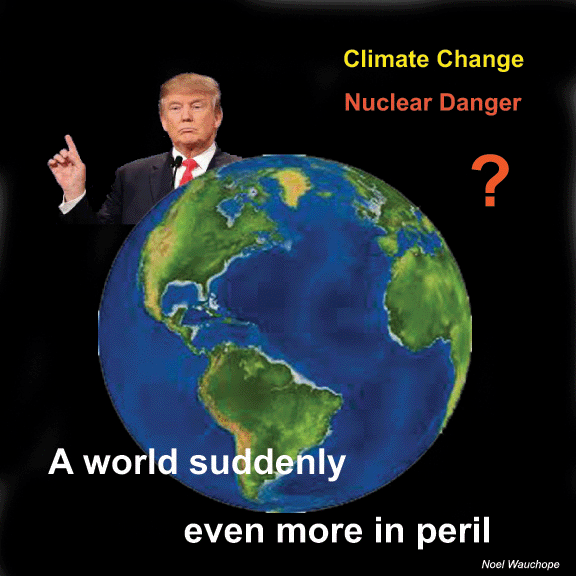
If the case succeeds, environmentalists believe it could force the Trump administration to reduce greenhouse gases and take other measures to prevent global warming.
The paper pointed out that the last time temperatures were this high, during the Eemian period, global sea levels were about six to nine metres higher than they are today, suggesting significant rises are still to occur.
The paper said that the Paris Agreement, the tumbling price of renewable energy and the recent slowdown in the increase of fossil fuel emissions had led to a sense of optimism around the world.
But, speaking to The Independent, Professor Hansen said he believed this optimism was misplaced.
“The narrative that’s out there now … is that we’ve turned the corner,” he said.
“On the contrary, what we show is the rate of growth of climate forcing caused by increased methane [and other gases] is actually accelerating.
That’s why it’s urgent.”
Asked to assess the world’s current progress in fighting climate change, he said the “s*** is hitting the fan”.
Professor Hansen, now a scientist at the Columbia University Earth Institute in the US, said he believed the court case had a chance of winning.
A court would not be able to tell the Government what to do, he admitted, but would be able to say that failing to deal with the problem was unconstitutional and require politicians to produce an effective plan.
The paper said the need for “prompt action implied by these realities [of climate change] may not be a surprise to the relevant scientific community” because of the available evidence.
“However, effective communication with the public of the urgency to stem human-caused climate change is hampered by the inertia of the climate system, especially the ocean and the ice sheets, which respond rather slowly to climate forcings, thus allowing future consequences to build up before broad public concern awakens,” it said.
“All amplifying feedbacks, including atmospheric water vapor, sea ice cover, soil carbon release and ice sheet melt could be reduced by rapid emissions phasedown.
“This would reduce the risk of climate change running out of humanity’s control and provide time to assess the climate response, develop relevant technologies, and consider further purposeful actions to limit and/or adapt to climate change.”
It warned that sea level rise of up to a metre “may be inevitable even if emissions decline” and would have “dire consequences”.
Sea level rise of several metres would result in “humanitarian and economic disasters”.
“Given the increasing proportion of global population living in coastal areas, there is potential for forced migrations of hundreds of millions of people, dwarfing prior refugee humanitarian crises, challenging global governance and security,” the paper said.
And, they argue in the journal Environment Magazine, even a single nuclear missile strike could darken the skies, chill the atmosphere, stop rainfall, ruin harvests and cost a billion lives.
Observers with memories that stretch back to the Cold War and the arms race between the U.S. and the North Atlantic Treaty Organization (NATO) powers on the one hand and the USSR on the other will know something of this already.
In 1983 the astronomer Carl Sagan and colleagues introduced the idea of global annihilation or at least the end of human civilization, in a “nuclear winter” as a consequence of a nuclear weapons exchange.
Years later, as the Soviet Union collapsed and the Russian Federation was born, the same scientists did their calculations again, and reduced the threat to a kind of “nuclear autumn.”
Nuclear Club
Eight nations now possess a nuclear arsenal: The U.S., Russia and China all have nuclear weapons big enough to precipitate a nuclear calamity, and a ninth, North Korea, now claims to have nuclear capability.
This prompted researchers and political scientists from the University of Nebraska-Lincoln to revisit the question. They contemplated the theoretical effect of a 15-kiloton nuclear warhead with the explosive force of 15,000 tons of TNT.
Once exploded, it would incinerate 1,300 square kilometers of a city and its surrounds. This would be quite enough to push five million metric tons of black carbon smoke particles into the stratosphere.
This would be enough to screen solar radiation, reduce the agricultural crop season by between 10 and 40 days a year for at least five years, and lower global temperatures to a point lower than normal for at least 25 years.
In the very short term, this cold snap would be colder than anything for the last 1,000 years. Rainfall would decrease by as much as 20 percent to 80 percent in the Asian monsoon region.
The American southwest and western Australia could become 20 percent to 60 percent drier. South America and southern Africa, too, would see less rain. This global “nuclear drought” and the resulting famines “could kill up to a billion people from starvation.”
The most immediate victims would be those in countries that are already poor or food-insecure. And, the scientists warn, should a warhead fall upon a nuclear power facility “the spread of toxic radionuclides and their long-term effects would be greatly magnified.”
The drop in precipitation would, they warn, also increase conflict in developing regions, “although global temperature reduction may reduce social violence in the United States and other developed countries.”
RPT-One of worst droughts in decades devastates South Europe crops,
* Crops damaged include olives, almonds and durum wheat
* Farmers in southern Europe question their long term future.
By Isla Binnie and Paul Day ROME/MADRID, July 14 (Reuters) – Italian durum wheat and dairy farmer Attilio Tocchi saw warning signs during the winter of the dramatic drought to come at his holding a mile away from the Tuscan coast.
“When it still hadn’t rained at the beginning of spring we realised it was already irreparable,” he said, adding that he had installed fans to try and cool his cows that were suffering in the heat.
Drought in southern Europe threatens to reduce cereal production in Italy and parts of Spain to its lowest level in at least 20 years, and hit other regional crops including olives and almonds.
Castile and Leon, the largest cereal growing region in Spain, has been particularly badly affected, with crop losses estimated at around 60 to 70 percent……By Isla Binnie and Paul Day
ROME/MADRID, July 14 (Reuters) – Italian durum wheat and dairy farmer Attilio Tocchi saw warning signs during the winter of the dramatic drought to come at his holding a mile away from the Tuscan coast.
“When it still hadn’t rained at the beginning of spring we realised it was already irreparable,” he said, adding that he had installed fans to try and cool his cows that were suffering in the heat.
Drought in southern Europe threatens to reduce cereal production in Italy and parts of Spain to its lowest level in at least 20 years, and hit other regional crops including olives and almonds.
Castile and Leon, the largest cereal growing region in Spain, has been particularly badly affected, with crop losses estimated at around 60 to 70 percent.
Abrupt Climate Mayhem Now, in Spite of Main-Stream-Climatologist Posturing https://paulbeckwith.net/ July 14, 2017 Quite frankly, I am sick and tired of people, especially main-stream-talking-head-scientists, downplaying the huge unprecedented threats that are accumulating daily and will soon take down our civilizations. Our world is one that is full of specialists, with no ability to join-the-dots and recognize that humanities existence, and that of our entire ecosystems of plants and animals is degrading rapidly. Even exponentially.
From my chair, I categorically state that anybody who downplays the significance and importance of our planets peril is part of the problem, and needs to get with the program or step aside so that the rest of us can do what is needed. The public needs the truth, no matter how bad it is to have any hope of changing course. And the truth is truly awful, at present.
Everyone agrees that this article hit a nerve with Main-Stream-(Media: MSM; Scientists: MSS) and the public.
We all hear over and over, from Main-Stream-Scientists), that climate change is occurring “faster than expected“. Think about what this means. It means that what is expected is completely wrong. What will, and is happening is way worse that what MSS are saying, and what MSM is reporting. The public needs the truth, and not some sugarcoated MSM/MSS bullshit.
Main-Stream-Media Awakens to Perils of Abrupt Climate Change? A lot can happen in a day. Things can turn on a dime. Has this just happened? David Wallace-Wells wrote a great article in nymag.com recently on “The Uninhabitable Earth”. Media around the world carried parts of it, and a number of scientists chimed in. Many people said the article is too apocalyptic. I say that the article is spot on. Civilization, more correctly humanity is going down big time, on our current path. Abrupt climate change all but guarantees that. Unless we collectively change course by:
1) Declare a global climate emergency.
2) Deploy technologies to remove carbon from the atmosphere &/or oceans.
Earth could become ‘practically ungovernable’ if sea levels keep rising, says former Nasa climate chief http://www.independent.co.uk/environment/earth-sea-levels-rising-nasa-climatechange-chief-jim-hansen-global-warming-melting-ice-antarctica-a7841026.html, Ian Johnston Environment Correspondent, 15 July 17 @montaukian The Earth could become “practically ungovernable” because of sea level rise, Nasa’s former head of climate research, Professor James Hansen, has warned.Professor Hansen, who was among the first scientists to alert politicians and the public to the risks posed by climate change, told New York Magazine that he doubted the atmosphere would warm by four or five degrees Celsius by the end of this century – the upper end of current projections, which would likely end human civilisation as we know it.However he said the biggest problem would be sea level rise. Professor Hanson was an author of a scientific paper published last year which warned that continued high fossil fuel emissions could increase sea levels by “several meters over a timescale of 50 to 150 years”.
This is significantly higher than the latest expert report by the Intergovernmental Panel on Climate Change, which forecast a range from about 30cm to just under a metre, depending on emissions.Asked to consider what the world would be like if the “scarier” projections of climate change for the end of the century became reality, Professor Hansen, former director of the Nasa Goddard Institute for Space Studies, said: “I don’t think we’re going to get four or five degrees this century, because we get a cooling effect from the melting ice. But the biggest effect will be that melting ice.“In my opinion that’s the big thing – sea-level rise – because we have such a large fraction of people on coastlines, more than half of the large cities in the world are on coastlines.
“The economic implications of that, and the migrations and the social effects of migrations … the planet could become practically ungovernable, it seems to me.
“Once sea levels go up significantly, you won’t have stable shorelines. Just parts of the city will go under water, but then it doesn’t make sense to continue to build there … By the time you get to even one-meter rise, you’re going to be losing more land.”The growing human population was a “problem”, he said.“That’s why you want to have energy that’s needed for people to eliminate poverty, because countries that have become wealthy have the population under control. But if you do begin to lose major cities [then] the planet becomes ungovernable,” Professor Hansen said.But if the world did reach four or five degrees, the scientist said this would mean “the tropics and the subtropics are going to be practically uninhabitable”.
“It’s already becoming uncomfortable in the summers, in the subtropics, you can’t work outdoors. And agriculture, more than half of the jobs are outdoors,” he said. He also reiterated the argument in favour of a carbon tax in which the proceeds were given back to the public – creating a windfall for more than two-thirds of the population.
“If you made the price of fossil fuels honest by including a gradually rising carbon fee, then it actually spurs the economy and increases the GNP as you shift toward clean energies and energy efficiency. It creates potentially millions of jobs,” Professor Hansen said.
“The way to spur the economy – to modernise the economy and modernise the energy structure – would be to give the money back to the public because a carbon fee is a progressive tax, in the sense that rich people have bigger carbon footprints.
“So if you do give 100 per cent of the money to the public, 70 per cent of the public comes out ahead.”
In Landmark Move, GOP Congress Calls Climate Change ‘Direct Threat’ to Security
Extreme weather and rising seas threaten bases from Virginia to Guam. For the first time, a Republican House has voted to recognize that. Foreign Policy, BY BETHANY ALLEN-EBRAHIMIAN, JULY 14, 2017 BETHANY.ALLEN @BETHANYALLENEBR
Kwajalein, a tiny atoll in the Marshall Islands, is home to a state-of-the-art radar installation called Space Fence. The U.S. government awarded Lockheed Martin a nearly $1 billion contract in 2014 to build the new system, meant to help protect U.S. satellites and spacecraft from space debris when it becomes operational next year.There’s just one problem. Kwajalein is a mere 10 feet above sea level, putting Space Fence at high risk for frequent flooding as sea levels rise over the coming decades.It’s one of many U.S. military installations threatened by climate change around the world. One study last year found that rising oceans threaten 128 military installations on the coasts, including naval facilities worth around $100 billion.
The Pentagon has been aware for years of the looming danger represented by climate change. But partisan infighting in Congress, budget sequestration, and the toxic nature of the climate debate have hamstrung the Defense Dept. from taking steps to protect key assets — or even identifying which facilities face the most serious threats.
This week, though, the Pentagon may have gotten a boost — from the unlikeliest of places. The Republican-controlled House retained an amendment to the 2018 defense funding bill affirming that “climate change is a direct threat to the national security of the United States.” It orders defense officials to draw up a report laying out which facilities would be most affected.
“This is a reflection that some Republicans at least are waking up to this reality and voting to affirm the work that DoD is doing,” said Andrew Holland, director of studies and senior fellow for energy and climate at the nonpartisan policy organization American Security Project.
Defense authorizations have included similar language before: In 2008, then-Sens. John Warner (R-Va.) and Hillary Clinton (D-N.Y.) included a similar amendment. But that was a Democratic-controlled Congress; this time, some 45 Republicans voted for the climate-change language, and lawmakers from both sides shot down an attempt to strike the focus on climate change.
“I think it’s maybe the beginning of a turning point in Congress,” Holland said.
For more than a decade, the Pentagon has been clear-eyed about the risks posed by climate change. Rising sea levels threaten coastal installations, while floods, famines, and droughts promise waves of instability and conflict across big chunks of the planet. Even in the climate-change denying Trump administration, Defense Secretary James Mattis has reiterated what is by now the Pentagon’s standard line.
‘‘I agree that the effects of a changing climate — such as increased maritime access to the Arctic, rising sea levels, desertification, among others — impact our security situation,’’ Mattis expressed in testimony prior to his confirmation.
But climate change is deeply polarizing in Congress, where many Republicans still believe it is a “hoax,” or not caused by human activities. ……….
Rising seas, extreme weather, and water stress won’t just affect domestic military infrastructure. America’s ability to project power around the world — and particularly in the Middle East — is likely to be weakened if no action is taken. In a 2012 report, the American Security Project ranked the top five U.S. military facilities most at risk from climate change — Norfolk, Guam, Eglin in Florida, Bahrain, and Diego Garcia, a shown on the map below: [on original]
The latter is the most threatened high-value base. Located on a British atoll, the U.S. base on Diego Garcia is a major hub for operations in the Middle East, allowing large bombers to deploy without being based in Saudi Arabia or Qatar and giving expeditionary access to the Indian Ocean, Persian Gulf, and Red Sea. But due to its location on a low-lying atoll, it’s the most threatened of all.
“It legitimately could disappear in a certain amount of years,” said Holland.
Closer to home, the world’s biggest naval base is an even starker illustration of what lies in store. The Hampton Roads region of Virginia, headquarters of the Atlantic fleet, is already buffeted by increasingly extreme weather and frequent flooding. The sea there has already risen by more than a foot in the past 100 years, and the base currently floods about 10 times a year. It’s going to get much worse — the Union of Concerned Scientists estimates that Norfolk may flood 280 times a year by 2100.
Hampton Roads is a climate change “crucible,” retired Rear Admiral Ann Phillips, who previously headed a Navy task force on climate change, said at a July 12 House roundtable on climate change and the military. “We have nearly every climate-related challenge in our future.”
In a battle over military’s approach to climate change, the military and preparedness won.
Forty-six House Republicans, including almost all of the GOP members of the bipartisan House Climate Solutions Caucus, joined Democrats late Thursday to defeat a bill amendment that would have prevented the Department of Defense from analyzing and addressing climate change.
Introduced by Rep. Scott Perry (R-PA), the amendment would have blocked a provision in the current version of the National Defense Authorization Act(NDAA) that requires a study into the 20-year impacts of climate change on the military. The amendment also would have removed language from the NDAA that recognizes climate change as a “direct threat” to the national security of the United States.
The House voted 185–234 against the amendment. No Democrat voted to support it, and Rep. Peter King (NY) was the only Republican member of the House Climate Solutions Caucus to vote in favor of the amendment. Rep. Rodney Davis (IL), another Republican member of the caucus, did not vote.
The other 22 Republican members of the caucus, including Rep. Darrell Issa (CA), joined their Democratic colleagues to help defeat the amendment. Issa has a 4 percent lifetime score from the League of Conservation Voters and is viewed by many climate activists as a long-time climate science denier.
The Climate Solutions Caucus was formed in early 2016 to bring Republicans and Democrats together to advance meaningful climate change legislation. The caucus uses what has come to be known as the “Noah’s Ark approach” to membership: No one can join without a member of the other party coming on board at the same time.
Rep. Ted Deutch (D-FL), co-chairman of the climate caucus, described the vote as proof that there is a “bipartisan majority in Congress of members who understand that climate change is a real threat to our communities, our economy, and our military readiness.”
“I hope my House colleagues were watching closely; denying climate change is no longer a winning strategy,” Deutch said in a statement.
Thursday’s vote not only backed climate action, it also backed the military. For more than a decade, the Department of Defense has warned that climate change poses a critical national security threat. Secretary of Defense James Mattis has stated that climate change is real and a threat to the military’s assets and activities — a position at odds with the views of President Donald Trump and many in his administration. Mattis also believes the U.S. military needs to cut its dependence on fossil fuels and use renewable energy where it makes sense.
“The Pentagon has long warned that climate change is a grave threat to our national security, and the Secretary of Defense says climate change threatens our military readiness today,” Sara Jordan, legislative representative for the League of Conservation Voters, said in a statement issued Thursday in response to the defeat of the amendment. “Now even a bipartisan majority of Congress agrees — showing just how out of step President Trump and his polluter allies are in their efforts to put polluter profits ahead of our health and national security.”
In late June, the House Armed Services Committee, in a bipartisan vote, passed an amendment, introduced by Rep. Jim Langevin (D-RI), to the annual defense authorization bill that directs the Defense Department to assess the vulnerabilities of the 10 bases in each service most threatened by the effects of climate change. Perry’s amendment would have undercut Langevin’s amendment and other policies at the Defense Department to account for climate change.
During a House floor debate on Thursday, Perry said he introduced the amendment because climate change should not be a priority for military leaders and that lawmakers should not tell the military on what matters to focus. “Literally litanies of other federal agencies deal with environmental issues including climate change,” Perry said.
Rep. Elise Stefanik (R-NY), a member of the House Climate Solutions Caucus, spoke out against her fellow Republican’s amendment. “We would be remiss in our efforts to protect our national security to not fully account for the risk climate change poses to our bases, our readiness, and to the fulfillment of our armed forces’ mission,” Stefanik said on the House floor.
Rep. Stefanik Speaks on Climate Change During NDAA Floor Debate
In her remarks, Stefanik was echoing the statements made by Richard Spencer, Trump’s Navy secretary nominee, to a Senate committee on Tuesday. Spencer said climate change represents a real threat to the military, Politico reported. “The Navy, from my briefings to date, is totally aware of rising water issues, storm issues, etc.,” he said.
In a statement released Thursday, the American Security Project, a nonpartisan national security educational group, commended the House for striking down Perry’s amendment. “The American Security Project strongly supports addressing climate change as a national security priority. The science around climate change is strong enough to take action,” the group said.
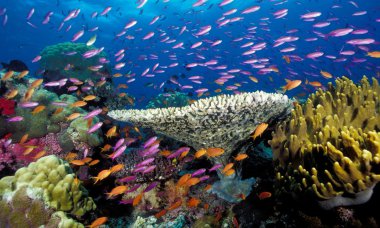
The uncomfortable truth: The Great Barrier Reef is doomed, Independent AustraliaDr Geoff Davies14 July 2017The Great Barrier Reef is unlikely to survive as more than a small, sad remnant of its past glory.
The reason is straightforward. It is well known in climate science that, even if we stopped harmful emissions tomorrow, global warming would not peak for another several decades. By then, most of the Reef will be long gone.
This is not pleasant news and clearly many would prefer it was not said, but there it is, the argument is simple and the conclusion is difficult to avoid.
The recent decision by the United Nations World Heritage Committee not to list the Reef as “in danger” is, of course, farcical. It reflects the crudest of politics, including the blinkered claim that Australia is not reponsible for global warming. Yet Australian governments, state and federal, do everything they can to spruik the coal mining that would ensure the death of the Reef and threaten to tip us into catastrophic warming.
Most news reports of global warming use only words and try for spurious he-said-she-said “balance”, so you don’t get a very clear impression of what is really going on. A good graph is worth millions of such waffle words.
[lengthy explanation given here with graphs]……
Suppose the world suddenly got sane and we set about the emergency reduction of greenhouse gas emissions, as scientists have been urging for several decades now. Even if emissions drop precipitously, there’s still too much already in the atmosphere. It takes a long time for the gases to be absorbed back into the land and ocean. In the meantime, warming will continue for 20 to 40 years — or even longer (the uncertainty is because we don’t know to what depth the oceans carry the extra heat they absorb)…….
Some scientists think corals have some chance of adapting and reversing a portion of the die-off if temperatures peak at “only” 1.5°C, but the corals’ diversity would be greatly reduced. If the peak is above 1.5°C, there is no chance of recovery.
If people like Donald Trump and Tony Abbott continue to be influential then global warming could even accelerate, as we pump out ever-more fossil fuel exhausts. Or natural reinforcings might already be kicking in and tipping the system into runaway. In that case, we would have to forget the Reef and worry about the survival of civilisation.
On the other hand, there is far more we can do to reduce emissions, reduce them quickly and live well as we do it. Leaders like William McDonough and Amory Lovins have long noted our wastefulness and the huge potential of good design and a cycling industrial system. Regenerative agriculture can not only reduce emissions but recapture and store greenhouse gases, all with abundant yields.
The Great Barrier Reef is not just a pretty decoration and earner of tourist dollars. Thousands of ocean species depend on it for food, shelter and breeding — even species that spend most of their lives far away. The effects of the present death will already be reverberating through ocean ecosystems. We depend heavily on the oceans to maintain a habitable planet.
There is a silence about the Reef. The massive bleachings have been prominent in the news, but nothing happens. We know it’s happening, but we don’t want to mention it. Why are we silent?
If our media were functioning properly, this dire prospect could have been widely understood before it became acute. The problem is not just the Murdoch media, which actively obfuscate and lie about global warming.
The media’s interpretation of ‘balance’ is so superficial as to seriously misrepresent the world. For example, paraphrasing a recent report: Much of the northern Great Barrier Reef is dead. But the good news is the southern parts are still mostly healthy. There is no good news. Such a report might reasonably have said, instead: The GBR has begun its death throes………
might there also be shame? We are the generation, out of all of the long history of humanity, that is allowing the glories of a planet to be destroyed. Oh dear, I’m not supposed to make my readers uncomfortable, they might switch off.
The question stares us in the face anyway. How will we face our grandchildren?
Labour Must Put More Focus On Climate Change, Morning Star, 12 July 17
Though the election didn’t focus much on the environment, the Labour Party must now thrust it into the political arena, argues IAN SINCLAIR
THERE is a tendency in Britain to look contemptuously upon the US political system. And nowhere are the deficiencies of the “shining city on a hill” more glaring than its sidelining of climate change — “the missing issue” of the 2016 US presidential campaign, reported the Guardian. According to the US writer Bryan Farrell, the topic was discussed for just 82 seconds during the 2016 televised presidential debates, which was actually an improvement on the 2012 debates, when it wasn’t mentioned at all.
Tragically, this omission was mirrored in the recent general election here. “The issue of #climatechange was completely marginalised during the #GE2017 media coverage,” Loughborough University’s Centre for Research in Communication and Culture tweeted about its election analysis.
This absence, the media watchdog Media Lens noted, is “the great insanity of our time.” Why? Because climate change is arguably the most serious threat the world faces today.
In January 2017 writer Andrew Simms surveyed over a dozen leading climate scientists and analysts and found none of them thought global temperatures would stay below 2°C — the figure world leaders agree we cannot exceed if we wish to stop dangerous climate change.
Last year, top climate scientist Professor Kevin Anderson told the Morning Star the pledges made by nations at the 2015 Paris climate summit would likely lead to a 3-4°C rise in global temperatures. Frighteningly he also told the author George Marshall that it’s hard to find any scientist who considers four degrees “as anything other than catastrophic for both human society and ecosystems.”
Surveying the environmental policies of the main parties just before June 8, Friends of the Earth scored the Green Party top with 46 points, followed by Labour on 34, the Liberal Democrats on 32 and the Conservatives trailing last with a poor 11.
The environment and climate change did not play a significant role in the Labour Party’s hugely successful election campaign. And though Labour leader Jeremy Corbyn himself rarely mentioned the topic on the campaign trail, the manifesto was a pleasant surprise to many.
“I’ve been really encouraged by Corbyn’s commitment to safeguarding our environment,” Nancy Strang, the women’s officer in Brent Central Labour, tells me. “The 2017 manifesto pledges to increase renewable energy production and investment, to tackle our air quality with a Clean Air Act, to protect Britain’s wildlife, and to ban fracking are all huge steps in the right direction … these pledges go beyond those in any previous Labour Party manifesto that I remember.”
The Green Party’s Dr Rupert Read agrees. “Corbyn’s Labour have some good environmental policies,” he tells me. “For example, their new-found opposition to fracking is much to be welcomed.”
However, he highlights a “fundamental problem” with Labour’s manifesto. “It is their unreconstructed insistence on ‘faster economic growth’,” Read argues.
The environment and climate change did not play a significant role in the Labour Party’s hugely successful election campaign. And though Labour leader Jeremy Corbyn himself rarely mentioned the topic on the campaign trail, the manifesto was a pleasant surprise to many.
“I’ve been really encouraged by Corbyn’s commitment to safeguarding our environment,” Nancy Strang, the women’s officer in Brent Central Labour, tells me. “The 2017 manifesto pledges to increase renewable energy production and investment, to tackle our air quality with a Clean Air Act, to protect Britain’s wildlife, and to ban fracking are all huge steps in the right direction … these pledges go beyond those in any previous Labour Party manifesto that I remember.”
The Green Party’s Dr Rupert Read agrees. “Corbyn’s Labour have some good environmental policies,” he tells me. “For example, their new-found opposition to fracking is much to be welcomed.”
it is clear external political pressure from the Green Party — “they have led where others were not so bold,” says Van Coevorden — also has an essential role to play in pushing Corbyn’s Labour in the right direction on green issues. It should also be noted that Corbyn personally opposes some of the environmentally damaging policies the broader Labour Party currently supports, such as Heathrow expansion and Trident renewal.
So, arguably, increased backing for the Labour leader and sidelining his neoliberal opponents within the party will likely improve Labour’s environmental policies.
The stakes couldn’t be higher. First, because against all the odds Corbyn now has a realistic chance of becoming Prime Minister — YouGov’s latest poll has Labour on 46 per cent and the Tories on 38 per cent. And second, because climate change continues to be an existential threat to humanity, with the Guardian reporting “scientists said they feared for their children” after hearing of US President Donald Trump’s vow to pull out of the Paris climate agreement.
It is, therefore, essential the environment and climate change are thrust to the centre of the national political debate as soon as possible — something Green Party and Labour Party members can both agree on, surely?
‘The island is being eaten’: how climate change is threatening the Torres Strait
In Boigu, part of Australia but just six kilometres from Papua New Guinea, roads are being washed into the sea, Guardian, Ben Doherty and Michael Slezak, 13 July 17, Torres Strait residents face being forced from their homes by climate change, as their islands are lost to rising seas.
On Boigu Island, the most northerly inhabited island in Australia, just six kilometres from Papua New Guinea, the community’s cemetery faces inundation and roads are being washed into the sea. A seawall installed to protect the community is already failing.
Boigu elder Dennis Gibuma says the situation is worsening every season.
“Our seawall is no longer any good,” he says. “When the high tide and strong winds come together, it breaks. We pray we don’t lose our homes. We don’t want to leave this place.”
Masig Island, to the south-east of Boigu, is less than three kilometres long, and just 800m across at its widest point. Also known as Yorke Island, the low-lying coral cay is steadily being lost to the waves.
“The island is being eaten,” says Songhi Billy, an engineering officer on Masig. “This is a big issue. I kind of feel hopeless in a sense. Our land is part of us.
“In the short term, we can do what we can. We can’t stop the erosion, our hope is to slow it down.”
But he says he has to face the possibility that his people may have to abandon their ancestral home.
“Long term, we may have to evacuate the island,” he says. “But I am not going. Slowly, I see Masig Island getting out of something I can control.”………
The precise sea level rise around the Torres Strait, and the projected inundation, has not been calculated but low-lying islands are expected to experience a much greater flooding risk than mainland Australia. The department identifies the remote islands of the Torres Strait as some of the most vulnerable, as does the Intergovernmental Panel on Climate Change (IPCC), which warns communities they may be forced to relocate………
Displacement caused by climate change is forecast to be a driver of massive forced migration movements in the 21st century.
Low-lying islands in the Pacific – and Torres Strait islands like Masig and Boigu – are likely to be at the forefront of forced displacement but large and densely populated countries such as Bangladesh also face widespread inundation.
But the global legal framework for resettling people displaced from their homes lost to natural disasters or climate change is unclear. The refugee convention – established in 1951 to regularise the resettlement of those displaced by the second world war – does not recognise someone forced from their home by rising seas, or natural disaster, as requiring protection.
On Masig Island, Hilda Mosby says climate change is already affecting the marine ecosystems on which communities depend for their livelihoods. Climate changeis already affecting her community “big time”, she says.
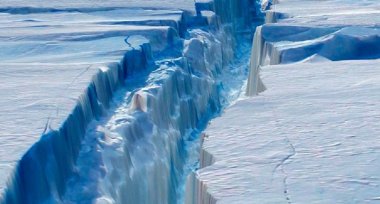
A massive crack in one of Antarctica’s largest ice shelves creates an iceberg bigger than Kangaroo Island. So, what impact will it have?
The 1-trillion-tonne iceberg, measuring 5,800 square kilometres, calved away from the Larsen C ice shelf in Antarctica sometime between July 10 and 12, scientists at the University of Swansea and the British Antarctic Survey said.
The iceberg has been close to breaking off for a few months. Throughout the Antarctic winter, scientists monitored the progress of the rift in the ice shelf using the European Space Agency satellites.
“The iceberg is one of the largest recorded and its future progress is difficult to predict,” said Adrian Luckman, professor at Swansea University and lead investigator of Project MIDAS, which has been monitoring the ice shelf for years.
“It may remain in one piece but is more likely to break into fragments. Some of the ice may remain in the area for decades, while parts of the iceberg may drift north into warmer waters,” he added.
The ice will add to risks for ships now it has broken off.
The peninsula is outside major trade routes but is the main destination for cruise ships visiting from South America.
In 2009, more than 150 passengers and crew were evacuated after the MTV Explorer sank after striking an iceberg off the Antarctic peninsula.
The iceberg, which is likely to be named A68, was already floating before it broke away so there is no immediate impact on sea levels, but the calving has left the Larsen C ice shelf reduced in area by more than 12 per cent.
The Larsen A and B ice shelves, which were situated further north on the Antarctic Peninsula, collapsed in 1995 and 2002, respectively.
“This resulted in the dramatic acceleration of the glaciers behind them, with larger volumes of ice entering the ocean and contributing to sea-level rise,” said David Vaughan, glaciologist and director of science at British Antarctic Survey.
“If Larsen C now starts to retreat significantly and eventually collapses, then we will see another contribution to sea level rise,” he added. Big icebergs break off Antarctica naturally, meaning scientists are not linking the rift to manmade climate change.
The ice, however, is a part of the Antarctic peninsula that has warmed quickly in recent decades.
“In the ensuing months and years, the ice shelf could either gradually regrow, or may suffer further calving events which may eventually lead to collapse — opinions in the scientific community are divided,” Professor Luckman said.
“Our models say it will be less stable, but any future collapse remains years or decades away.”
When it Comes to Climate Change, It’s G19 vs the United States, Slate, By Daniel Politi 8 Jul 17 The annual Group of 20 meeting is supposed to be one of those boring gatherings where world economic powers get together to slap each other on the back and utter platitudes about things they all agree on. This year though, the conflicts were clear and the divisions were stark. No split was more evident than climate change, where President Donald Trump was left isolated as as every other world leader signed up to the final compromise agreement that declared the Paris accord “irreversible.” They also vowed that the deal would be implemented “swiftly” and without exceptions.
Global leaders didn’t hide their anger at Trump’s intractable position. British Prime Minister Theresa May, for example, said she was “dismayed at the U.S decision to pull out” of the Paris accord and had personally urged Trump to reconsider. German Chancellor Angela Merkel also was careful to highlight the points of disagreement with the United States. “Wherever there is no consensus that can be achieved, disagreement has to be made clear,” Merkel said at the end of the summit. “Unfortunately—and I deplore this—the United States of America left the climate agreement.”
Climate change’s brutal toll on Africa, newsroom, 9 Jul 17 United Nations International Children’s Emergency Fund The vast majority of child migrants uprooted by violence, poverty and climate change remain in Africa, write UNICEF’s Lachlan Forsyth and Patrick Rose
The vast majority of child migrants uprooted by violence, poverty and climate change remain in Africa, according to a new report by child rights organisation UNICEF.
It is a bitter irony that the countries that have done the least to cause climate change are going to suffer the most. Countries that have minuscule carbon footprints are going to be the first to suffer the consequences of flooding, drought and displacement.
In West and Central Africa, the impact of climate change will be especially severe, with the region set to experience a 3 to 4 degree rise in temperature this century – more than one and a half times higher than anywhere else on the planet.
For the millions of people living in this vast region, longer droughts and intense storms will make farming and herding more difficult, and people will be forced to seek a better life.
Already, children account for more than half of the 12 million West and Central African people on the move each year. Contrary to many opinions, 75 percent of them remain in sub-Saharan Africa, with fewer than one in five heading to Europe.
This current wave of migrants is just the start of a swelling humanitarian crisis. Migration involving children and young people is likely to increase due to rapid population growth and urbanisation, climate change, inequitable economic development, and persistent conflict.
Poverty is a powerful driver of migration in West and Central Africa. Countries with high levels of poverty are more likely to be a source of migration as people look to improve their lot in life. In interviews conducted by UNICEF, migrants describe the feeling of ‘having nothing to lose,’ aware that by migrating they are taking a risk, but it is a gamble that might pay off.
Helene is one of them. She is 14 years old, holding a sign saying “I am a child, and not a commodity.”……..
With drought and temperatures intensifying in West and Central Africa, tensions in accessing scarce resources for cattle are also increasing hostilities in many rural areas, pushing greater numbers of people towards cities. But with more than 100 million people living in coastal cities less than one metre above sea level, even conservative estimates of a sea-level rise could result in the forced displacement of millions of climate refugees as people seek safety for their families and children.
For organisations like UNICEF, the challenges are enormous and complex. Aid money can only fix so much, when monumental societal changes are required also. Until the root causes of poverty are addressed, and solutions provided in the form of economic opportunities, access to health care and access to quality education, people are likely to continue to take dangerous risks migrating for better opportunities.
Unless the long-term planning of governments and civil society is equipped to anticipate these climate shocks and subsequent migration, the unmitigated impact of these forces will create detrimental outcomes for children across the region.