n the fight against climate change, much of the focus rests on reducing our dependence on fossil fuels and developing alternative energy sources. However, the results of a new study suggest that far more attention should be paid to deforestation and how the land is used subsequently – the effects of which make a bigger contribution to climate change than previously thought.
The research, conducted by Cornell University and published in the journal Environmental Research Letters,shows just how much this impact has been underestimated. Even if all fossil fuel emissions are eradicated, if current rates of deforestation in the tropics continue through to 2100 then there will still be a 1.5 degree Celsius increase in global temperature.
Most scientists believe that a temperature increase of 1.5 degrees above pre-industrial levels will bring dangerous disruption to the world’s climate. Indeed, many already think this target may be unattainable.
“A lot of the emphasis of climate policy is on converting to sustainable energy from fossil fuels”, said Natalie M. Mahowald, the paper’s lead author. “It’s an incredibly important step to take, but, ironically, particulates released from the burning of fossil fuels – which are severely detrimental to human health – have a cooling effect on the climate. Removing those particulates actually makes it harder to reach the lower temperatures laid out in the Paris agreement.”
Mahowald argues that in addition to reducing reliance on fossil fuels, scientists and policymakers must pay more attention to deforestation and the subsequent changes in land use for agricultural and other human industry. The negative consequences of this process are manifold.
When deforestation occurs, the burning of trees and plants releases carbon dioxide – a greenhouse gas – into the atmosphere. The problem is compounded when the land is then converted to farming or other human usage, releasing large amounts of other greenhouse gases like methane and nitrous oxide. Furthermore, the deforested area can no longer function as a carbon sink – trees and plants absorb carbon dioxide from the atmosphere.
The research showed this process has double the overall warming contribution than previously thought making it “twice as important” in Mahowald’s eyes.
“Normally people only think about what’s happening right now when they think about the carbon budget,” Mahowald said. “But if you think about what’s going to happen over the lifetime of that land, long into the future, you should multiply that land conversion by two to understand the net effect of it.”
As agriculture expands in the tropics and pressure to turn rainforest into cropland increases, Mahowald advocates looking further forward in time to truly assess the impact that these practices have on the climate.
Why Nuclear Energy May Not Be Our Best Alternative Option To Fossil Fuel, Forbes, 9 Sept 17 , Michael Barnard, low-carbon innovation analyst, on Quora: “… From a carbon capture and sequestration perspective, there’s exactly one sequestration project associated with a coal generation plant which is actually sequestering any reasonable amount of carbon. It’s in Saskatchewan, Canada. It was operating at 40% of targets for months and nobody noticed. It’s very expensive.
I did an assessment of all sequestration efforts in Australia over the past 19 years recently and found that they had spent $4,300 AUD per ton to sequester a vanishingly tiny fraction of Australia’s emissions.
The US CCS projects have gone vastly over forecasts and are abandoned and no new ones are projected. The UK government has stopped funding them………
Hurricanes Blow Away Climate Change Denial, Consortium News The startling landfall of two giant hurricanes – feasting on especially warm water off Texas and Florida – crashes into the climate change denialism that has been politically popular on the Right, notes ex-CIA analyst Paul R. Pillar.
The loss of respect for truth is one of the most consequential features of public affairs in American today. The roots and causes of this tragic development are multiple. The spread of social media and the related ability to spread untruths cheaply at the speed of electrons are parts of the story. Another part is the phenomenon of fake news (real fake news, that is, not alleged fake news that is really real news that the alleger doesn’t welcome).
The advent of Donald Trump’s presidency has taken this sad story to new depths. The President lies copiously, flagrantly, unashamedly, and far beyond what had been the norm for political fibbing. He has shown how a political career, rising even to the highest office of the land, can be built on lying.
Correctives to this awful trend are difficult to identify. The tribal belief system that prevails in most of the American population, in which people chiefly listen to and believe sources they identify with politically or socially and had already been telling them what they want to hear, is so well entrenched it seems almost impossible to overcome. Many people reject factual corrections as a form of bias and unfair treatment by sources (such as the “left-wing media”) with which they do not identify politically or socially…….
the United States getting hit with two major hurricanes in rapid succession provides a teaching opportunity regarding the critical issue of climate change…
Like Smoking and Cancer
Christine Todd Whitman, a Republican who ran the Environmental Protection Agency under George W. Bush, notes not only that the basic physical links involving global warming, greenhouse gases, and burning of fossil fuels are “as certain as the link between smoking and cancer.” She further observes that ”a broad consensus of scientists also warn of the influence of the warming climate on extreme weather events.”
The overall connections, in other words, in terms of cause, effect, and degree of risk are unquestionable, even if no one case of lung cancer can be blamed on any one pack of cigarettes……..
Without diminishing any immediate sympathy and support for those whose lives the hurricanes have upended, this is the time to shout from rooftops that dishonest climate-change-denying politicians are causing more such suffering in the future for Americans as well as others. And when Trump’s EPA destroyer (a.k.a. administrator) Scott Pruitt says that now is not the time to talk about climate change, the proper response is that now is an excellent time to talk about it.
Abandoned North Sea Wells May be Emitting ‘Significant’ Amounts of Methane, Study Warns, DESmog Blog, By Kyla Mandel • Monday, September 4, 2017 Abandoned offshore oil and gas wells in the North Sea may be a source of significant methane emissions finds a new study, which claims to be the first to measure the amount of methane leaking from offshore wells.
According to the study published recently in the journal Environmental Science and Technology, about one third of the region’s wells could be releasing between 3 and 17 thousand tonnes of methane into the North Sea each year. “This poses a significant contribution to the North Sea methane budget,” it states.
But despite the scale of emissions that may be leaking from abandoned wells, these emissions are not currently being monitored by regulators or operators.
Methane is a more potent greenhouse gas than carbon dioxide, and – pound for pound – can trap much more heat in the atmosphere over the course of a couple of decades.
The study comes as operators begin planning for the end of oil and gas extraction from the North Sea – over the next couple decades hundreds of oil rigs will need to be decommissioned. Yet, under current rules, operators are not required to monitor inactive or abandoned wells, opening up a regulatory gap as the North Sea moves into a new phase.
As the study’s authors write: “Our and other recent studies clearly document strongly increased CH4 [methane] emissions in areas with oil and gas operations, which may counteract our efforts to reduce greenhouse gas emissions by switching supply from coal to gas.
“Therefore, it is important to improve our surveying and monitoring efforts and adapt the respective regulatory frameworks (national and international), because the regional aggregate of thousands of wells with fairly low gas flows can be substantial.”
The study measured three abandoned offshore wells in the Central North Sea where shallow gas pockets were releasing methane. From this they were able to create a model to measure the impact across the region at depths limited to the upper 1000 meters of the ocean sediment.
Due to the shallow depths at which the methane is released, not all of it remains in the oceans. The scientists found that a large portion — 42 percent — of the methane emissions leaking from the abandoned wells reach the atmosphere where they will contribute to rising temperatures………
More and better data is needed in order to start addressing this issue of so-called fugitive emissions, Haekel argued. He and his team plan to make another trip to the North Sea this month to continue gathering more data from other wells.
Hurricane Irma Poses Toughest Test for U.S. Nuclear Industry Since Fukushima, US News, Sept. 8, 2017 By Scott DiSavino and Timothy Gardner (Reuters) – Hurricane Irma will pose the toughest test yet for U.S. nuclear power plants since reactors strengthened their defenses against natural disasters following the Fukushima Daiichi nuclear accident in Japan in 2011.
Irma was on course to hit South Florida early on Sunday as a Category 4 storm, packing winds of up to 145 miles (233 kilometers) per hour and bringing a storm surge of as much as 12 feet to a state that is home to four coastal nuclear reactors.
The National Hurricane Center’s forecast track shows Irma making landfall on the southwest side of the Florida Peninsula, west of the two nuclear reactors at the Turkey Point plant.
The operator, Florida Power & Light (FPL), has said it will shut Turkey Point well before hurricane-strength winds reach the plant. The reactors are about 30 miles (42 kilometers) south of Miami. FPL said it will also shut the other nuclear plant in Florida at St Lucie, which also has two reactors on a barrier island on the state’s east coast, about 120 miles (193 km) north of Miami. “We will shut the reactors down 24 hours before Category 1 force winds are forecast to hit,” FPL Chief Executive Eric Silagy told a news conference.
FPL said both Turkey Point and St Lucie were designed to withstand storms stronger than any ever recorded in the region and both plants are elevated 20 feet (6 meters) above sea level to protect against flooding and extreme storm surges.
But South Miami Mayor Philip Stoddard said he was concerned about the potential for floods to damage power generators at Turkey Point, which in turn might threaten the ability of the plant to keep spent nuclear fuel rods cool. At Fukushima in Japan, an earthquake and tsunami disrupted power supplies and caused the fuel in some units to meltdown.
“The whole site is pretty well able to handle dangerous wind, the real problem from my perspective is water,” Stoddard said. He said he was more worried about the nuclear waste than the reactors.
Too much mansplaining in climate conversations? http://www.nationalobserver.com/2017/09/07/news/too-much-mansplaining-climate-conversations , By Clothilde GoujardSeptember 7th 2017 #710 of 711 articles from the Special Report: Race Against Climate ChangeIn the catastrophic 2004 Boxing Day Asian tsunami, four times more women died than men. In the worst affected village, Indonesia’s Kuala Cangkoy, 80 per cent of the victims were female, according to Oxfam International. The number was so disproportionate, reported the humanitarian agency, because men were generally fishing or away from home, and many were able to flee while women at home tried to save children.
It’s an imbalance that disturbs the World Meteorological Organization’s Elena Manaenkova, who addressed the International Panel on Climate Change (IPCC) in Montreal earlier this week.
“Women couldn’t run because of their long clothes and they didn’t know how to swim,” she toldNational Observer in an interview.
The 56th session of the IPCC, which is tasked with providing sound climate science assessments to governments and policy makers, began in Montreal on Wednesday. At a closed-door workshop on Tuesday night however — held between the IPCC and Environment Canada — Manaenkova emphasized the importance of including more women in the world’s response to climate change.
She and a team of other climate experts are urging organizations and governments to recruit for women scientists to help improve sensitivity to gender issues in climate-related policy. Natural disasters, she explained, are just one example of how a warming world can have different impacts on women and men.
Women have to walk further for water
As temperatures rise and droughts become more frequent, for instance, women in some countries who are traditionally tasked with fetching water face more problems, including sexual violence.
According to the United Nations, women in Africa and Asia walk an average of six kilometres to get water but the distance can be much longer with droughts.
The delegate for Kenya, Patricia Nying’uro, has made note of that situation in her own country.
“If there’s a drought, (women) have to find water and in some areas they have to walk really far,” she said in an interview. “Even though everyone feels (climate change), these women feel it a bit more.”
As a senior meteorologist at the Kenyan Meteorological Department, she said whenever there are new seasonal forecasts for rain, they hold information forums and women are particularly interested.
“You will find that’s it’s mainly women who attend, one because they have the time and two, because they’re the most impacted,” she said.
To her, it’s important that more women participate in the climate change conversation because she feels not enough is being done to look at the impact on women.
“Women would be sensitive in general to things that happen to fellow women and the impacts on them,” she said.
In the catastrophic 2004 Boxing Day Asian tsunami, four times more women died than men.
In the worst affected village, Indonesia’s Kuala Cangkoy, 80 per cent of the victims were female, according to Oxfam International. The number was so disproportionate, reported the humanitarian agency, because men were generally fishing or away from home, and many were able to flee while women at home tried to save children.
It’s an imbalance that disturbs the World Meteorological Organization’s Elena Manaenkova, who addressed the International Panel on Climate Change (IPCC) in Montreal earlier this week.
“Women couldn’t run because of their long clothes and they didn’t know how to swim,” she toldNational Observer in an interview.
The 56th session of the IPCC, which is tasked with providing sound climate science assessments to governments and policy makers, began in Montreal on Wednesday. At a closed-door workshop on Tuesday night however — held between the IPCC and Environment Canada — Manaenkova emphasized the importance of including more women in the world’s response to climate change.
She and a team of other climate experts are urging organizations and governments to recruit for women scientists to help improve sensitivity to gender issues in climate-related policy. Natural disasters, she explained, are just one example of how a warming world can have different impacts on women and men.
Women have to walk further for water
As temperatures rise and droughts become more frequent, for instance, women in some countries who are traditionally tasked with fetching water face more problems, including sexual violence. According to the United Nations, women in Africa and Asia walk an average of six kilometres to get water but the distance can be much longer with droughts.
The delegate for Kenya, Patricia Nying’uro, has made note of that situation in her own country.
“If there’s a drought, (women) have to find water and in some areas they have to walk really far,” she said in an interview. “Even though everyone feels (climate change), these women feel it a bit more.”
As a senior meteorologist at the Kenyan Meteorological Department, she said whenever there are new seasonal forecasts for rain, they hold information forums and women are particularly interested.
“You will find that’s it’s mainly women who attend, one because they have the time and two, because they’re the most impacted,” she said.
To her, it’s important that more women participate in the climate change conversation because she feels not enough is being done to look at the impact on women.
“Women would be sensitive in general to things that happen to fellow women and the impacts on them,” she said.
IPCC aims to increase female participation
Manaenkova, the climate expert leading the World Meteorological Organization, shares Nying’uro’s position that more women experts need to participate in the conversation. During the gender workshop on Tuesday night, Manaenkova and other leaders working with IPCC gathered to discuss the situation and see how more women scientists could be included in IPCC’s work.
As a major organization assessing climate change to guide scientists and policy makers, the IPCC is trying to be more gender balanced, said Fatima Driouech, who spoke at the evening meeting. She is vice-chair of the IPCC Working Group 1, which deals with the physical science basis of climate change.
“Within IPCC, there’s good will to improve (gender balance) for the future. In this cycle, we feel there’s an improvement compared to the previous one,” Driouech told National Observer.
The Moroccan scientist is one of 10 women of the IPCC’s 34-member bureau, which includes chairs and vice-chairs of the organization and its working groups and task force. She was also a lead author of the IPCC’s previous climate change assessment report.
“It’s important to include (women) in climate research and in science because there’s a need for different viewpoints, different visions and different ideas,” she said.
According to numbers released at the workshop and confirmed by IPCC, there are more female authors of special reports currently in the works than in previous years. The IPCC is nearly 30 years old, and was first established by the United Nations and the World Meteorological Organization to “provide a scientific basis for governments at all levels to develop climate-related policies.”
Thirty-eight per cent of the 86 authors of the Special Report on Global Warming of 1.5 per cent — scheduled for publication next year — are women, compared with 21.5 per cent of 1,001 authors who participated in the IPCC’s fifth Assessment Report released in 2014. In a subreport of the fifth Assessment Report, all 33 authors from African countries were men.
In two other reports underway that are due in 2019, just under a third of the authors are women. That’s out of 101 authors for a report on climate change and oceans, the Special Report on the Ocean and Cryosphere in a Changing Climate, and 103 authors for the Special Report on Climate Change and Land.
While there’s some global improvement, Driouech said some countries are still struggling to be more gender-balanced: “There are some regions where there’s a little imbalance to fix for everyone’s good.”
For that reason, at the opening of the IPCC session on Wednesday morning, where representatives of member countries were present, Manaenkova mentioned the need for “active debate on the gender sensitivity of the issues” reflected in the IPCC reports.
Despite growing understanding that gender balance can inform better research and decision-making in climate science, she said organizations like the World Meteorological Organization, as well as the IPCC and other UN bodies, have had to put a lot of effort to convince “skeptics” who didn’t understand why more women need to be included. That persuasion effort is still underway.
Countries must nominate more women scientists
At IPCC, she said, some countries do not nominate enough women scientists to be authors.
“In some cases, (IPCC) has to positively discriminate, they prefer a woman to maybe ten men because she was the only one nominated,” she said.
At her own organization, she said they are thinking about enforcing nominations of women. As it stands, female nominations are encouraged and welcomed, rather than enforced.
Manaenkova believes that because IPCC focuses not just on physical climate change, but also socio-economic impacts and adaptation, it is even more important to have input from women. She said it would even be better to have reports with statistics separated by gender.
“(IPCC) says there’s some women nominated who could be lead authors and their competence is very high, and high enough to be coordinating author,” said Manaenkova. “We need to look for these women, find them, and pull them in.”
The IPCC will be in Montreal until Sunday to discuss their reports on the impacts of global warming, and to develop the outline for their main and sixth publication on the topic, which scheduled for release in 2022.
Independent 7th Sept 2017, Hurricane Irma, like Hurricane Harvey, was not caused by climate change.
But the horrifying destruction it has sent across the Atlantic might have
been. Scientists say that asking whether global warming was the reason for
the extreme weather is the wrong question. Instead, we should be focusing
on how global warming has helped turn the hurricanes into even more
destructive forces than they ever would have been before. http://www.independent.co.uk/environment/irma-climate-change-what-cause-hurricane-global-warming-caribbean-florida-a7933721.html
Two Florida nuclear power plants in the path of Hurricane Irma are shutting down to brace for the Category 5 storm’s devastating wind and rain.
Florida Power & Light announced on Thursday it will shut down the Turkey Point and St. Lucie nuclear plants ahead of Irma’s expected arrival this weekend. The two facilities are Florida’s only operating nuclear power plants. Both are on Florida’s Atlantic Coast, which is bracing to get hit very hard by Irma’s ferocious winds.
“This is an extremely dangerous storm,” Rob Gould, chief communications officer at Florida Power & Light, told reporters. Gould said the nuclear sites are among the strongest in the United States and are designed to withstand heavy wind and storm surge. Turkey Point’s nuclear reactors are enclosed in six feet of steel-reinforced concrete and sit 20 feet above sea level, the Miami Herald reported.Nuclear plants also have significant redundancies that serve as back-ups to back-ups.
Turkey Point, located just south of Miami in Homestead, survived a direct hit from Hurricane Andrew in 1992. However, the facility did suffer $90 million in damage from that Category 5 storm, according to press reports.
“This storm has the potential to eclipse Hurricane Andrew,” Gould said.
Chocolate company Mars to spend $1 billion on fighting climate change, Techly, By Stefan Kostarelis, 7 Sept 17, Mars, one of the largest chocolate companies in the world, has pledged $1 billion ($AUD 1.25 billion) to fight climate change.
The money will be spent on renewable energy initiatives, sourcing sustainable ingredients, and supporting farmers that use more environmentally sound methods of production. As a result, the company is hoping to reduce its greenhouse emissions by over 60% by 2050…….
Mars was among the 28 major companies that signed a letter asking U.S. President Donald Trump not to pull out of the Paris Agreement. Trump of course did, but that hasn’t stopped companies and U.S. states from continuing to fight climate change.
“We’re not interested in the politics here — this is about policy. We believe in the scientific view of climate science and the need for collective action,” Parkin added. “We’re clearly disappointed that the US administration has chosen to withdraw from the Paris Agreement.”
Mars’ bold plan comes ahead of the United Nations General Assembly and Climate Week NYC, which will both take place later this month. According to Climate Week NYC, the summit “will bring together international leaders from business, government and civil society to showcase the unstoppable momentum of global climate action.”
The overwhelming scientific consensus is that the world is getting warmer and we have to do something about it.
In other news, Trump has nominated Oklahoma politician Jim Bridenstine to run NASA.
Both islands were blasted by Hurricane Irma, one of the strongest ever to charge across the Atlantic Ocean, packing winds of 180 miles per hour (290 kilometers per hour).
Irma damaged 95 percent of Barbuda’s properties and left the island covered in rubble and “barely habitable,” said Prime Minister Gaston Browne.
“These storms are more ferocious, they are coming in greater frequency — evidence that climate change is real,” Browne said in an interview with CNN.
“We’re living the consequences of climate change.”
Irma has packed sustained winds of over 180 mph (295 kph) for more than 33 hours, making it the longest-lasting top-intensity cyclone ever recorded, France’s national weather service said.
It comes on the heels of Hurricane Harvey, which drenched Texas with deadly floods.
The next big storm, Hurricane Jose, is already churning in the Atlantic behind Irma.
“Those who do not believe in climate change, we’re hoping that when they would have looked at these natural disasters that they’ll change (their) position,” Browne said.
“All of us need to believe in it and take collective action.”
Edinburgh Reporter 6th Sept 2017, Environmental groups applauded the new Programme for Government announced in Holyrood yesterday, which contains a host of ‘green’ measures.
Friends of the Earth believe such steps will improve the lives of people in
Scotland through cleaner air, reduced waste, investment in green energy and
ensuring the transition to a low carbon economy is fair.
Key measures announced in the PFG: phasing out diesel and petrol vehicles from 2032;
tackling air pollution with 4 Low Emission Zones across Scotland by 2020;
new Just Transition Commission to help Scotland move to a low-carbon
economy fairly; new National Investment Bank to fund long term, patient
projects; deposit return scheme for bottles and cans; decision on fracking
in the coming weeks http://www.theedinburghreporter.co.uk/2017/09/scottish-governments-programme-hailed-as-greenest-ever/
Greenland: How rapid climate change on world’s largest island will affect us all The ice sheet is melting and permafrost is thawing. What’s happening in Greenland will speed up climate change across the world, The Independent, 7 Sept 17, Kathryn Adamson
The largest wildfire ever recorded in Greenland was recently spotted close to the west coast town of Sisimiut, not far from Disko Island where I research retreating glaciers. The fire has captured public and scientific interest not just because its size and location came as a surprise, but because it is yet another sign of deep environmental change in the Arctic.
Greenland is an important cog in the global climate system. The ice sheet, which covers 80 per cent of the island, reflects so much of the sun’s energy back into space that it moderates temperatures through what is known as the “albedo effect”. And since it occupies a strategic position in the North Atlantic, its meltwater tempers ocean circulation patterns.
But Greenland is especially vulnerable to climate change, as Arctic air temperatures are currently rising at twice the global average rate. Environmental conditions are frequently setting new records: “the warmest”, “the wettest”, “the driest”.
Despite its size, the fire itself represents only a snapshot of Greenland’s fire history. It alone cannot tell us about wider Arctic climate change.
But when we superimpose these extraordinary events onto longer-term environmental records, we can see important trends emerging.
The ice sheet is melting
Between 2002 and 2016 the ice sheet lost mass at a rate of around 269 gigatonnes per year. One gigatonne is one billion tonnes. One tonne is about the weight of a walrus.
During the same period, the ice sheet also showed some unusual short-term behaviour. The 2012 melt season was especially intense – 97 per cent of the ice sheet experienced surface melt at some point during the year. Snow even melted at its summit, the highest point in the centre of the island where the ice is piled up more than 3km above sea level………
In Greenland, like much of the Arctic, rising temperatures are thawing the permafrost. This means the active layer is growing by up to 1.5cm per year. This trend is expected to continue, seeing as under current IPCC predictions, Arctic air temperatures will rise by between 2.0°C and 7.5°C this century.
Arctic permafrost contains more than 1,500 billion tonnes of dead plants and animals (around 1,500 billion walrus equivalent) which we call “organic matter”. Right now, this stuff has been frozen for thousands of years. But when the permafrost thaws this organic matter will decay, releasing carbon and methane (another greenhouse gas) into the atmosphere.
LA Times, Sep 6, 2017 at 7:40 PM EDT: [T]he Nuclear Regulatory Commission said it was getting ready to shut down two Florida nuclear plants…Miami Herald, Sept 6, 2017 at 2:00 PM EDT (emphasis added): Two South Florida nuclear power plants lie in Irma’s path… projections on Wednesday showed [Irma] headed straight for South Florida… But neither Turkey Point nor the St. Lucie plant farther up the coast had made the call yet to shutting down the plants… “If we anticipate there will be direct impacts on either facility we’ll shut down the units,” [spokesman Peter Robbins] said.
Bloomberg, Sep 6, 2017 at 1:10 PM EDT: Nuclear Plants in Irma’s Path Plan Shutdowns Ahead of Storm… Two of the Sunshine State’s nuclear facilities are in the Category 5 storm’s path… NextEra Energy Inc. will shut the plants “long before” the onset of hurricane force winds, spokesman Peter Robbins told Bloomberg…
Washington Post, Sep 6, 2017 at 7:50 PM EDT: This could be The Big One, again, and everyone knows it… Hurricane Irma is about as big as a tropical cyclone can possibly get, and the latest computer models show it aimed at South Florida as if following directions by GPS… This hurricane’s 185-mph maximum sustained winds are the strongest recorded for a landfalling hurricane in the Atlantic Ocean… Storm preparations also were underway at two nuclear sites in Florida… NextEra said that it will shut down its four nuclear reactors before Irma makes landfall… NextEra also said that its reactors could weather a loss of electricity of the sort that caused a meltdown at Japan’s Fukushima Daiichi reactors…
PBS, Sep 6, 2017 at 6:50 PM EDT: Sustained winds are still blowing at a record 185 miles an hour, with gusts up to 225 miles an hour. One forecaster watching the assault today said this thing is a buzz saw…
The Times, Sep 7, 2017: Caribbean islands devastated by ferocity of Hurricane Irma, the worst Atlantic storm on record… The storm, at 480 miles wide and with gusts up to 225mph, is the most powerful recorded in the Atlantic — Hurricane Irma… left “apocalyptic” damage across Caribbean islands yesterday, inundating coastal areas and devastating buildings with 185mph winds… Officials on Barbuda said more than 90 per cent of the island had been destroyed. “Barbuda is literally rubble,” Gaston Browne, prime minister of Antigua and Barbuda, said after visiting the island. “The entire housing stock was damaged. It is just total devastation,” he said…
Denying Hurricane Harvey’s climate links only worsens future suffering, The variables in the climate change formula are mitigation, adaptation, and suffering. Denying the problem loads up on the suffering. Guardian, Dana Nuccitelli, 5 Sept 17, Human-caused climate change amplified the damages and suffering associated with Hurricane Harvey in several different ways. First, sea level rise caused by global warming increased the storm surge and therefore the coastal inundation and flooding from the storm. Second, the warmer atmosphere holds more water vapor, which intensifies extreme precipitation events like the record-shattering rainfall associated with Harvey. Third, warmer ocean waters essentially act as hurricane fuel, which may have made Harvey more intense than it would otherwise have been.
There are other possible human factors at play about which we have less certainty. ……
Other human activities also worsened Harvey’s impacts. For example, Houston suffers from urban sprawl, covering a larger area (nearly 600 square miles) than the cities of Chicago, San Francisco, Washington DC, Boston, Manhattan, and Santa Barbara combined. With urban sprawl and poor planning came expansive impervious surfaces – absorbent soil covered instead by concrete and asphalt, increasing flood risks. Houston’s lack of zoning laws combined with the National Flood Insurance Program (NFIP) also encouraged development in flood prone areas.
We’re subsidizing risky behavior
Private insurance companies don’t want to insure homes that face a significant risk of flooding, but with a lack of regulation and/or government insurance offered by NFIP, development in relatively high-risk flood areas can be profitable. That is, until a flood strikes. 85% of Houston homeowners don’t have flood insurance and will be unable to recover most of their losses from Hurricane Harvey. Others are covered by NFIP, which was already $24 billion in debt before Harvey. That’s because NFIP hasn’t been charging sufficiently high premiums, in large part because it has underestimated flood risks based on maps and projections that are sometimes decades out of date. And climate change is amplifying those flood risks…….
the government is effectively subsidizing the costs associated with living in high-risk flood areas. Between 1978 and 2005, NFIP paid out $5.5 billion (9.6% of paid claims) to just 30,000 properties (0.6% of the total covered by flood insurance) that each flooded an average of five times. Because the NFIP premiums are too low, taxpayers end up footing billions of dollars of those payouts.
The situation is analogous to climate change. Without a price on carbon pollution, industries and individuals can dump carbon in the atmosphere for free. But that carbon pollution has costs that we eventually pay, in the form of increased property damage due to amplified storms like Hurricane Harvey, for example. Or from higher food prices when farmers are struck by an intensified drought, or decreased worker productivity in heat waves, or valuable coastal property lost to encroaching sea levels, or homes lost to bigger wildfires and increased costs to fight them – the list of climate costs goes on and on.
Those costs are eventually paid by taxpayers, but we’re picking up the tab for the polluters. It’s effectively a subsidy for the fossil fuel industry to the tune of trillions of dollars every year, and as with artificially cheap flood insurance premiums, we’re subsidizing risky behavior that ultimately causes severe damages.
The Trump administration is in denial
Ten days before Hurricane Harvey hit, the Trump administration rolled back the Federal Flood Risk Mitigation Standard. The policy was implemented by the Obama administration, and required taxpayer-funded public infrastructure projects to plan for future flooding risks. Much infrastructure within and around Houston is now underwater, and accounting for future flooding risks when replacing it would be smart. But the Trump administration considered this policy a burdensome regulation, claiming that the infrastructure permitting process has too many “inefficiencies.” Apparently those “inefficiencies” include saving taxpayer money by reducing future flood losses.
Florida officials begin ordering evacuations as Hurricane Irma intensifies to a Category 5 storm, WP
By Francisco Alvarado, Mark Berman and Sandhya Somashekhar September 5 KEY WEST, Fla. — Another monster storm is hurtling closer to the United States, this time threatening Florida, where officials announced mandatory evacuations Tuesday in advance of what forecasters say could be the most powerful hurricane to strike the Atlantic coast in more than a decade.
Even as millions across Texas picked up the pieces after Hurricane Harvey, which battered that region with record-setting rain last week and was blamed for at least 60 deaths, Hurricane Irma gathered strength in the ocean, registering as a Category 5 with winds in excess of 180 miles per hour.
Concern centered particularly on the Florida Keys, a chain of islands at the southern tip of the state that is a tourist hot spot and home to more than 80,000 residents. It is in the direct path of the storm as currently forecast, leading local officials there to announce that the area would be under mandatory evacuation orders beginning Wednesday.
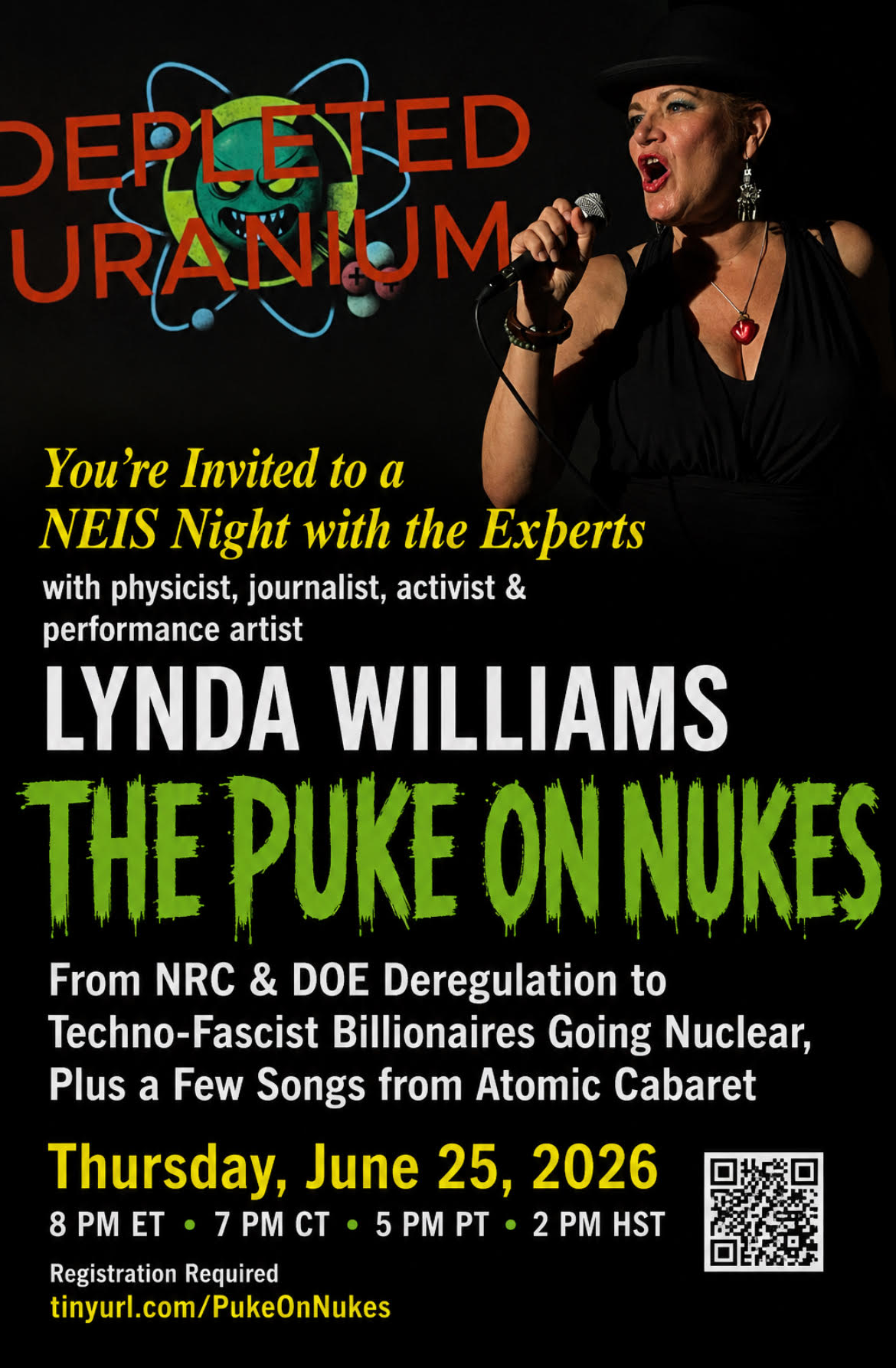
7pm Central Time (8pm ET, 6pm MT, 5pm PT) UTC – 5 From NRC & DOE Deregulation to Techno-Fascist Billionaires Going Nuclear, Plus a Few Songs from Atomic Cabaret REGISTER
 n the fight against climate change, much of the focus rests on reducing our dependence on fossil fuels and developing alternative energy sources. However, the results of a new study suggest that far more attention should be paid to deforestation and how the land is used subsequently – the effects of which make a bigger contribution to climate change than previously thought.





 nuclear-news