The climate report, obtained by NPR, notes that the past 115 years are “the warmest in the history of modern civilization.” The global average temperature has increased by about 1.8 degrees Fahrenheit over that period. Greenhouse gases from industry and agriculture are by far the biggest contributor to warming.
The findings contradict statements by PresidentTrump and many of his Cabinet members, who have openly questioned the role humans play in changing the climate.
“I believe that measuring with precision human activity on the climate is something very challenging to do,” EPA Administrator Scott Pruitt said in an interview earlier this year. “There’s tremendous disagreement about the degree of impact.”
That is not consistent with the conclusions of the 600-plus-page Climate Science Special Report, which is part of an even larger scientific review known as the fourth National Climate Assessment. The NCA4, as it’s known, is the nation’s most authoritative assessment of climate science. The report’s authors include experts from leading scientific agencies, including the National Oceanic and Atmospheric Administration, NASA and the Department of Energy, as well as academic scientists.The report states that the global climate will continue to warm. How much, it says, “will depend primarily on the amount of greenhouse gases (especially carbon dioxide) emitted globally.” Without major reductions in emissions, it says, the increase in annual average global temperature could reach 9 degrees Fahrenheit relative to pre-industrial times. Efforts to reduce emissions, it says, would slow the rate of warming.
“This is good, solid climate science,” says Richard Alley, a geoscientist at Penn State University, who says he made minor contributions to the report’s conclusions on sea level rise. “This has been reviewed so many times in so many ways, and it’s taking what we know from … a couple of centuries of climate science and applying it to the U.S.”
The assessments are required by an act of Congress; the last one was published in 2014. Alley says this year’s goes further in attributing changes in weather to the warming climate, especially weather extremes. “More heat waves and fewer cold snaps, this is very clear,” he says. The report also notes that warmer temperatures have contributed to the rise in forest fires in the West and that the incidence of those fires is expected to keep rising.
Some of the clearest effects involve sea level rise. “Coastal flooding, you raise the mean level of the ocean, everything else equal you get more coastal flooding,” Alley says. The report notes that sea level has risen 7 to 8 inches since 1900, and 3 inches of that occurred since 1993. The report says that rate is faster than during any century over the past 2,800 years.
The report also points out that heavy rainfall is increasing in intensity and frequency across the U.S., especially in the Northeast, and that is expected to keep increasing.
Other connections are harder to nail down, Alley says, such as whether a particular hurricane can be attributed to climate change.
“The Climate Science Special Report is like going to a doctor and being given a report on your vital signs,” says environmental scientist Rachel Licker of the Union of Concerned Scientists. She notes that the authors assessed more than 1,500 scientific studies and reports in making their conclusions.
Alley adds that the new report “does a better job of seeing the human fingerprint in what’s happening.” He says that while he hasn’t read all of it yet, he sees no evidence that it has been soft-pedaled or understates the certainty of the science.
Alley notes that “there’s a little rumbling” among climate scientists who are concerned that the Trump administration will ignore this effort. “I think the authors really are interested in seeing [the report] used wisely by policymakers to help the economy as well as the environment.”
The report has been submitted to the Office of Science and Technology Policy at the White House. Trump has yet to choose anyone to run that office; it remains one of the last unfilled senior positions in the White House staff.
To Close Climate Goals Gap: Drop Coal, Ramp Up Renewables — Fast, UN Says
A new UNEP report shows that the gap between the climate promises countries made at Paris and the emissions cuts needed is larger than previously thought. Inside Climate news Georgina Gustin, 2 Nov 17
Countries will have to phase out coal and invest in renewable energy even faster than previously expected to keep global warming below perilous levels and fend off the most dangerous impacts of climate change, according to a United Nations report released just before the next round of international climate talks.
The United Nations Environment Program on Tuesday released its annual report on the “emissions gap“—the distance between countries’ pledged commitments for meeting the targets of the 2015 Paris climate agreement and the pathways that scientists estimate could actually achieve those targets….
“The overarching conclusions of the report are that there is an urgent need for accelerated short-term action and enhanced longer-term national ambition, if the goals of the Paris Agreement are to remain achievable,” the report says. “And that practical and cost-effective options are available to make this possible.”
In other words, the world’s countries need to get moving—and fast. But there’s hope.
Staying Under 1.5C Tough, but Not Impossible
With each edition, the report’s message has become increasingly urgent as growing research suggests that reigning in global warming will require much more action than countries first outlined in their Intended Nationally Determined Contributions (INDCs) in advance of the Paris process……
The report also notes that “subnational” efforts, including those taken by corporations or states—such as the “We Are Still In” initiative and the Northeast’s Regional Greenhouse Gas Initiative—have major potential above countries’ INDCs.
Platts 1st Nov 2017, An International Atomic Energy Agency conference statement Wednesday said nuclear power is not attracting enough investment to limit climate change, and more clarity from policymakers may be needed to support its development.
The statement at the end of the three-day IAEA ministerial
meeting on nuclear energy in the United Arab Emirates represents the views
of the conference president, the UAE’s ambassador to the IAEA, only, and
was not voted on by the delegates to the event.
Global investment could hold the key to fighting climate change, with one trillion dollars already invested in solutions such as renewables and energy efficiency, says International Finance Corporation, Guardian, Fiona Harvey, 2 Nov 17, At least one trillion dollars are being invested globally in ways to reduce the threat of climate change, including renewable power, energy efficiency, and public transport around the world.
The sums involved are likely to make it possible in future for the world’s governments to meet their commitments under the Paris agreement on climate change, provided the investment continues and is directed to the right ends, according to a new report.
Philippe Le Houérou, chief executive of the IFC, said: “The private sector holds the key to fighting climate change. We can help unlock more private sector investment, but this also requires government reforms as well as innovative business models, which together will create new markets and attract the necessary investment. This can fulfil the promises of Paris.”
The IFC report, entitled Creating Markets for Climate Business, found that governments could work with businesses by fostering renewable energy as an alternative to fossil fuels. For instance, IFC provided $653m (£492m) in debt financing to fund the construction of 13 solar plants near Aswan, in Egypt. Such financing can result in lower electricity costs for local people, as well as reducing carbon dioxide emissions and cutting down on air pollution from coal-fired power plants.
People in developing countries can also benefit from renewable energy installations, such as solar panels and wind turbines, that provide local power, removing the need for them to be connected to a national electricity grid to receive power – a distant dream in some countries, where the national grid is under-developed or prone to breakdown. The availability of power generated locally has multiple benefits, including safety and education, as it enables emissions-free light and power late into the night, instead of people being forced to rely on expensive and polluting kerosene burners.
The authors of the report estimated that investments in energy storage and off-grid solar of $23bn a year could be possible by 2025, if national governments favour renewable energy over fossil fuels.
However, in many countries, developed and developing, fossil fuel companies have the incumbent advantage, and in some cases policies have been developed to suit them. The International Energy Agency estimated fossil fuel subsidies at $325bn a year in 2016.
Making buildings more energy efficient could also reduce carbon emissions dramatically, according to the IFC report, but only if countries adopt better building codes and higher standards. Public transport is another area ripe for investment, which could yield billions of dollars in greater efficiency, and improve the quality of lives of people around the globe, but which has been held back by poor government involvement.
Christian Aid, the development charity, called on the World Bank Group to stop lending to fossil fuel projects. Funding by the group’s members for fossil fuel projects has increased to $4.7bn in 2016, according to the charity.
Fran Witt, senior climate change adviser at Christian Aid, said: “Despite aiming to champion clean energy, the World Bank Group actually continues to finance large volumes of dirty energy projects, which are driving climate change around the world. It is staggering that even after the Paris agreement the group is still investing most of its energy portfolio in dirty energy.”
Emissions Gap Report, http://www.unenvironment.org/resources/emissions-gap-report [good graphs] , Authors: UN Environment, November 17 The goal of the Paris Agreement on climate change, as agreed at the Conference of the Parties in 2015, is to keep global temperature rise this century to well below 2 degrees Celsius above pre-industrial levels. It also calls for efforts to limit the temperature increase even further to 1.5 degrees Celsius.
The UN Environment Emissions Gap Report 2017 presents an assessment of current national mitigation efforts and the ambitions countries have presented in their Nationally Determined Contributions, which form the foundation of the Paris Agreement.
The report has been prepared by an international team of leading scientists, assessing all available information. The governments of countries mentioned specifically in the report have been invited to comment on the specific assessment findings; independent experts have also been invited to review the different chapters.
What’s new in this year’s report?
Update on global greenhouse gas emissions
This year, the Emissions Gap Report includes an assessment of the emissions associated with the Nationally Determined Contributions and current policies of each of the G20 members, including the European Union. This is in addition to presenting an update on global greenhouse gas emissions and national actions to meet the earlier Cancun pledges.
Exploring “negative emission technologies”
This year’s report explores removing carbon dioxide from the atmosphere as an additional way to mitigate climate change, over and above conventional abatement strategies.
An analysis of global carbon dioxide emissions from energy and industry
The Report includes a new systematic assessment of how various economic sectors can reduce their climate-warming emissions, focusing on the potential eductions from the wide application of already-known and cost-effective technologies.
The role of short-lived climate pollutants
The report describes the opportunities offered by limiting emissions of the so-called short-lived climate pollutants. Reductions of these pollutants will limit the rate of short-term warming, and when sustained and combined with reductions in carbon dioxide emissions, they help to limit long-term warming, which is the ultimate aim of closing the emissions gap.
Phasing out coal
This year’s report includes a detailed assessment of global developments in the coal sector. This also examines the options and barriers for a gradual coal phase-out.
Christiana Figueres is chair of the Lancet Countdown advisory board. When the doctor tells you that your cholesterol is too high, you tend to listen and change your diet. When the world’s climate scientists tell us that temperatures are rising to dangerous levels, we should heed their advice. It’s time to give up climate change, it’s bad for our health.
I’m not talking about the health of our planet or the health of species such as the polar bear, so often associated with climate change – though they are suffering. I’m talking about human health. The health of you, your family, your neighbours – each and every one of us.
A report just published in the Lancet from the specially created Lancet Countdown initiative, reveals just how bad climate change is for public health. The diagnosis reveals that hundreds of millions of people are already suffering the health impacts of climate change. Its insidious creep is being felt in multiple ways: rising temperatures are hastening the spread of infectious diseases; crop yields are becoming uneven and unpredictable, worsening the hunger and malnourishment for some of the most vulnerable people on the planet; allergy seasons are getting longer; and at times it is simply too hot for farmers to work in the fields.
Typhoons and hurricanes, such as Harvey, feed off unnaturally warm waters to deliver more forceful threats to human health, including to life itself. The attribution of climate change as a contributing factor in such events is of course complex. The Lancet report’s analysis – that there has been a 46% increase in extreme weather disasters since 2000 – helps to cut through any confusion.
Then there is the heat, which might be the most widespread and dangerous of all. In 2015 alone, according to Lancet Countdown findings, heatwaves affected the lives of 175 million more elderly people worldwide, following a strong trend over the last two decades. The list goes on. The most vulnerable – including elderly people and children – are most exposed to the risks, but everyone is affected and no country is immune. We are only just beginning to witness the manifestation of very concerning trends. Unavoidable increases in global temperature are set to further exacerbate a host of health challenges.
Here’s the good news. While the Lancet’s report lays bare the many ways that climate change impacts on our health, it also shows that tackling climate change directly, unequivocally and immediately improves global health. It’s as simple as that. Tackling the looming global medical emergency is also an unprecedented opportunity to improve public health around the globe. Let’s get to it.
Consider this: local air pollution around the world – much of it coming straight out of exhaust pipes – kills about 6.5 million people annually. In response, many cities – including London and Oxford – countries and major automotive companies have declared an end to the internal combustion engine and are working towards emissions-free transport. They see the market is moving, because it must, and expect it to be profitable. More can follow: getting ahead of the electrification wave that is exciting investors and delivering extraordinary benefits to our air, our lungs and our hearts is in all of our interests.
I learned a long time ago that success is more likely when we take on challenges with determination and stubborn optimism. That’s how parties to the United Nations climate talks regrouped after disappointing outcomes in Copenhagen and even more dire predictions from climate scientists, coming together to adopt the Paris agreement. It’s why I know that we can take this critical diagnosis from climate scientists – of a climate change-fuelled public health emergency – and accelerate solutions that improve the health and wellbeing of billions.
We are already finding the remedies. The UK has pledged to phase out coal by 2025, a process that will save thousands of lives each year, save the NHS up to £3.1bn a year in health costs and accelerate the modernisation of our electricity sector.
Our scientists have been telling us for some time that we’ve got a bad case of climate change. Now our doctors are telling us it’s bad for our health. The Lancet Countdown report is an important climate health check-up and prescription for the action we need. The benefits of getting climate fit are too good to resist: safer, cleaner air and water, more energy independence, more jobs and vastly improved land use. We can all support our governments to do more on this. The G7 meeting of health ministers later this week is as good an opportunity as any to ensure they are heeding the sage advice of our medical experts.
• Christiana Figueres is chair of the Lancet Countdown advisory board and convener of Mission 2020
Global atmospheric CO2 levels hit record high, UN warns that drastic action is needed to meet climate targets set in the Paris agreement, Guardian, Jonathan Watts, 31 Oct 17, The concentration of carbon dioxide in the atmosphere increased at record speed last year to hit a level not seen for more than three million years, the UN has warned.
The new report has raised alarm among scientists and prompted calls for nations to consider more drastic emissions reductions at the upcoming climate negotiations in Bonn.
“Globally averaged concentrations of CO2 reached 403.3 parts per million (ppm) in 2016, up from 400.00 ppm in 2015 because of a combination of human activities and a strong El Niño event,” according to The Greenhouse Gas Bulletin, the UN weather agency’s annual flagship report.
This acceleration occurred despite a slowdown – and perhaps even a plateauing – of emissions because El Niño intensified droughts and weakened the ability of vegetation to absorb carbon dioxide. As the planet warms, El Niños are expected to become more frequent.
The new category would make official the Green party’s pre-election policy which promised 100 visas for those affected by climate change.
As part of the new Labour-led coalition government, the Green party leader James Shaw was given the role of climate change minister.
He told Radio New Zealand on Tuesday that “an experimental humanitarian visa category” could be implemented for people from the Pacific who are displaced by rising seas resulting from climate change.
“It is a piece of work that we intend to do in partnership with the Pacific islands,” Shaw said.
Before the election, the Greens also proposed increasing New Zealand’s overall refugee quota from 750 each year to 4,000 places over six years.
Shaw’s announcement comes after the New Zealand immigration and protection tribunal rejected two families from Tuvalu who applied to become refugees in New Zealand due to the impact of climate change.
The families argued rising sea levels, lack of access to clean and sanitary drinking water and Tuvalu’s high unemployment rate as reasons for seeking asylum.
The tribunal ruled they did not risk being persecuted by race, religion, nationality or by membership of a political or religious group under the 1951 refugee convention.
International environmental law expert Associate Professor Alberto Costi, of Victoria University, told the Guardian that the current convention could not accommodate environmental refugees. “The conditions are pretty strict and really apply to persecution. These people who arrive here hoping to seek asylum on environmental grounds are bound to be sent back to their home countries.”
In 2014 Ioane Teitiota, from Kiribati, made headlines after he applied in New Zealand to become the world’s first climate change refugee “on the basis of changes to his environment in Kiribati caused by sea level rise associated with climate change”.
Costi acknowledged Shaw’s proposal would allow that gap in the refugee convention to be filled but said the problem would be legally determining whether an environmental migrant was still able to live in their home country.
“I have sympathy but legally it creates a big debate. There needs to be clear guidelines.”
Costi said there would be a difference in an application from someone from Tarawa in Kiribati, where conditions are obviously worsening every year, to those whose countries are only affected seasonally.
“It’s an idea to be explored. I would welcome more clarity.”
Government Scientist Blocked from Talking About Climate and Wildfires
Critics are accusing the Trump administration of stifling the dissemination of taxpayer-funded science, Scientific American , By Brittany Patterson, ClimateWire on October 31, 2017
A U.S. Forest Service scientist who was scheduled to talk about the role that climate change plays in wildfire conditions was denied approval to attend the conference featuring fire experts from around the country.
William Jolly, a research ecologist with the agency’s Rocky Mountain Research Station in Missoula, Mont., was supposed to give a 30-minute presentation titled “Climate-Induced Variations in Global Severe Fire Weather Conditions” at the International Fire Congress in Orlando, Fla., next month. The event is hosted by the Association for Fire Ecology (AFE).
The travel denial follows reports last week that U.S. EPA blocked three scientists from making presentations at a conference in Rhode Island featuring climate change. Critics accused the Trump administration of stifling the dissemination of taxpayer-funded science……..
Jolly’s presentation was slated to be part of a special session exploring the connection between wildfire and climate change. It focuses on what scientists can learn about fire behavior in a warming future by looking at clues from the past, according to Anthony Westerling, a professor at the University of California who is moderating the session.
“It’s kind of weird that they would make it hard for a government scientist to take part in this because managing wildfire is a huge challenge logistically and financially on a vast array of federal lands,” he said. “These scientists, by participating in these kinds of society meetings, share their thoughts and hear other people’s thoughts, which is important because their work is supposed to form how these lands are managed and how we prepare for and adapt under climate change.”
Jolly is not the only scientist whose request was denied. No travel authorizations were given to researchers from the Rocky Mountain Research Station’s Human Dimensions Science Program, according to AFE. That includes Karin Riley, a research ecologist who studies the relationship between climate and wildfire. Riley is vice president of AFE’s board of directors.
Three U.S. Geological Survey researchers who are scheduled to give presentations at the wildfire conference next month have been in limbo for months while their travel request is reviewed. All three scientists are slated to speak about climate change…….
The science shared at the Fire Congress draws on real world catastrophes. The United States is experiencing its most expensive fire season in history, with more than 8.8 million acres burned, according to the National Interagency Fire Center.
Massive fires have rained chaos on communities in Montana and California, in part due to climate change increasing the number of fires and making them more severe. A 2015 report by the Forest Service found that modern fire seasons are 78 days longer and burn twice as many acres as they did in 1970. The agency predicted that the number of acres burned could double again by 2050 (Climatewire, Aug. 6, 2015)……. https://www.scientificamerican.com/article/government-scientist-blocked-from-talking-about-climate-and-wildfires/
California governor heads to Europe for climate talks http://m.startribune.com/california-governor-heads-to-europe-for-climate-talks/454332843/?section=nationBy KATHLEEN RONAYNE , ASSOCIATED PRESS October 31, 2017 SACRAMENTO, Calif. — California Gov. Jerry Brown is continuing his international fight against climate change with an 11-day trip to Europe starting Saturday including stops at the Vatican and a United Nations conference in Germany.
Brown is a chief adversary to Republican President Donald Trump in the battle over U.S. climate policy, promising to help the country reach its emissions reductions targets even as Trump withdraws from an international climate accord. He’s been named the special adviser for states and regions at the U.N. Climate Change Conference in Bonn, Germany.
“While the White House declares war on climate science and retreats from the Paris Agreement, California is doing the opposite and taking action,” Brown said in a statement announcing the trip. “We are joining with our partners from every part of the world to do what needs to be done to prevent irreversible climate change.”
The non-profit California State Protocol Foundation, which accepts donations from private businesses, pays for Brown’s international travel. Travel for Brown’s staff members will be partially covered by money from the non-profit Climate Registry and the Climate Action Reserve, a program that deals with carbon offset projects, spokesman Evan Westrup said.
Brown’s November trip follows visits to China and Russia earlier this year to promote international collaboration on climate change. Next year, he plans to host a summit in San Francisco.
He will give a speech Saturday to the Vatican Pontifical Academy of Sciences symposium. During the week, Brown will address European Parliament leaders, the state parliament in Baden-Wurttemberg Germany, meet with representatives from national scientific academies and serve on several panels at the U.N. conference.
Govs. Kate Brown of Oregon, Jay Inslee of Washington and Terry McAuliffe of Virginia — all Democrats — will join him on a panel about states’ roles in fighting climate change. California Senate leader Kevin de Leon, also a Democrat, is scheduled to speak Friday at a Vatican workshop on climate.
Independent 26th Oct 2017, Global warming might be far worse than we thought, according to a new
study. The research challenges the ways that researchers have worked out
sea temperatures until now, meaning that they may be increasing quicker
than previously suggested. The methodology widely used to understand sea
temperatures in the scientific community may be based on a mistake, the new
study suggests, and so our understanding of climate change might be
fundamentally flawed.
Economic Times, AFP|2017, RIYADH: The world faces a “dark future” if it fails to tackle climate change and inequality, IMF managing director Christine Lagarde warned on Tuesday.
“If we don’t address these issues… we will be moving to a dark future” in 50 years, she told a major economic conference in the Saudi capital.
University of Melbourne paper combines latest understanding on Antarctica and current emissions projection scenarios, Guardian, Michael Slezak, Coastal cities around the world could be devastated by 1.3m of sea level rise this century unless coal-generated electricity is virtually eliminated by 2050, according to a new paper that combines the latest understanding of Antarctica’s contribution to sea level rise and the latest emissions projection scenarios.
It confirms again that significant sea level rise is inevitable and requires rapid adaptation. But, on a more positive note, the work reveals the majority of that rise – driven by newly recognised processes on Antarctica – could be avoided if the world fulfils its commitment made in Paris to keep global warming to “well below 2C”.
But that paper only examined the impact of Antarctica on sea level rise, ignoring other contributions, and didn’t examine the details of what measures society needed to take to avoid those impacts.
The new paper by Alexander Nauels from the University of Melbourne and colleagues uses simplified physical models that allowed them to explore all known contributions to sea level rise, and pair them with the new generation of emissions scenarios which the Intergovernmental Panel on Climate Change (IPCC) will use in the next set of reports.
They found that if nothing is done to limit carbon pollution, then global sea levels will rise by an estimated 1.32m. That is 50% more than was previously thought, with the IPCC’s AR5 report suggesting 85cm was possible by the end of the century.
But the extra contribution from Antarctica would not kick in if warming was kept at less than 1.9C above preindustrial levels, the researchers found. Temperatures above that threshold risked triggering the additional processes in Antarctica identified in the 2016 paper, causing much greater sea level rise.
“The 1.5C limit in the Paris Agreement is a much safer bet to avoid this additional contribution than only achieving 2C,” Nauels said.
But that paper only examined the impact of Antarctica on sea level rise, ignoring other contributions, and didn’t examine the details of what measures society needed to take to avoid those impacts.
The new paper by Alexander Nauels from the University of Melbourne and colleagues uses simplified physical models that allowed them to explore all known contributions to sea level rise, and pair them with the new generation of emissions scenarios which the Intergovernmental Panel on Climate Change (IPCC) will use in the next set of reports.
Under all scenarios we are going to have to adapt
They found that if nothing is done to limit carbon pollution, then global sea levels will rise by an estimated 1.32m. That is 50% more than was previously thought, with the IPCC’s AR5 report suggesting 85cm was possible by the end of the century.
But the extra contribution from Antarctica would not kick in if warming was kept at less than 1.9C above preindustrial levels, the researchers found. Temperatures above that threshold risked triggering the additional processes in Antarctica identified in the 2016 paper, causing much greater sea level rise.
“The 1.5C limit in the Paris Agreement is a much safer bet to avoid this additional contribution than only achieving 2C,” Nauels said.
Those scenarios suggested coal could only make up 5% of the world’s energy mix by 2050 if sea level rise is to be limited to about half a metre.
Similarly, those scenarios suggested a global carbon price would have to be well over US$100 per tonne, since at that cost, sea level would rise by 65cm by 2100.
John Church, a leading sea level rise expert from the University of New South Wales who was co-convening lead author of the chapter on sea level in the third and fifth IPCC Assessment Reports, told the Guardian the work was further confirmation that the world needed to prepare now for substantial sea level rises.
“Under all scenarios we are going to have to adapt,” Church said. “We cannot stop all sea level rise.”
He said the research community was not in consensus yet about the accelerated contribution of Antarctica to sea level rise, identified in the 2016 paper and modelled in this study, but examining the implications of those findings was still important.
DeConto, the lead author of the landmark paper from 2016, said it was important to recognise the good news in his original findings and this extension of that work.
“In the aggressive mitigation pathways, where we assume that the global community gets its act together and we reduce emissions, it’s a much rosier picture. There’s a much reduced risk of dramatic sea level rise from Antarctica,” he told the Guardian. “This study fully reinforces that.”
Nauels said his team’s work assumed that Antarctica would contribute to sea level rise as was suggested by the 2016 paper by DeConto, but more work was needed to confirm those findings.
“We still have to find out what’s going on in Antarctica,” he told the Guardian. “We can’t base all future sea level rise projects on just one paper. And the Antarctic ice sheet community are frantically working on the new insights.”
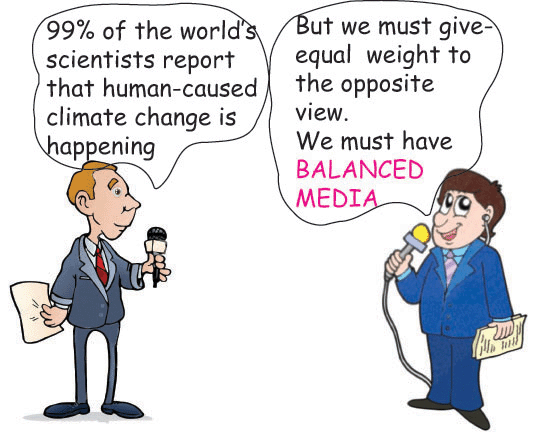
BBC Radio 4’s flagship news programme Today ran the item in August in which Lawson, interviewed by presenter Justin Webb, made the claim. The last three years have in fact seen successive global heat records broken.
The Today programme rejected initial complaints from listeners, arguing that Lawson’s stance was “reflected by the current US administration” and that offering space to “dissenting voices” was an important aspect of impartiality.
However, some listeners escalated their complaint and, in a letter seen by the Guardian, the BBC’s executive complaints unit now accepts the interview breached its guidelines on accuracy and impartiality.
The complaint centred on two statements by Lawson: that the UN’s Intergovernmental Panel on Climate Change “has confirmed that there has been no increase in extreme weather events” and “according to the official figures, during this past 10 years, if anything, mean global temperature, average world temperature, has slightly declined”.
The BBC complaints unit accepted that these statements “were, at the least, contestable and should have been challenged”. In fact the Global Warming Policy Forum itself, the campaign group chaired by Lawson, acknowledged on 13 August that the temperature data he was referring to was “erroneous” and not official. Senior scientists also declared that Lawson’s statement about extreme weather was wrong.
It is not the first time the Today programme has been censured by the BBC complaints unit for an interview with Lawson. A broadcast in February 2014 was judged to have “given undue weight to Lord Lawson’s views, and had conveyed a misleading impression of the scientific evidence on the matter”.
“I really thought the climate change debate had finished and that these voices of the very rich and well connected had lost relevance in the whole argument,” said Dr Tim Thornton, a recently retired GP from Yorkshire who made one of the complaints. “It’s fine that they don’t like the idea of climate change but they are on a par with flat-earthers.”
Thornton highlighted the claim that global temperatures had not risen: “Even a sixth-former would be able to tell you that wasn’t so. So the BBCinterviewer, if they are talking about climate change, should have done a little bit of homework.”
In his letter to Thornton, Colin Tregear, BBC complaints director, said: “I hope you’ll accept my apologies, on behalf of the BBC, for the breach of editorial standards you identified.”
Bob Ward, policy director at the Grantham Research Institute on Climate Change at the London School of Economics, welcomed the upholding of the complaint but said: “There needs to be a shift in BBC policy so that these news programmes value due accuracy as much as due impartiality.
“As well as taking account of the rights of marginal voices like Lord Lawson to be heard, the BBC should also take account of the harm that its audiences can experience from the broadcast of inaccurate information,” said Ward. “His inaccurate assertion that there has been no change in extreme weather was harmful to the programme’s listeners because they may have been misled into believing that they do not need to take precautions against the increasing risk of heatwaves and flooding from heavy rainfall in the UK.”
Lawson did not respond to the Guardian’s request for comment.
Neither the Global Warming Policy Forum or its charitable arm, the Global Warming Policy Foundation, disclose the source of their funding. On their websites, the groups state: “In order to make clear its complete independence, it does not accept gifts from either energy companies or anyone with a significant interest in an energy company.”
The programme in August featuring the interview with Lawson also included an interview with Al Gore, the former US vice president and climate campaigner, who discussed his new film An Inconvenient Sequel: Truth to Power, and another interview with the director Fisher Stevens, who made Before the Flood, also about climate change, starring Leonardo DiCaprio.
The BBC complaints team told Thornton that “the BBC accepts there is broad scientific agreement on climate change” and that “the global climate is changing and the change is predominantly manmade”. The complaints unit said a 2011 review by the BBC Trust had made clear “the requirement to avoid the impression a minority view stands on the same footing as the views of climate scientists”.
Simon Bullock, at Friends of the Earth, said: “It was a real choke-on-cornflakes interview, with Lord Lawson’s misleading climate-denial views given undue weight, and passing unchallenged. After this ruling hopefully the BBC will now move the climate debate on to how to stop our planet warming, not denying that it is happening.”
Climate Change Will Bring Major Flooding to New York Every 5 Years And that’s only counting the floods caused by hurricanes and tropical storms. The Atlantic ROBINSON MEYER 25 OCT 17
New York is a city on the water. For hundreds of years, its rivers and harbor have worked to its advantage, bringing it speedy transportation and pleasant temperatures.
The next couple hundred years may not be as smooth sailing. Global warming, caused by the release of carbon-dioxide pollution into the atmosphere, will cause the seas to rise and the storms to intensify around the city. A new study from an all-star list of climate scientists attempts to estimate how a few of climate change’s symptoms—higher seas, large storm surge, and more intense hurricanes—will intersect in New York over the next 300 years.
It isn’t pretty. Sea-level rise will make every tropical cyclone that hits New York more likely to release damaging floods. For instance, storm floods of nearly seven-and-a-half feet once occurred only a couple times per millennium. In today’s somewhat warmed climate, 7.5-foot floods are projected to happen every 25 years. By 2030, these floods will occur every five years.