Pacific Island nations urge world leaders to act as islands expected to sink
AUSTRALIA’S tropical island neighbours may exist today, but their leaders have urged us to help them from sinking.news.com.au, Matt Young@MattYoung 14 Nov 17 A LARGE swath of Pacific Island nations are slowly being eaten away until residents will be forced to evacuate and the islands eventually sink into the sea — and it’s coming sooner than we think.
This modern-day Atlantis is thanks to sea levels across small island nations that have seen a dramatic rise over the past few decades, a rate of up to 3-4 times larger than the global average. Tuvalu, in the western Pacific Ocean, will reportedly be uninhabitable by 2050, while its island neighbour Kiribati, is expected to be fully submerged by 2100.
The Maldives, which has the lowest elevation in the world and a population of 427,000, may also have sunk by the end of the century.
It has led experts — including Professor Tim Flannery, climate change expert and Professor at La Trobe University — to believe we are “on a trajectory that will see those nations compromised”.
Five reef islands in the Solomon Islands have already been lost forever while a further six have been completely eroded. Last year, the island of Nuatambu had already lost half of its habitable area.
Professor Flannery told news.com.au The Maldives, Kiribati, Marshall Islands, Tokelau and Tuvalu were most at risk.
“It’s very much on their minds, they’re trying to work out how to deal with it,” Mr Flannery told news.com.au.
Scientists are convinced more and more of these tiny islands at risk of sinking into the sea in the next 30 years and Pacific Island leaders have gathered to urge its neighbours, including Australia, to take action to save their dwindling nations……http://www.news.com.au/technology/environment/pacific-island-nations-urge-world-leaders-to-act-as-islands-expected-to-sink/news-story/9416ac1726d1f8d02a1ae435924e364f
November 15, 2017
Posted by Christina Macpherson |
climate change, OCEANIA |
Leave a comment
Labour vows to factor climate change risk into economic forecasts
Shadow chancellor John McDonnell to say ‘overwhelming challenge of climate change’ must be addressed from very centre of government, Guardian, Jessica Elgot, 14 Nov 17, The risk posed by climate change would be factored into projections from the government’s independent economic forecaster if Labour took office, the shadow chancellor will announce on Tuesday.
John McDonnell will highlight the human and economic costs of manmade climate change, calling it the “greatest single public challenge” and say the government should include the fiscal risks posed by global warming in future forecasts.
The landmark change would, for the first time, put climate change on an equal footing with other complex challenges affecting the public finances such as demography.
Under a Labour government, the Office for Budget Responsibility would be given total independence, McDonnell will announce, saying the forecaster would report directly to parliament rather than the Treasury.
Speaking at the Institute for Public Policy Research on Tuesday, McDonnell will say that meeting the challenges of climate change will require “a transformation of our institutions and how our economies are run”.
McDonnell said that Labour “wants to ensure that the overwhelming challenge of climate change is addressed from the very centre of government. This includes the potential losses to the public finances.
“The public deserve to know what impacts we might expect on the national purse from the degradation of our environment. Sound, responsible economic management should already be accounting for this.”…..https://www.theguardian.com/environment/2017/nov/13/labour-vows-to-factor-climate-change-risk-into-economic-forecasts
November 15, 2017
Posted by Christina Macpherson |
climate change, politics, UK |
Leave a comment
 PRESS-CONFERENCE OF THE COALITION DON’T NUKE THE CLIMATE: “IS NUCLEAR A SOLUTION TO CLIMATE CHANGE?” http://www.dont-nuke-the-climate.org/2017/11/10/press-conference-of-the-coalition-dont-nuke-the-climate-is-nuclear-a-solution-to-climate-change/ Theatre/BULA zone 3 – Press Conference Room 2
Press-conference of the coalition Don’t nuke the climate:
“Is nuclear a solution to climate change?”
Speaking: Speaking:Kerstin Rudek, BI Luchow-Dannenberg and Don’t Nuke The Climate campaign, Germany
Markus Atkinson, Anti-Nuclear Alliance of Western Australia
Vladimir Slivyak, Ecodefense, Russia
Nuclear industry and its supporters became very active inside the UN talks promoting outdated, expensive and dangerous nuclear energy as a climate friendly technology. Russia, USA and several other countries are organizing pro-nuclear side-events at COP-23 and trying to get developing world to believe in nuclear solution. The reality is that nuclear is not carbon free and far too expensive to be any kind of solution. Nuclear waste is another hot problem that doesn’t have a solution. Activists from various countries talk on why nuclear is part of problem and not part of solution. Also announcing the demonstration against false solutions for climate change on November 11 in Bonn.
November 13, 2017
Posted by Christina Macpherson |
2 WORLD, climate change |
Leave a comment
Iran slams rich nations over climate talks http://www.sbs.com.au/news/article/2017/11/12/iran-slams-rich-nations-over-climate-talks Iran and its fellow developing countries have accused the world’s richest nations of eroding trust and trying to undermine talks about the Paris agreement. Iran has delivered a blistering assessment of the world’s richest countries’ performance during UN climate negotiations, accusing them of eroding trust and censoring developing nations.
In an unusually strong statement, Iran’s representative told talks in Bonn on Saturday the group of more than 20 like-minded developing countries it spoke for believed others were trying to rewrite the Paris agreement.
The agreement, like the UN climate convention, only worked when all parties had trust in each other and worked together in good faith, he said.
“So soon after the Paris agreement entered into force we are already seeing that trust and good faith being eroded by constant attempts to move away from prior agreements, solemn pledges and treaty obligations,” he said.
“This does not lay a good foundation for long-lasting, equitable and durable action on climate change.”
And in negotiations over finance, technology and building the capacity of nations to cut emissions, suggestions put forward by developing country blocs were “immediately rejected outright by developed countries”.
“What we are seeing now is a concerted effort by developed countries to drop G77 and LMDC proposals from the table in order to focus further negotiations only on developed countries’ positions,” Iran’s representative said.
“Censoring other parties’ views from being included into negotiating text as the basis of negotiations is clearly not in good faith.”
The Saturday evening session was designed as a mid-COP23 update on the various negotiation bodies that have been working on different aspects of implementing the Paris agreement.
While the chairs of each of the bodies generally gave the impression good progress was being made, almost all the country groups said they were disappointed or concerned about the slow pace.
Ecuador said its G77+China group – representing 134 developing countries – was especially worried about the lack of progress on all financial matters.
This concern was echoed by Mali on behalf of African countries.
Finance is important to developing countries, who cannot afford on their own to cut emissions or adapt to climate change.
“One component is still missing – not from (Fiji) but from our developed country parties – and that is the political will that is needed to engage constructively towards the highest priority of ensuring a balanced progress on all agenda items,” Ecuador official Walter Schuldt said.
And the Maldives, speaking for small island states, accused some countries of taking a “seemingly hard stance” by wanting to limit access to finance.
Australian environment ambassador Patrick Suckling said its Umbrella Group of non-EU developed countries – including the US, Canada and New Zealand – was generally heartened that everyone at the negotiations wanted to see progress.
But Australia’s bloc was disappointed by persistent efforts from some countries to work outside the mandates of the Paris agreement.
Tension has arisen over adding extra items to the official agenda, including a formal discussion about increasing pledges for action before the Paris deal starts in 2020.
“(This) is hampering the very progress we are seeking,” Mr Suckling said.
The European Union said it did not recognise any lack of political will during negotiations and there was no disagreement about the urgency of pre-2020 action – only what form discussions should take.
Morocco, which has been working with countries on a solution to this dispute, also reported there was a clearly unanimous view on the importance of early action on climate change.
It said there was no consensus yet but was convinced once could be reached.
Greenpeace’s Jens Mattias Clausen said giving space to constructive discussions about pre-2020 ambitions was a way developed countries could show good faith to their partners.
“These discussions need to take place now, not only on climate action but also on issues such as the adaptation fund, to build trust and ensure that vulnerable countries will get the help they need,” he told AAP.
November 13, 2017
Posted by Christina Macpherson |
climate change, Iran, politics international |
Leave a comment
Al Gore: Voting Trump out in 2020 could save Paris Climate Agreement
‘A new president could simply give 30 days notice and the United States is back in the agreement,’ says former US Vice President ,Independent, Maya Oppenheim @mayaoppenheim Al Gore has suggested America could stay in the Paris Climate Agreement if a new president gets into the White House in 2020.
President Donald Trump announced he would be withdrawing the US from the Paris Climate Agreement in June, making the US as the only country in the world not to get behind the framework deal to tackle greenhouse gas emissions.
The agreement states that signatories cannot withdraw until 4 November 2019 but the actual departure would not become official until the following year.
“If there is a new president … a new president could simply give 30 days notice, and the United States is back in the agreement,” the former US Vice President told an audience at COP23, the United Nations Climate Change Conference in Bonn, Germany.
Mr Gore added: “The first date upon which the United States could actually leave the Paris Agreement happens to be the first day after the next presidential election in 2020 so that’s good news”……..
Syria, the last nation outside the pact, became a signatory of the Paris climate agreement last week http://www.independent.co.uk/news/world/americas/al-gore-donald-trump-vote-out-save-paris-climate-agreement-2020-a8050791.html
November 13, 2017
Posted by Christina Macpherson |
climate change, USA |
Leave a comment
COP23: African youth fighting for climate action, DW, 12 Nov 17 Africa is harnessing the power of its emerging youth demographic to spearhead efforts to tackle climate change. By 2050, UNICEF estimates that approximately two out of every five children on our planet will be African. Africa’s rapidly burgeoning young generation is viewed by some as a precursor to a range of serious problems across the continent, ranging from unemployment to further migration crises. But they could very well be the key to confronting one of the biggest challenges of our time: climate change.
As delegates from across Africa gather for the latest round of international climate talks in Bonn this week, young African leaders and experts are hosting their own side-events to draw attention to their own fight against climate change, while highlighting the importance of African youth getting involved in the process.
The African Youth Initiative on Climate Change (AYICC) was established back in 2006 shortly before COP12 talks kicked off in Nairobi, Kenya. Since then, support for climate change action among the African youth has grown considerably, as they actively work to raise awareness in their communities and hold their governments to account for inaction.
Young generation best equipped to tackle climate change
Maureen Sigauke is the co-founder of the community-based organization, Green Active Citizens Trust in Zimbabwe and was a speaker at WWF’s COP23 Africa Day panel, Youth and Climate Change in Africa. She explained to DW why young Africans should act now to secure their futures, when the effects of climate change will be more clearly felt across the continent.
“I think that it is important to know that climate change is a threat to development; it is a threat to job security – if floods happen it can threaten your job – it’s a threat to human rights, it’s a threat to economic development, it’s a threat to sustainable access to basic human rights such as food, shelter and poverty alleviation, particularly in the African case. So that’s why people should care, because everything that we know could change if climate change continues unabated.”…….http://www.dw.com/en/cop23-african-youth-fighting-for-climate-action/a-41333083
November 13, 2017
Posted by Christina Macpherson |
AFRICA, climate change |
Leave a comment
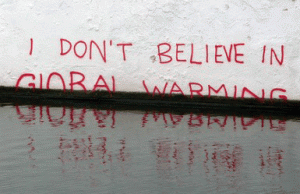 DeSmog Blog, By Graham Readfearn • Wednesday, November 8, 2017 We’re at that time of year when delegations from countries around the world gather for the latest round of United Nations climate negotiations — this time in Bonn, Germany.
For climate science deniers, this is also the time of year to polish up their dodgy climate science talking points and those mythical conspiracy theories about the UN, new world orders, secretive global government plans, and other such illuminati activities.
One recurring feature of these efforts is what’s known as quote mining, where lines are taken out of context to try and discredit people associated with climate science or the UN. If that doesn’t work, then just make up words that people never said.
Here’s how it usually works. The “source” for a particular quote will invariably lead you down a rabbit hole, echoing with the sounds of other climate science deniers quoting the same material. If a misrepresentation occurs in two different places, this does not suddenly make it real.
Rarely, if ever, will the quote be linked to a primary source that might give you some idea of the context, relevance, or the actual date when the quote was supposedly delivered.
At other times, the claimed “quote” turns out not to have been a quote at all, but a piece of reported speech or a headline that someone stuck quote marks around to turn it into a quote. This is not how quoting people works.
But let’s have a look at some of the worst cases. ……. https://www.desmogblog.com/2017/11/07/how-climate-science-deniers-manufacture-quotes-convince-you-united-nations-one-big-socialist-plot?utm_source=dsb%20newsletter
November 13, 2017
Posted by Christina Macpherson |
2 WORLD, climate change, spinbuster |
Leave a comment
 No2 Nuclear Power 9 Nov 17
Nuclear power is, according to the nuclear industry, nearly carbon-free and indispensable for mitigating climate change as a result of anthropogenic emissions of greenhouse gases. In the official publications of the International Atomic Energy Agency (IAEA) and the nuclear industry no figures could be found regarding the present and/or envisioned future nuclear contribution to the reduction of the global emissions of greenhouse gases.
A new study by Jan Willem Storm van Leeuwen assesses the following questions:
How large would the present nuclear mitigation share be, assumed that nuclear power does not emit carbon dioxide CO2?
- How large could the reduction become in the future, starting from nuclear generating capacity scenarios published by the IAEA, and also assumed that nuclear power does not emit CO2?
- How feasible are the projections of the nuclear industry?
- How large could the actual nuclear CO2 emissions be, estimated on the basis of an independent life cycle analysis?
- Does nuclear power emit also other greenhouse gases?
Present nuclear mitigation contribution
In 2014 nuclear power contributed 1.6% of global usable energy supply. If we assume nuclear power displaced fossil-fuelled electricity generation its contribution to emissions reduction would be about 4.7%, assuming nuclear power is free of Greenhouse Gases (GHGs) (which it is not).
Nuclear mitigation contribution in the future
A hypothetical nuclear mitigation contribution in 2050, based on two IAEA scenarios (assuming nuclear power is free of GHGs) shows the following reductions in GHGs:
IAEA Low scenario – constant nuclear capacity, 376 GWe in 2050: 1.3 – 2.4% reduction
IAEA High scenario – constant nuclear mitigation share, 964 GWe in 2050: reduction 3.8 – 6.8%.
Global construction pace
By 2060 nearly all currently operating nuclear power plants (NPPs) will have closed because they reach the end of their operational lifetime. The current construction rate for new capacity of 3-4 GWe per year is too low to maintain global nuclear capacity at the current level, so it is declining. To maintain current capacity the construction rate needs to be doubled. For the IAEA High Scenario it would need to increase to around 27 GWe/yr until 2050. In view of the massive cost overruns and construction delays that plague the nuclear industry such a high construction rate looks highly unlikely.
Prospects of new advanced nuclear technology
The nuclear industry talks about advanced nuclear systems that would enable mankind to use nuclear power for hundreds to thousands of years. These concepts concern two main classes of closed-cycle reactor systems: uranium-based systems and thorium-based systems. However, the prospects seem questionable in view of the fact that, after more than 60 years of research and development in several countries (e.g. USA, UK, France, Germany, the former Soviet Union) with investments exceeding €100bn, still not one operating closed-cycle reactor system exists in the world. If nuclear power ends up relying exclusively on a once-through cycle, as seems likely, the size of the uranium resources will be a restricting factor.
Nuclear generating capacity after 2050
In the highly unlikely event that the nuclear industry does manage to build 964 GWe of new nuclear capacity by the year 2050 these will be operating for 40-50 years. Will the industry expect to continue expanding?
Uranium demand and resources
Assuming, for the sake of argument, that no new nuclear power stations are built after 2050 with nuclear power phased out by 2100, presently known world recoverable uranium resources would be adequate to sustain the IAEA Low scenario, but not High scenario. A common view amongst nuclear proponents is that more exploration will yield more known resources, and at higher prices more and more uranium would become economically recoverable. In this view uranium resources are virtually inexhaustible. However, the amount of energy consumed per kg of recovered natural uranium rises exponentially with declining ore grades. No net energy can be generated by the nuclear system as a whole from uranium resources at grades below 200- 100 ppm (0.2-0.1 g U per kg rock); this relationship is called the energy cliff.
Actual CO2 emission of nuclear power
The nuclear process chain is a sequence of industrial activities which are required to generate nuclear electricity. CO2 emissions will result from the burning of fossil fuels and chemical reactions throughout the nuclear chain, except the nuclear reactor itself. The sum of the CO2 emissions of all processes in the chain are estimates at estimated at: 88-146 gCO2/kWh.
CO2 trap
The energy consumption and consequently the CO2 emission of the recovery of uranium from the earth’s crust strongly depend on the ore grade. As the average ore grade approaches 200 ppm, the specific CO2 emission of the nuclear energy system will surpass that of fossil-fuelled electricity generation. This phenomenon is called the CO2 trap. If no new major high-grade uranium resources are found in the future, nuclear power might lose its low carbon profile within the lifetime of new nuclear build.
Emission of other greenhouse gases
No data are found in the open literature on the emission of greenhouse gases other than CO2 by the nuclear system, likely such data never have been published. Assessment of the chemical processes required to produce enriched uranium and to fabricate fuel elements for the reactor indicates that substantial emissions of fluorinated and chlorinated gases are unavoidable; some of these gases may be potent greenhouse gases, with global warming potentials thousands of times greater than CO2. It seems inconceivable that nuclear power does not emit other greenhouse gases. Absence of published data does not mean absence of emissions.
Krypton-85, another climate changing gas
Nuclear power stations, spent fuel storage facilities and reprocessing plants discharge substantial amounts of a number of fission products, one of them is krypton-85, a radioactive noble gas. Krypton-85 is a beta emitter and is capable of ionizing the atmosphere, leading to the formation of ozone in the troposphere. Tropospheric ozone is a greenhouse gas, it damages plants, it causes smog and health problems. Due to the ionization of air krypton-85 affects the atmospheric electric properties, which gives rise to unforeseeable effects for weather and climate; the Earth’s heat balance and precipitation patterns could be disturbed.
Questionable comparison of nuclear GHG emission figures with renewables
Scientifically sound comparison of nuclear power with renewables is not possible as long as many physical and chemical processes of the nuclear process chain are inaccessible in the open literature, and their unavoidable GHG emissions cannot be assessed. When the nuclear industry is speaking about its GHG emissions, only CO2 emissions are involved. Erroneously the nuclear industry uses the unit gCO2eq/kWh (gram CO2-equivalent per kilowatt-hour), this unit implies that other greenhouse gases also are included in the emission figures, instead the unit gCO2/kWh (gram CO2 per kilowatt-hour) should be used. The published emission figures of renewables do include all emitted greenhouse gases. In this way the nuclear industry gives an unclear impression of things, comparing apples and oranges.
A second reason why the published emission figures of the nuclear industry are not scientifically comparable to those of renewables is the fact that the nuclear emission figures are based on incomplete analyses of the nuclear process chain. For instance the emissions of construction, operation, maintenance, refurbishment and dismantling, jointly responsible for 70% of nuclear CO2 emissions, are not taken into account. Exactly these components of the process chain are the only contributions to the published GHG emissions of renewables. Solar power and wind power do not consume fuels or other materials for generation of electricity, as nuclear power does.
Climate Change and Nuclear Power: An analysis of nuclear greenhouse gas emissions by Jan Willem Storm van Leeuwen. https://wiseinternational.org/will-nuclear-power-save-climate
Also see Don’t Nuke the Climate: http://www.dont-nuke-the-climate.org/?lang=en
The solutions to the climate crisis are clear: A rapid, just transition to a nuclear-free, carbon-free energy system. The only sure way to stop the global warming impacts of energy use is to transition as quickly as possible from antiquated energy models of the 20th Century and their polluting nuclear power and fossil fuel technologies … to the safe, clean, affordable and sustainable renewable, efficient, and smart technologies of the 21st Century. Nuclear power in particular cannot solve the climate crisis. Indeed, its continued use exacerbates global warming by preventing the deployment of clean energy systems.
November 11, 2017
Posted by Christina Macpherson |
2 WORLD, climate change |
Leave a comment
 The latest news from COP23 What has been going on in the second half of the first week of COP23 climate change negotiations? https://dailyplanet.climate-kic.org/latest-news-cop23/, Will Yeates, 10 Nov17,
Emerging nations have told rich countries to do more to cut emissions quicker. A group of campaigners have called for the US to be kicked out of the talks. But the main story seem to be around rich countries reluctance to commit to past promises around climate finance. NGOs may even sue.
With lighter news of how kale is climate-friendly and some art from Venice, here are the biggest COP23 stories from the second half of this week.
1. Emerging nations urge rich to kick-start climatepact before 2020
Emerging nations pressed developed countries on Wednesday to step up cuts in greenhouse gas emissions by 2020 to kick-start the Paris climate agreement, saying the rich were wrongly focused on 2030 goals.
“We came here needing to hit the accelerator, not the brakes,” Brazil’s chief negotiator Antonio Marcondes told Reuters
Read more on Thomson Reuters Foundation
2
. African campaigners call for the US to be kicked out of major UN climate talks because of Donald TrumpThe Pan African Climate Justice Alliance (PACJA) has organised a petition in favour of the US delegation being barred from the UN negotiations in response to Mr Trump’s decision to pull his country out of the Paris Agreement on Climate Change. The group claims the US has no right to be involved in discussions on how the agreement should be implemented given that it has chosen to opt-out of the deal.
Read more on The Independent
3. Climate-hit nations ask: Who will pay the rising costs of disasters?
The question of who might pay the mounting costs of disasters is a controversial one at the talks. Developed countries — as the biggest emitters of greenhouse gas emissions — have been reluctant to discuss the costs, fearing they could be held liable.
Read more on Thomson Reuters Foundation
4. Carbon price among policy wishlist issued by businesses at COP23Members of the World Business Council for Sustainable Development (WBCSD), including the chief executives of more than 200 international businesses, have called for governments to collaborate with the private sector to set meaningful carbon prices and improve climate resilience.
Read more on Edie
5. Kale on the agenda at COP23
Ten years ago, Nordic chefs drafted a manifesto to shape a new food culture, grounded in gastronomy, but their overall ambition was to create a new, sustainable food identity. What came out of was a boost in Nordic gastronomy based on locally sourced vegetables, creating thousands of new jobs and inspiring others across the food sector to follow suit.Read more on Huff Post
6. Climate change art illustrates sea level rise in Venice during COP 23
Andreco Studio has unveiled its latest art installation, Climate 04-Sea Level Rise in Venice, to raise awareness of the climate change conference COP 23 currently underway in Bonn, Germany. Introduced as a project promoting dialogue between the arts and sciences, the climate change-inspired installation calls attention to the effects of potential sea level rise in Venice.Read more on Inhabitat
7. COP23: NGOs may take nations to court over climate loss and damage
Developed countries have not lived up to their promises around climate financing. NGOs at the UN climate talks in Bonn are now pushing for action through legal means.Read more on Eco Business
7. COP23: NGOs may take nations to court over climate loss and damage
Developed countries have not lived up to their promises around climate financing. NGOs at the UN climate talks in Bonn are now pushing for action through legal means.Read more on Eco Business
9. Climate summit deadlocked over immediate action
A closed-door meeting over the inclusion of immediate climate action in the agenda at this year’s conference in Bonn, Germany, has failed to break the deadlock between developing and developed countries.
From the start of the UN summit on Monday, developing countries led by India, China and Iran have been asking for the inclusion of immediate climate action in the agenda.
Developed countries have been opposing this because it puts their actions under the spotlight. The Paris Agreement comes into force in 2020 so prior efforts to limit climate change are largely the responsibility of industrialised countries under the second phase of the Kyoto Protocol. But many industrialised countries have not even ratified the second phase in their legislatures.Read more on China Dialogue
10. One nation, two tribes: opposing visions of US climate role on show in Bonn
Donald Trump has pulled the US out of the Paris accord – but other Americans are standing with the world to help fight the ‘existential crisis’ of global warming. Deep schisms in the US over climate change are on show at the UN climate talks in Bonn – where two sharply different visions of America’s role in addressing dangerous global warming have been put forward to the world.Read more on Guardian
11. Rich countries not talking climate finance seriously, say African officials
Developed countries promised to deliver $100bn a year by 2020 in public and private fund to help struggling countries cope with climate change. Current flows are estimated at between $17bn and $61bn. However, at UN climate talks in Bonn, Seyni Nafo, who leads the group of African states, said the rich were refusing to advance even on procedural discussions around finance.Read more on Climate Home
November 11, 2017
Posted by Christina Macpherson |
2 WORLD, climate change |
Leave a comment
 Accelerate climate action and raise ambition, urges UN chief http://www.un.org/apps/news/story.asp?NewsID=58066#.WgYJwdKWbGg 10 November 2017 – As the impact of climate change worsens around the world, United Nations Secretary-General António Guterres has called on the global community to redouble efforts to help countries respond to climate shocks, especially the most vulnerable.
“I am encouraged to see climate action taking hold, at all scales, at all levels, involving an ever-wider coalition of actors and institutions,” said the Secretary-General, at a press stakeout at the UN Headquarters, in New York.
“But we need to do more,” he underlined.
In his remarks, the UN chief said that he will be travelling to Bonn to participate in the UN Climate Change Conference (COP23), where, he will urge efforts to accelerate climate action as well as to raise ambition to do more.
“The window of opportunity to meet the 2-degree target may close in 20 years or less – and we may have only five years to bend the emissions curve towards 1.5 degrees,” he said, noting the need for a further 25 per cent cut in emissions by 2020.
Speaking on the need for bolstering finance, Mr. Guterres called for mobilizing the agreed $100 billion annually for developing countries, which is crucial to spur action.
He also said that in September 2019, he will convene a Climate Summit to mobilize political and economic energy at the highest levels.
“I ask world leaders to show courage in combatting entrenched interests; wisdom in investing in the opportunities of the future; and compassion in caring what kind of world we build for our children,” he said.
“As a former politician myself, I have no doubt that in today’s world, this is the path to progress today and a meaningful legacy for tomorrow.”
Also at the stakeout, the UN chief informed that before Bonn, he will visit the Philippines to attend the UN-ASEAN (Association of Southeast Asian Nations) Summit, and after participating at COP23, he will deliver an address at the School of Oriental and African Studies (SOAS) University of London on counter-terrorism and human rights on Thursday, 16 November.
“As the world responds to modern terrorism, our goal must be to win the fight while upholding our values,” he said.
November 11, 2017
Posted by Christina Macpherson |
2 WORLD, climate change |
Leave a comment
As more corporates commit to sourcing 100 per cent renewable power, calls grow for clean power to play a central role in revamped national climate plans, Business Green, James Murray, 10 Nov 17
A wide-ranging coalition of businesses, NGOs, and energy industry experts have today unveiled a raft of new measures at the COP23 Summit in Bonn designed to accelerate the roll out of renewable energy technologies globally.
To mark the Summit’s Energy Day The Climate Group, IEA, IRENA and Sustainable Energy for All (SEforALL) initiative came together to put forward a series of reports and proposals that promise to beef up energy industry decarbonisation efforts through to 2020 and beyond.
Presented under the UN’s Marrakesh Partnership – which aims to encourage governments and businesses to step up climate action measures prior to the Paris Agreement coming in to full effect in 2020 – the group today unveiled fresh research on how national action plans can be strengthened to enable faster deployment of renewables, new corporate support for clean technologies, and additional funding for renewables research.
“With the price of renewable and storage technologies tumbling, and greater understanding on how to set the policy table for a cleaner energy mix and more integrated energy planning, the question before decision makers is, why wait?” said Rachel Kyte, Special Representative of the UN Secretary-General and CEO, Sustainable Energy for All.
She added that there was now ample evidence that clean energy investment could support both development efforts and the Paris Agreement. “The energy transition that we can see is underway and must be a transition towards energy systems around the world that secure sustainable energy for all,” she said. “This means placing energy efficiency first, adopting a laser like focus on ending energy poverty and using the renewable energy revolution to achieve universal access and a bending of the emissions curve.”
The International Renewable Energy Agency (IRENA) today published new research detailing how the national climate action plans – or Nationally Determined Contributions (NDCs) in the UN jargon – are failing to keep pace with the renewables deployment being delivered by the energy industry.
The report argues that there is “substantial scope” for NDCs to be strengthened to take advantage of the falling cost of renewables and support the roll out of clean technologies that would help move countries on to the most cost effective emissions reduction trajectory.
“Two-thirds of global greenhouse gas emissions stem from energy production and use, which puts the energy sector front and centre of global efforts to combat climate change,” said Adnan Z. Amin, director-general at IRENA. “Our analysis shows that renewables and energy efficiency can together provide over 90 per cent of the mitigation needed in the energy system by 2050 to achieve the ambitions of the Paris Agreement, while also boosting the economy, creating jobs and improving human health and well-being.”
“We have a large, untapped, and affordable renewable energy potential waiting to be developed,” he added. “Revising the Nationally Determined Contributions (NDCs) gives countries an opportunity to take a fresh look at how to harvest this potential, not only for mitigation, but in light of the multiple socio-economic benefits of renewables, also for adaptation.”
Further support for renewables deployment is now in the pipeline, after the International Energy Agency (IEA) announced this week it had teamed up with 13 countries to launch the IEA Clean Energy Transitions Programme, a new multi-year, €30m plan to support clean energy transitions around the world…….https://www.businessgreen.com/bg/news/3020842/cop23-world-leaders-urged-to-strengthen-renewables-action-plans
November 10, 2017
Posted by Christina Macpherson |
2 WORLD, climate change |
Leave a comment
Women’s voices for ocean and climate https://www.unenvironment.org/news-and-stories/story/womens-voices-ocean-and-climate 10 Nov 17, The crucial yet under-recognized role that the world’s women play as agents of change and healers of the ocean and climate was the focus of a side event at the 23rd UN Climate Change Conference (COP23) in Bonn, Germany on 6 November.
The event – hosted jointly by the World Wildlife Fund (WWF), UN Environment and the Secretariat of the Pacific Regional Environment Programme – aimed to draw attention to the value of inclusive ocean and climate management.
“Women are leaders in resource management and agents for building resilient communities, and their valuable work bridges across climate action, sustainable development, and nature protection,” said Ms. Raumanu Pranjivan-Sharma, a senior legal officer for the Government of Fiji who is serving as a liaison officer for the COP23 presidency. “I want to reiterate the COP23 presidency’s commitment to the work on gender and climate change.”
The event, “The Role of Women as Healers of the Ocean at the Frontlines of the Climate-Resilient Development–Nature Nexus”, showcased the varied and valuable roles of women amidst the rising tide of challenges brought on by climate change and other human-induced changes.
“We also know that when women are well represented in decision-making processes, their ability to share skills and knowledge strengthens our collective effort to face the challenge of climate change,” said Ms. Pranjivan-Sharma.
The speakers, ranging from government officials and academics to women from coastal communities whose livelihoods depend on the ocean, shed light on how women continue to punch above their weight in trying to maintain their way of life amid the challenges facing our ocean and climate-dependent livelihoods.
The discussion highlighted the value of empowering women in engaging in ocean governance and climate adaptation and mitigation, using locally appropriate methods.
The different social and cultural differences must be recognized. We cannot come in blazing about being inclusive,” said Ms. Monifa Fiu, coordinator of the Laje.Rotuma Initiative, Vice President of the Fiji voyaging Uto Ni Yalo Trust, and Climate Adaptation Planner and Adviser with the Rotary Pacific Water Foundation. “Understanding that local scenario is key.”
Mobilizing women to be part of decision-making processes at all levels will help to ensure that women’s voices, needs and concerns are taken into consideration in planning, implementing, monitoring and evaluating climate actions.
Other speakers included Ms. Ingrid-Gabriela Hoven, Director-General, Global Issues-Sector Policies and Programmes at the Federal Ministry for Economic Cooperation and Development (BMZ), Germany; Professor Elisabeth Holland, Director of the Pacific Center for Environment and Sustainable Development, University of the South Pacific; and Ms. Penina Moce, WWF Community Climate Witness, Fiji. The side event was moderated by Ms. Carol Phua from the MPA Action Agenda (WWF Netherlands).
The COP23 event builds on a multi-agency initiative to showcase experiences of women in the Asia-Pacific region in ocean management. The event premiered an Ocean Witness film of Roziah Jahalid from Semporna, Malaysia. Ocean Witness is a collection of stories told by people fully dedicated to the preservation of the ocean. Through the Ocean Witness platform, WWF and partners highlight tangible problems and solutions that are relevant to policymakers and the public.
Learn more about UN Environment’s work on gender and climate change.
For more information:
Tiffany Straza: unep.pacific@unep.org Tui Marseu, Communications Manager WWF-Pacific:
tmarseu@wwfpacific.org
November 10, 2017
Posted by Christina Macpherson |
climate change, oceans, Women |
Leave a comment
REneweconomy, By Andrew McCallister on 10 November 2017
I’m preparing for a trip to your fine nation later this month to speak at the National Energy Efficiency Conference in Melbourne, so I’ve been reading up on Australian energy policy debate. It’s been fascinating.
I still have a lot to learn about your energy system, but so far one thing stands out: the discussion in Australia seems overly focused on the transition underway on the supply side of the market.
Don’t get me wrong – the decarbonisation of the world’s energy supply is crucial, and you won’t find a stronger advocate for renewables than me. Way back in the 1990s, I installed many small, remote PV and wind systems with my own two hands, and trained others to do the same.
More recently I ran two of California’s signature renewables programs – the California Solar Initiative and Self-Generation Incentive Program.
However, focusing solely on the move to low carbon generation without pursuing demand side opportunities in an ambitious, systematic way actually makes the transition harder.
Energy efficiency and demand response are just as important to the energy transition as renewables are, as we’ve learnt in California. Today’s technology helps us utilise energy smartly; and indeed the least expensive and cleanest unit of energy is the one not needed at all.
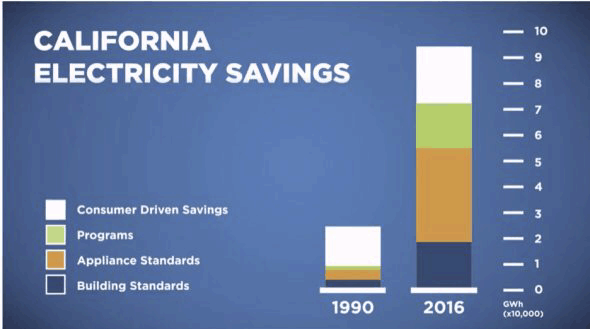
Energy efficiency has been a central contributor to California’s energy mix since the 1970s.∗Efficiency is responsible for an annual reduction in statewide electric consumption of 90 TWh (Figure 1), the equivalent of 30 percent of the state’s current electricity consumption and enough to power around eight million households.
California’s per capita electricity use has remained flat since the mid-1970s, despite a fourfold increase in real economic output, larger homes and the proliferation of consumer appliances and electronics.
Since 2000, the state’s overall carbon emissions are down 8 percent while its economy has grown by 28 percent. California’s deliberate, consistent focus on energy efficiency has played an important role in these successes.
Going forward, the California legislature and Governor Brown have established a goal to double the flow of efficiency savings by 2030. The estimated impacts of this doubling effort are shown in Figure 2. Achieving the goal will see per capita consumption decline around 25 percent by 2030. California’s suite of energy efficiency activities includes:
- Building energy efficiency standards. The 2019 Standards update will require residential new construction to have advanced building shells, high-performing water heating and mechanical systems, all-LED lighting and, for the first time, sufficient self-generation (typically PV) to offset all electric load. Incremental costs are shown to be cost-effective.
- Appliance efficiency standards. California has explicit authority to develop efficiency standards where national standards do not exist. Recent standards adopted include general service LEDs, computers, and battery chargers. Many appliance standards are currently in development (e.g. industrial fans and blowers, certain compressors and pumps, and room air conditioners)……
Modern energy management complements renewable energy supply
Highly efficient products and practices increasingly bundle with digital communication and control features to support demand-side responsiveness to the momentary needs of the grid. Good design of buildings and industrial processes, together with advanced energy management systems, can provide both beautifully tailored performance for customers and valuable and much-needed grid services that aid seamless incorporation of renewable energy into the supply mix.
Energy efficiency optimises the distribution grid
Energy efficiency frees capacity in the distribution grid, allowing new electric loads to be served with only moderate added investment. That ‘headroom’ will be essential, since California’s clean energy path will include widespread electrification: pervasive adoption of electric vehicles, heat pumps, induction cooking and other electric end use technologies. Electrification brings additional benefits, such as avoiding both investment in new retail gas distribution infrastructure and the risks to health and safety from indoor combustion.
Energy efficiency creates jobs and builds economic resilience…… Andrew McCallister is a Commissioner at the California Energy Commission, the state’s primary energy policy and planning agency. He will be the international keynote speaker at the National Energy Efficiency Conference in Melbourne on 20th and 21st November 2017. http://reneweconomy.com.au/energy-efficiency-foundation-climate-transition-48098/
November 9, 2017
Posted by Christina Macpherson |
climate change, ENERGY, USA |
Leave a comment
Don’t be complacent: climate change will ravage rich and poor alike, Guardian , Patricia Scotland, 9 Nov 17 Lady Scotland is secretary general of the Commonwealth
My trip to islands that bore the brunt of Hurricanes Irma and Maria proved one thing: we must think again about how to help those most at risk
“…….My worry is that change will not happen quickly enough to meet the mammoth challenges facing the Caribbean and other regions that have been so grievously damaged by a season of climatic upheaval.
All those involved in making these rules, such as the World Bank and the OECD’s Development Assistance Committee, have to consider seriously our present reality and to create eligibility criteria that adequately respond to what countries, particularly those more prone to natural disasters, are actually experiencing.
This is a concern for all of us; because just before the Caribbean hurricanes, hundreds died in mudslides in Sierra Leone and in floods in Asia, and thousands were displaced.
This is not just about a woman, thousands of miles away, sitting amid the wreckage of her home. This is about a rapid, drastic change in climate that is wreaking havoc on our planet. Even in Ireland, Storm Ophelia claimed three liveslast month.
We need to accept the new reality of fast and furious natural disasters and have a plan to deal with it. We need a targeted global response that enables us to implement the Paris agreement on climate change and better coordinate a rapid reaction, with everything taken into account: search and rescue, regional coordination and legal impediments, such as the revision of aid rules.
But it also needs to recognise that the human spirit demonstrated by the Commonwealth during this traumatic period is something upon which we can build. We need all hands on deck. If not us, who – and if not now, when?
https://www.theguardian.com/commentisfree/2017/nov/09/climate-change-ravage-rich-poor-alike-hurricane-irma-maria
November 9, 2017
Posted by Christina Macpherson |
2 WORLD, climate change |
Leave a comment
 The World’s Largest Climate Change Summit Starts Today. Here’s What’s Happening. Huffington Post 6 Nov 17 It is the first annual meeting of the United Nations group since President Donald Trump announced the U.S. would withdraw from the Paris climate deal. Representatives from nearly 200 countries gather at the United Nations’ 23rd climate change conference beginning Monday, an annual effort to tackle global warming and its impacts already inflicting havoc on the planet.
This year, however, the U.N. faces a new challenge: Addressing the phenomenon after U.S. President
Donald Trump, leader of the planet’s second-largest greenhouse gas emitter, pledged to do nothing to curb emissions.
The U.N. Framework Convention on Climate Change will deal with that question in Bonn, Germany, from Nov. 6 to Nov. 17 as countries work to firm up their commitments to adapt to a warmer world in line with 2015′s landmark Paris Climate Agreement. Scientists say the world should prevent the planet from warming
more than 2 degrees Celsius beyond pre-industrial levels to avoid the worst effects of climate change, a benchmark set by the Paris accord. Meeting the target means dramatic reduction in global emissions, and the Paris pact urges signatories to craft voluntary pledges to do that.
However, the agreement is not legally binding, and Trump followed through on a campaign pledge to withdraw America from what he calls the “draconian” pact in June. It is a multi-year process to do so, and the U.S. cannot leave until Nov. 4, 2020 ― the day after the next presidential election.
The Trump administration announced last week it would actively promote fossil fuelsduring a presentation at the climate conference, also known as the Conference of the Parties, or COP. Delegates sent by the White House will host a talk titled “The Role of Cleaner and More Efficient Fossil Fuels and Nuclear Power in Climate Mitigation,” which will tout the supposed benefits of coal, natural gas and nuclear power.
A delegation of U.S. negotiators are expected to work in Bonn to help write the rulebook for the Paris agreement, but their presence will be awkward. It’s unclear if negotiators from other countries will be willing to listen to a White House, which, under Trump, would not abide by any rules that emerge.
The summit will feature some U.S. star power, however. Former New York Mayor Michael Bloomberg and billionaire activist Tom Steyer are funding a pavilion to showcase climate action by U.S. cities and businesses. The federal government usually pays the $200,000 or so cost of the showcase, but declined to do so this year.
“The American people and American industry are pretty much all behind doing what the Paris agreement is designed to do, and that is to cut the amount of greenhouse gases going into the atmosphere so we will slow down and maybe even stop climate change, which has the potential to destroy the world,” Bloomberg told The New York Times last month.
Environmental groups and local governments around the U.S. reacted with fury following Trump’s decision to quit the Paris deal, but pledged to do their part to combat his agenda with or without federal support. Other world leaders have vowed to move forward regardless, and in July, every member of the G20, aside from the U.S., unveiled a detailed policy to abide by the Paris pact in a clear rebuke of the White House. …..
China and India, are on track to meet their emissions-reduction targets years earlier than expected, and both have invested heavily in renewable energy.
The talks in Bonn will be relatively low key compared with prior summits, as countries work to refine guidelines and review procedures to ensure signatories are meeting their commitments. The U.N. has agreed that negotiators will need to have such a framework in place by a 2018 deadline to make sure nations are doing enough to combat climate change. http://www.huffingtonpost.com.au/entry/bonn-climate-change-conference-united-nations_us_59fff9ece4b0c96530006e05
November 8, 2017
Posted by Christina Macpherson |
2 WORLD, climate change |
Leave a comment







