Government Scientist Blocked from Talking About Climate and Wildfires
Critics are accusing the Trump administration of stifling the dissemination of taxpayer-funded science, Scientific American , By Brittany Patterson, ClimateWire on October 31, 2017
A U.S. Forest Service scientist who was scheduled to talk about the role that climate change plays in wildfire conditions was denied approval to attend the conference featuring fire experts from around the country.
William Jolly, a research ecologist with the agency’s Rocky Mountain Research Station in Missoula, Mont., was supposed to give a 30-minute presentation titled “Climate-Induced Variations in Global Severe Fire Weather Conditions” at the International Fire Congress in Orlando, Fla., next month. The event is hosted by the Association for Fire Ecology (AFE).
The travel denial follows reports last week that U.S. EPA blocked three scientists from making presentations at a conference in Rhode Island featuring climate change. Critics accused the Trump administration of stifling the dissemination of taxpayer-funded science……..
Jolly’s presentation was slated to be part of a special session exploring the connection between wildfire and climate change. It focuses on what scientists can learn about fire behavior in a warming future by looking at clues from the past, according to Anthony Westerling, a professor at the University of California who is moderating the session.
“It’s kind of weird that they would make it hard for a government scientist to take part in this because managing wildfire is a huge challenge logistically and financially on a vast array of federal lands,” he said. “These scientists, by participating in these kinds of society meetings, share their thoughts and hear other people’s thoughts, which is important because their work is supposed to form how these lands are managed and how we prepare for and adapt under climate change.”
Jolly is not the only scientist whose request was denied. No travel authorizations were given to researchers from the Rocky Mountain Research Station’s Human Dimensions Science Program, according to AFE. That includes Karin Riley, a research ecologist who studies the relationship between climate and wildfire. Riley is vice president of AFE’s board of directors.
Three U.S. Geological Survey researchers who are scheduled to give presentations at the wildfire conference next month have been in limbo for months while their travel request is reviewed. All three scientists are slated to speak about climate change…….
The science shared at the Fire Congress draws on real world catastrophes. The United States is experiencing its most expensive fire season in history, with more than 8.8 million acres burned, according to the National Interagency Fire Center.
Massive fires have rained chaos on communities in Montana and California, in part due to climate change increasing the number of fires and making them more severe. A 2015 report by the Forest Service found that modern fire seasons are 78 days longer and burn twice as many acres as they did in 1970. The agency predicted that the number of acres burned could double again by 2050 (Climatewire, Aug. 6, 2015)……. https://www.scientificamerican.com/article/government-scientist-blocked-from-talking-about-climate-and-wildfires/
California governor heads to Europe for climate talks http://m.startribune.com/california-governor-heads-to-europe-for-climate-talks/454332843/?section=nationBy KATHLEEN RONAYNE , ASSOCIATED PRESS October 31, 2017 SACRAMENTO, Calif. — California Gov. Jerry Brown is continuing his international fight against climate change with an 11-day trip to Europe starting Saturday including stops at the Vatican and a United Nations conference in Germany.
Brown is a chief adversary to Republican President Donald Trump in the battle over U.S. climate policy, promising to help the country reach its emissions reductions targets even as Trump withdraws from an international climate accord. He’s been named the special adviser for states and regions at the U.N. Climate Change Conference in Bonn, Germany.
“While the White House declares war on climate science and retreats from the Paris Agreement, California is doing the opposite and taking action,” Brown said in a statement announcing the trip. “We are joining with our partners from every part of the world to do what needs to be done to prevent irreversible climate change.”
The non-profit California State Protocol Foundation, which accepts donations from private businesses, pays for Brown’s international travel. Travel for Brown’s staff members will be partially covered by money from the non-profit Climate Registry and the Climate Action Reserve, a program that deals with carbon offset projects, spokesman Evan Westrup said.
Brown’s November trip follows visits to China and Russia earlier this year to promote international collaboration on climate change. Next year, he plans to host a summit in San Francisco.
He will give a speech Saturday to the Vatican Pontifical Academy of Sciences symposium. During the week, Brown will address European Parliament leaders, the state parliament in Baden-Wurttemberg Germany, meet with representatives from national scientific academies and serve on several panels at the U.N. conference.
Govs. Kate Brown of Oregon, Jay Inslee of Washington and Terry McAuliffe of Virginia — all Democrats — will join him on a panel about states’ roles in fighting climate change. California Senate leader Kevin de Leon, also a Democrat, is scheduled to speak Friday at a Vatican workshop on climate.
Independent 26th Oct 2017, Global warming might be far worse than we thought, according to a new
study. The research challenges the ways that researchers have worked out
sea temperatures until now, meaning that they may be increasing quicker
than previously suggested. The methodology widely used to understand sea
temperatures in the scientific community may be based on a mistake, the new
study suggests, and so our understanding of climate change might be
fundamentally flawed.
Economic Times, AFP|2017, RIYADH: The world faces a “dark future” if it fails to tackle climate change and inequality, IMF managing director Christine Lagarde warned on Tuesday.
“If we don’t address these issues… we will be moving to a dark future” in 50 years, she told a major economic conference in the Saudi capital.
University of Melbourne paper combines latest understanding on Antarctica and current emissions projection scenarios, Guardian, Michael Slezak, Coastal cities around the world could be devastated by 1.3m of sea level rise this century unless coal-generated electricity is virtually eliminated by 2050, according to a new paper that combines the latest understanding of Antarctica’s contribution to sea level rise and the latest emissions projection scenarios.
It confirms again that significant sea level rise is inevitable and requires rapid adaptation. But, on a more positive note, the work reveals the majority of that rise – driven by newly recognised processes on Antarctica – could be avoided if the world fulfils its commitment made in Paris to keep global warming to “well below 2C”.
But that paper only examined the impact of Antarctica on sea level rise, ignoring other contributions, and didn’t examine the details of what measures society needed to take to avoid those impacts.
The new paper by Alexander Nauels from the University of Melbourne and colleagues uses simplified physical models that allowed them to explore all known contributions to sea level rise, and pair them with the new generation of emissions scenarios which the Intergovernmental Panel on Climate Change (IPCC) will use in the next set of reports.
They found that if nothing is done to limit carbon pollution, then global sea levels will rise by an estimated 1.32m. That is 50% more than was previously thought, with the IPCC’s AR5 report suggesting 85cm was possible by the end of the century.
But the extra contribution from Antarctica would not kick in if warming was kept at less than 1.9C above preindustrial levels, the researchers found. Temperatures above that threshold risked triggering the additional processes in Antarctica identified in the 2016 paper, causing much greater sea level rise.
“The 1.5C limit in the Paris Agreement is a much safer bet to avoid this additional contribution than only achieving 2C,” Nauels said.
But that paper only examined the impact of Antarctica on sea level rise, ignoring other contributions, and didn’t examine the details of what measures society needed to take to avoid those impacts.
The new paper by Alexander Nauels from the University of Melbourne and colleagues uses simplified physical models that allowed them to explore all known contributions to sea level rise, and pair them with the new generation of emissions scenarios which the Intergovernmental Panel on Climate Change (IPCC) will use in the next set of reports.
Under all scenarios we are going to have to adapt
They found that if nothing is done to limit carbon pollution, then global sea levels will rise by an estimated 1.32m. That is 50% more than was previously thought, with the IPCC’s AR5 report suggesting 85cm was possible by the end of the century.
But the extra contribution from Antarctica would not kick in if warming was kept at less than 1.9C above preindustrial levels, the researchers found. Temperatures above that threshold risked triggering the additional processes in Antarctica identified in the 2016 paper, causing much greater sea level rise.
“The 1.5C limit in the Paris Agreement is a much safer bet to avoid this additional contribution than only achieving 2C,” Nauels said.
Those scenarios suggested coal could only make up 5% of the world’s energy mix by 2050 if sea level rise is to be limited to about half a metre.
Similarly, those scenarios suggested a global carbon price would have to be well over US$100 per tonne, since at that cost, sea level would rise by 65cm by 2100.
John Church, a leading sea level rise expert from the University of New South Wales who was co-convening lead author of the chapter on sea level in the third and fifth IPCC Assessment Reports, told the Guardian the work was further confirmation that the world needed to prepare now for substantial sea level rises.
“Under all scenarios we are going to have to adapt,” Church said. “We cannot stop all sea level rise.”
He said the research community was not in consensus yet about the accelerated contribution of Antarctica to sea level rise, identified in the 2016 paper and modelled in this study, but examining the implications of those findings was still important.
DeConto, the lead author of the landmark paper from 2016, said it was important to recognise the good news in his original findings and this extension of that work.
“In the aggressive mitigation pathways, where we assume that the global community gets its act together and we reduce emissions, it’s a much rosier picture. There’s a much reduced risk of dramatic sea level rise from Antarctica,” he told the Guardian. “This study fully reinforces that.”
Nauels said his team’s work assumed that Antarctica would contribute to sea level rise as was suggested by the 2016 paper by DeConto, but more work was needed to confirm those findings.
“We still have to find out what’s going on in Antarctica,” he told the Guardian. “We can’t base all future sea level rise projects on just one paper. And the Antarctic ice sheet community are frantically working on the new insights.”
BBC Radio 4’s flagship news programme Today ran the item in August in which Lawson, interviewed by presenter Justin Webb, made the claim. The last three years have in fact seen successive global heat records broken.
The Today programme rejected initial complaints from listeners, arguing that Lawson’s stance was “reflected by the current US administration” and that offering space to “dissenting voices” was an important aspect of impartiality.
However, some listeners escalated their complaint and, in a letter seen by the Guardian, the BBC’s executive complaints unit now accepts the interview breached its guidelines on accuracy and impartiality.
The complaint centred on two statements by Lawson: that the UN’s Intergovernmental Panel on Climate Change “has confirmed that there has been no increase in extreme weather events” and “according to the official figures, during this past 10 years, if anything, mean global temperature, average world temperature, has slightly declined”.
The BBC complaints unit accepted that these statements “were, at the least, contestable and should have been challenged”. In fact the Global Warming Policy Forum itself, the campaign group chaired by Lawson, acknowledged on 13 August that the temperature data he was referring to was “erroneous” and not official. Senior scientists also declared that Lawson’s statement about extreme weather was wrong.
It is not the first time the Today programme has been censured by the BBC complaints unit for an interview with Lawson. A broadcast in February 2014 was judged to have “given undue weight to Lord Lawson’s views, and had conveyed a misleading impression of the scientific evidence on the matter”.
“I really thought the climate change debate had finished and that these voices of the very rich and well connected had lost relevance in the whole argument,” said Dr Tim Thornton, a recently retired GP from Yorkshire who made one of the complaints. “It’s fine that they don’t like the idea of climate change but they are on a par with flat-earthers.”
Thornton highlighted the claim that global temperatures had not risen: “Even a sixth-former would be able to tell you that wasn’t so. So the BBCinterviewer, if they are talking about climate change, should have done a little bit of homework.”
In his letter to Thornton, Colin Tregear, BBC complaints director, said: “I hope you’ll accept my apologies, on behalf of the BBC, for the breach of editorial standards you identified.”
Bob Ward, policy director at the Grantham Research Institute on Climate Change at the London School of Economics, welcomed the upholding of the complaint but said: “There needs to be a shift in BBC policy so that these news programmes value due accuracy as much as due impartiality.
“As well as taking account of the rights of marginal voices like Lord Lawson to be heard, the BBC should also take account of the harm that its audiences can experience from the broadcast of inaccurate information,” said Ward. “His inaccurate assertion that there has been no change in extreme weather was harmful to the programme’s listeners because they may have been misled into believing that they do not need to take precautions against the increasing risk of heatwaves and flooding from heavy rainfall in the UK.”
Lawson did not respond to the Guardian’s request for comment.
Neither the Global Warming Policy Forum or its charitable arm, the Global Warming Policy Foundation, disclose the source of their funding. On their websites, the groups state: “In order to make clear its complete independence, it does not accept gifts from either energy companies or anyone with a significant interest in an energy company.”
The programme in August featuring the interview with Lawson also included an interview with Al Gore, the former US vice president and climate campaigner, who discussed his new film An Inconvenient Sequel: Truth to Power, and another interview with the director Fisher Stevens, who made Before the Flood, also about climate change, starring Leonardo DiCaprio.
The BBC complaints team told Thornton that “the BBC accepts there is broad scientific agreement on climate change” and that “the global climate is changing and the change is predominantly manmade”. The complaints unit said a 2011 review by the BBC Trust had made clear “the requirement to avoid the impression a minority view stands on the same footing as the views of climate scientists”.
Simon Bullock, at Friends of the Earth, said: “It was a real choke-on-cornflakes interview, with Lord Lawson’s misleading climate-denial views given undue weight, and passing unchallenged. After this ruling hopefully the BBC will now move the climate debate on to how to stop our planet warming, not denying that it is happening.”
Climate Change Will Bring Major Flooding to New York Every 5 Years And that’s only counting the floods caused by hurricanes and tropical storms. The Atlantic ROBINSON MEYER 25 OCT 17
New York is a city on the water. For hundreds of years, its rivers and harbor have worked to its advantage, bringing it speedy transportation and pleasant temperatures.
The next couple hundred years may not be as smooth sailing. Global warming, caused by the release of carbon-dioxide pollution into the atmosphere, will cause the seas to rise and the storms to intensify around the city. A new study from an all-star list of climate scientists attempts to estimate how a few of climate change’s symptoms—higher seas, large storm surge, and more intense hurricanes—will intersect in New York over the next 300 years.
It isn’t pretty. Sea-level rise will make every tropical cyclone that hits New York more likely to release damaging floods. For instance, storm floods of nearly seven-and-a-half feet once occurred only a couple times per millennium. In today’s somewhat warmed climate, 7.5-foot floods are projected to happen every 25 years. By 2030, these floods will occur every five years.
In what has been interpreted by some as an attack on Donald Trump, actor makes remarks in a speech at the White House, Guardian, 24 Oct 17, The actor Leonardo DiCaprio has said he thinks that those who don’t believe in climate change should not hold public office.
Speaking at the White House ahead of a screening of his new documentary, Before the Flood, DiCaprio said such rejection indicated an inability to engage with the rational world.
“If you don’t believe in climate change, you don’t believe in facts, and science, and empirical truths,” he said.
“And, in my humble opinion, [you] should not be allowed to hold public office.”
The words were interpreted as a slight against presidential candidate Donald Trump, who has frequently tweeted his scepticism – despite denying he had made such claims in last week’s presidential debate……Before the Flood premiered in September at the Toronto film festival, where DiCaprio told the audience: “We cannot afford, at this critical moment in time, to have leaders in office that do not believe in the modern science of climate change.” https://www.theguardian.com/film/2016/oct/04/leonardo-dicaprio-climate-change-donald-trump-before-the-flood-documentary
New Zealand’s Jacinda Ardern signs coalition deal, names Winston Peters Deputy PM, ABC News 24 Oct 17, New Zealand’s incoming Government is hoping to make the nation greener by planting 100 million trees each year, ensuring the electricity grid runs entirely from renewable energy, and spending more money on cycle ways and rail transport.
Key points:
Incoming prime minister Jacinda Ardern signs coalition deal with NZ First and the Greens Party
Ms Ardern says the country aims to generate 100 per cent of its electricity from renewable sources by 2035
She also plans to raise the minimum wage by 27 per cent
Prime minister-elect Jacinda Ardern and NZ First Leader Winston Peters — who will serve as deputy prime minster and foreign affairs minister in the new Government — signed the coalition agreement on Tuesday and outlined their priorities……
Ardern aiming for 100 per cent renewable energy
Ms Ardern’s plan is for New Zealand to reduce its net greenhouse gas emissions to zero by the year 2050.
Some of the targets will require only incremental changes.
New Zealand already generates about 85 per cent of its electricity from renewable sources including hydroelectric, geothermal and wind.
Ms Ardern plans to increase that to 100 per cent by 2035, in part by investigating whether solar panels can be used atop schools.
She said the country would need to double the amount of trees it plants each year, a goal she said was “absolutely achievable” by using land that was marginal for farming animals.
Renew Our World, a partnership of several Christian groups, coordinated the letter signed by five Anglican archbishops and several other Christian leaders which called on governments to make good on the promises they released during the Paris Climate Change talks. The partnership said world leaders need to take action on the issue during the COP23 next month or else it will be too late, the Anglican News detailed.
The letter read in part: “As Christians across the globe we are calling for action on climate change. The changing climate is causing great damage to people and planet right now, and we are particularly concerned about hunger and poverty hitting the most vulnerable communities, who did least to cause it.”
The five archbishops who signed the letter were Philip Freier of Australia; Francisco De Assis Da Silva of Brazil; Thabo Makgoba of South Africa; Albert Chama of Central Africa; and Winston Halapua of Aotearoa, New Zealand and Polynesia. Bishop Jwan Zhumbes of Bukuru in Nigeria and Bishop Robert Innes from the Church of England’s Diocese in Europe also signed the document. There were also 580 other Christian leaders who signed the said document.
Meanwhile, Fiji’s Prime Minister Frank Bainimarama announced on Oct. 18 that their country will issue the first sovereign green bond from a developing country. The country wants to raise 100 million Fiji dollars (roughly $50 million) to be used in the fight for climate change and its transition to 100 percent renewable energy, Climate Home News reported.
Bainimarama explained that people in the Pacific were the first ones to be affected by climate change, and the changes in the sea level and weather patterns were becoming detrimental to their security and development. Ahead of their presidency of the COP23, Fiji wants to set an example to other countries that are vulnerable to the effects of the climate change.
E.P.A. Cancels Talk on Climate Change by Agency Scientists https://www.nytimes.com/2017/10/22/climate/epa-scientists.html By LISA FRIEDMANWASHINGTON— The Environmental Protection Agency has canceled the speaking appearance of three agency scientists who were scheduled to discuss climate change at a conference on Monday in Rhode Island, according to the agency and several people involved.
EPA’s climate change website reappears, missing the word ‘climate’, Mashable, BY ANDREW FREEDMAN, On April 28, the Environmental Protection Agency (EPA) abruptly took down its long-standing treasure trove of online climate change resources, and put up a message stating that they were being updated to reflect the new priorities of the Trump administration.
It’s becoming more and more clear that one of those priorities is to downplay the threat of climate change. And one way way to do that is to ignore it altogether.
To that end, on Friday, a group that monitors federal websites for changes in climate change content reported that the some of the climate websites taken down in April have returned to the EPA’s site, with all references to climate change removed.
According to the Environmental Data and Governance Initiative’s website monitoring group (EDGI), an EPA website that previously offered climate and energy resources for state, local, and tribal governments has been stripped of its references and links to climate science and policy. Prior to April 28, the site had contained programs and tools to assist these government entities in becoming more energy efficient, using more renewable energy, and developing climate change policies.
Instead, that main site is now a page on “energy resources,” including a “Clean Energy Finance Tool,” Energy Information Administration state reports, newsletters, and other resources with links to previously existing EPA climate sites removed as well. The new webpage, which went online in late July, but was just analyzed in detail on Friday, omits about 15 mentions of the word “climate” from the main page for local governments.
“Large portions of climate resources that were formerly found on the previous website have not been returned, and thus have ultimately been removed from the current EPA website,” the EDGI web monitoring group stated.
he EPA’s voluminous climate change website had previously been maintained under both Republican and Democratic administrations dating back at least to the first Bush administration, and it had served as a valuable tool for teachers and students, researchers, and government officials looking for data and advice on climate resilience efforts.
However, the site has become another casualty of an administration that appears hellbent on erasing as much climate science and climate policy from the books as possible.
Since becoming EPA administrator, Scott Pruitt has pursued an aggressive agenda of dismantling the Obama administration’s climate change regulations, culminating in his action on Oct. 10 to withdraw the Clean Power Plan, which would limit greenhouse gas emissions from power plants.
Pruitt has said he doesn’t believe that science shows greenhouse gases from burning fossil fuels are the main cause of global warming, even though scientific evidence demonstrates exactly that link.
These are a few of the ways vulnerable constituencies are confronting the risks global warming throws at them.
And on Friday, the Philippines Commission on Human Rights set a date to interrogate 47 carbon majors on their climate impact. Companies including ExxonMobil, Shell and BP have been called to a preliminary meeting on 11 December, as part of an ongoing investigation.
The Senate’s top climate advocate explains why Congress is doing nothing about global warming
“Trajectory points on the horizon aren’t part of our battle”: Sheldon Whitehouse on Democrats’ climate strategy.VOX, by Jeff SteinCombating climate change couldn’t be further from the Senate’s legislative agenda, but one Democratic senator claims a deal to enact a carbon tax may be closer than many realize.
Sen. Sheldon Whitehouse (D-RI), widely seen as the Senate’s most active advocate on climate change, says he is in routine communication with “six to 10” Senate Republicans who, he says, privately support his carbon tax bill but are unwilling to publicly back it. Only one Senate Republican, South Carolina’s Lindsey Graham, is willing to publicly support that idea.
In an interview with Vox, Whitehouse talked excitedly about the former Republican officeholders and George W. Bush officials who have formally voiced their support as well.
“If you want to have a valid Republican Party 10 years from now, you can’t have a generation of people that grows up seeing the Republican Party as climate deniers,” Whitehouse said in an interview, explaining his confidence that Republicans will move to address an issue their party’s president has called a “Chinese hoax.”
Former president Anote Tong compares Kiribati’s future to the sinking of the Titanic, ABC News By Sarah Hancock , 13 Oct 17 Anote Tong is the former president of the Republic of Kiribati and his island home, in the central Pacific Ocean, is already suffering from the effects of climate change.
Rising sea levels are causing land to be engulfed by tidal waters, driving people away from their homes and leaving them displaced.
Anote Tong is the former president of the Republic of Kiribati and his island home, in the central Pacific Ocean, is already suffering from the effects of climate change.
Rising sea levels are causing land to be engulfed by tidal waters, driving people away from their homes and leaving them displaced.
“What I have seen in my lifetime over the years has been villages, communities, who have had to leave … because it is no longer viable,” he said. “The sea is there and there is nothing. Everything has been taken away so they have had to relocate.”……..
“As a grandfather I have got to think beyond that, as a leader I have to think beyond what will happen today, and knowing what we know today, what will happen to the next generation,” he said.
Mr Tong compared Kiribati’s future to the sinking of the Titanic.
“We are the people who will be swimming,” he said.
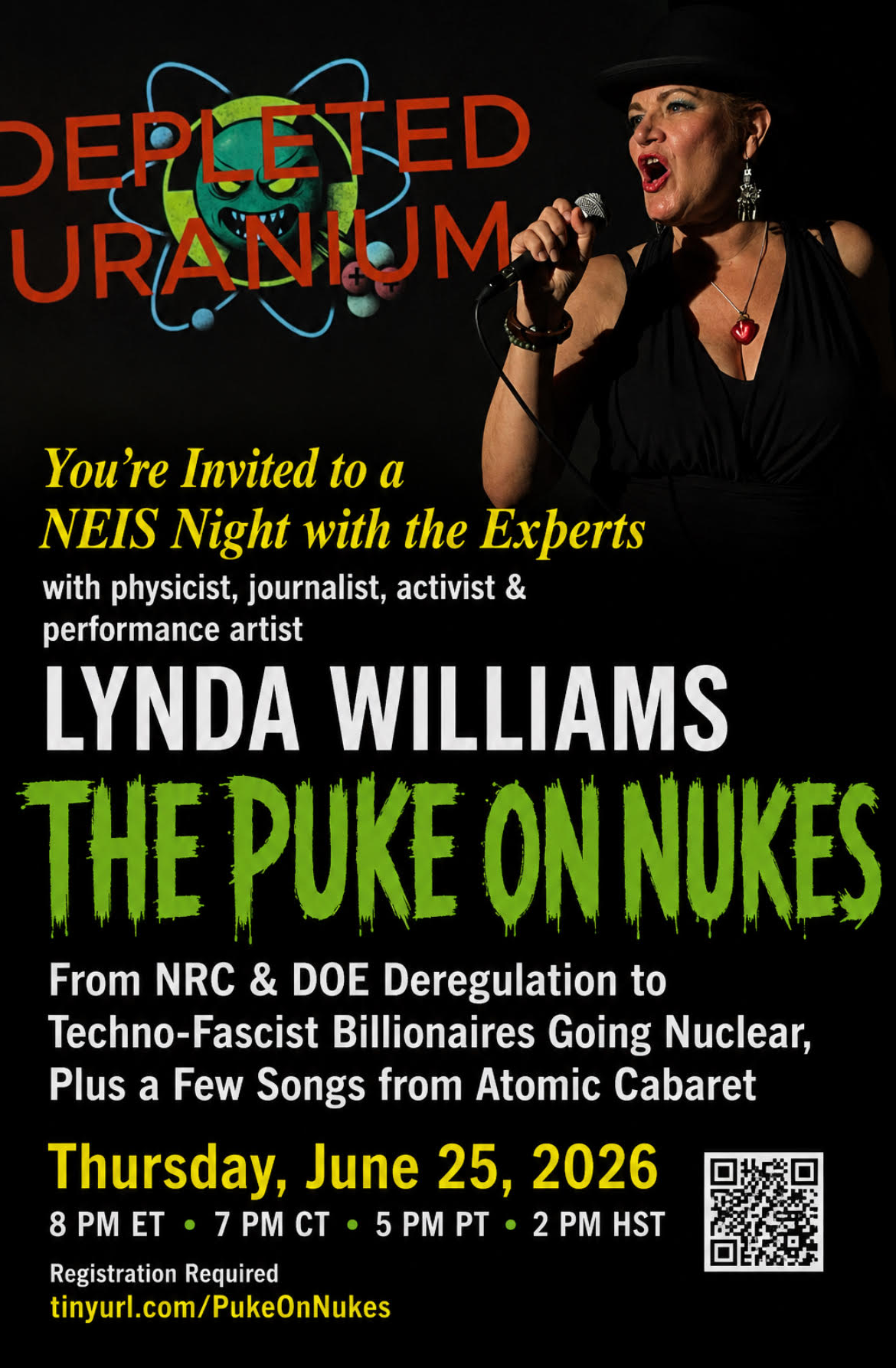
7pm Central Time (8pm ET, 6pm MT, 5pm PT) UTC – 5 From NRC & DOE Deregulation to Techno-Fascist Billionaires Going Nuclear, Plus a Few Songs from Atomic Cabaret REGISTER









 nuclear-news