California’s Climate Emergency, Rolling Stone, By Eric Holthaus, 8 Dec 17 Fires continue to burn Southern California, and climate scientists have warned us for years that the region was entering a year-round fire regime In the hills above the Pacific Ocean, the world crossed a terrifying tipping point this week.
As holiday music plays on the radio, temperatures in Southern California have soared into the 80s, and bone-dry winds have fanned a summer-like wildfire outbreak. Southern California is under siege.
As the largest of this week’s fires skipped across California’s famed coastal highway 101 toward the beach, rare snowflakes were falling in Houston, all made possible by a truly extreme weather pattern that’s locked the jet stream into a highly amplified state. It’s difficult to find the words to adequately describe how weird this is. It’s rare that the dissonance of climate change is this visceral.That one of California’s largest and most destructive wildfires is now burning largely out of control during what should be the peak of the state’s rainy season should shock us into lucidity. It’s December. This shouldn’t be happening.
The Thomas fire is the first wintertime megafire in California history. In a state known for its large fires, this one stands out. At 115,000 acres, it’s already bigger than the city of Atlanta. Hundreds of homes have already been destroyed, and the fire is still just 5 percent contained.
In its first several hours, the Thomas fire grew at a rate of one football field per second, expanding 30-fold, and engulfing entire neighborhoods in the dead of night. Hurricane force winds have produced harrowing conditions for firefighters. Faced with such impossible conditions, in some cases, all they could do is move people to safety, and stand and watch.
“We can’t control it,” firefighter and photographer Stuart Palley told me from a beach in Ventura. “In these situations, you can throw everything you’ve got at it, tanker planes dropping tens of thousands of gallons of flame retardant, thousands of firefighters, hundreds of engines, you can do everything man has in their mechanical toolbox to fight these fires and they’re just going to burn and do whatever the hell they want. We have to learn that.” As we spoke, another wall of flames crested a nearby ridge, reflecting its orange glow off the sea.
The Thomas fire isn’t the only one burning right now. At least six major fires threaten tens of thousands of homes and have forced hundreds of thousands of people to flee in recent days. “California fires enter the heart of Los Angeles” read one New York Timesheadline, a statement so dire it could double as a plot synopsis in a nearby Hollywood movie studio. Million-dollar mansions in Bel Air were evacuated, and the 405 freeway, one of L.A.’s busiest, was transformed into a dystopian hellscape during the morning commute. Ralph Terrazas, the Los Angeles fire chief, called the conditions the worst he’s seen in his entire 31-year career. “There will be no ability to fight fires in these kinds of winds,” said Ken Pimlott, the state fire chief. Shortly after these statements, state officials sent an unprecedented push notification to nearly everyone in Southern California, ominously warning millions of people to “stay alert.”
For years, climate scientists have warned us that California was entering a year-round fire regime. For years, climate campaigners have been wondering what it would take to get people to wake up to the urgency of cutting fossil fuel emissions. For years, we’ve been tip-toeing as a civilization towards a point of no return.
FT 8th Dec 2017, More than half of the coal-fired power stations in the EU are lossmaking
and almost all will be by 2030, according to a study that says the fossil
fuel faces a “death spiral” in Europe. Analysis of more than 600 power
plants by Carbon Tracker, the climate think-tank, estimates that £22bn of
losses could be avoided by phasing out coal in the EU by the end of the
next decade. The research comes ahead of a climate summit to be hosted by
French president Emmanuel Macron in Paris on Tuesday aimed at building on
the international agreement on emissions cuts struck in the same city two
years ago. https://www.ft.com/content/f32c3caa-daf3-11e7-a039-c64b1c09b482
EPA removes climate change references from website, report says (CNN) By Madison Park,
December 8, 2017 References to climate change and the Environmental Protection Agency’s use of renewable energy have been removed from several of its web pages, according to an analysis by the Environmental Data and Governance Initiative.
The group regularly monitors tens of thousands of federal environmental agency web pages to document what has been changed or scrubbed. It released a report Friday, noting changes to the website in the fall, including links to the EPA’s climate change adaptation plan and policy that have been removed.
This is not the first time references to climate change have been cut from its website.
CNN reported previously that the Trump administrationhas been swapping out the phrase “climate change,” while avoiding references to global warming. And in April, environmental groups were dismayed when climate change information was removed from the EPA site with a message that the page was being updated to “reflect the approach of new leadership.”
The Climate-Change Fight Returns to Paris Project Syndicate, LAURENCE TUBIANA
In 2015, the so-called “high ambition coalition” of developed and developing countries pushed the Paris climate agreement past the finish line. But when global leaders reconvene in Paris for new talks on climate change at the upcoming One Planet Summit, financial commitments must be the order of the day.
PARIS – Nearly two years have passed since France’s then-foreign minister, Laurent Fabius, struck his gavel and declared: “The Paris agreement for the climate is accepted.” Next week, President Emmanuel Macron and the French government will host world leaders and non-state actors for the One Planet Summit. The purpose of this gathering is to celebrate climate gains made since 2015, and to boost political and economic support for meeting the goals and targets of the Paris agreement………
the need for ambitious coalitions has returned. Strong global leadership on climate change scored a diplomatic victory two years ago, and today, new economic and political alliances are needed to turn those commitments into action.
The diplomatic success of the Paris accord is worthy of praise in its own right; it was a remarkable leap forward in the fight against climate change. But we must not rest on our laurels. With the United States, the world’s largest historical emitter of greenhouse gases, dismissive of the accord, the rest of the global community must reaffirm its commitment to reducing carbon dioxide emissions. Dramatic, meaningful, and immediate steps must be taken.
The best available science estimates that the world has only three years to begin a permanent reduction in greenhouse-gas emissions if there is to be any hope of achieving the Paris accord’s goal of keeping warming to “well below 2°C” relative to pre-industrial levels. And, whatever urgency science cannot convey is being communicated by the planet itself – through a ferocious display of hurricanes, floods, wildfires, and deadly droughts.
Given the immediacy of the challenge, what can and should be done to avert crisis?
Some of Trump’s tweets generate more national coverage than devastating disasters. As the weather gets worse, we need journalism to get better,
Which story did you hear more about this year – how climate change makes disasters like hurricanes worse, or how Donald Trump threw paper towels at Puerto Ricans?
If you answered the latter, you have plenty of company. Academic Jennifer Good analyzed two weeks of hurricane coverage during the height of hurricane season on eight major TV networks, and found that about 60% of the stories included the word Trump, and only about 5% mentioned climate change.
Trump doesn’t just suck the oxygen out of the room; he sucks the carbon dioxide out of the national dialogue. Even in a year when we’ve had string of hurricanes, heatwaves, and wildfires worthy of the Book of Revelation – just what climate scientists have told us to expect – the effect of climate change on extreme weather has been dramatically undercovered. Some of Trump’s tweets generate more national coverage than devastating disasters.
Good’s analysis lines up with research done by my organization, Media Matters for America, which found that TV news outlets gave far too little coverage to the well–documentedlinks between climate change and hurricanes. ABC and NBC both completely failed to bring up climate change during their news coverage of Harvey, a storm that caused the heaviest rainfall ever recorded in the continental US. When Irma hit soon after, breaking the record for hurricane intensity, ABC didn’t do much better.
Coverage was even worse of Hurricane Maria, the third hurricane to make landfall in the US this year. Not only did media outlets largely fail to cover the climate connection; in many cases, they largely failed to cover the hurricane itself.
The weekend after Maria slammed into Puerto Rico, the five major Sunday political talkshows devoted less than one minute in total to the storm and the humanitarian emergency it triggered. And Maria got only about a third as many mentions in major print and online media outlets as did Harvey and Irma, researchers at the MIT Media Lab found.
When Trump visited Puerto Rico on 3 October, almost two weeks after Maria assailed the island, he got wall-to-wall coverage as journalists reported on his paper-towel toss and other egregious missteps. But after that trip, prime-time cable news coverage of Puerto Rico’s recovery plummeted, Media Matters found, even though many residents to this day suffer from electricity outages and a lack of clean water, a dire situation that deserves serious and sustained coverage.
Scientists have been telling us that climate change will make hurricanes more intense and dangerous, an unfortunate reality made all too clear by this year’s record-busting hurricane season. “These are precisely the sort of things we expect to happen as we continue to warm the planet,” climate scientist Michael Mann, a distinguished professor of atmospheric science at Penn State, told Huffington Post.
But while nearly three-quarters of Americans know that most scientists are in agreement that climate change is happening, according to recent poll, only 42% of Americans believe climate change will pose a serious threat to them during their lifetimes. Too many still believe – wrongly – that climate disasters are just something that will happen in the future. They are happening now.
In the first nine months of 2017, the US was assailed by 15 weather and climate disasters that each did more than a billion dollars in damage – in the case of the hurricanes, much more. The combined economic hit from Harvey, Irma and Maria could end up being $200bn or more, according to Moody’s Analytics. And then in October, unprecedented wildfires in northern California did an estimated $3bn in damage.
But an extreme weather event is a moment when people can see and feel climate change – and if they’re unlucky, get seriously hurt by it. When those disasters happen, media outlets need to cover them as climate change stories. And when a number of them happen in quick succession, as they did this year, the media have an even greater responsibility to report the big-picture story about climate change and help the public understand the immediacy of the threat.
If we are to fend off the worst possible outcomes of climate change, we need to shift as quickly as possible to a cleaner energy system. We could expect more Americans to get on board with that solution if they more fully understood the problem – and that’s where the critical role of the media comes in. As the weather gets worse, we need our journalism to get better.
Lisa Hymas is the climate and energy program director at Media Matters
The climate models that predict the most warming over the next century were the best at predicting climate change over the past decade. Avery Thompson, Dec 8, 2017
It’s hard to predict the exact effects of climate change over the course of a few decades. Even while broad trends appear, the litany complex interactions between the air, the water, polar ice, land masses, and so on, make exact predictions elusive. To deal with this problem, scientists develop models that simulate a few of these elements at one time and see which models are the most accurate.
This variety of climate models is the reason long-term predictions tend to be all over the place, with some models predicting only a few degrees of warming while other models predict a lot more. While some people have been pointing to the more milder predictions as evidence that climate change might not be that bad, there is some bad news. A team of researchers from the Carnegie Institution for Science has found that the most accurate models so far also tend to be the most severe ones.
The new study, published in Nature, compared more than a decade’s worth of data from climate satellites to a wide range of different climate models. This data included the amount of sunlight reflected back into space, how much heat is leaving the Earth, and how much total energy is entering and leaving the atmosphere. Scientists then analyzed various climate models for that period to see which ones came closest to predicting reality.
The researchers found that the most accurate models were the ones that predicted the most warming over the next century. This means that rather than see only a few degrees of warming—as predicted by some of the milder models—we’re much more likely to see almost twice that.
According to the paper, there’s a good chance we could see 5 degrees C of warming by 2100, and a 95 percent chance of more than 4 degrees of warming, assuming we do nothing to stop it. The goal set by the Paris agreement in 2015—to keep warming below 2 degrees C by the end of the century—is looking increasingly impossible. Source: MIT Technology Review
New York City’s watchdog sets her sights on climate change, Grist, By Justine Calmaon Dec 7, 2017As New York City’s public advocate, Letitia James is first in line to succeed Mayor Bill de Blasio. The first woman of color to be elected to hold citywide office in the Big Apple, she investigates complaints against city agencies and introduces legislation in the city council. Effectively, she’s the city’s official watchdog. And she recently set her sights on climate change, which she regards as an imminent threat to New Yorkers.
Last week, James held a public hearing to discuss what she called “the catastrophic consequences” of a warming planet. New Yorkers hoping the city would take the lead on climate-related matters — at a time when the federal government has all but abdicated responsibility — gathered at the Borough of Manhattan Community College in Tribeca, a neighborhood that James pointed out would be completely underwater by 2200 — if the world continues warming at its current rate.
Climate change already costs us all money, and it’s going to get worse https://arstechnica.com/science/2017/12/weve-all-managed-to-end-up-paying-the-costs-of-climate-change/ When it comes to floods and wildfires, the damage is shared with the public.JOHN TIMMER – Tuesday evening, Columbia University’s Earth Institute hosted a panel that was meant to focus on an issue we’re likely to be facing with increasing frequency: the need to move entire communities that are no longer viable due to rising seas or altered weather. But the discussion ended up shifting to how people in at-risk locations aren’t moving, and the entire governmental structure in the US is focused on keeping them right where they are.As a result, the entire US population is already paying for climate change, whether we accept the science behind it or not. And things will almost certainly get worse.
Staying put
That’s not to say that climate-driven migrations aren’t an issue. They’ve happened in a number of countries, and the panel noted that China, in particular, has been fairly aggressive about moving communities that the government feels cost too much to support. It’s also happening a bit in the US with coastal villages in Alaska and Louisiana. But the wildfires on the edge of urban areas in California provided the panel with a perfect backdrop: climate risks in areas we’re not just going to walk away from.
here was also the perfect panelist for this: Lisa Dale has tracked climate-related issues in the Western US. She said a number of trends are colliding out west. One of these is the warming and drying climate, which has led to a hotter fire season and produced fires that reach higher temperatures. As a result, the amount of the US Forest Service budget that goes toward firefighting has more than tripled from 16 percent to half the agency’s budget. That drains its ability to take preventative actions on fire risks, even as many western states are seeing development on lands that border wilderness managed by the federal government.
Despite all that (and the steady flow of images of destroyed homes), development isn’t slowing down, and people who are living on the wildland-urban interface aren’t thinking of leaving. Dale said that surveys of people who had actually lost their homes to fire indicated that more than 90 percent preferred to rebuild.
Michael Gerrard said the responses to increasing flood risks aren’t much different. Climate change is enhancing these through rising ocean levels, changing patterns of rainfall, and increased intensity of storms. But the Federal Emergency Management Agency, which handles this issue, only evaluates flood risks based on historical events, even though climate change is altering those risks. Gerrard also called the results of FEMA’s evaluations “perverse,” since declaring an area high-risk allows its residents to obtain federally subsidized flood insurance, in effect “subsidizing continued development in high-risk areas.”
A few years back, the government actually considered bringing the insurance costs up to something closer to market rates. But a huge outcry from those living in these areas caused Congress to back down, leaving this subsidy in place. And, as panel member Alex de Sherbininnoted, FEMA does not have the ability to do anything other than offer post-disaster response.
No change in sight
Overall, the panel saw little hope of the market or government shifting matters so that our housing better reflected changing risks—”markets haven’t yet processed what’s inevitable,” as moderator Radley Horton put it. Mortgages “are a barrier to property prices reflecting reality,” Gerrard argued. Local governments don’t want to deal with relocating anyone out of harm’s way because it means they’ll lose tax revenue. And the federal government has generally acted to block restrictions on land use.
Which means that we’re going to be stuck paying these costs for the indefinite future. Dale said that there had been some successes when it came to fire risks. Private insurance companies have brought rates up to match risks and compelled owners to take measures like clearing underbrush, while local communities have rolled out fire-education programs.
But flood risks have proven much harder. There have been a few relocation programs, but Gerrard called them “very few and very expensive.” Yet, unlike the erratic danger of wildfires, the rising oceans can’t really be handled in a way that minimizes risk. Horton said that it’s estimated that about two million US residents will need to be relocated before the century’s out due to rising oceans, and, if that rise accelerates faster than we expect, we could be looking at situations like the complete loss of far-southern Florida.
At that point, the societal costs for our policy decisions get quite a bit larger.
The US Global Change Research Program recently released a Climate Science Special Report. It is clearly written – an authoritative summary of the science, and easy to understand.
The first main chapter deals with changes to the climate and focuses much attention on global temperatures. When most people think of climate change, they think of the global temperature – specifically the temperature of the air a few meters above the Earth surface. There are other (better) ways to measure climate change such as heat absorbed by the oceans, melting ice, sea level rise, or others. But the iconic measurement most people think of are these air temperatures, shown in the top frame of the figure below. [on original] ……..https://www.skepticalscience.com/report-steady-persistent-gw.html
Why remote Antarctica is so important in a warming world The Conversation.Chris Fogwill, Professor of Glaciology and Palaeoclimatology, Keele University, Chris Turney, Professor of Earth Sciences and Climate Change, UNSW, Zoe Robinson, Reader in Physical Geography and Sustainability/Director of Education for Sustainability, Keele University
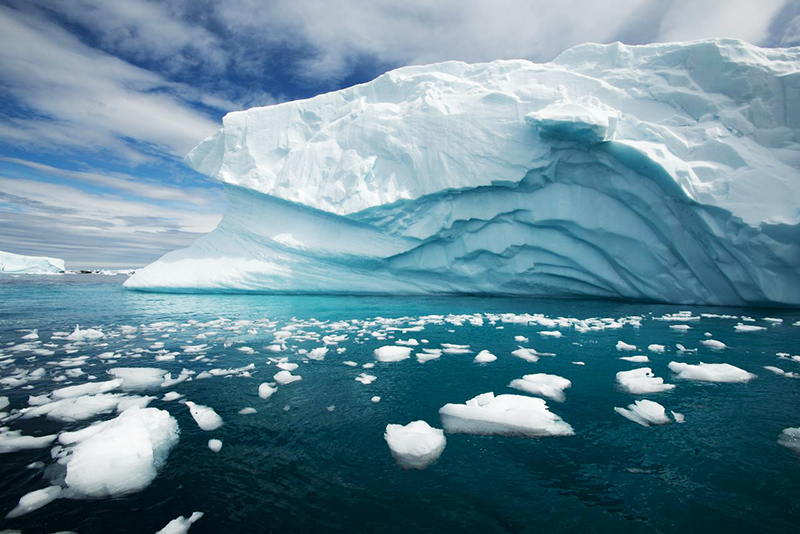
“……..What was once thought to be a largely unchanging mass of snow and ice is anything but. Antarctica holds a staggering amount of water. The three ice sheets that cover the continent contain around 70% of our planet’s fresh water, all of which we now know to be vulnerable to warming air and oceans. If all the ice sheets were to melt, Antarctica would raise global sea levels by at least 56m.
Where, when, and how quickly they might melt is a major focus of research. No one is suggesting all the ice sheets will melt over the next century but, given their size, even small losses could have global repercussions. Possible scenarios are deeply concerning: in addition to rising sea levels, meltwater would slow down the world’s ocean circulation, while shifting wind belts may affect the climate in the southern hemisphere.
In 2014, NASA reported that several major Antarctic ice streams, which hold enough water to trigger the equivalent of a one-and-a-half metre sea level rise, are now irreversibly in retreat. With more than 150m people exposed to the threat of sea level rise and sea levels now rising at a faster rate globally than any time in the past 3,000 years, these are sobering statistics for island nations and coastal cities worldwide.
An immediate and acute threat
Recent storm surges following hurricanes have demonstrated that rising sea levels are a future threat for densely populated regions such as Florida and New York. Meanwhile the threat for low-lying islands in areas such as the Pacific is immediate and acute.
Multiple factors mean that the vulnerability to global sea level rise is geographically variable and unequal, while there are also regional differences in the extremity of sea level rise itself. At present, the consensus of the IPPC 2013 report suggests a rise of between 40 and 80cm over the next century, with Antarctica only contributing around 5cm of this. Recent projections, however, suggest that Antarctic contributions may be up to ten times higher.Studies also suggest that in a world 1.5-2°C warmer than today we will be locked into millennia of irreversible sea level rise, due to the slow response time of the Antarctic ice sheets to atmospheric and ocean warming.
We may already be living in such a world. Recent evidence shows global temperatures are close to 1.5°C warmer than pre-industrial times and, after the COP23 meeting in Bonn in November, it is apparent that keeping temperature rise within 2°C is unlikely.
So we now need to reconsider future sea level projections given the potential global impact from Antarctica. Given that 93% of the heat from anthropogenic global warming has gone into the ocean, and these warming ocean waters are now meeting the floating margins of the Antarctic ice sheet, the potential for rapid ice sheet melt in a 2°C world is high.In polar regions, surface temperatures are projected to rise twice as fast as the global average, due to a phenomenon known as polar amplification. However, there is still hope to avoid this sword of Damocles, as studies suggest that a major reduction in greenhouse gases over the next decade would mean that irreversible sea level rise could be avoided. It is therefore crucial to reduce CO₂ levels now for the benefit of future generations, or adapt to a world in which more of our shorelines are significantly redrawn.
This is both a scientific and societal issue. We have choices: technological innovations are providing new ways to reduce CO₂ emissions, and offer the reality of a low-carbon future. This may help minimise sea level rise from Antarctica and make mitigation a viable possibility.
UNFROZEN IN TIME, Huffington Post, Video and Pictures: Tom Compagnoni | Words: Josh Butler, 1 December 17There’s a glacier in Antarctica so immense that, if it melted, would raise sea levels globally by 3.5 metres.
It’s melting. Right now.
“The facts around climate change are undeniable. It’s happening,” Australian glaciologist Ben Galton-Fenzi told The Huffington Post Australia. “The research we do now isn’t about trying to convince ourselves it’s real, because it’s irrefutable. What we’re trying to do is understand what the response time of the system is going to be into the future, so we can adapt to it.”
The Totten glacier is the biggest in east Antarctica. The glacier itself is around 120 kilometres long, 30 kilometres wide and drains some 538,000 square kilometres of the continent. That’s an area bigger than California. The ice is kilometres thick, but it’s melting at 70 metres a year in some spots. A study released in December reported warmer water was melting the Totten ice from below.
Galton-Fenzi and his small team will spend the next few months trying to work out exactly how fast the glacier is melting, gathering data to build better models to predict melt rates and how that will affect sea levels.
“The majority of the heat that has gone into the global climate system has gone into the ocean, about 90 percent over the last few decades of measurements,” he said. “The hypothesis is ocean temperatures around Antarctica will keep warming and drive the melting of the glaciers. If the glaciers flow faster, sea levels will rise, and that has profound implications for global civilisation.”……..“Climate change is a reality. There’s the whole debate around how we deal with it, and the work we do in Antarctica is influencing our ability to look forward and genuinely understand how much things are going to change,” Australian Antarctic Division director, Dr Nick Gales told HuffPost Australia from Hobart, the base of operations for the AAD.
“It is alarming. There is huge change going on there. The more we learn, the more we see change happening at rates faster than we predicted. It’s fundamentally important to support the science, communicate the science really well, and make sure the policy makers are aware of the science so they can take account of that in forming mitigation and adaptation strategies around the world.”
The AAD is the government body that administers Australian operations in Antarctica, from delivering workers and equipment to the continent, to selecting the research applications to be undertaken each season, to making sure the kitchen at Casey is well stocked with chocolate.
“When we started doing science in Antarctica, it was important and interesting because we were learning about things we simply didn’t know about.”
“Nowadays, the science is really critically important to what we do in the future.”
It’s critical to our wellbeing and our ability to understand what’s coming, and adapt and mitigate the effects. What about the droughts? Are they going to become more regular? What will happen to our low-lying areas and Pacific islands in relation to sea level rise? The science we do is critical for informing that.”This season, the AAD will support almost 100 projects in Antarctica and the Southern Ocean. More than 500 expeditioners will make their way down each year for major “season-defining” projects such as Galton-Fenzi’s Totten glacier work, and smaller-scale operations. Gales said around two-thirds of the Australian-led research in Antarctica is related to climate science.
It is a continent almost entirely covered by ice, the largest ice sheet in the world and the planet’s largest single reserve of fresh water. It’s almost entirely untouched by humans, uninhabited but for the research teams (and a whole lot of amazing animal life, as we soon discovered); a continent literally devoted to science.
The 1959 Antarctic treaty, signed by the 12 countries which had been active in Antarctica — Argentina, Australia, Belgium, Chile, France, Japan, New Zealand, Norway, Russia, South Africa, the United Kingdom and United States — agreed to set aside territorial claims and enshrine the continent as a place for peace, science and international collaboration. Scientists work together, sharing resources, manpower and findings, for the good of humanity under this treaty, which states:
– Antarctica shall be used for peaceful purposes only (Art. I)
– Freedom of scientific investigation in Antarctica and cooperation toward that end … shall continue (Art. II).
– Scientific observations and results from Antarctica shall be exchanged and made freely available (Art. III).
“It’s unique. It’s extraordinary that, in a place like that, the world can agree to set aside differences and focus on those really important issues,” Gales said………
Johnstone and Black are cutting through the frozen sea ice for experiments on ocean acidification. As the Earth continues to emit carbon dioxide, the oceans soak up a large percentage of that extra CO2; around 30 percent, Black said.
Rob King, an AAD biologist based in Hobart, said around eight billion tonnes of CO2 is going into oceans each year.
“It increases the acidity of the ocean and lowers the pH. The global ocean average is about 8.2pH, and we’re expecting by the year 2100 with the current emissions scenarios we have, the pH will drop to 7.8,” Black said.
That’s a massive change for the ocean, with the water becoming far more acidic. That’s bad news for many tiny organisms and plankton that make up the bottom of the oceanic food chain, upon which larger creatures like penguins, fish, dolphins, seals, sharks and whales depend. Black and Johnstone have planted tiny chambers on the ocean floor to simulate how the water and the organisms will react to more acidic waters. They will also collect water and loads of these tiny organisms for experiments in the lab.
“As we acidify the water, anything with a calcium carbonate structure in its shell, like shellfish, pteropods and other organisms, will actually have trouble forming that shell and maintaining it,” Black said.
“When we look at the relative biomass of different organisms, we get about 600 million tonnes of phytoplankton down here. That’s the most biomass of any organism in the Southern Ocean. While they seem small and insignificant, they are the most important part of the ecosystem. Any change in that under climate change conditions will have flow on effects up the food chain.”……….
“Under the sea ice you’ve got a really stable environment. It’s always the same temperature, even though it’s a really harsh temperature of minus 1.85C all year, but it doesn’t vary much so they only have to adapt to one temperature,” the marine biologist said.’
“There’s very little current under here, because for 10 months of the year, there’s a covering of sea ice. They don’t have to deal with big tidal currents or waves or storms or wind action, or temperature changes. The conditions are relatively stable through the year.”
The word ‘frozen’ is often used to denote something which has stopped; static, not moving. It is synonymous with lifelessness, death, a barren wasteland. Antarctica is a frozen continent, but it is by no means dead. It grows and shrinks like a living organism. With the yearly melt and refreeze, as the continent effectively doubles in size during the winter as sea water becomes ice, it is arguably the most alive continent on Earth. The life that exists down here — human, animal and plant alike — is some of the hardiest, most resilient on the planet. It’s an entire continent devoted to peace and science, to work for the betterment of the entire planet.
Communities in Texas, Florida, other coastal states at risk
Credit rating agency says it’s adding climate to credit risks
Coastal communities from Maine to California have been put on notice from one of the top credit rating agencies: Start preparing for climate change or risk losing access to cheap credit.
In a report to its clients Tuesday, Moody’s Investors Service Inc. explained how it incorporates climate change into its credit ratings for state and local bonds. If cities and states don’t deal with risks from surging seas or intense storms, they are at greater risk of default.
“What we want people to realize is: If you’re exposed, we know that. We’re going to ask questions about what you’re doing to mitigate that exposure,” Lenny Jones, a managing director at Moody’s, said in a phone interview. “That’s taken into your credit ratings.”
In its report, Moody’s lists six indicators it uses “to assess the exposure and overall susceptibility of U.S. states to the physical effects of climate change.” They include the share of economic activity that comes from coastal areas, hurricane and extreme-weather damage as a share of the economy, and the share of homes in a flood plain.
Study Discovers Why Global Warming Will Accelerate As CO2 Levels Rise, http://www.enn.com/pollution/article/53315From: The University of Reading November 29, 2017 The findings are supported by observations, suggesting that forecasts made by climate models evaluated by the Intergovernmental Panel on Climate Change are realistic.
Paulo Ceppi, researcher at the University of Reading and lead author of the study, said: “This resemblance of computer simulations to observations increases our confidence in projections that the climate sensitivity to the progressive rise in carbon dioxide concentrations will increase over time into the future.”
Evidence suggests that the upper level of the Earth’s atmosphere warms faster than the surface in response to CO? levels. However, the new study shows that as CO? levels increase further, the rate of warming in the upper levels slows in comparison with that closer to the Earth’s surface.
Analysis: How could the Agung volcano in Bali affect global temperatures? Carbon Brief, ZEKE HAUSFATHER 25.10.2017While human activity has been the dominant driver of climate change over the past century, natural factors can influence short-term variations in global temperature.
Major volcanic eruptions, in particular, can have a sizable cooling impact on the climate lasting for five years or so.
The Mount Agung volcano in Bali, Indonesia has been showing signs that an eruption is likely to occur this year. Last time Agung erupted, back in 1963, it had a noticeable cooling effect on the Earth’s climate.
Here, Carbon Brief examines how volcanoes influence the climate, and suggests that a new Agung eruption would likely only result in a modest and temporary cooling of global temperatures.
Volcanoes and climate changeVolcanoes generally have a cooling influence on the Earth’s surface.Eruptions send a cloud of ash and dust high into the atmosphere. The sulphur dioxidereleased combines with water to form sulfuric acid aerosols, which reflect incoming sunlight and influence cloud formation. When eruptions are powerful enough to reach the stratosphere (18 km or more above the surface at the equator), these sulphate aerosols can stay aloft for a number of years and have a strong cooling effect on the climate.
Volcanic eruptions also release CO2 into the atmosphere, meaning they contribute to warming by strengthening the greenhouse effect. But this influence is very small, and is outweighed by the cooling impact of the dust and ash.
The location of volcanoes also matter. Major volcanic eruptions near the equator are more likely to have a big effect on global temperatures, while high-latitude eruptions (like Laki) will have their effects more limited to the one hemisphere. Sulphate aerosols from high-latitude volcanoes generally will not cross the equator, while tropical volcanoes tend to cool both hemispheres………
This projection, which is based on the historical relationship between volcanic eruptions and temperature, suggests that an Agung eruption would reduce global temperatures between 0.1C to 0.2C in period from 2018 to 2020, with temperatures mostly recovering back to where they otherwise would be by 2023.
There is no guarantee that an eruption of Agung today would be the same size as the one in 1963, however. A small volcanic eruption that doesn’t reach the stratosphere would have a relatively minor climate impact, as sulphur dioxide from the volcano would quickly fall out of the atmosphere.
On the flip side, we have records of much larger volcanic eruptions, such as Tambora in 1815 that may have cooled the globe by 0.6C or more and led to the “year without a summer”. Even in large eruptions this cooling only lasts a few years, however, as once sulphate aerosols eventually fall back to earth the climate quickly returns to normal.
This projection, which is based on the historical relationship between volcanic eruptions and temperature, suggests that an Agung eruption would reduce global temperatures between 0.1C to 0.2C in period from 2018 to 2020, with temperatures mostly recovering back to where they otherwise would be by 2023.
There is no guarantee that an eruption of Agung today would be the same size as the one in 1963, however. A small volcanic eruption that doesn’t reach the stratosphere would have a relatively minor climate impact, as sulphur dioxide from the volcano would quickly fall out of the atmosphere.
We call it the tomb,” says Christina Aningi, the head teacher of Enewetak’s only school.
“The children understand that we have a poison in our island.” It’s “Manit Day” on Enewetak Atoll, a celebration of Marshall Islands culture when the Pacific nation’s troubled past seems a distant memory. Schoolchildren sit cross-legged on the coral sands as they sing of the islands and atolls, the sunshine and the breeze; “flowers and moonlight, swaying palm trees”.
They were born decades after the last nuclear explosion ripped through the warm Pacific air with a thunderous roar. But it’s hard to escape the long echo of the bombs.
“Gone are the days when we live in fear, fear of the bombs, guns and nuclear,” they sing.
“This is the time … this is my country, this is my land.”
But those old fears, thought to be long buried, are threatening to reawaken in their island paradise.
In the late 1970s, Runit Island, on the remote Enewetak Atoll, was the scene of the largest nuclear clean-up in United States history. Highly contaminated debris left over from dozens of atomic weapons tests was dumped into a 100-metre wide bomb crater on the tip of the uninhabited island. US Army engineers sealed it up with a half-metre thick concrete cap almost the size of an Australian football ground, then left the island.
Now with sea levels rising, water has begun to penetrate the dome.
A report commissioned by the US Department of Energy in 2013 found that radioactive materials were leeching out, threatening the already tenuous existence of Enewetak locals.
“That dome is the connection between the nuclear age and the climate change age,” says Marshall Islands climate change activist Alson Kelen.
“It’ll be a very devastating event if it really leaks. We’re not just talking the Marshall Islands, we’re talking the whole Pacific.”
The United States detonated 43 atomic bombs around the island chain in the 1940s and 50s.
Four of Enewetak’s 40 islands were completely vaporised by the tests, with one thermonuclear blast leaving a two-kilometre-wide crater where an island had been just moments before.
Enewetak’s population had been re-located to another island in the Marshalls ahead of the tests. Residents would only be allowed to return home more than three decades later — some on the island today can still recall returning to Enewetak as children.
As part of the clean-up process, Washington set aside funds to build the dome as a temporary storage facility, and initial plans included lining the porous bottom of its crater with concrete.
But in the end, that was deemed too expensive.
“The bottom of the dome is just what was left behind by the nuclear weapons explosion,” says Michael Gerrard, the chair of Columbia University’s Earth Institute in New York.
“It’s permeable soil. There was no effort to line it. And therefore, the seawater is inside the dome.” ocals rarely set foot on Runit Island. They’re fearful of the lingering radiation from the dome and because it’s been ruled off-limits.
To this day, only three islands along Enewetak Atoll’s slender rim are considered safe enough for human habitation. “[The other islands were] too hot, too radioactive to worry about,” says Giff Johnson, publisher of the Marshall Islands Journal, the country’s only newspaper.
“There was no point [cleaning them up].”
After the fall-out from the atomic testing, life for the people of Enewetak went from a traditional existence of fishing and subsistence living to one where the waters that once supported their livelihoods were now polluted.
On the main island, where most of the atoll’s few hundred people now live, concerns about the radioactive contamination of the food chain has seen a shift away from a traditional diet of fish and coconut.
The US Department of Energy has even banned exports of fish and copra from Enewetak because of the ongoing contamination.
The vast bulk of foodstuffs are now brought into the island by barge, and that means islanders are reliant on imported canned and processed goods like Spam that have triggered health problems such as diabetes. The shelves of Enewetak’s only store are largely filled with American brand chocolate bars, lollies and potato chips.
Locals sometimes visit Runit to scavenge from scrap copper left behind by the Americans, selling it for a few dollars to a Chinese merchant.
For 30 years, Jack Niedenthal has helped the people of neighbouring Bikini Atoll fight for compensation for the 23 atomic tests conducted there. “To me, it’s like this big monument to America’s giant f–k up,” says Niedenthal. “This could cause some really big problems for the rest of mankind if all that goes underwater, because it’s plutonium and cement.”
Some of the debris buried beneath the dome includes plutonium-239, a fissile isotope used in nuclear warheads which is one of the most toxic substances on earth.
It has a radioactive half-life of 24,100 years.
Cracks are visible in the dome’s surface and brackish liquid pools around its rim.“Already the sea sometimes washes over [the dome] in a large storm,” says Columbia University’s Michael Gerrard. “The United States Government has acknowledged that a major typhoon could break it apart and cause all of the radiation in it to disperse.”
While Professor Gerrard would like the US to reinforce the dome, a 2014 US Government report says a catastrophic failure of the structure would not necessarily lead to a change in the contamination levels in the waters surrounding it.
“I’m persuaded that the radiation outside the dome is as bad as the radiation inside the dome,” says Professor Gerrard.“And therefore, it is a tragic irony that the US Government may be right, that if this material were to be released that the already bad state of the environment around there wouldn’t get that much worse.”
But that is cold comfort to the people of Enewetak, who fear they may have to be relocated once again if the dome collapses or crumbles.
“If it does [crack] open most of the people here will be no more,” says Ms Aningi.
“This is like a graveyard for us, waiting for it to happen.”