Record warming in the Arctic
 Arctic warming: scientists alarmed by ‘crazy’ temperature rises, Guardian, Jonathan Watts, 28 Feb 18, Record warmth in the Arctic this month could yet prove to be a freak occurrence, but experts warn the warming event is unprecedented
An alarming heatwave in the sunless winter Arctic is causing blizzards in Europe and forcing scientists to reconsider even their most pessimistic forecasts of climate change.
Although it could yet prove to be a freak event, the primary concern is that global warming is eroding the polar vortex, the powerful winds that once insulated the frozen north.
The north pole gets no sunlight until March, but an influx of warm air has pushed temperatures in Siberia up by as much as 35C above historical averages this month. Greenland has already experienced 61 hours above freezing in 2018 – more than three times as many hours as in any previous year.
Seasoned observers have described what is happening as “crazy,” “weird,” and “simply shocking”.
“This is an anomaly among anomalies. It is far enough outside the historical range that it is worrying – it is a suggestion that there are further surprises in store as we continue to poke the angry beast that is our climate,” said Michael Mann, director of the Earth System Science Center at Pennsylvania State University. “The Arctic has always been regarded as a bellwether because of the vicious circle that amplify human-caused warming in that particular region. And it is sending out a clear warning.”
Although most of the media headlines in recent days have focused on Europe’s unusually cold weather in a jolly tone, the concern is that this is not so much a reassuring return to winters as normal, but rather a displacement of what ought to be happening farther north.
At the world’s most northerly land weather station – Cape Morris Jesup at the northern tip of Greenland – recent temperatures have been, at times, warmer than London and Zurich, which are thousands of miles to the south. Although the recent peak of 6.1C on Sunday was not quite a record, but on the previous two occasions (2011 and 2017) the highs lasted just a few hours before returning closer to the historical average. Last week there were 10 days above freezing for at least part of the day at this weather station, just 440 miles from the north pole.
“Spikes in temperature are part of the normal weather patterns – what has been unusual about this event is that it has persisted for so long and that it has been so warm,” said Ruth Mottram of the Danish Meteorological Institute. “Going back to the late 1950s at least we have never seen such high temperatures in the high Arctic.”
The cause and significance of this sharp uptick are now under scrutiny. Temperatures often fluctuate in the Arctic due to the strength or weakness of the polar vortex, the circle of winds – including the jetstream – that help to deflect warmer air masses and keep the region cool. As this natural force field fluctuates, there have been many previous temperature spikes, which make historical charts of Arctic winter weather resemble an electrocardiogram.
But the heat peaks are becoming more frequent and lasting longer – never more so than this year. “In 50 years of Arctic reconstructions, the current warming event is both the most intense and one of the longest-lived warming events ever observed during winter,” said Robert Rohde, lead scientist of Berkeley Earth, a non-profit organisation dedicated to climate science.
The question now is whether this signals a weakening or collapse of the polar vortex, the circle of strong winds that keep the Arctic cold by deflecting other air masses. The vortex depends on the temperature difference between the Arctic and mid-latitudes, but that gap is shrinking because the pole is warming faster than anywhere on Earth. While average temperatures have increased by about 1C, the warming at the pole – closer to 3C – is melting the ice mass. According to Nasa, Arctic sea ice is now declining at a rate of 13.2% per decade, leaving more open water and higher temperatures.
……… “This is too short-term an excursion to say whether or not it changes the overall projections for Arctic warming,” says Mann. “But it suggests that we may be underestimating the tendency for short-term extreme warming events in the Arctic. And those initial warming events can trigger even greater warming because of the ‘feedback loops’ associated with the melting of ice and the potential release of methane (a very strong greenhouse gas).”https://www.theguardian.com/environment/2018/feb/27/arctic-warming-scientists-alarmed-by-crazy-temperature-rises
Climate change’s great threat to global health
 Impact of climate change on health is ‘the major threat of 21st century’ Skeptical Science [good graphs], 26 February 2018 This is a re-post from Carbon Brief by Daisy Dunne
The health of millions of people across the world is already being significantly harmed by climate change, a major new report finds.
From driving up the number of people exposed to heatwaves to increasing the risk of infectious diseases, such as dengue fever, climate change has had far-reaching effects on many aspects of human health in last few decades, the authors say.
In fact, the effect of climate change on human health is now so severe that it should be considered “the major threat of the 21st century”, scientists said at a press briefing held in London.
The report is the first from the Lancet Countdown on Health and Climate Change, a project involving 24 academic institutions and intergovernmental organisations from across the world. The project plans to release a report tracking progress on climate change and global health every year.
Feeling the heat
The report uses a set of 40 indicators to track the effects of climate change on global health. The first of these indicators assesses the “direct impacts” of climate change on human health, including the effects of exposure to extreme heat and natural disasters.
One of the report’s findings is that, from 2000 to 2016, the rise in the average temperatures that humans were exposed to was around three times higher than the rise of average global temperatures worldwide….
he average temperatures that humans are exposed to are significantly higher than the global surface average because most people live on land, where warming happens most quickly, explains Prof Peter Cox, an author of the new report and a climate scientist at the University of Exeter. He tells Carbon Brief:
“Generally speaking, when you look at where people are, the rate of change appears much larger than when we look at global averages. So maybe when we think about global targets, we should be always bearing in mind that the global mean temperature doesn’t really mean much to most people. We don’t live on the ocean, which is two-thirds of the global mean. We live on the land, and on the land that tends to warm fastest.”
The report also finds the number of “vulnerable” people exposed to “heatwave” events increased by around 125 million between 2000 and 2016. “Vulnerable” is here defined as being over the age of 65, while a “heatwave” is defined as three consecutive nights where temperatures are in the top 1% of the 1986-2006 average for the region.
In 2015, a record 175 million more people were exposed to heatwaves, when compared to the average for 1986-2008, the report finds
These spikes in exposure are a result of an increase in heatwave events, as well as other environmental and social factors, including population growth, Cox says.
Heatwave exposure has previously been linked to an increased risk of premature death in many parts of the world, he explains:
“During the 2003 European heatwave, there were 75,000 extra premature deaths in Europe, including 2,000 in the UK. That was mainly because of people not being able to recover, and I guess breathing gets harder when it’s hot too. There is a correlation between these periods of hot nights and mortality. I suspect there must be a correlation with ill health as well.”
Natural disasters
The report finds that the number of weather-related disasters from 2007 to 2016 increased by 46%, when compared with the average for 1990-1999.
Asia is the continent most affected by weather-related disasters, the report says – particularly because of its size and population. Between 1990 and 2016, 2,843 weather-related disasters were recorded in Asia, affecting 4.8 billion people and causing more than 500,000 deaths……..
Losses to the global workforce
Another set of indicators explored by the report look at the “human-mediated” impacts of climate change. These are impacts that are intrinsically linked to human society, but often exacerbated by climate change.
The first of these indicators explores how climate change has affected the productivity of the global workforce, particularly in the less economically-developed parts of the world. The report finds that the global productivity in rural labour capacity – defined as those who work in outdoor manual labour in rural areas, but excluding agricultural workers – has fallen by 5.3% from 2000 to 2016……….
Infectious diseases
The report also investigates the “environment-mediated” impacts of climate change. These are impacts on human health that are caused by environmental factors but can be worsened by climate change.
One such impact is the spread of infectious diseases around the globe. Rising temperatures can increase the spread of infectious diseases by allowing pests to conquer new parts of the world, as well as by creating ideal conditions for reproduction and virus replication.
Climate change has affected the prevalence of many infectious diseases, the report notes. However, as an example, the report focuses on how climate change has impacted the spread of dengue fever, a disease spread by mosquitoes native to much of southeast Asia, central and south America, and Africa………. https://www.skepticalscience.com/impact-cc-on-health-major-threat-21st-century.html
North Pole could be headed for disappearance within a relatively short time
There could be just two years left before the North Pole disappears, news.com.au, Charles Firth, DECEMBER 7, 2016
RIGHT now it’s an unprecedented 22 degrees hotter than normal in the Arctic, and in just two years the North Pole could be completely gone.
“…….Santa is a fantasy but climate change is not, and it’s started to do truly alarming things to the North Pole.
Over the past few weeks the temperature of the North Pole has been 22 degrees hotter than the average temperature for this time of year. That’s not a typo. It’s not 2.2 degrees hotter. It’s 22 degrees Celsius hotter.
The reason it’s such a huge difference is because even though night is now falling, the temperature around the poles is still getting hotter rather than colder. That’s never happened before. What it means is that the gap between average temperature and this year’s temperature is getting wider and wider by the day……..
In salt water, minus five degrees (which is the current air temperature in the North Pole) is too warm for ice to form. That means the planet’s natural airconditioner (and sun reflector) is not regrowing back this winter. Two of the ways the earth keeps itself cool have just broken down……..
The ice caps melt because it’s getting warmer and then because the ice caps have melted, the earth gets even warmer even faster.
Peter Wadhams, a professor of Ocean Physics at Cambridge University, now reckons that it could be as little as two years before ice disappears completely from the North Pole during the summer months………
In addition to the environmental implications, the cultural implications of this are also huge.
We will need to start changing the stories that we tell ourselves and our children about what our planet looks like. The idea that ice was once at the North Pole will become folklore, much like the fabled North-West passage through the Arctic, which as recently as a decade ago was considered treacherous and impassable, but has now become a common route for ships and tourist boats in the summer months.
This is why I’m seriously considering taking the kids out of school next July, and taking them up to the North Pole to see the ice. It’s probably the last chance to see it. Fantasies of the North Pole are such a vivid part of my own childhood. When was a kid, I always assumed I’d go there one day. Now I know my children will not.
If I do take my kids to see the North Pole and they live long lives, they’ll end be some of the last people on earth to be able to attest that there was indeed, ice at the top of our planet……..http://www.news.com.au/technology/environment/climate-change/there-could-be-just-two-years-left-before-the-north-pole-disappears/news-story/80111828cd33bdb2b24ca0540013a70e
Preservation of intact forests is essential, in the battle to slow climate change
 Study shows climate value of earth’s intact forests
Conservation efforts and the fight against climate change risk failure unless intact forests are preserved, WILDLIFE CONSERVATION SOCIETY EurekAlert, 26 Feb 18, NEW YORK – New research published today in Nature Ecology & Evolution demonstrates the extraordinary value of Earth’s remaining intact forests for addressing climate change and protecting wildlife, critical watersheds, indigenous cultures, and human health. Yet the global policy and science communities do not differentiate among the relative values of different types of forest landscapes–which range from highly intact ones to those which are heavilylogged, fragmented, burnt, drained and/or over-hunted–due in part to the lack of a uniform way of measuring their quality.
With over 80 percent of forests already degraded by human and industrial activities, today’s findings underscore the immediate need for international policies to secure remaining intact forests–including establishing new protected areas, securing the land rights of indigenous peoples, regulating industry and hunting, and targeting restoration efforts and public finance. Absent specific strategies like these, current global targets addressing climate change, poverty, and biodiversity may fall short, including the United Nations’ Sustainable Development Goals to sustainably manage forests, combat desertification, halt and reverse land degradation and halt biodiversity loss.
“As vital carbon sinks and habitats for millions of people and imperilled wildlife, it is well known that forest protection is essential for any environmental solution–yet not all forests are equal,” said Professor James Watson of WCS and the University of Queensland. “Forest conservation must be prioritized based on their relative values–and Earth’s remaining intact forests are the crown jewels, ones that global climate and biodiversity policies must now emphasize.”
According to the study, the encroachment of human and industrial activity can have catastrophic effects. Once opened up, formerly intact forests become increasingly susceptible to natural pressures such as disease, fires, and erosion; they become less resilient to man-made climate change, and they become more accessible to human use, driving a spiral of decline.
Some key benefits of intact forests include:
- Climate change: Intact forests currently absorb around 25 percent of carbon emissions from all human sources – damaging them will leave far more carbon dioxide in the air to warm the climate.
- Water availability: Intact tropical forests ensure the stability of local and regional weather, generating more rain than cleared forests and thereby reducing the risk of drought.
- Biodiversity: Intact forests have higher numbers of forest dependent species and have higher functional and genetic diversity.
- Indigenous culture: Intact forests enable many indigenous groups to sustain their traditional cultures and livelihoods. In turn these peoples are often staunch defenders of their ancestral lands.
- Human health: Forest degradation and loss compromise the supply of medically-beneficial species that millions of people rely on; additionally, forest degradation drives the spread of many infectious diseases by bringing humans and disease vectors into close contact………..https://www.eurekalert.org/pub_releases/2018-02/wcs-ssc022218.php
Exceptional warmth in the Arctic
It will be warmer at the North Pole next week than much of Europe, as sea ice melts, Mashable, In what seems to be becoming an annual occurrence, temperatures at the North Pole are about to reach or possibly exceed the freezing point this week as the North Atlantic and the North Pacific Oceans inject unusually mild air into the Arctic.
In Europe, winds known as “The Beast from the East” will transport frigid temperatures from Russia and Scandinavia to the west, into Germany, France, and the UK, along with potential snowfall.
Consider some of these startling statistics. Arctic sea ice is at its lowest observed level since the satellite era began in 1979. The magnitude and pace of the sea ice decline observed during the 21st century, along with the warming of the ocean surface throughout the region, has been shown to be unprecedented in the last 1,500 years.
Temperatures in parts of the Arctic — including the North Pole — could rise to 45 degrees Fahrenheit above average this week. Already, the northernmost land-based weather station in Greenland, known as Cape Morris Jesup, rose above the freezing mark of 32 degrees Fahrenheit, or 0 degrees Celsius, five times since Feb. 16. That weather station is just about 400 miles from the North Pole.
At the same time as the Arctic heats up (relatively speaking), temperatures will plunge to about 35 degrees Fahrenheit below average across nearly all of Europe, from Moscow to London. ………
study published in Nature about a 2015 sudden polar warming event found that these events are growing more intense, meaning that the temperature extremes are getting more extreme, especially when compared to the overall rate of Arctic warming.
Arctic temperatures soar 45 degrees above normal, flooded by extremely mild air on all sides
This latest temperature spike is another striking indicator of the Arctic’s rapidly changing climate….. (registered readers only)
https://www.washingtonpost.com/news/capital-weather-gang/wp/2018/02/21/arctic-temperatures-soar-45-degrees-above-normal-flooded-by-extremely-mild-air-on-all-sides/?utm_term=.52bc34406fde
Globalsea level rise inevitable, but more emissions will make this worse.
Independent 20th Feb 2018, Global sea level to rise by up to 1.2 metres despite Paris agreement, say
scientists. ‘Even if we stop emitting today, the effects of our past
emissions will be felt for centuries to come and every year that we delay
action has consequences for the future’ The research, compiled by climate
scientists from a number of international institutions, analysed the
long-term impacts of different emission levels and concluded oceans will
rise by over one metre even if the world sticks to the Paris agreement.
Overall, the researchers estimated a global rise of between 0.7 and 1.2
metres – adding that if emissions are not curbed as soon as possible it
will be even greater.
http://www.independent.co.uk/environment/sea-level-rise-climate-change-paris-agreement-global-warming-greenhouse-gas-a8219681.html
France must redouble its efforts if it wants to achieve the goals it has set in terms of “green” energy.
to many of its neighbors, the Hexagon must redouble efforts if it wants to
achieve the goals it has set in terms of “green” energies. “Let’s
accelerate the growth of renewable energies in the face of the climate
emergency. The theme chosen for the 19th annual conference of the Union of
Renewable Energy (SER), Thursday, February 8 in Paris, summarizes the
situation of an economic sector in the middle of the ford. A laggard
compared to many of its neighbors, France must redouble its efforts if it
wants to achieve the goals it has set in terms of “green” energy.
http://www.lemonde.fr/planete/article/2018/02/08/la-france-peut-elle-rattraper-son-retard-dans-les-renouvelables_5253487_3244.html
Good news: White House withdraws environmental nomination of fossil fuel shill Kathleen Hartnett White
Trump’s environmental good news, Religion News, | The good news out of Washington is that the White House has withdrawn the nomination of Kathleen Hartnett White to head the President’s Council of Environmental Quality. A leading shill for the carbon industry, the one-time chair of the Texas Commission on Environmental Quality would have joined Energy Secretary Rick Perry and EPA Administrator Greg Pruitt in a troika of climate change deniers driving the Trump Administration’s environmental policies.
Hartnett White’s confirmation hearing in November did not go well, and although President Trump resubmitted her nomination last month, it can be presumed that he reversed course in the face of threats from at least a couple of Senate Republicans to vote her down……….
while the cause of climate change is hardly restricted to religious folks, it is perhaps the most religiously motivated of all progressive social causes today. Leading the way has been Pope Francis, with his great 2015 encyclical Laudato Si’. But it is a cause that has enlisted the full spectrum of the religious community — Jews and Muslims, Eastern Orthodox and Mainline Protestant, Hindu and Buddhist.
Except for white evangelicals. Outliers, they are now in thrall to a political party that over the past decade has increasingly opposed all efforts to address climate change. Their religious rationalization is that they are standing with a God who promised no more floods against pagan “Earth worshippers.”
“Slavery degrades the Religious Activity of the People,” preached Boston’s leading abolitionist minister Theodore Parker on July 4, 1858. Today it is climate change denial that is degrading the religious activity of the evangelical people. https://religionnews.com/2018/02/06/trumps-environmental-good-news/
France plans to phase out nuclear power without increasing carbon emissions
The centrist government of French President Emmanuel Macron has launched a year-long debate about energy policy before deciding in early 2019 on the future share of nuclear energy in France’s power production. It now stands at 75 percent.
To assist discussions, grid operator RTE has prepared scenarios for cutting nuclear energy’s share from 56 percent to 11 percent by 2035, and an additional scenario on reducing nuclear reliance to 50 percent by 2025.
Junior Energy and Environment Minister Sebastien Lecornu told Enerpresse the scenarios that would lead to the construction of new thermal power stations were held back.
“We are clear about what we want for the energy mix, the increase of carbon emissions is not an option for us,” he said.
France would not build more plants powered by coal or fuel oil, he said, but said the government would consider whether there was a role for gas, which has lower emissions than coal or other fossil fuels.
Lecornu’s office could not immediately be reached for comment.
Sustainable energy advocacy group NegaWatt said on Thursday the most ambitious scenarios for reducing nuclear reliance could be achieved without boosting CO2 emissions provided there was a stronger focus on energy efficiency and if the nuclear reactors had their lifespans’ extended a little beyond 40 years.
EDF wants to extend the lifespan of its reactors to 50 years, but will need approval of nuclear regulator ASN for each reactor. The ASN has said it will rule on the principle of lifespan extensions in 2021. Reporting by Geert De Clercq; Editing by Edmund Blair
Sea level rise, nuclear trash – Pacific islanders tragedy – only New Zealand offers help
Guano, Nuclear Testing, Chemical Weapons Another guano claim converted for U.S. military use is Johnston Atoll (Kamala), located about 800 miles southwest of Honolulu.
One phase of expansion on Johnston Island involved construction of a launch pad for high-altitude missile tests for Operation Dominic in the 1960s. Two of the tests were aborted, with radioactive contamination falling on the runway. Forty years later, in 2002, the Air Force “finished burying thousands of cubic meters of plutonium-contaminated waste in a 25-acre landfill on the atoll.”
The question, then, is not when will islands be submerged, but when will sea-level rise make life on low-lying islands impossible.
The answer to that question is close at hand for a number of Pacific islands.
Perhaps the biggest legal stride in New Zealand is Prime Minister Jacinda Ardern’s recent announcement of plans for a special refugee visa for Pacific Islanders, starting with 100 places annually. “We are anchored in the Pacific,” Ardern told reporters. “Surrounding us are a number of nations, not least ourselves, who will be dramatically impacted by the effects of climate change. I see it as a personal and national responsibility to do our part.”

American Polynesia, Rising Seas and Relocation, By Laray Polk, Global Research, January 06, 2018 The Asia-Pacific Journal: Japan Focus 22 December 2017 In the next 30 to 50 years, rising sea levels caused by global warming will subsume low-lying islands in the Pacific Ocean. Inhabitants will have to relocate, but there are few choices. Among nations (with the exception of Fiji and New Zealand) there is little preparation for the inevitable migration of Pacific Islanders. Which nations should commit to the processes of equitable relocation?
Radioactivity of the Arctic ocean increasing due to global warming
Global Warming Is Increasing The Radioactivity Of The Arctic Ocean, IFL Science, Stephen Lundtz, 3 Jan 18 “………what is happening in the polar regions may ultimately be much more important [than the Fukushima radiation] . As Lauren Kipp of Woods Hole Oceanographic Institution notes in Science Advances, climate change affects the Arctic region particularly strongly through the “Permafrost thawing on land and on continental shelves, increased river discharge, and reduced ice cover.” The last of these has been extensively tracked, but it is harder to measure the first two. Marine measurements of materials deposited in the ocean from permafrost melt and river discharge could change that.
Sediments on the continental shelves that make up half the Arctic Ocean’s territory contain thorium isotopes, which radioactively decay to radium. “Unlike thorium, radium is relatively soluble in seawater,” the paper notes, so measuring radium concentrations makes it possible to explore the interchange between the sediments and the waters above. In particular, it can provide a measure of the rate at which permafrost melting is releasing soluble materials into the ocean, a process enhanced as higher winds transport more water from coastal waters to the central Arctic.
Unfortunately, systematic records of radium concentrations in the Arctic prior to 2015 don’t exist. However, localized measurements taken in 1994, 2002, and 2007 allowed Kipp to conclude that radium-228 has risen sharply over the 2007-2015 period, and most of this increase must come from sediments at the continental margin.
The permafrost that was previously preventing the incorporation of sedimentary radium into the ocean contains something far more dangerous than tiny quantities of the radioactive element – methane, which would greatly amplify warming. more http://www.iflscience.com/environment/global-warming-is-increasing-the-radioactivity-of-the-arctic-ocean/

U.S. President Trump mocks climate change: delights in showing his ignorance?
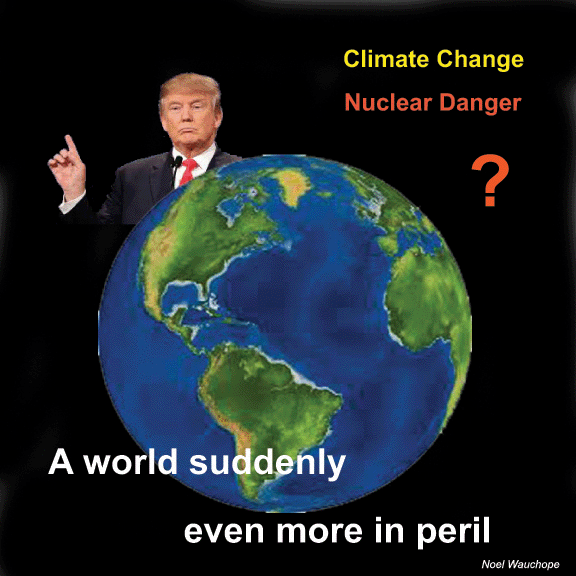 Trump’s call for some ‘good old global warming’ ridiculed by climate experts. US president again conflates weather with climate to mock climate change. Experts call comments ‘scientifically ridiculous and demonstrably false’, Guardian, Michael McGowan and Joanna Walters, -30 Dec 17, -Donald Trump once dismissed it as a “hoax” created by the Chinese to destroy American jobs, but on a freezing Thursday night in the eastern US the president found himself pining for some of that “good old global warming”.
On holiday in Florida on Thursday, Trump wondered if global warming might not be such a problem after all.
2017 – the year that the world was hit by climate change
 http://www.dw.com/en/2017-the-year-climate-change-hit/a-41944142
The devastating effects of climate change are becoming apparent — and the world has begun taking action. But the frequency of extreme weather events has shown we are starting to run out of time.
“Crazy” weather has been a hot topic for elevator conversations this year — and yes, extremes are starting to become the new normal.
No continent was spared in 2017 when it came to extreme weather. From droughts to hurricanes, from smog to forest fires, these events killed thousands of people — and have been directly linked to climate change.
Read more: Extreme weather on the rise in Europe
Southern Europe, Canada and the United States were among the areas worst hit by devastating wildfires. Both in California and Portugal, 2017 has been the deadliest year on record for wildfires. Even icy Greenland wasn’t spared. Climate change, along with the dangerous combination of a lack of sustainable forest management and careless — or malicious — human activity, has been to blame.
Read more: Climate change sets the world on fire
Hurricanes and high water
Major storms were also responsible for the year’s most catastrophic events. Hurricane Harvey in the US, Irma and Maria in the Caribbean and Katia in the Gulf of Mexico left destruction in their wake. While hurricanes aren’t unusual in tropical regions, the frequency and intensity of these most recent storms — fueled by warming oceans — were out of the ordinary. But they may be a sign of things to come, if the world doesn’t take action to limit climate change.
At the same time, global sea levels reached a new high in 2017, with the polar ice caps melting at an accelerating pace. Warmer ocean temperatures contributed to the breakaway of a 1 trillion ton iceberg from the Larsen C ice shelf in Antarctica in July, at 5,800 square kilometers (2,200 square miles) one of the largest icebergs ever recorded.
Flooding caused the death of hundreds of people in the Philippines, Greece, Germany and Vietnam, to name just a few countries. Meanwhile, drought is increasing the pressure on regions of Africa and Asia, such as Somalia, South Sudan and Pakistan, where armed conflicts are already making daily life a struggle for survival.
Often forgotten, the struggles of the world’s oceans also increased this year. Despite several initiatives protecting the Great Barrier Reef, coral bleaching has continued at an alarming rate. Ocean acidification, meanwhile, is on track to make the seas uninhabitable for many aquatic creatures, endangering entire ocean ecosystems.
Read more
— Great Barrier Reef coral bleaching even worse than expected
— Ocean acidification: climate change’s evil twin
Governments across the globe are taking action to address current and upcoming climate threats, and leaders like French President Emmanuel Macron, who took office in May and pledged to fund climate research, have been a source of hope for many.
Read more: Emmanuel Macron, Europe’s climate hero?
But 2017 will also, unfortunately, be remembered for the US withdrawal from the 2015 Paris climate accord, along with President Donald Trump’s other moves away from the fight against climate change.
Read more: Answering unresolved questions from Trump’s climate announcement
As despairing as all of this may sound, it’s actually another call to take action. Weather has always been out of our control — and will remain so. But we can still work to avoid making extremes the new normal.
Climate change will mean three times the number of migrants reaching Europe by 2100
Climate Change To Triple Number Of Migrants Reaching European Union By 2100, Study Predicts, Clean Technica, December 28th, 2017 by James Ayre
 The number of migrants making their way into the European Union will nearly triple by the year 2100 if rapid climate warming occurs, according to a new study published in the journal Science.
The new study — which was actually requested by the European Commission itself — relates directly only to climate warming, it should noted — mass migrations triggered by wars and cultural conflicts would be in addition to those discussed by the study……
the reality is that the findings are likely a vast underestimate of what will be occurring during the second half of the 21st century — as climate warming and weirding intensify; and as the common human activities of projection, scapegoating, and lazy thinking do as well.
According to the new study, asylum applications to the EU (from across 103 different nations) tended “to rise in the 2000–2014 period when temperatures at home were far hotter or colder than the ideal for growing maize.”
The projection put forward by the study is that asylum applications could climb to 1.01 million per year by 2100 (up from an average of 351,000 during 2000-2014) under a scenario that sees temperatures rise fairly fast. The primary driver of this rise would be reduced agricultural productivity (again, the human conflict aspects of what’s coming aren’t being factored into this work).
As I noted above, the reality is that even that figure is likely a vast underestimate of what’s coming — based on a look back at earlier periods of rapid climatic change and/or ecological collapse (soil fertility loss included) and taking into account more factors than the research did………
won’t rising temperatures and falling agricultural yields lead directly to weakening civil institutions (self-consumption), political repression, and civil war? Isn’t that exactly what’s happened in Syria over the last decade?
I’ll end things here with the study’s assertion that “our findings support the assessment that climate change, especially continued warming, will add another ‘threat multiplier’ that induces people to seek refuge abroad.”https://cleantechnica.com/2017/12/28/climate-change-triple-number-migrants-reaching-european-union-2100-study-predicts/
1 This Month




PLEASE OPPOSE HR 8255 AND S.3639 – bills would accelerate satellite deployment, with no environmental review or safeguards – https://ncstd5li.quorum.us/campaign/169331/
To see nuclear-related stories in greater depth and intensity – go to https://nuclearinformation.wordpress.com
-
Archives
- September 2026 (323)
- August 2026 (330)
- July 2026 (355)
- June 2026 (287)
- May 2026 (306)
- April 2026 (356)
- March 2026 (251)
- February 2026 (267)
- January 2026 (308)
- December 2025 (358)
- November 2025 (359)
- October 2025 (375)
-
Categories
- 1
- 1 NUCLEAR ISSUES
- business and costs
- climate change
- culture and arts
- ENERGY
- environment
- health
- history
- indigenous issues
- Legal
- marketing of nuclear
- media
- opposition to nuclear
- PERSONAL STORIES
- politics
- politics international
- Religion and ethics
- safety
- secrets,lies and civil liberties
- spinbuster
- technology
- Uranium
- wastes
- weapons and war
- Women
- 2 WORLD
- ACTION
- AFRICA
- Atrocities
- AUSTRALIA
- Christina's notes
- Christina's themes
- culture and arts
- Events
- Fuk 2022
- Fuk 2023
- Fukushima 2017
- Fukushima 2018
- fukushima 2019
- Fukushima 2020
- Fukushima 2021
- general
- global warming
- Humour (God we need it)
- Nuclear
- RARE EARTHS
- Reference
- resources – print
- Resources -audiovicual
- Weekly Newsletter
- World
- World Nuclear
- YouTube
-
RSS
Entries RSS
Comments RSS

