FT 12th April 2018 , New Zealand has become one of the world’s first countries to ban future offshore oil and gas exploration in a move heralded by environmental campaigners as a symbolic blow to “Big Oil”.
“There will be no further offshore oil and gas exploration permits granted,” said Jacinda Ardern, New
Zealand’s prime minister, on Thursday. “We must take this step as part of
our package of measures to tackle climate change,” she said.
The South Pacific nation’s ban is an important policy move at a time when nations are
exploring how to comply with their requirements under the Paris climate
change agreement.France, Belize and Costa Rica have already announced bans
on either fossil fuel exploration or production, although these are largely
symbolic as none are ma jor oil producers.
However, the policy shift announced by Prime Minister Ms Ardern marks a change in direction for
New Zealand, which under the previous conservative government prioritised
fossil fuel exploration to help the economy grow. https://www.ft.com/content/d91e9864-3ded-11e8-b7e0-52972418fec4
Marine heatwaves are increasing in their frequency and duration at an accelerating rate in many parts of the world, especially around Australia, a team of international scientists has found.
The number of oceanic heatwave days a year has increased by 54 per cent in the past century globally, the researchers determined, using data of sea-surface temperatures from long-established sites and satellites.
“We have seen an increasing trend in the frequency and duration [of marine heatwaves], and that trend has accelerated in the past 30 years or so,” said Lisa Alexander, associate professor at University of NSW’s Climate Change Research Centre, and an author of the paper published in Nature Communications on Wednesday.
Rather than a precursor, the number of heatwave days may even be an underestimate of what is to come as the planet warms, Professor Alexander said. “We could see it accelerated even more, given what we’ve seen recently,” she said.
Episodes of extreme heat over land have been studied more closely than those beneath the waves. Oceans, though, not only absorb about 93 per cent of the additional heat being trapped by rising greenhouse gas levels, they are also the main driver of the Earth’s climate.
Thank goodness we have the oceans as this massive sink [for both heat and carbon dioxide] but they are also changing too, and we tend to forget that,” said Sarah Perkins-Kirkpatrick, an author of the paper and also a researcher at the UNSW CCRC.
Dr Perkins-Kirkpatrick likened the oceans to the tropics, where temperatures typically move within a narrow band. Even moderate increases can have big impacts on humans and ecosystems alike.
The paper, which defined heatwaves as at least five consecutive days with sea-surface temperatures in the top 10 per cent of warmth over a 30-year period, found such events were on the increase in most parts of the world.
Global hot spots
Australia was home, along with the north Pacific and north Atlantic, of some of the global ocean hot spots.
While coral bleaching from extended heat over the Great Barrier Reef and elsewhere in recent years had drawn international attention, many other regions had seen “substantial ecological and economic impacts”, as fishing and tourism industries they support were hit, the paper said.
For instance, an extreme event off the Western Australia coast in 2011 led to large-scale effects in the Ningaloo region. Kelp forests south of Ningaloo were hammered and are yet to recover.
“You only need to have that one event to have this complete shift in the ecological environments,” Dr Perkins-Kirkpatrick said, noting such changes have tended to be less dramatic on land.
“Will it ever change back? Have we reached the point of no return for certain marine environments?” she said. “There are a lot of unknowns there, but it’s quite concerning.”
Coral bleaching events have garnered much of the attention but many other marine species, including kelp forests off Tasmania, can be vulnerable to changing conditions.
“[Corals] are the sort of poster child for ecological change, and other systems aren’t maybe as pretty to look at,” Professor Alexander said. “But [others] are equally as important in the ecosystems and food chains”.
Tasman Sea heat
The westward boundaries of the continents tend to be where oceans are warming fastest, including off the east Australian coast.
The Tasman Sea had experienced an increase in heatwave events even before this past summer’s record burst, that fell outside the researchers’ period of study.
In a special climate statement released last month by the Bureau of Meteorology and New Zealand’s National Institute of Water and Atmospheric Research, the agencies found the south Tasman Sea recorded sea-surface anomalies of as much as 2.12 degrees last December and 1.96 degrees in January.
Those readings were compared with a 1981-2010 baseline – and broke the record for those months by about a degree – an unusual departure from the norm for ocean readings.
An interdisciplinary team of scientists explores Lake Hazen’s response to climate change, Science Daily April 6, 2018
Source:
University of Alberta
Summary:
An interdisciplinary team of scientists examining everything from glaciology to freshwater ecology discovered drastic changes over the past decade to the world’s largest High Arctic lake. And from glacial melt to the declining lake ice to changes in lake ecology, the results from Lake Hazen on Ellesmere Island in Canada are alarming……..https://www.sciencedaily.com/releases/2018/04/180406155402.htm
The only thing more frightening than an advancing glacier may be one that is shrinking and raising sea levels round the world
Both the north pole and the south pole are situated in the middle of huge ice deserts which are melting around the edges under the influence of human activity. The difference that matters between them is that the ice of the Arctic floats: if it melted nothing much would happen to aggregate sea levels. The ice of Antarctica, like that of Greenland, rests on land. If it all were to melt, as it has done in the far distant past, sea levels could rise by as much as 60 metres. That is most unlikely to happen. What is possible, though, is that the smaller portion of the continent, west Antarctica, which is divided from the rest by a mountain range, could lose much of its ice. Even that would be catastrophic. A significant retreat in west Antarctica, as seems to be already under way, could raise sea levels by between one and three metres by the end of this century. Children now alive will see that happen across their lifetimes. That is what is meant by the urgency of global warming.
Previous surveys have concentrated on a few of the glaciers that are an obvious danger but the research released this week analysed satellite data covering the whole of the coastline of west Antarctica to reach its worrying conclusions. The problem is worsened by the shape of the seabed on which the glaciers now rest. It does not slope towards the deep ocean, but inwards, forming a bowl of which the far side is the mountain range that divides the continent. That means that the process of erosion will be working downhill as it moves inwards, with faster and less predictable results.
The present danger was discovered by measuring the thickness of the ice sheet from space and deducing from this the shape of the glacier beneath. This is much easier than knowing what to do. The contrast between the exquisite technological sophistication employed in the diagnosis of the problem and the lack of international coordination or political sophistication when it comes to solving it, illustrates the crisis of technological civilisation. As a species we have shown enough cleverness to disrupt the world’s climate, but may not have enough to remedy the damage that we’ve done. Things are of course made very much worse by the presence in the White House of an aggressively ignorant and anti-scienceadministration.
Predicting the future of these changes isn’t an exact science, which is one of the things which makes them so frightening, but neither is it entirely guesswork. Ignorance about the size of the threatened rise in sea levels is no excuse for inaction. We know it’s coming. We know it will be disruptive. We don’t know if it will be catastrophic. But the possibility must spur us into drastic action on fossil fuels. Keep them in the ground.
Two weeks ago, I gave a keynote presentation about anthropogenic climate disruption (ACD) at a large sustainability conference in Chico, California. During the question-and-answer session following my talk, a student asked me what I thought the world would look like by 2050. His question stopped me in my tracks. I had to pause and take a deep breath, to prepare myself emotionally for what I had to tell him.
Here is the gist of what I said: Based on years of research for my forthcoming book, The End of Ice, along with my work compiling these monthly climate disruption dispatches for four years now, I know that by 2050, we will be inhabiting a dramatically different planet. I believe we will already have tens — if not hundreds — of millions of climate refugees from sea-level rise and conflicts born of lack of food and water. What we currently call extreme weather events (massive floods, droughts, hurricanes) will have long since become the norm. In the US, growing food in the Midwest and the central valley of California will be extremely difficult, if not largely impossible, due to shifting weather patterns of rainfall and drought. Some swaths of the world, including the Gulf states in the Middle East and parts of the US Southwest, will be largely uninhabitable due to simply being too hot. Greenland and the Antarctic will both be experiencing dramatically advanced melting, and most of the glaciers in the contiguous 48 US states will have long since ceased to exist. And given that we are officially already amidst the Sixth Mass Extinction Event of the planet, which humans triggered, the biological annihilation that comes with this is happening apace.
This portrait might seem far-fetched to some. But to understand that this is our future, all we need to do is look at what is already happening around the planet.
Unchecked ACD — which appears likely to continue, since governments (particularly that of the United States) are not preparing to undertake the kinds of drastic mitigation measures that might have any impact — will dramatically degrade global fish catch over the coming centuries, and may well reduce total oceanic plant life for a millennium, according to a recent study. The study also noted that these changes cannot be reversed until the climate cools.
The amount of warming humans have already caused on Earth is, according to a recent study, likely already enough to melt more than one-third of all the world’s glaciers outside of Antarctica and Greenland, regardless of ongoing efforts to reduce fossil fuel emissions. The study analyzed the lag between global temperature increases and the retreat of glaciers and found a relatively slow response of glaciers to planetary warming. Researchers noted that it will take until 2100, at least, to see any benefits from serious mitigation efforts over the next decades — assuming those efforts actually happen. One of the scientists involved in the study told Carbon Brief that this glacier loss is already “baked in” to the system and has been overlooked, which essentially means “we really are on course to obliterate many of these mountain landscapes.”
Meanwhile, a recently published World Wildlife Fund report has predicted catastrophic losses in the world’s forests: As much as 60 percent of the plants and half of all the animals are predicted to disappear by 2100. if temperatures rise by more than 1.5 degrees Celsius (1.5°C). The scientific consensus states that a 1.5°C rise is a given; in fact, some prominent scientists believe an increase of 3.2°C by 2100 is most likely, given current national commitments. If emissions remain unchanged, which is the current actual trajectory, a 4.5°C rise is the forecast. It is worth noting that oil giants BP and Shell are planning on 5°C of planetary warming by 2050.
Taking all this information in is necessary if we are to see the world clearly and live our lives accordingly.
Earth
The World Bank recently warned that if dramatic intervention doesn’t occur on the ACD front, 140 million people across three regions (sub-Saharan Africa, South Asia, Latin America) of the Earth will become refugees between now and 2050.
An example of one of the factors driving such mass movement of people can be found in California, where a recent report citing nearly 90 different studies found that warming temperatures could alter where key crops grow across that state. Bearing in mind that California produces roughly two-thirds of all the produce in the US, the report notes that ACD could decrease the yield of some of the crops grown in California by as much as 40 percent by 2050.
In Vermont, warming temperatures, particularly during the winter, are causing extreme weather events and unpredictable rainfall, which experts recently warned was making forests across that state particularly vulnerable to ACD. Boreal forests and moose populations will be the hardest hit, warned the study.
The world’s northernmost regions have not escaped extreme weather. The Svalbard Global Seed Vault, known as the Doomsday Vault, was created to protect the world’s seeds in the event of cataclysmic ACD impacts or nuclear war, whichever comes first. Disturbingly, it is now in need of an upgrade, thanks to ACD. Norway, which built and maintains the vault, is having to invest $13 million to upgrade the vault to make room for more seeds and make it more resilient, given a recent flooding event there. Last year, flooding at the entrance of the vault prompted the Norwegian government to begin looking into the upgrade, which is now going to move forward.
Bad news also abounds for Earth’s animal species. A recently published study in the journal Nature Climate Change showed that Antarctica’s king penguins could be extinct by 2100, due primarily to ACD impacts and overfishing.
In Florida, research revealed recently that nearly all the sea turtles being born there are female, due to higher temperatures. Obviously, if this trend continues, which it almost assuredly will, there will be no more sea turtles in Florida.
Meanwhile over in Europe, the authors of a recent report out of France’s National Museum of Natural History and the National Centre for Scientific Research showed a “catastrophic” decline in France’s bird populations. The trend signals the possibility of Europe’s farmland turning into desert, a situation that would ultimately threaten all human beings. The scientists warned of a wider crisis of biodiversity — or lack thereof — across that continent, with ACD impacts and pesticides to blame. This comes on the heels of concerning news of a 76 percent decline in the abundance of flying insects in Germany over the last 27 years.
Water
As is often the case in the spring, the watery realms of the planet are where the ACD impacts are most evident.
Widespread ongoing winter drought across the US, from Kansas, Oklahoma and Missouri to the Dakotas, Texas and California, have many farmers worried about this year being a repeat of 2012, the worst drought in the US since the Dust Bowl. At present, the winter drought is worse than it was in 2012.
The problem extends beyond those states. In Colorado, at the time of this writing, snow would need to fall at 200 percent of the state’s average through the end of April for its snowpack to catch up to normal. Water managers there are keeping a leery eye on reservoirs as summer looms on the horizon.
Colorado is not an anomaly. Snowpack across the Western US has been dramatically lower than it was a century ago. A recent study showed the average snowpack in the west has dropped by nearly one-third since 1915. That is equivalent to the decrease we’d see from permanently draining Nevada’s Lake Mead, the single largest man-made reservoir in the US.
Changing weather patterns and warmer year-round temperatures have scientists in Western Canada — a place you wouldn’t think needs to worry about water issues — worried about running out of water in the future. For example, in 2017 there was a record amount of snowfall in one region, but even all that snow was still not enough to prevent a drought on the southern part of the prairies below it. The changing climate there also means the snowpack is melting faster and earlier than usual, which means that water is moving through river basins faster and leaving them dry before the end of summer.
On the other side of the world, New Zealand is experiencing similar concerns. Its alps have become incredibly barren, as a recent aerial survey shows how the loss of snow there is now being called “extreme.”
A recently released UN report on the state of the world’s water warned that more than 5 billion people could suffer water shortages by 2050 due largely to ACD and increasing demand.
Furthermore, extreme weather events like major floods and extreme rainfall events have surged more than 50 percent this decade alone, and are now happening four times more often than they were in just 1980, according to a recent paper.
Meanwhile, seas continue to rise. A recent NOAA report warned that sea level rise will rapidly worsen flooding that is already happening in coastal communities around the US. The report warned that some cities will see flooding on a daily basis by 2100.
Adding to this, another recent study showed that lakes on the Greenland Ice Sheet are now forming further inland, meaning they are now potentially threatening to speed up ice flow once they drain to the glacial floor.
In Antarctica the news is no better. The absence of sea ice near that continent over the past six weeks (as of the time of this writing) has deeply concerned scientists conducting research there.
In addition to paying attention to large, continental changes, it’s important to take note of ACD-driven shifts on the level of microorganisms. A recent report showed that excessive rates of carbon dioxide (CO2) affect the health of critical microorganisms in the oceans, which could potentially undermine the base of vital marine food chains. This is happening largely due to ocean acidification, a result of ACD.
Fire
Given the low snowpack levels across much of the Western US, this summer is already expected to be another above-average wildfire season for much of that part of the country. Since snowpack functions as a water source through much of the summer, when warmer temperatures cause it to melt off faster than normal, drier conditions ensue.
Meanwhile in Australia, more than 70 homes and buildings have been destroyed in a fast-moving bushfire in New South Wales, while separate fires destroyed 18 properties in Victoria. Local authorities there described the fires as the worst of Australia’s summer season thus far.
As is always the case with extreme weather events, none of these fires can be solely attributed to ACD. However, climate disruption’s impacts are a key contributing factor to how often they occur, as well as to their intensity.
Air
In Australia, a new study reveals that the country’s record-setting 2012 heat wave was responsible for the destruction of roughly 1,000 square kilometers of seagrass meadows. which had acted as a repository for CO2. When the meadows were destroyed, the disaster released as much as 9 million tons of CO2 into the atmosphere.
Meanwhile, nearby New Zealand experienced its hottest summer on record last year. It definitively broke with normal temperatures, clocking in at a shocking 2.1°C above the past 35-year average temperature.
Back in the US, USGS data has revealed how spring has arrived much earlier than normal for much of the country, a clear indicator of how ACD is continuing to shift overall climate patterns.
In the Arctic, in fact, spring is beginning an average of 16 days earlier now than it did just one decade ago. A study in the journal Scientific Reports noted an increase in the number of warm temperature records in the spring, along with changes to the timing of bird migrations, flowers blooming and other seasonal indicators.
What makes this even more disconcerting is the fact that scientists have found a direct and strong link between warmer Arctic temperatures and abnormally high snowfall amounts and frigid temperatures further south of that region. So, for example, the severe weather that has been impacting the northeastern US this spring, is linked directly to the ACD-related warm wave happening across the Arctic region.
Lastly in this section, but perhaps most importantly, thawing Arctic permafrost is now likely to release more methane than previously expected. Methane is a far more potent greenhouse gas than CO2, as it is 100 times stronger over a 10-year time scale. The new study found that waterlogged wetland soils will produce considerably more methane than previously predicted.
Denial and Reality
There is never a dull moment in the Trump administration’s land of ACD-denial.
A recent and excellent article published at The Conversation outlined the four primary methods used by this administration to deny or hide the reality of ACD. These methods are, according to the article: making documents more difficult to find on government websites, burying web pages, altering language, and silencing the science. Truthout’s Mike Ludwig also detailed how ACD, as a threat to the US, has literally “gone missing” under Trump.
Meanwhile, the cabinet continues to be filled with ACD deniers. One of the more recent additions has been hardline climate denier Mike Pompeo as Secretary of State, who along with having longstanding close ties to the Koch brothers, in 2013 said during a C-SPAN interview: “There are scientists who think lots of different things about climate change. There’s some who think we’re warming, there’s some who think that the last 16 years have shown a pretty stable climate environment.”
A Trump administration official even went so far recently as to say that USGS scientists went “outside their wheelhouse” by writing that ACD has “dramatically reduced” glaciers in Montana. One of the scientists who bore this attack responded, “This is what we do…. It is our wheelhouse.”
Trump administration US Energy Secretary, Rick Perry, who thinks wearing thick-framed glasses makes him appear more intelligent, recently said that international efforts to reduce fossil fuel use were “immoral.”
On the reality front, thousands of scientists from the 22 Commonwealth countries have urged that stronger government action on ACD needs to be taken if there is hope to keep planetary warming lower than 2°C.
Underscoring that urgency, global demand for energy increased by 2.1 percent in 2017 — more than twice the previous year’s rate, according to the International Energy Agency. According to the same agency, energy-related CO2 emissions also increased by 1.4 percent during 2017, reaching a historic high of 32.5 gigatons.
Despite glaring warning signs from around the planet, governments around the world are not taking dramatic measures to mitigate ACD impacts. In fact, the US government continues to refuse to even acknowledge that those impacts exist. The world’s most powerful forces are taking a business-as-usual approach, as we are hurtled deeper into the Sixth Mass Extinction event.
Energy Hogs: Can World’s Huge Data Centers Be Made More Efficient?
The gigantic data centers that power the internet consume vast amounts of electricity and emit 3 percent of global CO2 emissions. To change that, data companies need to turn to clean energy sources and dramatically improve energy efficiency. Yale Environment 360 BY FRED PEARCE•APRIL 3, 2018
The cloud is coming back to Earth with a bump. That ethereal place where we store our data, stream our movies, and email the world has a physical presence – in hundreds of giant data centers that are taking a growing toll on the planet.
Data centers are the factories of the digital age. These mostly windowless, featureless boxes are scattered across the globe – from Las Vegas to Bangalore, and Des Moines to Reykjavik. They run the planet’s digital services. Their construction alone costs around $20 billion a year worldwide.
The biggest, covering a million square feet or more, consume as much power as a city of a million people. In total, they eat up more than 2 percent of the world’s electricity and produce 3 percent of CO2 emissions, as much as the airline industry. And with global data traffic more than doubling every four years, they are growing fast.
Yet if there is a data center near you, the chances are you don’t know about it. And you still have no way of knowing which center delivers your Netflix download, nor whether it runs on renewable energy using processors cooled by Arctic air, or runs on coal power and sits in desert heat, cooled by gigantically inefficient banks of refrigerators.
We are often told that the world’s economy is dematerializing – that physical analog stuff is being replaced by digital data, and that this data has minimal ecological footprint. But not so fast. If the global IT industry were a country, only China and the United States would contribute more to climate change, according to a Greenpeace report investigating “the race to build a green internet,” published last year.
Storing, moving, processing, and analyzing data all require energy. Lots of it. The processors in the biggest data centers hum with as much energy as can be delivered by a large power station, 1,000 megawatts or more. And it can take as much energy again to keep the servers and surrounding buildings from overheating.
Almost every keystroke adds to this. Google estimates that a typical searchusing its services requires as much energy as illuminating a 60-watt light bulb for 17 seconds and typically is responsible for emitting 0.2 grams of CO2. Which doesn’t sound a lot until you begin to think about how many searches you might make in a year.
And these days, Google is data-lite. Streaming video through the internet is what really racks up the data count. IT company Cisco, which tracks these things, reckons video will make up 82 percent of internet traffic by 2021, up from 73 percent in 2016. Around a third of internet traffic in North America is already dedicated to streaming Netflix services alone.
Two things matter if we are to tame these runaway beasts: One is making them use renewable or other low-carbon energy sources; the other is ramping up their energy efficiency. On both fronts, there is some good news to report. Even Greenpeace says so. “We are seeing a significant increase in the prioritization of renewables among some of the largest internet companies,” last year’s report concluded.
More and more IT companies are boasting of their commitment to achieving 100 percent reliance on renewable energy. To fulfil such pledges, some of the biggest are building their own energy campuses. In February, cloud giant Switch, which runs three of the world’s top 10 data centers, announced plansfor a solar-powered hub in central Nevada that will be the largest anywhere outside China.
More often, the data titans sign contracts to receive dedicated supply from existing wind and solar farms. In the U.S., those can still be hard to come by. The availability of renewable energy is one reason Google and Microsoft have recently built hubs in Finland, and Facebook in Denmark and Sweden. Google last year also signed a deal to buy all the energy from the Netherlands’ largest solar energy park, to power one of its four European data centers.
Of the mainstream data crunchers for consumers, Greenpeace singled out Netflix for criticism. It does not have its own data centers. Instead, it uses contractors such as Amazon Web Services, the world’s largest cloud-computing company, which Greenpeace charged with being “almost completely non-transparent about the energy footprint of its massive operations.” Amazon Web Services contested this. A spokesperson told Yale Environment 360 that the company had a “long-term commitment to 100 percent renewable energy” and had launched a series of wind and solar farm projects now able to deliver around 40 percent of its energy. Netflix did not respond to requests for comment.
Amazon Web Services has some of its largest operations in Northern Virginia, an area just over the Potomac River from Washington D.C. that has the largest concentration of data centers in the world. Virginia gets less than 3 percent of its electricity from renewable sources, plus 33 percent from nuclear, according to Greenpeace.
Some industry insiders detect an element of smoke and mirrors in the green claims of the internet giants. “When most data center companies talk about renewable energy, they are referring to renewable energy certificates,” Phillip Sandino, vice-president of data centers at RagingWire, which has centers in Virginia, California, and Texas, claimed in an online trade journal recently. In the U.S. and some other countries, renewable energy certificates are issued to companies generating renewable energy for a grid, according to the amount generated. The certificates can then be traded and used by purchasers to claim their electricity is from a renewable source, regardless of exactly where their electricity comes from. “In fact,” Sandino said, “the energy [the data centers] buy from the power utility is not renewable.”
Others, including Microsoft, help sustain their claims to carbon neutrality through carbon offsetting projects, such as investing in forests to soak up the CO2 from their continued emissions.
All this matters because the differences in carbon emissions between data centers with different energy sources can be dramatic, says Geoff Fox, innovation chief at DigiPlex, which builds and operates centers in Scandinavia. Using data compiled by Swedish state-owned energy giant Vattenfall, he claims that in Norway, where most of the energy comes from hydroelectricity, generating a kilowatt-hour of electricity emits only 3 grams of CO2. By comparison, in France it is 100 grams, in California 300 grams, in Virginia almost 600 grams, in New Mexico more than 800 grams.
Meanwhile, there is growing concern about the carbon footprint of centers being built for Asian internet giants such as Tencent, Baidu, and Alibaba in China; Naver in South Korea; and Tulip Telecom in India. Asia is where the fastest global growth in data traffic is now taking place. These corporations have been tight-lipped about their energy performance, claims Greenpeace. But with most of the region’s energy coming from coal-fired power stations, their carbon footprint cannot be anything but large.
Vattenfall estimates the carbon emissions in Bangalore, home of Tulip’s giant Indian data center, at 900 grams per kilowatt-hour. Even more troubling, the world’s largest center is currently the Range International Information Hub, a cloud-data store at Langfang near the megacity of Tianjin in northeast China, where it takes more than 1,000 grams of CO2 for every kilowatt-hour.
Almost as important as switching data centers to low-carbon energy sources is improving their energy efficiency. Much of this comes down to the energy needed to keep the processors cool. Insanely, most of the world’s largest centers are in hot or temperate climates, where vast amounts of energy are used to keep them from overheating. Of the world’s 10 largest, two are in the desert heat of Nevada, and others are in Georgia, Virginia, and Bangalore.
Most would dramatically reduce their energy requirements if they relocated to a cool climate like Scandinavia or Iceland. One fast-emerging data hub is Iceland, where Verne Global, a London company, set up its main operation.
…….. Greenpeace says the very size of the internet business, and its exposure to criticism for its contribution to climate change, has the potential to turn it from being part of the problem to part of the solution. Data centers have the resources to change rapidly. And pressure is growing for them to do so.The hope is that they will bring many other giant corporations with them. “The leadership by major internet companies has been an important catalyst among a much broader range of corporations to adopt 100 percent renewable goals,” says Gary Cook, the lead author of the Greenpeace report. “Their actions send an important market signal.”
But the biggest signal, says Fox, will come from us, the digital consumers. Increasingly, he says, “they understand that every cloud lives inside a data center. And each has a different footprint.” We will, he believes, soon all demand to know the carbon footprint of our video streams and internet searches. The more far-sighted of the big data companies are gearing up for that day. “I fully expect we may see green labelling for digital sources as routine within five years.” https://e360.yale.edu/features/energy-hogs-can-huge-data-centers-be-made-more-efficient
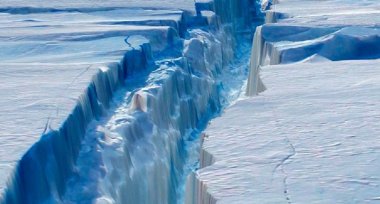
Antarctica retreating across the sea floor, EurekAlert , UNIVERSITY OF LEEDS , 3 April 18 Antarctica’s great ice sheet is losing ground as it is eroded by warm ocean water circulating beneath its floating edge, a new study has found.
Research by the UK Centre for Polar Observation and Modelling (CPOM) at the University of Leeds has produced the first complete map of how the ice sheet’s submarine edge, or “grounding line”, is shifting. Most Antarctic glaciers flow straight into the ocean in deep submarine troughs, the grounding line is the place where their base leaves the sea floor and begins to float.
Their study, published today in Nature Geoscience, shows that the Southern Ocean melted 1,463 km2 of Antarctica’s underwater ice between 2010 and 2016 – an area the size of Greater London.
The team, led by Dr Hannes Konrad from the University of Leeds, found that grounding line retreat has been extreme at eight of the ice sheet’s 65 biggest glaciers. The pace of deglaciation since the last ice age is roughly 25 metres per year. The retreat of the grounding line at these glaciers is more than five times that rate.
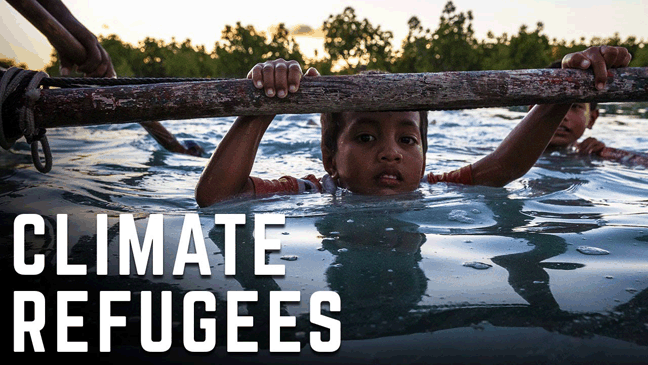
America’s first climate change refugees are preparing to leave an island that will disappear under the sea in the next few years, Business Insider David Usborne, The Independent, 1 April 18
In March, Louisiana state officials announced that everyone living on Isle de Jean Charles will have to leave.
Where there were 22,000 acres in 1955 there are only 320 acres today.
They are one hurricane away from obliteration.
The evacuation is a test-run for countless coastal communities in Louisiana, who must all move as the seas take over the land.
ISLE DE JEAN CHARLES, Louisiana — America comes to an end here. Connected to the marshes and moss-laced bayous of southern Louisiana by two miles of narrow causeway, waters lapping high on each side, Isle de Jean Charles takes you as far into the Gulf of Mexico as you can go without falling in. But the dolour in the salt air is not just about loneliness and separation. It’s about impending demise.
Don’t call it a death sentence – the intention is the opposite – but state officials in late March made the announcement that had been a long time coming. Some on the island, nearly all members of the Biloxi-Chitimacha-Choctaw Indian tribe, met it with relief; others with hostility.
Marking the kick-off of what will be the first climate resettlement of its kind in the entire United States, land had been chosen an hour’s drive to the north for a whole new town to be thrown up. No one will force them exactly, but the intention is clear: to evacuate those still living on the island to the new site, where at present nothing but sugar cane stands, before it is too late.
When that will be depends on whom you ask. But no one disputes that the island is sinking, thanks to a combination of subsidence and rising sea levels.
…… The vanishing of Isle de Jean Charles into the waves of the gulf might take another decade or even five. On the other hand, one more big storm could finally end its viability for human occupation for good, flooding homes beyond repair or cutting through the connecting road.
…….“It’s really a test run,” Mr Forbes, executive director of the Louisiana Office of Community Development,concedes in an interview from his Baton Rouge office. While Americans may have been displaced by environmental change before, notably in Alaska, no single community has been relocated lock, stock and barrel like this. “We are trying to keep the community intact and ensure that it’s economically and socially vibrant and viable. To our knowledge, it’s unique. There are places around the world who are looking at a similar type of thing but nobody in the US has done this.”Which makes residents on Isle de Jean Charles canaries in the mineshaft……..http://www.businessinsider.com/isle-de-jean-charles-climate-change-refugees-2018-4/?r=AU&IR=T
Leaked Memo: EPA Shows Workers How To Downplay Climate Change
Point 5: Suggest that humans are only responsible “in some manner.”, HuffPost, By Alexander C. Kaufman , 30 Mar 18The Environmental Protection Agency on Tuesday evening sent employees a list of eight approved talking points on climate change from its Office of Public Affairs ― guidelines that promote a message of uncertainty about climate science and gloss over proposed cuts to key adaptation programs.
An internal email obtained by HuffPost ― forwarded to employees by Joel Scheraga, a career staffer who served under President Barack Obama ― directs communications directors and regional office public affairs directors to note that the EPA “promotes science that helps inform states, municipalities and tribes on how to plan for and respond to extreme events and environmental emergencies” and “works with state, local, and tribal government to improve infrastructure to protect against the consequences of climate change and natural disasters.”
But beyond those benign statements acknowledging the threats climate change poses are talking points boiled down from the sort of climate misinformation EPA Administrator Scott Pruitt has long trumpeted.
“Human activity impacts our changing climate in some manner,” one point reads. “The ability to measure with precision the degree and extent of that impact, and what to do about it, are subject to continuing debate and dialogue.”
The other states: “While there has been extensive research and a host of published reports on climate change, clear gaps remain including our understanding of the role of human activity and what we can do about it.”
The email was sent under the subject line: “Consistent Messages on Climate Adaptation.” ………
The delivery of the talking points comes a week after Pruitt announced plans to restrict the agency’s use of science in writing environmental rules, barring the use of research unless the raw data can be made public for other scientists and industry to scrutinize. That directive would disqualify huge amounts of public health research conducted on the condition that subjects’ personal information will remain private. Two former top EPA officials called the move an “attack on science” in a New York Times op-ed published Monday.
Last year, the EPA reassigned the four staffers in the policy office who worked on climate adaptation, shuttered its program on climate adaptation and proposed eliminating funding for programs that deal with rising seas and warming temperatures.
Pruitt personally oversaw efforts to scrub climate change from EPA websites, and staunchly defended President Donald Trump’s decision last June to withdraw the United States from the Paris climate accord. In October, Pruitt proposed repealing the Clean Power Plan, one of the only major federal policies to reduce greenhouse gas emissions.
The agency had also suggested zeroing out funding for most of its major climate and regional science grant programs, only to see Congress reject most of the cuts in the budget bill passed last week.
The assertions made in the new EPA talking points are not rooted in science. Ninety-seven percent of peer-reviewed research agrees with the conclusion that emissions from burning fossil fuels, deforestation and industrial farming are enshrouding the planet in heat-trapping gases, and are the primary causes of rising planetary temperatures. A research review published in November 2016 found significant flaws in the methodologies, assumptions or analyses used by the 3 percent of scientists who concluded otherwise.
Katharine Hayhoe Reveals Surprising Ways to Talk About Climate Change These climate-skeptic-whispering tactics have nothing to do with science Sierra BY KATIE O’REILLY | MAR 20 2018
Katharine Hayhoe on how to talk about climate change (highlights video)
Katharine Hayhoe isn’t your typical atmospheric scientist. Throughout her career, the evangelical Christian and daughter of missionaries has had to convince many (including her pastor husband) that science and religion need not be at odds when it comes to climate change. Hayhoe, who directs Texas Tech’s University’s Climate Science Center, is CEO of ATMOS Research, a scientific consulting company, and produces the PBS Kids’ web series “Global Weirding,” rose to national prominence in early 2012 after then-presidential candidate Newt Gingrich dropped her chapter from a book he was editing about the environment. The reason? Hayhoe’s arguments affirmed that climate change was no liberal hoax. The Toronto native attracted the fury of Rush Limbaugh, who encouraged his listeners to harass her.
After the ensuing deluge of hate mail, Hayhoe made a habit of reaching out to climate foes. Along with her husband Andrew Farley, she wrote A Climate for Change: Global Warming Facts for Faith-Based Decisions. She also authored 2014’s third National Climate Change Assessment for the National Academy of Sciences. Last year, Fortune magazine named Hayhoe one of the world’s 50 greatest leaders. While she frequently gives talks on climate science and faith, she often makes a point of keeping science out of her talks………..
Sierra: From a global perspective, the United States stands out for our considerable contingent of vocal climate change deniers. Why do you think this attitude is so uniquely American?
Katharine Hayhoe: There’s some of that sentiment in Australia as well, and in Alberta, the province known as the “Texas of Canada.” Interestingly, if you look across all countries’ fossil fuel resources and political positions on climate, you’ll find that economics doesn’t account for all of it. Fossil fuel influences certainly have an influence, but look at Norway—oil made them rich! One recent study concluded that the U.S. Republican Party is an anomaly. Social scientists study the characteristics of different cultures—some, for instance, are very hierarchical, some are very communal, and some are very independent. I can do it myself. If you correlate the predominance of rejection of climate science with the independence of the culture, I’d bet you anything you’d find a significant correlation. The U.S. is the most culturally independent country in the world, followed by Australia, and then Alberta is much more independent-minded than other Canadian provinces.
Where does this independence stem from?
It comes from the ruggedness of the terrain and the challenges that people had to overcome and endure—and the recency of those struggles.
……. Of course, fighting climate change requires people to work together for the benefit of the entire community—to not just go it alone. When you try to talk climate action to resilient pioneer types, they’re often hearing that the government is gonna be their nanny and pick their car, set their thermostat, limit their water, and tell them what they can and can’t do. And rugged individualists do not need a nanny. They believe the government wants to take away their freedom, and what’s more American than freedom?…….
So how can you make tough, self-reliant, freedom-loving types care about climate change?
That’s the real problem because no one thinks it really matters. Even the people who think it’s really important don’t tend to think it affects them. Particularly if you’re not already a dyed-in-the-wool environmentalist, climate action has be be framed as something that’s a natural expression of something you already are—something that makes you feel like a better version of yourself. ……. So when we have these conversations, we need to start from a place of genuine appreciation of values we share with that person or that group…… https://www.sierraclub.org/sierra/katharine-hayhoe-reveals-surprising-ways-talk-about-climate-change
EUROPEAN COMMISSION JOINT RESEARCH CENTRE , Spurred on by climate change, international travel and international trade, disease-bearing insects are spreading to ever-wider parts of the world.
This means that more humans are exposed to viral infections such as Dengue fever, Chikungunya, Zika, West Nile fever, Yellow fever and Tick-borne encephalitis.
For many of these diseases, there are as yet no specific antiviral agents or vaccines.
Global warming has allowed mosquitoes, ticks and other disease-bearing insects to proliferate, adapt to different seasons, migrate and spread to new niche areas that have become warmer.
In anearly morning tweet, President Trump fired Secretary of State Rex Tillerson and announced that Mike Pompeo, CIA director and unofficial third Koch brother, would be taking over. In other words, a guy who believes climate change is merely an “engineering problem” is being replaced by someone who probably doesn’t think it’s even real.
Pompeo’s environmental record is pretty damning:
In a 2013 interview with C-SPAN’s Washington Journal, he argued that there’s considerable debate within the scientific community about the causes of global warming. There isn’t.
Since 2009, he has accepted more than a million dollars from the oil and gas industry while campaigning for Congress.
He was the largest recipient of Koch Industries campaign money in 2010. And soon afterward, as a newly elected Kansas representative, he hired a former Koch lawyer to be his chief of staff.
It looks like the Koch brothers, who’ve played a huge part in galvanizing the Republican Party against climate change, have Pompeo exactly where they want him.
And why is it important for our secretary of state to understand the basics of climate change? For one, climate change poses a “growing geopolitical threat” to national security — a threat that Pompeo appears quite unequipped to tackle.
A new study looks at how much global sea level will continue to rise even if we manage to meet the Paris climate target of staying below 2°C hotter than pre-industrial temperatures. The issue is that sea levels keep rising for several hundred years after we stabilize temperatures, largely due to the continued melting of ice sheets in Antarctica and Greenland from the heat already in the climate system.
The study considered two scenarios. In the first, human carbon pollution peaks somewhere between 2020 and 2035 and falls quickly thereafter, reaching zero between 2035 and 2055 and staying there. Global temperatures in the first scenario peak at and remain steady below 2°C. In the second scenario, we capture and sequester carbon to reach net negative emissions (more captured than emitted) between 2040 and 2060, resulting in falling global temperatures in the second half of the century.
The authors found that global average sea level will most likely rise by about 1.3 meters by 2300 in the first scenario, and by 1 meter in the second. However, there is large uncertaintydue to how little we understand about the stability of the large ice sheets in Greenland and especially Antarctica. At the high end of possible ice sheet loss, we could see as much as 4.5 meters of sea level rise by 2300 in the first scenario, and close to 3 meters in the second scenario.
The study also shows that it’s critical that our carbon pollution peaks soon. Each 5-year delay – a peak in 2025 instead of 2020, for example – most likely adds 20 cm of sea level rise by 2300, and could potentially add a full meter due to the uncertainty associated with the large ice sheets:
we find that a delay of global peak emissions by 5 years in scenarios compatible with the Paris Agreement results in around 20 cm of additional median sea-level rise in 2300 … we estimate that each 5 years of delay bear the risk of an additional 1 m of sea-level rise by 2300 … Delayed near-term mitigation action in the next decades will leave a substantial legacy for long-term sea-level rise.
And remember, this is all for scenarios in which we meet the Paris climate targets, which we’re currently not on pace to achieve. If we miss the Paris targets, sea levels will rise higher yet.
Another new study, published in the Proceedings of the National Academy of Sciences, found that sea level rise has been accelerating. If the rate of acceleration continues – which the lead author notes is a conservative estimate – we would see an additional 65 cm (close to a meter above pre-industrial sea level) of sea level rise by 2100.
Yet another new study published in The Cryosphere using satellite data found that while the East Antarctic Ice Sheet has remained stable in recent years, ice loss from the West Antarctic Ice Sheet has accelerated. Antarctica is now discharging 1.93 trillion tons of ice each year, up from about 1.89 trillion tons per year in 2008. When accounting for snow accumulation, the continent is losing about 183 billion tons of ice per year – enough to raise sea levels by about 3 to 5 millimeters per decade by itself. The melting of the Greenland Ice Sheet is likewise accelerating and is now responsible for about 25% of annual sea level rise (8.5 millimeters per decade).
The hot Arctic is important because the temperature difference between the Arctic and lower latitudes is one of the main forces that keeps the jet stream moving steadily west-to-east. With a hot Arctic, the jet stream is weakened, leading to weird weather in the USA and Europe. As a result, the western states have been experiencing relatively quite cold temperatures, while the US east coast has been unseasonably hot.
To sum up, ice sheet melt is accelerating, as in turn is sea level rise. Even if we manage to achieve the Paris target of less than 2°C global warming above pre-industrial temperatures, we’re likely to eventually see more than a meter of sea level rise, and potentially several meters. The longer we take to reach peak carbon pollution in the coming years, the higher the oceans will rise. Disappearing sea ice in the rapidly-warming Arctic also appears to be causing increasingly weird and extreme weather in places like America and Europe.
What a great article! and magnificent photos!. And Kenneth Weiss has a degree in folklore! Doesn’t that tell us something?
We are in an age where we are constantly being told that STEM (Science Technology Engineering Maths) are what matters most – indeed, are all that matters. Well- yes, they do matter. But what about the humanities – arts, social studies, history literature, cultures? We need more Kenneth Weiss’s – more students of folklore !
Combating Desertification and Drought,TerraViva United Nations Some of the World’s Biggest Lakes Are Drying Up. Here’s Why. [see this article if only for the superb photos] Warming climates, drought, and overuse are draining crucial water sources, threatening habitats and cultures. “
“……………..Around the globe, climate change is warming many lakes faster than it’s warming the oceans and the air. This heat accelerates evaporation, conspiring with human mismanagement to intensify water shortages, pollution, and loss of habitat for birds and fish. But while “the fingerprints of climate change are everywhere, they don’t look the same in every lake,” says Catherine O’Reilly, an aquatic ecologist at Illinois State University and co-leader of a worldwide lake survey by 64 scientists.
In eastern China’s Lake Tai, for example, farm runoff and sewage stimulate cyanobacterial blooms, and warm water encourages growth. The organisms threaten drinking-water supplies for two million people. East Africa’s Lake Tanganyika has warmed so much that fish catches that feed millions of poor people in four surrounding countries are at risk. The water behind Venezuela’s massive Guri hydroelectric dam has reached such critically low levels in recent years that the government has had to cancel classes for schoolchildren in an effort to ration electricity. Even the Panama Canal, with its locks recently widened and deepened to accommodate supersize cargo vessels, is troubled by El Niño–related rainfall shortages affecting man-made Gatun Lake, which supplies not only water to run the locks but also fresh drinking water for much of the country. Low water levels have also forced limits on the draft of ships so the ships don’t run aground in the lake.
Of all the challenges lakes face in a warming world, the starkest examples are in closed drainage basins where waters flow into lakes but don’t exit into rivers or a sea. These terminal, or endorheic, lakes tend to be shallow, salty, and hypersensitive to disturbance. The vanishing act of the Aral Sea in Central Asia is a disastrous example of what can happen to such inland waters. In its case the main culprits were ambitious Soviet irrigation projects that diverted its nourishing rivers.
Africa’s Lake Chad is a sliver of its former self. Iran’s Lake Urmia has shrunk by 80 percent in 30 years. What remain are the carcasses of ships settled into the silt.
Similar scenarios are playing out in terminal lakes on nearly every continent, a combination of overuse and worsening drought. Side-by-side satellite images reveal the shocking toll. Lake Chad in Africa has shrunk to a sliver of its former self since the 1960s, heightening shortages of fish and irrigation water. Displaced people and refugees who now depend on the lake put an additional strain on resources. Shortages as well as tensions in the hot, dry Sahel are driving conflict and mass migration. Utah’s Great Salt Lake and California’s Salton Sea and Mono Lake have undergone periods of recession too, diminishing critical breeding and nesting areas for birds as well as playgrounds for recreational boaters.
After the Caspian Sea, Iran’s Lake Urmia was once the largest saltwater lake in the Middle East. But it has shrunk by some 80 percent over the past 30 years. The flamingos that feasted on brine shrimp are mostly gone. So are the pelicans, egrets, and ducks. What remain are piers that lead nowhere, the rusting carcasses of ships settled into the silt, and white, barren salt flats. Winds that whip across the lake bed blow salt dust to farm fields, slowly rendering the soil infertile. Noxious, salt-tinged dust storms inflame the eyes, skin, and lungs of people 60 miles away in Tabriz, a city of more than 1.5 million. And in recent years Urmia’s alluring turquoise waters have been stained blood-red from bacteria and algae that flourish and change color when salinity increases and sunlight penetrates the shallows. Many of the tourists who once flocked here for therapeutic baths are staying away.
Although climate change has intensified droughts and elevated hot summer temperatures around Urmia, speeding up evaporation, that’s only part of the story. Urmia has thousands of illegal wells and a proliferation of dams and irrigation projects that divert water from tributary rivers to grow apples, wheat, and sunflowers. Experts worry that Urmia could fall victim to the same overexploitation of water as the Aral Sea. ……..
We live in an era of the most forced migration since the Second World War. We are going to need to support those who are ravaged by climate change so they can migrate with dignity.
William Lacy Swing director general of the United Nations’ International Organization for Migration
In sheer numbers those fleeing “natural” calamities have outnumbered those fleeing war and conflict for decades. Still, these figures do not include people forced to abandon their homelands because of drought or gradual environmental degradation; almost two and a half billion people live in areas where human demand for water exceeds the supply. Globally the likelihood of being uprooted from one’s home has increased 60 percent compared with 40 years ago because of the combination of rapid climate change and growing populations moving into more vulnerable areas.
Most of these displaced people stay within their home countries. If they cross a border, they do not qualify for UN protections as refugees because they cannot claim they are fleeing violence or persecution. “We live in an era of the most forced migration since the Second World War,” says William Lacy Swing, director general of the United Nations’ International Organization for Migration. “This time, though, in addition to war, climate is looming as a major driver. We are going to need to support those who are ravaged by climate change so they can migrate with dignity.”……..
When glaciers first begin to melt, they provide an extra flush of water, explains Dirk Hoffmann, a German researcher based in La Paz who co-authored the book Bolivia in a 4-Degree Warmer World. “But we’ve probably reached peak water in most glacial watersheds,” he says, meaning that meltwater from glaciers will now diminish in the region until it is gone. …….
Second World War. We are going to need to support those who are ravaged by climate change so they can migrate with dignity.
William Lacy Swing director general of the United Nations’ International Organization for Migration
In sheer numbers those fleeing “natural” calamities have outnumbered those fleeing war and conflict for decades. Still, these figures do not include people forced to abandon their homelands because of drought or gradual environmental degradation; almost two and a half billion people live in areas where human demand for water exceeds the supply. Globally the likelihood of being uprooted from one’s home has increased 60 percent compared with 40 years ago because of the combination of rapid climate change and growing populations moving into more vulnerable areas.
Most of these displaced people stay within their home countries. If they cross a border, they do not qualify for UN protections as refugees because they cannot claim they are fleeing violence or persecution. “We live in an era of the most forced migration since the Second World War,” says William Lacy Swing, director general of the United Nations’ International Organization for Migration. “This time, though, in addition to war, climate is looming as a major driver. We are going to need to support those who are ravaged by climate change so they can migrate with dignity.”……..
When glaciers first begin to melt, they provide an extra flush of water, explains Dirk Hoffmann, a German researcher based in La Paz who co-authored the book Bolivia in a 4-Degree Warmer World. “But we’ve probably reached peak water in most glacial watersheds,” he says, meaning that meltwater from glaciers will now diminish in the region until it is gone. ……..http://www.ipsnews.net/2018/03/worlds-biggest-lakes-drying-heres/
Anti-Nuclear Movement Founder Backs Cancer Crisis Clean-Up at US Base in Azores, 1 March 2018 , WASHINGTON (Sputnik) – The cancer epidemic sweeping Terceira Island in the Azores, home to the US Air Base at Lajes, is a health crisis that requires an immediate environmental cleanup, Dr. Helen Caldicott, founder of a Nobel Peace Prize anti-nuclear movement told Sputnik.
“The situation is a severe public health problem and all necessary facilities should be immediately devoted to helping these poor people,” Caldicott, founder of Physicians for Social Responsibility, the organization that was the co-winner of the 1985 Nobel Peace Prize, said.
Many inhabitants of Portugal’s Terceira Island on which Lajes is located are suffering from deadly diseases, especially cancer, at rates far higher than the rest of the Azores islands in the eastern Atlantic, the Russia-based Ruptly video agency reported.
Caldicott said the report was consistent with a pattern of environmental recklessness and irresponsibility at other US military facilities round the world.
“The US military has an exceptional reputation for leaving behind their toxic wastes wherever they are located, be it US territory or foreign soil… The situation confronting the residents of Terceira Island is typical of so many severely contaminated areas associated with Pentagon activities,” she said.
According to two reports that the local newspaper Diario Insular obtained via a confidential source, the US military is aware of 30 areas of concern and 17 major fuel spills, with six of them having the maximum level of severity on the island.
The reports also said Terceira had about 38 areas with high concentrations of hydrocarbons and heavy metals, including lead and zinc both in water and soil.
Caldicott said the existence of such concentrations of hazardous substances constituted a very clear and dangerous threat to public health.
“The chemicals named in this article as well as the existence of deadly alpha radioactive emitters are obviously contributing to this terrible cancer epidemic among the local population,” she said.
Caldicott also expressed skepticism that the US Air Force could be persuaded or pressured into carrying out a full-scale environmental clean-up on Terceira Island.
“There are some complex chemical methods now available to help ‘clean’ up these toxic carcinogenic hydrocarbon compounds, but as the waste inventories seem very extensive, I doubt that the Air Force will bother itself to perform such a task. It never has before to my knowledge,” she said.
The radioactive waste would need to be carefully assessed and charted before anything could be done, Caldicott concluded.