For nine days, representatives from governments across the globe have been meeting in Bonn, Germany, to hammer out details of the Paris climate agreement.
But participating at the talks alongside diplomatic representatives and environmental groups are some perhaps unexpected parties — like the U.S. Chamber of Commerce, which has long opposed climate regulations and is a vocal proponent of fossil fuels.
A coalition of developing nations in Africa and Latin America had hoped to draw attention to the influence that the fossil fuel industry maintains over the climate negotiation process with a formal acknowledgement of conflicts of interest at the conclusion of the talks in Bonn this week.
But developed nations — led largely by the United States — succeeded in preventing such a formal acknowledgement from being included in the meeting’s final notes.
Conflicts of interest within the United Nations Framework Convention on Climate Change (UNFCC) — the international treaty that dictates the UN’s annual climate conferences — aren’t a new phenomenon.
In 2015, companies like Engie — a utility company that gets more than 70 percent of its energy output from fossil fuels — were financial sponsors of the Paris climate talks.
But this year, developing nations — alongside environmental groups — have been working to make eliminating conflicts of interest a central part of the climate negotiations moving forward, much to the chagrin of countries like the United States and Australia.
“Every institution, especially of this scale, has some kind of policy to identify and mitigate internal conflict of interests,” Jesse Brag, media director for Corporate Accountability, which has been campaigning to make conflicts of interest within the United Nations climate negotiations a central issue since 2015, told ThinkProgress.
“Right now, there is no acknowledgement [within the UNFCCC] that there could be problems that arise from the financial interests of businesses and NGOs operating here.”
There are a few ways in which fossil fuel companies — or industry groups that represent fossil fuel companies — have already influenced UN climate negotiations.
At the Paris climate negotiations in 2015, for instance, fossil fuel companies that sponsored the talks were given access to “communications and networking” areas in rooms where negotiations were taking place.
The text of the Paris climate agreement, which calls for limiting global warming to “well below 2 degrees Celsius” (3.6 degrees Fahrenheit) doesn’t mention the term “fossil fuels” once, despite the fact that burning fossil fuels is the primary action driving climate change.
And the UNFCCC’s Climate Technology Network, which promotes the adoption of low carbon technology in developing countries, includes a member of the World Coal Association.
Developing nations, alongside NGOs like Corporate Accountability, had hoped to get parties on the record this year acknowledging that conflicts of interest exist within the climate negotiations.
They had also hoped that such acknowledgement would be followed by policy suggestions aimed at helping root out conflicts of interest within the process.
That effort was largely waylaid due to intense opposition from the United States, which refused to allow any mention of conflicts of interest or fossil fuel companies into the meeting’s official notes.
But a coalition of governments representing 70 percent of the world’s population — largely from developing countries in Latin America and Africa — did succeed in getting parties to agree to keep talking about the issue at climate negotiations next year.
That might seem like a small victory, but Bragg argues it’s an important signal that the culture of the talks — as well as general recognition of the issue of conflicts of interest within the negotiations — is starting to change.
“Three years ago, no one wanted to talk about the fossil fuel industry’s role in climate denial in these talks,” Bragg said. “Now, it’s a discussion that is happening in every area of these halls. As the process advances, so does the culture around what needs to be done.”
It is unsurprising that the United States — which is still a party to the UNFCCC even as President Trump has promised to withdraw from the Paris climate agreement — would oppose efforts to draw attention to conflicts of interest between environmental treaties and fossil fuel companies.
Under the Trump administration, several high-profile environmental regulator posts have been filled by people who previously represented the industries that they now oversee.
Environmental Protection Agency (EPA) Deputy Administrator Andrew Wheeler, for instance, came to the EPA after working as a lobbyist for Murray Energy, the largest privately-owned coal firm in the United States.
Nancy Beck, who is currently the highest-ranking political appointee at overseeing regulation of the chemical industry at the EPA, used to work for the American Chemical Council , the chemical industry’s main lobbying organization.
And over at the Department of the Interior, Deputy Secretary David Bernhardt came to the agency after working for years as a lobbyist in the natural resources department of the firm Brownstein Hyatt Farber Schreck.
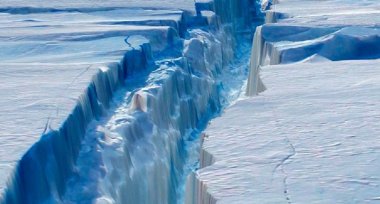
Warming oceans melting Antarctic ice shelves could accelerate sea level rise, Guardian, John Abraham, 9 May 18, “……With global warming, both of the poles are warming quite quickly, and this warming is causing ice to melt in both regions. When we think of ice melting, we may think of it melting from above, as the ice is heated from the air, from sunlight, or from infrared energy from the atmosphere. But in truth, a lot of the melting comes from below. For instance, in the Antarctic, the ice shelves extend from the land out over the water. The bottom of the ice shelf is exposed to the ocean. If the ocean warms up, it can melt the underside of the shelf and cause it to thin or break off into the ocean.
A new study, recently published in Science Advances, looked at these issues. One of the goals of this study was to better understand whether and how the waters underneath the shelf are changing. They had to deal with the buoyancy of the waters. We know that the saltier and colder water is, the denser it is.
Around Antarctica, water at the ocean surface cools down and becomes saltier. These combined effects make the surface waters sink down to the sea floor. But as ice melt increases, fresh water flows into the ocean and interrupts this buoyancy effect. This “freshening” of the water can slow down or shut down the vertical mixing of the ocean. When this happens, the cold waters at the surface cannot sink. The deeper waters retain their heat and melt the ice from below.
The study incorporated measurements of both temperature and salinity (saltiness) at three locations near the Dalton Iceberg Tongue on the Sabrina Coast in East Antarctica. The measurements covered approximately an entire year and gave direct evidence of seasonal variations to the buoyancy of the waters. The researchers showed that a really important component to water-flow patterns were ‘polynyas.’ These are regions of open water that are surrounded by ice, typically by land ice on one side and sea ice on the other side.
When waters from the polynya are cold and salty, the waters sink downwards and form a cold curtain around the ice shelf. However, when the waters are not salty (because fresh water is flowing into the polynya), this protective curtain is disrupted and warm waters can intrude from outside, leading to more ice melt.
Based on this study, we may see increased ice loss in the future – sort of a feedback loop. That concerns us because it will mean more sea level rise (which is already accelerating), and more damage to coastal communities. I asked the lead author, Alesandro Silvano about this work:
Lead author Alesandro Silvano.
We found that freshwater from melting ice shelves is already enough to stop formation of cold and salty waters in some locations around Antarctica. This process causes warming and freshening of Antarctic waters. Ocean warming increases melting of the Antarctic Ice Sheet, causing sea level to rise. Freshening of Antarctic waters weakens the currents that trap heat and carbon dioxide in the ocean, affecting the global climate. In this way local changes in Antarctica can have global implications. Multiple sources of evidence exist now to show that these changes are happening. However, what will happen in Antarctica in the next decades and centuries remains unclear and needs to be understood.
SELLING THE SCIENCE OF CLIMATE CHANGE , Climate One, 4 May 18,The scientific consensus is that human activity is cooking the planet and disrupting our economies. Yet many people still don’t believe that climate change will affect them personally. Or they deny that the problem is urgent enough to take action that would disrupt their lifestyles. Why has communicating the facts about climate change to the public been such a challenge?
“Facts don’t work by themselves,” says David Fenton, founder and chairman of Fenton Communications. “Facts only really work when one, they’re embedded in moral narratives. Secondly, facts don’t work unless they’re embedded in stories. And third, the brain only absorbs messages that are simple and that are repeated.”…….
“Part of my job,” he explains, “is to help scientists speak English and acceptable accurate drama.”
Fenton believes in exploiting the findings of cognitive science to deliver otherwise complex messages. “Only campaigns work,” he stresses, “Only the repetition – I’m repeating myself I know – of simple messages changes public opinion and affects the brain.”
Fenton notes that while it’s hard to be optimistic when you hang out with climate scientists, he remains so because the climate movement has never really tried to reach the general public at a scale similar to a national advertising campaign – let alone the disinformation campaign of the fossil fuel industry……. Climate One is presented in association with KQED Public Radio. https://climateone.org/audio/selling-science-climate-change
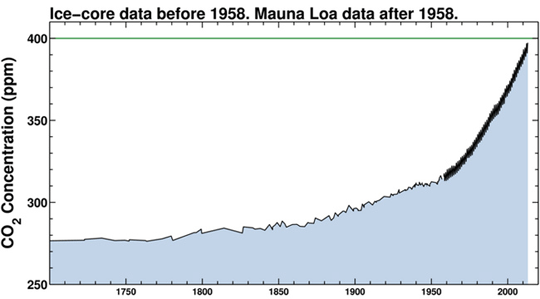
Earth’s atmosphere just crossed another troubling climate change threshold, By Chris MooneyMay 3 For the first time since humans have been monitoring, atmospheric concentrations of carbon dioxide have exceeded 410 parts per million averaged across an entire month, a threshold that pushes the planet ever closer to warming beyond levels that scientists and the international community have deemed “safe.”
The reading from the Mauna Loa Observatory in Hawaii finds that concentrations of the climate-warming gas averaged above 410 parts per million throughout April. The first time readings crossed 410 at all occurred on April 18, 2017, or just about a year ago.
Carbon dioxide concentrations — whose “greenhouse gas effect” traps heat and drives climate change — were around 280 parts per million circa 1880, at the dawn of the industrial revolution. They’re now 46 percent higher…….
The rate of growth is about 2.5 parts per million per year, said Ralph Keeling, who directs the CO2 program at the Scripps Institution of Oceanography, which monitors the readings. The rate has been increasing, with the decade of the 2010s rising faster than the 2000s. ……
“As a scientist, what concerns me the most is not that we have passed yet another round-number threshold but what this continued rise actually means: that we are continuing full speed ahead with an unprecedented experiment with our planet, the only home we have,” Katharine Hayhoe, a climate scientist at Texas Tech University, said in a statement on the milestone.
Planetary carbon dioxide levels have been this high or even higher in the planet’s history — but it has been a long time. And scientists are concerned that the rate of change now is far faster than what Earth has previously been used to.
In the mid-Pliocene warm period more than 3 million years ago, they were also around 400 parts per million — but Earth’s sea level is known to have been 66 feet or more higher, and the planet was still warmer than now.
As a recent federal climate science report (co-authored by Hahyoe) noted, the 400 parts per million carbon dioxide level in the Pliocene “was sustained over long periods of time, whereas today the global CO2 concentration is increasing rapidly.” In other words, Earth’s movement toward Pliocene-like conditions may play out in the decades and centuries ahead of us.
Climate Change Turns Coastal Property Into a Junk Bond, The returns can be great, unless the investment winds up under water. Bloomberg, By Noah Smith, May 3, 2018 “……… Even in the worst-case scenario, sea level rise will be moderate by 2050 — perhaps 1 or 2 feet along most U.S. east coast locations. And there’s a good chance it will be much less.
A rise of that magnitude doesn’t sound like a lot. But it would inundate a number of low-lying coastal areas. The National Oceanic and Atmospheric Administration’s sea level rise viewer app lets you play around with the data and look at maps. Even a moderately bad climate-change scenario could swamp some pieces of coastal real estate within a few decades.
But sea level rise isn’t a gradual, steady thing. The ocean is not a still bowl of water, but a roiling mass tossed around by winds and tides. Long before coastal areas are permanently underwater, they’ll experience increased risk of catastrophic flooding. Hurricane Harvey, which last year flooded much of the city of Houston and became the second most expensive natural disaster in U.S. history (behind another wind-induced coastal flood, 2005’s Hurricane Katrina), is probably a harbinger of more frequent storm-driven disasters.
So for the next few decades, climate change probably won’t send coastal real estate prices crashing, but it does create a tail risk for buyers. Increased probability of coastal flooding makes waterfront real estate a bit like a junk bond — something that will probably go up in value, but has a small to moderate chance of going to zero. Junk bonds generally don’t have a value of zero, but the risk of devastation definitely does depress their selling price.
Recent research confirms that the climate threat is already showing up in prices. Economists Asaf Bernstein, Matthew Gustafson and Ryan Lewis have a recent paper showing that houses exposed to sea-level rise of between 0 and 6 feet have been selling at a 7 percent discount relative to houses a similar distance from the beach that aren’t exposed. The time period they look at is 2007-2016 — before the damage from Harvey. They also confirm that the discount is higher in locations where people report more worry about climate change.
Another recent study, by environmental researchers Jesse Keenan Thomas Hill and Anurag Gumber, shows something similar. Focusing on Miami-Dade County, they show that higher-elevation locations have risen in price faster than similar locations at low elevations. That’s consistent with the theory that wealthy buyers pay a premium to escape flooding risk. High-elevation areas could also have other benefits, of course, such as increased safety from crime — but with crime down dramatically in Miami, this is a less convincing explanation of the increased elevation premium.
In fact, the price differences these economists find may be understating people’s worries about climate change, because of flood insurance. The U.S. government insures many coastal properties against floods, mostly in Texas and Florida. The National Flood Insurance Program charges below-market premiums to many of the riskiest houses, effectively subsidizing owners of the properties most vulnerable to coastal flooding.
The body is instrumental in delivering the commitments of the Paris Agreement and Kyoto Protocol to reduce carbon emissions and prevent the rise in global temperatures.
“Climate Change is the single biggest threat to life, security and prosperity on Earth,” said executive secretary Patricia Espinosa.
“This annual report shows how UN Climate Change is doing everything it can to support, encourage and build on the global response to climate change,” she added.
The report covers what UN Climate Change sees as its key achievements over the past year including its official conference, COP23, in Bonn. The 30,000 people who attended helped ensure action on climate change was maintained, including the importance of commitments before 2020.
The conference also saw financial commitments of almost $1 billion made by member states on partners. Norway led a coalition pledging $400 million to support sustainable agriculture and forest management. Germany, the UK, and others also pledged $153 million to fight deforestation in the Amazon rainforest.
The launch of the Talanoa Dialogues have been a central part of UN Climate Change’s work in 2017. This Fiji-led idea is designed to be a ‘global conversation’ to involve as many people in climate action as possible. The Dialogues aim to inform and inspire member states as they work on their climate commitments. UN Climate Change’s first-ever Gender Action Plan was also launched to increase the participation of women in the response to climate change.
The report also looks to the challenges throughout 2018, including the official adoption of the Paris Agreement’s work programme and procedures in December.
“Throughout 2018 and beyond, let us do all in our power, together, to accelerate action,” said Ms. Espinosa. “Only by doing so can we succeed in protecting our planet from climate change and securing a low-carbon, sustainable future.”
In addition, the report also details the agency’s total funding, with its running costs now reaching $98 million, covering its rolling programmes and activities. $29 million is set aside as part its core budget. Staff costs for its 400 employees are now at $1.5 million.
Melting Arctic sends a message: Climate change is here in a big way, The Conversation, Mark Serreze, Research Professor of Geography and director, National Snow and Ice Data Center, University of Colorado,
Scientists have known for a long time that as climate change started to heat up the Earth, its effects would be most pronounced in the Arctic. This has many reasons, but climate feedbacks are key. As the Arctic warms, snow and ice melt, and the surface absorbs more of the sun’s energy instead of reflecting it back into space. This makes it even warmer, which causes more melting, and so on.
This expectation has become a reality that I describe in my new book “Brave New Arctic.” It’s a visually compelling story: The effects of warming are evident in shrinking ice caps and glaciers and in Alaskan roads buckling as permafrost beneath them thaws.
But for many people the Arctic seems like a faraway place, and stories of what is happening there seem irrelevant to their lives. It can also be hard to accept that the globe is warming up while you are shoveling out from the latest snowstorm.
Since I have spent more than 35 years studying snow, ice and cold places, people often are surprised when I tell them I once was skeptical that human activities were playing a role in climate change. My book traces my own career as a climate scientist and the evolving views of many scientists I have worked with. When I first started working in the Arctic, scientists understood it as a region defined by its snow and ice, with a varying but generally constant climate. In the 1990s, we realized that it was changing, but it took us years to figure out why. Now scientists are trying to understand what the Arctic’s ongoing transformation means for the rest of the planet, and whether the Arctic of old will ever be seen again.
Guardian 25th April 2018 ,Hundreds of thousands of people will be forced from their homes on
low-lying islands in the next few decades by sea-level rises and the contamination of fresh drinking water sources, scientists have warned.
A study by researchers at the US Geological Survey (USGS), the Deltares Institute in the Netherlands and Hawaii University has found that many small islands in the Pacific and Indian Oceans will be uninhabitable for humans by the middle of this century. That is much earlier than previously thought.
Experts say the findings underline the looming climate change driven migration crisis that is predicted to see hundreds of millions of people forced from their homes in the coming years. More than half a
million people around the world live on atoll islands, often extraordinary and beautiful structures based on coral reefs. Their closeness to sea level makes them particularly vulnerable to climate change. https://www.theguardian.com/environment/2018/apr/25/climate-change-to-drive-migration-from-island-homes-sooner-than-thought
Russian Arctic glacier loss doubles as temps warm https://www.eurekalert.org/pub_releases/2018-04/cu-rag042518.php, CORNELL UNIVERSITY , 25 Apr 18, ITHACA, N.Y.– Ice mass loss in the Russian Arctic has nearly doubled over the last decade according to Cornell University research published in the journal Remote Sensing of Environment.
The research focused on Franz Josef Land, a glaciated Russian archipelago in the Kara and Barents seas – among the northernmost and most remote parcels of land on Earth.
“Glaciers there are shrinking by area and by height. We are seeing an increase in the recent speed of ice loss, when compared to the long-term ice-loss rate,” said lead researcher Whyjay Zheng, a Cornell University doctoral student in geophysics. “We are finding out that the ice is changing more rapidly than we previously thought,” said Zheng. “The temperature is changing in the Arctic faster than anywhere else in the world.”
From 1953 to 2010, the average rate of ice surface loss was 18 centimeters per year. From 2011 to 2015, the ice surface decrease was 32 centimeters per year, which is a water loss of 4.43 gigatons annually, said Zheng. For perspective, that much water would raise the level of Cayuga Lake — the longest of New York state’s Finger Lakes, at 38 miles — by 85 feet and inundate the cities of Ithaca and Seneca Falls.
he Arctic has been warming in recent decades, but glaciers across the region are responding in different ways. “Previous studies have shown that the glaciers in northern Canada seem to be shrinking at a faster rate than the ones in some parts of northern Russia,” said senior author Matt Pritchard, Cornell professor of geophysics.
“Our work takes a closer look at the Russian glaciers to understand why they might be responding to a warming Arctic differently than glaciers in other parts of the Arctic. Why glaciers in Franz Josef Land have been shrinking more rapidly between 2011 and 2015 than in previous decades is possibly related to ocean temperature changes,” said Pritchard.
###
Support for Zheng’s research was provided by an Overseas Ph.D. Scholarship funded by the Ministry of Education, Taiwan.
Cornell University has television, ISDN and dedicated Skype/Google+ Hangout studios available for media interviews.
https://www.eurekalert.org/pub_releases/2018-04/ugs-ml042318.php, US GEOLOGICAL SURVEY
Sea-level rise and wave-driven flooding will negatively impact freshwater resources on many low-lying atoll islands in such a way that many could be uninhabitable in just a few decades. According to a new study published in Science Advances, scientists found that such flooding not only will impact terrestrial infrastructure and habitats, but, more importantly, it will also make the limited freshwater resources non-potable and, therefore, directly threaten the sustainability of human populations.
Most of the world’s atolls are in the Pacific and Indian oceans. The scientists focused on Roi-Namur Island on Kwajalein Atoll in the Republic of the Marshall Islands for their site study from November 2013 to May 2015. The Republic of the Marshall Islands has more than 1,100 low-lying islands on 29 atolls, is home for numerous island nations and hundreds of thousands of people.
Scientists from the U.S. Geological Survey, Deltares, National Oceanic and Atmospheric Administration, and the University of Hawai?i at Mānoa used a variety of climate-change scenarios to project the impact of sea-level rise and wave-driven flooding on atoll infrastructure and freshwater availability. The approach and findings in this study can serve as a proxy for atolls around the world, most of which have a similar morphology and structure, including, on average, even lower land elevations.
“The tipping point when potable groundwater on the majority of atoll islands will be unavailable is projected to be reached no later than the middle of the 21st century,” said Curt Storlazzi, USGS geologist and lead author of the new report.
Sea levels are rising, with the highest rates in the tropics, where thousands of low-lying coral atoll islands are located. Previous studies on the resilience of these islands to sea-level rise projected they will experience minimal inundation impacts until at least the end of the 21st century. However, those previous studies did not take into account the additional hazard of wave-driven overwash (storm waters and waves that wash up and over the low-lying island) nor its impact on freshwater availability.
“Such information is key to assess multiple hazards and prioritize efforts to reduce risk and increase the resiliency of atoll islands’ communities around the globe,” said Storlazzi.
These findings have relevance not only to populated atoll islands in the Marshall Islands, but also to those in the Caroline Islands, Cook Islands, Gilbert Islands, Line Islands, Society Islands, Spratly Islands, Maldives, Seychelles, and Northwestern Hawaiian Islands.
Thus, the study scientists project that, based on current global greenhouse gas emission rates, the interactions between sea-level rise and wave dynamics over coral reefs will lead to an annual wave-driven overwash of most atoll islands by the mid-21st century. Such annual flooding would result in the islands becoming uninhabitable due to frequent damage to infrastructure and the inability of their freshwater resources to recover between overwash events.
The primary source of freshwater for populated atoll islands is rain that soaks into the ground and remains there as a layer of fresh groundwater that floats on top of denser saltwater. As atoll islands come to be overwashed annually, on average, in the next few decades (assuming current greenhouse gas emission rates), flooding impacts to infrastructure and the loss of freshwater resources would make human habitation difficult in most locations beginning between the 2030s to 2060s, requiring the relocation of island inhabitants or significant financial investments in new infrastructure.
“The overwash events generally result in salty ocean water seeping into the ground and contaminating the freshwater aquifer. Rainfall later in the year is not enough to flush out the saltwater and refresh the island’s water supply before the next year’s storms arrive repeating the overwash events,” explained Stephen Gingerich, USGS hydrologist and co-author of the new report.
The full report, “Most Atolls will be uninhabitable by the mid-21st century due to sea-level rise exacerbating wave-driven flooding,” in Science Advances is available online.
No more drilling. Af, CARLY CASSELLA, 13 APR 2018 Prime Minister Jacinda Ardern is doing everything in her power to wean New Zealand off fossil fuels.
This week, the New Zealand government announced it will no longer grant any new offshore oil exploration permits. The 22 permits that have already been issued are set to expire in 2030.
The new Prime Minister, who took office last year, says this is all part of her aggressive, long-term plan to move towards a carbon-neutral future.
Special vehicles are required to move the casks, as are specially built roads that can handle the immense weight.
“We don’t know if this highly dangerous material will be there for another 100 years or a thousand years.
if the casks are not moved in the coming decades, or even centuries, they worry about who would ultimately be responsible for protecting the nuclear waste. It’s unlikely, for example, that Entergy will still own the property, they say.
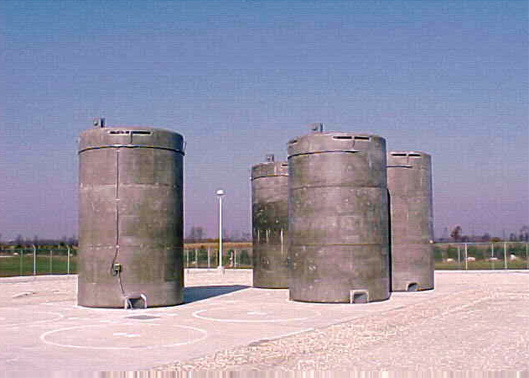
On a concrete pad about 25 feet above Plymouth Bay, eight massive steel-reinforced concrete cylinders hold the remains of the radioactive fuel that has kept the Pilgrim Nuclear Power Station running since the 1970s.
When the plant begins decommissioning next year, Pilgrim officials expect to fill another 54 of the so-called dry casks, which are 18 feet tall, weigh 360,000 pounds, and emit small amounts of radiation. The concrete pad is a little more than 200 feet from the shoreline.
The problem is where to store the nuclear waste — especially since its current location won’t stay 25 feet above Plymouth Bay for long.
As sea levels rise at an accelerating rate, increasing the threat that an extreme storm surge could flood the coastal facility, Pilgrim officials are considering whether to move the spent fuel to higher ground.
Plant officials and federal regulators maintain that the current location is safe, at least for the foreseeable future, noting that the containers are designed to withstand flooding. But local activists are urging Pilgrim to take action, worried that the daunting political obstacles to moving the casks to a federal repository could force them to remain in Plymouth permanently.
“Not moving them would be irresponsible,” said Pine duBois, executive director of the Jones River Watershed Association in Kingston, which is about 8 miles from Pilgrim. “We don’t know if this highly dangerous material will be there for another 100 years or a thousand years. It has to be moved.”
Environmental advocates are calling on the state to require Entergy Corp., the Louisiana-based conglomerate that owns Pilgrim, to move the casks to its helipad or parking lot, which are three times higher than the existing storage site and set further back from the water.
Plant officials and federal regulators maintain that the current location is safe, at least for the foreseeable future, noting that the containers are designed to withstand flooding. But local activists are urging Pilgrim to take action, worried that the daunting political obstacles to moving the casks to a federal repository could force them to remain in Plymouth permanently.
“Not moving them would be irresponsible,” said Pine duBois, executive director of the Jones River Watershed Association in Kingston, which is about 8 miles from Pilgrim. “We don’t know if this highly dangerous material will be there for another 100 years or a thousand years. It has to be moved.”
Environmental advocates are calling on the state to require Entergy Corp., the Louisiana-based conglomerate that owns Pilgrim, to move the casks to its helipad or parking lot, which are three times higher than the existing storage site and set further back from the water.
Despite the concerns, plant officials say the casks are secure……….
Under recent worst-case projections, tides could rise as much as 10 feet by the end of the century and as much as 37 feet by 2200. That’s not accounting for storm surges, such as the 15-foot high tides that battered the Massachusetts coast during two nor’easters this winter, causing widespread flooding. …….
Under recent worst-case projections, tides could rise as much as 10 feet by the end of the century and as much as 37 feet by 2200. That’s not accounting for storm surges, such as the 15-foot high tides that battered the Massachusetts coast during two nor’easters this winter, causing widespread flooding………
The decision about where to store the casks comes as the 46-year-old plant faces a host of maintenance challenges. Entergy announced three years ago that it would close Pilgrim in June 2019, after a litany of economic woes and safety issues. In 2015, the NRC designated Pilgrim as one of the nation’s three least-safe reactors.
Those problems have persisted. Until Thursday, the plant had been offline for 43 days — one of its longest unplanned outages — after crews discovered a significant issue with a transformer that provides power for Pilgrim to operate. It was the second unplanned shutdown this year.
Plant officials must also weigh a range of other issues in deciding whether to move the waste, including security, radiation, and the impact on decommissioning the plant.
Cost is another factor.
Special vehicles are required to move the casks, as are specially built roads that can handle the immense weight. For example, at Vermont Yankee, which began the decommissioning process several years ago, it cost $143 million to fill and move their remaining casks to a new storage site.
Moving the casks uphill would add to the expense, and plant officials have not ruled out building a new storage pad adjacent to the existing one, which is only about 100 feet from the reactor building.
Storing nuclear waste has long been a thorny political issue, one that has become increasingly urgent as more aging plants are shuttered………
For local activists who have long raised concerns about the dangers of nuclear power, the assurances of Pilgrim and the NRC provide little comfort.
While the casks may not leak from being submerged for a brief period, they could be subject to corrosion from exposure to saltwater, which could create cracks and eventually lead to leaks, they said.
And if the casks are not moved in the coming decades, or even centuries, they worry about who would ultimately be responsible for protecting the nuclear waste. It’s unlikely, for example, that Entergy will still own the property, they say.
“We need a plan for the next 100 to 300 years,” said Mary Lampert, director of Pilgrim Watch, a civic watchdog group. “I don’t see that happening.”
On the 20th anniversary of the graph that galvanized climate action, it is time to speak out boldly
By Michael E. Mann on April 20, 2018 Two decades ago this week a pair of colleagues and I published the original “hockey stick” graph in Nature, which happened to coincide with the Earth Day 1998 observances. The graph showed Earth’s temperature, relatively stable for 500 years, had spiked upward during the 20th century. A year later we would extend the graph back in time to A.D. 1000, demonstrating this rise was unprecedented over at least the past millennium—as far back as we could go with the data we had.
Although I didn’t realize it at the time, publishing the hockey stick would change my life in a fundamental way. I was thrust suddenly into the spotlight. Nearly every major newspaper and television news networkcovered our study. The widespread attention was exhilarating, if not intimidating for a science nerd with little or no experience—or frankly, inclination at the time—in communicating with the public.
Nothing in my training as a scientist could have prepared me for the very public battles I would soon face. The hockey stick told a simple story: There is something unprecedented about the warming we are experiencing today and, by implication, it has something to do with us and our profligate burning of fossil fuels. The story was a threat to companies that profited from fossil fuels, and government officials doing their bidding, all of whom opposed efforts to reduce greenhouse gas emissions. As the vulnerable junior first author of the article (I was a postdoctoral researcher), I found myself in the crosshairs of industry-funded attack dogs looking to discredit the iconic symbol of the human impact on our climate…by discrediting me personally.
In my 2013 book, The Hockey Stick and the Climate Wars: Dispatches from the Front Lines, I gave a name to this modus operandi of science critics: the Serengeti strategy. The term describes how industry special interests and their facilitators single out individual researchers to attack, in much the same way lions of the Serengeti single out an individual zebra from the herd. In numbers there is strength; individuals are far more vulnerable.
The purpose of this strategy, still in force today, is twofold: to undermine the credibility of the science community, thus impairing scientists as messengers and communicators; and to discourage other researchers from raising their heads above the parapet and engaging in public discourse over policy-relevant science. If the aggressors are successful, as I have argued before, we all lose out—in the form of policies that favor special interests over our interests.
As the Serengeti strategy has been deployed against me, I have beenvilified on the editorial pages of The Wall Street Journal and other conservative media outlets, and subject to inquisitions by fossil fuel industry–funded senators, congressmen and attorneys general. My e-mails have been stolen, cherry-picked, taken out of context and broadcast widely in an effort to embarrass and discredit me. I have been subject to vexatious, open-records law requests by fossil fuel industry–funded front groups for my personal e-mails and numerous other documents. I have experienced multiple death threats and have endured threats against my family members. All because of the inconvenience my scientific findings posed to powerful and influential special interests.
Yet, in the 20 years since the original hockey stick publication, independent studies again and again have overwhelmingly reaffirmed our findings, including the key conclusion: recent warming is unprecedented over at least the past millennium. The highest scientific body in the U.S., the National Academy of Sciences, affirmed our findings in an exhaustive independent review published in June 2006. Dozens of groups of scientists have independently reproduced, confirmed and extended our findings, including a team of nearly 80 scientists from around the world who in 2013 published their finding in the premier journal Nature Geoscience that recent warmth is unprecedented in at least the past 1,400 years.
The latest report of the Intergovernmental Panel on Climate Change, the most authoritative and exhaustive assessment of climate science on the planet, concluded recent warmth is likely unprecedented over an even longer time frame than we had concluded. There is tentative evidence, in fact, that the current warming spike is unprecedented in tens of thousands of years.
Of course, the hockey stick is only one of numerous lines of evidence that have led the world’s scientists to conclude climate change is (a) real, (b) caused by burning fossil fuels, along with other human activities and (c) a grave threat if we do nothing about it. There is no legitimate scientific debate on those points, despite the ongoing effort by some people and groups to convince the public otherwise.
Their preferred tactic is to exaggerate the uncertainty in models that project where climate change is heading and argue such uncertainty is a cause for inaction, when precisely the opposite is the case. Arctic sea ice is disappearing faster than the climate models have predicted. The Greenland and Antarctic ice sheets appear prone to collapse sooner than we previously thought—and with that, estimates of the sea level rise we could see by the end of this century have doubled from previous estimates of about three feet to more than six feet. If anything, climate model projections have proved overly conservative; they are certainly not an exaggeration.
Scientists are finding other examples as well. In part as a result of our own work three years ago, there is an emerging consensus—as publicized in recent news accounts—that the “conveyor belt” of ocean circulation may be weakening sooner than we expected. The conveyor delivers warm waters from the tropics to the higher latitudes of the North Atlantic, supporting vibrant fish communities there and moderating climates in western Europe and eastern North America. The earlier melt of Greenland ice, it appears, is freshening the surface waters of the subpolar North Atlantic, inhibiting the sinking of cold, salty water that helps drive the conveyor.
When the hockey stick was first attacked in the late 1990s I was initially reluctant to speak out, but I realized I had to defend myself against a cynical assault on my science and on me. I have come to embrace that role. What more noble cause is there than to fight to preserve our planet for our children and grandchildren?
There is great urgency to act now if we are to avert a dangerous 2- degree Celsius (3.6-degree Fahrenheit) planetary warming. My own recent work suggests the challenge is greater than previously thought. Yet I remain cautiously optimistic we will act in time. Along with many other Americans, I have been inspired by the renewed enthusiasm of our youth, who are demanding action now when it comes to the societal and environmental threats they face. Indeed, I have committed myself to helping insure a future in which we avoid catastrophic climate change. So let me conclude with this exhortation from the epilogue of The Hockey Stick and the Climate Wars:
“While slowly slipping away, that future is still within the realm of possibility. It is a matter of what path we choose to follow. I hope that my fellow scientists—and concerned individuals everywhere—will join me in the effort to make sure we follow the right one.”
The Trump Administration Just Hatched Another Plan to Buoy Coal and Nuclear
Welcome to the third act of the administration’s emergency plan to save its favorite fuels. GreenTech Media , EMMA FOEHRINGER MERCHANTAPRIL 20, 2018
The Trump administration is mulling the use of a Truman-era law to make good on the promise to restore the coal industry, according to a Thursday report from Bloomberg.
The Defense Production Act of 1950 offers the president power to implement subsidies for domestically produced materials in the name of national defense and also claims “it is necessary and appropriate to assure the availability of domestic energy supplies.”
Per reports, the Trump administration believes his authority under the law could be a way to help out nuclear and coal plants, and one that may have a better chance against judicial scrutiny.
So far, the administration hasn’t found a winning strategy for saving the two ailing industries.
The Federal Energy Regulatory Commission rebuffed one attempt to help coal and nuclear in January when it rejected Energy Secretary Rick Perry’s plan to provide support for plants with 90 days of fuel on site. It opted instead to open its own resilience proceeding.
FirstEnergy in March requested the Department of Energy use its emergency authority under Section 202(c) of the Federal Power Act to provide a lifeline to its coal and nuclear plants. The department has not yet made a decision on the request.
Guardian 11th April 2018, The warm Atlantic current linked to severe and abrupt changes in the
climate in the past is now at its weakest in at least 1,600 years, new research shows.
The findings, based on multiple lines of scientific evidence, throw into question previous predictions that a catastrophic
collapse of the Gulf Stream would take centuries to occur. Such a collapse
would see western Europe suffer far more extreme winters, sea levels rise
fast on the eastern seaboard of the US and would disrupt vital tropical
rains.