Tense political situation of mass migration – climate change compound s this problem
 A Warming World Creates Desperate People, NYT, By Lauren Markham, Ms. Markham is a freelance reporter who writes about migration and the environment. June 29, 2018 Last year I traveled to southern Guatemala, the source of one of the largest migrations of unauthorized immigrants to the United States in recent years. It’s clear why people are leaving: Guatemala is a country rife with political conflict, endemic racism against indigenous people, poverty and, increasingly, gang violence.
 But there’s another, lesser-known dimension to this migration. Drought and rising temperatures in Guatemala are making it harder for people to make a living or even survive, thus compounding the already tenuous political situation for the 16.6 million people who live there.
……….. Long before the unconscionable family-separation catastrophe at our southern border, President Trump had made the battle against illegal immigrants the rallying cry of his campaign and administration. He wants to lock up more immigrants — including toddlers — as a deterrent while casting all new unauthorized immigrants as potential, if not probable, violent criminals. Simultaneously, the president’s team has taken on the environment, doing nearly everything it can to walk back decades of regulation intended to protect our air, water and land. Last June, Mr. Trump pulled out of the Paris climate accord. Meanwhile, Scott Pruitt, the administrator of the Environmental Protection Agency, is doggedly eviscerating the agency he runs.
Today, according to global relief agencies, over 68 million people worldwide have been forced to flee their homes, often because of war, poverty and political persecution. As a writer, I focus largely on issues of forced migration. The hundreds of migrants I’ve interviewed in the past few years — whether from Gambia, Pakistan, El Salvador, Guatemala, Yemen or Eritrea — are most often leaving because of some acute political problem at home. But I’ve also noticed something else in my years of reporting. If you talk to these migrants long enough, you’ll hear about another, more subtle but still profound dimension to the problems they are leaving behind: environmental degradation or climate change.
The United Nations High Commissioner for Refugees estimates that since 2008, 22.5 million people have been displaced by climate-related or extreme weather events. This includes tragedies like the widespread famine in Darfur, monsoons and flooding in Bangladesh and the catastrophic hurricane in Puerto Rico. The more out of whack our climate becomes, the more people up and leave their homes. As our world heats up and sea levels rise, the problem of forced migration around the world is projected to become far worse.
And in refusing to take climate change or responsibility for our planet seriously, the Trump administration is encouraging the conditions that will increase unauthorized migrations to the United States and elsewhere.
…….. Many things are exacerbating the effects of the drought in Central America, including pervasive deforestation and farmers overtaxing their land. But according to Climatelinks, a project of the United States Agency for International Development, the average temperature in El Salvador has risen 2.34 degrees Fahrenheit since the 1950s, and droughts have become longer and more intense. The sea has risen by three inches since the 1950s, and is projected to rise seven more by 2050. Between 2000 and 2009, 39 hurricanes hit El Salvador, compared with 15 in the 1980s. This, too, is predicted to get worse………..
Like El Salvador, Gambia, Bangladesh and Guatemala, Ethiopia has been hit hard by climate change, though it is not even in the top 100 emitters of greenhouse gases. But the problem with climate change, of course, is that it is a problem that crosses borders.
The anti-immigrant rhetoric of the Trump administration has made for elaborate and bombastic theater — but with real, and sometimes deadly, human consequences (see again the children separated from their parents at the border). But Mr. Trump means what he says: He wants immigration from poor countries to stop. He sees the problems in those countries as theirs, not ours — never mind the centuries of catastrophic foreign intervention in places like El Salvador and the rest of the Americas, the Arab world and sub-Saharan Africa, or the growing menace of the changing climate.
If President Trump really wants to curb “illegal” migration to the United States for the long haul, he’d better get serious about climate change. The Trump administration can continue to eviscerate the E.P.A. and thumb its nose at global efforts to protect the climate. Or he can work responsibly to try to curb international migration by addressing the challenges of a warming planet.
Arctic climate change: The northern Barents Sea has warmed 1.5 degrees Celsius in just 18 years

Huge part of Arctic ocean is shifting to an Atlantic climate, study finds
The northern Barents Sea has warmed 1.5 degrees Celsius in just 18 years, Independent, Chris Mooney 28 June 1
South Asia will cop huge climate change effects over the coming decades

Half of South Asia living in vulnerable climate ‘hotspots’: World Bank https://www.reuters.com/article/us-south-asia-climatechange-worldbank/half-of-south-asia-living-in-vulnerable-climate-hotspots-world-bank-idUSKBN1JO2AV, Malini Menon– 29 June 18
NEW DELHI (Reuters) – Changes in temperature and rainfall will impact almost half of South Asia in the coming decades, reducing economic growth in one of the world’s poorest regions, the World Bank said.
A World Bank report released on Thursday analyses two scenarios – “climate sensitive”, based on collective action by nations to limit greenhouse gas emissions, and “carbon intensive”, which assumes no action on climate change.
The report combines future changes in temperature and rainfall with household survey data linking living standards to weather conditions for the first time.
More than 800 million people now live in areas predicted to become moderate-to-severe “hotspots”, or affected areas, by 2050 under the carbon intensive scenario, with India accounting for almost three quarters of them, the report said.
Moderate hotspots are areas where projected consumption spending declines by 4-8 percent and severe ones are where the drop exceeds 8 percent.
“There seems to be some kind of correlation between climate hotspots and water stressed areas,” Muthukumara Mani, a World Bank economist, said.
The World Bank’s expectation of about half of India living in moderately or severely-affected areas by 2050 tallies with a federal think tank’s report two weeks ago. This warned that 600 million Indians could suffer high to extreme water stress as the country faces the worst long-term water crisis in its history.
Rising temperature and changing monsoon rainfall patterns from climate change could cost India 2.8 percent of gross domestic product (GDP) and depress the living standards of one in every two Indians by 2050, the World Bank report said.
What happened last time it was as warm as it’s going to get later this century?
Kids today will be grandparents when most climate projections end—does the past have more hints? Ars Technica –
Wildfire danger s are increasing, due to climate change
How climate change is increasing the risk of wildfires, The Conversation, Senior Lecturer in GIS and Ecology, Anglia Ruskin University,
The army has been called in to help firefighters deal with a huge wildfire on Saddleworth Moor, Greater Manchester, where residents have been forced to evacuate. Wildfires are also blazing across Northern Californiawhile the issue of bushfires in Australia calls for constant vigilance from the emergency services there. These fires are becoming more common and one of the reasons for this is climate change.
Warmer temperatures in the summer and associated drier conditions desiccate plant materials and create more vegetation litter, providing more fuel for these fires. Several studies have linked the increase of wildfires with climate change in various parts of the world, such as North America and Southern Europe.
For example, a study in California from 2004 found that the warmer and windier weather (brought about by an atmosphere with higher levels of CO2) produced fires that burned more intensely and spread faster in most locations. Despite enhanced firefighting efforts, the number of escaped fires (those exceeding initial containment limits) increased by 51% in the south San Francisco Bay area, 125% in the Sierra Nevada.
It has also been demonstrated that increases in rainfall during winter and spring – which are also known consequences of climate change – provide more favourable conditions for plant growth and therefore more potential fuel for the fires later in the summer.
Even though climate change increases the vulnerability of dry environments to wildfires, a source of ignition is still required. In the UK, it can be natural (such as bolts of lightning) or caused by man either deliberately or accidentally. Various studies have shown that the number of recreational visits to “risky” sites, such as the English Peak District, increase the occurrence of wildfire.
Despite its destructive power, fire is an important ecological process that can benefit several endangered species by maintaining their habitat. It is an important tool in the management and preservation of heathlands and moorlands in the UK when used appropriately and in a controlled way.
But climate change and human activities increase the vulnerability of those habitats to uncontrolled wildfires and higher population densities near these areas will potentially put more people and houses at risk. In addition to the global battle against climate change, appropriate management procedures are necessary to maintain those habitats and ensure the risks of uncontrolled fires are minimised and the potential spread of them reduced. https://theconversation.com/how-climate-change-is-increasing-the-risk-of-wildfires-99056
Climate change linked to potential population decline in bees
Study finds that warmer temperatures push bees to their physiological limits, may drive local extinction, Science daily
- Date:
- June 28, 2018
- Source:
- Northwestern University
- Summary:
- A new study has found that climate change may drive local extinction of mason bees in Arizona and other naturally warm climates.
A new study from Northwestern University and the Chicago Botanic Garden has found that climate change may drive local extinction of mason bees in Arizona and other naturally warm climates.
In a two-year, in situ field experiment that altered the temperature of the bees’ nests to simulate a warmer, future climate, 35 percent of bees died in the first year and 70 percent died in the second year. This is compared to a 1-2 percent mortality rate in the control group.
“The projected temperatures appear to be pushing this species up against its physiological limits,” said Northwestern’s Paul CaraDonna, who led the research. “This is evidence that we might see local extinction in the warmer parts of this species’ range, which is pretty sobering.”
-
The study will publish online on Thursday, June 28 in the British Ecological Society’s journal Functional Ecology. CaraDonna is an assistant professor of instruction in the Program in Plant Biology and Conservation in Northwestern’s Weinberg College of Arts and Sciences and a research scientist at the Chicago Botanic Gardens…….https://www.sciencedaily.com/releases/2018/06/180628105009.htm
With climate change, it’s unwise for UK to build Hinkley Point C, as sea levels are rising
 Weatherwatch: the nuclear option and rising levels of anxiety Danger of coastal flooding might make sensible people think twice about building houses in vulnerable places, let alone nuclear power stations, Guardian, https://www.theguardian.com/news/2018/jun/22/weatherwatch-the-nuclear-option-and-rising-levels-of-anxiety Paul Brown,
Back in 2012 a document obtained under the Freedom of Information Act showed that the Environment Agency was warning that 12 out of the UK’s 19 nuclear sites were in danger of coastal flooding and erosion because of climate change. Among them was Hinkley Point in Somerset, one of the eight proposed sites for new nuclear power stations around the coasts.That was before the increasing volume of melting of the Greenland ice capwas properly understood and when most experts thought there was no net melting in the Antarctic.
Melting ice sheets are hastening sea level rise, satellite data confirms
Satellite measurements released earlier this month and other recent observations of how warmer seas are eroding ice shelves and glaciers have removed uncertainty.
Estimates of sea level rise in the next 50 years have gone up from less than 30cm to more than a metre, well within the lifespan of the nuclear stations the UK government has planned.
The extra coastal erosion and threat of storm surges that this increase in sea level will bring to our shores might make sensible people think twice about siting any buildings in vulnerable places, let alone nuclear power stations.
So far, however, the government has yet to respond and is pressing ahead with its plans.
The world needs now to recognise climate refugees
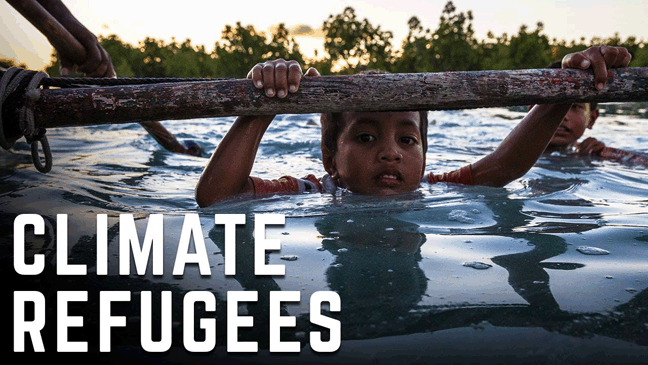
TIM MCDONNELL , This month, diplomats from around the world met in New York and Geneva to hash out a pair of new global agreements that aim to lay out new guidelines for how countries should deal with an unprecedented surge in the number of displaced people, which has now reached 65.6 million worldwide.
But there’s one emerging category that seems to be getting short shrift in the conversation: so-called “climate refugees,” who currently lack any formal definition, recognition or protection under international law even as the scope of their predicament becomes more clear.
Since 2008, an average of 24 million people have been displaced by catastrophic weather disasters each year. As climate change worsens storms and droughts, climate scientists and migration experts expect that number to rise.
Meanwhile, climate impacts that unravel over time, like desert expansion and sea level rise, are also forcing people from their homes: A World Bank report in March projects that within three of the most vulnerable regions — sub-Saharan Africa, South Asia and Latin America — 143 million people could be displaced by these impacts by 2050.
In Bangladesh, hundreds of thousands of people are routinely uprooted by coastal flooding, many making a treacherous journey to the slums of the capital, Dhaka. In West Africa, the almost total disappearance of Lake Chad because of desertification has empowered terrorists and forced more than four million people into camps.
It’s a problem in the United States as well. An estimated 2,300 Puerto Rican familiesdisplaced by Hurricane Maria are still looking for permanent housing, while government officials have spent years working to preemptively relocate more than a dozen small coastal communities in Alaska and Louisiana that are disappearing into the rising sea.
A December study by Columbia University climate researchers in the peer-reviewed journal Science projected that if global temperatures continue their upward march, applications for asylum to the European Union could increase 28 percent to nearly 450,000 per year by 2100.
Leaked UN draft report – world is on track to exceed 1.5C of warming
 Guardian 15th June 2018 The world is on track to exceed 1.5C of warming unless countries rapidly implement “far-reaching” actions to reduce carbon emissions, according to a draft UN report leaked to Reuters. The final draft report from the UN’s intergovernmental panel on climate change (IPCC) was due for publication in
October. It is the guiding scientific document for what countries must do to combat climate change.
Human-induced warming would exceed 1.5C by about 2040 if emissions continued at their present rate, the report found, but countries could keep warming below that level if they made “rapid and far reaching” changes.
Under the 2015 Paris climate agreement, almost 200 countries signed up to limit global temperature rises to well below 2C above pre-industrial levels and to pursue efforts to limit the temperature increase to 1.5C. Climate scientist and Climate Analytics director Bill Hare said the draft report showed with greater clarity how much faster countries needed to move towards decarbonisation under various temperature situations and that the impacts of climate change greatly increased between 1.5C and 2C of warming.
Necessary actions include making the transition to renewable energy, powering the transport sector with zero carbon electricity, improving agricultural management and stopping deforestation.
https://www.theguardian.com/environment/2018/jun/15/leaked-un-draft-report-warns-of-urgent-need-to-cut-global-warming
Scientists predict millions of climate refugees – but where will they go?
Universal migration predicts human movements under climate change, Physics World, 12 Jun 2018
Faster global warming predicted, with new Antarctic study
Climate Central By Mikayla Mace, Arizona Daily Star 10 June 18
A group of scientists, including one from the University of Arizona, has new findings suggesting Antarctica’s Southern Ocean — long known to play an integral role in climate change — may not be absorbing as much pollution as previously thought.
To reach their contradictory conclusion, the team used state-of-the-art sensors to collect more data on the Southern Ocean than ever before, including during the perilous winter months that previously made the research difficult if not impossible.The old belief was the ocean pulled about 13 percent of the world’s carbon dioxide — a greenhouse gas that contributes to climate change — out of the atmosphere, helping put the brakes on rising global temperatures.
Some oceanographers suspect that less CO2 is being absorbed because the westerlies — the winds that ring the southernmost continent — are tightening like a noose. As these powerful winds get more concentrated, they dig at the water, pushing it out and away.
Water from below rises to take its place, dragging up decaying muck made of carbon from deep in the ocean that can then either be released into the atmosphere in the form of CO2 or slow the rate that CO2 is absorbed by the water. Either way, it’s not good.
The Southern Ocean is far away, but “for Arizona, this is what matters,” said Joellen Russell, the University of Arizona oceanographer and co-author on the paper revealing these findings. “We don’t see the Southern Ocean, and yet it has reached out the icy hand.”
Oceans, rivers, lakes and vegetation can moderate extreme changes in temperature. Southern Arizona has no such buffers, leaving us vulnerable as average global temperatures march upward.
“Everybody asks, ‘Why are you at the UA?’” Russell said about studying the Southern Ocean from the desert at the University of Arizona. She said the research is important to Arizona and the university supports her work.
…….. scientists know less about the Southern Ocean than the rest of the world’s oceans. What they do know is mostly limited to surface CO2 levels in the summer, when it’s safer to take measurements by ships with researchers aboard. Shipboard sensors that directly measure CO2 are the accepted scientific standard in these types of studies.
Understanding CO2 levels within the air, land and sea and how it is exchanged between the three is necessary for making more accurate future climate predictions.
To fill the gap in knowledge, Russell and her team have deployed an array of cylindrical tanks, called floats, that collect data on carbon and more in the Southern Ocean year-round. Russell leads the modeling component of this project called Southern Ocean Carbon and Climate Observations and Modeling, or SOCCOM.
The floats drift 1,000 meters below the surface. Every 10 days, they plunge a thousand meters deeper, then bob up to the surface before returning to their original depth.
For three years, 35 floats equipped with state-of-the-art sensors the size of a coffee cup have been collecting data along the way and beaming it back to the researchers, like Russell in Tucson. Within hours, the data is freely available online.
They measure ocean acidity, or pH, and other metrics to understand the biogeochemistry of the elusive ocean, but not without controversy.
Making a splash
Alison Gray, an oceanographer at the University of Washington, is the lead author on the study. She said there are two reasons the study may contradict what has previously been thought of about the Southern Ocean: The lack of winter-time observations at the ocean by other researchers and the fact that ocean carbon levels might vary throughout the year.
So while SOCCOM is making it possible to get more data than ever before, others question her nontraditional methods. ………http://www.climatecentral.org/news/antarctic-ocean-discovery-warns-of-faster-global-warming-21865
President Trump’s conference wrecking strategy on climate action, at G7 meeting in Canada
“CANADA, FRANCE, GERMANY, ITALY, JAPAN THE UK AND THE EUROPEAN UNIONREAFFIRM THEIR STRONG COMMITMENT TO IMPLEMENT THE PARIS AGREEMENT, THROUGH AMBITIOUS CLIMATE ACTION”
“PRESIDENT TRUMP’S WRECKING BALL APPROACH TO INTERNATIONAL DIPLOMACY LEFT HIM UTTERLY ISOLATED AT THE G7 SUMMIT,”

Six of the G7 Commit to Climate Action. Trump Wouldn’t Even Join Conversation. https://insideclimatenews.org/news/10062018/g7-summit-climate-change-communique-trump-allies-estranged-germany-france-canada
Trump skipped the formal climate discussions, had the U.S. negotiators promote fossil fuels instead, and then renounced the group’s official communique. BY STAFF, INSIDECLIMATE NEWS JUN 10, 2018
Tons of water poured in by planes, to major wildfire inside the Chernobyl ‘dead zone’

 Large fire ravages Chernobyl Exclusion Zone, tons of water poured in by planes https://www.rt.com/news/428807-chernobyl-exclusion-zone-fire/
The fire inside the Chernobyl ‘dead zone,’ which is now part of Ukraine, started on Tuesday morning, when dry grass was ignited, local emergency services said in a statement. The wildfire subsequently reached a forest, where up to 10 hectares (24 acres) are now in flames.
Some 29 vehicles and 126 personnel have been dispatched at the scene, with several planes and helicopters dropping water from the sky on the area engulfed by wildfire.
The zone saw another large blaze last year, which scorched 25 hectares (60 acres) of land.
Chernobyl became the site of one of the biggest nuclear disasters in history, when a local power reactor blew up in 1986, leading to massive contamination of the surrounding area. The severely damaged reactor was sealed off by a protective ‘sarcophagus’ of steel and concrete, while the nearby town of Pripyat had its 50,000 population evacuated. Today, Pripayt is a ghost town. The so-called ‘exclusion zone’ was imposed around the site of the disaster, banning visitors.
Current winds are not blowing residual pollution towards the country’s capital Kiev, local authorities said, noting that radiation levels remain normal.
No surprise that Donald Trump is a no-show at G7 climate meeting
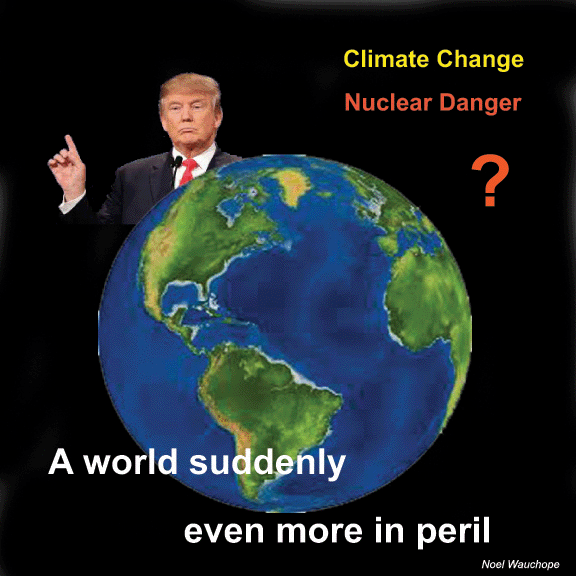 Donald Trump Is Reportedly Skipping The G7 Climate Meeting & It’s No Surprise, Elite Daily By Hannah Golden 9 June 18, The annual Group of 7 (G7) summit of world leaders was just kicking off on Friday afternoon, but for the U.S. president, the conference will be cut short. President Donald Trump is reportedly skipping the G7 climate meetings, the White House announced, per CNN. The announcement came Thursday amid a contentious series of exchanges on trade with his foreign counterparts on Twitter.
The summit — this year held in Canada — begins June 8 and continues through the weekend. This year’s program includes working sessions on oceans, climate change, and clean energy.
The G7 summits began in the 1970s as an informal meeting of the world’s most advanced economies to discuss issues facing them. The U.S. has always been a central fixture in the event, making the president’s decision to forego the meetings a notable one.
Trump reportedly pulled out of the climate meeting following a day of salty Twitter exchanges with French President Emmanuel Macron and Canadian Prime Minister Justin Trudeau. “The American President may not mind being isolated, but neither do we mind signing a 6 country agreement if need be,” tweeted Macron on June 7, referring to recent international policy moves by Trump. “Because these 6 countries represent values, they represent an economic market which has the weight of history behind it and which is now a true international force.”
That Trump decided to leave his international counterparts high and dry on the meeting is no surprise. Just over a year ago, the president pulled out of the international Paris climate accord, setting off a wave of criticism and straining diplomatic leverage. Trump also formally left the Joint Comprehensive Plan of Action (JCPOA), also called the Iran nuclear deal, in May.
Washington Post economic policy reporter Damian Paletta summed up Trump’s drama with world leaders in advance of the summit, showing that it was already making out to be a tense affair……..
……..Trump will be leaving early Saturday prior to the climate portion, CNN reports, and an aide is said to be filling in for him at the meetings.https://www.elitedaily.com/p/donald-trump-is-reportedly-skipping-the-g7-climate-meeting-its-no-surprise-9343750
Despite Ukrainian Prime Minister’s reassurances, Wildfires near Chernobyl are potentially catastrophic
 Radio Free Europe 6th June 2018 , Scientists have been concerned for decades about potentially catastrophic wildfires inside the exclusion zone around the defunct Chernobyl nuclear power plant in Ukraine — the site in 1986 of the world’s worst nuclear accident.
That’s because trees and brush in the zone have absorbed radioactive particles that can be released into the air by the smoke of a wildfire.
Not surprisingly, some experts are skeptical about Ukrainian Prime Minister Volodymyr Hroysman’s claim on Facebook that “there’s no need to worry” about a June 5 blaze that raced through the so-called Red Forest — one of the most contaminated patches of forest near Chernobyl.
https://www.rferl.org/a/prime-minister-says-don-t-worry-but-scientists-concerned-about-chernobyl-wildfires/29276072.html
1 This Month
26 September – International Day for the Total Elimination of Nuclear Weapons





PLEASE OPPOSE HR 8255 AND S.3639 – bills would accelerate satellite deployment, with no environmental review or safeguards – https://ncstd5li.quorum.us/campaign/169331/
To see nuclear-related stories in greater depth and intensity – go to https://nuclearinformation.wordpress.com
-
Archives
- September 2026 (323)
- August 2026 (330)
- July 2026 (355)
- June 2026 (287)
- May 2026 (306)
- April 2026 (356)
- March 2026 (251)
- February 2026 (267)
- January 2026 (308)
- December 2025 (358)
- November 2025 (359)
- October 2025 (375)
-
Categories
- 1
- 1 NUCLEAR ISSUES
- business and costs
- climate change
- culture and arts
- ENERGY
- environment
- health
- history
- indigenous issues
- Legal
- marketing of nuclear
- media
- opposition to nuclear
- PERSONAL STORIES
- politics
- politics international
- Religion and ethics
- safety
- secrets,lies and civil liberties
- spinbuster
- technology
- Uranium
- wastes
- weapons and war
- Women
- 2 WORLD
- ACTION
- AFRICA
- Atrocities
- AUSTRALIA
- Christina's notes
- Christina's themes
- culture and arts
- Events
- Fuk 2022
- Fuk 2023
- Fukushima 2017
- Fukushima 2018
- fukushima 2019
- Fukushima 2020
- Fukushima 2021
- general
- global warming
- Humour (God we need it)
- Nuclear
- RARE EARTHS
- Reference
- resources – print
- Resources -audiovicual
- Weekly Newsletter
- World
- World Nuclear
- YouTube
-
RSS
Entries RSS
Comments RSS

