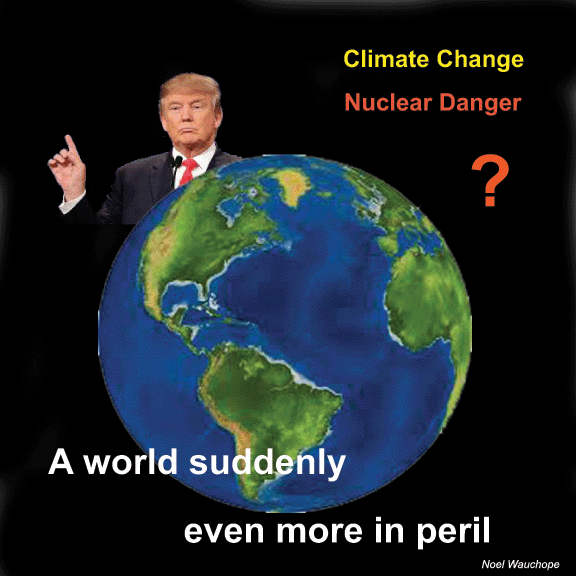
Trump’s environmental good news, Religion News, ByMark Silk | The good news out of Washington is that the White House has withdrawn the nomination of Kathleen Hartnett White to head the President’s Council of Environmental Quality. A leading shill for the carbon industry, the one-time chair of the Texas Commission on Environmental Quality would have joined Energy Secretary Rick Perry and EPA Administrator Greg Pruitt in a troika of climate change deniers driving the Trump Administration’s environmental policies.
Hartnett White’s confirmation hearing in November did not go well, and although President Trump resubmitted her nomination last month, it can be presumed that he reversed course in the face of threats from at least a couple of Senate Republicans to vote her down……….
while the cause of climate change is hardly restricted to religious folks, it is perhaps the most religiously motivated of all progressive social causes today. Leading the way has been Pope Francis, with his great 2015 encyclical Laudato Si’. But it is a cause that has enlisted the full spectrum of the religious community — Jews and Muslims, Eastern Orthodox and Mainline Protestant, Hindu and Buddhist.
Except for white evangelicals. Outliers, they are now in thrall to a political party that over the past decade has increasingly opposed all efforts to address climate change. Their religious rationalization is that they are standing with a God who promised no more floods against pagan “Earth worshippers.”
“Slavery degrades the Religious Activity of the People,” preached Boston’s leading abolitionist minister Theodore Parker on July 4, 1858. Today it is climate change denial that is degrading the religious activity of the evangelical people. https://religionnews.com/2018/02/06/trumps-environmental-good-news/
PARIS (Reuters) 27 Jan 18, – France will not increase carbon emissions as it reduces its reliance on nuclear energy in coming years, a junior minister told energy newsletter Enerpresse.
The centrist government of French President Emmanuel Macron has launched a year-long debate about energy policy before deciding in early 2019 on the future share of nuclear energy in France’s power production. It now stands at 75 percent.
To assist discussions, grid operator RTE has prepared scenarios for cutting nuclear energy’s share from 56 percent to 11 percent by 2035, and an additional scenario on reducing nuclear reliance to 50 percent by 2025.
Environment activists complain that the government has withheld scenarios cutting back nuclear capacity the most, when it held workshops this month to prepare for the public debate.
Junior Energy and Environment Minister Sebastien Lecornu told Enerpresse the scenarios that would lead to the construction of new thermal power stations were held back.
“We are clear about what we want for the energy mix, the increase of carbon emissions is not an option for us,” he said.
France would not build more plants powered by coal or fuel oil, he said, but said the government would consider whether there was a role for gas, which has lower emissions than coal or other fossil fuels.
Lecornu’s office could not immediately be reached for comment.
Sustainable energy advocacy group NegaWatt said on Thursday the most ambitious scenarios for reducing nuclear reliance could be achieved without boosting CO2 emissions provided there was a stronger focus on energy efficiency and if the nuclear reactors had their lifespans’ extended a little beyond 40 years.
The majority of EDF’s nuclear reactors were connected to the grid between 1980 and 1990. Closing them all promptly after 40 years, their scheduled lifespan, would cut so much capacity that France would have to build new gas plants to fill the gap.
EDF wants to extend the lifespan of its reactors to 50 years, but will need approval of nuclear regulator ASN for each reactor. The ASN has said it will rule on the principle of lifespan extensions in 2021. Reporting by Geert De Clercq; Editing by Edmund Blair
Guano, Nuclear Testing, Chemical Weapons Another guano claim converted for U.S. military use is Johnston Atoll (Kamala), located about 800 miles southwest of Honolulu.
One phase of expansion on Johnston Island involved construction of a launch pad for high-altitude missile tests for Operation Dominic in the 1960s. Two of the tests were aborted, with radioactive contamination falling on the runway. Forty years later, in 2002, the Air Force “finished burying thousands of cubic meters of plutonium-contaminated waste in a 25-acre landfill on the atoll.”
The question, then, is not when will islands be submerged, but when will sea-level rise make life on low-lying islands impossible.
The answer to that question is close at hand for a number of Pacific islands.
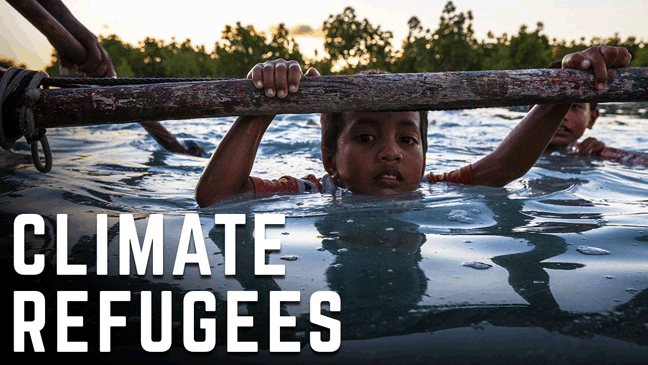
Perhaps the biggest legal stride in New Zealand is Prime Minister Jacinda Ardern’s recent announcement of plans for a special refugee visa for Pacific Islanders, starting with 100 places annually. “We are anchored in the Pacific,” Ardern told reporters. “Surrounding us are a number of nations, not least ourselves, who will be dramatically impacted by the effects of climate change. I see it as a personal and national responsibility to do our part.”
American Polynesia, Rising Seas and Relocation, By Laray Polk, Global Research, January 06, 2018 The Asia-Pacific Journal: Japan Focus 22 December 2017In the next 30 to 50 years, rising sea levels caused by global warming will subsume low-lying islands in the Pacific Ocean. Inhabitants will have to relocate, but there are few choices. Among nations (with the exception of Fiji and New Zealand) there is little preparation for the inevitable migration of Pacific Islanders. Which nations should commit to the processes of equitable relocation?
The following article will address this question through historical context and colonial occupation; current legal debates surrounding climate change and maritime migration; and the potential rights of “deterritorialized” states, such as retention of exclusive economic zones. Historical context includes an examination of U.S. insular territories in the Pacific and the continued exercise of presidential authority over island possessions.
There are strong arguments to be made that the United States has ethical obligations to assist Pacific Islanders as sea levels continue to rise, with assistance taking many forms. The U.S. is obligated namely because it is the second largest emitter of greenhouse gases, and the largest carbon emitter historically; it has extensively tested atomic and hydrogen bombs and biochemical agents in the Pacific Ocean (Marshall Islands, Christmas Island, Johnston Atoll); has commercially profited from the Pacific ecosystem since the early days of whaling; and in addition to American Samoa, Guam, and the Commonwealth of the Northern Mariana Islands, possesses eight insular territories referred to as “United States Minor Outlying Islands.”1
The U.S. Minor Outlying Islands are Baker Island, Howland Island, Jarvis Island, Johnston Atoll, Kingman Reef, Midway Islands, Palmyra Atoll, and Wake Island. (A ninth minor outlying island, Navassa Island, is located in the Caribbean Ocean, near Haiti.) Around these insular territories is an exclusive economic zone (EEZ) of 200 nautical miles. The National Oceanic and Atmospheric Administration defines the EEZ as “the zone where the U.S. and other coastal nations have jurisdiction over natural resources,” such as fisheries, energy, and other mineral resources.
When the zones of the eight minor outlying islands are combined with those of American Samoa, Guam, Hawaii and the Northern Mariana Islands, it forms a U.S. EEZ in the Pacific Ocean of 2.2 million square miles.2 The United States, seen in this light, is not a distant observer to the Pacific Islanders’ plight but an invested neighbor with shared history; a history defined in large part by commercial exploitation and continuing military entanglements……….
Guano to Nuclear Testing
The early annexation of guano islands by commercial interests explains why access to Christmas Island (Kiritimati) for testing nuclear weapons, first by the U.K., then the U.S., was easily facilitated. How economic rivalry in the 19th century turned to military alliance in the 20th century involves a more complex telling……….
Guano, Nuclear Testing, Chemical Weapons
Another guano claim converted for U.S. military use is Johnston Atoll (Kamala), located about 800 miles southwest of Honolulu. The atoll, claimed by the Pacific Guano Company in 1857, consists of four islands on a coral reef platform, all of which have been artificially expanded by blasting, dredging, and reconstruction programs. According to NOAA, the U.S. Navy began preparing the atoll for military operations in 1939 by enlarging the main island (also named Johnston). Construction lasted until 1942, followed by a second phase in 1963. That year, Johnston and Sand Islands were further enlarged and two artificial islands created, called Akau and Hikina. Johnston, by far the largest of the four, is 16 times its original size and resembles an aircraft carrier.18
One phase of expansion on Johnston Island involved construction of a launch pad for high-altitude missile tests for Operation Dominic in the 1960s. Two of the tests were aborted, with radioactive contamination falling on the runway. Forty years later, in 2002, the Air Force “finished burying thousands of cubic meters of plutonium-contaminated waste in a 25-acre landfill on the atoll.”19
Other uses of the atoll include open-air biochemical testing; chemical weapons storage; and destruction of nerve agents VX and Sarin, sulfur mustard gas, and Agent Orange. Stockpiles of chemical weaponry were transported from Okinawa, Germany, and the Solomon Islands and incinerated on site using the Johnston Atoll Chemical Agent Disposal System (JACADS).20………..
Rate of Rising Seas
Pacific island nations and territories are at different stages of addressing the pressing issues of sea-level rise. Discussions involving retention of EEZs—and the rights and financial security maritime zones confer—represent the long game, and enters into a conceptual realm of “What is nationhood, if a nation no longer exists?” Legitimate answers to questions of this magnitude would require changes in international law, a notoriously slow process. As scientific data on climate change feedbacks demonstrate, island nations and territories need answers now.
The Intergovernmental Panel on Climate Change predicts the oceans will rise by between 11 and 38 inches by the end of the century, with the potential to submerge low-lying islands. A report from 2016, written by former NASA scientist James Hansen and 16 co-authors, predicts that without serious mitigation of greenhouse gas emissions, global sea level is likely to increase “several meters over a timescale of 50 to 150 years.”34 If less than one meter of sea-level rise has the potential to cause an island to disappear by 2100, then Hansen’s numbers portend something more urgent. The question, then, is not when will islands be submerged, but when will sea-level rise make life on low-lying islands impossible.
The answer to that question is close at hand for a number of Pacific islands. Sea-level rise increases both the frequency and magnitude of flooding caused by high tides and storms; saltwater intrusion destroys freshwater sources and the prospect of productive agriculture. Writer and filmmaker Jack Niedenthal, who lives in the Marshall Islands, says that on the island of Kili, “there have been huge changes since about 2011.” That was the first year the island was heavily flooded, and he says it’s happened every year since. Kili, which averages an elevation of 6 feet, is home to many displaced families originally from Bikini Atoll.35
The population there, he says, is trying to raise awareness of climate change with the rest of the world, but it’s challenging. “I find it stunning that there are still so many climate change deniers out there. In the Marshall Islands, we are building numerous seawalls, some very large, others are just building them with old tires and broken down cars.”……..
Freedom and Fear in the High Seas
At a climate change symposium in 2015, Fiji’s Foreign Affairs secretary Esala Nayasi explained the dilemma of Islanders succinctly: “These are people who are on the verge of losing their land that they call home, losing their critical basic necessities and infrastructure, culture, identity and traditional knowledge. This is no longer a news story, it is happening now.”
Nayasi’s sense of urgency is reflected in policy. Among nations, the Republic of Fiji is in the vanguard of relocation efforts……. Because Fiji is a combination of high and low islands, it’s geographically advantaged (though not immune to climate disruption). For other nations such as Tuvalu, comprised of nine coral atolls with a mean elevation of 2 meters, all choices look the same.
Options for relocation are limited in other ways, such as the exclusion of “climate change refugees” from the 1951 Refugee Convention. Under the convention, there are five grounds to qualify for refugee status and fleeing the catastrophic conditions caused by climate change is not one of them. It hasn’t stopped legal challenge in several recent cases in New Zealand. Asylum-seeker Ioane Teitiota from Kiribati lost his case, and was deported in 2015. Sigeo Alesana from Tuvalu had his asylum application declined, but he won his immigration case based partially on the “vulnerability of the couple’s children to illnesses as a result of poor water quality.” According to Radio New Zealand, it’s the first time climate change has been successfully used in an immigration case.40
Perhaps the biggest legal stride in New Zealand is Prime Minister Jacinda Ardern’s recent announcement of plans for a special refugee visa for Pacific Islanders, starting with 100 places annually. “We are anchored in the Pacific,” Ardern told reporters. “Surrounding us are a number of nations, not least ourselves, who will be dramatically impacted by the effects of climate change. I see it as a personal and national responsibility to do our part.”41……….
The U.S. government, with the exception of the Pentagon, is in official denial concerning a major cause of climate disruption: the unabated burning of fossil fuels.44 The current administration has no interest in reducing CO2 emissions or admitting the country’s hand in environmental catastrophe. What will be of interest to U.S. policymakers when the low-lying islands and atolls in the Pacific Ocean begin to disappear is likely to center on the retention of EEZs and other maritime entitlements associated with U.S. insular possessions. If there is to be any U.S. involvement in “adaptation” in this part of the world, preserving these zones is high on the list; Pacific island nations and territories should be included in those efforts. Subsequent to resource depletion, war, nuclear testing and contamination, engagement with the Pacific Ocean ultimately means taking care of the people who live there. https://www.globalresearch.ca/american-polynesia-rising-seas-and-relocation/5624927
Global Warming Is Increasing The Radioactivity Of The Arctic Ocean, IFL Science, Stephen Lundtz, 3 Jan 18 “………what is happening in the polar regions may ultimately be much more important [than the Fukushima radiation] . As Lauren Kipp of Woods Hole Oceanographic Institution notes in Science Advances, climate change affects the Arctic region particularly strongly through the “Permafrost thawing on land and on continental shelves, increased river discharge, and reduced ice cover.” The last of these has been extensively tracked, but it is harder to measure the first two. Marine measurements of materials deposited in the ocean from permafrost melt and river discharge could change that.
Sediments on the continental shelves that make up half the Arctic Ocean’s territory contain thorium isotopes, which radioactively decay to radium. “Unlike thorium, radium is relatively soluble in seawater,” the paper notes, so measuring radium concentrations makes it possible to explore the interchange between the sediments and the waters above. In particular, it can provide a measure of the rate at which permafrost melting is releasing soluble materials into the ocean, a process enhanced as higher winds transport more water from coastal waters to the central Arctic.
Unfortunately, systematic records of radium concentrations in the Arctic prior to 2015 don’t exist. However, localized measurements taken in 1994, 2002, and 2007 allowed Kipp to conclude that radium-228 has risen sharply over the 2007-2015 period, and most of this increase must come from sediments at the continental margin.
Trump’s call for some ‘good old global warming’ ridiculed by climate experts. US president again conflates weather with climate to mock climate change. Experts call comments ‘scientifically ridiculous and demonstrably false’,Guardian, Michael McGowan and Joanna Walters, -30 Dec 17, -Donald Trump once dismissed it as a “hoax” created by the Chinese to destroy American jobs, but on a freezing Thursday night in the eastern US the president found himself pining for some of that “good old global warming”.
On holiday in Florida on Thursday, Trump wondered if global warming might not be such a problem after all.
The devastating effects of climate change are becoming apparent — and the world has begun taking action. But the frequency of extreme weather events has shown we are starting to run out of time.
“Crazy” weather has been a hot topic for elevator conversations this year — and yes, extremes are starting to become the new normal.
No continent was spared in 2017 when it came to extreme weather. From droughts to hurricanes, from smog to forest fires, these events killed thousands of people — and have been directly linked to climate change.
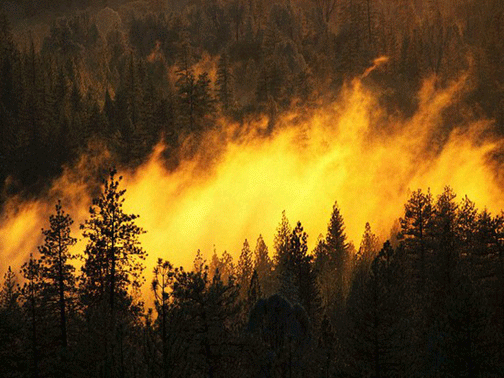
Southern Europe, Canada and the United States were among the areas worst hit by devastating wildfires. Both in California and Portugal, 2017 has been the deadliest year on record for wildfires. Even icy Greenland wasn’t spared. Climate change, along with the dangerous combination of a lack of sustainable forest management and careless — or malicious — human activity, has been to blame.
Major storms were also responsible for the year’s most catastrophic events. Hurricane Harvey in the US, Irma and Maria in the Caribbean and Katia in the Gulf of Mexico left destruction in their wake. While hurricanes aren’t unusual in tropical regions, the frequency and intensity of these most recent storms — fueled by warming oceans — were out of the ordinary. But they may be a sign of things to come, if the world doesn’t take action to limit climate change.
At the same time, global sea levels reached a new high in 2017, with the polar ice caps melting at an accelerating pace. Warmer ocean temperatures contributed to the breakaway of a 1 trillion ton iceberg from the Larsen C ice shelf in Antarctica in July, at 5,800 square kilometers (2,200 square miles) one of the largest icebergs ever recorded.
Flooding caused the death of hundreds of people in the Philippines, Greece, Germany and Vietnam, to name just a few countries. Meanwhile, drought is increasing the pressure on regions of Africa and Asia, such as Somalia, South Sudan and Pakistan, where armed conflicts are already making daily life a struggle for survival.
Often forgotten, the struggles of the world’s oceans also increased this year. Despite several initiatives protecting the Great Barrier Reef, coral bleaching has continued at an alarming rate. Ocean acidification, meanwhile, is on track to make the seas uninhabitable for many aquatic creatures, endangering entire ocean ecosystems.
Governments across the globe are taking action to address current and upcoming climate threats, and leaders like French President Emmanuel Macron, who took office in May and pledged to fund climate research, have been a source of hope for many.
But 2017 will also, unfortunately, be remembered for the US withdrawal from the 2015 Paris climate accord, along with President Donald Trump’s other moves away from the fight against climate change.
As despairing as all of this may sound, it’s actually another call to take action. Weather has always been out of our control — and will remain so. But we can still work to avoid making extremes the new normal.
Climate Change To Triple Number Of Migrants Reaching European Union By 2100, Study Predicts, Clean Technica, December 28th, 2017 by James Ayre
The number of migrants making their way into the European Union will nearly triple by the year 2100 if rapid climate warming occurs, according to a new study published in the journal Science.
The new study — which was actually requested by the European Commission itself — relates directly only to climate warming, it should noted — mass migrations triggered by wars and cultural conflicts would be in addition to those discussed by the study……
the reality is that the findings are likely a vast underestimate of what will be occurring during the second half of the 21st century — as climate warming and weirding intensify; and as the common human activities of projection, scapegoating, and lazy thinking do as well.
According to the new study, asylum applications to the EU (from across 103 different nations) tended “to rise in the 2000–2014 period when temperatures at home were far hotter or colder than the ideal for growing maize.”
The projection put forward by the study is that asylum applications could climb to 1.01 million per year by 2100 (up from an average of 351,000 during 2000-2014) under a scenario that sees temperatures rise fairly fast. The primary driver of this rise would be reduced agricultural productivity (again, the human conflict aspects of what’s coming aren’t being factored into this work).
As I noted above, the reality is that even that figure is likely a vast underestimate of what’s coming — based on a look back at earlier periods of rapid climatic change and/or ecological collapse (soil fertility loss included) and taking into account more factors than the research did………
won’t rising temperatures and falling agricultural yields lead directly to weakening civil institutions (self-consumption), political repression, and civil war? Isn’t that exactly what’s happened in Syria over the last decade?
On the boil: five climate lawsuits to watch in 2018 Reuters
Sebastien Malo, Sophie Hares, NEW YORK/TEPIC, Mexico (Thomson Reuters Foundation) 28 Dec 17 – Lawyers and advocates stepped up the fight against climate change this year by pursuing a rising number of legal cases around the world that aim to test the limits of national laws.
Climate change cases numbered nearly 900 in 24 nations as of March, according to a survey by UN Environment and Columbia Law School, marking a steady increase in lawsuits filed to hold governments and companies to account over carbon pollution.
They include a handful of milestone suits that charge violations of various states’ constitutions.
Here are five cases whose outcomes, some expected in the coming year, could reshape the roles and responsibilities of governments and businesses in tackling climate change:
– URGENDA FOUNDATION V. KINGDOM OF THE NETHERLANDS (NETHERLANDS)
This landmark case energized the climate movement in 2015 when a district court sided with the nearly 900 Dutch citizens behind it, ordering their government to cut greenhouse has emissions faster.
It was “one of the most important climate change decisions ever issued”, said Michael Gerrard, director of Columbia Law School’s Sabin Center for Climate Change Law in New York…….
– JULIANA V. UNITED STATES (UNITED STATES)
Trial in this federal suit filed by a group of 21 U.S. teenagers could begin in February 2018……
– LLIUYA V. RWE (GERMANY)
A Peruvian farmer, Saúl Luciano Lliuya, is seeking $20,000 in damages from a large German energy utility based half-way around the world…..- EXXON MOBIL CORPORATION V. MAURA TRACY HEALEY (UNITED STATES)
Exxon Mobil is battling attorney generals in Massachusetts and New York who are investigating the oil giant, after news reports charged in 2015 that its own scientists had found cutting fossil fuel use was needed to slow down climate change…….
– GREENPEACE NORDIC V. GOVERNMENT OF NORWAY (NORWAY)
“……..Weekly or daily weather patterns tell you nothing about longer-term climate change (and that goes for the warm days too). Climate is defined as the statistical properties of the atmosphere: averages, extremes, frequency of occurrence, deviations from normal, and so forth. The clothes that you have on today do not describe what you have in your closet but rather how you dressed for today’s weather. ……
The other thing to point out is that because one part of the world is cold (in that valley), there is likely another part of the world experiencing abnormally warm conditions (in the hill part of the wave pattern). In the temperature map tweeted by long-time weather observer Joe Stepansky, it is clear that on December 28th the United States and parts of Canada are experiencing the anomalously cold weather. …..
Climate Change Is Happening Faster Than Expected, and It’s More Extreme
New research suggests human-caused emissions will lead to bigger impacts on heat and extreme weather, and sooner than the IPCC warned just three years ago.BY BOB BERWYN, INSIDE CLIMATE NEWS DEC 26, 2017 IN THE PAST YEAR, THE SCIENTIFIC CONSENSUS SHIFTED TOWARD A GRIMMER AND LESS UNCERTAIN PICTURE OF THE RISKS POSED BY CLIMATE CHANGE.
When the UN’s Intergovernmental Panel on Climate Change issued its 5th Climate Assessment in 2014, it formally declared that observed warming was “extremely likely” to be mostly caused by human activity.
Other scientific authorities have issued similar assessments:
The Royal Society published a compendium of how the science has advanced, warning that it seems likelier that we’ve been underestimating the risks of warming than overestimating them.
The American Meteorological Society issued its annual study of extreme weather events and said that many of those it studied this year would not have been possible without the influence of human-caused greenhouse gas emissions.
While 2017 may not have hit a global temperature record, it is running in second or third place, and on the heels of records set in 2015 and 2016. Talk of some kind of “hiatus” seems as old as disco music.
‘A Deadly Tragedy in the Making’
Some of the strongest warnings in the Royal Society update came from health researchers, who said there hasn’t been nearly enough done to protect millions of vulnerable people worldwide from the expected increase in heat waves……..
One of the starkest conclusions of the Royal Society update is that up to 350 million people in places like Karachi, Kolkota, Lagos and Shanghai are likely to face deadly heat waves every year by 2050—even if nations are able to rein in greenhouse gas emissions enough to keep the average global temperature increase to 1.5 degrees Celsius, as per the Paris climate agreement.
There’s also an increasing chance global warming will affect a key North Atlantic current that carries ocean heat from the tropics toward western Europe, according to a 2016 study. It shows the Atlantic Meridional Overturning Current weakening by 37 percent by 2100, which could have big effects on European climate and food production.
Melting Ice and Risks to Oceans and Ecosystems
The Royal Society report also notes:
An increasing risk that ocean acidification will rapidly and significantly alter many ecosystems and food webs;
A concern that crops grown in high-CO2 conditions could be less nutritious, leading to mineral deficiencies;
That the commonly accepted wet-areas-wetter and dry-areas-drier scenario has regional nuances with important implications for local water management and food production planning; and,
That scientists are finding more links between melting Arctic sea ice and weather extremes like heat waves, droughts and blizzards.
Study suggests higher temperatures in the Rocky Mountains are preventing trees from growing back following wildfires Josh Gabbatiss Science Correspondent 21 Dec 17 A new study suggests hotter climates resulting from global warming may prevent forests from regenerating after wildfires.
In hot, dry climates like those found in the western US, wildfires are often a natural part of the environment, contributing to the cycling of nutrients and growth of new plants.
However, a new study published in the journal Ecology Letterssuggests increasing global temperatures may be preventing this natural cycling from taking place.The result could be long-term damage to areas of forest destroyed by wildfires.
Led by Dr Camille Stevens‐Rumann, an ecologist at Colorado State University, the study involved testing fire-struck areas of forest for signs of regeneration.
The scientists examined 1485 sites in the Rocky Mountains, all of which had been affected by fires between 1985 and 2015.
They looked for seedlings growing in the examined sites, comparing growth with nearby unburned forests to determine how well forests in each area were able to regenerate.
The team found the proportion of sites in which no post-fire tree regrowth had taken place increased from 19 to 32 per cent when comparing earlier years of the analysis to the more recent years.“Significantly less tree regeneration is occurring after wildfires in the start of the 21st century compared to the end of the 20th century,” the scientists wrote in their paper.
Comparing these findings with information on the region’s changing climate suggested increases in global temperatures were influencing forest regeneration, particularly in the driest regions.
“Dry forests that already occur at the edge of their climatic tolerance are most prone to conversion to non-forests after wildfires,” the scientists wrote. Natural disasters are increasingly being linked to climate change, and according to Todd Gartner, a senior associate at environmental think tank World Resources Institute, climate change is a “contributing factor” to the recent events in California.
Scientists have linked changes in temperature, levels of rain and soil moisture – all of which are influenced by global warming – to increased risk of wildfires.
This new study suggests the impact of climate change on wildfires may have longer term consequences as well.
“As scientists, managers and the public aim to understand and plan for increasing fire activity, our results suggest a high likelihood that future wildfires will facilitate shifts to lower density forest or non-forested states under a warming climate,” the scientists concluded.
WILDFIRES MARK THE NEW REALITY OF CLIMATE CHANGE IN 2017
As fire conditions intensify around the globe, scientists are helping countries prepare for a fiery new normal. Pacific Standard, BOB BERWYN, DEC 20, 2017
Sometimes the effects of climate change seem to creep up, as when sea levels rise an inch every few years, or when temperatures break records by a tenth of a degree. But when your backyard is on fire, you feel global warming breathing down your neck.
In the last three years, as global temperatures spiked to new records, it sometimes felt like the whole world was ablaze, as a series of “worst-ever” fires damaged and destroyed ecosystems and human communities on nearly every continent, under new climate conditions that will be the norm by 2050.
Even if we stopped emitting greenhouse gases today, fire conditions will become even more persistent in areas already at risk, and will spread to new regions as warming drives vegetation patterns and land-use changes. Without rethinking our relationship with nature, landscapes, and wildfire, we are doomed to repeat the mistakes of the past, with the same catastrophic results.
The past few years have shown how bad things can get, fire experts say. In the super-heated El Niño years of 2015 and 2016, there were late-summer tundra fires in Greenland, peat fires in Indonesia, and hardwood forests in the southeast United States that burned on an unprecedented scale.
By early 2017, El Niño had faded, but parts of the Southern Hemisphere were scorched by record heat and fires, including Australia, where fire experts made statements similar to the bulletins coming out of Southern California right now: “This is the worst day we have seen in the history of New South Wales when it comes to fire danger ratings and fire conditions,” Shane Fitzsimmons, the state’s rural fire chief, told the BBC in February, with almost 100 bushfires burning………..
Scientists have been warning for 20 years that climate change would increase the risk of damaging fires, and that many of these fires can’t be stopped. Communities in less developed countries are most at risk right now. They need more resources to manage landscapes to prevent fires, and they need better weather and climate forecasting services—and the ability to put people and tools on the ground.
At times, the growing risk already seems to be outpacing society’s capacity to adapt. In 2016, the GFMC sent a team of experts to South America to warn of fire risks and help communities prepare. Six months later, before any measures were taken, deadly fires burned across parts of Chile and Argentina following a record heat wave.
Alexander Held, a resilience expert at the European Forest Institute, says that hubris is the biggest problem in the face of a growing fire threat. “It’s all coming down to failed land management and that our societies have forgotten how to live with fire,” Held tells Pacific Standard via email.
Held advocates shifting resources from fire suppression to fire prevention, including managed fires, which are scientifically proven to be the best way to minimize catastrophic effects on communities and natural resources.
“Look at Western Australia. They had a large-scale prescribed burning program, and for decades there was nothing like a disaster fire. Only when they reduced the area that was supposed to be burned by prescription did disaster fires start to happen,” he says. “The biggest challenge is how to influence policymakers and political decision making,” Held says. https://psmag.com/environment/2017-the-year-in-wildfires
governments and organizations such as the United Nations should consider modifying international law to provide legal status to environmental refugees and establish protections and rights for them.
The scale of this challenge is unlike anything humanity has ever faced
Climate change will displace millions in coming decades. Nations should prepare now to help them, https://theconversation.com/climate-change-will-displace-millions-in-coming-decades-nations-should-prepare-now-to-help-them-89274The Conversation, Gulrez Shah Azhar Ph.D. Candidate, Pardee RAND Graduate School, 20 Dec 17,Wildfires tearing across Southern California have forced thousands of residents to evacuate from their homes. Even more people fled ahead of the hurricanes that slammed into Texas and Florida earlier this year, jamming highways and filling hotels. A viral social media post showed a flight-radar picture of people trying to escape Florida and posed a provocative question: What if the adjoining states were countries and didn’t grant escaping migrants refuge?
By the middle of this century, experts estimate that climate change is likely to displace between 150 and 300 million people. If this group formed a country, it would be the fourth-largest in the world, with a population nearly as large as that of the United States.
Yet neither individual countries nor the global community are completely prepared to support a whole new class of “climate migrants.” As a physician and public health researcher in India, I learned the value of surveillance and early warning systems for managing infectious disease outbreaks. Based on my current research on health impacts of heat waves in developing countries, I believe much needs to be done at the national, regional and global level to deal with climate migrants.
Millions displaced yearly
Climate migration is already happening. Every year desertification in Mexico’s drylands forces 700,000 people to relocate. Cyclones have displaced thousands from Tuvalu in the South Pacific and Puerto Rico in the Caribbean. Experts agree that a prolonged drought may have catalyzed Syria’s civil war and resulting migration.
Between 2008 and 2015, an average of 26.4 million people per year were displaced by climate- or weather-related disasters, according to the United Nations. And the science of climate change indicates that these trends are likely to get worse. With each one-degree increase in temperature, the air’s moisture-carrying capacity increases by 7 percent, fueling increasingly severe storms. Sea levels may rise by as much as three feet by the year 2100, submerging coastal areas and inhabited islands.
The Pacific islands are extremely vulnerable, as are more than 410 U.S. cities and others around the globe, including Amsterdam, Hamburg, Lisbon and Mumbai. Rising temperatures could make parts of west Asia inhospitable to human life. On the same day that Hurricane Irma roared over Florida in September, heavy rains on the other side of the world submerged one-third of Bangladesh and eastern parts of India, killing thousands.
Climate change will affect most everyone on the planet to some degree, but poor people in developing nations will be affected most severely. Extreme weather events and tropical diseases wreak the heaviest damage in these regions. Undernourished people who have few resources and inadequate housing are especially at risk and likely to be displaced.
Recognize and plan for climate migrants now
Today the global community has not universally acknowledged the existence of climate migrants, much less agreed on how to define them. According to international refugee law, climate migrants are not legally considered refugees. Therefore, they have none of the protections officially accorded to refugees, who are technically defined as people fleeing persecution. No global agreements exist to help millions of people who are displaced by natural disasters every year.
Refugees’ rights, and nations’ legal obligation to defend them, were first defined under the 1951 Refugee Convention, which was expanded in 1967. This work took place well before it was apparent that climate change would become a major force driving migrations and creating refugee crises.
Under the convention, a refugee is defined as someone “unable or unwilling to return to their country of origin owing to a well-founded fear of being persecuted for reasons of race, religion, nationality, membership of a particular social group, or political opinion.” The convention legally binds nations to provide access to courts, identity papers and travel documents, and to offer possible naturalization. It also bars discriminating against refugees, penalizing them, expelling them or forcibly returning them to their countries of origin. Refugees are entitled to practice their religions, attain education and access public assistance.
In my view, governments and organizations such as the United Nations should consider modifying international law to provide legal status to environmental refugees and establish protections and rights for them. Reforms could factor in the concept of “climate justice,” the notion that climate change is an ethical and social concern. After all, richer countries have contributed the most to cause warming, while poor countries will bear the most disastrous consequences.
Some observers have suggested that countries that bear major responsibility for greenhouse gas emissions should take in more refugees. Alternatively, the world’s largest carbon polluters could contribute to a fund that would pay for refugee care and resettlement for those temporarily and permanently displaced.
It is tough to define a climate refugee or migrant. This could be one of the biggest challenges in developing policies.
As history has shown, destination countries respond to waves of migration in various ways, ranging from welcoming immigrants to placing them in detention camps or denying them assistance. Some countries may be selective in whom they allow in, favoring only the young and productive while leaving children, the elderly and infirm behind. A guiding global policy could help prevent confusion and outline some minimum standards.
Short-term actions
Negotiating international agreements on these issues could take many years. For now, major G20 powers such as the United States, the European Union, China, Russia, India, Canada, Australia and Brazil should consider intermediate steps. The United States could offer temporary protected status to climate migrants who are already on its soil. Government aid programs and nongovernment organizations should ramp up support to refugee relief organizations and ensure that aid reaches refugees from climate disasters.
In addition, all countries that have not signed the United Nations refugee conventions could consider joining them. This includes many developing countries in South Asia and the Middle East that are highly vulnerable to climate change and that already have large refugee populations. Since most of the affected people in these countries will likely move to neighboring nations, it is crucial that all countries in these regions abide by a common set of policies for handling and assisting refugees.
The scale of this challenge is unlike anything humanity has ever faced. By midcentury, climate change is likely to uproot far more people than World War II, which displaced some 60 million across Europe, or the Partition of India, which affected approximately 15 million. The migration crisis that has gripped Europe since 2015 has involved something over one million refugees and migrants. It is daunting to envision much larger flows of people, but that is why the global community should start doing so now.
Trump Drops Climate Threats from National Security Strategy, Scientific American, The president claimed yesterday that the true danger to U.S. security is not climate change, but regulations By Jean Chemnick, ClimateWire on December 19, 2017President Trump argued yesterday that the true threat to national security is not climate change but regulations that get in the way of U.S. economic and energy “dominance.”
Trump introduced his first National Security Strategy, in which he broke from the Obama administration in not listing climate change as a chief threat. His remarks at times sounded like an economic address, frequently veering into discussion of tax and trade, industrial deregulation, and a celebration of the stock market. Trump insisted that wealth and national security go hand in hand.
“Economic vitality, growth and prosperity at home is absolutely necessary for American power and influence abroad,” he said in an address that heavily focused on global competition over cooperation……
It was a sentiment that permeated the 56-page security strategy, and in particular the section titled “Embrace Energy Dominance,” which dealt with energy and climate issues…….
Climate Change Is Already Wreaking Havoc on Our Weather, Scientists Find, http://time.com/5064577/climate-change-arctic/By JUSTIN WORLAND The Arctic is melting with no turning back. Climate change increased rainfall during Hurricane Harvey by at least 15%. And several extreme weather events that occurred in 2016 would not have been possible without man-made global warming.
These are among the findings being discussed this week at this fall’s meeting of the American Geophysical Union in New Orleans, the largest gathering of Earth scientists in the world. Taken together, the findings show the deepening urgency of the fight against climate change.
“Climate change is hurting us without a doubt,” said James Byrne, a professor at the University of Lethbridge who studies climate change, at a press conference. “Houston, India, Bangladesh, Nepal, British Columbia — worst fire season ever. California, I think they declared it the worst fire season.”
Scientists have explored the link between climate change and extreme weather events for years, but many of the conclusions have relied on forecasts of potential future damage. This year, scientists say, the findings are no longer theoretical. Man-made global warming is causing problems here and now.
Take the American Meteorological Society’s report on extreme weather events in 2016, the sixth annual iteration of the report. In the past, the group found that likelihood had increased the chances of certain extreme weather events. But this year scientists found that 2016’s record global temperatures and historic warm waters in the Bering Sea “would not have been possible” in a world without human-caused climate change.
“These events were not just influenced by human-caused climate change,” said Jeff Rosenfeld of the American Meteorological Society at a press conference. “Some of the events in 2016 could not have happened without climate change.”
The report also highlighted global heat waves, an extreme occurence of El Niño and bleaching of coral reefs. These extreme events are all closely tied to climate change, though they remain theoretically possible in a world without the phenomenon.
Another report from the National Oceanic and Atmospheric Administration found that the state of continued ice melt, loss of snow cover and warm temperatures will be the “new normal” in the Arctic. The signs of climate change in the region have been pronounced for years as air temperatures have risen there at twice the rate as they have globally.
The effects of a melting Arctic — and the strong likelihood that it will not return to a normal state anytime soon — has significant implications far beyond its boundaries. Arctic sea ice plays an important role moderating global temperatures as it reflects sunlight back into space. And scientists say that the swift warming in the Arctic is a concerning sign of what’s to come globally. “Unlike Vegas what happens in the Arctic doesn’t stay in the Arctic,” said Tim Gallaudet, acting NOAA administrator, at a press conference. “It affects the rest of the planet.”
Two separatestudies presented at the conference showed that climate change worsened rainfall when Hurricane Harvey struck Houston earlier by somewhere between 15% and 38%. That storm brought nearly 50 inches of rain to some areas and caused billions in damages. The research comes as scientists increasingly try to draw explicit conclusions about the effect of climate change and individual storms, a practice unthinkable just a decade ago.
The warning from scientists comes as policymakers across the globe continue to grapple how to stem temperature rise. Countries have committed to trying to keep temperatures from rising more than 2 degrees Celsius (or 3.6 degrees Fahrenheit) by 2100, but recent research shows leaders remain far from meeting that goal.
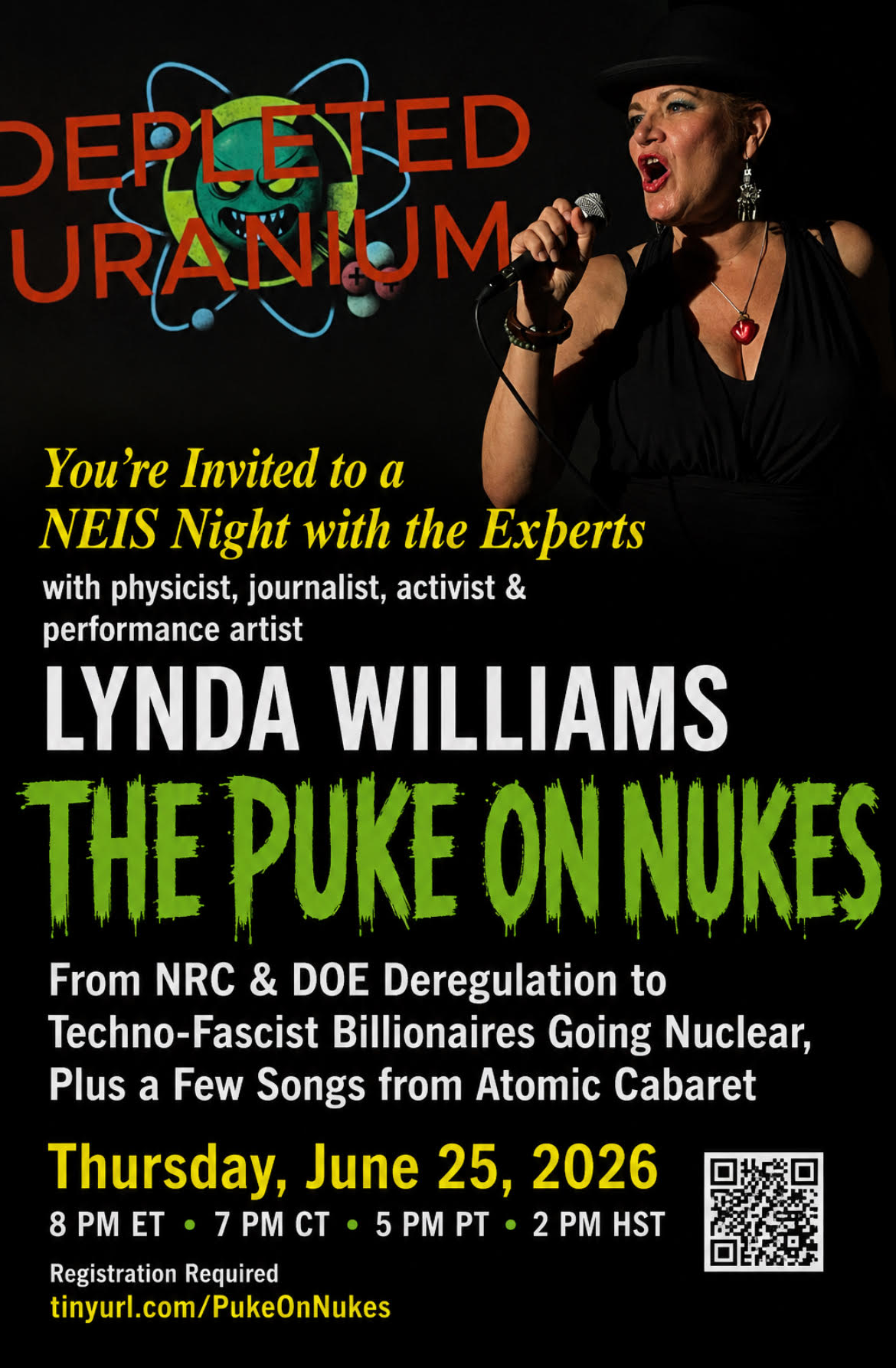
7pm Central Time (8pm ET, 6pm MT, 5pm PT) UTC – 5 From NRC & DOE Deregulation to Techno-Fascist Billionaires Going Nuclear, Plus a Few Songs from Atomic Cabaret REGISTER










 nuclear-news