This is good news for the nuclear reactors in its path. However, as torrential rain is predicted, it surely still remains a threat to reactors close to the sea in low-lying areas.
Hurricane Florence weakened to Category 2 by ‘tremendous’ wind shear By Chelsea Prince Zachary Hansen, The Atlanta Journal-Constitution Sept 13, 2018Hurricane Florence has weakened to a Category 2 storm in the Atlantic Ocean, according to the 11 p.m. projection by the National Hurricane Center.
Of course, the nuclear propagandists hasten to tell us that there’s “no problem” . James Conca writes in Forbes, Hurricane Florence No Problem For Nuclear Power Plants, (Forbes, 12/09/18) “…….. The United States Nuclear Regulatory Commission (NRC) is watching carefully. But no one is really worried that much will happen, contrary to lots of antinuclear fearmongering.”
With 1.5 million residents now under orders toevacuate their homes in preparation for Hurricane Florence’s landfall in Virginia, North Carolina, and South Carolina, the region faces the possibility of catastrophe should the storm damage one or more of the nuclear power plants which lie in its potential path.
As the Associated Pressreported on Monday, “The storm’s potential path also includes half a dozen nuclear power plants, pits holding coal-ash and other industrial waste, and numerous eastern hog farms that store animal waste in massive open-air lagoons.”
The plants thought to lie in the path of the hurricane, which is expected to make landfall on the Southeastern U.S. coast on Thursday, include North Carolina’s Brunswick Nuclear Power Plant in Southport, Duke Energy Sutton Steam Plant in Wilmington, and South Carolina’s V.C. Summer Nuclear Station in Jenkinsville.
“Florence will approach the Carolina coast Thursday night into Friday with winds in excess of 100mph along with flooding rains. This system will approach the Brunswick Nuclear Plant as well as the Duke-Sutton Steam Plant,” Ed Vallee, a North Carolina-based meteorologist, toldZero Hedge. “Dangerous wind gusts and flooding will be the largest threats to these operations with inland plants being susceptible to inland flooding.”
In 2015, the Huffington Post and Weather.comidentified Brunswick as one of the East Coast’s most at-risk nuclear power plants in the event of rising sea levels and the storm surges that come with them.
As of Tuesday afternoon, Hurricane Florence was thought to have the potential to cause “massive damage to our country” according to Jeff Byard, associate administrator of the Federal Emergency Management Agency (FEMA).
The storm was labeled a Category 4 tropical storm with the potential to become a Category 5 as it nears the coast, with 130 mile-per-hour winds blowing about 900 miles off the coast of Cape Fear, North Carolina.
Meteorologists warned of hurricane-force winds in the region by mid-day Thursday, with storm surges reaching up to 12 feet or higher.
Warning of the risks of “runaway” global warming, the United Nations secretary general, António Guterres, on Monday called on global leaders to rein in climate change faster.
· “If we do not change course by 2020, we risk missing the point where we can avoid runaway climate change,” Mr. Guterres said at United Nations headquarters in New York.
· “Climate change is the defining issue of our time, and we are at a defining moment,” he said. “Scientists have been telling us for decades. Over and over again. Far too many leaders have refused to listen.”
· His remarks came with countries around the world far short of meeting the goals they set for themselves under the 2015 Paris accord to reduce the emissions that have warmed the planet over the last century. The next round of climate negotiations is scheduled for this year in Poland.
· One of the big tests at those talks, which start Dec. 3 in Katowice, will be whether countries, especially industrialized countries that produce a large share of global emissions, will set higher targets for reducing their emissions.
· “The time has come for our leaders to show they care about the people whose fate they hold in their hands,” Mr. Guterres said, without taking questions from reporters. “We need to rapidly shift away from our dependence on fossil fuels.”
· Mr. Guterres’s speech came days before a high-level climate meeting in San Francisco, spearheaded by Gov. Jerry Brown of California, meant to demonstrate what businesses and local leaders have done to tackle climate change.
· The United Nations chief seems to be taking a page from Mr. Brown’s playbook. He, too, is looking beyond national leaders to make a difference. He has invited heads of industry and city government leaders to his September 2019 climate change forum in an apparent effort to increase pressure on national governments.
The Paris Agreement aims to keep temperatures from rising more than 2 degrees Celsius from preindustrial levels in order to avoid what scientists call the most catastrophic impacts of climate change.
But few countries are even close to meeting the targets they set under the Paris pact. And an assessment by the United Nations found that country targets so far would achieve only one-third of the global target.
Mr. Guterres sought to make the case that a shift away from fossil fuels like oil and coal would create jobs and bolster economies. Rebutting critics who argue that such a shift would be costly, he called that idea “hogwash.”
He cited the steps private companies are taking to wean themselves away from polluting fossil fuels — including a hat tip to the insurance company Allianz, which has promised to stop insuring coal fired power plants — though he said such actions are plainly insufficient.
“These are all important strides,” Mr. Guterres said. “But they are not enough. The transition to a cleaner, greener future needs to speed up.”
He warned that governments were not meeting their Paris Agreement commitments and goaded world leaders to step up.
“What we still lack, even after the Paris Agreement, is leadership and the ambition to do what is needed,” he said.
Mr. Guterres did not mention any countries or any heads of state by name. But looming large over his remarks was the leader of world’s most powerful country: President Trump, who has dismissed climate science, rolled back environmental regulations and vowed to pull the United States out of the Paris climate accord.
‘Limited’ progress at Bangkok climate talks, Executive secretary says ‘progress was made, but nothing was finalised’. Nations will meet again in Poland in December, Guardian, 11 Sep 18An international meeting in Bangkok fell short of its aim of completing fruitful preparations to help an agreement be reached in December on guidelines for implementing the 2015 Paris climate change agreement.The six-day meeting, which ended on Sunday, was scheduled to step up progress in the battle against rising global carbon emissions by adopting a completed text that could be presented at the COP24 conference in Katowice, Poland, three months from now.
A primary objective of the 2015 Paris agreement, to which 190 nations subscribe, is to limit the global temperature increase by 2100 to less than 2C and as close as possible to 1.5C, which is vital to the survival of island nations threatened by rising seas. But the absence of guidelines for meeting that goal has led to fears that not enough action is being taken.
There have been notable disagreements over fair financing for implementation of the rules by developing countries, and the technical details of their reporting on progress.
Patricia Espinosa, executive secretary for the United Nations Framework Convention on Climate Change, said on Sunday at the closing press briefing for the Bangkok meeting that progress was made on most issues but nothing was finalised.
The meeting was attended by representatives of most of the countries party to the Paris agreement, as well as the United States, which has announced that it is pulling out of the pact…………
wealthy and developed countries “led by the United States and including countries such as Australia, Japan and even the European Union” refused to clearly show “how much money they are going to provide and how that is going to be counted.”
Advocacy for the developing countries was led at the meeting by China, said Meyer, but was also supported by others, including India, Iran, Saudi Arabia and Malaysia.
Activists were critical of Washington’s lobbying at the meeting, especially because president Donald Trump has announced plans to have the US withdraw from the Paris pact, which had been heavily promoted by his predecessor, Barack Obama.
“The US has announced its withdrawal from the Paris Agreement but still negotiates as if it is a party, weakening international cooperation by not contributing to finance and technology transfer to developing countries,” Meena Raman, legal adviser at Third World Network, said in an emailed statement.
Climate change is a polarising issue in the United States, and some states and local communities have announced policies supporting the Paris agreement.
“…..Nobody alive or dead has ever seen anything like what just happened in the past few months. No human has ever lived with carbon dioxide levels this high in the atmosphere. And that carbon load continues to climb as motorized life and fossil-powered electricity spread across the globe. The human cloud of greenhouse gases found an echo as forests released their carbon on every continent.
Here in British Columbia, on the west coast of Canada, we had our second year of fire emergency. Over 700 large fires burned through the mountains. Gigantic out-of-control blazes lit up the night, and then buried the whole sky with thick smoke, turning the day into night. Thousands were evacuated, turning on their vehicle headlights at ten in the morning……..
Thick smoke was blown down into Vancouver and Seattle and Portland. Then it blew back right across the continent, thousands of miles across the Prairies and into Ontario and New York State. Of course the smoke was rained out in the East, where a series of strange storms stoked up alternating high heat with hard-to-bear humidity and then unseasonable cold. Nobody in North America got a free pass to enjoy the summer.
And that’s the thing. During my life, summer was the time of good weather you could count on, except for the occasional thunder storm. Now in the age of climate change, summer is the season to survive.
When I was growing up, old people feared the winter. More old men and old women died during the cold weather. Now in the new climate times, the lore has changed. Old people should fear the summer. That’s true with the heat deaths this summer in Canada in 2018, and the mass heat deaths in Europe 2003. From Australia to California to Pakistan, we will dread the coming of summer. Think about that.
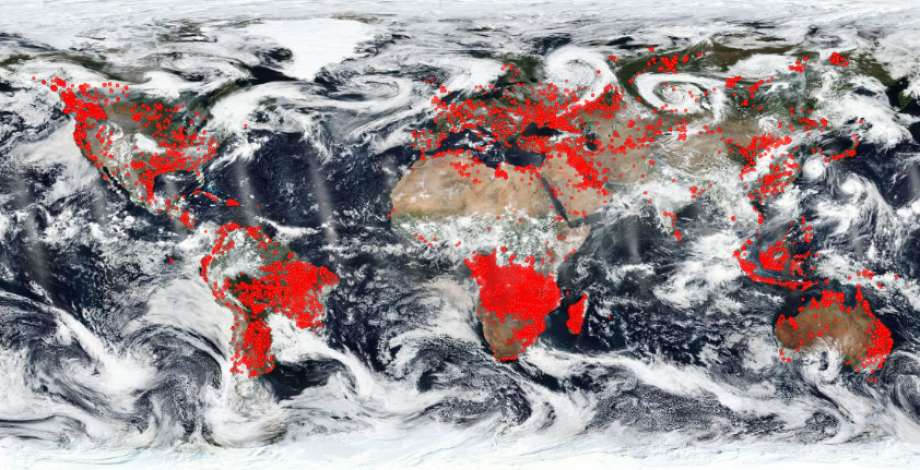
Below, NASA space shot showing fires August 2018
SPREADING LIKE WILDFIRE…….. At one point in July the whole Northern Hemisphere seemed ablaze. It may be the first transcontinental fire ever seen. Fires rages in most of western North America, in the Arctic, in Sweden, Germany, Greece, Russia, Japan, and even Australia – where it is supposed to be winter. A global fire-mapping service just blaring red all over. Meanwhile in Africa the annual crop-burning, and in the Amazon and Indonesia, slash and burn to expand agriculture added to the planetary pulse of carbon into the atmosphere. It as all in the same two weeks of July.Here is a graphic by NASA based on fires they can see from space. Continue reading →
Learrning to Die in the Anthropocene ROY SCRANTON Our world is changing. Rising seas, spiking temperatures, and extreme weather imperil global infrastructure, crops, and water supplies. Conflict, famine, plagues, and riots menace from every quarter. From war-stricken Baghdad to the melting Arctic, human-caused climate change poses a danger not only to political and economic stability, but to civilization itself . . . and to what it means to be human. Our greatest enemy, it turns out, is ourselves. The warmer, wetter, more chaotic world we now live in—the Anthropocene—demands a radical new vision of human life.
In this bracing response to climate change, Roy Scranton combines memoir, reportage, philosophy, and Zen wisdom to explore what it means to be human in a rapidly evolving world, taking readers on a journey through street protests, the latest findings of earth scientists, a historic UN summit, millennia of geological history, and the persistent vitality of ancient literature. Expanding on his influential New York Times essay (the #1 most-emailed article the day it appeared, and selected for Best American Science and Nature Writing 2014), Scranton responds to the existential problem of global warming by arguing that in order to survive, we must come to terms with our mortality…..http://royscranton.com/books/learning-to-die-in-the-anthropocene/
A wildfire burned an estimated 3,000 acres on the Hanford nuclear reservation early Saturday morning, and a larger fire was burning uncontained on Saddle Mountain.
The nuclear reservation fire burned to the east of Highway 240 in the southern end of Hanford, said Rae Moss, spokeswoman for Hanford contractor Mission Support Alliance.
No buildings or areas with radioactive waste were involved, she said. The fire was discovered about 3:20 a.m. and the Hanford Fire Department had it contained at 6:50 a.m., according to Mission Support Alliance.
Highway 240 was closed from Highway 225 to the Highway 24 until about 4:30 a.m., according to the Washington Department of Transportation.
Hanford workers were told to use the Wye Barricade entrance to the site just north of Richland rather than the Yakima Barricade secure entrance.
The cause of the fire has not been announced, but a thunderstorm passed through the Mid-Columbia overnight.
The thunderstorm was the likely cause of two more fires that started on the Saddle Mountain area of the Hanford Reach National Monument north of the Columbia River. The reach includes the original security zone around the nuclear reservation.
The fires started about 10:30 p.m. Friday and merged.
The combined size was estimated at about 12,000 acres, with 30 percent of the fire contained at 10 a.m. Saturday.
Protests spearheaded by march in San Francisco ahead of climate change summit in the city next week
Tens of thousands of people took part in marches and other events across the US on Saturday, calling for a swift transition to renewable energy in order to stave off the various perils of climate change.
The Rise for Climate protests was spearheaded by what organizers called the largest ever climate march on the US west coast. The march, which snaked through the heart of San Francisco, came ahead of a climate change summit in the city next week that will gather mayors and business leaders from around the world.
The San Francisco march, which called for California governor Jerry Brown to end fossil fuel extraction in the state, attracted around 30,000 people, organizers said.
An array of activities, including rallies, voter registration drives and vigils, were scheduled to take place across the US, in cities such as Boston, Miami and Portland, Oregon. Events were also planned in Puerto Rico. In New Orleans, protesters planned to agitate for the halt of the Bayou Bridge pipeline, an extension of the controversial Dakota Access project that last year spurred a lengthy standoff at the Standing Rock reservation.
Hundreds of other actions took place in cities around the world, as part of a coordinated effort to counter what climate activists see as the dangerously regressive policies of Donald Trump’s administration, which has sought to dismantle rules to lower greenhouse gas emissions and has thrown open vast areas of land and water to drilling.
“Today, people across the country are rising up for climate, jobs and justice in their communities to fight back against Trump’s toxic agenda and to send a message to every politician that the time for action is now,” said Michael Brune, executive director of environment group the Sierra Club.
“Families living in the shadows of coal plants and oil refineries, losing homes and livelihoods to wildfires and extreme weather, and struggling to make a living wage are coming together because we know we don’t have time to waste.”
The activists’ ire is largely aimed at governors who though relatively progressive on climate issues, such as Brown and New York governor Andrew Cuomo, are deemed not to be ambitious enough in phasing out fossil fuels. On Thursday, several thousand people took part in a climate march in New York City. Ten activists were arrested after blocking the street in front of Cuomo’s Manhattan office.
A week of protests are planned surrounding the summit in San Francisco, with organizers hoping to draw attention to air pollution and social inequity that has tainted California’s economic growth.
“Climate change, economic inequality, the housing crisis, increased criminalization, attacks on immigrant communities – all these challenges are driven by systemic devaluation of the lives of people of color and choosing profit over people and the planet,” said Gladys Limon, executive director of the California Environmental Justice Alliance.
“We are standing up to life destructive industries, from big oil to natural gas companies, that obstruct progress toward a healthy, sustainable and just society.”
Weatherwatch: nuclear power plants feel the heat, During this summer’s heatwave, nuclear reactors in five European countries had to be shut down or put on reduced power, https://www.theguardian.com/news/2018/sep/07/weatherwatch-nuclear-power-plants-feel-the-heatGuardian, Paul Brown, 8 Sep 2018 An argument of the nuclear lobby is that renewables, particularly wind and solar, are unreliable because of changing weather. Only nuclear power can guarantee to keep the lights on or the air conditioners running.
This summer’s heatwave has shown that prolonged high pressure does reduce the output of the wind industry but it has also had serious consequences for nuclear power. In five European countries, Finland, France, Germany, Sweden and Switzerland, nuclear reactors have had to be put on reduced power or shut down completely because their cooling water got too hot.
Nuclear stations use an enormous amount of cooling water, dumping it back into rivers, lakes or the sea, when it has done its work – much warmer than when it was extracted. Problems occurred this summer when the water intake was too warm to cool the plant, and the hot water being returned to the river or sea was killing fish and other wildlife. This problem has occurred in French rivers before, but this year the Baltic Sea was too warm to cool stations in Finland and Sweden.
Fortunately the UK’s operating nuclear stations are on colder seas where the threat is more from winter storm damage and rising sea levels.
Hundreds of thousands expected to join global climate marches this weekend, Protests against politicians’ failure to tackle the environmental crisis will take place in more than 90 countries, Guardian, Matthew Taylor Environment correspondent, 7 Sep 2018 Hundreds of thousand of people in more than 90 countries are expected to take part in demonstrations this weekend to protest about the failure of politicians to tackle the global environmental crisis.
Organisers say more than 800 events – from marches to street theatre, acts of civil disobedience to mini festivals – will take place in towns and cities amid growing frustration at the lack of meaningful political action over the emerging climate breakdown.
Nick Bryer from campaign group 350.org which is organising the event said: “Politicians are failing. They are still protecting the interests of the fossil fuel companies over the interests of people, despite mounting evidence of the devastation these companies and this system is causing the planet.”…….
In the UK there are events organised in cities from London to Wigan, Bradford to Durham.
Jane Thewlis, from Fossil Free West Yorkshire, is organising an event in Bradford……….
One of the biggest protests is expected in Paris where up to 100,000 people are expected. Events in other European cities including Copenhagen, Brussels and Lisbon are also expected to attract tens of thousands of protesters.
Giles Parkinson, 7 September 2018Well, that didn’t take long. Little more than a week after the elevation of Scott Morrison to the prime minister’s office, Australia has returned to the bad old ways that were a feature of Tony Abbott’s engagement on climate change, and John Howard’s involvement with Kyoto.In separate arena this week, Australia has been accused of attempting to water down the languageof the Pacific Islands Forum declaration on climate change. And in Bangkok it has sided with the Trump administration and Japan in attempting to weaken climate finance obligations in a move that has horrified some observers.
Australia is coming under increasing scrutiny since Malcolm Turnbull announced the country was dumping the emissions obligation proposed for the National Energy Guarantee, and was then dumped by the party’s climate denying conservative wing anyway.
Morrison has shown no interest in climate change, and has instructed new energy minister Angus Taylor to focus only on “bringing down prices” and ensuring the country retains as much “fair dinkum” coal in the system as it can.
Even environment minister Melissa Price, a former mining company lawyer who is supposed to be responsible for emissions, is talking up the idea of having new coal-fired generators.
The international community is looking on in horror, and so are the main business lobby groups in Australia, such as the Business Council of Australia – who have campaigned vigorosuly for a decade to minimise Australia’s contribution to climate action, but understand the considerable reputational, trade and business consequences of choosing to do nothing.
Morrison has so far resisted calls from the party’s far right to follow Trump out of the Paris climate treaty, but in crucial and complex climate talks in Bangkok this week, sided with the US and Japan in a dramatic attempt to weaken climate finance obligations.
The Bangkok talks were called to give negotiators extra time to put together the so-called “rule-book,” which will provide the fine details of the Paris agreement, particularly as countries gear up to increase their climate targets to try and drag the collective efforts closer to the target of limiting global warming to “well below” 2°C, and possibly 1.5°C.
But little progress has been made in Bangkok, forcing the UNFCCC, which runs the climate talks, to call for the annual talks scheduled this year in Poland to begin a day earlier, in the hope that visiting heads of state have something to work with when they turn up.
One of the biggest road-blocks has been erected by Australia, the US and Japan, who put in a joint submission that seeks to water down climate finance guidelines, and casts doubt that this week’s Bangkok negotiations will deliver the clear climate rules UN leaders have been calling for. Climate campaigners say the proposed text on article 9.7 of the Paris accord, which refers to accounting and is meant to establish rules about how developed countries report what finance they provide to developing countries, serves to muddy the rules rather than clarify them.
The campaigners say that the proposal would allow countries to report whatever items they like – including commercial loans ≠ as climate finance, in contrast to demands of clear financial and technical packages to help them developing countries cope with future extreme weather-related events.
“(This) does not create any meaningful rules on how climate finance is accounted for, and instead it essentially says ‘countries should report what they want,’” Brandon Wu, director of policy and campaigns for ActionAid USA, told Devex.
“This would completely let rich countries off the hook and deprive developing countries of real money for real action,” Wu said. Other campaigners said this meant climate finance could just be re-badged existing aid.
These problems are being felt acutely in the Pacific, where island nations are furious with Australia’s stance on climate, its attachment to coal, and its refusal to act on its declarations that “it takes climate change seriously.”
The current Coalition government still has no policy in place to try and reach what is regarded as a very low interim target of a 26-28 per cent reduction in emissions by 2030. Continue reading →
An additional 290 million people could face malnutrition by 2050 if little is done to stop the rise of greenhouse gas emissions, a study finds.
The increased presence of CO2 in the atmosphere could cause staple crops to produce smaller amounts of nutrients such as zinc, iron and protein, the researchers say.
Using international datasets of food consumption, the study estimates that these changes could cause an additional 175 million people to be zinc deficient and an additional 122 million people to be protein deficient by 2050.
The findings show that malnutrition is most likely to affect parts of the world that are already grappling with food insecurity, such as India, parts of North Africa and the Middle East, the lead author tells Carbon Brief.
Growing problems
Climate change is known to threaten food security by increasing the chances of extreme weather events such as heatwaves and drought – which can cause crop failures.
However, climate change could also threaten food security by worsening malnutrition.
Across the world, humans get the majority of the key nutrients they need from plants. Crops, including cereals, grains and beans, provide humans with 63% of their protein, which is needed to build new body tissue.
Plants also provide humans with 81% of their iron, a nutrient that facilitates the flow of blood around the body, and 63% of their zinc, a nutrient that helps fight off disease. (Other sources of these nutrients include meat and dairy.)
However, recent experiments show that, when food crops are exposed to high levels of CO2, they tend to produce lower amounts of these three key nutrients.
The reason why this happens is still not well understood, says Dr Matthew Smith, a researcher in environmental health from Harvard University and lead author of the new study published in Nature Climate Change. He tells Carbon Brief:
“The prevailing theory for many years has been that higher CO2 causes a faster growth rate[in crops] – which favours carbohydrates rather than other nutrients important for human health that cannot be taken up quickly enough by the roots.”
However, there is also evidence that suggests not all nutrients decrease under higher CO2, notes Smith, meaning the extent of the impact is still an “open question”.
Under pressure
For the new study, the researchers estimated how global levels of malnutrition would be affected when the average concentration of CO2 in the atmosphere reaches 550 parts per million (ppm). He tells Carbon Brief:
“The prevailing theory for many years has been that higher CO2 causes a faster growth rate[in crops] – which favours carbohydrates rather than other nutrients important for human health that cannot be taken up quickly enough by the roots.”
However, there is also evidence that suggests not all nutrients decrease under higher CO2, notes Smith, meaning the extent of the impact is still an “open question”.
Under pressure
For the new study, the researchers estimated how global levels of malnutrition would be affected when the average concentration of CO2 in the atmosphere reaches 550 parts per million (ppm)…….
The results show that India faces the largest malnutrition increases out of any country. By 2050, an additional 50 million people in India could become zinc deficient, while an additional 502 million women and children under five could face anemia as a result of iron deficiencies.
Other high-risk countries include Algeria, Iraq and Yemen – three countries which are already grappling with higher-than-average rates of malnutrition, Smith says:
“Hundreds of millions of people could become newly deficient in these nutrients – primarily in Africa, southeast Asia, India and the Middle East – potentially contributing to a range of health effects: anemia, wasting, stunting, susceptibility to infectious disease, and complications for mothers and newborns.”
Curbing CO2
Despite the stark findings, there are “many steps that can be taken” to reduce the impact of rising CO2 levels on malnutrition, Smith says:…..
The findings add to previous research showing “the potential health consequences” of rising CO2 levels, says Prof Kristie Ebi, a researcher in public health and climate change from the University of Washington, who was not involved in the study. She tells Carbon Brief:
With rising sea levels, Bangkok struggles to stay afloat https://www.afp.com/en/news/2265/rising-sea-levels-bangkok-struggles-stay-afloat-doc-18o4x91As Bangkok prepares to host climate-change talks, the sprawling city of more than 10 million is itself under siege from the environment, with dire forecasts warning it could be partially submerged in just over a decade.
A preparatory meeting begins Tuesday in Thailand’s capital for the next UN climate conference, a crunch summit in Poland at the end of 2018 to set rules on reducing greenhouse emissions and providing aid to vulnerable countries.
As temperatures rise, abnormal weather patterns — like more powerful cyclones, erratic rainfall, and intense droughts and floods — are predicted to worsen over time, adding pressure on governments tasked with bringing the 2015 Paris climate treaty to life.
Bangkok, built on once-marshy land about 1.5 metres (five feet) above sea level, is projected to be one of the world’s hardest hit urban areas, alongside fellow Southeast Asian behemoths Jakarta and Manila.
“Nearly 40 percent” of Bangkok will be inundated by as early as 2030 due to extreme rainfall and changes in weather patterns, according to a World Bank report.
Currently, the capital “is sinking one to two centimetres a year and there is a risk of massive flooding in the near future,” said Tara Buakamsri of Greenpeace.
Seas in the nearby Gulf of Thailand are rising by four millimetres a year, above the global average.
The city “is already largely under sea level”, said Buakamsri.
In 2011, when the monsoon season brought the worst floods in decades, a fifth of the city was under water. The business district was spared thanks to hastily constructed dikes.
But the rest of Thailand was not so fortunate and the death toll passed 500 by the end of the season.
Experts say unchecked urbanisation and eroding shorelines will leave Bangkok and its residents in a critical situation.
– ‘Venice of the East’ –
With the weight of skyscrapers contributing to the city’s gradual descent into water, Bangkok has become a victim of its own frenetic development.
Making things worse, the canals which used to traverse the city have now been replaced by intricate road networks, said Suppakorn Chinvanno, a climate expert at Chulalongkorn University in Bangkok.
“They had contributed to a natural drainage system,” he said, adding that the water pathways earned the city the nickname ‘Venice of the East’.
Shrimp farms and other aquacultural development — sometimes replacing mangrove forests that protected against storm surges — have also caused significant erosion to the coastline nearest the capital.
This means that Bangkok could be penned in by flooding from the sea in the south and monsoon floods from the north, said Chinvanno.
“Specialists anticipate more intense storms in this region in the years to come. Narong Raungsri, director of Bangkok’s Department of Drainage and Sewage, admitted that the city’s “weaknesses” stem from its small tunnels and the hyper-development of neighbourhoods.
“What used to act as water basins are now no more,” Raungsri said.
“Our system can only handle so much — we need to enlarge it.”
Today, the government is scrambling to mitigate the effects of climate change, constructing a municipal canal network of up to 2,600 kilometres with pumping stations and eight underground tunnels to evacuate water if disaster strikes.
Chulalongkorn University in 2017 also built in central Bangkok an 11-acre park specially designed to drain several million litres of rain and redirect it so surrounding neighbourhoods are not flooded.
But these ad-hoc fixes may not be enough.
“We need a clear policy of land management,” said Greenpeace’s Buakamsri, adding that the need for increased green spaces is outweighed by developers’ interests.
“The high price of land in Bangkok makes economic interests a priority.”
It’s not only summer weather that is changing. Earlier this year, one study showed that when the Arctic is unusually warm, extreme winter weather is two-to-four times more likely in the eastern U.S.
Think of the Arctic as our early warning system, a big screaming alarm that is alerting us to the fact that the planet we will live on tomorrow is nothing like the planet we lived on yesterday, and we better get ready
Last week, scientists learned that 40-foot piles of compacted sea ice — some of the oldest and most durable clusters in the Arctic — are breaking away from the coast of Greenland and drifting out to sea. One meteorologist called it “scary,” but it was hardly unexpected. As the earth’s climate heats up, the idea of a “blue Arctic” — that is, the disappearance of sea ice for at least part of the year, leaving only open ocean — has long been predicted by climate scientists. Some researchers believe that you might be able to kayak to the North Pole as early as 2030; others think the sea ice might last until 2040 or longer.
The thawing of the Arctic is one of the biggest stories of our time, even if it is playing out at a pace and in a way that virtually guarantees most people will pay little or no attention to it. What’s going on is not a future concern, or simply a tragedy for polar bears; the warming Arctic is already having a tremendous impact on our world and may help explain much of the extreme weather this summer, especially in the U.S. and in western Europe. To oversimplify this only slightly, you could argue that this summer’s historic wildfires in California were predicted by heat in the Arctic.
In recent years, the Arctic has been heating up faster than any other place on the planet. (Last winter, temperatures in the Arctic were 45 degrees Fahrenheit above normal). Last week, German climate scientist Stefan Rahmstorf wrote an excellent piece in Politico explaining why the warming Arctic is not only causing ice to melt, but changing the weather dynamics for the entire planet. Continue reading →
What’s happening to our weather? The answers are hiding in Arctic air, Guardian, Helen Czerski, 1 Sept 18, Dozens of scientists, Helen Czerski among them, are at work in the Arctic, seeking answers to questions that profoundly affect the future of everyone on the planet …….. For two months, the Swedish icebreaker Oden is home to 74 of us, living and working at the top of the world to tap into the stories that the blue and the white have to tell.
…….on this trip, the desire to go one step further is merged with self-preservation. The Arctic may be a long way from most of us, but what happens here matters to all of us. The weather up here is intimately connected to the patterns of weather further south, particularly the jet stream that feeds endless British conversations about the weather. As the sea ice melts, shipping routes are opening up across the Arctic, bringing questions about regulation and control over this previously inaccessible region. And this is an important area for many species, providing summer feeding grounds for visitors from the south. The Arctic may be a long way away, but it is woven into all our lives.
This scientific expedition was funded by the Swedish Polar Research Secretariat and the American National Science Foundation to answer a specific question: how does the ocean affect the weather in the high Arctic? It’s thought that material produced by life beneath the ice reaches and influences the clouds, but how does that happen and when?
Answers to those questions are essential to improve the weather forecasts for this region, and to allow us to predict the effects of the substantial changes in temperature and sea ice that have been observed.
Sea ice doesn’t just matter for its own sake. It has a strong influence on both the ocean and atmosphere, and the consequences tweak our planet’s energy budget. The solar energy that flows into the Earth system is mostly absorbed in the tropics, transported northwards by the atmosphere and ocean, and eventually re-emitted into space as infra-red radiation.
The Arctic balance sheet controls the final part of that process, and the keys to the energy flow through this vast icy wilderness are held by the clouds. Oden is a tiny speck in the white, drifting with the sea ice only a few miles from the north pole, perfectly positioned between the clouds and the ocean to watch and sample and learn………
Understanding this environment is slow work, but the need is urgent. This region is already changing very rapidly, and we cannot understand the importance of a change if we don’t understand the starting point. Expeditions like this are difficult and expensive to run, but the data they produce is essential. In the next couple of weeks, there will be plenty of news stories about the annual sea ice minimum, but less discussion about the specifics of why it might matter. If the ice changes, many other things will also change, and we need to predict the consequences. ……..https://www.theguardian.com/environment/2018/sep/01/whats-happening-weather-answers-arctic-air-oden-helen-czerski