What’s Causing Antarctica’s Ocean to Heat Up? New Study Points to 2 Human Sources
With help from floating data-collectors, a new study reveals the impact greenhouse gas emissions and ozone depletion are having on the Southern Ocean. Inside Climate News, Sabrina Shankman SEP 24, 2018 The Southern Ocean around Antarctica is warming at an alarming rate—twice that of the rest of the world’s oceans. Now, researchers have developed more powerful evidence pointing to the human causes.
Though warming had been observed in the past, there was little historical data to allow scientists to pinpoint the causes with much certainty.
In a new study, researchers used climate models, the past observations that did exist and data flowing in from new ocean-going sensors to show how greenhouse gas emissions and the depletion of ozone in the atmosphere have led to both a warming of the Southern Ocean and an increase in its freshwater content. The findings also rule out natural variability as a major source of those changes.
“The observed warming is due to human influence,” said oceanographer Neil Swart, a research scientist with Environment and Climate Change Canada who led the study, published Monday in the journal Nature Geoscience. “That may have been suspected or proposed before, but this is the evidence that really proves it.”
Ocean-Going Floats and Climate Models……..https://insideclimatenews.org/news/23092018/antarctica-warming-southern-ocean-human-greenhouse-gas-ozone-ice-loss-stu
September 26, 2018
Posted by Christina Macpherson |
ANTARCTICA, climate change |
Leave a comment
Observer 23rd Sept 2018 , Warnings about the dangers of global warming are being watered down in the
final version of a key climate report for a major international meeting
next month, according to reviewers who have studied earlier versions of the
report and its summary.
They say scientists working on the final draft of
the summary are censoring their own warnings and “pulling their
punches” to make policy recommendations seem more palatable to countries
– such as the US, Saudi Arabia and Australia – that are reluctant to
cut fossil-fuel emissions, a key cause of global warming.
“Downplaying the worst impacts of climate change has led the scientific authors to omit
crucial information from the summary for policymakers,” said one
reviewer, Bob Ward, policy director at the Grantham Research Institute on
Climate Change and the Environment.
The report – to be presented at a
meeting in Korea in early October – will make clear that allowing
temperatures to rise by 2C will have devastating consequences, including
rising sea levels, spreading deserts, loss of natural habitats and species,
dwindling ice-caps and increases in the number of devastating storms.
https://www.theguardian.com/science/2018/sep/23/scientists-changing-global-warming-report-please-polluters
September 26, 2018
Posted by Christina Macpherson |
2 WORLD, climate change, secrets,lies and civil liberties |
Leave a comment
 Utility begins restoring power to only nuclear plant to shut down during Hurricane Florence https://www.washingtonexaminer.com/policy/energy/utility-begins-restoring-power-to-only-nuclear-plant-to-shut-down-during-hurricane-florence, by Josh Siegel September 20, 2018 Utility company Duke Energy is restoring power at Brunswick nuclear plant in North Carolina after the site closed because of Hurricane Florence, with one reactor in service and the other set to restart soon.
Shannon Brushe, a Duke spokeswoman, confirmed to the Washington Examiner that it returned power Thursday to one of two units at the 1,978-megawatt Brunswick nuclear plant near Wilmington.
Duke had shut down the two reactors as a precaution before Florence hit. It was the only nuclear plant to close in either North or South Carolina because of the storm.
Over the weekend, Duke workers had limited access to the Brunswick plant because of flooding.
The Nuclear Regulatory Commission said Monday that the plant was completely surrounded by water, with no way in or out of the facility.
Duke issued an emergency alert to the nuclear watchdog commission on Saturday, called an “unusual event” notice, which is the lowest emergency alert that the power plant is required to issue.
Roads in and out of the power plant’s 1,200-acre campus were impassable, making it impossible to relieve the Duke Energy and federal NRC staff stationed at the plant to ride out Hurricane Florence.
But a NRC spokesperson told the Washington Examiner on Thursday that there is now “adequate access to the plant and no other concerns related to flooding at the Brunsw
As of 5:30 p.m. Wednesday, 114,000 Duke customers — most of them in North Carolina — remained without power.
September 22, 2018
Posted by Christina Macpherson |
climate change, USA |
Leave a comment

Beyond Nuclear 20th Sept 2018 , The two-unit coastal Brunswick nuclear power station in South Port, NC was
powered down to zero power shortly in advance of the September 14th arrival
Hurricane Florence with Category 1 winds (sustained < 75 mph), storm surge
and torrential rainfall. Operators maintained the Brunswick units in “hot
standby” (reactor cooling water at 212O F and capable of steam powering
onsite turbines for emergency electricity) to provide an added measure of
power supply for reactor safety and cooling systems in the event of loss of
offsite power and backup emergency diesel generators.
However, throughout the storm, Duke Energy reported that the nuclear power station was in
“stable” condition and never lost offsite electricity power from the
grid providing primary power to safety systems and cooling.
A low-level emergency was declared September 15th when the reactor site was completely
surrounded by rising flood waters making it inaccessible by road. Two
shifts of workers were already housed onsite and supplied in advance for
the storm’s duration. Offsite access by road to the Brunswick units was
restored on September 18th and the “Unusual event” emergency was
terminated.
The continued flooding has damaged many of the bridges and
roads within the ten-mile radius that encompasses the radiological
evacuation planning zone for the Brunswick nuclear power station. As the
flooding recedes, the Federal Emergency Management Agency (FEMA) will
assess the damage to the infrastructure and will provide its recommendation
to the U.S. Nuclear Regulatory Commission (NRC) before Brunswick is allowed
to restart.
http://www.beyondnuclear.org/nuclear-reactors-whatsnew/2018/9/20/brunswick-nuclear-plant-remains-shut-down-following-hurrican.html
September 21, 2018
Posted by Christina Macpherson |
climate change, USA |
Leave a comment

At this rate, Earth risks sea level rise of 20 to 30 feet, historical analysis shows New research finds that a vast area of Antarctica retreated when Earth’s temperatures weren’t much warmer than they are now, WP Chris Mooney, September 20 2018
Temperatures not much warmer than the planet is experiencing now were sufficient to melt a major part of the East Antarctic ice sheet in Earth’s past, scientists reported Wednesday, including during one era about 125,000 years ago when sea levels were as much as 20 to 30 feet higher than they are now.
“It doesn’t need to be a very big warming, as long as it stays 2 degrees warmer for a sufficient time, this is the end game,” said David Wilson, a geologist at Imperial College London and one of the authors of the new research, which was published in Nature. Scientists at institutions in Australia, New Zealand, Japan and Spain also contributed to the work.
The research concerns a little-studied region called the Wilkes Subglacial Basin, which is roughly the size of California and Texas combined and contains more than 10 feet of potential sea-level rise. Fronted by three enormous glaciers named Cook, Mertz and Ninnis, the Wilkes is known to be vulnerable to fast retreat because the ice here is not standing on land and instead is rising up from a deep depression in the ocean floor.
Moreover, that depression grows deeper as you move from the current icy coastline of the Wilkes farther inland toward the South Pole, a downhill slope that could facilitate rapid ice loss.
What the new science adds is that during past warm periods in Earth’s history, some or all of the ice in the Wilkes Subglacial Basin seems to have gone away. That’s an inference researchers made by studying the record of sediments in the seafloor just off the coast of the current ice front……..
Humans have caused about 1 degree Celsius (1.8 degrees Fahrenheit) of warming above the preindustrial planetary temperatures experienced before the year 1880 or so. The world has pledged to avoid a warming above 2 degrees Celsius, and even hopes to hold the warming to 1.5 degrees, but current promises made by countries are not nearly enough to prevent these outcomes.
n other words, we are already on a course that could heat the planet enough to melt some or all of the Wilkes Basin.
“We say 2 degrees beyond preindustrial, and we’re already beyond preindustrial,” Wilson said. “So this is potentially the kinds of temperatures we could see this century.”
The study cannot reveal, however, just how quickly ice emptied out of the Wilkes Basin. The past warm periods in question are thought to have been driven by slight variations in Earth’s orbit as it rotates around the sun, leading to stronger summer heat. That warmth was maintained for thousands of years.
…….. The new research “contributes to the mounting pile of evidence that East Antarctica is not as stable as we thought,” Isabella Velicogna, a glaciologist at the University of California at Irvine, said by email. Velicogna was not directly involved in the paper…….https://www.washingtonpost.com/energy-environment/2018/09/20/antarctica-warming-could-fuel-disastrous-sea-level-rise-study-finds/?utm_term=.7c426ea2a985
September 21, 2018
Posted by Christina Macpherson |
ANTARCTICA, climate change |
Leave a comment
 Guardian 19th Sept 2018 Companies including Facebook, Google and Microsoft have failed to distance
themselves from a lobby group’s proposal to fight any effort by the EU to
set more ambitious climate change goals. A leaked document shows that
BusinessEurope, Europe’s biggest business lobbying group, will urge members
to oppose any moves by the European Commission to ratchet up the bloc’s
2030 targets for clean energy, carbon cuts and energy efficiency.
The commission is considering whether to set more ambitious goals in November
after a key international science panel report on meeting tougher global
warming targets is published in October, and before a UN climate summit in
December.
But, at meeting in Brussels on Wednesday, BusinessEurope will ask
big companies to agree a “line to take” on the prospect of steeper carbon
cuts. If the commission’s measures have teeth, the group’s “advocacy and
communication strategy” recommends companies agree to fight them. “To
oppose the new increase of ambition, using the usual arguments of global
playing field, we cannot compensate for others, etc,” the document said. If
the commission opts for warm words and a political statement rather than a
material ratcheting up of the targets, the group suggests it should react
by being “rather positive”.
https://www.theguardian.com/environment/2018/sep/19/tech-giants-fail-to-distance-from-businesseurope-fight-against-eu-climate-targets
September 21, 2018
Posted by Christina Macpherson |
climate change, EUROPE |
Leave a comment
FT 18th Sept 2018 , As President Donald Trump weakens one environmental rule after another, the
deep green state of California has found a way to fight back: with a
rocket. “With science still under attack and the climate threat growing, we
are launching our own damn satellite,” declared Governor Jerry Brown,
explaining that the craft will track emissions and share the results. One
of the pollutants the satellite will measure is methane, a potent
greenhouse gas. Mr Brown’s declaration on Friday in San Francisco, came
just two days after the Environmental Protection Agency in Washington said
it wanted to relax methane rules. For California and Mr Brown, the
satellite is not only about monitoring methane monitoring but also shows
how much states can do themselves to fight climate change.
https://www.ft.com/content/aae5fe16-b91b-11e8-94b2-17176fbf93f5
September 21, 2018
Posted by Christina Macpherson |
climate change, USA |
Leave a comment
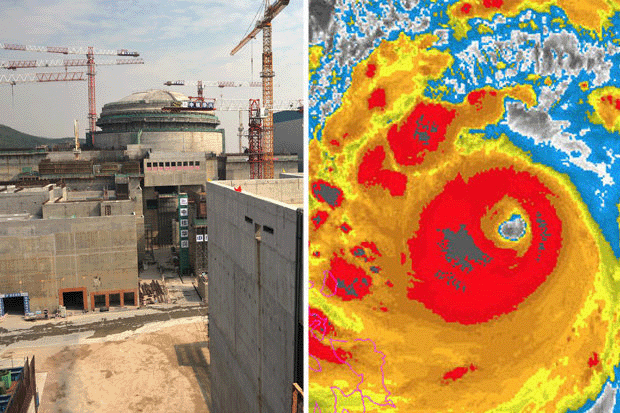
RED ALERT: Typhoon Mangkhut to SMASH into TWO nuclear plants as MILLIONS evacuate in panic https://www.express.co.uk/news/world/1018412/Typhoon-Mangkhut-Hong-Kong-China-nuclear-plants-red-alert-worst-storm
TYPHOON MANGKHUT – the most powerful storm of the year – is expected to directly hit two nuclear power plants later today with shocking 120mph winds, as officials issue a red alert warning.
By OLI SMITH Sep 16, 2018 Typhoon Mangkhut has battered Hong Kong and southern China today, prompting 2.45 million to evacuate.
The typhoon is the world’s most powerful storm of the year, with winds as high as 170 miles per hour – twice as powerful as Hurricane Florence which has struck the US east coast. At least 64 people have died in the wake of the typhoon in the Phillipines while so far two are reportedly dead in Hong Kong.
Officials have issued a red alert warning amid mounting fears over two nuclear power stations in the direct path of the typhoon.There are concerns the typhoon will damage the nuclear reactors and efforts are underway to avoid a repeat of the Japanese Fukushima catastrophe, when an earthquake and tsunami sent three nuclear reactors into meltdown.
The Taishan Nuclear Power Plant and Yangjiang Nuclear Power Station, both in Guangdong, mainland China, confirmed they were “combat ready” and in emergency lockdown as the superstorm nears.
Emergency safety investigations have been carried out at both plants for last-minute preparations behind the typhoon strikes this evening with 120mph winds.
A spokesman for the Taishan facility said: “All emergency personnel are at their posts and have conducted their preparatory work.The plant is fully prepared for the typhoon, and everything is in its place.”
Workers at the Yangjiang plant also secured the facility’s five generating units but fears remain for the sixth, which remains under construction.
Plant manager Chen Weizhong added that all doors and windows were tightly closed.
Mangkhut has already caused mass devastation in the Philippines, where around 40 gold miners are feared trapped following a landslide.The Hong Kong Observatory (HKO) raised the storm signal to T10 – the highest level possible, as the city shut down.
Footage from Hong Kong shows the scale of devastation, including a high-rise construction crane collapsing and windows in skyscrapers breaking under pressure.
One video shows a father and son swept off their feet and thrown into a wall due to the sheer power of the winds
After the typhoon passes over Hong Kong, the powerful storm is expected to wreak havoc across several Chinese megacities.
September 19, 2018
Posted by Christina Macpherson |
China, climate change, safety |
Leave a comment
 Typhoon Mangkhut: Two nuclear power plants on China’s Guangdong coast in path of storm Workers batten down the hatches at Yangjiang and Taishan facilities as superstorm set to make landfall nearby, South China Morning Post Sarah Zheng, 16 September, 2018,
Two nuclear power plants stand on the projected path of Typhoon Mangkhut, which is expected to make landfall in mainland China as early as Sunday afternoon. Taishan Nuclear Power Plant and Yangjiang Nuclear Power Station, both in Guangdong province, said they were “in combat readiness” mode as the superstorm approached.
The Taishan plant, which is about 135km from Hong Kong, said via WeChat that officials had discussed how best to deal with the approaching storm and specialist workers had conducted safety investigations.
Mangkhut LIVE blog: signal No 10 raised as typhoon batters Hong Kong
Emergency response teams had also been briefed and were prepared for the typhoon’s arrival………
The Yangjiang power plant, which went into commercial operation in 2014, has been in the news before.
In 2016, four members of its staff were punished for breaching operational guidelines and covering up an incident in which a residual heat-removal pump on one of the reactors stopped functioning for six minutes.
Last year, component supplier Dalian Teikoku Canned Motor Pump Company was fined for violating operating rules regarding welding at the plant……..https://www.scmp.com/news/china/society/article/2164363/chinese-nuclear-power-plant-path-super-typhoon-mangkhut
September 17, 2018
Posted by Christina Macpherson |
China, climate change |
Leave a comment
 Independent 14th Sept 2018 A group of almost 400 of the world’s leading investors, controlling over $30tn (£23tn) in assets, have agreed to work together to back initiatives to combat climate change and help meet the objectives of the Paris agreement. The group aims to lobby and put pressure on governments around the world to accelerate action to tackle global greenhouse gas emissions.
Investors including the BBC Pensions Trust, Transport for London pensions fund, Aviva, the Environment Agency pension fund, Legal and General, and
the Joseph Rowntree Charitable Trust are calling on the companies in their portfolios to reduce their carbon footprint, support clean energy, and
strengthen climate-related financial disclosures. The list of organisations who are part of the newly launched “Investor Agenda” includes 279
investors controlling $31tn who had already signed up to the aims of the Climate Action 100+ in agreement with this statement:
“We, the institutional investors that are signatories to this statement, are aware of the risks climate change presents to our portfolios and asset values in
the short, medium and long term. We therefore support the Paris Agreement and the need for the world to transition to a lower carbon economy
consistent with a goal of keeping the increase in global average temperature to well below 2° Celsius above pre-industrial levels.”
https://www.independent.co.uk/environment/climate-change-funding-global-warming-investment-company-investor-agenda-a8536286.html
September 17, 2018
Posted by Christina Macpherson |
business and costs, climate change |
Leave a comment
AN “extremely dangerous” super typhoon predicted to be the one of the strongest systems on record is howling towards Hong Kong and the Philippines with up to 43 million people in the firing line.
Typhoon Mangkhut is the equivalent of a Category 5 severe tropical cyclone, boasting maximum sustained winds of 205kph and gusts up to 285kph. Bureau of Meteorology Australia tropical climatologist Greg Browning told news.com.au that Mangkhut was “significantly stronger” than Hurricane Florence which is simultaneously hurtling towards the US as North Carolina locals evacuate the region to avoid the onslaught.
“(Mangkhut is) relatively rare (because it’s) at the top of the severe scale,” Mr Browning said. It’s extremely dangerous as it’s a very large system with very strong winds and a potential storm surge over a large distance.
“There will be very heavy rainfall associated with it which has potential to cause widespread damage.”
Mr Browning said Mangkhut was the most powerful storm system to have developed on Earth this year but that it wasn’t the strongest since records began in 1946, as has been reported internationally. Typhoon Haiyan – which killed more than 6,000 people when it lashed the Philippines with maximum sustained winds of 230kph and gusts of 325kph in 2013 – holds that record.
On Friday, Mangkhut was in the Pacific, about 450km from the Philippines with the 125km-wide eye expected to make landfall on the country’s largest island, Luzon, on Saturday.
The Global Disaster Alert and co-ordination System (GDACS) said it expected a “high humanitarian impact based on the storm strength and the affected population in the past and forecasted path” of destruction. As many as 43 million people could be exposed to Mangkhut’s cyclonic winds, according to the GDACS. More than four million Filippinos are reportedly at risk of the storm which could drench areas as far south as the country’s island capital, Manila. Mr Browning said the super typhoon was then likely to continue tracking west to Hong Kong and southern China, jeopardising millions more lives, on Sunday and Monday.
‘THE BIGGEST KILLER OF ALL’
The Joint Typhoon Warning Center in Hawaii has categorised the system as a “super typhoon“ which Mr Browning said equates to “very destructive winds” and heavy rainfall that’s likely to cause infrastructure damage anywhere it hits.
“But the biggest killer of all with a system like this is typically the storm surge,” he said.
“The region close to the typhoon’s crossing can expect (to bare the brunt).”
With a 900km wide rain band – which is 50 per cent bigger than Haiyan’s – combined with seasonal monsoon rains, the typhoon could also set off landslides, according to forecasters.
Countries across east and southeast Asia are issuing emergency alerts and ordering evacuations as both Mangkhut and a second storm, Typhoon Barijat taunt the region.
Mangkhut is forecast to hit the northeastern Cagayan province of the Philippines, early on Saturday local time.
Office of Civil Defense chief Ricardo Jalad told an emergency meeting led by the Philippines President Rodrigo Duterte that about 4.2 million people in Cagayan, nearby Isabela province and outlying regions were vulnerable to the most destructive effects near the typhoon’s 125km-wide eye. Nearly 48,000 houses in those high-risk areas are made of light materials and vulnerable to Mangkhut’s ferocious winds.
Storm warnings have been raised in 25 provinces across the Philippines restricting air and sea travel. Schools have been closed and bulldozers are on standby in the event of landslides.
The military and police in Luzon have been placed on red alert — barring all troops from going on leave — so they can respond to emergencies in communities expected to bear the brunt of the typhoon.
Cagayan Governor Manuel Mamba told local media that this typhoon was “very different, this is more complicated because of possible storm surges”.
MEGACITIES IN PATH OF DESTRUCTION
The Hong Kong observatory’s tracking system shows a 70 per cent probability that Mangkhut could deviate within a 500km radius from its predicted position, causing uncertainty over the next few days. The observatory warned of rough seas and frequent heavy squalls, urging residents of the densely populated financial hub to “take suitable precautions and pay close attention to the latest information” on the storm.
Australian expat Alexis Galloway, who lives in Hong Kong, told news.com.au the government this morning “announced on the radio they are opening 47 emergency shelters once the T3 is raised”.
“This is the first time I’m actually quite nervous (about a typhoon) … we live right on the water too and 15 minutes from Shenzhen! Right in the thick (of it),” she said.
The system is already stronger than any of the 15 past severe or super typhoons that warranted the highest “No 10” warning sign, the South China Morning Post reports.
On the Chinese mainland, the three southern provinces of Guangdong, Guangxi and Hainan are co-ordinating preparations, including suspending transport and moving people to shelter inland, the national meteorological agency reported. The area is home to a string of megacities and more than 100 million people. Guangdong, China’s manufacturing hub, has set up 3777 shelters, while more than 100,000 residents and tourists have been moved to safety or sent home. The province has recalled more than 36,000 fishing boats to port, while train services between the cities of Zhanjiang and Maoming have been suspended and all ferry services between the Guangdong and Hainan have been put on hold.
megan.palin@news.com.au | @Megan_Palin
September 14, 2018
Posted by Christina Macpherson |
ASIA, climate change |
Leave a comment
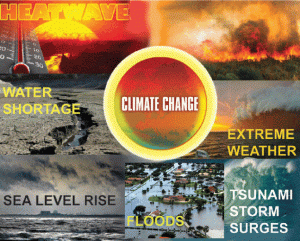 Here’s how climate change is fueling Hurricane Florence A novel forecast looks at the size and fury of the storm with and without human-caused warming, Science News, BY CAROLYN GRAMLING , SEPTEMBER 13, 2018
Even as Hurricane Florence bears down on the Carolinas, bringing fierce winds and heavy rains, one team of scientists has undertaken a different kind of forecast: Understanding the influence of human-caused climate change on a storm that hasn’t made landfall yet.
Real-time storm forecasts continuously update as new data become available. But what would happen if, from a single starting point — in this case, the state of the atmosphere on September 11 — Florence roared ahead in two parallel worlds: one with and one without the influence of human-caused climate change?
In that hypothetical scenario, Florence was bigger than if it would be if it had occurred in a world with no human-caused warming, climate modeler Kevin Reed of Stony Brook University in New York and colleagues conclude in a study posted on the university’s website September 12. And thanks to warmer sea surface temperatures and more available moisture in the air, it would dump 50 percent more rain on the Carolinas, the researchers predict.
The goal of such climate change attribution studies is to determine whether — and by how much — human-driven climate change might have caused a particular extreme event, such as a hurricane, a heat wave or a flood. It’s an increasingly high-profile area of research, particularly after three studies last year found that a trio of extreme events in 2016 simply could not have happened without climate change (SN: 1/20/18, p. 6).
Until now, such studies have been conducted only when the event is long over. Reed and his colleagues got a jump on that question, conducting the first attribution study for an extreme event that is still in progress. It’s not yet clear what role such real-time attribution studies might play in society; they could aid emergency planning, policy making and even climate-related litigation.
In the meantime, what this study reveals is that “dangerous climate change is here now,” says study coauthor Michael Wehner, a climate scientist at Lawrence Berkeley National Laboratory in California. “The chances and magnitude of dangerous extreme weather have already been significantly increased.”
Reed talked with Science News about what a forecast attribution study is, how the new study suggests climate change may have altered Florence’s rainfall and size, and the future of real-time attribution. His responses are edited for space and clarity………https://www.sciencenews.org/article/how-climate-change-fueling-hurricane-florence
September 14, 2018
Posted by Christina Macpherson |
climate change, USA |
Leave a comment
 Higher temperatures, higher suicide rates, study finds https://thebulletin.org/2018/09/higher-temperatures-higher-suicide-rates-study-finds/?utm_source=Bulletin%20Newsletter&utm_medium=iContact%20email&utm_campaign=September14 By Dan Drollette Jr, September 7, 2018 There may be another, unexpected risk associated with global warming: higher rates of suicide.
For centuries, researchers have noticed that rates of violence and suicide tend to to increase in the summer. In a study published in Nature Climate Change, Stanford University professors showed that temperature increases by 2050 could increase suicide rates by 1.4 percent in the United States and 2.3 percent in Mexico. These seemingly small percentages in the suicide rate are actually quite significant—about twice as large in size as the influence of economic recessions, for example—and might explain why the rate of suicide in the United States has risen dramatically over the last 15 years. In real numbers, it means an additional 21,000 suicides in the US and Mexico per year.
Interestingly, the effects in Texas are some of the highest in the country. Even after the introduction of air conditioning—which would be expected to be a counterbalance—suicide rates there have not declined over recent decades. If anything, the researchers say, the effect has grown stronger in Texas over time.
And the effect is even stronger in Mexico, lending credence to the idea of a connection between how hot it is outside and how much people want to kill themselves. The researchers got it down to a mathematical formula: Every 1-degree Celsius increase in average monthly temperature means an additional 0.7 percent increase in suicides in the United States (and an additional 2.1 percent in Mexico).
In their paper, the authors stressed that rising temperature and climate change alone should not be viewed as direct motivations for suicide. Instead, they point out that these factors may contribute to the risk of suicide by affecting the likelihood that an individual makes a suicide attempt.
September 14, 2018
Posted by Christina Macpherson |
2 WORLD, climate change, psychology - mental health |
Leave a comment
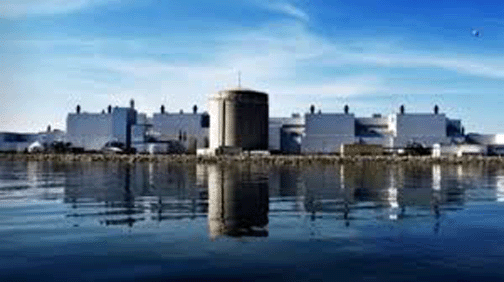
A NUCLEAR PLANT BRACES FOR IMPACT WITH HURRICANE FLORENCE, Wired, MEGAN MOLTENIMEGAN MOLTENI 13 Sept 18 I N MARCH 11, 2011, a one-two, earthquake-tsunami punch knocked out the safety systems at the Fukushima Dai-ichi nuclear power plant, triggering an explosion of hydrogen gas and meltdowns in three of its six reactors—the world’s worst nuclear disaster since Chernobyl. Fukushima’s facility was built with 1960s technology, designed at a time when engineers underestimated plant vulnerabilities during natural disasters. In the US, 20 plants with similar designs are currently operating.
One of them is slated for a head-on collision with Hurricane Florence. Duke Energy Corp’s dual-reactor, 1,870-megawatt Brunswick plant sits four miles inland from Cape Fear, a pointy headland jutting out into the Atlantic Ocean just south of the city of Wilmington, North Carolina. Brunswick has survived decades of run-ins with hurricanes, but Florence could be its biggest test yet. The plant perches near the banks of the Cape Fear River, which drains 9,000 square miles of the state’s most densely populated regions. Like Hurricane Harvey in 2017, Florence is predicted to stall out for days, pounding the Carolinas with unrelenting amounts of water, leading to life-threatening storm surges and catastrophic flooding. NOAA’s National Hurricane Center is projecting 110 mile-per-hour winds, waves as high as 13 feet, and in some places, up to 40 inches of rain.
Duke Energy Corp’s dual-reactor, 1,870-megawatt Brunswick plant sits four miles inland from Cape Fear, a pointy headland jutting out into the Atlantic Ocean just south of the city of Wilmington, North Carolina. Brunswick has survived decades of run-ins with hurricanes, but Florence could be its biggest test yet. The plant perches near the banks of the Cape Fear River, which drains 9,000 square miles of the state’s most densely populated regions. Like Hurricane Harvey in 2017, Florence is predicted to stall out for days, pounding the Carolinas with unrelenting amounts of water, leading to life-threatening storm surges and catastrophic flooding. NOAA’s National Hurricane Center is projecting 110 mile-per-hour winds, waves as high as 13 feet, and in some places, up to 40 inches of rain.
They’re part of a sweep of changes nuclear plants around the US have adopted post-Fukushima……….
Duke predicted a maximum storm surge of 7 feet at the plant’s safety-related buildings. But the plant was originally designed to cope with only 3.6 feet of expected surge, according to the NRC’s 2017 summary assessment of Duke’s hazard reevaluation report, which has not been made public.
In a letter earlier this year, the NRC reminded Duke that the plant’s current design falls short of the reevaluated flood risks. According to Burnell, Duke has since submitted an assessment of how it will cope—including the use of those steel door reinforcements—which the NRC is still evaluating. “The review is not complete but there’s nothing in there to this point that causes us any concern,” says Burnell………….
Storms can be unpredictable, however. Dave Lochbaum, who directs a nuclear safety watchdog group at the Union of Concerned Scientists, has spent a lifetime studying nuclear failures. Brunswick troubles him because in 2012, Duke found hundreds of missing or damaged flood protections at the plant, such as cracked seals and corroded pipes. According to the group, none of the NRC’s subsequent reports have mentioned repairs. “Hopefully they’ve been fixed,” says Lochbaum. “But we’ve not been able to confirm that with the available documentation.”………
In its 2012 post-Fukushima review, Florida Power & Light told the NRC that flood protections at its St. Lucie plant on South Hutchinson Island were adequate, despite failing to discover six electrical conduits with missing seals in one of the emergency core cooling systems. Two years later, a freak storm inundated Florida’s central coast with record rainfall, flooding one of the plant’s reactors with 50,000 gallons of stormwater. The deluge submerged core cooling pumps, rendering them useless. Had the reactor faltered during the storm, the plant would not have been able to maintain a safe and stable status beyond 24 hours, according to an NRC notice of violation issued to FPL after the incident………https://www.wired.com/story/a-nuclear-plant-braces-for-impact-with-hurricane-florence/
September 14, 2018
Posted by Christina Macpherson |
climate change, safety, USA |
Leave a comment

Earth could enter permanent ‘hothouse‘ state, scientists warn https://zeelandpress.com/earth-could-enter-permanent-hothouse-state-scientists-warn/ by Katie Hansen on September 10, 2018
The planet urgently needs to transition to a green economy because fossil fuel pollution risks pushing the Earth into a lasting and dangerous “hothouse” state, researchers warned on Monday.
If polar ice continues to melt, forests are slashed and greenhouse gases rise to new highs — as they currently do each year — the Earth will pass a tipping point.
Crossing that threshold “guarantees a climate 4-5 Celsius (7-9 Fahrenheit) higher than pre-industrial times, and sea levels that are 10 to 60 meters (30-200 feet) higher than today,” cautioned scientists in .
And that “could be only decades ahead,” they said.
What is ‘Hothouse Earth‘?
“Hothouse Earth is likely to be uncontrollable and dangerous to many,” said the article by scientists at University of Copenhagen, Australian National University and the Potsdam Institute for Climate Impact Research in Germany.
Rivers would flood, storms would wreak havoc on coastal communities, and coral reefs would be eliminated — all by century‘s end or even earlier.
Global average temperatures would exceed those of any interglacial period — meaning warmer eras that come in between Ice Ages — of the past 1.2 million years.
Melting polar ice caps would lead to dramatically higher sea levels, flooding coastal land that is home to hundreds of millions of people.
“Places on Earth will become uninhabitable if ‘Hothouse Earth‘ becomes the reality,” said co-author Johan Rockstrom, executive director of the Stockholm Resilience Centre.
Where is the tipping point?
Researchers suggest the tipping point could come once the Earth warms to 3.6 Fahrenheit (2 Celsius) over pre-industrial times.
The planet has already warmed 1 C over pre-industrial times, and is heating up at a rate of 0.17 C per decade.
“A 2 C warming could activate important tipping elements, raising the temperature further to activate other tipping elements in a domino-like cascade that could take the Earth System to even higher temperatures,” said the report.
This cascade “may tip the entire Earth system into a new mode of operation,” said co-author Hans Joachim Schellnhuber, director of the Potsdam Institute for Climate Impact Research.
Experts also worry about phenomena like , which will spread as the planet gets hotter and drier and have the potential to accelerate carbon dioxide buildup and global warming.
How they calculated this
The “Perspective” article is based on previously published studies on tipping points for the Earth.
The scientists also examined conditions the Earth has seen in the distant past, such as the Pliocene period five million years ago, when CO2 was at 400 ppm like today.
During the Cretaceous period, the era of the dinosaurs some 100 million years ago, CO2 levels were even higher at 1,000 ppm, largely due to volcanic activity.
To state that 2 C is a no-return threshold “is new,” said Martin Siegert, co-director of the Grantham Institute at Imperial College London, who was not involved in the study.
The study authors “collated previously published ideas and theories to present a narrative on how the threshold change would work,” he said.
“It‘s rather selective, but not outlandish.”
How to stop it
People must immediately change their lifestyle to be better stewards of the Earth, the researchers said.
Fossil fuels must be replaced with low or zero emissions energy sources, and there should be more strategies for absorbing carbon emissions such as ending deforestation and planting trees to absorb carbon dioxide.
Soil management, better farming practices, land and coastal conservation and carbon capture technologies are also on the list of actions.
Yet even if humans stopped emitting greenhouse gases, the current warming trend could trigger other Earth system processes, called feedbacks, driving even more warming.
These include permafrost thaw, deforestation, loss of northern hemisphere snow cover, sea ice and polar ice sheets.
Researchers say it‘s not certain that the Earth can remain stable.
“What we do not know yet is whether the climate system can be safely ‘parked‘ near 2 C above preindustrial levels, as the envisages,” said Schellnhuber.
September 14, 2018
Posted by Christina Macpherson |
2 WORLD, climate change |
Leave a comment