Growing threat to human health, as night time temperatures are going up around the world
Research published in the International Journal of Climatology last year found night-time temperatures were increasing more rapidly than daytime temperatures.
 Why temperatures at night are going up around the world and what we can do about it http://www.abc.net.au/news/2018-07-19/nights-getting-hotter-climate-change-has-deadly-consequences/9985340, ABC Weather By Kate Doyle
Britain’s new rules will force companies to declare their carbon footprint
Telegraph 18th July 2018, Britain’s largest companies will need to lay bare the size of their
carbon footprint alongside their statutory financial results in their
annual reports from next year. Under new rules, the Government will force
large private companies and those quoted on the London Stock Exchange to
account for their energy use, carbon emissions and their energy efficiency
measures in the drive towards a zero carbon economy. The new rules take
effect for the financial years from April 2019 and replace a defunct carbon
reporting regime which was heavily criticised by business for needlessly
adding layers of bureaucracy at a cost of around £20m.
https://www.telegraph.co.uk/business/2018/07/18/government-force-carbon-accounting-annual-reports/
Nuclear power vanishing in America, irrelevant to climate action
 Nuclear power predicted to ‘virtually disappear’ in the US Power Technology 5th July 2018 By Scarlett Evans, Researchers from Carnegie Mellon University’s Department of Engineering and Public Policy have released a report detailing nuclear power’s dwindling significance in the US, stating that it is unlikely to make any noteworthy contributions to the country’s decarbonised energy system over the next few decades.
The report, published in Proceedings of the National Academy of Science, examined the potential contribution of large, light water nuclear reactors (LWRs) to the US energy system over the next three or four decades…… The researchers also examined whether advanced reactor designs and factory-manufactured smaller light water reactors (known as small modular reactors or SMRs) would play a significant role in US energy markets, being the only other option for the large-scale deployment of nuclear power. The study took several scenarios into account, such as using SMRs as wind or solar back-ups, to desalinate water, produce heat for industrial processes, or serve military bases.
https://www.power-technology.com/news/nuclear-power-predicted-virtually-disappear-us/
Temperature rise could be double what has been predicted
 Guardian 6th July 2018 Temperature rises as a result of global warming could eventually be double
what has been projected by climate models, according to an international
team of researchers from 17 countries. Sea levels could also rise by six
metres or more even if the world does meet the 2 degree target of the Paris
accord.
The findings, published last week in Nature Geoscience, were based
on observations of evidence from three warm periods in the past 3.5m years
in which global temperatures were 0.5-2 degrees above the pre-industrial
temperatures of the 19th century.
The researchers say they increase theurgency with which countries need to address their emissions. The
scientists used a range of measurements to piece together the impacts of past climatic changes to examine how a warmer earth would appear once the climate has stabilised.
https://www.theguardian.com/environment/2018/jul/06/global-temperature-rises-could-be-double-those-predicted-by-climate-modelling
Nuclear power big or small, old or new – all unlikely to help against climate change
The vanishing nuclear industry, Science Daily, July 2,  2018, Source: College of Engineering, Carnegie Mellon University
- Summary:
- Could nuclear power make a significant contribution to decarbonizing the US energy system over the next three or four decades? Probably not.
-
Could nuclear power make a significant contribution to decarbonizing the U.S. energy system over the next three or four decades? That is the question asked by four current and former researchers from Carnegie Mellon University’s Department of Engineering and Public Policy (EPP). Their answer: probably not.
In a paper, “U.S. nuclear power: The vanishing low-carbon wedge,” just published in the Proceedings of the National Academy of Science (PNAS), the team examined the current U.S. nuclear fleet, which is made up of large light water nuclear reactors (LWRs). While for three decades, approximately 20% of U.S. power generation has come from these LWRs, these plants are ageing, and the cost of maintaining and updating them along with competition from low cost natural gas, makes them less and less competitive in today’s power markets.
In place of these LWRs, the team asked whether advanced reactor designs might play a significant role in U.S. energy markets in the next few decades. They concluded that they probably would not. Then, the team examined the viability of developing and deploying a fleet of factory manufactured smaller light water reactors, known as small modular reactors (SMRs). The team examined several ways in which a large enough market might be developed to support such an SMR industry, including using them to back up wind and solar and desalinate water, produce heat for industrial processes, or serve military bases. Again, given the current market and policy environments, they concluded that the prospects for this occurrence do not look good. …https://www.sciencedaily.com/releases/2018/07/180702154736.htm
For climate change action, nuclear is a poor choice

Many argue that NPPs are necessary to mitigate climate change, but only one stage out of the 14-stage nuclear fuel cycle is carbon free. Unless equipped with desalination facilities, reactors consume vast amounts of water, an increasingly-scarce resource in countries like Pakistan, which is predicted to completely run out of water by 2025. Nuclear waste must be stored and secured for tens of thousands of years, not to mention the environmental disasters caused by reactor meltdowns. There are other strategies to limit global temperature rise below two degrees, and the idea that countries should deploy all low-carbon technologies no matter the costs should not be used to support such a volatile industry
Why the Civil Nuclear Trap Is Part and Parcel of the Belt and Road Strategy
Civil nuclear energy presents grave pitfalls in terms of cost, innovation and security that BRI countries cannot and should not afford. The Diplomat By Sam Reynolds July 05, 2018 The Larger Point
Although China will continue to promote the benevolent aspects of the BRI, countries along its corridors and elsewhere should not fall victim to the civil nuclear trap. Nuclear energy is too costly, too time-consuming and too risky, especially in light of better alternatives. Instead, developing countries should lead the way towards a secure, low-carbon, low-cost energy future without NPPs.
Nuclear advocates argue correctly that nuclear has comparable levelized costs to solar photovoltaics (PV). The irony is that projects regularly go over budget and costs can actually increase the more nuclear experience a country has, contradicting the learning curve phenomenon. Although the French nuclear program was incredibly successful, it demonstrated “negative learning,” wherein costs actually increased for additional projects. (Solar PV and wind costs decreased the fastest with every doubling of experience.)
Therefore, innovations and experience in nuclear technology might not lead to cost reductions. Continue reading
A week of unprecedented heat records across the planet
 All-time heat records have been set all over the world during the past week, https://www.brisbanetimes.com.au/environment/climate-change/all-time-heat-records-have-been-set-all-over-the-world-during-the-past-week-20180705-p4zply.htmlBy Jason Samenow
Washington: From the normally mild summers of Ireland, Scotland and Canada to the scorching Middle East, numerous locations in the Northern Hemisphere have witnessed their hottest weather ever recorded over the past week.
Large areas of heat pressure or heat domes scattered around the hemisphere led to the sweltering temperatures. No single record, in isolation, can be attributed to global warming. But collectively, these heat records are consistent with the kind of extremes we expect to see increase in a warming world.
Let’s take a tour around the world of the recent hot-weather milestones.
North America
A massive and intense heat dome has consumed the eastern two-thirds of the United States and south-east Canada since late last week. It’s not only been hot but also exceptionally humid. Some of the notable all-time records include: Denver tied its all-time high-temperature record of 40.5 degrees Celsius on Thursday; Burlington, Vermont, set its all-time warmest minimum temperature ever recorded of 26.6 degrees on Monday; Montreal recorded its highest temperature in recorded history, dating back 147 years, of 36.6 degrees on Monday. The city also posted its most extreme midnight combination of heat and humidity.
Excessive heat torched the British Isles late last week. The stifling heat caused roads and roofs to buckle, the Weather Channel reported, and resulted in multiple record highs in Scotland, Ireland, and Northern Ireland.
Eurasia
A large dome of high pressure, or heat dome, has persistently sat on top of Eurasia over the past week, resulting in some extraordinarily hot weather.
Several locations in southern Russia topped or matched their warmest June temperatures on record on Thursday.
Middle East
Qurayat, Oman, posted the world’s hottest minimum temperature ever recorded on June 28: 42.6 degrees.
In late May 2017, the western town of Turbat in Pakistan hit 53.5 degrees, tying the all-time highest temperature in the country and the world-record temperature for May.
It followed the hottest temperature ever observed on Earth during the month of April — 50.2 degrees also in Pakistan.
Washington Post
Climate change brings collapse of ecosystems in Australia
The Conversation 4 July 18 Climate Research Fellow, University of Tasmania, Professor, Environmental Change Biology, University of Tasmania, Senior Lecturer, Macquarie University,
To the chagrin of the tourist industry, the Great Barrier Reef has become a notorious victim of climate change. But it is not the only Australian ecosystem on the brink of collapse.
Our research, recently published in Nature Climate Change, describes a series of sudden and catastrophic ecosystem shifts that have occurred recently across Australia.
These changes, caused by the combined stress of gradual climate change and extreme weather events, are overwhelming ecosystems’ natural resilience.
Variable climate
Australia is one of the most climatically variable places in the world. It is filled with ecosystems adapted to this variability, whether that means living in scorching heat, bitter cold or a climate that cycles between the two.
Despite land clearing, mining and other activities that transform the natural landscape, Australia retains large tracts of near-pristine natural systems.
Many of these regions are iconic, sustaining tourism and outdoor activities and providing valuable ecological services – particularly fisheries and water resources. Yet even here, the combined stress of gradual climate change and extreme weather events is causing environmental changes. These changes are often abrupt and potentially irreversible.
They include wildlife and plant population collapses, the local extinction of native species, the loss of ancient, highly diverse ecosystems and the creation of previously unseen ecological communities invaded by new plants and animals.
Australia’s average temperature (both air and sea) has increased by about 1°C since the start of the 19th century. We are now experiencing longer, more frequent and more intense heatwaves, more extreme fire weather and longer fire seasons, changes to rainfall seasonality, and droughts that may be historically unusual.
The interval between these events has also shortened, which means even ecosystems adapted to extremes and high natural variability are struggling.
As climate change accelerates, the magnitude and frequency of extreme events is expected to continue increasing.
What is ecosystem collapse?
Gradual climate change can be thought of as an ongoing “press”, on which the “pulse” of extreme events are now superimposed. In combination, “presses” and “pulses” are more likely to push systems to collapse.
We identified ecosystems across Australia that have recently experienced catastrophic changes, including:
not all examples can be directly linked to a single weather event, or a series of events. These are most likely caused by multiple interactingclimate “presses” and “pulses”. It’s worth remembering that extreme biological responses do not always manifest as an impact on the dominant species. Cascading interactions can trigger ecosystem-wide responses to extreme events.
The cost of intervention
Once an ecosystem goes into steep decline – with key species dying out and crucial interactions no longer possible – there are important consequences.
Apart from their intrinsic worth, these areas can no longer supply fish, forest resources, or carbon storage. It may affect livestock and pasture quality, tourism, and water quality and supply.
Unfortunately, the sheer number of variables – between the species and terrain in each area, and the timing and severity of extreme weather events – makes predicting ecosystem collapses essentially impossible.
Targeted interventions, like the assisted recolonisation of plants and animals, reseeding an area that’s suffered forest loss, and actively protecting vulnerable ecosystems from destructive bushfires, may prevent a system from collapsing, but at considerable financial cost. And as the interval between extreme events shorten, the chance of a successful intervention falls.
Critically, intervention plans may need to be decided upon quickly, without full understanding of the ecological and evolutionary consequences.
How much are we willing to risk failure and any unintended consequences of active intervention? How much do we value “natural” and “pristine” ecosystems that will increasingly depend on protection from threats like invasive plants and more frequent fires?
We suspect the pervasive effects of the press and pulse of climate change means that, increasingly, the risks of doing nothing may outweigh the risks of acting.
The beginning of this century has seen an unprecedented number of widespread, catastrophic biological transformations in response to extreme weather events.
This constellation of unpredictable and sudden biological responses suggests that many seemingly healthy and undisturbed ecosystems are at a tipping point https://theconversation.com/ecosystems-across-australia-are-collapsing-
Tense political situation of mass migration – climate change compound s this problem
A Warming World Creates Desperate People, NYT, By Lauren Markham, Ms. Markham is a freelance reporter who writes about migration and the environment. June 29, 2018 Last year I traveled to southern Guatemala, the source of one of the largest migrations of unauthorized immigrants to the United States in recent years. It’s clear why people are leaving: Guatemala is a country rife with political conflict, endemic racism against indigenous people, poverty and, increasingly, gang violence.
 But there’s another, lesser-known dimension to this migration. Drought and rising temperatures in Guatemala are making it harder for people to make a living or even survive, thus compounding the already tenuous political situation for the 16.6 million people who live there.
……….. Long before the unconscionable family-separation catastrophe at our southern border, President Trump had made the battle against illegal immigrants the rallying cry of his campaign and administration. He wants to lock up more immigrants — including toddlers — as a deterrent while casting all new unauthorized immigrants as potential, if not probable, violent criminals. Simultaneously, the president’s team has taken on the environment, doing nearly everything it can to walk back decades of regulation intended to protect our air, water and land. Last June, Mr. Trump pulled out of the Paris climate accord. Meanwhile, Scott Pruitt, the administrator of the Environmental Protection Agency, is doggedly eviscerating the agency he runs.
Today, according to global relief agencies, over 68 million people worldwide have been forced to flee their homes, often because of war, poverty and political persecution. As a writer, I focus largely on issues of forced migration. The hundreds of migrants I’ve interviewed in the past few years — whether from Gambia, Pakistan, El Salvador, Guatemala, Yemen or Eritrea — are most often leaving because of some acute political problem at home. But I’ve also noticed something else in my years of reporting. If you talk to these migrants long enough, you’ll hear about another, more subtle but still profound dimension to the problems they are leaving behind: environmental degradation or climate change.
The United Nations High Commissioner for Refugees estimates that since 2008, 22.5 million people have been displaced by climate-related or extreme weather events. This includes tragedies like the widespread famine in Darfur, monsoons and flooding in Bangladesh and the catastrophic hurricane in Puerto Rico. The more out of whack our climate becomes, the more people up and leave their homes. As our world heats up and sea levels rise, the problem of forced migration around the world is projected to become far worse.
And in refusing to take climate change or responsibility for our planet seriously, the Trump administration is encouraging the conditions that will increase unauthorized migrations to the United States and elsewhere.
…….. Many things are exacerbating the effects of the drought in Central America, including pervasive deforestation and farmers overtaxing their land. But according to Climatelinks, a project of the United States Agency for International Development, the average temperature in El Salvador has risen 2.34 degrees Fahrenheit since the 1950s, and droughts have become longer and more intense. The sea has risen by three inches since the 1950s, and is projected to rise seven more by 2050. Between 2000 and 2009, 39 hurricanes hit El Salvador, compared with 15 in the 1980s. This, too, is predicted to get worse………..
Like El Salvador, Gambia, Bangladesh and Guatemala, Ethiopia has been hit hard by climate change, though it is not even in the top 100 emitters of greenhouse gases. But the problem with climate change, of course, is that it is a problem that crosses borders.
The anti-immigrant rhetoric of the Trump administration has made for elaborate and bombastic theater — but with real, and sometimes deadly, human consequences (see again the children separated from their parents at the border). But Mr. Trump means what he says: He wants immigration from poor countries to stop. He sees the problems in those countries as theirs, not ours — never mind the centuries of catastrophic foreign intervention in places like El Salvador and the rest of the Americas, the Arab world and sub-Saharan Africa, or the growing menace of the changing climate.
If President Trump really wants to curb “illegal” migration to the United States for the long haul, he’d better get serious about climate change. The Trump administration can continue to eviscerate the E.P.A. and thumb its nose at global efforts to protect the climate. Or he can work responsibly to try to curb international migration by addressing the challenges of a warming planet.
Arctic climate change: The northern Barents Sea has warmed 1.5 degrees Celsius in just 18 years

Huge part of Arctic ocean is shifting to an Atlantic climate, study finds
The northern Barents Sea has warmed 1.5 degrees Celsius in just 18 years, Independent, Chris Mooney 28 June 1
South Asia will cop huge climate change effects over the coming decades

Half of South Asia living in vulnerable climate ‘hotspots’: World Bank https://www.reuters.com/article/us-south-asia-climatechange-worldbank/half-of-south-asia-living-in-vulnerable-climate-hotspots-world-bank-idUSKBN1JO2AV, Malini Menon– 29 June 18
NEW DELHI (Reuters) – Changes in temperature and rainfall will impact almost half of South Asia in the coming decades, reducing economic growth in one of the world’s poorest regions, the World Bank said.
A World Bank report released on Thursday analyses two scenarios – “climate sensitive”, based on collective action by nations to limit greenhouse gas emissions, and “carbon intensive”, which assumes no action on climate change.
The report combines future changes in temperature and rainfall with household survey data linking living standards to weather conditions for the first time.
More than 800 million people now live in areas predicted to become moderate-to-severe “hotspots”, or affected areas, by 2050 under the carbon intensive scenario, with India accounting for almost three quarters of them, the report said.
Moderate hotspots are areas where projected consumption spending declines by 4-8 percent and severe ones are where the drop exceeds 8 percent.
“There seems to be some kind of correlation between climate hotspots and water stressed areas,” Muthukumara Mani, a World Bank economist, said.
The World Bank’s expectation of about half of India living in moderately or severely-affected areas by 2050 tallies with a federal think tank’s report two weeks ago. This warned that 600 million Indians could suffer high to extreme water stress as the country faces the worst long-term water crisis in its history.
Rising temperature and changing monsoon rainfall patterns from climate change could cost India 2.8 percent of gross domestic product (GDP) and depress the living standards of one in every two Indians by 2050, the World Bank report said.
What happened last time it was as warm as it’s going to get later this century?
Kids today will be grandparents when most climate projections end—does the past have more hints? Ars Technica –
Wildfire danger s are increasing, due to climate change
How climate change is increasing the risk of wildfires, The Conversation, Senior Lecturer in GIS and Ecology, Anglia Ruskin University,
The army has been called in to help firefighters deal with a huge wildfire on Saddleworth Moor, Greater Manchester, where residents have been forced to evacuate. Wildfires are also blazing across Northern Californiawhile the issue of bushfires in Australia calls for constant vigilance from the emergency services there. These fires are becoming more common and one of the reasons for this is climate change.
Warmer temperatures in the summer and associated drier conditions desiccate plant materials and create more vegetation litter, providing more fuel for these fires. Several studies have linked the increase of wildfires with climate change in various parts of the world, such as North America and Southern Europe.
For example, a study in California from 2004 found that the warmer and windier weather (brought about by an atmosphere with higher levels of CO2) produced fires that burned more intensely and spread faster in most locations. Despite enhanced firefighting efforts, the number of escaped fires (those exceeding initial containment limits) increased by 51% in the south San Francisco Bay area, 125% in the Sierra Nevada.
It has also been demonstrated that increases in rainfall during winter and spring – which are also known consequences of climate change – provide more favourable conditions for plant growth and therefore more potential fuel for the fires later in the summer.
Even though climate change increases the vulnerability of dry environments to wildfires, a source of ignition is still required. In the UK, it can be natural (such as bolts of lightning) or caused by man either deliberately or accidentally. Various studies have shown that the number of recreational visits to “risky” sites, such as the English Peak District, increase the occurrence of wildfire.
Despite its destructive power, fire is an important ecological process that can benefit several endangered species by maintaining their habitat. It is an important tool in the management and preservation of heathlands and moorlands in the UK when used appropriately and in a controlled way.
But climate change and human activities increase the vulnerability of those habitats to uncontrolled wildfires and higher population densities near these areas will potentially put more people and houses at risk. In addition to the global battle against climate change, appropriate management procedures are necessary to maintain those habitats and ensure the risks of uncontrolled fires are minimised and the potential spread of them reduced. https://theconversation.com/how-climate-change-is-increasing-the-risk-of-wildfires-99056
Climate change linked to potential population decline in bees
Study finds that warmer temperatures push bees to their physiological limits, may drive local extinction, Science daily
- Date:
- June 28, 2018
- Source:
- Northwestern University
- Summary:
- A new study has found that climate change may drive local extinction of mason bees in Arizona and other naturally warm climates.
A new study from Northwestern University and the Chicago Botanic Garden has found that climate change may drive local extinction of mason bees in Arizona and other naturally warm climates.
In a two-year, in situ field experiment that altered the temperature of the bees’ nests to simulate a warmer, future climate, 35 percent of bees died in the first year and 70 percent died in the second year. This is compared to a 1-2 percent mortality rate in the control group.
“The projected temperatures appear to be pushing this species up against its physiological limits,” said Northwestern’s Paul CaraDonna, who led the research. “This is evidence that we might see local extinction in the warmer parts of this species’ range, which is pretty sobering.”
-
The study will publish online on Thursday, June 28 in the British Ecological Society’s journal Functional Ecology. CaraDonna is an assistant professor of instruction in the Program in Plant Biology and Conservation in Northwestern’s Weinberg College of Arts and Sciences and a research scientist at the Chicago Botanic Gardens…….https://www.sciencedaily.com/releases/2018/06/180628105009.htm
With climate change, it’s unwise for UK to build Hinkley Point C, as sea levels are rising
 Weatherwatch: the nuclear option and rising levels of anxiety Danger of coastal flooding might make sensible people think twice about building houses in vulnerable places, let alone nuclear power stations, Guardian, https://www.theguardian.com/news/2018/jun/22/weatherwatch-the-nuclear-option-and-rising-levels-of-anxiety Paul Brown,
Back in 2012 a document obtained under the Freedom of Information Act showed that the Environment Agency was warning that 12 out of the UK’s 19 nuclear sites were in danger of coastal flooding and erosion because of climate change. Among them was Hinkley Point in Somerset, one of the eight proposed sites for new nuclear power stations around the coasts.That was before the increasing volume of melting of the Greenland ice capwas properly understood and when most experts thought there was no net melting in the Antarctic.
Melting ice sheets are hastening sea level rise, satellite data confirms
Satellite measurements released earlier this month and other recent observations of how warmer seas are eroding ice shelves and glaciers have removed uncertainty.
Estimates of sea level rise in the next 50 years have gone up from less than 30cm to more than a metre, well within the lifespan of the nuclear stations the UK government has planned.
The extra coastal erosion and threat of storm surges that this increase in sea level will bring to our shores might make sensible people think twice about siting any buildings in vulnerable places, let alone nuclear power stations.
So far, however, the government has yet to respond and is pressing ahead with its plans.
1 This Month
26 April – Chernobyl: Inside the Meltdown airs on National Geographic on Sunday 26th April from 4pm

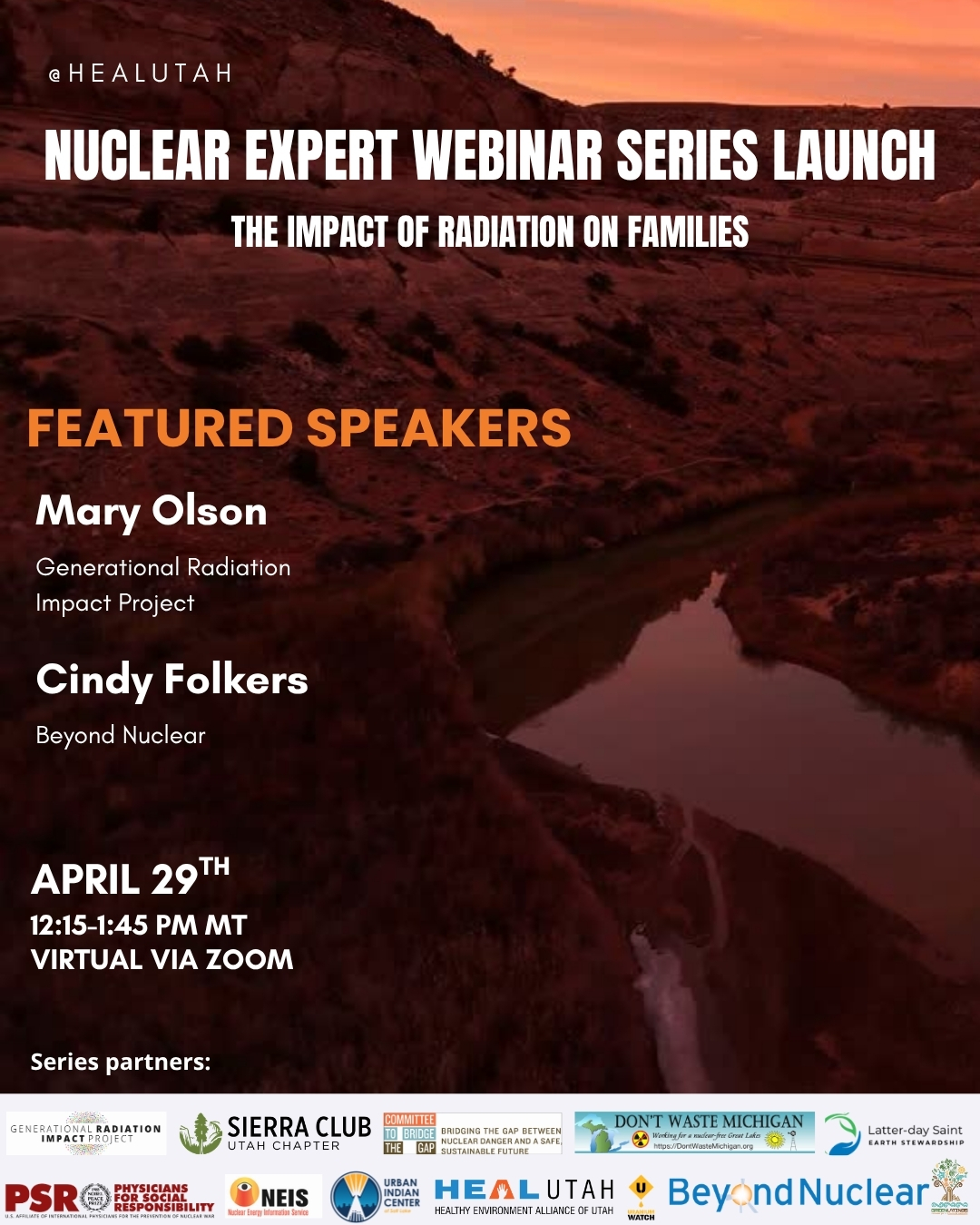
29 April – Nuclear Expert Webinar #1 – Radiation Impacts on Families with Mary Olson and Cindy Folkers
- 12:15 PM MT – 1:45 PM MT
- Location: Virtual – REGISTER TODAY

4 May -West Suburban Peace Coalition to discuss Iran war at May Educational Forum
Monday, May 4, 7:00 – 8:00 PM Central Standard Time
Title: : How Trump’s Narrative Tries to Shape the Reality of the War on Iran.
Contact Walt Zlotow, zlotow@hotmail.com 630 442 3045 for further information
14 May – online event From Bombs to Data Centres: the Face of Nuclear Colonialism

Pine Ridge Uranium is the real threat, not Tehran- Tell Burgum: Stop the Extraction.
Chernobyl: The Lost Tapes – A good documentary on Chernobyl on SBS available On Demand for the next 3 weeks– https://www.sbs.com.au/ondemand/tv-program/chernobyl-the-lost-tapes/2352741955560
To see nuclear-related stories in greater depth and intensity – go to https://nuclearinformation.wordpress.com
-
Archives
- May 2026 (25)
- April 2026 (356)
- March 2026 (251)
- February 2026 (268)
- January 2026 (308)
- December 2025 (358)
- November 2025 (359)
- October 2025 (376)
- September 2025 (257)
- August 2025 (319)
- July 2025 (230)
- June 2025 (348)
-
Categories
- 1
- 1 NUCLEAR ISSUES
- business and costs
- climate change
- culture and arts
- ENERGY
- environment
- health
- history
- indigenous issues
- Legal
- marketing of nuclear
- media
- opposition to nuclear
- PERSONAL STORIES
- politics
- politics international
- Religion and ethics
- safety
- secrets,lies and civil liberties
- spinbuster
- technology
- Uranium
- wastes
- weapons and war
- Women
- 2 WORLD
- ACTION
- AFRICA
- Atrocities
- AUSTRALIA
- Christina's notes
- Christina's themes
- culture and arts
- Events
- Fuk 2022
- Fuk 2023
- Fukushima 2017
- Fukushima 2018
- fukushima 2019
- Fukushima 2020
- Fukushima 2021
- general
- global warming
- Humour (God we need it)
- Nuclear
- RARE EARTHS
- Reference
- resources – print
- Resources -audiovicual
- Weekly Newsletter
- World
- World Nuclear
- YouTube
-
RSS
Entries RSS
Comments RSS
 nuclear-news