Climate change is melting the French Alps, say mountaineers

 Permafrost ‘cement’ is evaporating, making rocks unstable and prone to collapse with many trails now deemed too dangerous to use, Guardian, Simon Birch, 24 Aug 18, For the tourists thronging the streets and pavement cafes of Chamonix, the neck-craning view of Mont Blanc, the highest mountain in the Alps, is as dazzling as ever.
But the mountaineers who climb among the snowy peaks know that it is far from business as usual – due to a warming climate, the familiar landscape is rapidly changing.
“Global climate change has serious and directly observable consequences in high mountains,” says Vincent Neirinck from Mountain Wilderness, a campaign group that works to preserve mountain environments around the world.
One of the consequences of climate change is the ongoing retreat of glaciers. “In the Alps, the glacier surfaces have shrunk by half between 1900 and 2012 with a strong acceleration of the melting processes since the 1980s,” says Jacques Mourey, a climber and scientist who is researching the impact of climate change on the mountains above Chamonix.
The most dramatic demonstration of glacial retreat is shown by the Mer de Glace, the biggest glacier in France and one of Chamonix’s biggest tourist hotspots which would now be unrecognisable to the Edwardian tourists who first flocked there.
“The Mer de Glace is now melting at the rate of around 40 metres a year and has lost 80m in depth over the last 20 years alone,” says glaciologist Luc Moreau.
A stark consequence of the melting Mer de Glace is that 100m of ladders have now been bolted onto the newly exposed vertical rock walls for mountaineers to climb down onto the glacier.
Another key impact of climate change in the mountains is that it is leading to an increase in the number of rockfalls; more than 550 occurred in the Mont Blanc massif alone between 2007 and 2015.
Another key impact of climate change in the mountains is that it is leading to an increase in the number of rockfalls; more than 550 occurred in the Mont Blanc massif alone between 2007 and 2015……..https://www.theguardian.com/environment/2018/aug/24/climate-change-is-melting-the-french-alps-say-mountaineers
August 25, 2018
Posted by Christina Macpherson |
climate change, France |
Leave a comment
 S&P Global 20th Aug 2018
 , Delayed reactor returns slash French nuclear availability nearly 9 GW. Available nuclear

power generating capacity in France fell sharply by almost 9 GW after EDF delayed the return of multiple nuclear plants, while high temperatures continued to restrict production at its Saint Alban power station, the operator said. This amounted to a total nuclear output loss of around 2.37 TWh, according to S&P Global Platts calculations.
In updates over the weekend and on Monday, EDF announced plans to delay the return of its 1.31-GW Nogent-1 reactor by more than five weeks to September 19, after initially expecting a two-day outage that started on late Thursday night. Also restarting on September 19 is EDF’s 890-MW Dampierre nuclear unit-1, where production stopped on Saturday. The return of Dampierre-3, with the
same generating capacity on the other hand, was delayed by two days after it was taken off the grid on August 6. The 1.31-GW Golfech-2 reactor, which was taken off the grid for planned outage in May, is now expected to restart on Friday, extending the outage by four days. The restart of both 915-MW Cruas-4 and 1.495-GW Civaux-1, which was scheduled for Tuesday, was set to return on Friday and Saturday, respectively, EDF said.
August 24, 2018
Posted by Christina Macpherson |
climate change, France, Legal |
Leave a comment
 Wind, tidal conditions force Pilgrim plant to half capacity, http://www.patriotledger.com/news/20180823/wind-tidal-conditions-force-pilgrim-plant-to-half-capacity- By Joe DiFazio
The Patriot Ledger PLYMOUTH — The Pilgrim Nuclear Power Station entered its fourth day at half capacity Thursday due to wind and tidal conditions.
Sea water helps cool the station and the plant’s spokesperson Pat O’Brien said that wind was blowing the warm water that leaves the station over toward the station’s intake.
The reduced power, he said, keeps the water leaving the station cooler.
“We can only take in water at 75 degrees and we reduce power to stay well below that,” said O’Brien.
Neil Sheehan, spokesperson for the U.S. Nuclear Regulatory Commission, said that tidal conditions also played a factor in the capacity reduction and pointed out that Cape Cod Bay’s water is generally warmer this time of year.
The power reduction, Sheehan said, should not have any impact on New England’s grid.
ISO New England, the region’s grid operator, said that nuclear power made up one quarter of the system’s fuel Thursday afternoon. New England has one other nuclear power plant in Seabrook, New Hampshire.
Pilgrim was offline for 43 days earlier this year to replace a startup transformer, said O’Brien. Winter storms and other repairs also put the station offline for several days.The beleaguered 45-year-old Pilgrim is the only station in the country’s lowest performance category for nuclear power plants due to technical problems and intermittent shutdowns. Pilgrim’s performance triggered additional federal oversight.
The plant is scheduled to go offline June 2019.
August 24, 2018
Posted by Christina Macpherson |
climate change, USA |
Leave a comment

More than a dozen local environmental groups from coast to coast have organized the Freedom to Breathe Tour, where journalists, activists, and environmental-justice experts will present vulnerable communities with their case for swift and dramatic action on climate change. The 21-day tour, which begins August 25 and will traverse the entirety of the American South and Southwest, will illustrate the current climate realities for communities of color in the nation’s most marginalized places.
“I don’t believe the science is inaccessible,”
The Victims of Climate Change Are Already Here
With a new global summit approaching, communities in the southern United States are calling attention to the disaster scenarios they currently face., VANN R. NEWKIRK II
The Atlantic, AUG 22, 2018 In the new global reality, where each passing year is the hottest on record, the final month of summer foretells calamity. It’s always hot and volatile in the dog days between mid-August and mid-September, but the past few years have dialed those elements up high. Heat waves, droughts, storms, floods, and other extreme events have garnered increasing attention. The largest wildfire in California’s history is now raging almost a year after the previous record holder hit the state. Hurricanes Harvey and Irma ravaged the Gulf Coast and Florida in late August last year. Hurricane Maria became the second-most deadly natural disaster in contemporary American history when it passed over Puerto Rico last September. And the 13th anniversary of the Louisiana landfall of Hurricane Katrina, the largest such storm, is on August 29.Climate change is not a future problem. Climate change is a current problem. Yet the United States—despite this recent history—has pulled back from a number of already insufficient commitments to reversing emissions and global warming. Faced with this vacuum, American nongovernmental organizations and states have stepped forward with campaigns designed to reinvigorate climate activism and policy making. But they have a long way to go, especially in connecting a mainstream climate movement with the majority of the victims of those disasters.
One of the major initiatives put together as President Donald Trump began to withdraw the White House from climate leadership is the Global Climate Action Summit, which will take place in September. “This summit’s happening in San Francisco, California, but it’s something that was requested several years ago by the United Nations,” says Nick Nuttall, the summit’s spokesman. A collective of non-state actors organized the event, Nuttall says, with the goal of “bring[ing] together leaders from state and local governments, business, and citizens from around the world to demonstrate how the tide has turned in the race against climate change.” As Nuttall told me, the general idea is to recapture the energy that preceded the 2015 Paris climate agreement, in which most of the world’s countries agreed to pursue policies that would curb global temperature growth to well under 2 degrees Celsius.*
Why the wildfires of 2018 have been so ferocious
However, the problem with many climate summits—and much of the mainstream climate movement, generally—is that many of them focus on a future target, planning for and attempting to avert doomsday scenarios that might play out over the course of decades or a century. The mainstream paradigm often views climate change as a collective risk, and pushes people to action by selling fears of future societal collapse and environmental ruin. Both can be averted if politicians and people work together and with urgency, the common argument goes; if we all pitch in, we can avoid the worst.
As the fallout from Harvey, Irma, and Maria shows, though, that argument is false. The suffering caused by a warming and more temperamental environment is already happening, and it isn’t distributed equally, nor will it be. From the poor people in Vieques, Puerto Rico, who still face uncertain medical care and unstable electricity after Maria, to black and Latino communities severed from dialysis services in Houston during Harvey, if there’s anything the current climate regime tells us, it’s that vulnerable populations are already in trouble.
But as the anniversaries of America’s most infamous climate disasters come around once again, there are real efforts by a loose network of veteran environmental-justice leaders and groups across the country to spread the gospel of climate justice in this moment of crisis.
More than a dozen local environmental groups from coast to coast have organized the Freedom to Breathe Tour, where journalists, activists, and environmental-justice experts will present vulnerable communities with their case for swift and dramatic action on climate change. The 21-day tour, which begins August 25 and will traverse the entirety of the American South and Southwest, will illustrate the current climate realities for communities of color in the nation’s most marginalized places.
“I don’t believe the science is inaccessible,” says Caroline Lewis, the founder of the cleo Institute, a nonprofit organization focused on climate literacy and education in South Florida. “What we’re trying to do is simplify climate science for the general population.” During the tour’s stop in Miami, Lewis and her organization will run a workshop that uses well-known concepts like sea-level rise and gentrification as what she called “gateway drugs” to a full understanding of climate change.
|
August 24, 2018
Posted by Christina Macpherson |
climate change, USA |
Leave a comment
 BANNG 22nd Aug 2018 , Fake news has arrived on the shores of the Blackwater estuary!! It takes
the form of the recent, widely distributed CGN/EDF glossy and upbeat
‘Community’ Newsletter, which gives information about what is happening
at the site of the proposed Bradwell B new nuclear power station.
The Blackwater Against New Nuclear Group (BANNG) feels compelled to respond to
this Newsletter, which it considers to be a partial and misleading piece of
smooth ‘nuke speak’ that gives all the upsides and none of the
downsides of a new nuclear power station at Bradwell.
So what does the Newsletter actually tell us? It says ‘The project is at an early
stage’. But nowhere is there the slightest hint that Bradwell B might not
go ahead. In fact, early stage or not, so sure is CGN/EDF of success that
an indicative project timeline is provided, showing that construction
‘begins’ in 5 – 7 years from now. It tells us that comments can be
made on the Generic Design Assessment (GDA) process.
But the new Blackwater Nuclear Community might well ask if there is any point in commenting on
this given the obvious confidence of CGN/EDF that the Hualong 1000 reactor,
not yet in use anywhere in the world, will pass the regulators’ tests.
BANNG thinks that there is every point in commenting and would encourage
our fellow residents of the new Blackwater Nuclear Community to do so. If
you find a GDA process difficult to comment on (and who doesn’t?), simply
draw attention to the fact that all the digging of boreholes and marine
surveys cannot disguise the fact that the site is in Flood Zone 3 and,
therefore, totally unsuitable for potentially dangerous new nuclear
reactors.
Words such as ‘flooding’, storm surges’, ‘other coastal
processes’, ‘all predicted to get worse with climate change’,
‘madness’ could be woven into your comments, along with ‘the
Blackwater is a Marine Conservation Zone’ and ‘potential harm to marine
and human life’.
August 24, 2018
Posted by Christina Macpherson |
climate change, UK |
Leave a comment
Sweden calls for nuclear reactors to be shielded from hot weather, Business Times, AUG 21, 2018
 [OSLO]Sweden’s nuclear energy regulator SSM has asked plant operators to produce plans in the coming months to shield their reactors from harmful hot weather, its director told Reuters on Monday.
A number of Swedish reactors had to shut down or reduce output as the summer heatwave sent temperatures to record highs in July, with the sea water that is used to cool them becoming much warmer than normal, exceeding safety levels. The last time that SSM, the Swedish radiation safety authority, asked operators to produce plans to modify their reactors was after Japan’s Fukushima disaster in 2011. The cost of those changes, which are due by 2020, was in the hundreds of millions of euros.
“We really have to take into consideration what happened this summer … We have asked them orally to come with suggestions. Of course there will be a cost. I do not know how much at this stage,” said SSM chief Mats Persson said.
The cost of post-Fukushima modifications to Swedish nuclear plants reached as much as 100 million euros (S$155 million) per reactor, Persson said……..https://www.businesstimes.com.sg/energy-commodities/sweden-calls-for-nuclear-reactors-to-be-shielded-from-hot-weather
August 22, 2018
Posted by Christina Macpherson |
climate change, Sweden |
Leave a comment

Leaving no stone unturned in heatstroke battle at nuclear plant http://www.asahi.com/ajw/articles/AJ201808180033.htmlBy HIROSHI ISHIZUKA/ Staff Writer , 18 Aug 18 OKUMA, Fukushima Prefecture–How to avert a heatstroke is more pressing than usual in Japan this summer as the archipelago bakes in a record heat wave.
It’s not just sun-worshipers, children, the elderly and the infirm who should worry.
Spare a thought for the 5,000 or so workers who toil at the crippled Fukushima No. 1 nuclear power plant to get it ready for decommissioning.
They have to work outside in protective gear, with limited access to water and other resources.
At 5 a.m. on Aug. 6, a manager reminded a 20-strong group from IHI Plant Construction Co., which was contracted by Tokyo Electric Power Co., of the importance of adhering strictly to work rules.
“Please limit your efforts to shifts of less than 90 minutes,” the manager told the assembled workers in a lounge at the plant as he checked the complexion of each individual to gauge their health condition.
The workers are installing storage tanks for radioactive water that is accumulating at the plant.
They are not permitted to take food and beverages with them because of the risk of internal radiation exposure if the perishables are contaminated while they are working.
Water stations have been set up, but workers generally don’t bother to quench their thirst as it means they have to change out of their work gear to reach the sites.
During the morning meeting, the manager also checked each worker’s alcohol level and made sure that everybody had water from oral rehydration solution. After that, workers put a cold insulator in their vests and headed to the work site.
The Fukushima plant complex has about 900 tanks set up. IHI Plant Construction installed about 20 percent of them.
The workers’ primary responsibility in recent weeks is to inspect the condition of covers put in place to stop rainwater from accumulating around the tanks.
The workers are spared from the scorching sun as they work under cover, but coping with 90 to 95 percent humidity is a formidable challenge.
Junichi Ono, the head of the IHI Plant Construction’s task force assigned to the plant, said his company has tried to take every precaution against heatstroke.
“We need to pay attention because we work in a humid environment,” he said. “If a worker falls sick, we will lose valuable time taking that person to the doctor.”
According to TEPCO, 23 workers suffered heatstroke in the summer of 2011, shortly after the nuclear crisis unfolded at the plant.
Learning a lesson from that, workers were later instructed to start their tasks early in the morning and not work outdoors in principle between 2 p.m. and 5 p.m. in July and August, the hottest part of the day.
The “summer time” schedule appears to be paying off.
In fiscal 2014, the number of workers afflicted with heatstroke at the plant stood at 15.
It dropped to four in fiscal 2016, but went back up to six in fiscal 2017 despite it being a relatively cool summer that year.
Although this year’s heat wave is unprecedented, only four workers have suffered heatstroke at the plant this summer.
The Japan Meteorological Agency forecast blistering summer heat in the coming week after a respite this weekend.
August 20, 2018
Posted by Christina Macpherson |
climate change, employment, Fukushima continuing |
Leave a comment

Climate change sea level rises could increase risk for more devastating tsunamis worldwide https://www.eurekalert.org/pub_releases/2018-08/vt-ccs081418.php, Even minor sea-level rise, by as much as a foot, poses greater risks VIRGINIA TECH 16 Aug 18
As sea levels rise due to climate change, so do the global hazards and potential devastating damages from tsunamis, according to a new study by a partnership that included Virginia Tech.
Even minor sea-level rise, by as much as a foot, poses greater risks of tsunamis for coastal communities worldwide.
The threat of rising sea levels to coastal cities and communities throughout the world is well known, but new findings show the likely increase of flooding farther inland from tsunamis following earthquakes. Think of the tsunami that devasted a portion of northern Japan after the 2011 Tohoku-Oki earthquake, causing a nuclear plant to melt down and spread radioactive contamination.
These findings are at the center of a new Science Advances study, headed by a multi-university team of scientists from the Earth Observatory of Singapore, the Asian School of the Environment at Nanyang Technological University, and National Taiwan University, with critical support from Virginia Tech’s Robert Weiss, an associate professor in the Department of Geosciences, part of the College of Science.
“Our research shows that sea-level rise can significantly increase the tsunami hazard, which means that smaller tsunamis in the future can have the same adverse impacts as big tsunamis would today,” Weiss said, adding that smaller tsunamis generated by earthquakes with smaller magnitudes occur frequently and regularly around the world. For the study, Weiss was critical in helping create computational models and data analytics frameworks.
At Virginia Tech, Weiss serves as director of the National Science Foundation-funded Disaster Resilience and Risk Management graduate education program and is co-lead of Coastal@VT, comprised of 45 Virginia Tech faculty from 13 departments focusing on contemporary and emerging coastal zone issues, such as disaster resilience, migration, sensitive ecosystems, hazard assessment, and natural infrastructure.
For the study, Weiss and his partners, including Lin Lin Li, a senior research fellow, and Adam Switzer, an associate professor, at the Earth Observatory of Singapore, created computer-simulated tsunamis at current sea level and with sea-level increases of 1.5 feet and 3 feet in the Chinese territory of Macau. Macau is a densely populated coastal region located in South China that is generally safe from current tsunami risks.
At current sea level, an earthquake would need to tip past a magnitude of 8.8 to cause widespread tsunami inundation in Macau. But with the simulated sea-level rises, the results surprised the team.
The sea-level rise dramatically increased the frequency of tsunami-induced flooding by 1.2 to 2.4 times for the 1.5-foot increase and from 1.5 to 4.7 times for the 3-foot increase. “We found that the increased inundation frequency was contributed by earthquakes of smaller magnitudes, which posed no threat at current sea level, but could cause significant inundation at higher sea-level conditions,” Li said.
n the simulated study of Macau – population 613,000 – Switzer said, “We produced a series of tsunami inundation maps for Macau using more than 5,000 tsunami simulations generated from synthetic earthquakes prepared for the Manila Trench.” It is estimated that sea levels in the Macau region will increase by 1.5 feet by 2060 and 3 feet by 2100, according to the team of U.S.-Chinese scientists.
The hazard of large tsunamis in the South China Sea region primarily comes from the Manila Trench, a megathrust system that stretches from offshore Luzon in the Philippines to southern Taiwan. The Manila Trench megathrust has not experienced an earthquake larger than a magnitude 7.8 since the 1560s. Yet, study co-author Wang Yu, from the National Taiwan University, cautioned that the region shares many of the characteristics of the source areas that resulted in the 2004 Sumatra-Andaman earthquake, as well as the 2011 earthquake in northern Japan, both causing massive loss of life.
These increased dangers from tsunamis build on already known difficulties facing coastal communities worldwide: The gradual loss of land directly near coasts and increased chances of flooding even during high tides, as sea levels increase as the Earth warms.
“The South China Sea is an excellent starting point for such a study because it is an ocean with rapid sea-level rise and also the location of many mega cities with significant worldwide consequences if impacted. The study is the first if its kind on the level of detail, and many will follow our example,” Weiss said.
Policymakers, town planners, emergency services, and insurance firms must work together to create or insure safer coastlines, Weiss added.
“Sea-level rise needs to be taken into account for planning purposes, for example for reclamation efforts but also for designing protective measures, such as seawalls or green infrastructure.”
He added, “What we assumed to be the absolute worst case a few years ago now appears to be modest for what is predicted in some locations. We need to study local sea-level change more comprehensively in order to create better predictive models that help to make investments in infrastructure that are or near sustainable.”
August 17, 2018
Posted by Christina Macpherson |
2 WORLD, climate change, oceans |
Leave a comment
 Europe’s Nuclear Reactors Fall Victim to the Heat http://www.earthisland.org/journal/index.php/elist/eListRead/europes_nuclear_reactors_fall_victim_to_the_heat/,BY ANDY ROWELL – AUGUST 10, 2018
Closures raise questions about viability of nuclear power in a warming world
This story originally appeared in Oil Change International.
As many parts of the Northern hemisphere continue to experience an unprecedented heat-wave, with near-record temperatures in Spain and Greece this weekend, the heat-wave is having an effect on the continent’s nuclear reactors.
But first let’s keep joining the dots. What we are witnessing this summer is climate change in action.
For many people trying to understand why we are having record temperatures this year, there is further evidence contained in the annual “Bulletin of the American Meteorological Society,” which is for actually for last year but gives us further evidence of our warming world.
The “State of the Climate 2017” report, as it is known, is compiled by over 500 scientists from sixty five countries. It states:
“In 2017, the dominant greenhouse gases released into Earth’s atmosphere — carbon dioxide, methane, and nitrous oxide — reached new record highs. The annual global average carbon dioxide concentration at Earth’s surface for 2017 was 405.0 ± 0.1 ppm, 2.2 ppm greater than for 2016 and the highest in the modern atmospheric measurement record and in ice core records dating back as far as 800 000 years. The global growth rate of CO2 has nearly quadrupled since the early 1960s.”
The report adds: “Notably, it was the warmest non-El Niño year in the instrumental record.”
My hunch is that 2018 will be warmer that 2017, but we will have to wait to see. And this year it is not just people dying in wild-fires or mountains in Sweden literally melting in the heat, but now the excessive temperatures have forced the closure of over half a dozen nuclear reactors.
The French energy company, EDF has halted four nuclear reactors at three different power plants in France due to the heat, a spokesman confirmed yesterday.
The force of the closure was the high temperatures registered in the Rhone and Rhine rivers, which are used to cool the nuclear reactors, according to Reuters.
But these are not the only nuclear reactors suffering in the heat. Due to increased sea temperatures in Nordic region, Reuters is also reporting that the heat “has forced some nuclear reactors to curb power output or shut down altogether, with more expected to follow suit.”
One of those plants struggling is Vattenfall’s Ringhal’s plant in Sweden. The company, which operates seven reactors in Sweden, shut a 900 megawatt PWR unit — one of the four located at its Ringhals plant — earlier this month, as water temperatures exceeded 25 degrees Celsius, according to Reuters.
The short-term nuclear shut downs raise numerous issues.
Vegard Willumsen, section manager at Norway’s energy regulator NVE, told Reuters. “If nuclear reactors in the Nordics shut down or reduce power due to the heatwave, it could also put pressure on the supply and consequently on the Nordic power prices.”
But more importantly, there is an obvious question that needs answering. For the last decade the nuclear industry has been telling us it is the solution to climate change. But if their reactors can’t work in our rapidly warming world, are we just building a whole new generation of expensive white elephants?
August 13, 2018
Posted by Christina Macpherson |
climate change, EUROPE |
1 Comment
How nuclear is preparing for climate change http://www.corporateknights.com/channels/utilities-energy/nuclear-preparing-climate-change-15339111/, BY JOHN VIDAL – AUGUST 10, 2018
Plans to weather erosion and storm surges for new nuclear power plants may not be up to date, some experts say.The outer defensive wall of what is expected to be the world’s most expensive nuclear power station is taking shape on the shoreline of the choppy gray waters of the Bristol Channel in western England.
 By the time the US$25 billion Hinkley Point C nuclear station is finished, possibly in 2028, the concrete seawall will be 12.5 meters (41 feet) high, 900 meters (3,000 feet) long and durable enough, the UK regulator and French engineers say, to withstand the strongest storm surge, the greatest tsunami and the highest sea-level rise.
But will it? Independent nuclear consultant Pete Roche, a former adviser to the UK government and Greenpeace, points out that the tidal range along this stretch of coast is one of the highest in the world, and that erosion is heavy. Indeed, observers reported serious flooding on the site in 1981 when an earlier nuclear power station had to be shut down for a week. following a spring tide and a storm surge. However well built, says Roche, the new seawall does not adequately take into account sea-level rise due to climate change.
“The wall is strong, but the plans were drawn up in 2012, before the increasing volume of melting of the Greenland ice cap was properly understood and when most experts thought there was no net melting in the Antarctic,” he says. “Now estimates of sea level rise in the next 50 years have gone up from less than 30 centimeters to more than a meter, well within the operating lifespan of Hinkley Point C — let alone in 100 years time when the reactors are finally decommissioned or the even longer period when spent nuclear fuel is likely to be stored on site.”
In fact, research by Ensia suggests that at least 100 U.S., European and Asian nuclear power stations built just a few meters above sea level could be threatened by serious flooding caused by accelerating sea-level rise and more frequent storm surges.
Some efforts are underway to prepare for increased flooding risk in the future. But a number of scientific papers published in 2018 suggest that climate change will impact coastal nuclear plants earlier and harder than the industry, governments or regulatory bodies have expected, and that the safety standards set by national nuclear regulators and the United Nations’ nuclear watchdog, the International Atomic Energy Agency (IAEA), are out of date and take insufficient account of the effects of climate change on nuclear power.
The Problem With Flooding
Flooding can be catastrophic to a nuclear power plant because it can knock out its electrical systems, disabling its cooling mechanisms and leading to overheating and possible meltdown and a dangerous release of radioactivity. Flooding at the Fukushima Daiichi plant in Japan as a result of the March 2011 tsunami caused severe damage to several of the plant’s reactors and only narrowly avoided a catastrophic release of radioactivity that could have forced the evacuation of 50 million people.
According to maps prepared by the World Association of Nuclear Operators (WANO), around one in four of the world’s 460 working commercial nuclear reactors are situated on coastlines. Many were built only 10–20 meters (30–70 feet) above sea level at a time when climate change was barely considered a threat.
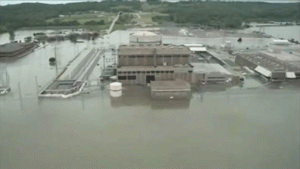 (At left flooded Fort Calhoun nuclear plant, USA) In the U.S., where nine nuclear plants are within 2 miles (3 kilometers) of the ocean and four reactors have been identified by Stanford academics as vulnerable to storm surges and sea-level rise, flooding is common, says David Lochbaum, a former nuclear engineer and director of the nuclear safety project at the Union of Concerned Scientists (UCS).
Lochbaum says over 20 flooding incidents have been recorded at U.S. nuclear plants since the early 1980s. “The most likely [cause of flooding] is the increasing frequency of extreme events,” he says.
“There was no consideration of climate change when most U.S. plants were built,” says Natalie Kopytko, a University of Leeds researcher who has studied nuclear power plant adaptations to climate change. “They used conservative models of historical reference. Also, they were largely built at a calm period, when there were not many major storms.”
“While an accident has never yet happened due solely to sea-level rise and storms, the flooding experienced at Fukushima resembles what could occur in the future from sea-level rise,” says Kopytko.
Considering Climate Change
IAEA’s current global safety standards were published in 2011. These state that operators should only “take into account” the 18- to 59-centimeter (7- to 23-inch) sea-level rise projected by 2100 in the Intergovernmental Panel on Climate Change (IPCC)’s fourth assessment report, published in 2007.
But those safety standards don’t factor in the most recent assessment of the IPCC, published in 2013–14. This scientific consensus report has seas rising 26 centimeters (10 inches) to 1 meter (39 inches) by 2100, depending on how far temperature continue to rise and the speed at which the polar ice caps melt.
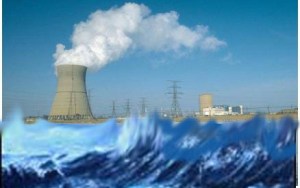 A 1-meter (39-inch) increase, combined with high tides and a storm surge, significantly increases the risk of coasts and nuclear stations being swamped, says Michael Mann, director of the Earth System Science Center at Pennsylvania State University.
“Nuclear stations are on the front line of climate change impacts both figuratively and quite literally,” Mann says. “We are likely profoundly underestimating climate change risk and damages in coastal areas.”
A recent study from NASA’s Goddard Space Flight Center expects the mean average rise to be a minimum of 65 centimeters (26 inches) by 2100.
“This 65-centimeter [rise] is almost certainly a conservative estimate,” says NASA lead author Steve Nerem, a professor of aerospace engineering sciences at the University of Colorado Boulder. “Our [study] assumes that sea level continues to change in the future as it has over the last 25 years. Given the large changes we are seeing in the ice sheets today, that’s not likely.”
A Matter of Timing Continue reading →
August 11, 2018
Posted by Christina Macpherson |
2 WORLD, climate change |
Leave a comment
 Factcheck: How global warming has increased US wildfires , Carbon Brief , 9 Aug 18
In the midst of record or near-record heatwaves across the northern hemisphere this summer, deadly wildfires have swept through many regions, such as the western US, Europe and Siberia. This has focused a great deal of public attention on the role that climate change plays in wildfires.
Recently, some commentators have tried to dismiss recent increases in the areas burnt by fires in the US, claiming that fires were much worse in the early part of the century. To do this, they are ignoring clear guidance by scientists that the data should not be used to make comparisons with earlier periods.
The US National Interagency Fire Center (NIFC), which maintains the database in question, tells Carbon Brief that people should not “put any stock” in numbers prior to 1960 and that comparing the modern fire area to earlier estimates is “not accurate or appropriate”.
Here, Carbon Brief takes a look at the links between climate change and wildfires, both in the US and across the globe. As with any environmental issue, there are many different contributing factors, but it is clear that in the western US climate change has made – and will continue to make – fires larger and more destructive.
As one scientist tells Carbon Brief: “There is no question whatsoever that climate plays a role in the increase in fires.”
More area burned………
August 11, 2018
Posted by Christina Macpherson |
climate change, USA |
Leave a comment
 What are coastal nuclear power plants doing to address climate threats ? As shorelines creep inland and storms worsen, nuclear reactors around the world face new challenges. ENSIA, John Vidal @john_vidal, Environment editor August 8, 2018 — The outer defensive wall of what is expected to be the world’s most expensive nuclear power station is taking shape on the shoreline of the choppy gray waters of the Bristol Channel in western England.
By the time the US$25 billion Hinkley Point C nuclear station is finished, possibly in 2028, the concrete seawall will be 12.5 meters (41 feet) high, 900 meters (3,000 feet) long and durable enough, the UK regulator and French engineers say, to withstand the strongest storm surge, the greatest tsunami and the highest sea-level rise.
But will it? Independent nuclear consultant Pete Roche, a former adviser to the UK government and Greenpeace, points out that the tidal range along this stretch of coast is one of the highest in the world, and that erosion is heavy. Indeed, observers reported serious flooding on the site in 1981 when an earlier nuclear power station had to be shut down for a week. following a spring tide and a storm surge. However well built, says Roche, the new seawall does not adequately take into account sea-level rise due to climate change.
“The wall is strong, but the plans were drawn up in 2012, before the increasing volume of melting of the Greenland ice cap was properly understood and when most experts thought there was no net melting in the Antarctic,” he says. “Now estimates of sea level rise in the next 50 years have gone up from less than 30 centimeters to more than a meter, well within the operating lifespan of Hinkley Point C — let alone in 100 years time when the reactors are finally decommissioned or the even longer period when spent nuclear fuel is likely to be stored on site.”
In fact, research by Ensia suggests that at least 100 U.S., European and Asian nuclear power stations built just a few meters above sea level could be threatened by serious flooding caused by accelerating sea-level rise and more frequent storm surges.
Some efforts are underway to prepare for increased flooding risk in the future. But a number of scientific papers published in 2018 suggest that climate change will impact coastal nuclear plants earlier and harder than the industry, governments or regulatory bodies have expected, and that the safety standards set by national nuclear regulators and the United Nations’ nuclear watchdog, the International Atomic Energy Agency (IAEA), are out of date and take insufficient account of the effects of climate change on nuclear power.
The Problem With Flooding
Flooding can be catastrophic to a nuclear power plant because it can knock out its electrical systems, disabling its cooling mechanisms and leading to overheating and possible meltdown and a dangerous release of radioactivity. Flooding at the Fukushima Daiichi plant in Japan as a result of the March 2011 tsunami caused severe damage to several of the plant’s reactors and only narrowly avoided a catastrophic release of radioactivity that could have forced the evacuation of 50 million people.
The interactive map above from Carbon Brief shows the location of nuclear power plants around the world. According to mapsprepared by the World Association of Nuclear Operators(WANO), around one in four of the world’s 460 working commercial nuclear reactors are situated on coastlines. Many were built only 10–20 meters (30–70 feet) above sea level at a time when climate change was barely considered a threat.
In the U.S., where nine nuclear plants are within 2 miles (3 kilometers) of the ocean and four reactors have been identified by Stanford academics as vulnerable to storm surges and sea-level rise, flooding is common, says David Lochbaum, a former nuclear engineer and director of the nuclear safety project at the Union of Concerned Scientists (UCS).
Lochbaum says over 20 flooding incidents have been recorded at U.S. nuclear plants since the early 1980s. “The most likely [cause of flooding] is the increasing frequency of extreme events,” he says.
………. The most comprehensive research yet conducted also shows sea-level rises are accelerating as ice caps melt. Such is the speed of ice melt observed since 2007 that even the 2013 IPCC estimates of sea-level rise are thought to be outdated.
…….. Threats From Storms
On top of sea-level rise, the added impact of flooding from storm surges must be considered as well, scientists say. Since 1970, the magnitude and frequency of extreme sea levels (ESLs, a factor of mean sea level, tide and storm-induced increases), which can cause catastrophic flooding, have increased throughout the world, according to the Global Extreme Sea Level Analysisproject. New satellite studies by the U.S. government’s National Oceanic and Atmospheric Administration (NOAA), NASA, and other leading scientific institutions all show mean sea level rising and magnifying the frequency and severity of ESLs………. https://ensia.com/features/coastal-nuclear/
August 10, 2018
Posted by Christina Macpherson |
2 WORLD, climate change |
3 Comments
 Children are highly vulnerable to health risks of a changing climate https://www.eurekalert.org/pub_releases/2018-08/cums-noc080618.php, COLUMBIA UNIVERSITY’S MAILMAN SCHOOL OF PUBLIC HEALTH , August 6, 2018 —
Young children are far more vulnerable to climate-related disasters and the onus is on adults to provide the protection and care that children need, according to research by Columbia University’s Mailman School of Public Health and Columbia University Irving Medical Center. In a paper published in PLoS Medicine, researchers set out some specific challenges associated with the impacts of climate change on the world’s 2.3 billion children and suggest ways to address their underprioritized needs.
“Because of their anatomic, cognitive, immunologic, and psychologic differences, children and adolescents are more vulnerable to climate change-related events like floods, droughts, and heatwaves than adults,” says Madeleine Thomson, PhD, a research scholar in the Department of Environmental Health Sciences, faculty member at Columbia’s Earth Institute, a guest editor in PLOS One Medicine’s Special Issue on Climate Change and Health in the International Research Institute for Climate and Society.
Because of their small surface-to-body ratio, infants and children are particularly vulnerable to dehydration and heat stress. During heat waves, children are more likely to be affected by respiratory disease, kidney disease, electrolyte imbalance, and fever. Heat waves have also been shown to exacerbate allergens and air pollution which impact children more severely than adults because of their underdeveloped respiratory and immune systems and because they breathe at a faster rate than adults.
The authors write that hotter temperatures may also expand the range of vector-borne diseases, including the Zika virus which, following the 2015 epidemic, has profoundly affected the lives of children and their families across Latin America and the Caribbean. Even children who were asymptomatic at birth may develop problems later in life.
After Hurricane Maria made landfall in Puerto Rico in September 2017 medical responders encountered increases in gastroenteritis, asthma exacerbations and skin infections. Children were also at increased risk for mosquito-borne diseases such as Chikungunya and Dengue, as well as leptospirosis through the drinking of contaminated water. Flood waters from Hurricane Harvey a few weeks earlier dropped record breaking rain. Most of the Harvey-related toxic releases were never publicized and the long-term implications for children’s health is unknown. Studies suggest that climate change is increasing the intensity of North Atlantic hurricanes and the likelihood that the severe consequences for children’s health will grow.
In rural households droughts can have significant impacts on child development through increased food insecurity and dietary changes [17]. Droughts may also contribute to conflict and forced migration in resource poor settings, thereby increasing children’s vulnerability to a wide range of health issues.
To begin to address the specific needs of children confronted with climate-change related health disasters, Thomson and colleagues are proposing the following:
- Establish an international consortium of experts to develop adoptable medical and behavioral protocols and to set research agendas to address the unmet child specific needs that arise from climate-related natural disasters.
- Develop best practice guidelines for climate-change related event planning that incorporates strategies for addressing the health-related needs of children.
- Fund mechanisms designed to help the most vulnerable nations prepare for and respond to climate related disasters must consider funding the development of responses that specifically address the unmet needs of children’s health.
August 8, 2018
Posted by Christina Macpherson |
children, climate change |
Leave a comment
Europe’s heatwave is forcing nuclear power plants to shut down, Quartz, By Akshat Rathi, August 6, 2018
Nuclear power is one of the world’s biggest sources of carbon-free electricity. But it has an Achilles’ heel: it needs lots of water to operate.
That’s bad news right now. Europe’s heatwave—which led to wildfires in Greece and Sweden, droughts in central and northern parts, and made the normally green UK look brown from space—is forcing nuclear plants to shut down or curtail the amount of power they produce. French utility EDF shut four reactors at three power plants on Saturday, Swedish utility Vattenfall shut one of two reactors at a power plant earlier last week, and nuclear plants in Finland, Germany, and Switzerland have cut back the amount of power they produce.
Thermal power plants, such as nuclear or coal, use high-temperature steam to turn turbines, which convert heat energy into electricity. In the process, the steam’s temperature falls, so it can no longer be used to move the turbine again. To raise its temperature back up, the steam first needs to be condensed into water, because liquids absorb heat better than gases. The condensation is achieved by using cooling water drawn from rivers, lakes, or seas, which is then dumped back at a temperature that is safe for wildlife in those waters. (Gas power plants also use cooling water, but they need less of it than coal or nuclear installations.)
Europe’s heatwave, however, hasn’t just increased air temperatures but also water temperatures. Regulations protecting wildlife mean that the usual water sources drawn on by nuclear plants cannot always be used for cooling, leading to shutdowns. It’s not the first time this has happened: Heatwaves forced nuclear shutdowns or curtailments across Europe in 2003, 2006, and 2015.
Worse still, scientists warn that thermal power interruptions will worsen because of climate change—not just because of heatwaves but also droughts…https://qz.com/1348969/europes-heatwave-is-forcing-nuclear-power-plants-to-shut-down/
August 8, 2018
Posted by Christina Macpherson |
climate change, EUROPE |
Leave a comment









 nuclear-news