Study shows that women care more than men do, about climate change
Gender Differences in Public Understanding of Climate Change, Yale Program on Climate Change Communication By Matthew Ballew, Jennifer Marlon, Anthony Leiserowitz and Edward Maibach , 21 Nov 18, While political views play a strong role in Americans’ opinions on climate change, there are many other individual, social, and cultural factors that influence public understanding of the issue. Here we explore how views on climate change differ between men and women. A large body of research shows a small—but consistent—gender gap in environmental views and climate change opinions. On average, women are slightly more likely than men to be concerned about the environment and have stronger pro-climate opinions and beliefs. Scholars have proposed several explanations for this gender gap, including differences in gender socialization and resulting value systems (e.g., altruism, compassion), perceptions of general risk and vulnerability, and feminist beliefs including commitment to egalitarian values of fairness and social justice. Some researchers also note that some of the strongest gender differences are found in concern about specific environmental problems, particularly local problems that pose health risks.In our research, we find that, although a similar proportion of men and women think global warming is happening and is human-caused, women consistently have higher risk perceptions that global warming will harm them personally, and will harm people in the U.S., plants and animals, and future generations of people (Fig. 1 on original). Also compared with men, a greater proportion of women worry about global warming, think that it is currently harming the U.S., and support certain climate change mitigation policies, specifically regulating CO 2 as a pollutant and setting strict CO 2 limits on coal power plants……….
on average, women scored lower than men in scientific knowledge on climate change ……..Women were also more likely than men to express uncertainty about a variety of questions. For instance, respondents were asked how much several factors contribute to global warming (e.g., deforestation, nuclear power plants, burning fossil fuels, the sun, cars and trucks). Across many of these questions, a greater proportion of women said “don’t know” than did men
Closing gender gaps in knowledge and understanding of the problem, therefore, ought to receive more attention in climate education and outreach efforts to further engage and empower women in climate issues. This is especially important because women are more likely than men to be harmed by environmental problems like climate change—both nationally and globally. In a recent BBC News Science & Environment article, U.N. data show that globally women make up 80% of people who are displaced by climate change. Because women in many countries tend to have roles as primary caregivers and food providers—and tend to have less socioeconomic power than men—they are more vulnerable to climate problems including natural hazards like flooding, droughts, and hurricanes. In the U.S., for instance, the Institute for Women’s Policy Research reported that 83% of low-income, single mothers did not return to their homes in New Orleans after Hurricane Katrina hit in 2005. In terms of public health, air pollution is considered a leading threat to pregnant women and their babies-to-be.
Women play an essential role in responding to climate change. In fact, out of 100 substantive climate solutions identified through rigorous empirical modeling, improving the education of women and girls represents one of the top solutions (#6) to reducing greenhouse gas emissions that cause global warming—similar in ranking to restoring tropical forests and ranking above increased solar energy generation. Women in leadership positions can also foster climate policy solutions. A study on gender equality and state-level environmentalism found that, across 130 countries, women in government positions were more likely to sign on to international treaties to reduce global warming than men. Promoting the participation of diverse women in leadership positions, as well as climate science, can also inspire young women to participate too.
……… For more information on survey methods, please review the 2010 Americans’ Knowledge of Climate Change report and 2018 Climate Change in the American Mind report. http://climatecommunication.yale.edu/publications/gender-differences-in-public-understanding-of-climate-change/
The fallacy of recommending nuclear power as a solution to climate change
More Nuclear Energy Is Not The Solution To Our Climate Crisis http://www.wbur.org/cognoscenti/2018/11/19/nuclear-energy-climate-change-philip-warburg, November  19, 2018 Philip Warburg
Faced with the Intergovernmental Panel on Climate Change’s latest report, some environmental leaders are all too ready to toss a lifeline to aging, uneconomic nuclear power plants. The Union of Concerned Scientists (UCS), long venerated as America’s most rigorous nuclear watchdog group, joined this chorus in early November.
The UCS report, “The Nuclear Dilemma,” proposes that we single out “safe” but financially ailing nuclear plants and subsidize their operations, so that they might remain open — thus avoiding additional carbon emissions from coal or natural gas plants that might replace them. America gets about 20 percent of its electricity from nuclear power, but only 17 of the 99 reactors that generate this power are unprofitable, according to UCS. Those reactors account for just 3 percent of overall U.S. power generation, though UCS says the share of unprofitable nuclear plants could grow in future years if the price of natural gas drops or the costs of maintaining older nuclear facilities rise.
 What do we gain by breathing some extra life into these plants? Proponents say “zero-carbon emissions.” That’s if we choose to ignore the emissions associated with mining and processing uranium, building nuclear power stations, managing nuclear waste, and — on those rare but horrific occasions — dealing with the consequences of a major nuclear disaster.
Bailing out old, financially shaky nuclear plants is a short-sighted response to a huge challenge that requires much bigger, much more transformative thinking. Instead, we ought to invest big in our leading zero-carbon alternatives — solar and wind — which offer far cheaper electricity and, unlike nuclear, have life-cycle costs that have steadily dropped over the past  several years.
Setting aside the questionable economics of boosting the bottom lines of unprofitable power plants, how would we determine if a nuclear plant is “safe”?
The UCS recommends that we rely upon the Nuclear Regulatory Commission’s five-tier performance matrix, and offer financial support only to plants that have earned the NRC’s highest rating. In 2002, the Davis Besse Nuclear Power Station in Ottawa County, Ohio, enjoyed that rating, but in March of that year, its reactor vessel — which contains the nuclear reactor coolant and shrouded reactor core — was found to be a fraction of an inch away from a potentially catastrophic rupture. Years of undetected corrosion had worn a football-sized hole in the vessel wall.
If the vessel had ruptured, the plant’s backup water pump (which was known to be impaired) would not have been able to re-flood the reactor vessel, an essential step in stabilizing the reactor core. In a recent interview, UCS scientist Dave Lochbaum, a seasoned reactor engineer, told me he remembers telling residents near Davis Besse: “You can stop buying lottery tickets. Your luck has been used up.”
Hundreds of thousands of people in Central Europe and Japan didn’t fare so well in the nuclear safety lottery.
Following the Chernobyl disaster in 1986, some 350,000 people were evacuatedfrom parts of Ukraine and Belarus, and to this day 1,000 square miles of territory remain off-bounds to human habitation. In Japan, some 100,000 people had still not returned home five years after the March 2011 meltdown at the Fukushima Daiichi plant. Utterly different circumstances precipitated these two nuclear disasters, as well as the earlier meltdown at Three Mile Island, but all three proved the statistician’s axiom that rare events do happen.
And then there’s the question of security at nuclear plants.
 Shortly after the 9/11 attacks on the World Trade Center and the Pentagon, word got out that unnamed nuclear plants were on al-Qaida’s list of potential terror targets. This was particularly alarming to people living near the Pilgrim power station in Plymouth, Massachusetts, situated on the flight path of the hijacked planes departing from Logan Airport.
Suicide air attacks were one concern post-9/11; saboteurs carrying rocket-propelled grenades and other portable weapons were another. To help plant operators prepare for potential threats, the NRC increased the frequency of “force-on-force” mock confrontations with plant infiltrators. It also required plant personnel to be trained in the use of portable pumps, generators and other devices that could fill in for safety equipment knocked out by sabotage.
Yet, at Pilgrim, this added training didn’t engender lasting vigilance.
Diane Turco, executive director of the volunteer watchdog group Cape Downwinders, brought attention to gaping holes in Pilgrim’s plant security when she and another activist visited the plant unannounced in 2014. She explained to me how they walked by an empty guardhouse, down the plant’s interior roadway, and into the access control building, where they observed employees punching in their security codes. No one stopped them, questioned them or searched for weapons. In 2012, a member of the same group, Paul Rifkin, circled Pilgrim in a friend’s helicopter and took detailed aerial photos of the plant. He encountered no response from plant security, the FAA or the U.S. armed forces.
To be sure, Pilgrim is not on the NRC’s list of star performers. Burdened by a backlog of operational problems, it will be shutting down next spring. That said, the security deficits plaguing this plant are, to some degree, a warning about the broader vulnerability of nuclear plants.
We need to cut carbon emissions drastically if we are to have any hope of avoiding the very worst of climate change. Were there no better low-carbon electricity choices, groups like UCS might be on the right track in calling for a bailout of financially strapped nuclear plants. But we do have safer, more economically viable options.
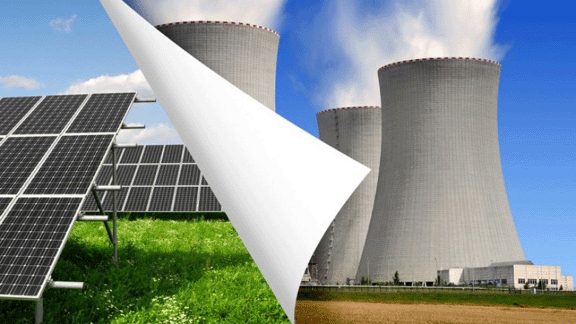 The National Renewable Energy Laboratory projects that renewable energy, combined with a more flexible electric system, would be “more than adequate to supply 80 percent of total U.S. electricity generation in 2050, while meeting demand on an hourly basis in every region of the country.” Keeping our least- profitable nuclear plants online is a distraction from meeting — or exceeding — this goal.
Follow Cognoscenti on Facebook and Twitter, and sign up for our twice-weeklynewsletter.
USA’s navy shipyards already threatened by climate change: storms, rising seas, and worse to come
 U.S. Nuclear Fleet’s Dry Docks Threatened by Storms and Rising SeasDamage to key military shipyards would undermine the Pentagon’s ability to respond to military crises and counter China’s ambitions. Inside Climate News, By Nicholas Kusnetz NOV 19, 2018 PORTSMOUTH, Va. — At the foot of the Chesapeake Bay in southeast Virginia lies a Naval shipyard older than the nation itself. One of the country’s first warships was built here in 1799. So was the first battleship, and decades later the first aircraft carrier.Over a quarter millennium, Norfolk Naval Shipyard has been blockaded and burnt to the ground by the British, the Union and the Confederates, only to be rebuilt again and again to evolve into a hub of Naval power.
Today, it’s an essential maintenance facility for the nation’s fleet of nuclear-powered submarines and aircraft carriers, and it’s facing a threat that could shut it down permanently.
Rising seas will likely engulf the shipyard by century’s end, but the reckoning for Norfolk and nearby military installations could come much sooner.
“They’re going to disappear” unless the Pentagon acts quickly to protect them, said Ray Mabus, Navy secretary under President Barack Obama.
The most immediate worry is a direct hit from a major storm. “It would have the potential for serious, if not catastrophic damage, and it would certainly put the shipyard out of business for some amount of time,” Mabus said. “That has implications not just for the shipyard, but for us, for the Navy.”
The shipyard is among the American military sites most vulnerable to climate change. Because of its role in maintaining the fleet, damage to the aging facility could undermine the Pentagon’s ability to respond to military and humanitarian crises and to counter China’s growing naval ambitions. …….
The dry docks “were not designed to accommodate the threats” of rising seas and stronger storms, according to a 2017 report by the Government Accountability Office. Navy officials warned the GAO that flooding in a dry dock could cause “catastrophic damage to the ships.”
Already, high-tide flooding is contributing to extensive delays in ship repairs, the GAO said, disrupting maintenance schedules throughout the nuclear fleet.
The Navy has erected temporary flood walls to protect the dry docks and has begun elevating some equipment. It also recently proposed a more permanent barrier and other projects to address flooding, part of a 20-year, $21 billion plan the Navy submitted to Congress this year to modernize its four shipyards.
But the new projects have yet to be approved by lawmakers……….
Climate change is threatening to impair the military’s ability to respond to crises and defend the nation, not only at the shipyard but throughout its operations. The Defense Department has publicly recognized this risk for at least 15 years. The Navy, in particular, understands what is at stake, with so many facilities along the coasts and its forces often the first to arrive on the scene of humanitarian crises triggered by extreme weather……….
Addressing climate change has become more difficult under President Donald Trump. His administration omitted mention of climate change in its first National Security Strategy and instead called for greater fossil fuel development. Trump rescinded an Obama executive order that, in part, sought to provide intelligence analysts with the most current climate science to better monitor potential global hotspots. Nearly all references to climate change were also stripped from the final draft of a survey about the effects of climate-driven weather on facilities.
Military officials have become reluctant to work openly on climate change in the current political environment, said Joan VanDervort, former deputy director for ranges, sea and airspace at the Pentagon. “They have gone underground. They’re doing the same work but calling it something different. They try to stay away from the words ‘climate change,’ and use words like natural resources and resiliency and terms like weather, hurricanes,” she said. When you omit “climate change as a priority related to our national security, it’s very difficult to get funding.”…………
Every Year You Wait, the Risk Goes Up
A decade ago, the chief of naval operations commissioned the National Research Council to study the implications of climate change on the Navy’s mission. The 2011 report warned that global warming would strain the service’s capabilities. More severe weather would trigger famine and mass migration, requiring more humanitarian aid. A thawing Arctic would stress the Navy’s fleet by opening a vast new arena to police in particularly harsh conditions. Rising seas and harsher storms would put bases at risk: 56 facilities worth a combined $100 billion would be threatened by about 3 feet of sea level rise (the list has not been made public).
It warned that the Navy needed to begin investing in protections immediately at facilities facing the greatest climate risks, and had only 10 to 20 years to begin work on the rest. Seven years later, there’s been little progress, said retired Rear Adm. Jonathan White, who led the Navy’s Task Force Climate Change before retiring in 2015.
“Many of those recommendations, most if not all, have gone unanswered,” he said. “Every year you wait to make decisions and take actions, the risk goes up. And I think the expense also goes up.”………..InsideClimate News reporter Neela Banerjee contributed to this story.
Read this next: Dangers Without Borders: Military Readiness in a Warming World https://insideclimatenews.org/news/19112018/military-ships-nuclear-fleet-norfolk-shipyard-climate-change-threat-hurricane-sea-level-rise
Climate changes multiplying hazards, and the limits to ‘top down’ solutions
 Mind-blowing’: Hazards to multiply and accumulate with climate change, https://www.brisbanetimes.com.au/environment/climate-change/mind-blowing-hazards-to-multiply-and-accumulate-with-climate-change-20181119-p50gx7.html, By Peter Hannam
20 November 2018 — Humanity is already enduring cumulative effects from climate change and damages will continue to mount along with carbon emissions, a new study has found. Tropical coastal regions will be the most exposed to multiple hazards.
The research – which involved analysis of 3280 research papers and was published on Tuesday by Nature Climate Change – identified 467 pathways that populations were already being hit by a warmer climate. Those impacts will likely increase and intensify unless aggressive efforts are taken to curb greenhouse gas pollution.
“We never stopped being surprised by how many impacts had already happened to us,” said Camilo Mora, an associate professor at the University of Hawaii and lead author of the paper. (An interactive can be seen here.)
“It was also mind-blowing that we just refuse to wake up about how serious this is,” he said.
Examples of impacts cited ranged from famine deaths triggered by droughts and the increased spread of diseases in a warming world, to worsening heavy metal contamination in lakes after wild fires and a poor Russian wheat harvest amid heatwaves in 2010 that led to a doubling of world prices for the commodity.
The tendency towards more extreme weather includes accelerated evaporation rates as temperatures rise, worsening droughts and contributing to more severe wildfires – a combination currently being played out in California, Professor Mora said.
Similarly, with the atmosphere holding about 7 per cent more moisture for each degree of warming, the potential for more intense rain events increases.
About 20-40 per cent of the rainfall from the record wet Hurricane Harvey that soaked Houston in 2017 has been attributed to climate change, Professor Mora said.
Coastal regions were already being exposed to overlapping hazards from both the land and the ocean, making them particularly vulnerable locations now and in the future.
If carbon emissions continued to rise unabated at their current rate, tropical coastal areas such as in Southeast Asia could face as many as six climate hazards concurrently, the paper said.
These included rising sea level and the increased acidity of oceans as they absorb more carbon from the atmosphere.
Top-down limitations
While societies often relied on top-down approaches to dealing with emissions, the result was often a fragile policy set-up.
“One person can come along and reverse the whole thing,” Professor Mora said.
“We need to build the solution for climate change from the bottom up,” he said, citing a project currently being tested in Hawaii to make the US state fully carbon neutral by tree planting and other efforts.
ExxonMobil, Southern Company, American Petroleum Institute, and Charles G. Koch Foundation behind climate denialism camps for kids
“We are looking for creativity — are they learning what we are teaching them?”
And what are they being taught? Conspiracy theories about the United Nations (UN) and how climate change is a hoax, and they’ve drafted in two of the world’s most notorious climate science denialists to do the job.
The rooms — named after “places of refuge in the old testament” — are covered with U.S. nationalistic garlands and flags. A “Make America Great Again” (MAGA) hat is perched on a wooden bunk post.
Children take quotes they’ve learned from classes, and turn them into posters. One encourages the United Nations to keep out.
Another lists “buzzwords” including CO2, climate change, environmental justice, and endangered species.
“You hear these buzzwords and you know the bad guys are behind the scenes,” says a commentating Shurtleff.
Shurtleff is a former regional director of the John Birch Society — the UN-hating, right-wing conservative group known for, among other things, pushing a conspiracy that the UN’s promotion of environmental sustainability was in fact a sinister plot to install a world government.
But as well as learning about the evils of sensible resource use, the kids at this summer’s Camp Constitution attended classes by climate science deniers Lord Christopher Monckton and Dr. Willie Soon………..
Research from Greenpeace and the Climate Investigations Center has shown Soon’s work to be heavily funded by fossil fuel industry interests, including more than $1 million from ExxonMobil, Southern Company, American Petroleum Institute, and Charles G. Koch Foundation.
Also on the agenda was former John Birch Society president John “Jack” McManus, who told the youngsters, some who stay with their parents, how the U.S. should “Get Us Out of the United Nations” while explaining his full anti-UN “world governement” conspiracy theory. He even sold them a booklet for the discounted price of $2.
Eccentric British climate science denier, Lord Christopher Monckton, was also at the camp to regale the kids with tales of how climate change science is one big con-job. …….https://www.desmogblog.com/2018/11/13/christian-vacation-camp-climate-science-deniers-monckton-soon?utm_source=dsb%20newsletter
Habitable areas of our planet are shrinking – as climate change exacerbates extreme weather
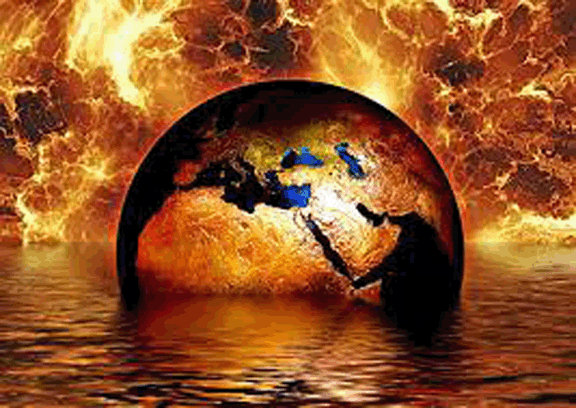
Until now, human beings have been spreading, from our beginnings in Africa, out across the globe—slowly at first, and then much faster. But a period of contraction is setting in as we lose parts of the habitable earth.
some of the world is becoming too hot for humans.
As some people flee humidity and rising sea levels, others will be forced to relocate in order to find enough water to survive.
escaping the wreckage is, almost certainly, a fantasy. Even if astronauts did cross the thirty-four million miles to Mars, they’d need to go underground to survive there. To what end?
“People think if we fuck up here on Earth we can always go to Mars or the stars,” “It’s pernicious.”
 How Extreme Weather Is Shrinking the Planet, New Yorker, by Bill McKibben November 18, 2018 With wildfires, heat waves, and rising sea levels, large tracts of the earth are at risk of becoming uninhabitable. But the fossil-fuel industry continues its assault on the facts …
“……For the past few years, a tide of optimistic thinking has held that conditions for human beings around the globe have been improving. Wars are scarcer, poverty and hunger are less severe, and there are better prospects for wide-scale literacy and education. But there are newer signs that human progress has begun to flag. In the face of our environmental deterioration, it’s now reasonable to ask whether the human game has begun to falter—perhaps even to play itself out. Late in 2017, a United Nations agency announced that the number of chronically malnourished people in the world, after a decade of decline, had started to grow again—by thirty-eight million, to a total of eight hundred and fifteen million, “largely due to the proliferation of violent conflicts and climate-related shocks.” In June, 2018, the Food and Agriculture Organization of the U.N. found that child labor, after years of falling, was growing, “driven in part by an increase in conflicts and climate-induced disasters.”
Scientists have warned for decades that climate change would lead to extreme weather. Shortly before the I.P.C.C. report was published, Hurricane Michael, the strongest hurricane ever to hit the Florida Panhandle, inflicted thirty billion dollars’ worth of material damage and killed forty-five people. President Trump, who has argued that global warming is “a total, and very expensive, hoax,” visited Florida to survey the wreckage, but told reporters that the storm had not caused him to rethink his decision to withdraw the U.S. from the Paris climate accords. He expressed no interest in the I.P. C.C. report beyond asking “who drew it.” (The answer is ninety-one researchers from forty countries.) He later claimed that his “natural instinct” for science made him confident that the climate would soon “change back.” A month later, Trump blamed the fires in California on “gross mismanagement of forests.
……….As a team of scientists recently pointed out in the journal Nature Climate Change, the physical shifts we’re inflicting on the planet will “extend longer than the entire history of human civilization thus far.”
The poorest and most vulnerable will pay the highest price. But already, even in the most affluent areas, many of us hesitate to walk across a grassy meadow because of the proliferation of ticks bearing Lyme disease which have come with the hot weather; we have found ourselves unable to swim off beaches, because jellyfish, which thrive as warming seas kill off other marine life, have taken over the water.
The planet’s diameter will remain eight thousand miles, and its surface will still cover two hundred million square miles. But the earth, for humans, has begun to shrink, under our feet and in our minds.
Climate change,” like “urban sprawl” or “gun violence,” has become such a familiar term that we tend to read past it. But exactly what we’ve been up to should fill us with awe. During the past two hundred years, we have burned immense quantities of coal and gas and oil—in car motors, basement furnaces, power plants, steel mills—and, as we have done so, carbon atoms have combined with oxygen atoms in the air to produce carbon dioxide. This, along with other gases like methane, has trapped heat that would otherwise have radiated back out to space. ……..
When I say the world has begun to shrink, this is what I mean. Until now, human beings have been spreading, from our beginnings in Africa, out across the globe—slowly at first, and then much faster. But a period of contraction is setting in as we lose parts of the habitable earth. Sometimes our retreat will be hasty and violent; the effort to evacuate the blazing California towns along narrow roads was so chaotic that many people died in their cars. But most of the pullback will be slower, starting along the world’s coastlines. Each year, another twenty-four thousand people abandon Vietnam’s sublimely fertile Mekong Delta as crop fields are polluted with salt. As sea ice melts along the Alaskan coast, there is nothing to protect towns, cities, and native villages from the waves. In Mexico Beach, Florida, which was all but eradicated by Hurricane Michael, a resident told the Washington Post, “The older people can’t rebuild; it’s too late in their lives. Who is going to be left? Who is going to care?” ………
According to a study from the United Kingdom’s National Oceanography Centre last summer, the damage caused by rising sea levels will cost the world as much as fourteen trillion dollars a year by 2100, if the U.N. targets aren’t met. “Like it or not, we will retreat from most of the world’s non-urban shorelines in the not very distant future,” Orrin Pilkey, an expert on sea levels at Duke University, wrote in his book “Retreat from a Rising Sea.” “We can plan now and retreat in a strategic and calculated fashion, or we can worry about it later and retreat in tactical disarray in response to devastating storms. In other words, we can walk away methodically, or we can flee in panic.” ………
some of the world is becoming too hot for humans. ……….
According to the National Oceanic and Atmospheric Administration, increased heat and humidity have reduced the amount of work people can do outdoors by ten per cent, a figure that is predicted to double by 2050. About a decade ago, Australian and American researchers, setting out to determine the highest survivable so-called “wet-bulb” temperature, concluded that when temperatures passed thirty-five degrees Celsius (ninety-five degrees Fahrenheit) and the humidity was higher than ninety per cent, even in “well-ventilated shaded conditions,” sweating slows down, and humans can survive only “for a few hours, the exact length of time being determined by individual physiology.”
According to the National Oceanic and Atmospheric Administration, increased heat and humidity have reduced the amount of work people can do outdoors by ten per cent, a figure that is predicted to double by 2050. About a decade ago, Australian and American researchers, setting out to determine the highest survivable so-called “wet-bulb” temperature, concluded that when temperatures passed thirty-five degrees Celsius (ninety-five degrees Fahrenheit) and the humidity was higher than ninety per cent, even in “well-ventilated shaded conditions,” sweating slows down, and humans can survive only “for a few hours, the exact length of time being determined by individual physiology.” ………
As some people flee humidity and rising sea levels, others will be forced to relocate in order to find enough water to survive. In late 2017, a study led by Manoj Joshi, of the University of East Anglia, found that, by 2050, if temperatures rise by two degrees a quarter of the earth will experience serious drought and desertification. The early signs are clear:
………We’ve already overpumped the aquifers that lie beneath most of the world’s breadbaskets …
…….All this has played out more or less as scientists warned, albeit faster. What has defied expectations is the slowness of the response.
………..Exxon’s behavior is shocking, but not entirely surprising. Philip Morris lied about the effects of cigarette smoking before the government stood up to Big Tobacco. The mystery that historians will have to unravel is what went so wrong in our governance and our culture that we have done, essentially, nothing to stand up to the fossil-fuel industry.
There are undoubtedly myriad intellectual, psychological, and political sources for our inaction, but I cannot help thinking that the influence of Ayn Rand, the Russian émigré novelist, may have played a role. Rand’s disquisitions on the “virtue of selfishness” and unbridled capitalism are admired by many American politicians and economists—Paul Ryan, Tillerson, Mike Pompeo, Andrew Puzder, and Donald Trump, among them.
Trump, who has called “The Fountainhead” his favorite book, said that the novel “relates to business and beauty and life and inner emotions. That book relates to . . . everything.” Long after Rand’s death, in 1982, the libertarian gospel of the novel continues to sway our politics: Government is bad. Solidarity is a trap. Taxes are theft. The Koch brothers, whose enormous fortune derives in large part from the mining and refining of oil and gas, have peddled a similar message, broadening the efforts that Exxon-funded groups like the Global Climate Coalition spearheaded in the late nineteen eighties…….
Musk, Jeff Bezos, and Richard Branson are among the billionaires who have spent some of their fortunes on space travel—a last-ditch effort to expand the human zone of habitability. In November, 2016, Stephen Hawking gave humanity a deadline of a thousand years to leave Earth. Six months later, he revised the timetable to a century. In June, 2017, he told an audience that “spreading out may be the only thing that saves us from ourselves.” He continued, “Earth is under threat from so many areas that it is difficult for me to be positive.”
But escaping the wreckage is, almost certainly, a fantasy. Even if astronauts did cross the thirty-four million miles to Mars, they’d need to go underground to survive there. To what end? The multimillion-dollar attempts at building a “biosphere” in the Southwestern desert in 1991 ended in abject failure. Kim Stanley Robinson, the author of a trilogy of novels about the colonization of Mars, recently called such projects a “moral hazard.” “People think if we fuck up here on Earth we can always go to Mars or the stars,” he said. “It’s pernicious.”
The dream of interplanetary colonization also distracts us from acknowledging the unbearable beauty of the planet we already inhabit. …….https://www.newyorker.com/magazine/2018/11/26/how-extreme-weather-is-shrinking-the-planet?mbid=nl_Daily%20111718&CNDID=53818310&utm_source=nl&utm_medium=email&utm_campaign=Daily%20111718&utm_content=&utm_brand=tny&utm_mailing=Daily%20111718&hasha=8c9f4

Success of Exxon and the fossil fuel industries in developing climate change denialism
The strategy of muddling the public’s impression of climate science has proved to be highly effective. In 2017, polls found that almost ninety per cent of Americans did not know that there was a scientific consensus on global warming.
What is certain is that the industry’s campaign cost us the efforts of the human generation that might have made the crucial difference in the climate fight
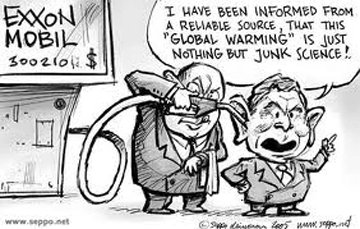 How Extreme Weather Is Shrinking the Planet, New Yorker, by Bill McKibben November 18, 2018 “………The climatologist James Hansen testified before Congress about the dangers of human-caused climate change thirty years ago. Since then, carbon emissions have increased with each year except 2009 (the height of the global recession) and the newest data show that 2018 will set another record. Simple inertia and the human tendency to prioritize short-term gains have played a role, but the fossil-fuel industry’s contribution has been by far the most damaging. Alex Steffen, an environmental writer, coined the term “predatory delay” to describe “the blocking or slowing of needed change, in order to make money off unsustainable, unjust systems in the meantime.” The behavior of the oil companies, which have pulled off perhaps the most consequential deception in mankind’s history, is a prime example.
As journalists at InsideClimate News and the Los Angeles Times have revealed since 2015, Exxon, the world’s largest oil company, understood that its product was contributing to climate change a decade before Hansen testified. In July, 1977, James F. Black, one of Exxon’s senior scientists, addressed many of the company’s top leaders in New York, explaining the earliest research on the greenhouse effect. “There is general scientific agreement that the most likely manner in which mankind is influencing the global climate is through carbon-dioxide release from the burning of fossil fuels,” he said, according to a written version of the speech which was later recorded, and which was obtained by InsideClimate News. In 1978, speaking to the company’s executives, Black estimated that a doubling of the carbon-dioxide concentration in the atmosphere would increase average global temperatures by between two and three degrees Celsius (5.4 degrees Fahrenheit), and as much as ten degrees Celsius (eighteen degrees Fahrenheit) at the poles.
Exxon spent millions of dollars researching the problem. It outfitted an oil tanker, the Esso Atlantic, with CO2 detectors to measure how fast the oceans could absorb excess carbon, and hired mathematicians to build sophisticated climate models. By 1982, they had concluded that even the company’s earlier estimates were probably too low. In a private corporate primer, they wrote that heading off global warming and “potentially catastrophic events” would “require major reductions in fossil fuel combustion.”
An investigation by the L.A. Times revealed that Exxon executives took these warnings seriously. Ken Croasdale, a senior researcher for the company’s Canadian subsidiary, led a team that investigated the positive and negative effects of warming on Exxon’s Arctic operations. In 1991, he found that greenhouse gases were rising due to the burning of fossil fuels. “Nobody disputes this fact,” he said. The following year, he wrote that “global warming can only help lower exploration and development costs” in the Beaufort Sea. Drilling season in the Arctic, he correctly predicted, would increase from two months to as many as five months. At the same time, he said, the rise in the sea level could threaten onshore infrastructure and create bigger waves that would damage offshore drilling structures. Thawing permafrost could make the earth buckle and slide under buildings and pipelines. As a result of these findings, Exxon and other major oil companies began laying plans to move into the Arctic, and started to build their new drilling platforms with higher decks, to compensate for the anticipated rises in sea level.
The implications of the exposés were startling. Not only did Exxon and other companies know that scientists like Hansen were right; they used his nasaclimate models to figure out how low their drilling costs in the Arctic would eventually fall. Had Exxon and its peers passed on what they knew to the public, geological history would look very different today. The problem of climate change would not be solved, but the crisis would, most likely, now be receding. In 1989, an international ban on chlorine-containing man-made chemicals that had been eroding the earth’s ozone layer went into effect. Last month, researchers reported that the ozone layer was on track to fully heal by 2060. But that was a relatively easy fight, because the chemicals in question were not central to the world’s economy, and the manufacturers had readily available substitutes to sell. In the case of global warming, the culprit is fossil fuel, the most lucrative commodity on earth, and so the companies responsible took a different tack.
A document uncovered by the L.A. Times showed that, a month after Hansen’s testimony, in 1988, an unnamed Exxon “public affairs manager” issued an internal memo recommending that the company “emphasize the uncertainty” in the scientific data about climate change. Within a few years, Exxon, Chevron, Shell, Amoco, and others had joined the Global Climate Coalition, “to coordinate business participation in the international policy debate” on global warming. The G.C.C. coördinated with the National Coal Association and the American Petroleum Institute on a campaign, via letters and telephone calls, to prevent a tax on fossil fuels, and produced a video in which the agency insisted that more carbon dioxide would “end world hunger” by promoting plant growth. With such efforts, it ginned up opposition to the Kyoto Protocol, the first global initiative to address climate change.
In October, 1997, two months before the Kyoto meeting, Lee Raymond, Exxon’s president and C.E.O., who had overseen the science department that in the nineteen-eighties produced the findings about climate change, gave a speech in Beijing to the World Petroleum Congress, in which he maintained that the earth was actually cooling. The idea that cutting fossil-fuel emissions could have an effect on the climate, he said, defied common sense. “It is highly unlikely that the temperature in the middle of the next century will be affected whether policies are enacted now, or twenty years from now,” he went on. Exxon’s own scientists had already shown each of these premises to be wrong.
On a December morning in 1997 at the Kyoto Convention Center, after a long night of negotiation, the developed nations reached a tentative accord on climate change. Exhausted delegates lay slumped on couches in the corridor, or on the floor in their suits, but most of them were grinning. Imperfect and limited though the agreement was, it seemed that momentum had gathered behind fighting climate change. But as I watched the delegates cheering and clapping, an American lobbyist, who had been coördinating much of the opposition to the accord, turned to me and said, “I can’t wait to get back to Washington, where we’ve got this under control.”
He was right. On January 29, 2001, nine days after George W. Bush was inaugurated, Lee Raymond visited his old friend Vice-President Dick Cheney, who had just stepped down as the C.E.O. of the oil-drilling giant Halliburton. Cheney helped persuade Bush to abandon his campaign promise to treat carbon dioxide as a pollutant. Within the year, Frank Luntz, a Republican consultant for Bush, had produced an internal memo that made a doctrine of the strategy that the G.C.C. had hit on a decade earlier. “Voters believe that there is no consensus about global warming within the scientific community,” Luntz wrote in the memo, which was obtained by the Environmental Working Group, a Washington-based organization. “Should the public come to believe that the scientific issues are settled, their views about global warming will change accordingly. Therefore, you need to continue to make the lack of scientific certainty a primary issue in the debate.”
The strategy of muddling the public’s impression of climate science has proved to be highly effective. In 2017, polls found that almost ninety per cent of Americans did not know that there was a scientific consensus on global warming. Raymond retired in 2006, after the company posted the biggest corporate profits in history, and his final annual salary was four hundred million dollars. His successor, Rex Tillerson, signed a five-hundred-billion-dollar deal to explore for oil in the rapidly thawing Russian Arctic, and in 2012 was awarded the Russian Order of Friendship. In 2016, Tillerson, at his last shareholder meeting before he briefly joined the Trump Administration as Secretary of State, said, “The world is going to have to continue using fossil fuels, whether they like it or not.”
It’s by no means clear whether Exxon’s deception and obfuscation are illegal. The company has long maintained that it “has tracked the scientific consensus on climate change, and its research on the issue has been published in publicly available peer-reviewed journals.” The First Amendment preserves one’s right to lie, although, in October, New York State Attorney General Barbara D. Underwood filed suit against Exxon for lying to investors, which is a crime. What is certain is that the industry’s campaign cost us the efforts of the human generation that might have made the crucial difference in the climate fight.…..https://www.newyorker.com/magazine/2018/11/26/how-extreme-weather-is-shrinking-the-planet?mbid=nl_Daily%20111718&CNDID=53818310&utm_source=nl&utm_medium=email&utm_campaign=Daily%20111718&utm_content=&utm_brand=tny&utm_mailing=Daily%20111718&hasha=8c9f4
Millstone Nuclear Power Plant uses the ‘zero carbon’ claim to try to qualify as ‘renewable’
 Connecticut utility regulators say Millstone Nuclear Power Plant ‘at risk’ of closing, New Haven Register, By Luther Turmelle A tentative ruling by state utility regulators may boost efforts by the owner of the Millstone Nuclear Power Plant to have the electricity it produces considered in ‘zero carbon’ auction that the state’s Department of Energy and Environmental Protection conducts to procure power.
Commissioners with Connecticut’s Public Utilities Regulatory Authority ruled that the Waterford-based power plant “is at risk of retirement.” Dominion Energy, the Virginia-based company that owns Millstone, has claimed for several years that economic conditions in the nation’s energy markets are making it difficult for the utility to keep operating the plant if it not allowed to compete for lucrative long-term contracts that are awarded to the winners of the zero-carbon auction.
“This interim decision does not reach the issue of whether a purchase power agreement with Millstone should be selected by DEEP or approved,” the tentative ruling says in part. “But (it) addresses solely the basis on which such a bid may be evaluated.”
Dominion officials release a statement Friday following PURA’s ruling say they are pleased with the decision made by regulators.
“They have been given access to our confidential information, have done their own analysis, and reached their own conclusion, Millstone is at risk,” the statement says in part. “We are now focused on the zero carbon procurement at the Department of Energy & Environmental Protection. We made numerous offers that would both ensure Millstone’s continued operations and provide benefits to Connecticut ratepayers ranging from the hundreds of millions of dollars to billions of dollars.”
DEEP officials are expected to announce the winners of the zero carbon auction by the end of the year. PURA’s determination that Millstone is at risk of closing will be a factor that DEEP officials will take into account as they try to determination the winners of the auction from a field of dozens of renewable energy sources that submitted proposals earlier this year……….
Joel Gordes, a West Hartford-based energy industry consultant, said PURA’s commissioners erred in their draft ruling.
“To treat nuclear power as it were a renewable resource is completely inappropriate,” Gordes said. “Real renewable resources don’t produce a deadly byproduct that has to be guarded for an eternity.” https://www.nhregister.com/news/article/Conn-utility-regulators-say-Millstone-at-13401695.php
The city of Bristol is taking action on the ‘climate emergency’
unanimously backing a commitment to be carbon neutral by 2030 in an effort
to avoid catastrophic climate breakdown.
party councillor Carla Denyer and passed on Tuesday means the city has the
most ambitious emissions targets of the UK’s core cities group – with
radical policy implications in the coming years.
a UN report last month which said the world has just 12 years left to avoid
catastrophic climate breakdown. Denyer said: “This is a fantastic day for
Bristol and I’m delighted the council will be bringing forward its target
for making the city carbon neutral by 2030. She said the UN report made it
clear that “time to preserve Earth as we know it is running out”.
an 80% reduction in emissions by 2050 and comes amid growing concern about
interlinked ecological crisis, from climate breakdown to extinction. Denyer
said that the Bristol declaration could see a focus on renewable
electricity, carbon neutral buildings, congestion charges and investment in
clean transport infrastructure.
implications for big-ticket projects like the proposed expansion of Bristol
airport. The move was inspired by US cities such as Berkeley and Hoboken,
and the global C40 cities which have all set ambitious emissions targets.
Jonathan Bartley, the co-leader of the Green party, said Bristol’s
decision – which won cross-party support on the council – had set “a
gold standard on climate action”. “With the UN warning we have just 12
years to limit climate catastrophe this is the common-sense policymaking we
need to face the future.”
https://www.theguardian.com/uk-news/2018/nov/14/bristol-plans-to-become-carbon-neutral-by-2030
Global warming is making hurricanes more extreme
|
Climate change is making hurricanes even more destructive, research finds, Guardian, Oliver Milman, @olliemilman 15 Nov 18 Hurricane rainfall could increase by a third and wind speeds boosted by up to 25 knots if global warming continues. Climate change worsened the most destructive hurricanes of recent years, including Katrina, Irma and Maria, by intensifying rainfall by as much as 10%, new research has found.
High-resolution climate simulations of 15 tropical cyclones in the Atlantic, Pacific and Indian Oceans found that warming in the ocean and atmosphere increased rainfall by between 5% and 10%, although wind speeds remained largely unchanged. This situation is set to worsen under future anticipated warming, however. Researchers found that if little is done to constrain greenhouse gas emissions and the world warms by 3C to 4C this century then hurricane rainfall could increase by a third, while wind speeds would be boosted by as much as 25 knots…… The research, published in the journal Nature, used climate models to see how factors such as air and ocean temperatures have influenced hurricanes. Projections into the future were then made, based upon various levels of planetary warming. The findings suggest that enormously destructive storms have already been bolstered by climate change and similar events in the future are on course to be cataclysmic. In a world where temperatures were 3C warmer on average, Hurricane Katrina, which resulted in nearly 2,000 deaths when levees breached near New Orleans in 2005, would’ve been even worse, with around 25% more rainfall. Cyclone Yasi, which hit Australia in 2011, would have had around a third more rain, while the deluge during Gafilo, a huge storm that killed more than 300 people in Madagascar in 2004, would have been 40% more intense. …. Hurricanes, or cyclones as they are known in the Pacific region, draw their strength from warmth in the upper layers of the ocean, while their rainfall is influenced by the amount of moisture in the atmosphere. Climate change, driven by human activity, is creating more favorable conditions for stronger hurricanes, with recent research finding that storms are intensifying more rapidly than they were 30 years ago…….https://www.theguardian.com/environment/2018/nov/14/climate-change-hurricanes-study-global-warming |
|
Opposition to subsidies to keep alive aging and financially failing nuclear power plants
opposed to the present attempts by utilities in Pennsylvania and Ohio to
secure huge subsidies to keep their aging and financially failing nuclear
power plants operational well beyond their “expiration dates”.
dollars into nuclear subsidies would distort markets and state regulatory
decisions and result in lower investment in renewable resources and energy
efficiency.
resource that is not clean energy.
and efficiency standards are insufficient to prevent a dangerous increase
in CO2 emissions, and that a price on carbon could serve to better mitigate
carbon emissions as long as nuclear reactors remain operational.
years that show that, even in Pennsylvania, a state with one of the highest
greenhouse gas (GHG) emissions rates, GHG reduction goals can be met under
the Environmental Protection Agency’s Clean Power Plan targets through
planned power plant retirements.
https://beyondnuclearinternational.org/2018/11/11/no-nuclear-bailouts-for-pennsylvania-and-ohio/
California fires – the “New Abnormal” if climate change goes on, unchecked
31 Dead In Devastating California Wildfires: Here’s What To Know | TIME
California Fires Could Be The ‘New Abnormal’ If Climate Change Continues A leading climate scientist says a worrying pattern helped light the match for the devastating California fires. 10 daily, 13 Nov 18
The fires have devastated the state, killing 31 people so far.
It’s not looking likely the blaze will calm any time soon.
One of the reasons for the scale of destruction being visited on the state is a collection of environmental triggers brought about by climate change, according to Doctor Daniel Swain of UCLA…….He said due to rising temperatures and dryness similar fires could affect the state for many years to come.
“This is not the new normal, this is the new abnormal, and this new abnormal will continue, certainly in the next 10 to 15 to 20 years,” he said…..https://tendaily.com.au/news/world/a181112wih/california-fires-could-be-the-new-abnormal-if-climate-change-continues-apace-20181112
How climate change is making deadly wildfires worse
Climate change is making wildfires more extreme. Here’s how
|
Ten ways climate change is making wildfires worse, As deadly wildfires threaten thousands in northern and southern California, scientists have identified 10 ways climate change can make wildfires worse. https://www.sbs.com.au/news/ten-ways-climate-change-is-making-wildfires-worse 13 Nov 18
Deadly wildfires such as those raging in northern and southern California have become more common in the US state and elsewhere in the world in recent years. AFP talked to scientists about the ways in which climate change can make them worse. Other factors have also fuelled an increase in the frequency and intensity of major fires, including human encroachment on wooded areas, and questionable forest management. “The patient was already sick,” in the words of David Bowman, a professor of environmental change biology at the University of Tasmania and a wildfire expert. “But climate change is the accelerant.” Fine weather for a fire Any firefighter can tell you the recipe for “conducive fire weather”: hot, dry and windy. No surprise, then, that many of the tropical and temperate regions devastated by a surge in forest fires are those predicted in climate models to see higher temperatures and more droughts. Besides bringing more dry and hot air, climate change – by elevating evaporation rates and drought prevalence – also creates more flammable ecosystems,” noted Christopher Williams, director of environmental sciences at Clark University in Massachusetts. In the last 20 years, California and southern Europe have seen several droughts of a magnitude that used to occur only once a century. More fuel Dry weather means more dead trees, shrubs and grass – and more fuel for the fire. “All those extremely dry years create an enormous amount of desiccated biomass,” said Michel Vennetier, an engineer at France’s National Research of Science and Technology for Environment and Agriculture (IRSTEA).“That’s an ideal combustible.” Change of scenery To make matters worse, new species better adapted to semi-arid conditions grow in their place. “Plants that like humidity have disappeared, replaced by more flammable plants that can withstand dry conditions, like rosemary, wild lavender and thyme,” said Vennetier.“The change happens quite quickly.” Thirsty plants With rising mercury and less rain, water-stressed trees and shrubs send roots deeper into the soil, sucking up every drop of water they can to nourish leaves and needles. That means the moisture in the earth that might have helped to slow a fire sweeping through a forest or garrigue is no longer there. Longer season In the northern hemisphere’s temperate zone, the fire season was historically short – July and August, in most places. “Today, the period susceptible to wildfires has extended from June to October,” said IRSTEA scientist Thomas Curt, referring to the Mediterranean basin.In California, which only recently emerged from a five-year drought, some experts say there’s no longer a season at all – fires can happen year-round. More lightning “The warmer it gets, the more lightning you have,” said Mike Flannigan, a professor at the University of Alberta, Canada and director of the Western Partnership for Wildland Fire Science. Especially in the northern areas, that translates into more fires.” At the same time, he noted that 95 per cent of wildfires worldwide are started by humans. Weakened jet stream Normal weather patterns over North America and Eurasia depend heavily on the powerful, high-altitude air currents – produced by the contrast between polar and equatorial temperatures – known as the jet stream. But global warming has raised temperatures in the Arctic twice as fast as the global average, weakening those currents. “We are seeing more extreme weather because of what we call blocked ridges, which is a high-pressure system in which air is sinking, getting warmer and drier along the way,” said Flannigan. “Firefighters have known for decades that these are conducive to fire activity.” Unmanageable intensity Climate change not only boosts the likelihood of wildfires, but their intensity as well. “If the fire gets too intense” as in California right now, and in Greece last summer – “there is no direct measure you can take to stop it,” said Flannigan. “It’s like spitting on a campfire.” Beetle infestations With rising temperatures, beetles have moved northward into Canada’s boreal forests, wreaking havoc – and killing trees – along the way. “Bark beetle outbreaks temporarily increase forest flammability by increasing the amount of dead material, such as needles,” said Williams.
Positive feedback Globally, forests hold about 45 per cent of Earth’s land-locked carbon and soak up a quarter of human greenhouse gas emissions.But as forests die and burn, some of the carbon is released back into the atmosphere, contributing to climate change in a vicious loop that scientists call “positive feedback.”
|
Tell Ft.com solar air-conditioning is the answer to air-conditioning’s greenhouse gas problem
This article highlights Sir Richard Branson (a nuclear power proponent) and correctly reminds us of the carbon footprint if air-conditioning, if fuelled by fossil power. Important to India, Australia, and many other counties. Why didn’t Ft mention this? – Solar air conditioning.
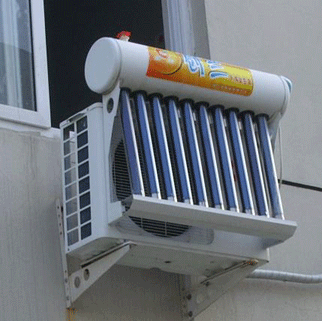

BUT – the logical alternative is renewable energy – either by use of a total renewable energy electrical system, or just a solar air-conditioner.
FT 12th Oct 2018 Air Conditioning A competition to find a breakthrough in air-conditioning technology has been launched with the backing of Sir Richard Branson and the Indian government, in an effort to avert the climate impact of the huge expected growth in the use of cooling systems.
The prize is intended to encourage inventors to find new ideas for indoor cooling that can be economically competitive against current technologies, while reducing energy consumption and the use of refrigerants such as hydrofluorocarbons that contribute to global warming.
There are about 1.2bn air-conditioning units installed worldwide today, and that number is forecast to rise to 4.5bn by 2050 as incomes rise and living standards improve in hot countries in Asia, Africa and Latin America.
If today’s technology is used for those units, they would by themselves emit enough greenhouse gases to raise global temperatures by 0.5C, according to Rocky Mountain Institute, an energy think-tank. The International Energy Agency has also sounded the alarm over air-conditioning, describing it as one of the most critical blind spots in international energy policy.
https://www.ft.com/content/1e056bde-e5ef-11e8-8a85-04b8afea6ea3
Nuclear reactors “are a bad bet for a climate strategy” – former NRC chairman
 Nuclear watchdog group causes stir with call to financially support existing nuclear plants, “Hard choices” are needed in the face of dire climate projections, Union of Concerned Scientists says. Think Progress
1 This Month
26 September – International Day for the Total Elimination of Nuclear Weapons





PLEASE OPPOSE HR 8255 AND S.3639 – bills would accelerate satellite deployment, with no environmental review or safeguards – https://ncstd5li.quorum.us/campaign/169331/
To see nuclear-related stories in greater depth and intensity – go to https://nuclearinformation.wordpress.com
-
Archives
- September 2026 (313)
- August 2026 (330)
- July 2026 (355)
- June 2026 (287)
- May 2026 (306)
- April 2026 (356)
- March 2026 (251)
- February 2026 (267)
- January 2026 (308)
- December 2025 (358)
- November 2025 (359)
- October 2025 (375)
-
Categories
- 1
- 1 NUCLEAR ISSUES
- business and costs
- climate change
- culture and arts
- ENERGY
- environment
- health
- history
- indigenous issues
- Legal
- marketing of nuclear
- media
- opposition to nuclear
- PERSONAL STORIES
- politics
- politics international
- Religion and ethics
- safety
- secrets,lies and civil liberties
- spinbuster
- technology
- Uranium
- wastes
- weapons and war
- Women
- 2 WORLD
- ACTION
- AFRICA
- Atrocities
- AUSTRALIA
- Christina's notes
- Christina's themes
- culture and arts
- Events
- Fuk 2022
- Fuk 2023
- Fukushima 2017
- Fukushima 2018
- fukushima 2019
- Fukushima 2020
- Fukushima 2021
- general
- global warming
- Humour (God we need it)
- Nuclear
- RARE EARTHS
- Reference
- resources – print
- Resources -audiovicual
- Weekly Newsletter
- World
- World Nuclear
- YouTube
-
RSS
Entries RSS
Comments RSS

