New nuclear power plants, prolong existing ones – to solve global warming?
 Evaluation of Nuclear Power as a Proposed Solution to Global Warming, Air Pollution, and Energy Security In 100% Clean, Renewable Energy and Storage for Everything Textbook in Preparation Mark Z. Jacobson December 10, 2018 Contact: Jacobson@stanford.edu; Twitter @mzjacobson
Summary In evaluating solutions to global warming, air pollution, and energy security, two important questions arise are (1) should new nuclear plants be built to help solve these problems, and (2) should existing, aged nuclear plants be kept open as long as possible to help solve these problems? To answer these questions, the main risks associated with nuclear power are examined.
The risks associated with nuclear power can be broken down into two categories: (1) risks affecting its ability to reduce global warming and air pollution and (2) risks affecting its ability to provide energy and environmental (aside from climate and air pollution) security. Risks in the former category include delays between planning and operation, emissions contributing to global warming and outdoor air pollution, and costs. Risks in the latter category include weapons proliferation risk, reactor meltdown risk, radioactive waste risk, and mining cancer and land despoilment risks. These risks are discussed, in this section. Here are additional specific findings:
New nuclear power plants cost over 3.5 times those per kWh of onshore wind or utility solar PV, take 7-14 years longer between planning and operation, and produce 9 to 37 times the emissions per unit electricity generated.
As such, a fix amount of money spent on a new nuclear plant means much less power generation, a much longer wait for power, and much greater emission rate than the same money spent on WWS technologies.
There is no such thing as a zero- or close-to-zero emission nuclear power plant. Even existing plants emit due to the continuous mining and refining of uranium needed for the plant. However, all plants also emit 4.4 g-CO2e/kWh from the water vapor and heat of reaction they release. This contrasts with solar panels and wind turbines, which reduce heat or water vapor fluxes to the air by ~2.2 gCO2e/kWh for a net difference from this factor alone of 6.6 g-CO2e/kWh.
On top of that, because all nuclear reactors take 10-19 years or more between planning and operation vs. 2-5 year for a utility solar or wind plant, nuclear emits 64-102 g-CO2/kWh more over 100 years just due emissions from the background grid waiting for it to come online or be refurbished vs. a wind or solar farm.
Overall, emissions from new nuclear are 78-178 g-CO2/kWh, not close to 0 [detailed chart on original, compares emissions from various technologies]…….
3.3. Why Nuclear Power Represents an Opportunity Cost In evaluating solutions to global warming, air pollution, and energy security, two important questions arise are (1) should new nuclear plants be built to help solve these problems, and (2) should existing, aged nuclear plants be kept open as long as possible to help solve these problems? To answer these questions, the main risks associated with nuclear power are first examined. The risks associated with nuclear power can be broken down into two categories: (1) risks affecting its ability to reduce global warming and air pollution and (2) risks affecting its ability to provide energy and environmental (aside from climate and air pollution) security. Risks in the former category include delays between planning and operation, emissions contributing to global warming and outdoor air pollution, and costs. Risks in the latter category include weapons proliferation risk, reactor meltdown risk, radioactive waste risk, and mining cancer and land despoilment risks. These risks are discussed, in this section. ………..
3.3.1. Risks Affecting the Ability of Nuclear Power to Address Global Warming and Air Pollution The first category of risk associated with nuclear power includes risks affecting nuclear power’s ability to reduce global warming and air pollution. These risks include the long lag time between planning and operating and for refurbishing a nuclear reactor, nuclear’s higher carbon equivalent emissions than WWS technologies, and nuclear’s high costs.
3.3.1.1. Delays Between Planning and Operation and Due to Refurbishing Reactors As discussed in Section 3.2.2, the longer the time lag between the planning and operation of an energy facility, the more the air pollution and climate-relevant emissions from the background electric power grid. Similarly, the longer the time required to refurbish a plant for continued use at the end of its life, the greater the emissions from the background grid while the plant is down. The time between planning and operation of a nuclear power plant includes the time to obtain a site, a construction permit, financing, and insurance; the time between construction permit approval and issue; and the construction time of the plant.
In March 2007, the United States Nuclear Regulatory Commission approved the first request for a site permit in 30 years. This process took 3.5 years. The time to review and approve a construction permit is another 2 years and the time between the construction permit approval and issue is about 0.5 years. Thus, the minimum time for preconstruction approvals (and financing) in the United States is 6 years. An estimated maximum time is 10 years. The time to construct a nuclear reactor depends significantly on regulatory requirements and costs. Although recent nuclear reactor construction times worldwide are often shorter than the 9-year median construction times in the United States since 1970 (Koomey and Hultman, 2007), they still averaged 6.5 years worldwide in 2007 (Ramana, 2009). As such, a reasonable range estimate for construction time is 4-9 years, bringing the overall estimated time between planning and operation of a nuclear power plant worldwide from 10-19 years.
An examination of some recent nuclear plant developments confirms that this range is not only reasonable, but is an underestimate in at least one case. The Olkiluoto 3 reactor in Finland was proposed to the Finnish cabinet in December 2000 to be added to an existing nuclear power plant. Its latest estimated completion date is 2020, giving a planning-to-operation (PTO) time of 20 years. The Hinkley Point nuclear plant was planned starting in 2008 and, as of 2019, has an estimated completion year of 2025-27, giving it a PTO time of 17-19 years. The Vogtle 3 and 4 reactors in Georgia were first proposed in August 2006 to be added to an existing site. The anticipated completion dates are November 2021 and November 2022, respectively, given them PTO times of 15 and 16 years, respectively. The Haiyang 1 and 2 reactors in China were planned starting in 2005. Construction started in 2009 and 2010, respectively. Haiyang 1 was commissioned October 22, 2018 and Haiyang 2 is expected in 2019, giving them construction times of 9 years and PTO times of 13 and 14 years, respectively. The Taishan 1 and 2 reactors in China were bid in 2006. Construction began in 2008. Taishan 1 was connected to the grid in August 2018 and Taishan 2 is not expected to be connected until 2019, giving them construction times of 10 and 11 years and PTO times of 12 and 13 years, respectively. Planning and procurement for four reactors in Ringhals, Sweden started in 1965. One took 10 years, the second took 11 years, the third took 16 years, and the fourth took 18 years to complete. In sum, PTO times for both recent and historic nuclear plants have mostly been in the range of 10-19 years.
…….. 3.3.1.2. Global Warming Relevant Emissions From Nuclear Nuclear power contributes to global warming in the following ways: (1) Emissions from the background grid due to its long planning-to-operation times and refurbishment times (Section 3.2.2.1), (2) its lifecycle emissions (constructing, operating, and decommissioning the plant), (3) emissions from its heat and water vapor emissions (Sections 3.2.2.2 and 3.2.2.3), (4) emissions due to covering soil or clearing vegetation due to it (Section 3.2.2.5), and (5) the risk of emissions due to nuclear weapons proliferation (Section 3.3.2.1). Every one of these categories represents an actual emission or emission risk, yet most of these emissions, except for lifecycle emissions, are incorrectly ignored in virtually all lifecycle studies, thereby distorting the impacts on climate associated with some technologies over others.
Table 3.5 [ on original] summarizes the CO2e emissions from nuclear power from each of the five categories ….
Emissions from the heat and water vapor fluxes from nuclear (totaling 4.4 g-CO2-kWh) alone suggest that during the life of an existing nuclear power plant, nuclear can never be a zero-carbon-equivalent technology, even if its lifecycle emissions from mining and refining uranium were zero. On the other hand, the emissions from nuclear due to covering and clearing soil are relatively small (0.17-0.28 g-CO2e/kWh). Finally, Table 3.5 provides a low estimate (zero) and a high estimate (1.4 g-CO2e/kWh) for the 100-year risk of CO2e emissions associated with nuclear weapons proliferation due to nuclear energy. This issue is discussed in Section 3.3.2.1
The total CO2e emissions from nuclear power in Table 3.5 are 78 to 178 g-CO2e/kWh. These emissions are 7.2-25 times the emissions from onshore wind power. Although the emissions are lower than from coal and natural gas with carbon capture, nuclear power’s high CO2e emissions coupled with its long planning-tooperation time render it an opportunity cost relative to the faster-to-operation and lower-emitting alternative WWS technologies.
. 3.3.1.3. Nuclear Costs The third risk of nuclear power related to its ability to reduce global warming and air pollution is the high cost for a new nuclear reactor relative to most WWS technologies. In addition, the cost of running existing nuclear reactors has increases sufficiently and the costs of new WWS technologies have dropped so much that many existing reactors are scheduled to shut down early. Others have requested large subsidies to stay open. In this section, nuclear costs are discussed briefly.
The levelized cost of energy for a new nuclear plant in 2018 according to Lazard (2018), is $15.1 (11.2 to 18.9)/MWh, which compares with $4.3 (2.9 to 5.6) for onshore wind and $4.1 (3.6 to 4.6) for utility-scale solar PV. A good portion of the high cost of nuclear is related to its long planning-to-operation time, which in turn is partly due to construction delays.
The spiraling costs of new nuclear plants in recent years has resulted in the cancelling of several nuclear reactors under construction (e.g., two reactors in South Carolina) and in requests for subsidies to keep construction projects alive (e.g., the two Vogtle reactors in Georgia). High costs have also reduced the number of new constructions to a crawl in liberalized markets of the world. However, in some countries, such as China, nuclear reactor growth continues due to large government subsidies, albeit with the same 10-19 time lag between planning and operation and escalating costs.
In sum, a new nuclear power plant costs over 3.5 times that of onshore wind or utility solar PV, take 7-14 years longer between planning and operation, and produce 9 to 37 times the emissions per unit electricity generated. As such, a fix amount of money spent on a new nuclear plant means much less power generation, a much longer wait for power, and much greater emission rate than the same money spent on WWS technologies.
The Intergovernmental Panel on Climate Change similarly concluded that the economic, social, and technical feasibility of nuclear power have not improved over time,
“The political, economic, social and technical feasibility of solar energy, wind energy and electricity storage technologies has improved dramatically over the past few years, while that of nuclear energy and Carbon Dioxide Capture and Storage (CCS) in the electricity sector has not shown similar improvements.” (de Coninck et al., 2018, page 4- 5)
Costs of operating existing nuclear plants have also escalated tremendously, forcing some plants either to shut down early or request large subsidies to stay open. Whether an existing nuclear plant should be subsidized to stay open should be evaluated on a case-by-case basis. The risk of shutting a functioning nuclear plant is that its energy may be replaced by higher-emitting fossil fuel generation. However, the risk of subsidizing the plant is that the funds could otherwise be used to replace the nuclear plant with lowercost and lower-emitting wind or solar electricity generation, which the nuclear plant would likely need to be replaced by within a decade in any case.
For example, three existing upstate New York nuclear plants requested and received subsidies to stay open using the argument that the plants were needed to keep emissions low. However, Cebulla and Jacobson (2018) found that subsidizing such plants may increase carbon emissions and costs relative to replacing the plants with wind or solar. For different nuclear plants and subsidy levels, however, the results could change, which is why each plant needs to be evaluated individually.
3.3.2. Risks Affecting the Ability of Nuclear Power to Address Energy and Environmental Security The second category of risk related to nuclear power is its risk of not being able to provide energy and environmental (aside from climate and air pollution) security. One reason for this is risk of nuclear meltdown. Others are its risks related to weapons proliferation, waste disposal, and uranium mining (cancer and land degradation). WWS technologies do not have these risks. ……https://web.stanford.edu/group/efmh/jacobson/Articles/I/NuclearVsWWS.pdf
A wave of change is coming to our planet’s water resources
Thanks to climate change, Earth’s freshwater supplies will never be the same again, Science News for Students, BETH GEIGER, DEC 6, 2018 This is the fourth in a 10-part series about the ongoing global impacts of climate change. These stories will look at the current effects of a changing planet, what the emerging science suggests is behind those changes and what we all can do to adapt to them.
It’s January 2018 in Cape Town, South Africa. After three years of record low rainfall, reservoirs that supply this city’s water are dangerously low. The city is running out of water, and fast………..
Water world Our cool blue planet is covered in water. Just 2.5 percent of that water, however, is fresh. Of that, only about one third is liquid. The rest is locked up as ice.That isn’t much freshwater. Yet we depend on it for everything. In the United States, each person uses an average of 340 liters (90 gallons) per day at home. And that doesn’t include the water needed to grow our food or manufacture everything from clothes to cars to cell phones. It takes 3,400 liters (900 gallons) just to make one pair of jeans.
Water world Our cool blue planet is covered in water. Just 2.5 percent of that water, however, is fresh. Of that, only about one third is liquid. The rest is locked up as ice.That isn’t much freshwater. Yet we depend on it for everything. In the United States, each person uses an average of 340 liters (90 gallons) per day at home. And that doesn’t include the water needed to grow our food or manufacture everything from clothes to cars to cell phones. It takes 3,400 liters (900 gallons) just to make one pair of jeans.
As climate changes, though, so does how much water is available. Water, climate and weather are connected in a never-ending loop called the water cycle. And like any natural system, change one part of it — whether it’s temperature, soil moisture or even how many trees are in a region — and everything else changes, too. Continue reading
Australia’s dirty tricks in Poland: getting away with no reduction in greenhouse emissions
Fake action’: Australia’s secret path to hitting Paris climate goals, Brisbane Times, By Peter Hannam,– 10 December 2018 Australia could use a little-known loophole to help meet up to half its Paris climate commitments in a move that analysts warn could undermine the global accord.
Neither Environment Minister Melissa Price nor Labor will rule out counting Australia’s expected credits from beating its 2020 goal under the soon-to-be-superseded Kyoto Protocol against its 2030 Paris pledge.
The analysts say such a move by Australia would encourage other nations to follow suit.
One ex-member of Australia’s negotiating team said the government had considered using the credits for some time even though it went against the spirit of the Paris accord signed in 2015. While not formally on the agenda at the current climate talks in Poland, the issue of Kyoto credits is expected to be discussed in coming days.
Ms Price, who is attending the summit in the city of Katowice, has put the expected surplus by 2020 – when the Paris agreement kicks in –
at 294 million tonnes of carbon dioxide-equivalent.
However, consultancy Climate Analytics calculated the final figure will be at least 333 million tonnes. If accounting around land use changes – including tree planting and land clearing – is settled in Australia’s favour, the surplus could swell to 400 million tonnes.
Australia’s current pledge under the Paris agreement is to cut emissions 26-28 per cent below 2005 levels by the year 2030.
Unless other nations object to the use of carryover credits, it could then meet the target with just a 15 per cent cut – a much easier task.
“This appears to be the ‘canter’ the government keeps talking about,”
said Bill Hare, director of Climate Analytics. “It is fake action and would be rorting the planet, and will undermine real action in Australia.”
Carryover estimates are based on data provided by Australia to the UN Framework Convention on Climate Change (UNFCCC) at the end of 2017.
Ms Price declined to directly answer questions about how it will use any Kyoto carryover.
‘Fatal undermining’
Richie Merzian, who was part of Australia’s climate negotiations
team for nine years before joining think tank The Australia Institute in April, said the government had long considered deploying a Kyoto surplus towards its Paris target.
“It was certainly part of their train of thinking,” Mr Merzian said. “It could be they were banking on this.”
“You’re basically getting away without reducing your emissions,” he said…….
Labor caution
Mark Butler, Labor’s climate spokesman, declined to rule out using Kyoto credits if the ALP wins office next year………
Adam Bandt, the Greens’ climate spokesman, said the public expected “a government of climate deniers to use dodgy accounting to shirk their climate responsibilities, but not Labor”.
“Labor needs to follow the lead of many other developed countries and immediately rule out using carryover credits to meet our measly Paris obligations if it wins office,” he said.
Emma Herd, chief executive of the Investor Group on Climate Change, said any weakening of emissions targets would sap investments needed to tranform the economy to net-zero emissions by mid-century.
“To secure the long-term prosperity of Australia, targets need to be in line with the objectives of the Paris Agreement – limiting warming to 1.5 degrees and well below 2 degrees,” Ms Herd said.
“The longer we delay credible taking action, the harder the economic adjustment will be and Australia will continue to lose the opportunity to unlock the benefits of investment in clean energy and other low carbon
Nuclear catastrophes are sudden, but might be prevented. Climate change is gradual, and becoming irreversible?

Former Defense Secretary Compares Climate Change To Nuclear War, Forbes, Jeff McMahon, 9 Dec 18, There are two existential catastrophes threatening the world, former Defense Secretary William Perry said. One is quick but avoidable, while the other is slowly unfolding.“Our planet today faces two existential dangers,” Perry said at Stanford University, where he now serves as a senior fellow at the Hoover Institute. “One of them is nuclear war—nuclear catastrophe—and the other is a climate catastrophe.
The nuclear catastrophe could happen next month, next year, ten years from now or if we’re lucky, never. But if it happens it happens all at once. On the other hand the climate-change catastrophe is on a slow roll. It is happening. It’s happening every month, every year. It’s getting worse…….https://www.forbes.com/sites/jeffmcmahon/2018/12/09/former-defense-secretary-compares-climate-change-to-nuclear-war/#15e849ee60bb

US and Russia ally with Saudi Arabia to water down climate pledge
Guardian, Jonathan Wattsand Ben DohertyMon 10 Dec 2018 , Move shocks delegates at UN cnference as ministers fly in for final week of climate talks The US and Russia have thrown climate talks into disarray by allying with Saudi Arabia and Kuwait to water down approval of a landmark report on the need to keep global warming below 1.5C.
After a heated two-and-a-half-hour debate on Saturday night, the backwards step by the four major oil producers shocked delegates at the UN climate conference in Katowice as ministers flew in for the final week of high-level discussions.
It has also raised fears among scientists that the US president, Donald Trump, is going from passively withdrawing from climate talks to actively undermining them alongside a coalition of climate deniers.
Two months ago, representatives from the world’s governments hugged after agreeing on the 1.5C report by the UN Intergovernmental Panel on Climate Change (IPCC), commissioned to spell out the dire consequences should that level of warming be exceeded and how it can be avoided.
Reaching a global consensus was a painstaking process involving thousands of scientists sifting through years of research and diplomats working through the night to ensure the wording was acceptable to all nations.
But when it was submitted to the UN Framework Convention on Climate Change on Saturday, the four oil allies – with Saudi Arabia as the most obdurate – rejected a motion to “welcome” the study. Instead, they said it should merely be “noted”, which would make it much easier for governments to ignore. The motion has not yet been able to pass as a result of the lack of consensus.
t opened up a rift at the talks that will be hard to close in the coming five days. During the plenary, the EU, a bloc of the 47 least developed countries, as well as African and Latin and South American nations, all spoke in favour of the report. Several denounced the four countries trying to dilute its importance. ………
Scientists were also outraged. “It is troubling. Saudi Arabia has always had bad behaviour in climate talks, but it could be overruled when it was alone or just with Kuwait. That it has now been joined by the US and Russia is much more dangerous,” said Alden Meyer, the director of strategy and policy in the Union of Concerned Scientists….
Ministers have only five days to establish a rulebook for the Paris agreement. A wild card is the role of the host nation, Poland – the most coal-dependant nation in Europe – which will chair the final week of the meeting………
As well as acceptance of the report, there are several other potential fights brewing regarding transparency rules for reporting emissions and proposals for wealthy high emitters to provide financial support to poorer nations struggling to adapt. https://www.theguardian.com/environment/2018/dec/09/us-russia-ally-saudi-arabia-water-down-climate-pledges-un
Climate denialist group held fringe meeting in Poland, banning access by environmental reporter
 As negotiators, campaigners, and policy wonks from across the world gather in Katowice, Poland, for the latest round of UN climate talks, so too have a small group of climate science deniers attempting to discredit those efforts.
DeSmog UK reporter Chloe Farand was denied press access to the fringe denier gathering, hosted by the Heartland Institute, which attracted a whopping 10 attendees for its five speakers.
While nations attempt to hammer out the “rulebook” for implementing the Paris Agreement in Katowice, greenwashing continues to be placed on full display, with coal literally on display and Polish coal companies serving as sponsors of the climate talks.
Watch for more of DeSmog’s on-the-ground reporting from the climate talks. We’re there to call out corporate capture and climate denial and elevate the voices of those most affected by climate change.
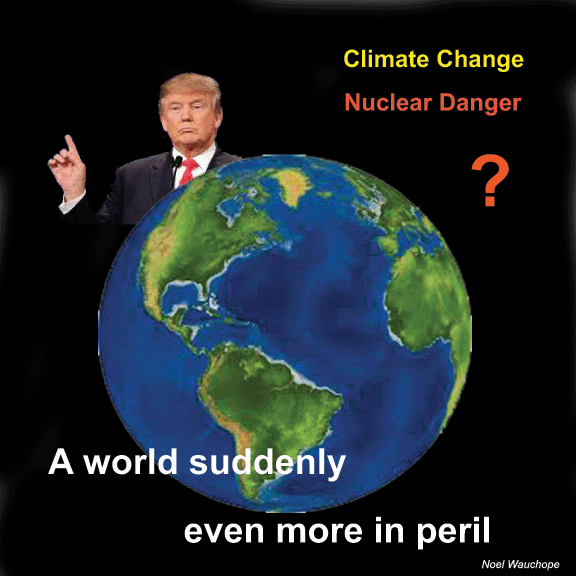
Donald Trump – ” It’s time to scrap the Paris climate accord
|
Trump, observing French turmoil, suggests end of climate change pact https://www.reuters.com/article/us-usa-trump-france/trump-observing-french-turmoil-suggests-end-of-climate-change-pact-idUSKBN1O70RP, 9 Dec 18WASHINGTON (Reuters) – U.S. President Donald Trump, commenting on the clashes between police and “yellow vest” protesters in Paris, said on Saturday that it may be time to do away with the Paris accord on climate change. “Very sad day & night in Paris,” the president said in a message issued on Twitter. “Maybe it’s time to end the ridiculous and extremely expensive Paris Agreement and return money back to the people in the form of lower taxes?” Reporting by David Morgan; Editing by Nick Zieminski |
|
Saudi Arabia, the US, Kuwait and Russia tried to erase meaning of UN’s report on the impacts of 1.5C warming
Climate science on 1.5C erased at UN talks as US and Saudis step in Climate Home News, 08/12/2018, In a moment of drama in Poland, countries closed ranks against a push by oil producers to water down recognition of the UN’s report on the impacts of 1.5C warming By Sara Stefanini and Karl Mathiesen
Four big oil and gas producers blocked UN climate talks from welcoming the most influential climate science report in years, as a meeting in Poland descended into acrimony on Saturday.
By failing to reach agreement after two and half hours of emotional negotiations, delegates in Katowice set the scene for a political fight next week over the importance of the UN’s landmark scientific report on the effects of a 1.5C rise in the global temperature.
The battle, halfway through a fortnight of Cop24 negotiations, was over two words: “note” or “welcome”.
Saudi Arabia, the US, Kuwait and Russia said it was enough for the members of the UN climate convention (the UNFCCC) to “note” the findings.
But poor and undeveloped countries, small island states, Europeans and many others called to change the wording to “welcome” the study – noting that they had commissioned it when they reached the Paris climate agreement in 2015.
“This is not a choice between one word and another,” Rueanna Haynes, a delegate for St Kitts and Nevis, told the plenary. “This is us, as the UNFCCC, being in a position to welcome a report that we requested, that we invited [scientists] to prepare. So it seems to me that if there is anything ludicrous about the discussion that is taking place, it is that we in this body are not in a position to welcome the report.”
The four opposing countries argued the change was not necessary. Saudi Arabia threatened to block the entire discussion if others pushed to change the single word – and warned that it would disrupt the last stretch of negotiations between ministers next week.
The aim of the Cop24 climate summit is to agree a dense set of technical rules to underpin the Paris Agreement’s goals for limiting global warming to well below 2C, and ideally 1.5C, by the end of the century.
The scientific report was published by the Intergovernmental Panel on Climate Change (IPCC) in October. It found that limiting global warming to 1.5C, rather than below 2C, could help avoid some of the worst effects of climate change, and potentially save vulnerable regions such as low-lying islands and coastal villages in the Arctic. But it also made clear that the world would have to slash greenhouse gases by about 45% by 2030……….
Financial aid is still contentious issue. The rules on how and what developed countries must report on their past and planned funding, and the extent to which emerging economies are urged to do the same, remains largely up for debate.
In a further moment of drama on Saturday afternoon, Africa stood firm as UN officials tried to finalise a draft of the rules that will govern the deal. Africa’s representative Mohamed Nasr said the continent could not accept the deal as it was presented, forcing the text to be redrafted on the plenary floor.
“You can’t bully Africa, it’s 54 countries,” said one negotiator, watching from the plenary floor.
The change will mean new proposals to be made to the text next week. That would allow African ministers to attempt to strengthen a major climate fund dedicated to helping countries adapt to climate change and push for less strict measures for developing countries.
“We have been voicing our concerns, maybe the co-chairs in their attempt to seek a balanced outcome they overlooked some of the stuff. So we are saying that we are not going to stop the process but we need to make sure that our views are included,” Nasr told CHN.
Mohamed Adow, a campaigner with Christian Aid, said the African intervention had “saved the process” by ensuring that dissatisfied countries could still have their issues heard.
“It’s actually much better than it’s ever been in this process at this stage,” he said. “Because this is the end of the first week and ministers have been provided with clear options. Of course nothing is closed but the options are actually narrower.”
It was a long and emotional plenary meeting to mark the halfway point in a fortnight of negotiations.
Four big oil and gas producers blocked the UN climate talksfrom welcoming the most influential climate science report in years – and met backlash from a broad range of poor, developing and rich countries. The battle was over two words: “note” or “welcome”.
Saudi Arabia, the US, Kuwait and Russia wanted the final statement to merely “note” the UN science report on the effects of 1.5C rise in the global temperature. But a call that started with the alliance of small island states pushed to “welcome” the findings.
The plenary chair’s attempt to find a compromise fell flat, setting the scene for a big political fight when ministers arrive in Katowice next week.
And that wasn’t the only moment of drama on Saturday. Earlier in the day, Africa stood firm as UN officials tried to finalise a draft of the rules that will govern the Paris Agreement. “You can’t bully Africa, it’s 54 countries,” one negotiator said.
The change will mean new proposals could come next week. http://www.climatechangenews.com/2018/12/08/climate-science-1-5c-erased-un-talks-us-saudis-step/
In 2014, Saudi Arabia tried to delete part of UN climate science report
Saudis accused of deleting part of UN climate science report Climate Home News 23/05/2014 British scientist expresses his surprise when parts of IPCC text were ‘mutilated’ at April meeting in Berlin By Ed King
A coalition led by Saudi Arabia attempted to mask their contribution to rising levels of greenhouse gas emissions during discussions at the UN’s most recent climate science meeting.
That’s the charge laid by John Broome, a British philosopher and economist at Oxford University, and contributing author to the Intergovernmental Panel on Climate Change’s Fifth Assessment Report.
He’s not the first to make these accusations – that prize goes to Giovanni Baiocchi, an economist at the University of Maryland.
But Broome is the first to offer a compelling narrative of how the four–day Berlin meeting of IPCC Working Group 3 scientists in April unfolded.
In a detailed blog published on May 20 he says the ‘Summary for Policymakers’, a concise document that pulls together thousands of pages of work, was “mutilated” by government officials.
“The degree of compression in the SPM meant that every sentence counts. In drafting it, we authors each found ourselves defending our favourite sentences,” Broome writes.
“Some sections were cut to pieces because the different views of the delegations turned out to be irreconcilable.”
Broome contends that in the early hours of April 12, a coalition of countries led by Saudi Arabia insisted that all figures showing emissions of greenhouse gas from countries classified by their “income group” were deleted. Other reports indicate China was also part of this push. ……..
Key summary
It should be stressed the SPM is the only part of the IPCC texts that receives this level of political interrogation or interference from governments – perhaps because they know it’s the only part most policymakers will read.
This can then form the basis of various negotiating positions at UN climate talks, which are heating up as a global emissions reduction deal scheduled to be signed off in December 2015 draws close.
The original findings remain untouched…….. http://www.climatechangenews.com/2014/05/23/saudi-blocking-of-un-climate-science-report-exposed/
Coal lobby is prominent at COP24 U.N climate change conference

COP24 President defends participation of coal companies at climate talks, ABC, The World By Erin Handley 7 Dec 18, COP24 President Michal Kurtyka has defended displays of coal soap and jewellery at key climate change talks in Poland, saying “it’s good to have everybody on board”.
Key points:
- The climate talks drew some ridicule for putting coal on display in the foyer
- New Zealand has named climate change as its biggest security threat
- Pacific nations are facing an existential threat, Michal Kurtyka said
Conference attendees were confronted with coal displays in the foyer and greeted by a performance from the Polish Coal Miners Band during the talks designed to bring about global action on climate change.
Polish President Andrzej Duda said using coal was not in conflict with climate protection, and with the climate change talks taking place in the city of Katowice — a coal mining stronghold — some observers said the setting undermined the purpose of the talks.
Mr Kurtyka, who is also a secretary of state in the Ministry of Environment, denied that coal companies “sponsored” the event, which he said was publicly funded by Poland — but said there were several partners, including Ikea and energy companies. …….
Richie Merzian, director of the Australia Institute’s Climate and Energy Program, said the coal-heavy setting left “a sour taste in the mouths of those who are committed to climate action”.
“But at the same time it is symbolic of trying to deal with the vested interests and the long history of reliance on fossil fuels in many of these cities and countries.”
Mr Merzian added that coal companies were not on the same page as delegates seeking an ambitious plan to combat climate change.
“Their core business is directly in contrast to … the goal of the Paris Agreement, which is to transition completely away from reliance on fossil fuels,” he said, adding that the influence of coal companies on governments ran deep.
“Stopping that outright, in-your-face sponsorship would definitely help in terms of optics, but a lot of the influence is just strongly embedded into the positions that the countries bring forward.”………
Yesterday New Zealand released a defence policy statement naming climate change as its biggest security threat and stressing the impact of climate change on the Pacific.
“It identifies climate change as one of the most significant security threats of our time, and one that is already having adverse impacts both at home and in New Zealand’s neighbourhood,” said Defence Minister Ron Mark in an emailed statement to Reuters.
Australia, however, has turned its back on its Pacific neighbours in terms of climate change, Mr Merzian said.
“The Pacific are getting desperate, and instead of their friends helping, they’re hurting,” he said.
“Poland is the Australia of the EU — the largest coal user, the largest coal producer — but unlike Australia that can operate in its own bubble, Poland has to marry up its position with its EU colleagues as a bloc, and that’s why they help drag Poland to be better than what it would otherwise be.” https://www.abc.net.au/news/2018-12-07/coal-company-participation-at-climate-talks-defended/10592146
World Bank funding for action on climate change, and for adaptation to climate change
 World Bank to raise $200 billion to fight climate change SBS News 4 Dec 18 The World Bank Group will spearhead a five-year, $200 billion investment to fight climate change. The World Bank has unveiled a $200 billion in climate action investment for 2021-25, adding this amounts to a doubling of its current five-year funding.
The World Bank said the move, coinciding with a UN climate summit meeting of some 200 nations in Poland, represented a “significantly ramped up ambition” to tackle climate change, “sending an important signal to the wider global community to do the same.”
Developed countries are committed to lifting combined annual public and private spending to $100 billion in developing countries by 2020 to fight the impact of climate change — up from 48.5 billion in 2016 and 56.7 billion last year, according to latest OECD data.
Southern hemisphere countries fighting the impact of warming temperatures are nonetheless pushing northern counterparts for firmer commitments.
In a statement, the World Bank said the breakdown of the $200 billion would comprise “approximately $100 billion in direct finance from the World Bank.”
Around one third of the remaining funding will come from two World Bank Group agencies with the rest private capital “mobilised by the World Bank Group.”……..
Much of the climate action financing is being set aside for reducing greenhouse gas emissions, notably through development of renewable energy strategies.
However, the World Bank stated that “a key priority is boosting support for climate adaptation,” given the millions of people already battling the consequences of extreme weather.
“By ramping up direct adaptation finance to reach around $50 billion over (fiscal) 21-25, the World Bank will, for the first time, give this equal emphasis alongside investments that reduce emissions,” the bank stated.
Given the urgency to act in the face of sea level rise, flooding and drought “we must fight the causes, but also adapt to the consequences that are often most dramatic for the world’s poorest people,” said World Bank CEO Kristalina Georgieva.
The countries whose representatives are meeting at the UN climate summit which opened Sunday in the Polish city of Katowice are seeking to make good on commitments made in the 2015 Paris climate accord.
That agreement saw countries commit to limiting global temperature rises to well below two degrees Celsius and to the safer cap of 1.5C if at all possible. https://www.sbs.com.au/news/world-bank-to-raise-200-billion-to-fight-climate-change
Grim warning from David Attenborough on climate – he urges world leaders to LEAD
 Our greatest threat’: David Attenborough’s grim warning on climate Naturalist David Attenborough has told delegates at a UN conference the world is facing the end of civilisation if it does not unite to tackle climate change. SBS News, 4 Dec 18 British broadcaster and environmentalist David Attenborough has urged world leaders, meeting in Poland to agree ways to limit global warming, to get on and tackle “our greatest threat in thousands of years”.Known for countless nature films, Attenborough has gained prominence recently with his Blue Planet II series, which highlighted the devastating effect of pollution on the oceans.
Leaders of the world, you must lead,” said the naturalist, given a “People’s seat” at the two-week UN climate conference in the Polish coal city of Katowice alongside two dozen heads of state and government.
“The continuation of our civilisations and the natural world upon which we depend, is in your hands,” he said.
“Climate change is running faster than we are and we must catch up sooner rather than later before it is too late.”
Attenborough told the delegates: “Right now, we are facing a man-made disaster of global scale. Our greatest threat in thousands of years. Climate Change.”……….
Representatives of some of the most powerful countries and biggest polluters were conspicuous by their absence, and the United States is quitting the UN climate process.
To maximise the chances of success in Poland, technical talks began on Sunday, a day early, with delegates from nearly 200 nations debating how to meet the Paris target of limiting global warming to between 1.5 and 2.0 degrees Celsius (2.7 and 3.6 Fahrenheit).
Michal Kurtyka, Poland’s deputy environment minister and president of the talks, said that without success in Katowice, Paris would not be a success, as it had only decided what was needed, not how it could be done.
Moreover, the wider political environment had changed.
“The wave of optimism and global co-operation that carried us to and through Paris has now crested, broken and is now tumbling,” he told delegates. https://www.sbs.com.au/news/our-greatest-threat-david-attenborough-s-grim-warning-on-climate
Flawed arguments in nuclear industry’s push to be seen as climate change solution
| Should We Subsidize Nuclear Power to Fight Climate Change? https://blogs.scientificamerican.com/observations/should-we-subsidize-nuclear-power-to-fight-climate-change/ That’s what some are advocating, but the arguments in favor of doing so are flawed By M. V. Ramana on December 3, 2018 Last month, the Union of Concerned Scientists (UCS) put out a reportentitled The Nuclear Power Dilemma: Declining Profits, Plant Closures, and the Threat of Rising Carbon Emissions that calls for offering subsidies to unprofitable nuclear power plants. Not surprisingly, it has been widely welcomed by nuclear advocates, who interpret the report as essentially saying “yes to nuclear power” in order to reduce carbon emissions. But that interpretation misses the many important but less prominent insights in the UCS report. Nuclear power plants are associated with significantly less carbon dioxide emitted per unit of electricity produced when compared to fossil fuel plants, even when including the emissions associated with the fuel chainrequired to generate nuclear energy. Therefore, the report’s basis for argument—if utilities were to replace “existing nuclear plants with natural gas and coal rather than low-carbon sources,” then it would compromise “our ability to achieve the deep cuts in carbon emissions” (p. 1)—is obvious. Whether nuclear plants would be replaced by fossil fueled plants is questionable. Nuclear plants are hugely expensive, and it has been known for a while that they are not an economically competitive choice. Thus, building new nuclear plants makes no sense. In the UCS report too, the power planning model used does not recommend constructing new nuclear plants, even at the highest assumed price of carbon. The authors, unfortunately, do not highlight this outcome of their modeling, sidestepping its implications by not “assessing the potential role of new nuclear plants in meeting long-term emissions reduction targets” (p. 12). For decades, nuclear advocates had a comforting response: although expensive to build, nuclear plants are cheap to operate and profitable in the long run. That is no longer true. Several nuclear plants have been shut down because the utilities operating them are losing money. As shown by the UCS report and similar studies, many more are likely to be shuttered. So, the question in essence is how to deal with a dying source of electricity generation in the United States. Globally, the share of nuclear energy in the world’s electricity generation has been declining continuously since 1996. The UCS report is a plea to keep the nuclear industry on life support by states providing subsidies to nuclear power plants that are not profitable, provided the operators of the nuclear plants and the states play by some rules. Regardless of these subsidies, it remains the case that over the next few decades, the reactor fleet will have to be retired. Some of these reactors are nearly half a century old, and some have a checkered past. Many others have demanded that states subsidize nuclear plants, and there is even a tool kit to help plant owners to continue profiting at public expense. It is the imposition of various requirements that distinguishes the UCS report from the rest of the chorus—and unfortunately the media has by and large highlighted the call for subsidies without the conditions. The conditions are: “Require plant owners to open their financial books and demonstrate need”; “make financial support for distressed plants temporary [and] periodically assess whether continued support is necessary and cost effective”; “Ensure that qualifying plants maintain strong safety performance”; “Strengthen renewable energy and efficiency standards”; “Develop transition plans for affected workers and communities”; and state “requirements [on resources subject to state jurisdiction, such as the use of local water supplies for cooling and the impact of cooling-water discharges] need to be vigorously enforced”. These requirements are not easy to meet, and other proponents of nuclear subsidies are, in some cases, undermining them. The Nuclear Energy Institute “has proposed merging the highest and second-highest safety ratings”—measures of plant safety produced by the Nuclear Regulatory Commission—which “would effectively render the rating meaningless” (p. 24). In Connecticut, the Millstone nuclear plant’s “owner refused to make a disclosure” when seeking subsidies (p. 41). These subsidies are being offered to an industry that has profited enormously in the past from direct and indirect subsidies. As the Illinois attorney general explained, current subsidy demands “amount to a third round of subsidies for these plants.” Let us return to the most basic assumption needed for the argument for subsidies to stick, namely that utilities would replace shut down nuclear plants with fossil fueled plants. This is possible but by no means necessary, especially with continued falling costs for renewable energy and storage technologies. The energy industry is changing so rapidly that what the UCS report attempts, to forecast costs and plan over multi-decadal periods, is all but impossible to do with any degree of certainty. Further, the report’s inputs to the electricity planning model are already outdated. For example, the central cost figures it uses for nuclear reactor costs are significantly lower than the costs of the two reactors currently being constructed in the state of Georgia. In contrast, costs of solar PV plants and wind turbines are significantly higher than the most recent numbers. Renewables are not just getting cheaper, they are also quick to construct. All these factors undermine the report’s central assumption that nuclear plants will be replaced by fossil fueled plants. To be fair, the UCS report does call for periodically assessing whether continued support is necessary and cost effective. But such support might already not be cost effective. All told, the economic basis for subsidies is uncertain at best; more likely, it is flawed. Either way, it may be best to get onward with the transition from fossil fuels and nuclear power to renewables. |

U.N Climate Conference – but the climate future is grim

Portrait of a planet on the verge of climate catastrophe As the UN sits down for its annual climate conference this week, many experts believe we have passed the point of no return, Guardian, by Robin McKie, 2 Dec 18
On Sunday morning hundreds of politicians, government officials and scientists will gather in the grandeur of the International Congress Centre in Katowice, Poland. It will be a familiar experience for many. For 24 years the annual UN climate conference has served up a reliable diet of rhetoric, backroom talks and dramatic last-minute deals aimed at halting global warming.
But this year’s will be a grimmer affair – by far. As recent reports have made clear, the world may no longer be hovering at the edge of destruction but has probably staggered beyond a crucial point of no return. Climate catastrophe is now looking inevitable. We have simply left it too late to hold rising global temperatures to under 1.5C and so prevent a future of drowned coasts, ruined coral reefs, spreading deserts and melted glaciers.
One example was provided last week by a UN report that revealed attempts to ensure fossil fuel emissions peak by 2020 will fail. Indeed the target will not even be reached by 2030. Another, by the World Meteorological Organization, said the past four years had been the warmest on record and warned that global temperatures could easily rise by 3-5C by 2100, well above that sought-after goal of 1.5C. The UK will not be exempt either. The Met Office said summer temperatures could now be 5.4C hotter by 2070.
At the same time, prospects of reaching global deals to halt emissions have been weakened by the spread of rightwing populism. Not much to smile about in Katowice.
Nor will the planet’s woes end in 2100. Although most discussions use the year as a convenient cut-off point for describing Earth’s likely fate, the changes we have already triggered will last well beyond that date, Continue reading
Why nuclear power is a hindrance, not a help, to climate change action

nuclear emits twice as much carbon as solar PV and six times as much as onshore wind.
Beyond Nuclear, 2 Dec 18 Nuclear power has no constructive role to play in climate change solutions. In fact, it is a hindrance.
Nuclear power does have a carbon footprint When nuclear power is said to have “zero emissions,” this refers only to the electricity generation phase and only to greenhouse gas emissions. There are emissions at this stage, especially heat and radioactivity. Certain emissions during reactor operations, such as carbon-14 in CO2 form and methane, are greenhouse gases.
However, there are plenty of carbon emissions involved in making a nuclear power plant a reality. Therefore, when discussing the carbon footprint of nuclear energy compared to other energy forms, the entire uranium fuel chain needs to be taken into account. In doing so, nuclear energy compares poorly to renewable energy and energy efficiency. Lifecycle emissions along the nuclear fuel chain occur through uranium mining and milling, transportation, plant construction, operation, reactor site decommissioning, and nuclear waste management.1
Life-cycle carbon emissions of a nuclear power plant When taking into account planning, permitting, construction, operation, refurbishing and decommissioning, a nuclear power plant emits at least 6-24 times more carbon-dioxide equivalent emissions than wind per unit energy produced over the same 100-year period.2
Life-cycle carbon emissions from the entire nuclear fuel chain How do we calculate this? Evaluating the total carbon output of the nuclear industry involves calculating emissions from every carbon-emitting phase of the uranium fuel chain, then dividing them by the electricity produced over the entire lifetime of the plant.3 Some of the most reliable analysis on this has been done by Dr. Benjamin Sovacool whose data we use here (see footnote 1).
Let’s take a look at the mean carbon emissions of each phase:
The entire uranium fuel chain. This includes every phase from uranium mining to decommissioning and waste management. 66 gCO2e/kWh. (StormSmith has 80-130 gram CO2/kWh.)4
» Uranium mining, milling, processing, refining and fuel fabrication. Calculations can vary depending on factors such as grade of uranium ore, energy source used to mine etc. 25.09g/kWh
» Construction of a nuclear power plant. This includes fabrication, transportation and use of materials. 8.20 g/kWh » Reactor operation and maintenance. 11.58g/kWh
» Radioactive Waste Management and storage. 9.20 g/KWh » Decommissioning. 12.01 g/KWh
Carbon emissions broken down by percentage Percentage of total carbon emissions released by each stage of the uranium fuel chain.
Uranium mining, milling, and enrichment: 38%
Construction: 13%
Operation (inc. backup diesel generators): 17%
Fuel processing and waste management: 14% Decommissioning: 18%
Life-cycle carbon emissions of the nuclear fuel chain compared to other resources
Scrubbed coal-fired plants: 960 gCO2e/kWh
Natural gas-fired plants: 443 gCO2e/kWh
Nuclear power plants: 66 gCO2e/kWh
Solar photovoltaic: 32 gCO2e/kWh
Onshore wind farms: 10 gCO2e/kWh
So nuclear emits twice as much carbon as solar PV and six times as much as onshore wind.
Here’s one way Sovacool sums it up:
“Every dollar you spend on nuclear, you could have saved five or six times as much carbon with efficiency, or wind farms.”
“Every dollar you spend on nuclear, you could have saved five or six times as much carbon with efficiency, or wind farms.”
1 https://www.sciencedirect.com/science/article/pii/S0301421508001997
2 https://web.stanford.edu/group/efmh/jacobson/Articles/I/15-12-30-ResponseHansen.pdf
1 This Month
26 September – International Day for the Total Elimination of Nuclear Weapons





PLEASE OPPOSE HR 8255 AND S.3639 – bills would accelerate satellite deployment, with no environmental review or safeguards – https://ncstd5li.quorum.us/campaign/169331/
To see nuclear-related stories in greater depth and intensity – go to https://nuclearinformation.wordpress.com
-
Archives
- September 2026 (305)
- August 2026 (330)
- July 2026 (355)
- June 2026 (287)
- May 2026 (306)
- April 2026 (356)
- March 2026 (251)
- February 2026 (267)
- January 2026 (308)
- December 2025 (358)
- November 2025 (359)
- October 2025 (375)
-
Categories
- 1
- 1 NUCLEAR ISSUES
- business and costs
- climate change
- culture and arts
- ENERGY
- environment
- health
- history
- indigenous issues
- Legal
- marketing of nuclear
- media
- opposition to nuclear
- PERSONAL STORIES
- politics
- politics international
- Religion and ethics
- safety
- secrets,lies and civil liberties
- spinbuster
- technology
- Uranium
- wastes
- weapons and war
- Women
- 2 WORLD
- ACTION
- AFRICA
- Atrocities
- AUSTRALIA
- Christina's notes
- Christina's themes
- culture and arts
- Events
- Fuk 2022
- Fuk 2023
- Fukushima 2017
- Fukushima 2018
- fukushima 2019
- Fukushima 2020
- Fukushima 2021
- general
- global warming
- Humour (God we need it)
- Nuclear
- RARE EARTHS
- Reference
- resources – print
- Resources -audiovicual
- Weekly Newsletter
- World
- World Nuclear
- YouTube
-
RSS
Entries RSS
Comments RSS

